A Widow Smashed Her Dead Husband’s Helmet While a Biker Was Wearing It — What Fell From the Broken Lining Revealed an Eighteen-Year Promise
The first blow cracked my helmet above the left ear; the second split the visor—and while twenty bikers wrestled the screaming widow away from me, she kept shouting that something alive was trapped against my skull.
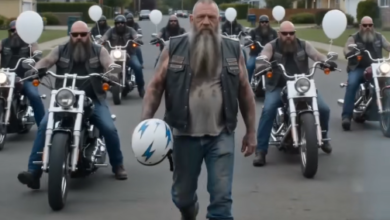
My name is Ray Dawson, though the Iron Vale Motorcycle Club calls me Hammer. At fifty-six, I stand six-foot-four and weigh close to 285 pounds. I have a shaved head, a gray-streaked beard, tattooed forearms, and scarred knuckles that make people assume I am usually the one holding the weapon.
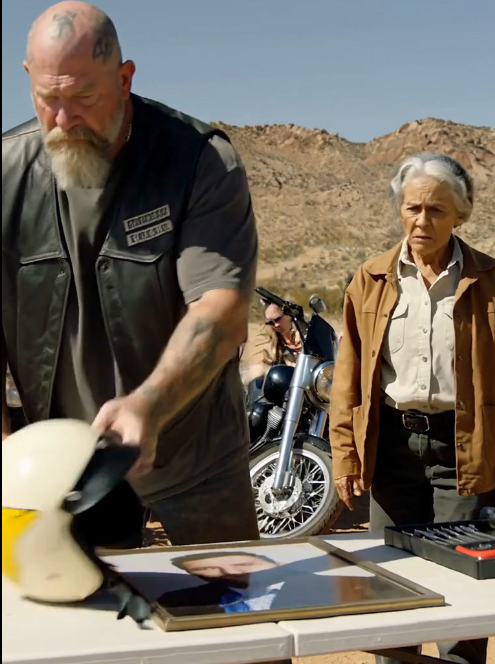
That afternoon, I was not.
Elena Ortiz was seventy-two, barely five-foot-three, and wearing a pale gardening shirt beneath a brown canvas jacket. Until she picked up the mason’s hammer from the memorial display, she looked like somebody’s quiet grandmother.
Then she swung it at my head.
We were standing outside the Desert Bell Community Hall near Tucson, Arizona, where Iron Vale had gathered for a charity ride benefiting families of fallen road workers. Harleys lined the sun-faded parking lot. Engines ticked as they cooled. The air smelled of gasoline, hot asphalt, mesquite smoke, and the honey cakes sold at Elena’s booth.
I had been wearing the vintage helmet for less than a minute.
It was cream-colored with a black stripe, a scratched visor, and a hand-painted yellow roadrunner along one side. The chin strap had stiffened with age. Nobody should have trusted it at highway speed, so I had ridden there in a modern helmet and put the old one on only after parking.
A photographer wanted to recreate a picture taken eighteen years earlier.
He never took it.
Elena came through the crowd, saw the helmet, and stopped so suddenly that a paper cup slipped from her hand. Coffee darkened the pavement around her shoes.
She whispered one name.
“Gabriel.”
Then she heard the buzzing.
I had noticed a faint vibration near my right ear, but with thirty motorcycles idling nearby, I mistook it for engine noise. Elena did not. She had kept bees with her husband for twenty-seven years. She recognized the uneven, trapped roar before anybody else saw the first insect crawl from beneath the cracked rubber trim.
“Don’t pull it off,” she warned me.
I reached for the chin buckle.
She grabbed the hammer.
The crowd saw an angry widow charging a biker wearing her dead husband’s helmet. Boone lunged toward her. Leon shouted for somebody to stop her. Two bystanders raised their phones before asking what had happened.
Elena swung.
The first strike made my vision flash white. The second opened the visor hinge. A dark knot shifted beneath the exposed lining, and the buzzing changed from vibration to fury.
“Hold still!” she screamed. “They’re trapped inside!”
Bees began pouring from the ear opening.
Not two or three.
Hundreds.
Some scattered toward the sunlight. Others crawled down my beard and beneath my leather collar. I froze while Elena broke the shell in controlled blows, opening space without driving the sharp plastic inward.
Several bikers tried to pull her away.
I raised one hand.
“Let her work.”
She shattered the crown, tore back the foam, and knocked the remaining cluster into an empty metal cooler. A beekeeper from a nearby booth covered it while everyone else retreated.
When the final section of lining fell away, something yellowed and folded dropped onto the asphalt beside my boot.
Elena saw it.
Her anger disappeared.
Inside the ruined helmet had been a hand-drawn route from Tucson to the Pacific Coast, a faded photograph of three younger riders, and a sealed envelope bearing Elena’s name in her husband’s handwriting.
She looked from the paper to me.
“Where did you get Gabriel’s helmet?”
I removed what remained of it from my head.
“He gave it to me.”
“My husband died eighteen years ago.”
“I know.”
Elena turned over the photograph. On the back was a date written three days before Gabriel’s death—and beneath it, seven words explaining why I had kept his helmet longer than some marriages survive.
Elena read them once.
Then again.
When she finally looked up, she was no longer asking why I had worn the helmet. She was asking what else her husband had trusted me to carry.
Want to know what Gabriel wrote behind the photograph and why Hammer waited eighteen years to finish one final ride? Drop HELMET in the comments — I’ll share more soon.
Part 2 — The Roadrunner Helmet in the Locked Cabinet
I met Gabriel Ortiz in 1998, inside a repair garage where the swamp cooler pushed hot air from one end of the building to the other.
He was thirty-eight, lean, dark-haired, and precise enough to arrange his wrenches by length before starting any job. I was twenty-eight, recently discharged from the Army, sleeping behind the garage, and still waking whenever a truck backfired on the highway.
Gabe did not ask about the Army.
He handed me a carburetor.
“Clean it.”
That was the beginning.
The garage stood off South Sixth Avenue in Tucson, between a welding shop and a tire yard guarded by a three-legged dog. Gabe repaired city vehicles during the week and motorcycles after hours. Elena managed the bills, brought food when we forgot to eat, and kept two beehives behind their house in Vail.
She did not like me at first.
I smelled of motor oil and road coffee. I rode too fast. I rarely answered direct questions, and Gabe had begun spending more nights at the shop after I arrived.
“You collect broken things?” she asked him once.
Gabe looked at me, then at the dismantled Harley between us.
“Only the ones with parts left.”
Elena heard.
So did I.
We became brothers slowly. Gabe taught me to rebuild engines without rushing. I helped him construct an old shovelhead Harley from three donor motorcycles and a frame purchased from a county auction. Elena chose its paint—deep copper with a cream stripe—and hand-painted a yellow roadrunner on the fuel tank.
The helmet came later.
Gabe found the cream-colored shell at a swap meet near Casa Grande. It was already outdated, but he liked its shape. Elena replaced the interior padding and painted another roadrunner along the side.
“It needs a name,” Gabe told her.
“It’s a helmet.”
“Everything that saves your head deserves a name.”
She called it Coyote’s Mistake because the bird was always faster.
For ten years, that helmet hung from Gabe’s handlebar whenever he stopped for coffee. It appeared in every club photograph, every roadside repair, and every story Elena told after his death.
The machine changed with us. Saddlebags replaced the stripped-down rear fender. Gabe lowered the suspension when Elena’s knees began hurting. A narrow sidecar came and went during the years their son Mateo was small enough to ride in it.
The motorcycle became a record of their family.
Then Gabe began losing weight.
At first, he blamed the Arizona summer. Next came the pain beneath his ribs. By the time Elena forced him to see a doctor, pancreatic cancer had already spread beyond surgery.
They gave him six months.
He lasted four.
Gabe did not spend those months pretending death had made him wise. He complained about hospital food, argued with Elena over medication, and tried repairing a generator the day after chemotherapy.
But he also made a list.
One item involved the copper Harley.
Gabe and Elena had once planned to ride from Tucson to Ocean Beach in San Diego, following back roads through Ajo, Gila Bend, Yuma, and the desert west of El Centro. They postponed it when Mateo was born, again when Elena’s mother became ill, and again when the repair shop nearly failed.
By the time Gabe received his diagnosis, the trip had become a private joke.
“Someday,” Elena would say.
“Tuesday,” Gabe would answer.
Three weeks before he died, Gabe asked me to prepare the motorcycle.
His body could no longer manage a full ride. We installed the sidecar so Elena could drive while he sat beside her, but his blood pressure collapsed during a practice run around the block.
The doctor ended the plan.
Gabe did not.
One evening, he called me to the garage after Elena had gone home. The copper Harley stood beneath a canvas cover. His helmet rested on the workbench beside a folded map and two sealed envelopes.
“I need you to keep these.”
“For how long?”
“Until she’s ready.”
“Ready for what?”
“The ride.”
I stared at him. “You won’t be there.”
“That’s usually how final rides work.”
I asked why he could not tell Elena himself.
“Because she’ll do it for me.”
“Isn’t that the point?”
“No. I need her to do it for herself.”
He explained that the route contained seven stops from their marriage: the diner where they spent their first night after eloping, the gas station where Mateo had taken his first steps, a desert overlook where Elena admitted she was pregnant, and the motel where they once sold a toolbox to pay for fuel home.
At the ocean, she would open the second envelope.
He placed the helmet in my hands.
“Don’t let anybody wear it on the road. It’s too old.”
“Then why keep it?”
“She’ll know it.”
I promised.
Gabe died three days later.
At the funeral, Elena could barely stand. Mateo was nineteen and angry at everyone—the doctors, his father, the club, and especially me. He knew Gabe had spent his last clear evening at the garage. He believed I had helped his father plan one more impossible motorcycle trip instead of persuading him to remain home.
After the burial, Elena asked whether Gabe had left anything at the shop.
Fear made me dishonest.
“Just tools,” I said.
She sold the garage within a month. Mateo moved to Nevada. Elena left Tucson without giving Iron Vale a forwarding address.
The first envelope instructed me not to force contact and not to send the helmet through anyone else.
“When Elena is ready,” Gabe had written, “she’ll return to the bees.”
I did not understand.
So I locked the helmet, the map, and the unopened second envelope inside a steel cabinet at the Iron Vale clubhouse.
For eighteen years, I kept the key around my neck.
Part 3 — The Sound Elena Heard Beneath Thirty Engines
The helmet remained inside that cabinet through three club presidents, two clubhouse moves, a flood, and one fire that destroyed the neighboring garage.
I checked it every month.
The cream paint yellowed. The rubber trim cracked. The padding began turning to dust despite the sealed storage bag. I replaced the bag twice, but I never repaired the helmet because Gabe had said Elena must recognize it.
I tried finding her.
Letters sent to her old address returned unopened. Mateo refused my calls. A private investigator located Elena in Oregon, but Gabe’s note said not to force the promise into her hands. I mailed a single card without mentioning the ride.
No reply came.
Years passed.
The club assumed the helmet belonged to a dead Army friend. I never corrected them. Gabe’s promise had been given in private, and explaining it felt too close to spending something that did not belong to me.
Then, eighteen years after his death, Boone showed me a community newspaper from Tucson.
The article featured a seventy-two-year-old widow named Elena Ortiz teaching neighborhood families how to protect pollinators during Arizona’s dry season. A photograph showed her standing beside two blue beehives.
She had returned to the bees.
At the bottom of the article was an announcement for the Desert Bell charity ride. Elena’s honey cooperative would operate a fundraising booth.
I took the helmet from the cabinet.
The lining was more brittle than I expected, so I did not touch it. I sealed the helmet inside a padded transport case and loaded it into my saddlebag. The copper Harley remained under restoration at another Iron Vale member’s shop; decades of storage had hardened the seals and corroded the tank.
We planned to bring the helmet first.
If Elena told us to leave, we would.
We arrived at Desert Bell before sunrise. Volunteers were hanging banners, setting folding tables, and placing donated items around the community hall. I carried the helmet inside its case to a shaded pavilion and left it open while helping Boone move barricades.
That was the mistake.
A migrating swarm had gathered beneath the pavilion roof. The beekeeper later explained that honey-bee colonies sometimes divide when overcrowded, sending part of the population out with a queen to search for a new home. The old helmet’s dark, enclosed liner offered temporary shelter.
Scout bees entered through the open visor.
By midday, a dense cluster occupied the crown.
Nobody noticed.
At one thirty, a local photographer found the old Iron Vale picture we had displayed for the fundraiser. It showed Gabe, Elena, and me beside the copper Harley. Gabe wore the roadrunner helmet.
The photographer suggested recreating my position.
I had already parked my motorcycle. I knew the old helmet was not roadworthy, but wearing it for one stationary photograph seemed harmless.
I lifted it from the case.
The weight felt wrong.
I assumed the foam had absorbed moisture.
The first bee pressed against my hair as the helmet settled over my head. I felt movement near my right ear, but a row of Harleys started simultaneously, drowning the sound. By the time I reached for the chin strap, several bees were trapped between the liner and my beard.
Then Elena saw me.
At first, she recognized only the helmet.
Her husband’s helmet.
A man she had not seen in eighteen years was wearing it beneath the same yellow roadrunner she had painted at her kitchen table. The memory struck her before the danger did. She walked toward me with both hands raised, face emptied by shock.
“You.”
I heard the word but not its meaning.
Elena stopped six feet away.
A bee crawled beneath the cracked trim and disappeared near my temple. Another emerged through the vent and landed on my beard.
She understood.
“Don’t move.”
I reached toward the buckle.
“Ray, don’t touch it!”
Nobody there had called me Ray.
That made me freeze.
Elena grabbed the nearest tool—a small mason’s hammer used to secure stakes around the memorial display. Boone thought she intended to attack me because of the helmet. He moved between us.
She shoved him aside.
The first blow landed above my left ear.
Pain flashed through the shell, but the crack opened a channel. Bees began escaping instead of remaining trapped against my skin.
Leon caught Elena’s wrist.
She screamed, “Listen!”
He did.
The buzzing had become louder than the motorcycles.
I told him to release her.
The second strike broke the visor hinge. The third split the outer shell without touching my skull. Elena worked as if opening a damaged hive, making controlled gaps and retreat paths. She knew that tearing off the helmet could crush insects against my scalp and trigger more stings.
Boone threw a riding blanket over my shoulders to keep bees from entering my vest. Leon shut down the nearby engines. A beekeeper approached with a ventilated collection box.
Elena kept striking.
Plastic broke.
Foam scattered.
Bees poured toward daylight in a dark, moving cloud.
The crowd ran, but Elena stayed close enough to remove the fragments around my ears. She was stung four times on her hands. I took seven stings along my neck and scalp.
Neither of us stopped.
When the swarm was contained and the ruined helmet finally came away, my knees folded. Boone caught me. An EMT administered antihistamine and monitored my breathing while Elena sat on the asphalt, holding the hammer between both hands.
People stared at her.
Five minutes earlier, they had believed she was attacking me.
Now nobody knew what to say.
The helmet lay in pieces beside us. Its broken liner had released the folded map, photograph, and first envelope I had hidden beneath a removable panel that morning.
Elena picked up the photograph.
On its front stood three younger people beside a copper motorcycle.
On the back, Gabe had written:
HAMMER HOLDS THE ROAD UNTIL ELENA CHOOSES TUESDAY.
Elena turned toward me.
“What does Tuesday mean?”
I looked at the broken helmet.
“Your husband said you’d know.”
Her face tightened.
Every Tuesday morning during their marriage, regardless of work, bills, illness, or arguments, Gabe and Elena had shared breakfast at a diner west of Tucson.
She had not eaten there since he died.
Part 4 — Eighteen Years Was Not the Delay
The diner still existed.
Its sign had changed from red to blue, and the booths had been reupholstered, but Elena recognized it when we arrived the following Tuesday. I drove my Harley. Boone brought Elena in his truck because her hands remained swollen from the stings.
We carried the broken helmet inside a clear storage box.
Elena chose the booth beside the west window without asking. The waitress brought coffee and gave us enough distance to speak privately.
I handed Elena the first envelope.
The paper had softened at the folds. Gabe’s handwriting slanted downward near the end, evidence of the medication and exhaustion he had hidden from everyone except the people changing his IV lines.
“Elena,” he had written, “if Hammer gives you this, then you found your way back to the bees. That means you can hear small things again.”
She stopped reading.
“That arrogant man.”
“He was dying.”
“He was arrogant before cancer.”
I said nothing.
She continued.
Gabe confessed that he had given me the helmet and map. He knew Elena would demand the trip immediately if she learned about it while he was alive. She would have loaded his weakened body into the sidecar, ignored the doctors, and risked his last days trying to grant a wish he no longer needed.
“The ocean was never for me,” he wrote. “You are the one who kept saying someday. I need you to have a someday that doesn’t include my hospital bed.”
Elena pressed the letter flat against the table.
Then she reached the paragraph explaining my role.
Gabe had not told me to wait eighteen years.
He told me to wait until Elena chose Tuesday.
The delay belonged to grief, pride, bad addresses, and my fear of breaking the one promise Gabe had entrusted to me. I could have found her sooner. I could have explained at the funeral. I could have sent the map after locating her in Oregon.
Instead, I treated his instructions like law because rigid promises are easier than uncertain people.
Elena understood that before I did.
“You hid behind him,” she said.
“Yes.”
“For eighteen years?”
“Yes.”
“You lied when I asked about the garage.”
“Yes.”
Her voice remained level, which hurt worse than shouting.
“Why?”
“Because he told me not to make you ride before you wanted to.”
“I didn’t know there was a ride to want.”
That was the truth.
I had honored Gabe’s words while betraying their purpose.
Elena stood. For a moment, I thought she would leave. Instead, she walked around the table and examined the broken helmet through the clear lid.
“You kept this in a cabinet?”
“Locked.”
“Did you ever wear it?”
“Yesterday was the first time.”
“Good. It expired before my husband did.”
Even then, she sounded like herself.
I removed the second key from my neck and placed it on the table. It opened the cabinet containing Gabe’s route notes, repair records, and the second sealed envelope.
“There’s something else,” I said.
Outside the diner, a trailer waited beneath a canvas cover.
Boone and Leon stood beside it.
Elena followed me into the parking lot. The morning sun hit the trailer as Boone released the straps and pulled back the cover.
The copper Harley waited underneath.
Her hand rose to her mouth.
For eighteen years, I had kept more than the helmet.
After the garage sale, Mateo told the buyer that the motorcycle could not be sold because its title remained in Gabe’s name. Elena wanted nothing connected to the final months, so Mateo moved the bike into storage. When fees accumulated, he called me and said I could take it if I never contacted him again.
The motorcycle changed storage buildings four times. Iron Vale members paid the rent when I could not. We protected the tank, rotated the engine, drained the fuel, and covered the painted roadrunner from sunlight.
When I found Elena’s newspaper article, we began restoring it.
We rebuilt the brakes, wiring, fuel system, wheel bearings, and sidecar mounts. The paint remained untouched. Elena’s yellow bird still ran across the tank, scratched but visible.
She approached slowly.
One hand touched the handlebar. The other traced the place where Gabe’s wedding ring had repeatedly struck the fuel cap.
“You kept his bike too.”
“He asked me to keep the road.”
She looked at the restored machine, then at the shattered helmet in the box.
“Where is the route?”
I unfolded Gabe’s map across the sidecar seat.
Seven circles marked seven stops between Tucson and the Pacific. Beside each circle, Gabe had written a date from their marriage.
The final circle lay at Ocean Beach.
“Who rides it?” Elena asked.
“You choose.”
“You?”
“If you want.”
“Mateo?”
“He won’t answer me.”
Elena studied the map for a long time.
Then she folded it along the old creases.
“Not without my son.”
I thought the ride had ended before it began.
But Elena had spent eighteen years learning what waiting cost.
She removed her phone.
This time, she called Mateo herself.
Part 5 — The Passenger Who Refused the Sidecar
Mateo Ortiz arrived from Reno three weeks later.
He was thirty-seven, broad through the shoulders, with his father’s dark eyes and Elena’s habit of tightening his jaw before saying something difficult. He drove a gray pickup and parked at the far end of the Iron Vale lot, as though distance could prevent him from becoming part of the scene.
The copper Harley stood outside the garage.
Mateo did not greet me.
He walked directly to the motorcycle and placed one palm against the roadrunner on the tank. His thumb found a small scratch near the bird’s tail.
“I did that,” he said. “Bicycle handlebar.”
“Your dad blamed me.”
“He blamed you for everything he didn’t want Mom to know.”
Elena stood beside the sidecar. “Your father left us a route.”
Mateo looked at the broken helmet displayed in its clear box.
“I saw the video.”
“The video made me look unstable.”
“You hit a man with a hammer.”
“There were bees.”
“I watched the explanation too.”
They faced each other across the motorcycle. Eighteen years of missed calls and unfinished arguments stood between them.
Mateo had left after the funeral because he believed Elena wanted to erase every reminder of Gabe. Elena believed her son blamed her for supporting hospice instead of demanding more treatment. Neither belief was entirely false, which made reconciliation harder.
Elena gave him the first letter.
He read it beside the bike.
When he finished, he handed it back without speaking.
Then he looked at me.
“What’s in the second envelope?”
“I don’t know.”
“You kept it eighteen years without opening it?”
“It wasn’t mine.”
That answer softened nothing, but it established the truth.
The ride was scheduled for the following Tuesday.
We did not use Gabe’s helmet. Its remaining fragments were secured inside a padded case mounted behind the sidecar. Elena wore new protective gear and a modern helmet. Gabe’s copper Harley had been thoroughly inspected by two independent mechanics.
I assumed Elena would take the sidecar.
She refused.
“I rode that machine before either of you learned to shave.”
Mateo objected. Boone objected. I objected louder.
Elena listened, then produced her current motorcycle endorsement and a receipt from a private riding course she had completed after calling Mateo.
“I didn’t return to the bees yesterday,” she said.
She had also returned to riding six months earlier, practicing on a lightweight cruiser before working up to a touring bike. The newspaper article had told only half the story.
Elena piloted Gabe’s Harley.
Mateo rode beside her on a borrowed machine. I followed one position back. Twenty Iron Vale bikers spread behind us, leaving enough space that the trip belonged to the family, not the club.
At the first stop, a diner outside Tucson, Elena ordered two breakfasts and left the second untouched across from her.
At the second, an abandoned gas station near Why, Arizona, Mateo stood on the cracked concrete where he had taken his first steps. Elena carried a photograph showing Gabe crouched there with both arms open.
The third stop was a desert overlook.
Gabe had marked it with the date Elena told him she was pregnant. Mateo read the note and turned away, pretending to study the highway.
At Gila Bend, the Harley developed a fuel leak.
For a moment, everyone assumed the eighteen-year-old promise would end beside a convenience store. Elena knelt before anyone else removed a tool, identified a loose fitting, and told Boone he was holding the wrong wrench.
“She kept the shop’s books,” I reminded him. “That doesn’t mean she never watched us work.”
Elena tightened the fitting herself.
We continued.
The old motel west of Yuma had been demolished, but one section of neon tubing remained in a local museum. Gabe’s map instructed Elena to find the room where they had sold his toolbox for gasoline money.
The room no longer existed.
Mateo laughed for the first time.
“Dad built an eighteen-year scavenger hunt with outdated directions.”
“He expected us to go sooner,” Elena replied.
That sentence could have reopened the wound.
Instead, she smiled.
We crossed California under a white afternoon sky. Desert heat pressed through our jackets. The engines settled into a steady pulse, loud enough to feel through boots and footboards but soft enough that memory filled the spaces between them.
Near El Centro, Mateo signaled us onto the shoulder.
He removed his helmet.
“I can’t finish.”
Elena shut down her motorcycle. “Why?”
“Because he should be riding it.”
“He is.”
“No, Mom.”
Mateo looked at the copper Harley.
“I spent eighteen years angry that he died. Then I spent eighteen years angry at you because you let him. Now we’re acting like some map fixes it.”
Elena stood beside him.
“It doesn’t.”
“Then what are we doing?”
“Going to the ocean.”
“That’s it?”
“That’s all your father asked.”
Mateo looked toward the western highway.
Grief had taught him to distrust simple answers. Yet no larger one arrived.
He put his helmet back on.
We reached Ocean Beach forty minutes before sunset.
Elena parked Gabe’s motorcycle facing the Pacific. The club remained near the road while she and Mateo carried the helmet case onto the sand. I followed because Gabe’s first letter instructed me to witness the opening of the second.
Elena removed the sealed envelope.
Inside were three pages and a small brass key.
Gabe’s final words did not ask anyone to scatter ashes. Elena had already buried him in Tucson. He did not ask them to forgive each other, sell the house, preserve the motorcycle, or continue riding.
He asked Elena to look beneath the sidecar seat.
Mateo returned to the parking area and unlocked a narrow compartment with the brass key.
Inside was a child’s red sneaker.
His sneaker.
The one he had worn during his first sidecar ride at age four.
Beside it lay a note:
YOU THOUGHT THIS TRIP WAS MY LAST. IT WAS YOUR FIRST. KEEP GOING.
Mateo carried the shoe to the water.
Elena read the final page while the sun lowered behind him. Gabe admitted he did not know whether she would make the journey in a month, a year, or never. He told her not to turn the motorcycle into a shrine.
“Machines are for carrying the living,” he wrote. “Let the helmet carry me.”
Elena opened the padded case.
She placed the shattered roadrunner helmet on the sand between herself and Mateo. The bees had destroyed its lining. Her hammer had split its shell. Eighteen years had faded its paint.
Yet the yellow bird remained.
The tide advanced until one thin sheet of water touched the broken visor.
Then receded.
Part 6 — What We Built From the Pieces
We did not leave the helmet at the ocean.
Elena refused.
“Gabriel hated littering,” she said. “He once chased a receipt across three lanes of traffic.”
We carried it home in the padded case.
Back in Tucson, Elena and I repaired only enough of the shell to hold its original shape. We did not conceal the hammer marks. Clear resin stabilized the cracks while leaving every fracture visible.
The beekeeper who collected the swarm saved a small section of wax found inside the lining. She placed it in a sealed display capsule beside the broken visor hinge.
Iron Vale mounted everything inside a wooden shadow box.
The helmet occupied the center. Gabe’s route map rested behind it. The red child’s shoe sat beneath one side, and Elena’s mason’s hammer beneath the other.
A brass plate carried no explanation, only three words:
CHOOSE YOUR TUESDAY.
We hung the box inside the Desert Bell Community Hall, not the clubhouse. Elena wanted strangers to see it, including people who knew nothing about motorcycles.
She also demanded a practical result.
The charity ride created a rule requiring every donated or vintage helmet to be inspected, sealed, and kept off riders’ heads. Elena conducted short demonstrations about bee swarms, explaining that striking the helmet had been an emergency choice, not advice others should imitate.
“If you hear buzzing,” she told one audience, “do not find a hammer. Find someone who knows bees.”
Boone raised his hand. “What if the bee expert has a hammer?”
“Run.”
The room laughed.
Elena rode the copper Harley every Tuesday morning when weather allowed. Mateo returned to Nevada but called her each week and joined the annual trip to the first route stop.
She never joined Iron Vale.
She attended enough meetings to criticize us, which was nearly the same thing.
One Tuesday, Elena parked outside the clubhouse and handed me a new helmet painted cream with a black stripe. A bright yellow roadrunner crossed the side.
I refused it.
“Your last gift nearly killed me.”
“My last gift saved you.”
“You hit me three times.”
“Only because the first two were insufficient.”
Inside the new helmet, she had written a date.
Not Gabe’s death.
The day we reached the Pacific.
Part 7 — The Helmet That Never Had to Finish Alone
Five years after the swarm, Elena still rode.
Shorter distances. Earlier mornings. No desert crossings in July. She listened to her knees more than she had listened to doctors in her twenties, which Mateo considered progress.
The copper Harley remained hers.
Every October, on the Tuesday closest to Gabe’s birthday, we retraced the first twenty miles of his route. Elena led. Mateo rode beside her when he could travel from Nevada. Iron Vale followed far enough behind to let the family hear its own engines.
At the diner, Elena ordered one breakfast.
That change took three years.
The first year, she left food untouched across from her. The second year, she ordered Gabe’s coffee but not his meal. The third, she sat alone for five minutes before waving Mateo and me into the booth.
Nobody mentioned the empty chair.
One autumn, we returned to Desert Bell after the ride and found a young widow standing beneath the helmet display. Her husband had died six months earlier. She had not opened his garage since.
She asked Elena how long grief was supposed to last.
Elena looked at Gabe’s shattered helmet.
“Long enough,” she said.
“That isn’t an answer.”
“No.”
The woman waited.
Elena touched one of the resin-filled cracks.
“Don’t let anybody choose your Tuesday. But when it comes, don’t punish yourself for going.”
The widow returned the following week with her husband’s riding jacket. She did not give it away. She asked the club to repair its torn zipper so she could wear it while walking their old dog.
That was how Elena helped people—not by telling them to move on, but by repairing what still had a use.
On the eighteenth anniversary of the original ride, Mateo brought his daughter to Tucson. She was eight and had never met Gabe. Elena showed her the red sneaker, the old map, and the yellow roadrunner.
The child stared at the hammer.
“Grandma, did you really hit Uncle Hammer?”
“Three times.”
“Were you scared?”
“Terrified.”
“Was he?”
Elena glanced at me.
“He should have been.”
That afternoon, three generations rode to the desert overlook where Elena had once told Gabe she was pregnant. Mateo’s daughter traveled safely in the restored sidecar, wearing a modern helmet painted with a small crooked-winged bee.
We stopped before sunset.
Elena shut down the copper Harley. The V-twin gave one final uneven pulse, then silence spread across the desert.
She removed her helmet and looked west.
“Tuesday,” she said.
I understood.
We did not need the ocean that year. We did not need the complete route, the old motel, or the sand beneath a broken visor.
The promise had already arrived.
Behind us, the sidecar passenger laughed as a harmless honeybee landed on the painted roadrunner and lifted away again.
Follow our page for more powerful biker stories about misunderstood moments, old promises, and the quiet miles people travel to carry love beyond goodbye.