Part 2: A Tattooed Biker Wore a Child’s Tooth in a Silver Ring Every Day—When It Vanished at a Route 66 Diner, He Defended the Boy Everyone Blamed
Part 2 — A Father Who Looked Like a Warning
Bear had not planned to become a father.
He had barely planned to survive thirty.
I learned his history from three people: his daughter, June; his oldest brother in the Road Saints, Hawk Mercer; and Bear himself, though he supplied only the parts the others got wrong.
He grew up in a trailer outside Amarillo with a father who repaired agricultural machinery and considered tenderness a defect. Wade Callahan learned to weld at fourteen, fight at fifteen, and leave home before finishing high school.
By twenty-one, he could rebuild a Harley transmission on a gravel shoulder. He could also empty a bottle before noon and turn any insult into broken furniture.
His tattoos came from those years. Some covered scars. Others covered names he no longer wanted to remember.
He served eleven months in county jail after a bar fight near Clovis. The police report said he had assaulted two men. It did not mention that one had cornered a waitress behind a locked storeroom door.
Bear never used that omission as an excuse.
“I hurt people,” he told June years later. “Having a reason doesn’t make every swing right.”
When he left jail, he joined the Road Saints. They were not outlaws, though strangers often assumed they were. They hauled stranded motorcycles, escorted military funerals, raised money for medical bills, and enforced loyalty with an intensity that could become either protection or pressure.
Hawk gave him the name Bear after seeing him lift a fallen touring bike off an injured rider.
For five years, the club was the closest thing he had to a home.
Then he met Leah.
She worked nights at a twenty-four-hour pharmacy near Route 66. Bear entered with a split eyebrow and asked for butterfly bandages. Leah looked at his bloodied face, his neck tattoos, and the skull rings on his fingers.
“You look like the reason those were invented,” she said.
Bear returned the following night without an injury.
Their daughter, June, was born three years later.
The first time Bear held her, he wore nitrile gloves because he had spent the morning changing oil and could not remove the grease from the cracks in his hands. A nurse told him the gloves were unnecessary.
Bear kept them on.
June’s fingers still closed around his thumb.
That tiny grip frightened him more than jail, knives, or winter highways. For the first time, another human being could be hurt simply because he failed to come home.
He stopped drinking before they left the hospital.
Not gradually.
That night.
The Road Saints marked sober anniversaries with brass challenge coins. On Bear’s first year, Hawk handed him one beside a gas pump in Santa Rosa.
Bear kept it in his pocket for five years.
Life with Leah was never easy, but for a while it was solid. She handled the office of Bear’s repair shop. He worked long hours and learned the daily tasks nobody had taught him—warming bottles, checking fevers, cutting grapes, attending preschool meetings while other fathers stared at his hands.
June spent afternoons in the shop wearing purple ear protection. She called sockets “metal cups” and believed every motorcycle required a name.
Bear’s black Harley became Ruth.
The trouble arrived quietly.
Leah began disappearing for a night, then two. Bills remained unpaid. The pharmacy dismissed her after prescription medication went missing.
Bear recognized addiction because he knew its habits.
He tried anger first.
It failed.
He tried control. He took Leah’s keys, counted pills, checked drawers, and slept in front of the apartment door.
That failed too.
One October morning, when June was six, Leah packed a bag and left. She promised to return after treatment.
June stood at the window until sunset.
Leah did not come back that year.
Three days later, June lost her first tooth.
It had been loose for a week, but she refused to let anyone touch it. Bear offered apples, corn on the cob, and one ridiculous suggestion involving dental floss and the slowest motorcycle ride in history.
June kept her mouth closed.
Then the tooth fell into her cereal.
She screamed.
Bear expected blood to frighten her. Instead, June grabbed the tiny tooth and asked whether the rest of her would begin falling away too.
First Mommy.
Now this.
What came next?
Bear crouched beside her chair. His knees cracked against the kitchen tile. He had faced armed men with steadier hands.
“You didn’t lose anything,” he said. “Dad’s keeping it right here.”
He tapped his chest.
June demanded proof.
Bear placed the tooth in the small pocket of his leather cut. For two weeks, he checked it every hour because he knew another disappearance would destroy her trust.
Then June found the pocket empty.
Bear had taken the tooth to Miriam Yazzie, a Navajo silversmith who operated a small jewelry shop near Gallup. Miriam refused his first idea of drilling a hole through it.
“You promised to keep it,” she told him. “Not destroy it.”
She designed a silver ring with a clear protective setting. Bear offered his sobriety coin as payment when he discovered he could not afford the work.
Miriam examined the coin.
“This got you here,” she said. “Keep it.”
She charged him twenty dollars and made him sweep her workshop for three Saturdays.
The purple thread came from June’s favorite blanket. Miriam tied it beneath the setting before sealing the tooth inside.
“Now it has home around it,” June said.
Bear put the ring on.
He never removed it except when machinery made wearing jewelry dangerous.
For sixteen years, he carried that first tooth through rain, desert heat, breakdowns, funerals, school concerts, two jobs, and every sober anniversary. When June woke from nightmares, he pressed the ring against her palm.
When Leah returned after eighteen months of treatment, June did not run to her.
She looked at Bear’s hand first.
The ring was still there.
Only then did she open the door.
Part 3 — The Boy Beneath the Table
Mateo Reyes had worked at our diner for six months before the ring disappeared.
He washed dishes,
A Tattooed Biker Wore a Child’s Tooth in a Silver Ring for Fifteen Years—Then Its Disappearance Exposed the Promise He Never Broke
SEO Description: A feared biker wears a child’s tooth in a ring, but when it vanishes, his daughter reveals the promise hidden inside it.
Part 1 — Teaser, Version 1: The Tooth in the Silver Ring
The tattooed biker pressed a child’s tooth against his bleeding knuckle and warned everyone in our Route 66 diner not to touch it—but why did a man that frightening carry something so small?
My name is Molly Keene, and I had worked the evening shift at Mile Marker 17 outside Tucumcari, New Mexico, for eleven years when Wade Callahan first showed me the ring.
Most people called him Bear.
He was fifty-three, six-foot-four, and close to 285 pounds, with a shaved head, a thick gray-streaked beard, and tattoos covering both arms before climbing over his collarbones and wrapping around his neck. Heavy silver rings crowded his scarred fingers. His black leather cut carried a faded Iron Lanterns patch, and his boots made the sugar jars tremble when he crossed our worn tile floor.
Strangers noticed the skull tattoo on his hand.
I noticed the ring beside it.
It was thick, dull silver, crudely shaped and scratched from years of engine work. Instead of a stone, a tiny off-white object sat beneath a clear protective dome.
At first, I thought it was a broken pearl.
Then seven-year-old Sophie Bell saw it.
She had been crying in booth four because her first loose tooth had begun bleeding while she ate a grilled-cheese sandwich. Her mother held a paper napkin beneath her mouth, but Sophie kept pushing her tongue against the tooth and asking whether another one would grow.
Bear was sitting two booths away.
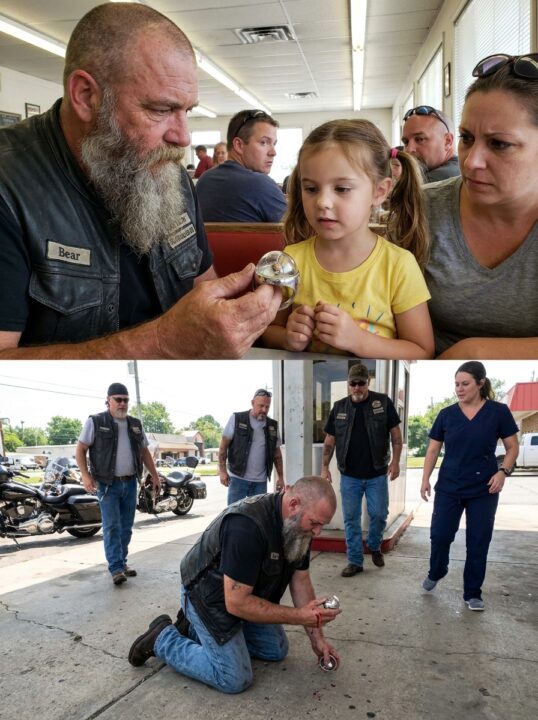
He never approached children without permission. He turned sideways instead, resting one huge forearm on the table so the girl could see his hand.
“Lost my first one too,” he said.
Sophie stared at him through wet eyelashes.
“Your tooth?”
Bear raised the ring.
“No. Somebody else’s.”
The diner went quiet.
Sophie’s mother pulled her daughter closer. A salesman near the register lowered his coffee. Two tourists turned their phones toward Bear without bothering to hide what they were doing.
The ring caught the fluorescent light.
That was when I understood.
The pale object beneath the clear dome was not a pearl.
It was a child’s tooth.
Small root. Rounded crown. A faint brown line along one side. Preserved carefully enough that somebody had wanted it to last.
“Whose is it?” Sophie’s mother asked.
Bear closed his fist.
“Family.”
That answer did not help.
The salesman stood and told Bear carrying human remains into a restaurant was sick. One tourist whispered that the police should examine it. Sophie stopped crying about her own tooth and watched Bear’s face instead.
His expression never changed.
But his thumb moved across that ring once.
Slowly.
Like a man checking that a pulse was still there.
Then Sophie’s tooth came free.
It landed beside her plate with a tiny click. She screamed, covered her mouth, and began shaking so hard that orange soda spilled across the table.
“I lost it,” she cried. “Mom, I lost part of me.”
Bear stood.
Every chair near him scraped backward.
He did not move closer. He removed the strange silver ring, placed it on a clean saucer, and pushed it across the empty table between them.
“You didn’t lose anything,” he said. “You changed.”
Sophie reached toward it, but her mother caught her wrist.
The salesman grabbed the saucer first.
“What kind of man wears a little girl’s tooth?”
Bear’s chair struck the floor behind him.
The sound brought three Iron Lanterns through the door. Engines still rumbled outside, their low V-twin pulse vibrating through the glass. Leather creaked. Chains rattled. Suddenly the diner held four large bikers and one frightened mother.
Bear extended his hand.
“Put it down.”
The salesman lifted the ring toward the light.
“Maybe somebody should find out where you got this.”
“Put it down.”
The man stepped backward, struck a waitress carrying coffee, and dropped the ring.
It hit the tile.
The silver band spun once, struck the metal base of a stool, and stopped.
The clear dome had cracked.
Bear dropped to his knees.
He picked up the ring with both hands, but the tiny tooth was no longer inside it.
We searched beneath the stool. Under the booth. Across every groove in the dirty tile. Sophie’s mother emptied her purse. The bikers moved tables while customers recorded them from behind the counter.
Nothing.
Then Bear saw a small smear of blood on the salesman’s palm and a white shape disappearing between his curled fingers.
Bear rose.
The diner had been afraid of him before.
Now men backed against the wall.
He seized the salesman’s wrist, opened the man’s fist, and found only a sugar crystal stuck to the blood.
The tooth was still gone.
Outside, twelve more motorcycles entered the parking lot. The Iron Lanterns were supposed to escort a fallen firefighter’s son to his high-school graduation that evening, but their road captain stood frozen beside a cracked silver ring while the clock above our register kept moving.
Their president told him they had to leave.
Bear looked at his club brothers.
Then he removed his road-captain pin.
“Go without me.”
It was the first time in fifteen years he had abandoned a ride.
What none of us understood was why that tooth mattered more than his patch, why he had worn it every day since his daughter was six, or what had happened on the night she begged him not to let another piece of her disappear.
Leave the word TOOTH if you want the full story behind Bear’s ring and the promise that divided his brotherhood.
Part 1 — Teaser, Version 2: The Biker Who Never Removed His Ring
For fifteen years, the largest biker in Tucumcari removed his silver ring only when working near an open engine—until a frightened child recognized what was mounted where a diamond should have been.
Wade “Bear” Callahan frightened people before his Harley stopped moving.
His old black touring bike announced him through a low, uneven V-twin rumble that traveled through the windows of Mile Marker 17. Then came the silence, the cooling engine ticking beneath the New Mexico heat, and Bear’s heavy boots crossing our parking lot.
He was fifty-three, broad enough to block the diner doorway, with tattoos covering his knuckles, forearms, chest, and neck. A pale scar split his left eyebrow. His black-and-gray beard reached the top of a worn leather cut that carried the Iron Lanterns patch.
Parents often watched him until he sat down.
Bear noticed.
That was why he always chose the last booth, turned his patch toward the wall, and kept his scarred hands wrapped around a coffee mug.
Except for the hand wearing the ring.
The band was silver, thick and battered. Its center held something pale beneath a scratched clear dome, too irregular to be a stone and too small to identify from a distance.
I had served Bear black coffee every Thursday for nearly eight years. He never removed that ring. Not during meals. Not while washing blood from a rider’s scraped elbow. Not even when his swollen knuckle turned purple after a dropped transmission pinned his hand against a workbench.
“It’ll have to be cut off,” the emergency-room nurse had told him.
Bear had pulled his injured hand against his chest.
“Then fix the hand around it.”
I thought it carried the ashes of someone he had lost.
I was wrong.
The truth surfaced when seven-year-old Sophie Bell lost her first tooth in booth four.
It came free in the middle of a grilled-cheese sandwich. Sophie felt blood against her tongue, saw the little white tooth beside her plate, and began crying.
Her mother tried every promise parents use. A new tooth would grow. The Tooth Fairy would come. Losing baby teeth meant she was growing up.
Sophie heard only one word.
Losing.
“I don’t want part of me to go away.”
Bear looked down at his ring.
Then he did something I had never seen him do.
He removed it.
The pale circle beneath the clear dome was no stone. It had a smooth little crown, a shortened root, and a faint stain where blood had once dried.
A child’s tooth.
Bear placed it on an empty saucer and slid it to the edge of his table.
“I know someone who felt the same,” he said.
Sophie leaned forward.
“Did she get better?”
Bear’s thumb remained against the empty place on his finger.
“She learned nothing loved is gone just because it changes places.”
Sophie’s mother stared at the ring.
“Where did you get that?”
Bear hesitated.
That pause changed the room.
A man near the counter asked whether it was real. Someone raised a phone. Another customer whispered that a biker wearing a child’s body part should not be speaking to a seven-year-old girl.
Bear reached for the saucer.
The man grabbed it first.
“Let’s see what the police think.”
Bear stood.
Three Iron Lanterns entered behind him, their boots striking tile while Harley engines pulsed in the parking lot. Sophie’s mother moved between her daughter and the bikers.
Bear did not threaten anyone.
He held out his hand.
“That ring comes back to me.”
The customer turned away. His elbow struck a coffee pot, and the saucer fell.
The ring cracked against the base of a stool.
The tooth vanished.
Bear dropped before the broken glass stopped moving. Coffee soaked his jeans. A shard opened his knuckle, but he swept both hands beneath the booth without noticing the blood.
His brothers joined him.
Customers filmed.
Someone called the police.
Then their club president, Hank “Preacher” Bell, checked the time and said the Iron Lanterns had twelve minutes to leave for a graduation escort they had promised to perform.
Bear stayed on his knees.
“Take the brothers,” he said.
“You’re road captain.”
“Not tonight.”
“You gave your word.”
Bear looked at the empty ring setting.
“So did I.”
He removed his road-captain pin and placed it on the table.
Preacher stared at the pin, then at the man who had never missed a funeral, hospital ride, storm escort, or roadside rescue in fifteen years.
Outside, fourteen motorcycles waited.
Inside, Bear searched for one tiny tooth.
And before that night ended, the ring would divide his brotherhood, lead us to a locked bedroom that had not been opened in years, and bring a young woman racing back to Tucumcari with the truth about the terrifying biker everyone had judged.
Leave RING if you want the full story of the child’s tooth, the broken promise, and the daughter nobody expected to meet.
Part 2 — The Man Behind the Iron Lanterns Patch
Bear had not always been a man children watched from behind their mothers.
At twenty-four, he was a welding apprentice outside Amarillo, Texas, with two assault charges, a suspended license, and a habit of settling shame with whiskey. His father had taught him that apology was weakness and pain became respectable only after a man hid it.
Bear learned both lessons too well.
He fought when mocked, drank when alone, and slept in the back room of a repair shop because no landlord trusted him with a lease. The skulls tattooed across his fingers were not symbols of an outlaw club. They covered scars left by a factory press he had operated while hungover.
Then Lena Morales walked into the shop with a broken alternator.
She was twenty-six, a Mexican American nursing assistant with dark curls, quick eyes, and no patience for men performing toughness. Bear quoted her three hundred dollars for a repair that should have cost one hundred and eighty.
Lena looked at the invoice.
“You’re either dishonest or bad at math.”
Bear reduced the price.
She still reported him to the owner.
He asked her out the following week.
She laughed.
He returned the week after that with the correct alternator invoice, one black coffee for himself, and a sweet tea for her because he had remembered what she ordered.
Lena eventually said yes.
Their daughter, June, arrived five years later during a dust storm that turned the hospital windows brown. Bear heard her cry before the nurse opened the delivery-room door. He entered wearing oil-stained jeans, then stopped six feet from the bed because his hands were black beneath the nails.
Lena told him to wash.
He scrubbed until his knuckles bled.
When the nurse finally placed June in his arms, Bear held her like a machine part he did not understand and could never replace. The baby closed one tiny hand around his beard.
He stopped drinking that night.
Not gradually.
Not after a final bottle.
He poured everything in their apartment down the kitchen sink and called Preacher, then a newly sober rider he knew from the welding yard. Preacher came over at two in the morning and sat on the floor beside him until sunrise.
That was how their brotherhood began.
Bear joined the Iron Lanterns two years later. They were not an outlaw club. Most members were mechanics, roofers, veterans, truck drivers, and tradesmen who organized funeral escorts and transported supplies after desert storms. Their appearance made people nervous, but their charter prohibited drugs, weapons at charity events, and anyone using the patch to intimidate civilians.
Bear took those rules seriously because he knew how easily a frightened man could mistake control for strength.
At home, he was learning a different language.
June called wrenches “silver bananas.” She painted his smallest fingernail purple before rides. She fell asleep against his chest while cartoons played, one hand resting on his beard as if she feared he might leave once she let go.
Lena loved them both.
She also grew tired.
Sobriety had stopped Bear’s drinking, but it had not taught him how to talk. When frightened, he became silent. When ashamed, he worked longer hours. Every bill, argument, and memory of his father disappeared beneath motorcycle parts stacked in the garage.
Lena asked him to attend counseling.
He went twice.
Then he said the shop needed him.
The week June turned six, Lena packed two suitcases and left for Albuquerque. She did not disappear forever, and she did not abandon her daughter without contact. But she told Bear she could no longer live in a house where every hard feeling became another locked door.
June heard the front door close.
Three nights later, her first tooth began moving.
The timing mattered.
June had already lost the ordinary shape of her family. Now something inside her mouth was coming loose, and every adult kept saying the same thing.
It had to go.
She refused to eat apples. She slept with both hands pressed over her lips. She asked Bear whether all her teeth would leave, whether her hair might fall out next, and whether people stopped loving children after too many pieces changed.
Bear tried logic.
A new tooth would grow.
Every child went through it.
Nothing worked.
Then the tooth came free while June was eating cereal at the kitchen table.
A pink thread of blood stretched from her gum. The tooth landed in the milk. June screamed so loudly that Bear knocked over his chair.
He scooped it from the bowl and rinsed it beneath the faucet.
June stood behind him, shaking.
“Don’t throw it away.”
“I won’t.”
“You said Mom wasn’t going away either.”
That sentence struck harder than anything Bear had heard inside a bar or jail cell.
He turned off the water.
June watched the tiny tooth resting in his scarred palm.
Bear had no gentle speech prepared. He was still learning how fathers remained present after their promises failed.
So he closed his fist.
“You didn’t lose it,” he said. “I’ve got it right here.”
“For how long?”
Bear looked at his daughter.
“Every day.”
The following morning, he took the tooth to Miriam Gold, a sixty-eight-year-old Jewish American silversmith whose shop stood beside an abandoned gas station on Route 66.
Miriam thought he wanted a keepsake box.
Bear placed his father’s silver wedding band on the counter.
“Make a ring.”
“With this?”
He nodded.
“And put the tooth where the stone goes.”
Miriam removed her glasses.
“You want to wear a baby tooth?”
“Every day.”
She studied his neck tattoos, his scarred knuckles, and the purple polish June had left on his smallest nail.
Then she took the job.
Part 3 — The Day the Promise Fell Out
Miriam needed nine days to make the ring.
She melted Bear’s father’s wedding band, hammered the silver into a thick setting, and secured June’s tooth beneath a small dome of clear dental resin. The result was not elegant. One side sat higher than the other, and the tooth leaned slightly toward Bear’s smallest finger.
He loved it.
When he returned home, June was sitting on the living-room floor, lining up stuffed animals in front of the door as if they could stop anyone else from leaving.
Bear knelt beside her.
He showed her the ring.
“See?”
June touched the clear dome with one fingertip.
“You kept it.”
“Right where you can find it.”
She looked toward the front window, where Lena’s empty parking space remained visible.
“Even when you ride?”
“Especially then.”
That answer became ritual.
Before school: Where is it?
Right here.
Before Bear left for a club meeting: Are you wearing it?
Right here.
After a nightmare: Did you lose it?
Never.
The ring did not repair the marriage. Lena and Bear divorced the following year. They slowly learned to co-parent without using June as a messenger, and Lena remained part of her daughter’s life.
But June lived mostly with Bear in Tucumcari.
He learned to pack lunches, although every sandwich looked stepped on. He watched tutorials on braiding hair and practiced using rope clamped to a workbench. He sat in the back row at school performances so his size would not block other parents.
He also kept the ring on.
For fifteen years.
It survived engine rebuilds, desert rides, June’s braces, her first school dance, her high-school graduation, and the morning she left for a dental-hygiene program in Albuquerque.
Bear removed it only while working near spinning machinery. Even then, he placed it inside a small red parts tray and kept the tray within sight.
The Iron Lanterns knew there was something unusual in the setting. Few knew what it was.
Preacher knew.
Miriam knew.
Lena knew.
June asked Bear not to explain it to anyone else because she had reached the age when childhood fears felt embarrassing. Bear respected that. If a stranger asked about the pale center, he called it family.
Then Sophie lost her tooth in our diner.
The cracked ring lay empty on the tile while sixteen bikers searched beneath tables. Preacher’s road-captain pin remained beside Bear’s coffee cup.
Outside, the fallen firefighter’s son waited at the county station for the escort the Iron Lanterns had promised. His father had ridden with them during charity events before dying in a warehouse collapse. Thirty motorcycles were supposed to carry the boy to his graduation because his father could not.
Bear had planned the route himself.
Now he would not leave.
Preacher crouched beside him.
“We have a promise across town.”
Bear kept one cheek against the floor, looking beneath the booth.
“I know.”
“That boy’s waiting.”
“Take the club.”
“He asked for you.”
Bear closed his eyes.
Then he removed his cut and handed it to Preacher.
“Tell him I’m sorry.”
Preacher did not take it.
“That isn’t how we handle this.”
Bear finally looked up.
“You think I don’t know what that ride means?”
“I think you’re choosing an object over a kid.”
The diner went silent.
Bear stood slowly. Without the leather cut, he seemed less like a road captain and more like a tired father wearing an old charcoal shirt stained with coffee.
“It isn’t an object.”
“Then tell the brothers what it is.”
Bear glanced at the phones pointed toward them.
“No.”
Preacher’s jaw tightened.
For fifteen years, Bear had put the club’s commitments before his comfort. He had ridden through fever, repaired bikes without charging stranded brothers, and once waited eight hours beside a wrecked motorcycle so a dead rider would not be alone before the coroner arrived.
But brotherhood built on reliability had a cruel edge.
The first time a man failed, everyone remembered what they had trusted him to be.
Preacher picked up the road-captain pin.
“You walk away from this escort, you don’t wear this again until the club votes.”
Bear nodded.
“Understood.”
Several younger riders looked stunned. Hawk Mercer, Bear’s closest friend and no relation despite the shared surname, stepped between them.
“Split the group,” Hawk said. “Ten search. The rest ride.”
“The escort requires every bike we promised,” Preacher answered.
“Then I stay alone.”
“You ride.”
Hawk looked at Bear.
Bear gave one short nod.
“Ride.”
The Iron Lanterns left in staggered formation. Their engines started one after another until the diner windows shook. Bear stood beside the empty ring setting and listened as the V-twin thunder moved east along Route 66.
For the first time in years, no motorcycle waited outside for him.
Police arrived because the salesman had reported that Bear threatened him. Security footage showed the opposite. Bear had grabbed the man’s wrist, but released it immediately after seeing the sugar crystal.
No charges were filed.
The officers helped us search.
We moved every booth. Opened the floor vents. Emptied the vacuum bag onto butcher paper. The tooth was smaller than a corn kernel and almost the same color as the diner tile.
Sophie’s mother, Erin, stayed despite Bear telling her to take her daughter home. Sophie sat on the counter holding her own tooth in a folded napkin.
“Was the other one your little girl’s?” she asked.
Bear stared at the empty ring.
“Yeah.”
“Is she dead?”
The question hurt the adults more than it hurt him.
“No.”
Sophie considered that.
“Then maybe she has another tooth.”
Bear almost smiled.
“Not that one.”
At 9:16 p.m., the Iron Lanterns returned from the graduation escort without music or celebration. The firefighter’s son had crossed the stage. He had asked why Bear was absent.
Preacher had told him the road captain was keeping another promise.
Now the brothers filled the diner and resumed searching.
At midnight, Hawk removed the drain trap beneath the dishwasher.
Something white rested inside the black sludge.
Bear reached toward it.
Hawk stopped him.
The object was a piece of rice.
Bear turned away before anyone saw his face.
Then Mateo, our nineteen-year-old dishwasher, looked toward the back door.
“Mr. Bear,” he said, “there’s something I need to tell you.”
Mateo had seen the tooth after the ring cracked.
And he knew exactly who had picked it up.
Part 4 — The Boy Everyone Was Ready to Blame
Mateo pointed toward the salesman.
The man’s name was Curtis Hale. He sold dental equipment across New Mexico and West Texas, which explained why he had identified the object as a real tooth so quickly.
Curtis had not hidden it in his hand.
Mateo had seen it bounce against his shoe.
When Curtis stepped backward, the tooth stuck briefly in the wet edge of his rubber sole. He walked through the diner, into the restroom, and then outside before the police arrived.
“Why didn’t you say something?” Preacher asked.
Mateo’s shoulders drew inward.
“Because I wasn’t sure. Everybody was yelling.”
Bear asked the only useful question.
“Where did he go?”
Curtis’s rental car remained in the lot. An officer found him inside the motel across the highway. His shoes were beside the air conditioner, recently washed in the sink.
He denied seeing the tooth.
The security footage was too blurry to prove anything. Police searched the motel room with his permission and found nothing.
Bear stood outside while Curtis spoke through the doorway.
“You attacked me over garbage,” Curtis said.
Bear’s hands closed.
Hawk moved nearer.
Preacher watched Bear, waiting to see whether the old man inside him—the one who used fists when language failed—would return.
Bear looked at Curtis’s wet shoes.
Then he stepped back.
“Not garbage.”
That was all.
Curtis shut the door.
The club searched the path between the diner and motel. Flashlights swept across gravel, cigarette filters, bottle caps, and pale stones. Trucks passed on Route 66, pushing hot wind across the lot.
At 2:04 a.m., Lena called.
Erin had posted a short video before understanding what was happening. The clip showed Bear standing over Curtis, demanding the ring, while other bikers entered behind him. It did not show Sophie’s panic or Curtis grabbing the saucer.
The caption called Bear a biker wearing a child’s tooth.
The video had reached Albuquerque.
June saw it.
“Dad,” she said through Bear’s phone, “whose tooth was in that ring?”
Bear remained silent.
“Mine?”
“Yeah.”
“You lost it?”
Another pause.
“Yeah.”
June did not sound sentimental. She sounded angry.
“I told you the setting was loose at Christmas.”
“I had it checked.”
“By whom?”
“Mouse.”
“Mouse fixes radios.”
“He fixes everything.”
“Apparently not teeth.”
Several Iron Lanterns looked away to hide smiles. Bear did not.
“I’m coming home,” June said.
“No.”
“You lost my tooth.”
“I noticed.”
“I’m coming.”
The call ended.
By sunrise, the club had searched every visible foot of ground. Preacher ordered the exhausted brothers home for two hours. Bear refused.
Hawk stayed with him.
They followed Curtis after he checked out of the motel, not to threaten him but because Bear believed the tooth might still be lodged in the tread of his shoe or dropped near his next stop.
Curtis drove east.
Bear and Hawk followed on motorcycles until he entered a truck stop near the Texas line. They parked far enough away to avoid confrontation.
Curtis walked inside wearing different shoes.
Hawk went to examine the rental car.
Bear stopped him.
“We don’t touch it.”
“We’re searching around it.”
“No.”
“Brother, that tooth could be underneath.”
“Then we wait until he moves.”
They waited forty minutes beneath the rising sun. Heat gathered inside their leather cuts. Fuel fumes drifted from the diesel pumps.
Curtis returned carrying coffee.
He saw them.
Then he walked directly toward Bear.
“I didn’t take your tooth.”
Bear said nothing.
Curtis’s voice dropped.
“My daughter died when she was nine.”
The confession changed the air between them.
Curtis had recognized the tooth because his company supplied preservation kits to pediatric dentists. After his daughter died from meningitis, his former wife kept a box containing every tooth the girl had lost.
Curtis hated the box.
He thought it turned grief into a shrine and believed Bear’s ring represented the same kind of refusal to let go. When he grabbed the saucer, he had not been protecting Sophie.
He had been reacting to his own house.
“I saw it on my shoe,” Curtis said.
Bear stepped closer.
“You lied.”
“Yes.”
“Where is it?”
Curtis opened his wallet and removed a folded gas receipt.
Inside rested a tiny tooth.
One side was stained with black road grit.
Bear did not take it immediately.
Hawk swore beneath his breath.
Curtis explained that he had found the tooth stuck to his sole inside the motel bathroom. He washed it, then planned to throw it away.
But he could not.
At dawn, he called his former wife for the first time in eleven months. He asked whether she still had their daughter’s teeth.
She said yes.
Then she asked why.
Curtis had no answer that made him look good.
He held out the folded receipt.
“I’m sorry.”
Bear took the tooth between two fingers. His entire hand trembled, though his face remained still.
Hawk expected anger.
Curtis expected a punch.
Bear folded the receipt again and placed it inside his vest.
“Call your wife back.”
Curtis looked at him.
“That’s none of your business.”
Bear swung one leg over his Harley.
“No. It isn’t.”
He started the engine.
The V-twin settled into a rough idle.
Curtis remained beside the rental car, staring at the biker he had accused, robbed, and lied to.
Then he removed his phone.
Bear and Hawk rode back toward Tucumcari with the tooth wrapped inside Bear’s inner pocket. The crisis seemed finished.
It was not.
When they reached Miriam Gold’s old jewelry shop, the windows were covered with plywood. A notice on the door said she had suffered a stroke four months earlier and now lived in assisted care.
The ring’s original maker could no longer repair it.
Worse, when June examined the recovered tooth that afternoon, she noticed a narrow crack running down its back.
The diner impact had split it.
One wrong movement could break it into pieces.
Bear had recovered the promise.
He still might lose it.
Part 5 — What the Ring Had Truly Been Holding
June arrived from Albuquerque wearing navy dental scrubs beneath a denim jacket, her dark hair twisted into a loose knot and a purple toothbrush tucked into the outer pocket of her backpack.
People expected a child.
Instead, a twenty-one-year-old woman stepped from an old Honda and crossed the diner parking lot with Bear’s eyes and Lena’s determined jaw.
Bear met her near the motorcycles.
June did not hug him.
“Show me.”
He opened the folded receipt.
She put on magnifying glasses and examined the tooth without touching it.
“The enamel’s cracked.”
“Can you fix it?”
“I clean teeth, Dad. I don’t perform miracles on dead ones.”
Bear looked toward the highway.
June’s expression softened.
“But my restorative-materials instructor might.”
Inside the diner, Sophie was waiting with Erin. The girl held her own tooth inside a clear sandwich bag decorated with blue stars.
June introduced herself.
Sophie stared between her and Bear.
“That was your tooth?”
“My first one.”
“Why did he put it on a ring?”
June looked at her father.
Bear remained silent.
She sat beside Sophie.
“Because I asked him not to lose it.”
That was the simple answer.
The complete answer took longer.
June remembered Lena’s suitcases. She remembered the bedroom door closing, her father sleeping on the couch, and adults using phrases like temporary arrangement and personal space as if softer words changed the sound of someone leaving.
Then her tooth began moving.
She believed the two events were connected.
At six, she did not understand marriage, depression, or the years of silence that had exhausted her mother. She understood that families came apart and teeth came out. Both were things adults said had to happen.
When the tooth landed in her cereal, June believed her body had joined the leaving.
Bear promised to keep it.
Miriam’s ring turned that promise into something June could touch. For nearly a year, she checked Bear’s hand whenever he came home. If the ring was there, then at least one adult statement remained true.
But the deeper twist was not the tooth.
It was the silver.
June told us Bear’s father had been cruel, especially after Bear’s mother died. The older Callahan used his wedding band like evidence that a violent man could still call himself a husband.
Bear inherited it after the funeral.
For nine years, he kept it in a drawer because throwing it away felt like surrendering history, while wearing it felt like accepting the man who had owned it.
Then June lost her tooth.
Bear gave Miriam the ring and asked her to melt it.
He turned the last object connecting him to his father’s version of manhood into a promise to become a different father.
Bear had never told June that part.
She learned it from Miriam years later while interviewing the silversmith for a school project.
Sophie touched the bag holding her tooth.
“Did the ring make you not scared?”
June shook her head.
“No. My dad staying made me less scared. The ring only helped me check.”
Bear stared down at the cracked setting.
For fifteen years, people had assumed the tooth represented a dead child, an obsession, or something stolen.
It represented continuity.
A frightened six-year-old had asked her father whether he would carry one lost part of her every day. A man who had failed at marriage, sobriety, anger, and language decided this was one promise he would not break.
So he wore it through everything.
June’s first sleepover.
The morning Lena remarried.
Parent-teacher meetings where other fathers avoided sitting beside him.
June’s high-school graduation.
Her first highway accident.
The day she left home and Bear stood in the driveway long after her car disappeared.
People had diamond rings, Bear told us.
He had his daughter’s first lost tooth.
To him, it was worth more than every diamond.
June’s instructor, Dr. Naomi Patel, agreed to help stabilize the crack. She worked at a dental-materials laboratory in Albuquerque and had access to clear medical resin, micro-tools, and scanners precise enough to build a protective shell around the tooth.
But she would not remount it in the old ring.
“The metal is fatigued,” she explained through a video call. “If I put it back, you’ll lose it again.”
Bear rejected every alternative.
A pendant would not satisfy the promise. A display box could not travel with him. A replica would be a copy.
He needed that tooth on his hand.
June became angry.
“You promised to keep it, not destroy it.”
Bear answered with four words.
“I wear it every day.”
“You did. For fifteen years.”
“Still do.”
“The ring is broken.”
“I’m not.”
June stood.
“Then stop acting like changing it means you failed.”
Bear looked at his empty finger.
The room waited.
For a man who had built his life around endurance, adaptation felt dangerously close to surrender. The ring had survived because he controlled where it rested. Changing its form meant admitting that no object, body, family, or promise could remain exactly as it began.
June understood that before he did.
She removed the little purple toothbrush from her pocket and placed it beside the cracked setting.
“When I was six, I thought growing meant losing myself,” she said. “You taught me it didn’t. Now let me teach you.”
Bear did not answer.
June gathered the tooth and ring.
He caught her wrist—not hard, but fast.
Every Iron Lantern in the room went still.
Bear looked at her hand.
Then released it.
“How long?” he asked.
“Three weeks.”
“No.”
“Two if Dr. Patel clears her schedule.”
“One.”
June almost smiled.
“You’re still impossible.”
“Runs in the family.”
It was the closest they came to laughing.
Bear surrendered the ring.
For the first time in fifteen years, his right hand remained bare.
Part 6 — The Brotherhood That Had to Vote
Bear’s empty finger changed him more than anyone expected.
He kept rubbing the pale groove where the band had rested. At the repair shop, he reached toward the red parts tray before remembering there was nothing to place inside it. At the diner, he wrapped both hands around his coffee so no one would notice the missing weight.
The Iron Lanterns noticed.
Preacher called a club meeting three nights after the graduation escort. Bear arrived without his road-captain pin. He sat at the far end of the long table while ceiling fans pushed the smell of gasoline and leather through the clubhouse.
The missed escort had been completed successfully.
That did not erase the choice.
Club rules required a vote before Bear could reclaim his position. Some brothers believed the matter was simple: he had placed a personal keepsake ahead of a promise to a grieving teenager.
Hawk disagreed.
“He sent every bike that was needed.”
“He didn’t send himself,” Finch replied.
“The kid still crossed the stage.”
“He asked for Bear.”
Bear listened without defending himself.
Then Preacher invited the firefighter’s son into the room.
Eighteen-year-old Caleb Ross entered wearing his graduation shirt beneath his late father’s old riding jacket. He had watched the video, spoken with Sophie’s family, and learned what Bear had been searching for.
Caleb placed the road-captain pin on the table.
“When my father died,” he said, “Bear kept his helmet at the front of every memorial ride. Said nobody gets left behind just because they aren’t riding.”
Bear lowered his eyes.
Caleb continued.
“I wanted him at graduation. I was angry he wasn’t there. But if he had left a promise on that diner floor to keep one he made me, then every word he ever said about my dad would’ve been empty.”
Finch leaned back.
“That doesn’t change the rules.”
“No,” Caleb said. “It changes what the rule is protecting.”
Preacher called the vote.
Bear was restored as road captain by all but two votes.
He did not put the pin on.
Instead, he handed it to Caleb.
“You hold it until the ring comes back.”
Caleb accepted.
That decision became another ritual. Each morning, Bear rode without his road-captain pin. Caleb attended club meetings and placed it on the table where Bear could see it.
Meanwhile, June and Dr. Patel worked on the tooth.
The crack was deeper than expected. They stabilized it with a penetrating resin, then scanned its exact shape. June rejected a bulky protective dome because it made the tooth appear trapped.
Instead, she designed two thin silver arms to hold the root while leaving the crown visible. The new setting used metal from the original band. Nothing was discarded.
But June added something.
Inside the band, where only Bear could see it, she engraved four words:
I’m still right here.
They were the answer she had given every time he checked on her as a child.
After nightmares, Bear would stand in the doorway.
“You okay?”
“I’m still right here.”
After her first solo drive:
“You home?”
“I’m still right here.”
After she moved to Albuquerque and missed one of his calls:
“June?”
“I’m still right here.”
Dr. Patel finished the ring on a Thursday afternoon.
June did not mail it.
She rode home behind Hawk on the passenger seat of his Harley because her Honda had developed a transmission problem. When eighteen Iron Lanterns entered Tucumcari, their V-twins produced a low rolling thunder that brought people to the diner windows.
Bear was waiting in the parking lot.
June climbed off the motorcycle carrying a small wooden box.
She opened it.
The ring looked familiar but stronger. The scratches remained. The asymmetrical shape remained. The child’s tooth leaned toward the smallest finger exactly as before.
Bear turned it over.
He read the engraving.
His beard moved as he swallowed.
June expected him to put it on immediately.
He did not.
Bear looked toward Sophie, who stood beside Erin holding her own lost tooth in a new silver locket. Curtis had paid for it anonymously after reconnecting with his former wife.
Then Bear looked at Caleb.
“Pin.”
Caleb crossed the lot and handed it over.
Bear fastened the road-captain pin inside his cut, beside the purple patch June had sewn there during elementary school.
Only then did he slide the repaired ring onto his finger.
It stopped at the swollen knuckle.
Hawk offered soap.
Bear pushed harder.
The ring settled into its old groove.
June raised an eyebrow.
“Comfortable?”
“No.”
“Good.”
Bear opened one arm.
June stepped into it.
The intimidating biker held his grown daughter in front of the diner while trucks passed on Route 66 and his brothers pretended to inspect their motorcycles.
No one filmed.
Not this time.
Part 7 — Right Here
Bear still wears the ring every day.
The repaired silver has developed new scratches. Engine grease gathers along the setting, so June makes him bring it to Albuquerque every six months for inspection.
He complains.
She ignores him.
Sophie keeps her first tooth inside the locket Curtis purchased. She no longer believes she lost part of herself, although she occasionally asks her mother whether a motorcycle ring would be cooler.
Erin always says no.
Curtis returned to Mile Marker 17 once. He brought the old box of his daughter’s baby teeth, not because Bear asked to see them but because he had finally collected them from his former wife’s house.
He and Bear sat in booth seven.
Neither man said much.
Curtis placed the box on the table. Bear rested his ring beside it. Two fathers looked at the small white pieces their children had once surrendered without understanding how long adults might carry them.
Before leaving, Curtis apologized again.
Bear shook his hand.
That was enough.
The Iron Lanterns completed Caleb’s first charity ride the following spring. Bear planned every fuel stop and rode at the front, his repaired ring wrapped around the throttle as the V-twin engines rolled through Tucumcari.
June watched from the diner parking lot.
She had finished her dental-hygiene program and accepted a position at a children’s clinic in Albuquerque. On her desk sits a photograph of Bear’s hand beside hers. His fingers are tattooed and scarred. Hers are clean, gloved, and holding a child’s first loose tooth.
Bear pretends the picture embarrasses him.
It does not.
Last month, a new waitress noticed the ring and asked whether the tooth belonged to someone who had died.
Bear looked toward June, who had stopped for coffee on her way back to Albuquerque.
“No,” he said. “She’s right there.”
The waitress apologized.
Bear told her there was nothing to apologize for.
“People wear diamonds,” he said, turning the ring beneath the diner light. “I carry my daughter’s first tooth. Mine’s worth more.”
June groaned.
“You tell everybody that now?”
“Only people who ask.”
“You used to say it was family.”
Bear looked at the engraving inside the band.
“Still is.”
At sunset, June left for Albuquerque. Bear walked her to the parking lot and checked the tires on her Honda even though she had told him not to.
She opened the driver’s door.
“Dad.”
He looked up.
“I’m still right here.”
Bear tapped the tooth set into his ring.
“So am I.”
Her taillights disappeared east along Route 66. A minute later, Bear started his Harley and rode in the opposite direction, the small white tooth steady beneath his scarred hand.
Still right there.
Follow our page for more biker stories about intimidating men, quiet promises, and the love they carry beneath leather every mile.