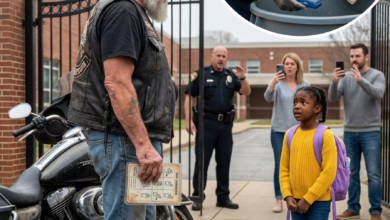
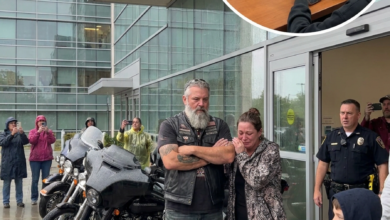
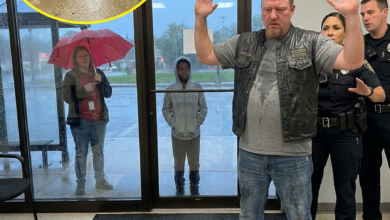
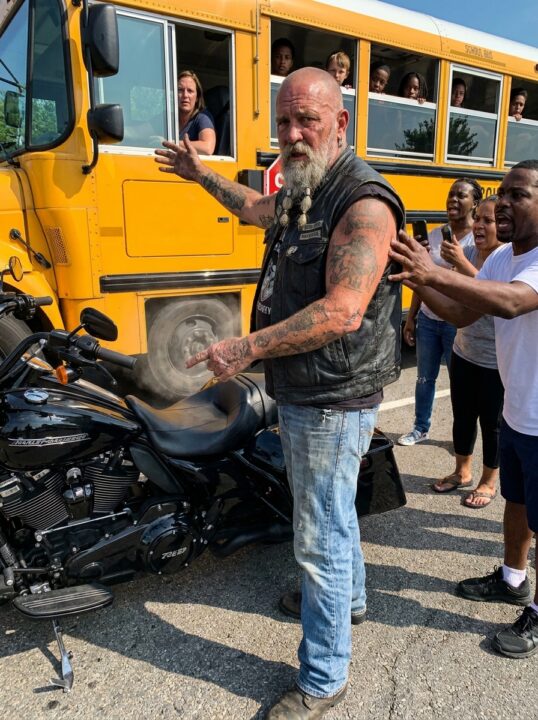
A Tattooed Biker Turned His Harley Sideways in Front of My School Bus While Parents Screamed — Then the Sound Beneath One Rear Wheel Explained Why He Refused to Move
Part 2 — The Man Who Heard What the Rest of Us Missed
The story began four miles before Silas blocked Bus 27, although I did not understand that until later.
I had left Cedar Ridge Elementary at 2:51 p.m. with twenty-six students, three backpacks in the aisle that I made their owners move, and one fourth grader upset because another child had taken the window seat. It was the kind of ordinary afternoon a school bus driver learns to value.
Bus 27 was a nine-year-old diesel with 143,000 miles on its odometer. It rattled over potholes, sighed when the air brake released, and produced enough background noise to hide a child unwrapping candy three rows behind me.
The bus had passed its annual state inspection. That morning, I had checked the lights, mirrors, tires, emergency exits, fluid levels, brake pressure, and visible lug nuts. Nothing looked wrong.
Silas was fueling his Harley at the Green Lantern station when we passed.
He heard the first click from across two lanes.
Later, he described it as a dry metallic tick followed by a softer scrape, repeating once per wheel rotation. The rhythm quickened as the bus accelerated and slowed when I approached the next light.
Most people would have mistaken it for a stone trapped in a tire.
Silas knew stones did not make that second sound.
He abandoned six dollars of prepaid gasoline, closed the cap, and started his Harley. The V-twin struck the air with two heavy pulses before settling into its familiar uneven idle.
He followed us east along Patterson Road.
At first, I barely noticed him. Motorcycles often rode behind the bus because passing opportunities were limited. When he moved into my left mirror and pointed downward, I thought he wanted to pass.
I waved him back.
He fell behind, listened through another turn, then accelerated beside the driver’s window at the next straight stretch. His beard moved in the wind, and one tattooed hand pointed toward the rear axle.
All I saw was a biker riding too close to children.
I closed the window.
He tried again at the traffic light near County Road 8. I kept the door locked and motioned for him to move away. A line of cars formed behind us, and someone began honking.
Silas looked toward Sutter Hill.
The hill waited three stops beyond Brookstone Avenue. It descended through two sharp bends bordered by a drainage ditch and mature sycamore trees. I drove it every afternoon at less than thirty miles per hour.
Silas knew the road better than I did.
His repair shop stood near the bottom.
He also knew that a school bus placed more than twice its empty weight on the rear axle when loaded with children, fuel, and equipment. On a downhill curve, lateral force would work against any wheel assembly already losing clamping pressure.
He had no proof yet.
Only a sound.
At Brookstone, he made the decision everyone saw. He passed at low speed, reached the stop before me, and placed the most valuable thing he owned across the road.
His Harley.
That detail mattered. Had I failed to stop, the bus would have crushed the motorcycle and probably Silas with it. He did not wave from a safe shoulder or hope I understood another hand signal.
He forced the question.
Who was this man willing to risk arrest and a thirty-thousand-dollar motorcycle over a noise no one else could hear?
His full name was Silas Joseph Kane, though nearly everyone along Highway 35 called him Rivet. He was fifty-three, a certified heavy-diesel technician, owner of Kane Roadside & Diesel, and road captain of the Iron Lantern Riders.
He had also served eighteen months in state prison.
The town remembered the last fact more easily than the others.
Silas began working around engines at fourteen in his uncle’s farm shop. He could identify a failing alternator bearing from across a parking lot, balance twin carburetors by ear, and detect a loose heat shield before most mechanics opened the hood.
At twenty-four, he joined the Beckford County school transportation garage. He spent six years maintaining buses, snowplows, and district vans.
Drivers trusted his inspections because he never treated a small noise as an inconvenience.
Then his wife, Dana, died from an aggressive cancer eleven months after diagnosis.
Silas was thirty-one. Their daughter Grace was eight.
After a warehouse accident injured his shoulder, he was prescribed pain medication. He used it as directed at first. Then he used it to sleep. Later, he used it to get through days he no longer knew how to carry.
The pills changed what grief had not.
He stopped showing up on time. He borrowed money. When that ran out, he falsified inventory records and sold several district-owned engine components through a private buyer.
The theft was discovered.
Silas confessed without a trial. He lost his job, his certifications, his home, and temporary custody of Grace. The court sentenced him to eighteen months.
Grace moved in with Dana’s older sister in Kettering.
For years, people told the story as if that was where Silas Kane became a criminal.
Grace remembered a different version. She remembered a father who attended every school concert before the pills, packed crackers in her lunch because she hated cookies, and once stayed awake all night rebuilding a broken wheelchair lift so a student would not miss a field trip.
Both versions were true.
That was what made him difficult to summarize.
In prison, Silas stopped using pills. Withdrawal took the comfort from his body before grief had finished taking it from his mind. He joined every recovery meeting available, repaired laundry carts without being asked, and kept a photograph of Grace beside a yellow school bus taped above his bunk.
He called her every Sunday.
Some Sundays, she spoke.
Some Sundays, she did not.
Seven months into his sentence, Grace boarded Bus 12 for school. A man named Elias Brooks happened to be riding behind it on an old Harley Electra Glide.
Elias heard a clicking sound from the left rear wheel.
He tried signaling the driver. She misunderstood him. At the entrance to Sutter Hill, Elias rode around the bus and blocked the lane with his Harley.
Parents screamed.
The driver sounded the horn.
A father shoved Elias against a guardrail.
The bus mechanic who responded found four loosened lug nuts and two cracked studs. One fragment had been trapped between the dual wheels.
Grace’s bus had been less than a mile from the same steep descent.
No one was injured.
That evening, Elias visited Silas in prison.
They spoke through scratched glass using heavy black telephones. Elias was sixty-two, lean, gray-haired, and wore a denim work shirt because club colors were not permitted in the visiting room.
He placed a dark piece of broken steel against the glass.
Silas recognized it immediately.
A wheel stud.
“Grace was on that bus,” Elias said.
Silas gripped the telephone until his knuckles whitened.
“Is she hurt?”
“No.”
“Where is she?”
“With your sister-in-law. Safe.”
Silas lowered his head.
Elias waited.
“What do you want?” Silas finally asked.
“Nothing.”
“You came here for something.”
“I came because a noise asked for an answer today.”
Silas looked at the broken stud.
Elias’s next words remained with him for twenty-two years.
“Noise asks once, brother. After that, consequences do the talking.”
When Silas was released, Elias met him outside the gate on the same old Harley. He gave Silas the broken stud, a leather cord, and a job sweeping floors in his motorcycle shop.
Silas earned back his diesel certifications one examination at a time. He repaid the district for every stolen part. He rebuilt his relationship with Grace without demanding that she forget anything.
It took years.
Elias founded the Iron Lantern Riders around one rule: nobody wearing their patch rode past a stranded person because the situation looked inconvenient.
Silas eventually bought the shop when Elias retired.
The old man died six years later from a stroke, leaving Silas the black Road King and a note inside the saddlebag.
Keep listening.
That was the motorcycle now parked across my bus.
That was the history hidden beneath Silas’s leather cut.
But on Brookstone Avenue, none of us knew it.
We saw an ex-con standing between parents and their children.
Silas saw a yellow bus approaching Sutter Hill.
And beneath everything we shouted at him, he could still hear the click.
Part 3 — Six Inches
Officer Price had dealt with Silas before, though never for violence.
There had been noise complaints at the Iron Lantern clubhouse, an argument over motorcycles parked near a veterans’ fundraiser, and one incident involving a stranded horse trailer that Silas repaired in the center of a county road while refusing to move until the axle was safe.
“He gets stubborn around machinery,” the officer told me quietly.
“That’s supposed to reassure me?”
“No.”
The district’s mobile mechanic, Tom Danner, arrived in a white service truck. Tom was thirty-six, careful and capable, and had worked on our fleet for seven years.
He did not appreciate a former district mechanic questioning him in front of parents, police, and cameras.
Tom began with the obvious checks. Tire pressure was normal. No sidewall bulges showed. The axle housing was dry. The visible lug nuts were present.
He looked at Silas.
“What exactly did you hear?”
“One hard tick. One soft scrape. Right rear. Repeats with rotation.”
“Could be gravel between the duals.”
“Could be.”
“Could be a brake spring.”
“Could be.”
“Could be nothing.”
Silas looked toward the children.
“Can you promise that?”
Tom’s jaw tightened.
No mechanic makes that promise.
By then, the transportation supervisor had ordered us to evacuate. Officer Price closed the road, and another driver arrived with an empty bus.
I opened my door.
The children came out by rows, some excited by the disruption and others frightened by the adults’ expressions. Silas moved his motorcycle farther across the opposite lane to create a steel barrier between the children and approaching traffic.
He stood beside it while they passed.
His hands remained visible.
One first grader began crying when she saw his tattoos. Silas turned his body away so she would not have to walk directly toward him.
That small movement unsettled the story I had already created about him.
Nora Hensley ran into Mark’s arms. Mark held her tightly, then looked toward Silas with the shame of a man remembering the leather he had grabbed.
He was not ready to apologize.
Neither was I.
Once the students transferred to the replacement bus, Tom placed heavy chocks around the front wheels. Silas’s two club brothers—Malcolm “Moose” Reed and Walter “Bishop” Lane—helped move bystanders behind the police line.
Tom drew a chalk line across the right rear lug nuts and wheel face. At his instruction, I restarted the engine, released the brake, and allowed Bus 27 to move forward six inches.
The click reached my seat.
Faint.
Dry.
Precise.
Tom raised his hand.
I stopped.
One chalk line no longer aligned. A lug nut had rotated slightly against the wheel.
Tom crouched.
“Okay,” he said. “We have movement.”
The parents became quiet.
A loose lug nut by itself does not mean a wheel will separate. Wheels sometimes settle after service. Proper tightening can restore clamping force if the studs, wheel, and hub remain undamaged.
Tom brought out a calibrated torque wrench.
Silas stopped him.
“Pull the outer.”
“We can torque first.”
“You saw the dust.”
“Road dust.”
“Fretting dust.”
Gray powder circled the bases of three lug nuts. It formed when metal surfaces moved against each other under load. The wheel had been shifting by fractions too small for us to see but large enough to grind away material.
Tom wiped the powder with one finger.
Tiny silver particles remained on his skin.
“I can tighten it, drive empty at five miles an hour, then inspect at the garage,” he said.
“Not down Sutter.”
“I know the road.”
“Then you know better.”
Tom stood. “You don’t work for the district anymore.”
Silas’s face changed, but his voice did not.
“No. I don’t.”
The reference landed harder than Tom intended. Everyone nearby knew enough of Silas’s past to understand it.
Tom looked away first.
District management called through his radio. A tow for a loaded commercial bus could take more than an hour. Traffic was already backing into the adjacent subdivision.
The instruction was to tighten the wheel, remove the bus slowly, and complete inspection at the depot.
Silas stepped between Tom and the torque wrench.
Officer Price warned him again.
“You touch him, you’re going in cuffs.”
Silas held out his wrists.
“Then do it.”
The officer stared at him.
Silas had spent eighteen months behind a locked door. He understood precisely what he was offering. He was not performing bravery for the cameras.
He believed one more rotation was too many.
Tom exhaled and requested authorization to remove the outer wheel on site.
While we waited, wind moved dry leaves across the roadway. The bus engine was off now. Without it, Brookstone Avenue seemed unnaturally quiet.
Silas stood near the right rear axle, listening to metal cool.
Moose approached him.
“Club charity ride leaves in twenty minutes,” he said.
The Iron Lantern Riders had planned to escort donated winter coats to a shelter in Dayton. More than thirty riders were waiting at the clubhouse.
“Take them,” Silas said.
“You coming?”
“No.”
Moose looked toward the police cruisers. “You get arrested, club gets dragged through every local feed by dinner.”
“Then keep the coats off camera.”
“You’re road captain.”
“Today I’m a roadblock.”
Moose called the clubhouse.
Within fifteen minutes, the other riders had divided. Half continued toward the shelter with the donations. Eight rode to Brookstone carrying portable work lights, a low-profile hydraulic jack, cribbing blocks, and a wheel dolly from Silas’s shop.
That choice tested the brotherhood more than any dramatic highway confrontation could have. If Silas was wrong, they would become a line of intimidating men helping an ex-con disrupt a school route.
They came anyway.
No engines revved.
No one argued with police.
They parked where Officer Price directed, removed their leather cuts before working near the bus, and waited for Tom to lead the inspection.
District authorization finally arrived.
Tom loosened the outer wheel nuts in sequence. The first broke free normally. The second required less force than expected. The third turned under the weight of the wrench.
The fourth stud snapped.
The sound was small.
A sharp metallic pop.
Everyone flinched.
Tom froze with both hands on the torque wrench.
Silas looked at the pavement.
“Unload the assembly,” he said.
Using the hydraulic jack and safety stands, they raised the right rear axle just enough to remove weight from the dual wheels. Moose positioned the dolly. Tom removed the remaining nuts.
When they drew the outer wheel away, a dark metal fragment fell from behind it and struck the asphalt.
It spun once.
Then it stopped beside Silas’s boot.
He removed the old wheel stud from beneath his vest and held it next to the new fragment.
Same diameter.
Same diagonal fracture.
Same gray dust polished into the broken surface.
Grace’s bus had left him one piece twenty-two years earlier.
Bus 27 had produced another.
Tom inspected the exposed inner wheel. Two stud holes had elongated into shallow ovals. Three studs showed bright crescent marks where the wheel had moved against them. Another bore a thin crack near its base.
The outer wheel had not been clamped securely to the hub.
Each turn allowed microscopic movement.
Each brake application added heat.
Each curve flexed the remaining studs.
Tom sat back on his heels.
“How far to Sutter?” Moose asked.
“Less than two miles,” I said.
No one spoke for several seconds.
A district engineer later estimated the assembly might have lasted another ten miles—or failed at the next turn. Mechanical fracture does not provide appointments.
Had the right rear dual assembly separated on Sutter Hill, I might have lost steering stability while carrying twenty-six children downhill.
The bus might have stopped safely.
It might not have.
Silas never exaggerated what could have happened. He did not need to.
He pointed at the damaged studs.
“That’s why we don’t roll it.”
Tom nodded.
The false climax should have ended there. The children were safe, the defect had been found, and the frightening biker had been proven right.
Parents approached with apologies forming awkwardly in their mouths. Phones lowered. Officer Price stepped away from his cuffs.
Then an ambulance turned onto Brookstone Avenue.
A female paramedic climbed out, saw Silas, and ran toward him.
She was thirty, with dark hair tied beneath a navy cap and a narrow scar across her left wrist.
She stopped in front of the biker everyone had feared.
“Dad,” she said. “Are the kids safe?”
Silas nodded.
The old photograph in his saddlebag had just stepped onto the road.
Part 4 — The First Bus
Grace Kane had heard the call over the county emergency channel: school bus, blocked roadway, possible mechanical failure, multiple children.
The dispatcher mentioned Silas’s name.
Grace knew he would not block a school bus casually. She requested permission to respond, telling her supervisor there might be children requiring evaluation after evacuation.
By the time she arrived, every child was already aboard the replacement bus. No one had been injured.
She still checked.
Grace spoke to frightened parents, examined one boy who felt dizzy from panic, and reassured a second grader who thought the broken wheel meant her original driver had done something wrong.
Only after the replacement bus departed did she approach her father.
Silas stood beside the exposed hub, holding the two fractured wheel studs.
Grace looked at the old one first.
“You still carry it.”
“Still works.”
“As what?”
“A reminder.”
She took the new fragment and studied its fracture. “Same sound?”
“Close.”
Grace’s scar had come from the first bus incident. When Elias blocked Bus 12 twenty-two years earlier, the sudden stop threw her hand against a damaged seat-frame edge. She required five stitches.
That was the full extent of the injuries.
The scar remained because children’s bodies remember small things adults dismiss.
Grace remembered the horn. She remembered parents yelling at Elias. She remembered a man grabbing his denim vest and calling him a criminal.
Most of all, she remembered Elias kneeling outside her bus, one ear close to the wheel, refusing to move.
At the hospital, her aunt told her that the biker had saved them.
Grace asked whether her father would come home now.
No one knew how to answer.
Elias visited Silas in prison the following evening. After Silas’s release, he became more than an employer or recovery sponsor. He became the man willing to stand in the space Silas had abandoned.
He drove Grace to supervised visits when her aunt’s car failed. He taught Silas how to apologize without explaining away the damage. He refused every attempt Silas made to turn guilt into permanent punishment.
“Guilt is a wrench,” Elias once told him. “Use it or put it down. Quit hitting yourself with it.”
Silas rarely discussed those years. The town knew he had gone to prison for theft. Few people knew that his addiction began after losing Dana, or that he repaid the district, completed nineteen years of recovery, and spent more than a decade repairing vehicles for families who could not afford commercial rates.
Grace knew everything.
She also knew recovery had not transformed him into a soft, endlessly patient man. Silas remained stubborn, suspicious of praise, and capable of turning a five-minute repair into an argument about responsibility.
He was complicated.
He was present.
That mattered more.
Mark approached while Grace and Silas stood together.
“I grabbed your father,” he told her.
Grace glanced at Silas. “Did he hit you?”
“No.”
“Then he likes you.”
Mark almost laughed, but shame stopped him.
“I thought he was trying to take the bus.”
“So did a man twenty-two years ago.”
Grace looked at the old stud hanging from her father’s hand.
She told us the first story.
As she spoke, the afternoon’s events rearranged themselves. Silas’s refusal to raise his hands, his awareness of where parents stood, the way he turned his body from the crying first grader, and his willingness to be arrested all came from a scene he had replayed for two decades.
He had not merely recognized a failing wheel.
He had recognized every frightened face around it.
Mark rubbed his palms together. “Why didn’t he just tell us?”
Silas answered for himself.
“I did.”
“You shouted, ‘Kill the engine.’”
“Bus was moving.”
“You could’ve explained after it stopped.”
“You were shouting.”
“So were you.”
“I don’t have a quiet face.”
That time, Mark did laugh.
The tension loosened, though it did not disappear. Being right did not erase how terrifying Silas had appeared to people who knew nothing about him.
He understood that.
“I’d have grabbed me too,” he told Mark.
That sentence mattered because it did not demand forgiveness. It acknowledged what every parent had seen before they heard the faint click.
Officer Price asked Grace whether Elias had ever been arrested during the first incident.
“Almost,” she said. “The district mechanic wanted to move the bus. Elias lay down in front of it.”
Silas looked at her. “He left that part out.”
“He knew you’d copy him.”
“I used the Harley.”
“Much more reasonable.”
The officer shook his head.
Tom continued examining the wheel assembly. The visible damage explained the noise, but not why the clamping force had been lost.
The outer dual wheel had been installed forty-three days earlier after a tire replacement. According to service records, its lug nuts had been torqued properly.
A follow-up torque inspection was required after the wheel completed its initial service interval.
The record showed that check had been performed.
Tom found the mechanic’s initials.
They were his.
His face drained of color.
“I checked this wheel,” he said.
Silas crouched beside him.
“Then find what changed.”
Tom stared at the elongated holes. “Nothing should have.”
“Something did.”
Parents who had spent an hour directing anger at Silas now turned toward Tom. A few demanded his name. One asked whether he had falsified the inspection.
Silas stood and placed himself between them.
“Back up.”
The same voice that had frightened us now protected the man who might have missed the defect.
Mark stared at him. “You think he did this?”
“I think we don’t know.”
“He signed the inspection.”
“So did I, once.”
Silas’s criminal record involved stolen parts, not negligent inspections, but he allowed the comparison to settle the crowd.
Tom looked up at him.
Silas offered one grease-darkened hand.
“Find the failure before you find the villain.”
Tom took it.
That became the second twist of the day. Silas had every reason to humiliate the district garage that fired him and the younger mechanic who had dismissed him.
Instead, he defended the inspection process until evidence could speak.
The bus was placed on a heavy recovery vehicle and transported to a secure maintenance bay. Police cleared Brookstone Avenue. Parents returned home with children who would tell increasingly dramatic versions of the event by dinner.
Silas remained until the damaged wheels were loaded.
Before leaving, he placed the new fractured stud inside his saddlebag, beside the faded photograph of Grace.
She saw him do it.
“You don’t need two reminders,” she said.
“One’s Elias.”
“What’s the other?”
Silas looked toward the empty place where Bus 27 had stood.
“Today.”
Grace touched the old leather cord around his neck.
Then she climbed onto the passenger seat of the Harley.
She had not ridden with him for almost a year.
Silas handed her the spare helmet without commenting. He started the Road King, and its V-twin rumble moved through the quiet neighborhood.
Mark raised one hand.
Silas returned the gesture.
The motorcycle left Brookstone Avenue with father and daughter riding together, while the broken bus traveled in the opposite direction.
The full reason for the wheel failure would take three days to find.
What investigators discovered changed more than one bus.
Part 5 — What the Gray Dust Revealed
The district moved Bus 27 into an isolated maintenance bay and brought in an independent wheel specialist from Columbus. Tom requested the outside inspection himself.
He did not sleep much while waiting.
Neither did I.
Even though no warning light had appeared and my pre-trip inspection met policy, I replayed every turn from Cedar Ridge Elementary. Had the rear of the bus felt loose? Had the brake pedal changed? Had I heard the click and dismissed it as ordinary vibration?
School bus drivers live with a specific kind of responsibility. We do not transport cargo. Every sound behind us belongs to someone’s child.
Silas attended the inspection as a witness, not a district employee. He wore a clean mechanic’s shirt without his leather cut, though the old wheel stud remained beneath the collar.
The investigation found no sabotage.
It found something more ordinary.
During the tire replacement forty-three days earlier, corrosion scale remained on the mating surface between the inner wheel and the hub. It was thin, uneven, and hidden once the dual wheels were mounted.
The lug nuts reached the specified torque. On paper, the assembly was correct.
But torque measures resistance while tightening. It does not directly measure the clamping force holding every surface together. The trapped corrosion gradually crushed beneath the load, creating microscopic space.
Clamping force fell.
The wheel began to move.
Tom had performed the scheduled follow-up check, but the bus arrived late during a storm response. Mud and salt covered the wheel face. He verified the visible nuts with a torque wrench, recorded the reading, and returned the bus to service.
The nuts resisted at the specified value because corrosion and damaged threads created friction.
The reading appeared correct.
The clamping force was not.
Over the next weeks, repeated braking and cornering flexed the studs. Two developed fatigue cracks. One fractured inside the dual assembly, where no daily visual inspection could reveal it.
The click Silas heard was the wheel shifting against a damaged stud.
The softer scrape came from the broken fragment moving between the wheels.
The gray ring was fretting debris.
Tom had not lied.
I had not skipped my inspection.
A chain of ordinary limitations had lined up beneath twenty-six children.
The school board held an emergency meeting. Parents filled the room, along with local reporters attracted by phone footage of an enormous biker blocking a bus.
Silas refused to sit at the front.
He stood near the back wall with Moose and Bishop, arms folded, leather cuts creaking whenever they moved. People kept turning to look at them.
The transportation director explained the findings and announced immediate inspections of every recently serviced wheel assembly in the fleet.
Three additional buses showed early loss of torque.
None had fractured studs.
All were removed from service.
The district revised its procedures. Wheel mating surfaces would be photographed after cleaning. Torque checks would use visible witness marks. Any broken witness line, metallic dust, unusual heat, or rotational clicking required immediate removal from service.
Drivers received additional sound-recognition training.
Silas asked for one more change.
“Turn the engines off during the check.”
A board member asked why.
“Hard to hear a wheel over a diesel.”
The room became silent.
The board adopted a mandatory sixty-second engine-off listening pause during post-service inspections.
Reporters approached Silas after the meeting. One wanted him to stand beside the damaged wheel. Another asked him to hold the broken stud for a photograph.
He refused.
“You saved twenty-six children,” a reporter said.
“I stopped a bus.”
“Because no one else heard the danger.”
“Because I happened to be close.”
“What made you recognize the sound?”
Silas touched the leather cord beneath his shirt.
“An old man listened first.”
That was all he gave them.
Tom stood several feet away. When the reporters left, he approached Silas carrying a small cardboard box.
Inside were the damaged studs, tagged as released evidence.
“The district said you could have one,” Tom said.
“Keep them for training.”
“I thought you wanted the piece from the road.”
“I got the reminder.”
Silas nodded toward Tom’s face.
The younger mechanic looked exhausted.
“I should’ve pulled the wheel when you asked.”
“You got there.”
“You had to fight me.”
“You were following what you knew.”
“I was wrong.”
Silas considered that. “Next time, be wrong faster.”
Tom smiled despite himself.
The district superintendent wanted to recognize Silas at the next school assembly. He declined that too.
Grace convinced him to attend only after Cedar Ridge promised there would be no stage, no speech, and no surprise media.
The promise lasted eight minutes.
When Silas entered the gym, more than four hundred children turned toward him. Teachers had explained that he was the rider who stopped Bus 27, but several younger students knew him only as the frightening man from their siblings’ videos.
Silas wore his leather cut. The patches had been covered with plain black fabric at the school’s request.
His boots sounded heavy against the polished floor.
A little boy in the front row leaned toward his teacher and whispered loudly, “He looks mean.”
Silas heard him.
“So do you,” he said.
The boy grinned.
I introduced Silas without calling him a hero. He had insisted on that word being removed.
He stood at the microphone.
The gym waited.
Silas disliked public speaking almost as much as praise. He gripped the podium with both hands, exposing HOLD across his knuckles.
“If your bus driver tells you to sit,” he said, “sit.”
Teachers glanced at one another.
“If something sounds wrong, tell an adult. Don’t make it a joke. Don’t be embarrassed if you’re mistaken.”
He paused.
“Machines whisper before they shout.”
Then he stepped away.
His entire speech lasted twenty-three seconds.
Nora Hensley raised her hand.
Silas stopped.
“My dad grabbed you,” she said.
Mark sat among the parents and closed his eyes.
Silas looked at Nora. “He was protecting you.”
“Did it hurt?”
“No.”
Mark stood afterward and approached Silas in front of everyone.
“I owe you an apology.”
Silas shook his head. “You owe your daughter dinner.”
“I still owe you.”
“You were scared.”
“That doesn’t excuse it.”
“No. But it explains it.”
Mark offered his hand.
Silas looked at it, then pulled him into a brief one-armed embrace that almost lifted Mark off the floor.
The children laughed.
That was the first warm sound anyone associated with the biker from the video.
The school presented Silas with a small framed drawing made by the children of Bus 27. It showed a black motorcycle in front of a yellow bus, twenty-six square faces in the windows, and one enormous biker holding both hands up.
At the bottom, Nora had written:
HE HEARD US BEFORE WE KNEW WE NEEDED HELP.
Silas read it twice.
He did not cry. His jaw tightened, and his scarred thumb rubbed the wooden frame until the room became uncomfortable with how quietly he stood.
Then he handed the frame to Grace.
“Keep this safe.”
She smiled. “You keep it.”
“I break things.”
“You fix more.”
He carried it home inside the same saddlebag that held her old photograph.
Part 6 — The Eli Check
Winter settled over Beckford County. Salt whitened the roads, diesel engines complained through cold mornings, and Bus 27 returned to service with a rebuilt hub, new wheels, new studs, and yellow torque-witness marks visible on every lug nut.
I did not drive it immediately.
For two weeks, I chose another bus whenever one was available. I told myself the schedule required it, but the truth was simpler.
I no longer trusted silence.
Silas understood.
One morning before dawn, he arrived at the depot carrying two paper cups of bad coffee. He stood beside Bus 27 while vapor rolled from its exhaust.
“You going to drive it?” he asked.
“I’m thinking.”
“Dangerous habit.”
“What if I miss something else?”
“You will.”
I stared at him.
“Everybody misses something,” he continued. “That’s why checks overlap.”
He walked around the bus with me. We inspected the torque marks, tire sidewalls, valve stems, hub seals, and the spaces between the dual wheels.
Then he told me to shut off the engine.
The garage became quiet.
“Don’t listen for the old sound,” he said. “Listen for what’s here.”
Metal cooled. Air lines settled. Somewhere beyond the bay, a wrench struck concrete.
Bus 27 made no rotational click.
Silas stepped back. “Drive your route.”
I did.
The transportation staff began calling the new engine-off listening procedure the Eli Check. Most employees did not know who Elias Brooks had been, but the name remained.
Tom mounted the damaged wheel assembly on a training stand. Drivers and mechanics could turn it by hand and hear the click Silas had recognized from across two lanes.
It was softer than anyone expected.
That was the point.
The Iron Lantern Riders funded portable wheel-temperature sensors for the district’s older buses, though Silas insisted the donation remain anonymous. The board listed it as coming from a local transportation safety group.
Parents knew better.
On Fridays, Silas and Tom began offering free wheel inspections at Kane Roadside & Diesel. School employees, parents, church vans, food-bank trucks, and small daycare buses lined the gravel lot.
The bikers handled traffic and coffee.
No one wore threatening slogans. No one filmed customers for social media. They checked wheels, marked lug nuts, explained warning signs, and sent people home without charging when nothing was wrong.
Silas hated the attention but loved the work.
Grace visited often. Their relationship had once been measured in supervised hours and unanswered calls; now it moved through ordinary disagreements about cholesterol, motorcycle helmets, and whether Silas needed a doctor for his shoulder.
Ordinary was precious.
On the anniversary of the first bus incident, Grace rode with him to Elias’s grave. Silas carried two wheel studs: the old one from Bus 12 and the newer fragment from Bus 27.
He placed neither on the stone.
Elias would have called that wasteful.
Instead, Silas held them in his palm while the cold wind moved through the cemetery grass.
“Still listening?” Grace asked.
Silas closed his fingers around the steel.
“Trying.”
They stayed until evening.
When they left, the Harley’s engine rolled through the cemetery with a low, uneven thunder. Silas rode slowly, and Grace’s hands rested around his leather cut.
Two broken pieces of steel traveled beneath his heart.
Part 7 — The Sound After the Horns
One year after Silas blocked Bus 27, I pulled into the Brookstone stop at 3:18 p.m.
Parents waited along the sidewalk. Mark stood near the mailbox with Nora’s younger brother on his shoulders.
Silas’s Road King was parked safely beside the curb.
He no longer needed to block the road.
The children knew him now. Several raised two fingers in the biker greeting he had taught them, though one first grader used the wrong hand and nearly hit her seatmate.
I set the brake and opened the door.
Before releasing the students, I shut down the diesel.
That had become our ritual.
For sixty seconds, we listened.
No clicking came from the wheels. No scrape hid beneath the engine. The bus rested with the ordinary creaks of warm metal and settling suspension.
I restarted it.
Silas nodded.
Nora stepped off carrying a small wrapped package. She walked past her father and handed it to the biker.
Inside was a leather key ring stamped with one word.
HEARD.
Silas turned it over in his thick fingers.
“You make this?”
“My dad helped.”
Mark shrugged. “She supervised.”
Silas attached it to the key of Elias’s Harley.
A minivan pulled away from the opposite curb. As it passed, Silas tilted his head.
Every adult froze.
The driver stopped immediately and lowered her window.
“What is it?”
Silas listened again, then crouched near the rear bumper.
“Loose heat shield,” he said. “Annoying. Not dangerous.”
The entire sidewalk exhaled.
Mark laughed first. I followed. Soon even Silas smiled beneath his gray beard.
He tightened the shield with a small wrench from his saddlebag while the children watched. Then he closed the tool roll, climbed onto his Harley, and started the engine.
The familiar V-twin rumble moved through our shoes.
Before leaving, he looked once at Bus 27’s right rear wheels. The yellow witness marks remained straight.
Silas raised two fingers.
I returned the gesture.
The Harley rolled toward Highway 35, its red taillight shrinking between bare Ohio trees. The key ring Nora made tapped softly against the ignition.
He heard that too.
Follow our page for more biker stories about intimidating riders, quiet courage, and the moments when one person refuses to ride past trouble.