A Tattooed Biker Sat Down in a Dead Soldier’s Empty Chair and Drank the Coffee Meant for Him — Then the Old Veteran Whispered a Name That Changed the Entire Club
I had heard the name Marcus Cole before I knew what war was.
My father never told combat stories the way movies told them.
There were no speeches.
No grand descriptions.
He mostly talked about ordinary things.
Bad coffee.
Wet socks.
A sergeant who could sleep through artillery but woke if someone opened a candy wrapper.
A man named Marcus who could repair a radio with tape, profanity and no available parts.
Whenever my father spoke about Marcus, his voice changed.
Softer.
Careful.
As though memory itself required respect.
But he had never known what happened to him.
At least not fully.
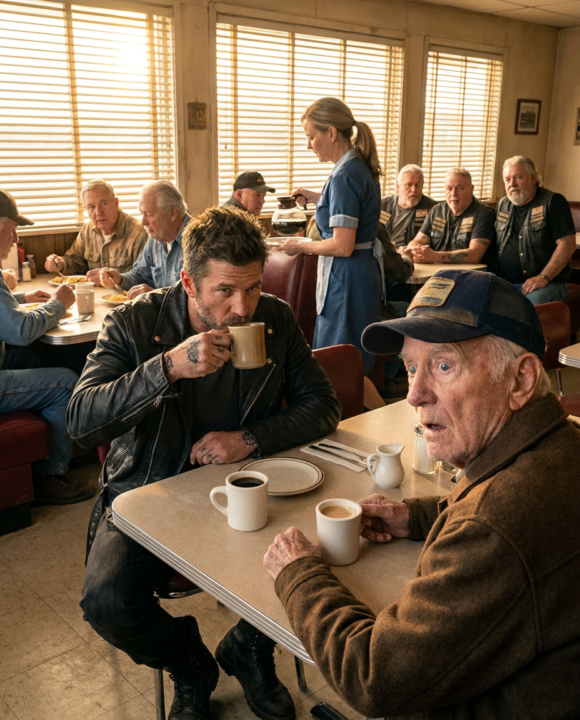
I sat across from Walter Bennett with the second coffee in my hand.
The cream had already started cooling.
“Marcus Cole,” I said.
Walter nodded.
“Sergeant Marcus Elijah Cole.”
My skin prickled.
“My dad said Marcus switched guard duty with him one night.”
Walter did not respond.
“He said he was sick. Fever. Marcus took his post.”
Still nothing.
“My father woke up the next morning and their position had been hit.”
Walter closed his eyes.
The entire diner faded into a blur of chrome, vinyl booths and morning sunlight.
Millie walked over quietly.
She set a fresh pot down.
Walter whispered, “He lived.”
“My father?”
He opened his eyes.
“Yes.”
“He lived until three years ago.”
Walter looked toward the window.
For twelve years, everybody in that diner had seen him as an old man ordering coffee for a ghost.
Now I understood that ghost had a history.
“Tell me about Marcus,” I said.
Walter looked irritated.
“You sat in his chair before asking permission.”
“I know.”
“You drank his coffee.”
“I know.”
“Now you want his story.”
I nodded.
“Yes.”
Walter looked at me for a long time.
Then pointed.
“Get out of the chair.”
I stood immediately.
He looked surprised.
Maybe he expected an argument.
I moved to the next booth instead.
“Better?”
“Marginally.”
Bear—Frank Donnelly—choked on his coffee behind me.
Walter ignored him.
Then he began.
Marcus Cole was twenty-six when Walter met him.
Black.
Born outside Birmingham, Alabama.
Tall.
Lean.
Always smiling at the wrong time.
Walter said Marcus had a wife named Ruth and a daughter he had met only once before deployment.
“He carried her picture in his helmet liner,” Walter said.
“Why there?”
“Said if he lost his head, she should be the last thing next to it.”
Nobody laughed.
Walter stared at his black coffee.
“He was like that.”
The two men became close.
Not because they were similar.
Walter grew up on a farm in Pennsylvania.
Marcus grew up in Alabama.
Walter liked country music.
Marcus hated it.
Marcus liked jazz.
Walter called jazz “seventeen musicians falling down stairs.”
They argued constantly.
But they trusted each other.
One evening, over army coffee so bad that both men complained for half an hour, Marcus made a joke.
“When we get home, I’m buying you a cup that doesn’t taste like boiled boots.”
Walter replied, “Every morning.”
Marcus said, “Every morning what?”
“Coffee.”
“You paying?”
“First one.”
“Then we got a deal.”
A stupid promise.
Small.
Ordinary.
The kind people make because they assume life will give them time to fulfill it.
Then came the day Marcus died.
Walter stopped.
His hands tightened around the mug.
Millie quietly asked whether he wanted more coffee.
“No, ma’am.”
He never called her ma’am.
That was how I knew he was struggling.
“You don’t have to tell us,” I said.
Walter glanced at me.
“You people already invaded breakfast.”
Rook smiled.
“Accurate.”
Walter ignored him.
Their unit had been moving through difficult terrain when the attack came.
Walter remembered noise.
Dirt.
Confusion.
He remembered someone shouting his name.
Then Marcus hit him.
Not struck.
Shoved.
Hard.
Walter fell into a shallow depression.
A moment later, fragmentation tore through the place where he had been standing.
Marcus went down.
Walter crawled to him.
He would never describe the injuries.
He only said, “There wasn’t anything anybody could do.”
Marcus died with Walter holding his hand.
His last words were not dramatic.
Not about country.
Not about glory.
He said, “You still owe me coffee.”
Walter smiled once.
The saddest smile I had ever seen.
“So I told him, ‘Back home. Every morning.’”
Nobody spoke.
Then Walter looked at the empty chair.
“That was forty years ago.”
I frowned.
“But you started ordering the coffee twelve years ago.”
He nodded.
“Why wait?”
His face closed.
That was the next locked door.
Walter’s wife was named Helen.
They had been married forty-six years.
Millie knew her.
Everybody in town over fifty knew her.
Helen Bennett had been a school secretary, church pianist and apparently the only person who could tell Walter he was being stubborn without starting a fight.
For decades, Walter kept Marcus mostly private.
He visited the memorial.
Sent Christmas cards to Marcus’s widow until the letters began returning.
Tried twice to find the daughter.
Failed.
But he never set an empty coffee across the table.
Helen would not let him.
That surprised me.
“She didn’t approve?” I asked.
Walter almost smiled.
“She approved of Marcus.”
“Then why?”
“She said I was confusing remembering the dead with refusing the living.”
The words landed hard.
After Walter came home, he struggled.
He worked at a hardware store.
Then a machine shop.
He slept badly.
He hated fireworks.
Could not sit with his back to a door.
Helen learned every warning sign.
When Walter disappeared into himself, she pulled him back.
Sometimes gently.
Sometimes not.
“You think I’m letting you spend your whole life sitting at breakfast with Marcus?” she once told him. “Absolutely not. I married one veteran, not two.”
Bear smiled.
“I would have liked her.”
Walter looked at him.
“Everybody did.”
They had no children.
Not by choice at first.
Then, after years of trying, life simply became what it was.
Helen filled it anyway.
Neighbors.
Students.
Church.
Walter.
When she died twelve years earlier, something inside the old veteran collapsed.
The morning after the funeral, Walter walked to Millie’s.
Sat at the corner table.
Millie brought one coffee.
Walter said, “Two.”
“For who?”
He pointed across the table.
“That morning,” Walter told us, “I didn’t know how to eat alone.”
That sentence changed the whole story.
The second cup was for Marcus.
But it was also because Helen was gone.
With her death, Walter lost the person who had spent forty-six years preventing grief from becoming his entire house.
Marcus returned to the table because Helen no longer occupied Walter’s life.
Not literally.
Emotionally.
Every morning afterward, Walter ordered two cups.
One black.
One with cream.
Marcus always took cream.
“Did you ever drink it?” I asked.
“Never.”
“Why?”
“It isn’t mine.”
I thought about what I had done earlier.
My stomach tightened.
“I’m sorry.”
Walter nodded once.
Not forgiveness.
Acknowledgment.
Fair.
Then Jonah “Atlas” Reed spoke from the booth behind us.
“Marcus Cole from Alabama?”
Walter turned.
“Yes.”
“Do you know where exactly?”
“Outside Birmingham.”
Atlas leaned forward.
“What year was he born?”
“1955.”
Atlas looked toward me.
“Caleb.”
I knew that tone.
“What?”
“Call your mother.”
I frowned.
“Why?”
“Ask if your father kept his service papers.”
“He did.”
“Ask about Marcus.”
Walter stiffened.
My mother answered on the fourth ring.
“Caleb? Everything okay?”
“Yeah. Weird question.”
“Those are your specialty.”
“Did Dad keep anything about Marcus Cole?”
Silence.
Then, “Why?”
“I’m sitting with a man who knew him.”
The line went completely quiet.
“Mom?”
“Where are you?”
“Millie’s.”
“I’m coming.”
She hung up.
Forty minutes later, my mother entered carrying a plastic storage box.
Linda Hayes.
Sixty-two.
Short gray-blond hair.
Blue cardigan.
She looked at Walter before she looked at me.
“Walter Bennett?”
His face changed.
“You know me?”
“No.”
She placed the box on the table.
“But Tom had your name.”
Everybody looked down.
Inside were photographs.
Letters.
Old military documents.
A yellowed envelope labeled MARCUS.
Walter touched it with one finger.
His hand shook.
“Where did he get this?”
“My husband spent thirty years trying to find Marcus’s family.”
Walter closed his eyes.
My mother continued.
“He believed he owed him his life.”
Walter whispered, “He didn’t.”
“Yes, he did.”
“No.”
His voice became sharp.
“Marcus didn’t die so Thomas could spend his life owing him.”
My mother stared.
Walter looked at me.
“That is not what he wanted.”
There was more emotion in those six words than in everything Walter had said all morning.
Then my mother opened the envelope.
Inside was a photocopy of an old handwritten roster.
Marcus Cole.
Thomas Hayes.
Walter Bennett.
Three names.
Same unit.
Same week.
Same history.
Then she removed a letter.
Unsent.
My father’s handwriting.
Dear Marcus,
I don’t know where to send this.
You took my shift because I had a fever. That choice put you where I should have been.
I got married.
Had a son.
His name is Caleb.
Everything after that night feels borrowed.
Walter covered his face.
I felt suddenly embarrassed to be in the room.
Not because grief was private.
Because it was enormous.
Then Walter said something through his hands.
“Thomas got it wrong.”
My mother looked at him.
“What?”
“Marcus did not die on Thomas’s watch.”
He lifted his head.
“Marcus died on mine.”
And for the first time, the old veteran looked not lonely.
Guilty.
Walter had carried something for forty years that nobody at Millie’s knew.
Not Helen.
Not Millie.
Not us.
Maybe not even himself in words he could admit.
Thomas Hayes believed Marcus saved him by changing duty.
Walter believed Marcus died saving Walter later.
One man survived because Marcus traded places with him.
Another survived because Marcus shoved him down.
Two lives continued.
Marcus did not.
Walter knew about Thomas.
He remembered him.
But after the war, records became names.
Names became addresses.
Addresses changed.
People vanished into civilian life.
Walter never knew whether Thomas married.
Had children.
Lived to old age.
I was sitting proof.
My existence was not abstract anymore.
I was a man in Marcus’s chair.
A son of someone who had lived because Marcus said yes to one extra shift.
Walter stared at me.
“How old are you?”
“Thirty-one.”
“Children?”
“No.”
“Married?”
“Not anymore.”
He nodded.
“Work?”
“Garage. Motorcycles.”
“Like your father?”
“Dad hated bikes.”
Walter smiled.
“Then probably.”
My mother sat beside him.
“Tom wanted to find someone who knew Marcus.”
“He had me.”
“He didn’t know.”
Walter’s eyes filled again.
“I was right here.”
Not literally.
But close enough.
Same state.
Same country.
Four decades of almost.
That is one of the crueler things about grief.
Sometimes the person who can answer your question exists.
You just never find the right door.
Millie brought breakfast without asking.
Eggs.
Toast.
Bacon.
Walter stared at it.
“I already ate.”
“You’re upset. That resets breakfast.”
He did not argue.
We bikers moved back to our booth.
This mattered.
Walter deserved room.
But the diner had other ideas.
Word traveled.
Somebody had recorded part of our conversation.
Not intentionally at first.
A young man at the counter had been filming his breakfast for social media when I sat in the empty chair.
His video captured Walter telling me to put down the cup.
It captured me drinking it.
It did not capture the later conversation.
By noon, the clip had been posted.
TATTOOED BIKER DISRESPECTS OLD VETERAN’S MEMORIAL COFFEE.
That was one caption.
Another said:
BIKER DRINKS DEAD SOLDIER’S CUP IN FRONT OF 82-YEAR-OLD VET.
Technically true.
Contextually terrible.
People got angry.
The comments became predictable.
Disrespectful.
Trash.
Someone find this guy.
Our garage page received messages.
One person threatened to come “teach the biker respect.”
Bear deleted that one.
Rook wanted to answer everybody.
We stopped him.
Again.
Walter did not know until Millie showed him.
He stared at the phone.
“That’s dumb.”
Millie blinked.
“What?”
“He didn’t know.”
The simplicity of Walter’s response stopped her.
The next morning, a local reporter showed up outside the diner.
Walter refused to speak.
The reporter asked me.
I refused too.
Then the reporter tried filming the empty coffee.
Millie nearly physically removed him.
“No cameras at that table.”
Walter watched.
For twelve years, nobody cared about his second cup enough to ask respectfully.
Now strangers wanted an angle.
That made him furious.
But something useful happened because of the attention.
A retired veterans-services officer named Paul Jenkins saw the video.
He knew the names Walter mentioned.
Marcus Cole.
Thomas Hayes.
He contacted Millie.
Not the press.
The diner.
Asked permission to come.
Walter almost refused.
My mother convinced him.
Paul arrived carrying records.
Casualty information.
Unit documents.
Archived correspondence.
Nothing secret.
Nothing dramatic.
Just proof.
He confirmed what Walter remembered.
Marcus Cole had died during that deployment.
Thomas Hayes had served in the same unit.
Walter Bennett had been present.
Records also showed Marcus had received a commendation for actions during the engagement.
Walter looked annoyed.
“He hated paperwork.”
Paul smiled.
“He also apparently saved at least two men.”
Walter’s face tightened.
“At least?”
Paul opened another document.
“There were others.”
That silenced the diner.
Marcus had helped evacuate another injured soldier earlier that same day.
Walter shook his head.
“He never told me.”
Paul closed the folder.
“People usually don’t understand the size of what they do while they’re doing it.”
That sentence seemed to reach Walter.
I thought about the empty chair.
The second coffee.
Forty years of remembering one death.
Maybe Walter had forgotten there were lives on the other side of it.
Then I noticed something.
The coffee across from him was cold again.
I did not touch it.
My father died three years earlier from pancreatic cancer.
Fast.
Too fast.
He went from complaining about indigestion to funeral arrangements in less than eight months.
During the last weeks, he talked more about the past.
Not because dying makes people automatically wise.
My father remained stubborn, sarcastic and obsessed with the thermostat until the end.
But he asked me once if I knew the name Marcus.
I laughed.
“Of course.”
He nodded.
“Good.”
Then said nothing else.
“Why?”
He looked toward the window.
“Because you should know why you’re here.”
That sentence bothered me for years.
I thought he meant ancestry.
History.
Luck.
Now I understood.
One night, when he was weak enough that speaking exhausted him, he told me about the shift.
He had been sick.
High fever.
Marcus saw him shaking and volunteered to cover the post.
The position took incoming fire that night.
My father survived.
Marcus survived that night too.
Dad always emphasized that.
“He didn’t die because of me that night.”
But later, after the attack where Marcus died saving Walter, my father built his own version of guilt.
If he had taken his original shift…
If Marcus had been more rested…
If he had not swapped…
If.
Grief loves that word.
If.
It builds entire prisons from it.
My father carried Marcus as debt.
Walter carried Marcus as responsibility.
Neither man seemed to understand that Marcus may have seen it differently.
I did not understand that until my mother gave me one more letter.
Not from my father.
From Marcus.
It had been copied from records preserved by another veteran.
Short.
Written to his wife Ruth.
Most of it was ordinary.
Weather.
Food.
Missing home.
Then one paragraph:
There is a kid here named Hayes who thinks needing help means he failed. I swapped him yesterday because he was sick enough to fall over. He said he owed me. Told him not to start that nonsense. If we all keep count, nobody ever gets home.
I read it three times.
Then a fourth.
Walter sat across from me.
Not in the booth.
We were at the garage after closing.
He had agreed to come because the diner had become too public for a few days.
Marcus’s words sat between us.
If we all keep count, nobody ever gets home.
Walter stared at the photocopy.
“He said that?”
“Yes.”
“He sounds like himself.”
I smiled.
“You spent forty years keeping count.”
Walter looked annoyed.
“That is an accusation.”
“Observation.”
“You’re young.”
“You sat with a ghost every morning.”
“I drank coffee.”
“Two coffees.”
“One was his.”
“No.”
Walter looked at me sharply.
I continued.
“The coffee was yours too.”
He frowned.
“You ordered it because you needed him there.”
He started to object.
I lifted a hand.
“I’m not telling you to stop.”
That mattered.
“I’m saying maybe Marcus did not spend forty years waiting for you to pay him back.”
Walter stared at the letter.
“Then what was the promise?”
“Coffee.”
“Exactly.”
“Yeah.”
I leaned back.
“Coffee is not a debt.”
Silence.
“You’re irritating,” he said.
“That’s hereditary.”
He almost smiled.
Then he told me something nobody knew.
The second coffee had not originally been Marcus’s preferred order.
Marcus drank coffee black.
I frowned.
“But you order cream.”
Walter nodded.
“Why?”
“Helen took cream.”
There it was.
The twist beneath the twist.
For twelve years, Walter had said the cup belonged to Marcus.
But he had been ordering it the way Helen drank hers.
Marcus’s chair.
Helen’s coffee.
Two dead people folded into one ritual because Walter could not face breakfast alone.
He had not lied.
Not really.
Grief is rarely that tidy.
The empty chair belonged to Marcus because of the promise.
The coffee belonged partly to Helen because she was the one who had kept Walter living long enough to remember.
I looked at him.
“Does Millie know?”
“No.”
“My mother?”
“No.”
“Why tell me?”
Walter shrugged.
“You already drank it.”
Fair.
Then he said, “Helen would have liked you.”
“Even after today?”
“She liked difficult people.”
That was the nicest thing Walter ever said to me.
The viral clip became a bigger problem before it became smaller.
A national veterans page reposted it without context.
Millions of views.
My face.
Walter’s face.
The coffee.
The empty chair.
People projected everything onto it.
Disrespect.
Generational decline.
Veterans forgotten.
Bikers being bikers.
Nobody knew Marcus.
That bothered Walter more than insults about me.
“They’re talking around him,” he said.
“What do you want?”
“I want them to stop.”
So we tried.
Millie released a simple statement.
The motorcycle club member shown in the video had spoken with Walter afterward. The situation had been misunderstood. Walter requested privacy.
It slowed nothing.
People wanted a story.
Finally, Walter changed his mind.
He agreed to one interview.
His rules.
No filming inside the diner during breakfast.
No dramatic music.
No photographs of Marcus’s death.
No turning me into a villain or hero.
No pretending war was beautiful.
The reporter agreed.
Walter sat in the empty diner after closing.
The table was clean.
Two cups waited.
He told the story.
Marcus.
Thomas.
The shift.
The promise.
Helen.
Twelve years of coffee.
He also told viewers what they did not expect.
“Caleb did something rude.”
I looked at him off camera.
He continued.
“He sat down where I told him not to.”
Fair.
“He drank coffee that wasn’t his.”
Also fair.
The reporter asked, “Did you forgive him?”
Walter shrugged.
“He paid for breakfast.”
Millie shouted from off camera, “He absolutely did not.”
Everybody laughed.
Even Walter.
Then his expression changed.
“But if he had not sat down, I might never have known Thomas Hayes lived.”
The room became quiet.
“And I would not have known Thomas had a son.”
He looked at me.
“I spent forty years remembering the moment Marcus died. I forgot to look for the lives that kept going because he lived first.”
That became the part people shared.
Not the confrontation.
The reversal.
Comments changed.
People apologized.
Some deleted their earlier insults.
Others wrote stories about people they still set places for.
Veterans wrote about friends.
Widows wrote about spouses.
Children wrote about parents.
One message mattered more than all of them.
It came through the station.
A woman named Denise Cole.
Marcus’s granddaughter.
We verified carefully before telling Walter.
Her mother—Marcus’s daughter—was still alive.
Her name was Angela.
She lived two states away.
Walter sat down when he heard.
“No.”
“Yes.”
“No.”
Millie put a hand on his shoulder.
Walter’s face emptied.
For decades, he had believed the trail ended.
It had not.
Angela had grown up.
Married.
Had children.
Marcus had grandchildren.
One of them had seen the interview.
Angela agreed to a phone call.
Walter refused at first.
Then accepted.
We gave him privacy.
Twenty minutes later, he came out of Millie’s office crying.
Not politely.
Not silently.
He looked eighty-two.
Not like a veteran.
Not like a symbol.
Like a man who had finally heard a voice he should have heard forty years earlier.
Angela had one question.
“Were you with my father?”
“Yes.”
“Was he alone?”
“No.”
That answer was all she wanted at first.
Walter told her he held Marcus’s hand.
Told her his father spoke of home.
Told her about the coffee promise.
Angela cried.
Then she laughed.
“My father hated cream.”
Walter looked stunned.
She knew.
He told her about Helen.
Angela said, “Then maybe Mom’s right.”
“What?”
“My mother says Dad would be furious you wasted twelve years buying him coffee instead of pie.”
Walter laughed harder than I had ever heard.
Three weeks later, Angela visited.
She brought Marcus’s granddaughter Denise.
Nobody sat in the empty chair without asking.
Walter invited Angela.
She shook her head.
“That’s Dad’s?”
“Yes.”
“Then you sit across from it.”
She pulled another chair from the next table.
Denise did the same.
Our biker club stood near the counter pretending not to watch.
Millie failed to pretend entirely.
Then Walter looked at me.
“Caleb.”
“What?”
He pointed to the empty chair.
“Sit.”
I froze.
Everybody did.
“You sure?”
“No.”
I waited.
He sighed.
“Yes.”
I walked over.
Slowly.
Sat.
Millie brought two coffees.
Black for Walter.
Cream for me.
I touched the cup.
“Marcus drank black.”
“I know.”
“Helen took cream.”
“I know.”
“Then this is—”
“Coffee.”
Just coffee.
I understood.
For the first time in twelve years, Walter was not drinking with the dead.
He was drinking with what came after them.
The little brass plate appeared two months later.
Our club made it.
Walter objected.
Naturally.
Bear designed it.
Rook paid for engraving.
Atlas installed it.
Millie approved the location.
I was only trusted to keep Walter distracted.
The plate was small.
Three inches wide.
Mounted on the edge of the corner table.
No dates.
No rank.
No medal citation.
Just one name.
MARCUS COLE
Underneath:
COFFEE’S WAITING.
Walter stared at it for almost a full minute.
“That’s sentimental.”
“Yes.”
“I hate sentimental.”
“No, you don’t.”
“I hate public sentimental.”
Bear pointed around the nearly empty diner.
“It’s six in the morning.”
Walter shook his head.
But he touched the brass once before sitting.
The tradition changed after that.
Not all at once.
Walter still came every morning.
Still ordered two coffees.
Still took the same seat.
But the chair across from him no longer stayed empty every day.
Sometimes I sat there.
Sometimes Bear.
Sometimes Atlas.
Sometimes a veteran passing through.
Sometimes nobody.
That became important too.
We did not erase the empty chair.
We stopped treating emptiness as the only honest form of remembrance.
Every morning, one biker from Iron Harbor tried to stop by.
Not as a guard shift.
Not formal.
Somebody simply came.
A cup.
Ten minutes.
Half an hour.
Walter complained about motorcycles.
We complained about Walter.
He told the same stories.
We pretended they were new.
Sometimes he talked about Marcus.
Sometimes Helen.
Mostly he talked about ordinary things.
Weather.
Road construction.
Baseball.
Why everyone under forty held forks incorrectly.
The chair became less like a memorial and more like a bridge.
Angela visited twice a year.
Denise sent photographs.
Walter learned the names of Marcus’s grandchildren.
Then great-grandchildren.
The first time a photograph arrived of Marcus’s great-grandson holding a toy motorcycle, Walter accused me of corrupting the bloodline.
I framed it anyway.
Four years passed.
Walter became slower.
His hands trembled more.
He used a cane.
Then a walker.
Millie started opening the diner ten minutes early because Walter could not stand outside comfortably in cold weather.
He still paid for two coffees.
Nobody was allowed to cover the second.
“Promise is mine,” he said.
One winter morning, Walter did not come.
Millie waited.
Six-fifteen.
Six-thirty.
Seven.
She called his house.
No answer.
Police conducted a welfare check.
Walter had died during the night.
In bed.
Peacefully, according to the coroner.
Eighty-six years old.
Four years after I drank Marcus’s coffee.
The next morning, Millie opened at six.
We were all there.
Rook.
Bear.
Atlas.
Me.
Angela had not arrived yet.
Snow fell outside.
The corner booth waited.
Nobody knew what to do.
For twelve years, the ritual had been Walter’s.
Then for four more years, we had shared it.
Now both seats were empty.
Millie stood behind the counter holding a coffee pot.
Her hands shook.
Finally she walked over.
Placed one mug on Walter’s side.
Black.
Then one across from it.
Cream.
I stared.
“Millie.”
“What?”
“Who’s the second one for?”
She looked annoyed.
“You people ask too many questions.”
Fair.
We sat in surrounding booths.
Nobody took Walter’s chair.
Nobody took Marcus’s either.
At six-twenty, a young veteran entered.
He had heard about the diner.
He removed his cap.
Saw the brass plate.
Asked Millie if he could sit.
She looked at us.
I nodded.
He sat in Marcus’s chair.
Not Walter’s.
He wrapped both hands around the cream coffee.
Then looked at the black cup across from him.
“Who sat there?”
I answered.
“Friend of ours.”
That was the first morning after Walter died.
The second coffee tradition continued.
But it changed again.
Millie refused to charge for it.
Walter had left instructions in his will.
We did not know until his lawyer contacted her.
There was a small envelope addressed to Millie.
Inside was enough cash to cover one coffee every morning for years.
A note:
For Marcus.
Or whoever needs the chair.
Millie framed the note but did not put it on the wall immediately.
She kept it behind the counter.
Walter had also left something for me.
His navy veteran’s cap.
Inside was a folded piece of paper.
Caleb,
You sat where I told you not to.
It was rude.
Do not let Bear tell you otherwise.
But I think Marcus would have laughed.
For forty years I thought loyalty meant keeping a seat empty.
Turns out maybe loyalty means remembering why someone wanted you to come home.
Your father came home.
I came home.
You came later.
That counts.
Coffee is not a debt.
You were right once.
Do not get used to it.
Walter
I read it until the paper blurred.
Then I found one more line on the back.
Helen took cream.
Don’t forget her either.
That was Walter.
He spent twelve years telling everyone the second cup belonged to Marcus.
In the end, he admitted the truth.
The chair had held more than one person.
A dead soldier.
A dead wife.
A promise.
A guilt.
A friendship.
A life that kept moving after people were gone.
A year after Walter’s death, Millie renovated the diner.
New booths.
New tile.
New counter.
Everybody assumed the corner table would disappear.
It did not.
She had the table removed carefully.
Repaired.
Sanded.
Refinished except for the section holding Marcus’s brass plate.
Then put back in exactly the same place.
Walter’s side got a second small brass plate.
WALTER BENNETT
Below it:
HE KEPT THE COFFEE HOT LONG ENOUGH FOR THE REST OF US TO FIND THE TABLE.
We argued about that line.
Bear thought it was perfect.
Rook thought it was too long.
Atlas said nothing for five minutes, which meant he liked it.
I hated it because it made me cry.
So we kept it.
Today, the table is still there.
The morning shift still pours two coffees.
Not because anybody thinks Marcus is walking through the door.
Not because Walter is.
Because traditions can change without becoming betrayal.
Sometimes a veteran sits there.
Sometimes a widow.
Sometimes one of us.
Sometimes a college kid studying before class who has no idea why the little brass plates matter until Millie tells the story.
And sometimes both chairs stay empty.
That is allowed too.
My father’s letter to Marcus is framed at home.
I used to read the line about everything feeling borrowed and think Dad was right.
I don’t anymore.
His life was not borrowed.
Mine is not borrowed.
Walter’s was not borrowed.
Marcus gave something.
You do not honor a gift by pretending you stole it.
You honor it by using it.
My father went home.
Married my mother.
Raised me badly in several areas and very well in the important ones.
Walter went home.
Loved Helen for forty-six years.
Annoyed an entire diner.
Kept a promise far longer than Marcus probably intended.
And Marcus?
Marcus went home differently.
In stories.
In names.
In my father’s survival.
In Walter’s mornings.
In Kayla—no, different story.
That is what grief does after enough years.
People begin connecting.
One life touches another.
Then another.
Eventually you realize the empty chair was never truly empty.
The last time Angela visited, she sat across from me.
Walter had been gone almost three years.
Millie poured two coffees.
Angela touched her father’s brass plate.
“My mother is ninety now.”
“How is she?”
“Mean.”
“Good.”
“She says Dad would hate this much attention.”
“Walter said the same.”
Angela smiled.
Then looked at me.
“You know the strange part?”
“What?”
“My father died before I really knew him.”
She looked around the diner.
“But now I know things.”
“What kind?”
“He hated cream.”
I smiled.
“He liked jazz.”
“Hated country.”
“Fixed radios badly.”
She laughed.
“Mom says he fixed everything badly.”
“That tracks.”
Angela touched the table.
“I used to think losing someone young means their story gets smaller every year.”
I waited.
She shook her head.
“This one got bigger.”
That stayed with me.
Because she was right.
Marcus died forty years before I sat down in his chair.
But his story was still moving.
Through Walter.
Through my father.
Through me.
Through Angela.
Through everybody who stopped at that table and learned that remembrance is not the same thing as refusing to move.
Walter ordered two cups of coffee every morning for twelve years because he thought he was keeping a promise to a dead man.
Maybe he was.
But the promise did something neither of them planned.
It made a place.
A place where my father’s story finally found Walter.
Where Marcus’s daughter found someone who held her father’s hand at the end.
Where an old veteran learned that the men Marcus saved had not simply survived.
They had lived.
That difference matters.
Years ago, when Walter first asked my father’s name, I thought the strangest thing in the diner was a second cup of coffee growing cold beside an empty chair.
I was wrong.
The strange thing was how many lives had been waiting to find each other around that table.
Marcus never drank the coffee.
Walter never needed him to.
He just needed somewhere to keep the promise until the rest of us arrived.
Now every morning at six-fifteen, Millie’s—or whoever is working—pours two cups.
One black.
One with cream.
Sometimes somebody drinks both.
Sometimes neither.
Nobody argues about which one belongs to whom anymore.
That feels right.
Because Marcus has the chair.
Walter has the table.
Helen has the cream.
My father has the reason I am there.
And the rest of us?
We have the morning.
The first time I sat in that empty chair, I thought I was challenging a ritual.
Four years later, I understood Walter had been saving a place.
Not only for Marcus.
For whoever eventually came home.
Follow this page for more unforgettable biker stories about misunderstood strangers, old promises, quiet loyalty, and the rough-looking people who sometimes discover that an empty chair was never truly empty.