A Tattooed Biker Ripped an 83-Year-Old Woman’s Knitting Ledger From Her Hands in a Hospital Lobby — Then He Discovered Her First Tiny Blue Hat Had Been Waiting in His Family for 22 Years
Ten minutes earlier, none of us had known Margaret Ellis existed.
I was president of the Iron Lantern Motorcycle Club, and that morning twelve of us had ridden to St. Catherine’s with a cashier’s check from our annual winter fundraiser. We were not a famous club. We were mechanics, roofers, a retired firefighter, two truck drivers, one high-school custodian and a guy named Dennis who could rebuild almost any transmission made after 1975 but could not successfully operate the calendar on his phone.
People saw twelve motorcycles and leather vests before they saw any of that.
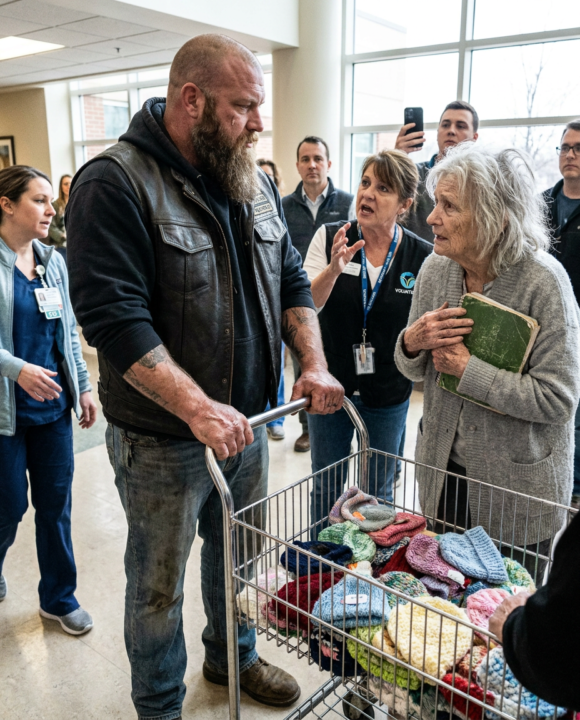
We were used to it.
The neonatal unit had been one of our charities for years because several members had children or grandchildren who had spent time there. We bought fuel cards for parents driving back and forth, motel nights for families who lived outside the county, cafeteria vouchers and sometimes the unglamorous things hospitals needed but nobody wanted to put on a fundraising poster.
That morning, a nurse named Lauren was giving us a tour of a family waiting area when she pointed through a glass partition.
“You guys want to see the person who has probably donated more individual items to this department than anyone alive?”
That was how we saw Margaret.
She sat alone beside the window, afternoon light across her lap, surrounded by baskets.
At first I thought the baskets held doll clothes.
Then I realized every little bundle was a hat.
Some looked impossibly small.
Lauren told us Margaret had been bringing them in almost every week for twenty-two years.
“Four thousand and change,” she said.
“Four thousand?” Dennis repeated.
Margaret heard him.
“Four thousand one hundred and eighty-seven as of this morning,” she corrected without looking up.
That made us laugh.
She did too.
There was nothing dramatic about her. No plaque. No photographer. No donor wall with her name in gold letters. Just an elderly woman with yarn looped around swollen fingers.
I noticed Evan staring at her hands.
He was our youngest member.
At twenty-two, Evan still had the strange mix of toughness and uncertainty young men sometimes carried when they had learned to survive before they had learned what to do with survival. He had joined us after getting a job at Ray Collins’s repair shop. He rode an old black Sportster he maintained better than most people maintained their homes.
His mother had raised him alone.
He almost never talked about his father.
He talked even less about the beginning of his own life.
Lauren introduced us.
Margaret brushed off the attention.
“I sit down,” she said. “I knit. Hospital does the important part.”
“You’ve made all these?” Evan asked.
“All those, and a few more.”
“A few?”
“About four thousand.”
He smiled faintly.
Then Margaret showed us the ledger.
That was when the atmosphere changed.
Every hat had a number.
Every number had a date.
Every date had a color.
She had recorded all of them.
Lauren teased that if the hospital ever lost its computer system, Margaret could probably reconstruct twenty years of neonatal fashion history from memory.
Margaret opened to the first page.
Evan leaned over her shoulder.
I saw him go completely still.
There are different kinds of stillness.
There is relaxed stillness.
There is cautious stillness.
Then there is the kind a man has when something from his past suddenly steps into the room wearing a new face.
Evan reached for the ledger.
Too fast.
Margaret recoiled.
The notebook came out of her hands.
That was the moment everyone else saw.
The big tattooed biker taking property from the tiny old woman.
They did not see his lips forming the date before he even looked at it twice.
They did not know it was his birthday.
And neither did Margaret.
Security arrived.
Phones came out.
One teenager nearby whispered that the biker was probably trying to steal donation records.
Another person said maybe the club wanted credit for Margaret’s work.
Evan heard everything and explained nothing.
That made it worse.
I stepped toward him.
“Son, give her the book.”
He did.
Immediately.
That mattered to me.
Not to the crowd.
To them, the damage had already happened.
Margaret pressed the ledger to her chest.
“You frightened me.”
Evan lowered his eyes.
“I’m sorry.”
It was not enough.
It should not have been.
An apology does not erase fear merely because the person who caused it had a reason.
Margaret was embarrassed. People were filming. A security officer had been called. Her quiet morning had turned into a spectacle.
She had every right to be angry.
Then Evan made the call to his mother.
I listened to him ask for the wooden keepsake box.
I watched Margaret’s expression change when he mentioned a blue hat.
Then Evan asked about red thread.
That was when Margaret dropped her needles.
But she still did not explain.
She simply sat down.
Lauren knelt beside her.
“Margaret?”
The old woman’s eyes remained on Evan.
“Where did you get that photograph?”
“My mom sent it to me a few years ago.”
“Whose hat is that?”
“Mine.”
Margaret shook her head.
“No.”
Evan almost smiled, but there was no humor in it.
“Yes, ma’am.”
She opened her notebook again.
Her fingers struggled with the page.
Finally she turned it toward him.
The first entry read:
Blue.
Number 1.
And beside it was the date Evan Cole was born.
The first person to realize the situation was larger than a coincidence was not Margaret, Evan or me.
It was Lauren.
She had worked at St. Catherine’s for seventeen years, long enough to know how neonatal donations were handled and long enough to understand why records from twenty-two years earlier would be difficult to reconstruct.
She looked at Evan’s phone.
Then at Margaret’s ledger.
Then back at the phone.
“Can I see the picture?”
Evan handed it over.
The photograph showed an old wooden box sitting on a bedspread. Inside were several hospital bracelets, two photographs, a lock of baby hair taped to an index card and a blue knitted cap no larger than Lauren’s palm.
The number 1 had been stitched near the rim.
Not printed.
Not labeled by the hospital.
Stitched.
In red.
Margaret asked for the phone.
Evan hesitated only because her hands were trembling.
He placed it gently into her palms.
She enlarged the image with difficulty.
Then she touched the screen.
“I did that.”
Nobody spoke.
Margaret looked around at the people gathered near us and seemed to remember that strangers had been watching.
She straightened her cardigan.
“Would everyone please stop filming?”
Several phones lowered.
One did not.
The security officer noticed and asked the man to give us space.
Margaret turned back to Evan.
“Your mother kept this?”
“My whole life.”
“Why?”
“She told me it was the first thing anybody ever put on me that belonged to me.”
That sentence landed differently.
Even before we understood everything, it changed the room.
Lauren asked Evan whether he had been born at St. Catherine’s.
“Yes.”
“Premature?”
“Eleven weeks.”
Margaret covered her mouth.
Evan continued more quietly.
“Three pounds, two ounces. My mom says I looked like an angry bird.”
Dennis muttered, “Still do.”
Normally Evan would have laughed.
He did not.
Lauren began searching the hospital archive from a workstation.
Electronic records did not reach far enough back, but some admission data had been digitized from paper.
After several minutes she found a neonatal admission under Evan’s mother’s name.
Date of birth matched.
Unit matched.
He had been here.
Not merely in the same hospital.
In the same neonatal department.
Margaret kept staring at the photograph.
Finally I asked the question everyone was avoiding.
“Why did you start numbering them?”
She closed the phone.
For the first time that morning, she looked old.
Not eighty-three in the ordinary sense.
Older.
Like someone who had carried the same six days for most of her life.
“My granddaughter,” she said.
Her name was Grace.
Twenty-two years earlier, Margaret’s only daughter, Rebecca, had gone into labor far too early.
Grace was born critically premature.
She survived six days.
There were shortages in the unit that week—not of medicine or machines, Margaret was careful to explain, but of properly sized donated caps. Premature babies lose heat easily, and the hospital relied partly on volunteers for knitted clothing small enough to fit them.
A nurse found a cap for Grace eventually.
It was white.
Margaret remembered how enormous it looked on her granddaughter.
She remembered Rebecca sitting beside the incubator with one finger through the opening.
She remembered a machine sounding differently on the sixth night.
She remembered going home without a baby.
Three days after Grace’s funeral, Margaret found leftover blue yarn in a closet.
She could not sleep.
So she knitted.
One tiny hat.
Then another.
She numbered the first one because grief had made time feel shapeless.
“If I gave it a number,” she explained, “then at least something had come after Grace.”
The room was so quiet I could hear an elevator opening down the hall.
Margaret had brought that first blue hat to St. Catherine’s herself.
She did not know which baby received it.
She had never asked.
Privacy rules meant volunteers did not receive names or stories.
The hat disappeared into the neonatal unit.
Margaret went home and made number two.
Then number three.
Twenty-two years passed.
Her daughter eventually moved to another state.
Margaret’s husband died.
Her eyesight worsened.
Arthritis twisted her fingers.
Still she knitted.
Some weeks five hats.
Some weeks one.
Never zero.
Evan listened without interrupting.
Then he asked, “Why red thread?”
Margaret looked at him.
“I ran out of blue.”
That almost made her smile.
Almost.
Evan stared at the floor.
“So there was no reason the number was red?”
“No.”
“No special meaning?”
“None.”
He nodded slowly.
Sometimes the details that connect two lives are not dramatic.
No prophecy.
No grand design anyone can prove.
Just an old woman running out of blue thread.
A young mother keeping a hat.
Twenty-two years passing.
And one photograph surviving.
But there was still a problem.
A photograph was not the hat itself.
And Evan knew exactly where the real one was.
By then, the video of Evan taking the notebook had already escaped the hospital.
Someone had posted a fourteen-second clip online.
It began at the worst possible second: Evan pulling the ledger from Margaret’s hands.
It ended before the phone call.
The caption described him as a biker harassing an elderly hospital volunteer.
The clip spread quickly enough that one of our members got a text about it while he was standing in the same lobby where it had happened.
“Wonderful,” Dennis said. “Internet has solved another case.”
I told everyone not to respond.
Evan did not care about the video anyway.
He was pacing near the window, talking to his mother.
I could hear pieces.
“No, Mom, don’t mail it.”
Pause.
“Yes, I’m serious.”
Another pause.
“Please.”
He hung up.
“My mother lives forty minutes away.”
Margaret looked at him sharply.
“You called her here?”
“She’s bringing the box.”
“You didn’t have to do that.”
“Yes,” he said. “I did.”
Her face tightened.
“You don’t know that it’s mine.”
“No.”
“And if it isn’t?”
“Then I scared you for nothing.”
There it was.
No heroic speech.
No attempt to rewrite his behavior.
Evan walked over and crouched so he was not towering above her.
“I should not have grabbed your book.”
Margaret looked at him.
“I know.”
“I saw my birthday, and I reacted.”
“That explains it.”
She paused.
“It doesn’t make it polite.”
“No, ma’am.”
That was the first moment I saw her anger soften—not disappear, but become more complicated.
People often want these stories to turn cleanly.
Someone is wrong.
Then the truth appears.
Then everyone hugs.
Real life is messier.
Margaret had been frightened.
Evan might have discovered something extraordinary, but discovery did not erase the fear in her body when a large stranger moved too quickly.
He accepted that.
Forty-five minutes later, a woman named Lisa Cole entered the lobby carrying a wooden box against her chest.
She was small, tired-looking and still wearing the navy polo shirt from the grocery store where she worked.
The moment she saw Evan surrounded by bikers, nurses and security, she stopped.
“What did you do?”
A few people laughed.
Evan did too, finally.
“Nothing good at first.”
Lisa walked over.
Margaret stood.
The two women looked at each other with no idea what etiquette existed for a meeting like this.
Lisa opened the box.
Hospital bracelets.
Photographs.
Cards.
And the hat.
It was faded now, more gray-blue than blue, stretched slightly at the bottom and carefully folded.
The red number was unmistakable.
Margaret did not touch it.
Not immediately.
Her hands hovered.
“May I?”
Lisa nodded.
Margaret lifted the cap.
Her fingers recognized it before her face did.
She turned it inside out.
Near one seam was a tiny mistake.
One loop of yarn had been caught incorrectly.
Margaret made a sound I still do not know how to describe.
Not quite a sob.
Not quite a laugh.
“Oh.”
She pressed the hat against her mouth.
“That was me.”
Lisa began crying.
Evan looked away.
Margaret sat down with the first hat she had ever donated resting in her lap.
Twenty-two years earlier she had knitted it because she had just buried a baby.
She had handed it to a nurse and never known whether it mattered.
Now the person who had worn it was kneeling three feet away.
Alive.
Six-foot-three.
Tattooed.
Bearded.
Embarrassed by attention.
Margaret reached out.
Evan thought she wanted the hat.
Instead she took his hand.
She turned his enormous scarred fingers over in hers.
“These?”
“Mechanic.”
“You work with your hands?”
“Yes.”
“So do I.”
Then she smiled.
The crowd that had judged him forty-five minutes earlier went completely silent.
But the deepest truth had not surfaced yet.
Because Evan had never told us why that tiny cap mattered so much to his mother.
That afternoon Lisa told the story Evan usually avoided.
He had not simply been premature.
He had almost not come home.
Lisa was nineteen when he was born.
She worked part time, had no savings and was living in a rented room after separating from Evan’s father. She went into labor unexpectedly and arrived at St. Catherine’s terrified, alone and convinced every alarm in the neonatal unit meant her son was dying.
For weeks she sat beside him.
She learned numbers she never wanted to understand.
Oxygen saturation.
Weight gain.
Respiratory rate.
She learned to celebrate grams.
She learned how to place one finger against a tiny palm without disturbing wires.
And on Evan’s first night, a nurse brought her a blue knitted hat.
Lisa remembered asking where it came from.
The nurse said a volunteer had dropped it off.
That was all.
“There was this little red one on it,” Lisa said. “I figured maybe it was inventory.”
Margaret shook her head.
“No. It was me trying to remember where I had started.”
Lisa wiped her cheek.
“Well, I kept it because I needed to remember where he started too.”
Evan looked at her.
He had heard pieces of this story before.
Not all of it.
Lisa admitted that there had been nights during those first months when she was afraid to believe he would survive.
So she created a box.
Every object inside became evidence.
Evidence that he had existed yesterday.
Therefore maybe he would exist tomorrow.
The bracelet.
A footprint card.
His first photograph without a breathing tube.
The hat.
When Evan was five, she showed him the box.
When he was ten, she told him he had once fit inside his grandfather’s two hands.
When he was sixteen and angry at everything, she showed him the cap again after he punched a hole in a bedroom door.
“You started smaller than that thing,” she had told him. “Try not to spend your whole life proving you’re big.”
Dennis laughed so hard he had to turn away.
Evan covered his face.
“Mom.”
But Margaret was smiling.
Then Lisa said something that changed him.
“There were years when I thought I had failed at almost everything. But I could look at that hat and remember one thing went right. You came home.”
Evan’s eyes filled.
He did not wipe them.
That was the deeper reason he had reacted to the ledger.
The hat was not merely memorabilia.
It was his mother’s proof that the worst part of her life had not won.
And Margaret had made it while living through the worst part of hers.
Two young mothers had existed in the same hospital at the same time.
One was grieving the baby she could not take home.
The other was terrified she would not be able to take hers home either.
They never met.
They never knew each other’s names.
Yet grief had traveled from one woman’s hands into a piece of blue yarn and ended up warming the child of the other.
That would have been enough.
But Margaret’s ledger contained 4,186 more numbers.
And once Lauren understood what number one meant, she asked a dangerous question.
“How many of the others are still out there?”
Margaret blinked.
“What?”
“The hats.”
Lauren picked up the notebook.
“You know the number, date and color of every one.”
“Most families wouldn’t have kept them.”
Lisa held number one against her palm.
“I did.”
I watched Margaret look toward the four baskets at her feet.
For twenty-two years she had imagined those hats disappearing into drawers, donation bins, attic boxes or nothingness.
She had never expected an answer from any of them.
The next morning, with Margaret’s permission, the hospital posted a photograph.
Not the video.
Not Evan grabbing the book.
Just Margaret, her ledger and a simple request:
If your child received a numbered hand-knitted cap from St. Catherine’s neonatal unit during the past twenty-two years, the woman who made it would like to know that child made it home.
The response began before lunch.
The first family sent a photograph of a pink cap marked 611.
Their daughter was fourteen.
Then came number 904.
Twins.
Both alive.
Number 1288.
A boy now playing high-school baseball.
Number 2031.
A girl standing beside her graduation gown.
Number 317.
A nurse working in another state.
Some messages were joyful.
Some were harder.
Not every baby had survived.
One mother wrote that her son had worn Margaret’s yellow hat for only nine days, but she had kept it for nineteen years.
Margaret read that message twice.
Then she closed the laptop and cried.
This was not a story in which knitting defeated mortality.
Margaret knew better than anyone that love did not guarantee a particular ending.
The hats had not saved those babies.
Doctors, nurses, medicine, machines, families and sometimes luck had determined outcomes far beyond a volunteer’s control.
The hats had done something smaller.
They had provided warmth.
They had given terrified parents something handmade to touch.
They had made impossibly clinical rooms feel, for a moment, like places where ordinary tenderness still belonged.
Meanwhile, the fourteen-second video of Evan had continued circulating.
Then St. Catherine’s released a longer statement—with Margaret’s and Evan’s permission—explaining what happened.
Security footage showed the full interaction.
Evan had taken the notebook impulsively.
He had returned it immediately when asked.
He had apologized.
There had been no threat, theft or attempt to intimidate Margaret.
The hospital did not describe him as a hero.
Neither did we.
The facts were more interesting than that.
A young man had made a bad-looking choice during a moment of overwhelming recognition.
An elderly woman had been frightened and angry.
Then both of them had stayed in the room long enough to discover something larger than the mistake.
The comments beneath the original viral clip began changing.
People apologized.
Some deleted accusations.
One woman who had filmed the incident returned to the hospital three days later and personally apologized to Margaret and Evan.
Evan accepted it.
Margaret asked the woman if she knitted.
She did not.
“Then learn,” Margaret said.
That became a joke around the unit.
But the responses to the hospital’s hat request kept growing.
Lauren created a spreadsheet.
Evan built a simple wooden display case for Margaret’s ledger.
Our club volunteered to help contact families who had given permission to participate in a reunion.
Three months later, St. Catherine’s rented a community hall.
We expected maybe fifty people.
Three hundred and forty came.
They arrived carrying hats.
Pink hats.
Blue hats.
Yellow hats.
Striped hats.
Tiny hats that had once fit over heads small enough to rest in a palm.
Some were framed.
Some were in plastic bags.
Some were inside baby books.
One father carried his daughter’s cap in a jewelry box because, he said, nothing else in his house was precious enough to store it.
The oldest former neonatal babies were now young adults.
Others were teenagers.
Children.
Toddlers.
There were parents who came without children because the children had grown up and moved away.
There were families representing babies who had not survived.
We gave them space too.
Nobody pretended every hat meant the same thing.
That was important.
Margaret entered through a side door.
She stopped when she saw the room.
Three hundred and forty people stood.
She began crying before anyone applauded.
Evan walked beside her carrying the green ledger.
He no longer looked intimidating to anyone in that hall.
He still looked exactly the same—shaved head, beard, tattoos, leather vest, scarred hands.
Only the story around those details had changed.
That taught me something I should probably have learned years earlier.
Sometimes appearances do not deceive us.
Sometimes they simply fail to explain enough.
Margaret sat in the middle of the room.
Families came one at a time.
“Number 72.”
“Number 444.”
“Number 1803.”
“Number 3001.”
She opened the ledger for each one.
Date.
Color.
Number.
Proof that on an ordinary night twenty years earlier, she had sat under a lamp and made something for a person whose name she would never know.
Then Evan stepped forward.
He was carrying number one.
The room grew quiet.
He knelt beside her.
Margaret touched the red thread.
“I always wondered where you went,” she whispered.
Evan smiled.
“Mostly to a motorcycle shop.”
She laughed so hard she had to wipe her glasses.
Then he said, “My mom wants you to keep it.”
Margaret immediately shook her head.
“No.”
“It was yours first.”
“No.”
She folded his fingers around the tiny blue cap.
“I made it to leave my house.”
He looked confused.
Margaret pointed toward him.
“It found where it was supposed to go.”
Over the next two years, Margaret knitted more slowly.
Arthritis worsened.
Sometimes she could complete only half a cap in a week.
She complained about her hands but refused to call herself retired.
Evan began visiting on Sundays.
At first he claimed it was because her kitchen chair needed fixing.
Then a cabinet hinge.
Then a window latch.
After we ran out of broken things in her house, he stopped inventing reasons.
He simply showed up.
Margaret taught him to knit.
He was terrible.
His first hat looked like a collapsed bucket.
She numbered it anyway.
“Absolutely not,” he said.
“Every hat gets a number.”
“No baby deserves this.”
“Then improve.”
So he did.
Eventually.
The Iron Lantern clubhouse gained something none of us expected: a basket of yarn in the corner.
A few men learned.
Most did not.
Dennis produced one object that might have been a hat or a tea cozy and was politely asked to return to transmission repair.
But every winter, our club delivered Margaret’s hats along with our donation.
Two years after the reunion, Margaret died peacefully at eighty-five.
Her daughter Rebecca called Evan first.
The funeral was held on a cold Saturday morning.
I had expected a modest crowd.
Instead, cars lined both sides of the road.
Families came from three states.
Nurses came in scrubs after night shifts.
Young adults arrived carrying old keepsake boxes.
Children held their parents’ hands.
At the front of the funeral home stood Margaret’s closed casket.
Around it were 340 knitted hats.
Not on babies.
Not in baskets.
Laid carefully in a circle of color.
Each represented one family from the reunion.
Some people thought the display would be unbearably sad.
It was.
But it was something else too.
It looked like evidence.
Evidence that grief had not been the final thing Margaret made.
Rebecca placed her daughter Grace’s photograph beside the casket.
The baby in the picture was six days old.
Margaret had spent twenty-two years answering those six days.
Not erasing them.
Not replacing Grace.
Answering them.
One hat at a time.
Evan stood near the back until Rebecca found him.
“You belong up front.”
He shook his head.
“I’m fine here.”
She took his arm.
“No.”
She led him to the casket.
On top was Margaret’s green ledger.
The final entry was unfinished.
Hat 4216.
Blue.
There was no completion date.
Her hands had stopped before the hat was done.
Rebecca gave Evan a paper bag.
Inside were knitting needles, blue yarn and the unfinished cap.
“She wanted you to finish it.”
Evan stared at the yarn.
“I’m not good enough.”
Rebecca smiled through tears.
“She knew.”
A few of us laughed.
So did he.
Then Rebecca handed him an envelope.
Inside was a note written in Margaret’s shaky handwriting.
Evan read it silently first.
Then again.
Later he told us what it said.
She had written that for years she believed the first hat disappeared into a place she could never follow.
She thought that was the bargain of giving something away.
You make it.
You release it.
You accept that you may never know whether it mattered.
Then, twenty-two years later, a frightened young biker had grabbed her notebook and accidentally returned an answer.
She told Evan never to confuse not seeing an outcome with having no impact.
Then came the last line:
“Number one was never mine to get back. It was mine to send forward.”
Evan sat down.
For a long time, he held the letter in one hand and the unfinished hat in the other.
Lisa came beside him.
She had brought the wooden keepsake box.
Inside was number one.
She took it out and placed it in Evan’s hands.
The cap looked impossibly tiny against his scarred palms.
A blue piece of yarn made by a grieving grandmother.
Worn by a premature baby.
Saved by a terrified nineteen-year-old mother.
Kept for twenty-two years.
Recognized because of one red number.
That afternoon, after most people had gone, Evan placed the hat against his chest.
I asked him if he was all right.
He nodded.
Then he said something I have never forgotten.
“My whole life, Mom told me this hat meant I survived.”
He looked toward Margaret’s casket.
“Now I know it also meant somebody survived losing someone.”
Months later, St. Catherine’s placed Margaret’s ledger in a glass case near the neonatal family room.
Not as a monument to miracles.
Hospitals know better than to promise miracles.
The small plaque beneath it explained only what Margaret actually did:
For twenty-two years, Margaret Ellis knitted more than four thousand caps for premature infants.
Beside the case was a photograph from the reunion.
Margaret sat in the center.
Around her were hundreds of people whose earliest days had included something made by her hands.
Evan stood behind her.
He was impossible to miss.
Tall.
Tattooed.
Bearded.
Wearing black leather.
One hand rested gently on the back of Margaret’s chair.
In the other was a tiny blue hat.
Number one.
There is one more detail.
Evan eventually finished Margaret’s last hat.
It took him eleven attempts to get the shape right.
He brought it to the neonatal unit himself.
Lauren checked the ledger and wrote the final date beside number 4216.
Evan insisted on one addition.
Under Margaret’s name, in smaller writing, he added:
Finished by a former baby who wore number 1.
Then he handed the blue cap to Lauren.
He did not ask who would receive it.
He finally understood why Margaret never had.
Some gifts are not made so we can watch what happens next.
They are made because once, somewhere, somebody needed warmth.
And someone else chose to keep their hands moving.
Follow this page for more unforgettable biker stories about misunderstood people, hidden acts of kindness, and the quiet moments that can connect two lives decades apart.