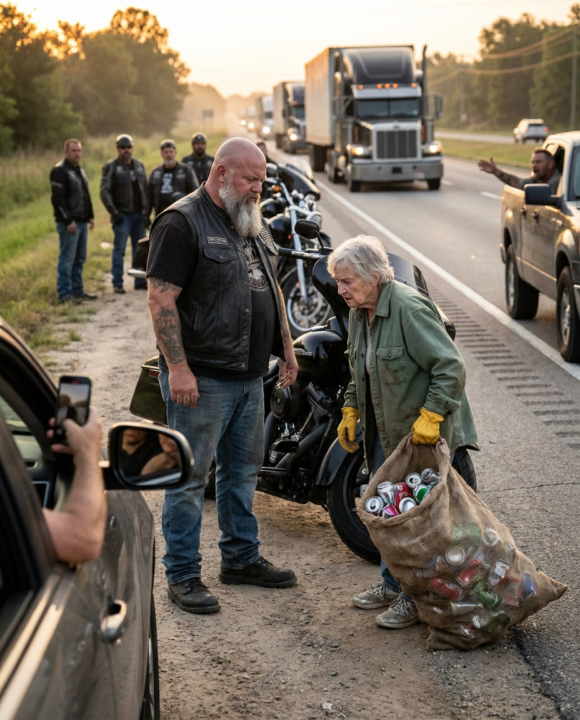
A Tattooed Biker Ripped a 77-Year-Old Woman’s Sack of Cans Away Beside a Highway — Then Everyone Learned What She Had Been Buying One Nickel at a Time for Nine Years
Bellamy Music sat between a laundromat and a closed insurance office in a strip mall that looked as though the county had forgotten it sometime around 1998. Its faded red sign had two dead letters, and the front window held a trumpet, three guitars, a drum kit and a black digital piano with a white card hanging from the music stand.
Eleanor climbed out of Bear’s truck before anyone could help her.
She carried a coffee tin in both hands.
I carried the sack of cans.
She didn’t ask me to.
She also didn’t tell me to put it down.
Inside, the store smelled like old carpet, wood polish and the metallic dust of guitar strings. A bell jingled over the door.
A man behind the counter looked up.
He was in his early sixties, slim, Black, wearing wire-frame glasses and a brown cardigan over a button-down shirt. The instant he saw Eleanor, his expression softened.
“Morning, Miss Hayes.”
“Morning, Raymond.”
Then he saw six bikers behind her.
His expression changed.
“You all right?”
“She’s fine,” I said.
Eleanor looked back at me.
“I can answer for myself.”
Bear coughed into his fist to hide a smile.
“Yes, Raymond,” she said. “I’m fine. They have confused interference with charity.”
Raymond stared at us.
“That sounds about right.”
Eleanor set the coffee tin on the counter.
Then she opened it.
Inside were folded dollar bills, quarters, dimes, nickels and a handful of pennies.
Raymond took a ledger from beneath the register.
It wasn’t a computer printout.
It was an actual book.
Blue cloth cover.
Corners worn white.
He opened it near the middle.
Lines of handwriting filled page after page.
E. Hayes.
$8.40.
$11.75.
$6.15.
$14.20.
Date after date.
Year after year.
I stared at the entries.
“What is this?”
Eleanor stiffened.
Raymond looked at her before answering.
She gave the smallest nod.
“A payment plan.”
“For what?”
He pointed toward the black digital piano in the window.
At first I thought I had misunderstood.
“That piano?”
“Yes.”
“How long?”
Neither of them answered immediately.
I looked at the ledger again.
The first date was nearly nine years old.
Bear stepped closer.
“You’ve been paying on one piano for nine years?”
Eleanor quietly arranged her coins into stacks.
“Things cost what they cost.”
I looked at the price tag.
The original price was written beneath a strip of correction tape.
Even discounted, the piano had once cost more than she could possibly afford.
“How much is left?”
Eleanor stopped counting.
“That is none of your business.”
Raymond closed the ledger halfway.
“Three months, more or less.”
My stomach tightened.
Three months.
After nine years.
I pulled out my wallet again.
Eleanor slapped the counter with one yellow-gloved hand.
“No.”
“Ma’am—”
“No.”
“You’ve walked beside eighteen-wheelers for nine years.”
“Yes.”
“You nearly stepped into traffic this morning.”
“I did not.”
“You did.”
Her eyes sharpened.
“I have buried a husband, worked thirty-eight years cleaning motel rooms, raised two daughters, survived cancer, arthritis and three landlords who thought repainting mold counted as repair. Do not explain to me what I did with my own feet.”
The whole store went quiet.
I put the wallet away.
She returned to her coins.
That should have been the end of it.
But then a small sound came from a back room.
Tap.
Tap-tap.
Pause.
Tap-tap-tap.
It sounded almost like someone practicing scales on a table.
Eleanor immediately looked toward the hallway.
Raymond did too.
A moment later, a child appeared.
A girl.
Eleven years old.
Tiny for her age.
Long brown hair pulled into two braids.
Dark glasses.
A white cane held lightly in one hand.
She paused at the doorway.
“Grandma?”
Eleanor’s whole face changed.
The hard lines disappeared.
“I’m here, Lucy.”
The girl smiled toward the sound of her voice.
“Did you get enough today?”
Every biker in that store stopped breathing.
Eleanor crossed to her.
“Almost.”
Lucy reached out.
Eleanor guided the child’s fingers into her palm.
The girl tapped four notes against her grandmother’s skin.
Not random.
A melody.
Raymond looked at me.
“She was born blind,” he said quietly.
Eleanor’s head snapped around.
“Raymond.”
But the truth had already started opening.
He continued gently.
“She’s never owned a piano.”
I looked at the instrument in the window.
Then at the child tapping music into an old woman’s palm.
And for the first time, I understood that the cans on Highway 18 were not trash.
They were keys.
One nickel at a time.
Lucy had been born with bilateral anophthalmia, Raymond explained later—not while she was standing there, and not as though her life could be reduced to a diagnosis, but because I asked why she wore dark glasses even indoors. Eleanor corrected him immediately.
“She is blind,” she said. “She is not fragile.”
Lucy smiled.
“I’m fragile when Grandma makes meatloaf.”
That got the first real laugh out of the room.
The tension eased.
Not much.
Enough.
Lucy walked toward an old wooden table in the lesson area at the rear of the store. She sat down, spread her fingers and began tapping.
Left hand.
Right hand.
Rhythm.
Chords.
Imaginary keys.
I watched for nearly a minute before realizing she was playing something I recognized.
Clair de Lune.
Not perfectly.
Not completely.
But unmistakably.
On a tabletop.
“How?” Bear whispered.
Raymond leaned against a shelf.
“Memory.”
Eleanor placed her coins into his hand.
“She hears recordings.”
Raymond nodded.
“I teach her here when the schedule allows. We use whatever isn’t being rented or serviced. But she practices at home on the kitchen table.”
“For nine years?” I asked.
Eleanor’s jaw tightened.
“She started tapping rhythms when she was two.”
The number hit me.
Nine years collecting cans.
Nine years of a child practicing on furniture.
I walked toward the digital piano in the window.
It was not extravagant.
Weighted keys.
Pedals.
Built-in speakers.
A headphone jack.
A serious instrument, but not some concert grand.
“Why this one?”
Lucy answered from the table.
“Because the keys feel real.”
Eleanor closed her eyes.
The child continued.
“Mr. Bellamy let me touch it once when I was little.”
Raymond’s face changed.
“She remembers everything.”
Lucy grinned.
“Not everything. Grandma says I forget socks.”
I looked at Raymond.
“You’ve kept one piano here nine years?”
He didn’t answer.
That silence became the next clue.
A woman entered carrying a clarinet case. Raymond helped her while Eleanor prepared to leave. I noticed the piano’s display tag had a strange series of tiny pencil marks along the bottom.
Three circles.
Each crossed out.
I waited until Eleanor was helping Lucy into her coat.
“What are those?”
Raymond followed my eyes.
He sighed.
“Three times someone tried to buy it.”
My jaw tightened.
“You refused?”
“Eventually.”
“What does that mean?”
“The first time, five years ago, I accepted a deposit.”
I looked at Eleanor.
She couldn’t hear us from across the room.
Raymond lowered his voice.
“She came in that afternoon with eleven dollars and thirty cents. I told her the piano had sold.”
“What happened?”
“She thanked me for keeping it as long as I had.”
That sounded exactly like Eleanor.
No scene.
No begging.
Just dignity swallowing disappointment.
“Then?”
“I called the buyer and offered him a newer model at the same price.”
“The second time?”
“Similar.”
“The third?”
Raymond stared through the front window.
“I told my staff that piano was no longer inventory.”
I looked around the nearly empty shop.
“You can afford to do that?”
He smiled without humor.
“No.”
That answer stopped me.
Independent music stores were disappearing everywhere. I noticed patched carpet, old fixtures, handwritten repair tickets clipped behind the register.
“You kept a piano you needed to sell for nine years?”
“Yes.”
“Why?”
Raymond removed his glasses and cleaned them slowly.
“My mother’s name was Dorothy Bellamy.”
I waited.
“She came here from Mississippi when she was nineteen with fourteen dollars, two dresses and enough sewing skill to keep herself from starving if she could get a machine.”
He looked toward Eleanor.
“In 1983, Miss Hayes was cleaning rooms at the Maple Crest Motel. She had two children, an unreliable car and less money than my mother did.”
I knew where the story was heading, but I didn’t interrupt.
“My mother found a used Singer machine for sale. She was short fifty-eight dollars.”
In 1983, fifty-eight dollars meant something.
“What did Eleanor do?”
“She loaned it to her.”
“When did your mother repay her?”
Raymond smiled.
“She tried.”
I frowned.
“Tried?”
“Miss Hayes kept saying there was no hurry. Then there was always another rent bill, another school expense. Eventually my mother built a small alteration business. That sewing machine paid for food, then school clothes, then my college tuition.”
He glanced toward the old woman.
“When my mother finally had enough money to repay the loan properly, Eleanor refused it.”
“Why?”
“She said, ‘Your children ate. That was the repayment.’”
My throat tightened.
“Does Eleanor know you’re keeping this piano because of that?”
“No.”
“Does she remember your mother?”
Raymond looked at her.
“I’ve mentioned Dorothy twice.”
“And?”
“She said she was sorry but couldn’t place the name.”
Eleanor had given away fifty-eight dollars forty-three years earlier and forgotten it.
Raymond had built half his life on what that fifty-eight dollars allowed his mother to become.
The piano had not been waiting nine years because a store owner was sentimental.
It had been waiting because kindness had arrived decades before the child who needed it was even born.
Then Lucy called from across the store.
“Mr. Rook?”
I turned.
Nobody outside my riding group had called me that yet.
“How did you know my name?”
She smiled.
“Your friends keep saying it.”
Fair enough.
She tilted her head.
“Are you the angry one?”
Bear laughed out loud.
“Usually.”
I looked at her small hands.
“Sometimes.”
Lucy held her palms over the wooden tabletop.
“Grandma says angry people are usually scared about something.”
That sentence went through me like a nail.
Because Eleanor’s blue ribbon had already opened a door in my memory I had spent twenty-seven years trying to keep shut.
And I suddenly knew I was not going to leave Bellamy Music unchanged.
The story might have ended that morning with six bikers feeling humbled and an old woman returning home with eleven dollars and some change added to a ledger.
Instead, I did something Eleanor hated.
I followed her.
Not secretly.
She knew.
She complained the entire way.
Bear drove Lucy and Eleanor in his pickup while the rest of us rode behind them to a small rental house ten miles outside town. The porch sagged. Wind chimes hung from fishing line. Two tomato plants were dying heroically in plastic buckets.
Inside, the house was spotless.
Old furniture.
Clean curtains.
Family photographs everywhere.
And against one wall sat the saddest piano I had ever seen.
It was cardboard.
Lucy had drawn keys across the top with raised strips of glue so she could feel where the notes should be.
I stood there staring.
Lucy dropped her backpack and sat on the bench, which was actually an old storage chest.
Then she began to practice.
Her fingers moved across paper and hardened glue.
No sound except tapping.
Eleanor went into the kitchen.
I followed.
“You let her do that every day?”
“She enjoys it.”
“That isn’t a piano.”
“She knows.”
I regretted the words the instant I said them.
Eleanor turned.
“You think I don’t know?”
Her voice remained low.
That made it worse.
“You think I enjoy listening to a child make music nobody can hear? You think I do not know what she is missing?”
“I didn’t mean—”
“You saw one morning of my life and decided it required your management.”
She removed her gloves.
Her fingers were swollen with arthritis.
Two nails were cracked.
A scar crossed her left palm.
“I get up at four-thirty,” she said. “I walk because the cans are there before county cleanup comes. I sort them. I redeem them twice a week. I pay electricity. I buy groceries. What remains goes to Raymond.”
“Where are Lucy’s parents?”
Her expression changed.
“My daughter is dead.”
I lowered my eyes.
“I’m sorry.”
“Six years.”
“And her father?”
“Gone before Lucy learned to say his name.”
That explained something, but not everything.
“You’re raising her alone?”
“Mostly.”
“How much do you live on?”
“That is another question that is none of your business.”
I leaned against the counter.
“Okay.”
That answer surprised her.
I wasn’t there to win.
Not anymore.
“You were right at the store,” I said. “I embarrassed you.”
She folded her gloves.
“Yes.”
“I thought money solved the problem.”
“It usually solves the giver’s problem first.”
That one hurt.
She looked toward the living room where Lucy kept tapping silent chords.
“You wanted to feel useful.”
“Yes.”
“Then listen before you fix.”
So I did.
Eleanor told me the piano was not simply a gift.
Lucy had been accepted into a summer program for visually impaired young musicians. She had talent, but her instructor said the next stage required regular access to weighted keys.
No piano meant no serious preparation.
No preparation meant the opportunity might disappear.
“Why didn’t you tell people?”
Eleanor stared at me like the question itself was absurd.
“Tell who?”
“The church. Community groups. A fundraiser.”
“I asked once.”
“What happened?”
“A man took photographs of Lucy. Put them online. Used words like ‘tragic blind child.’ Raised money.”
I felt cold.
“How much reached you?”
“Forty dollars.”
“Where did the rest go?”
“He said administrative expenses.”
My fists closed.
Eleanor noticed.
“Do not go looking for him.”
“I wasn’t.”
“You were thinking about it loudly.”
I slowly opened my hands.
“What did the police say?”
“Not enough documentation. The page eventually disappeared.”
There it was.
The deeper wound.
Eleanor was not refusing help because she was stubborn.
She was protecting Lucy’s dignity.
She would rather collect cans beside a highway than turn her granddaughter into an advertisement for pity again.
I finally understood the difference.
That afternoon, I returned to Bellamy Music alone.
Raymond saw me enter and immediately said, “She told you no.”
“She did.”
“And?”
“I’m trying to listen before I fix.”
He smiled.
“That must hurt.”
“A lot.”
I pointed toward the ledger.
“I want to pay the balance.”
He shook his head.
“She’ll know.”
“Not secretly.”
“Then how?”
I stared at the piano.
“I don’t know yet.”
Raymond studied me.
“Why does this matter so much to you?”
I reached into the inner pocket of my vest and removed something I had carried for nearly three decades.
A narrow piece of blue ribbon.
Faded.
Frayed.
Almost the same color as the ribbon tied around Eleanor’s sack.
Raymond looked at it.
“What is that?”
“My daughter’s.”
And that was the moment the old woman’s story stopped being only hers.
Her name was Sarah.
She would have been twenty-nine that year.
I almost never said that sentence aloud because the age kept moving even though she never did.
Sarah was born when I was twenty-seven. I was a diesel mechanic, newly married, broke enough that my wife and I once paid for groceries with coins collected from the floorboards of my truck.
Sarah had dark hair and a laugh that started in her stomach.
She also had a congenital heart defect.
By her second birthday, hospitals were more familiar to her than playgrounds.
The blue ribbon came from a small stuffed rabbit a nurse gave her before surgery.
Sarah loved music.
Not in some miraculous movie-child way.
She just liked sound.
She would slap kitchen cabinets with wooden spoons. Bang pots. Hum while machines beeped around her.
At the hospital, there was an old upright piano in a family lounge downstairs.
One afternoon, while we waited for lab results, Sarah climbed onto the bench and pressed one key.
Middle C.
She laughed.
Then another.
Then another.
For ten minutes, she forgot tubes, doctors and adults whispering behind doors.
She was just a child making noise.
Three weeks later, she died.
After the funeral, I stopped going near pianos.
I stopped going near children’s hospitals when I could avoid them.
I stopped believing that noticing small moments mattered when life could take everything anyway.
My marriage lasted another eighteen months.
My anger lasted much longer.
Motorcycles came later.
So did sobriety.
So did enough humility to understand that grief had not made me deep; for several years it had simply made me cruel.
Eventually, I started fixing motorcycles for veterans who couldn’t afford shop prices. Then Bear dragged me into food-bank volunteering. Then our Thursday rides became routine.
I had never told the whole crew about Sarah.
Bear knew I had lost a child.
He didn’t know about the piano.
When I showed him the ribbon that evening, he sat on a stool in my garage without speaking.
Finally he asked, “You want to buy Lucy that piano because of Sarah?”
“No.”
He looked surprised.
“I did this morning.”
“What changed?”
“Eleanor.”
I told him what she said.
Listen before you fix.
“I don’t want to turn Lucy into a replacement for my daughter. And I don’t want to turn Eleanor into a charity project.”
Bear nodded slowly.
“So what do we do?”
“We ask.”
The next morning, all six of us returned to Eleanor’s house.
She opened the door, saw us and immediately looked exhausted.
“No.”
“I haven’t asked anything yet.”
“No preemptively.”
Lucy laughed from the kitchen.
We sat at the table.
I put my ribbon down.
Then I told them about Sarah.
Not dramatically.
Not every detail.
Just enough.
Eleanor touched the faded ribbon with one arthritic finger.
When I finished, she did not say she was sorry.
I appreciated that.
She said, “How old?”
“Two.”
She closed her eyes.
Then opened them.
“What do you want from me, Dean?”
It was the first time she used my real name.
“Permission.”
“For what?”
“To finish the piano payments.”
“No.”
I expected that.
“So I have another idea.”
She crossed her arms.
“You’re going to say it regardless.”
“Yes.”
“What?”
“Let us buy your cans.”
Her eyes narrowed.
Bear leaned forward.
“Not charity. A contract.”
I took out a notebook.
“Our riding club does cleanup runs twice a month. Events too. Rally grounds. VFW halls. County fairs. We throw away or recycle a ridiculous amount of aluminum.”
Eleanor listened despite herself.
“We sell it to you,” I said. “At market rate.”
She blinked.
“What?”
“You collect it from us. Or we deliver it. You redeem it. Your money. Your work.”
“That sounds suspiciously like charity wearing work boots.”
“Probably.”
Bear grinned.
“But the boots are nice.”
She almost smiled.
Almost.
Lucy reached across the table until she found her grandmother’s hand.
“Grandma.”
“What?”
“Three months.”
Silence.
Eleanor rubbed her thumb across Lucy’s knuckles.
Then she looked at me.
“Market rate.”
“Market rate.”
“No photographs.”
“None.”
“No internet fundraiser.”
“Absolutely not.”
“No story about tragic children.”
“Never.”
“And I continue paying Raymond myself.”
“Yes.”
She thought for nearly a minute.
Then extended her hand.
I took it.
Her grip was stronger than mine expected.
That was our agreement.
It lasted exactly four days.
Because four days later, Raymond Bellamy called me and said someone had walked into his store with cash and asked to buy Lucy’s piano.
I reached Bellamy Music in twelve minutes.
I did not ride recklessly.
Bear later disputed this.
The buyer was a middle-aged man from another county who had seen the digital piano online months earlier. One of Raymond’s employees, unaware of the arrangement, had mentioned that the model might eventually become available.
The man offered full retail price.
Cash.
Raymond refused.
The man offered more.
Raymond refused again.
By the time I arrived, the buyer was gone.
Raymond stood behind the counter looking sick.
“I can’t keep doing this,” he said.
At first I thought he meant financially.
Then he opened the ledger.
Tucked inside were overdue notices.
Rent.
Utilities.
Vendor accounts.
Bellamy Music itself was in trouble.
“How bad?”
He sat down.
“Bad enough.”
“You’ve been protecting the piano while your own store is sinking?”
He laughed softly.
“People are complicated.”
I looked at the black instrument.
“Sell it.”
His head snapped up.
“What?”
“Sell it to me.”
“Eleanor said—”
“Not for Lucy.”
Now he really looked confused.
I explained.
Two days later, we held our scheduled county cleanup ride.
No fundraiser.
No social-media plea.
No photographs of Lucy.
Instead, our club bought the piano from Bellamy Music at full price and donated it to the community arts nonprofit that ran Lucy’s summer program.
Then the nonprofit placed the instrument in Eleanor’s home under a long-term student loan agreement.
Technically, Eleanor had not accepted a gift.
Technically, Lucy had access to a weighted digital piano for educational use.
Technically, Raymond received the money his store desperately needed.
I thought the solution was brilliant.
Eleanor thought it was manipulative nonsense.
“You people spent two days inventing paperwork to avoid hearing me say no.”
“Yes.”
She stared at me.
I waited.
Then she laughed.
It was the first time I heard her really laugh.
Not polite.
Not restrained.
A deep, surprised laugh that made her hold her side.
“You are the most irritating man I have met since my husband died.”
“Was he irritating?”
“Professionally.”
The piano arrived on a Saturday.
We used a borrowed box truck.
Raymond came.
So did Lucy’s music teacher.
Two neighbors stood on their lawns watching six bikers carefully carry a digital piano up a sagging porch.
No cameras.
No reporters.
No posts.
Just work.
Lucy waited in the living room.
When we finished setting the stand, she walked toward it with her cane.
Then stopped.
Her breathing changed.
Nobody spoke.
Eleanor took her hand.
“It’s here.”
Lucy reached forward.
Her fingertips touched the edge.
Then one key.
Middle C.
The note filled the room.
I had known what sound would come out.
I had heard that exact pitch thousands of times.
Still, my knees almost gave out.
Lucy touched the key again.
C.
Then D.
E.
She found a chord.
Her face folded.
She began to cry without making a sound.
Eleanor covered her mouth.
I turned away.
Bear put one hand on my shoulder.
I hated him for knowing why.
Lucy played for nearly twenty minutes.
Nothing concert-worthy.
Scales.
Fragments.
Melodies she had practiced silently for years.
But the strange thing was how quickly her hands changed.
On the cardboard keyboard, she had always struck downward cautiously.
On real keys, she began to understand weight.
Resistance.
Velocity.
Sound.
For the first time, she could hear the consequences of her own touch.
When she stopped, she turned her head toward me.
“Mr. Rook?”
“Yeah?”
“Was your daughter good at piano?”
I swallowed.
“No.”
Lucy smiled.
“Me neither yet.”
I laughed.
Then cried anyway.
But the story did not end there.
A week later, a highway patrol officer stopped at Eleanor’s house.
My first thought was that someone had reported us.
Instead, Officer Daniel Reeves held up a printed photograph.
It had been taken by a roadside traffic camera.
Eleanor was visible near the shoulder.
So was my motorcycle blocking her path.
And in the background, a tractor-trailer occupied nearly the entire lane beside her.
Reeves had reviewed the footage after the woman who filmed our confrontation posted a shortened video accusing me of harassing Eleanor.
The original clip had spread locally.
People had called me a bully.
A criminal.
A coward.
The full highway footage showed something the phone video did not.
Seconds before I grabbed Eleanor, a loose metal strap had fallen from the trailer and skidded across the exact section of shoulder she was stepping toward.
If she had moved two steps farther—
Reeves didn’t finish the sentence.
He didn’t need to.
Eleanor watched the footage once.
Then again.
She looked at me.
“You saw it?”
“No.”
Her brow furrowed.
“I saw the truck drifting close. I saw you moving toward the road. I didn’t see the strap.”
“So you didn’t know.”
“No.”
I could have pretended otherwise.
I didn’t.
She nodded slowly.
“You were still rude.”
“Yes.”
“You still embarrassed me.”
“Yes.”
“You still saved me from something you didn’t even know was there.”
“Maybe.”
She reached over and patted my tattooed forearm.
“Do not become smug.”
“I’ll fight it.”
The woman who filmed the original clip later posted the full footage herself.
She apologized.
That mattered.
Not because strangers suddenly decided I was a hero.
I wasn’t.
I had made mistakes that morning.
I had ignored Eleanor’s pride.
I had grabbed before explaining.
Good intentions do not erase fear.
The better thing was that people saw the whole moment instead of twelve misleading seconds.
For once, the truth got enough time to breathe.
Three years later, I sat in a concert hall wearing the only suit I owned.
It still smelled faintly like cedar because it had spent most of its life in a garment bag.
Bear sat beside me.
His tie was crooked.
Eleanor sat on my other side.
At eighty now, she walked with a cane and complained about it constantly.
“You breathe loudly,” she whispered to me.
“We haven’t started yet.”
“That does not improve the breathing.”
Onstage, seventeen-year-old musicians were taking their places for the state conservatory scholarship auditions.
Lucy was fourteen.
She was the youngest finalist.
She walked onto the stage with her cane folded in one hand and a student assistant beside her.
The black grand piano waited under the lights.
Three years earlier, she had practiced Beethoven on cardboard.
Now she sat before a Steinway.
I looked at Eleanor.
She was clutching something in her lap.
The old blue ledger.
Raymond had brought it.
Bellamy Music survived.
Barely at first.
Then better.
Word spread—not because he advertised Lucy’s story, but because musicians in town began deliberately shopping there after hearing how he treated customers. A local high school moved its instrument repair contract to him. Two teachers started giving lessons from rooms in the back.
He never became rich.
He did become busy.
The digital piano technically belonged to the nonprofit until Lucy aged out of the program.
When that day came, the board voted to transfer ownership to her for one dollar.
Eleanor insisted on providing the dollar.
Of course she did.
Lucy placed her hands on the concert piano.
The hall became silent.
Then she played.
I will not pretend I understand classical music.
I know engines.
I know compression ratios.
I know whether a transmission bearing is failing by the sound it makes under load.
But I knew what happened in that room.
She made people stop breathing.
Her hands moved with confidence that had been built in silence long before anyone could hear it.
The piece ended.
For half a second, nobody reacted.
Then the hall erupted.
Eleanor did not stand.
She couldn’t anymore.
She simply held the ledger against her chest and cried.
Lucy received a full scholarship.
Not because she was blind.
Not because anyone felt sorry for her.
Because she had earned it.
That distinction mattered enormously to Eleanor.
After the ceremony, Raymond found us in the lobby.
He held the ledger.
“I need you to sign something.”
Eleanor frowned.
“No.”
“You don’t know what.”
“Experience suggests no.”
He opened the book to the first page.
Below the original payment entry from nine years earlier, Raymond had written a note.
He read it aloud.
“Account closed. Debt paid in full through labor, patience, music, and forty-three years of interest no bank could calculate.”
Eleanor stared at him.
“What forty-three years?”
Raymond finally told her.
About Dorothy.
The sewing machine.
The fifty-eight dollars.
The alterations business.
The groceries it bought.
The tuition it helped pay.
The life it changed.
Eleanor listened with increasing confusion.
When he finished, she shook her head.
“I don’t remember that.”
“I know.”
“I gave your mother fifty-eight dollars?”
“Yes.”
“Why?”
“She needed a sewing machine.”
“That sounds reasonable.”
Bear made a strange choking noise.
Raymond laughed through tears.
“Miss Hayes, my mother spent the rest of her life telling that story.”
Eleanor looked embarrassed.
“I’m sure she improved it.”
“She did not.”
He closed the ledger.
“This piano stayed in my store because forty years before Lucy needed help, you helped my mother when nobody was watching.”
Eleanor stared down at the blue cover.
Then said the most Eleanor thing possible.
“Well, keeping it nine years was poor inventory management.”
Everybody laughed.
Everybody except Raymond.
He reached into a bag.
“I had it framed.”
Inside was a shadow box containing photocopies of several ledger pages, one of Eleanor’s old yellow gloves and a crushed aluminum can.
She shook her head.
“You put garbage in a frame.”
“It’s history.”
“It is a soda can.”
“It can be both.”
The original ledger went back to Bellamy Music.
Raymond mounted it behind the counter.
Below it, on a small brass plate, he wrote only:
Eleanor Hayes — Paid in Full.
No mention of blindness.
No mention of bikers.
No tragedy.
No charity.
Just her name.
Years later, people would ask why that old ledger mattered.
Raymond always told them some version of the truth.
That a seventy-seven-year-old woman had walked the shoulder of Highway 18 for nine years collecting cans while trucks passed at sixty miles an hour.
That she did it because her granddaughter could hear music in her head but had only a tabletop beneath her fingers.
That the woman refused pity because she had learned what pity could cost.
That a music-store owner protected a piano because the same woman had once helped his mother buy a sewing machine and forgotten the kindness entirely.
And sometimes Raymond mentioned us.
The bikers.
The frightening men in leather who looked terrible in a twelve-second phone video.
But I always corrected him when he called us heroes.
Eleanor did the hard part.
Raymond did the patient part.
Lucy did the impossible-looking part.
We just arrived late and carried something heavy.
I still ride Highway 18.
The shoulder looks different now.
The county widened it two years ago and added rumble strips.
Sometimes I pass the place where I first saw Eleanor reaching for a crushed can.
I remember the anger I felt.
I thought I was angry because she was in danger.
Maybe I was.
But I also think I was angry because the blue ribbon tied to her sack reminded me of Sarah before I was ready to admit it.
Grief can disguise itself as urgency.
Love can disguise itself as anger.
Help can disguise itself as control if you forget to listen.
Eleanor taught me that.
Lucy taught me something else.
A few months after receiving her scholarship, she invited me to Bellamy Music after closing.
The digital piano was still in Eleanor’s house, but Raymond had restored an old upright for the lesson room.
Lucy sat down.
“I wrote something.”
“For school?”
“No.”
“For your grandmother?”
“Partly.”
She started playing.
The first few measures were slow.
Then she stopped.
“Recognize that?”
I didn’t.
She played three notes again.
C.
D.
E.
My throat closed.
Sarah’s notes.
The three keys my daughter had pressed in that hospital lounge almost three decades earlier.
I had told Lucy the story once.
She remembered.
“What’s it called?” I asked.
She smiled.
“Blue Ribbon.”
I sat in a folding chair while a fourteen-year-old girl played music built around three notes from a child she had never met.
I cried without embarrassment.
When she finished, Eleanor emerged from the back room.
She had known.
Of course she had.
She handed me a small wooden frame.
Inside was the faded blue ribbon I had carried in my vest for twenty-seven years.
Beside it was another piece of ribbon.
The one that had been tied around her can sack.
Mine was dark and frayed.
Hers had nearly faded white.
Underneath, Eleanor had written one sentence in shaky black ink:
Some things look worn because they spent a long time carrying hope.
I kept that frame above my workbench.
It is still there.
Customers sometimes ask about it.
I usually tell them it belonged to two stubborn women.
One was seventy-seven.
The other was two.
Then I get back to work.
Because Eleanor never believed kindness needed an audience.
She believed it needed hands.
Hands to pick up cans.
Hands to sew clothes.
Hands to repair motorcycles.
Hands to carry pianos.
And, if we are lucky, hands that someday find the right keys.
Follow this page for more unforgettable biker stories about misunderstood people, quiet kindness, unexpected second chances, and the rough-looking strangers who notice what everyone else walks past.