A Tattooed Biker Practiced French Braids Every Night On A Bowling Ball — Until His Daughter Learned Why He Never Touched Her Hair First
The biggest man in the bowling alley had skulls tattooed across both forearms, grease under his nails, and a black leather vest folded beside him, but he was hunched over lane twelve at midnight, carefully French braiding a blonde wig taped to a purple bowling ball.
I only saw him because I had stayed late to fix the snack bar freezer.
My name is Karen Mills, and I managed Smoky Ridge Lanes off Route 321 in Lenoir, North Carolina, for almost twenty years. I had seen men cry over league scores, teenagers sneak cheap beer into rented shoes, grandfathers teach children how to roll six-pound balls with both hands, and one pastor throw a gutter ball so hard he apologized to the floor. But I had never seen anything like Ray “Bear” Maddox sitting alone under half-lit fluorescent lanes, whispering numbers to himself while separating strands of fake hair with hands that looked built for breaking bolts.
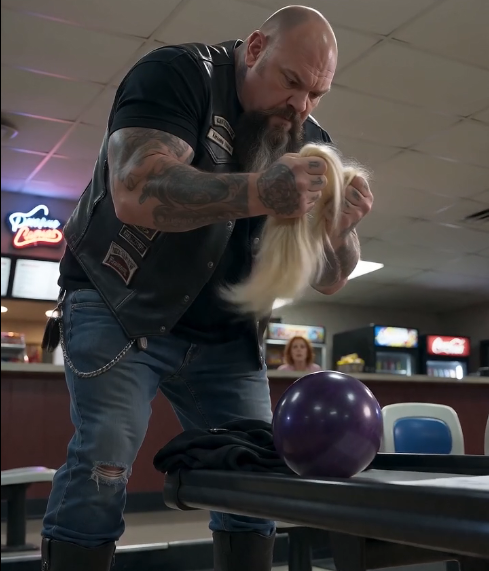
Ray was forty-two, white American, six-foot-two, and close to two hundred ninety pounds, with a barrel chest, thick tattooed arms, a dark beard that had started going gray at the chin, and a shaved head he covered with a black bandana when he rode. He owned Maddox Towing & Repair near the old gas station, the kind of garage with dented trucks out front, a coffee pot that never shut off, and men in leather leaning around the doors like storm clouds with boots.
People in our town crossed the parking lot when his Harley rolled in.
Not because he had ever bothered them, exactly. It was more that Ray looked like a man who came with consequences. His wallet chain clicked against his jeans when he walked. His leather cut creaked when he shifted his shoulders. The tattoos climbing up his neck made church ladies lower their voices in the grocery store. His boots sounded too heavy for most quiet rooms, and his face carried the permanent tension of someone who expected the world to swing first.
That night, none of that fit the scene in front of me.
The Harley was parked outside beneath the neon sign, engine still ticking in the damp mountain air. His work gloves were on the scoring table. A half-empty cup of black coffee sat beside a pile of rubber bands, a cheap comb, several YouTube instructions printed on wrinkled paper, and a child’s pink hair bow still clipped to its cardboard backing. At the center of all of it sat the bowling ball, wedged inside a towel so it would not roll away, with a wig taped to it in three places.
The wig was crooked.
The braid was worse.
Ray pulled one section over another, paused, frowned at the paper, then muttered, “Left over middle. Right over middle. Add more. Don’t yank.”
His voice was low enough that he probably thought the empty building swallowed it.
It did not.
He started again. The fake hair slipped loose. He blew out a breath, pinched the strands between two thick fingers, and tried to divide them evenly. When that failed, he sat back in the plastic chair and rubbed both hands over his face, leaving a streak of motor oil near his temple.
That was when I laughed.
I did not mean to.
It came out small, surprised, and gone too quickly to take back.
Ray’s head snapped toward me.
For one second, I saw the version of him people expected: hard eyes, clenched jaw, shoulders rising like a wall. Then his hand moved to the wig, almost protectively, and the hardness shifted into embarrassment so plain it made me feel cruel.
“Freezer’s busted again?” he asked.
“Always,” I said, stepping out from behind the snack bar.
He looked down at the bowling ball.
Then at the wig.
Then at the terrible braid hanging off one side like a rope that had given up.
“You didn’t see this,” he said.
I should have let him have that. A kinder woman might have gone back to the freezer and pretended the town’s scariest biker was not sitting under lane lights practicing a child’s hairstyle on rented sports equipment. But curiosity is a stubborn thing, and grief has a way of leaving clues even when people try to hide it.
“Ray,” I said, “why is there a wig on Mrs. Hanley’s purple house ball?”
He looked offended.
“I’m not using the good balls.”
That almost made me laugh again, but his face stopped me. His eyes were tired in a way a long workday did not explain. There was a rawness around them, like sleep had become a stranger. On the table beside the comb was a small photograph in a clear sleeve. I could not see it clearly from where I stood, but I saw enough: a little girl with brown hair, a missing front tooth, and a smile bright enough to make the bowling alley lights look cheap.
Ray followed my eyes and turned the photo facedown.
“My daughter’s got picture day Friday,” he said.
The words came out rough.
I waited.
He stared at the braid as if it had personally betrayed him.
“She wants a French braid.”
The building hummed around us. The freezer clicked behind me. Rain tapped the back door near the dumpsters, and outside, a truck rolled down Route 321 with wet tires hissing against the road.
“Can’t her mom help?” I asked.
I knew the answer the moment his face changed.
Ray’s hand went still on the wig.
“No,” he said.
That one syllable had a grave inside it.
I had heard about his wife, Emily Maddox, though not enough to know what was true. In small towns, death becomes public property before grief has even found a chair. People said she died in a wreck outside Hickory. People said Ray had been driving. People said the motorcycle club came to the funeral and scared half the cemetery. People said their daughter stopped talking for two weeks after.
People say too much.
Ray lifted the comb again and forced his attention back to the wig.
“I can do ponytails,” he said, more to the bowling ball than to me. “Bad ones. Real bad. But she asked for this like it mattered.”
He separated three sections with painful concentration.
“I don’t want to learn on her.”
That sentence landed quietly, but it stayed with me longer than anything louder could have. A man our town feared was practicing on a bowling ball because he was afraid of pulling his daughter’s hair too hard, afraid of disappointing her, afraid of turning one small school morning into another reminder that her mother was gone.
He tried the braid again.
This time, he got four crossings before the left side loosened and slid out from his fingers.
“Damn it,” he whispered.
Not angry.
Wounded.
Then the back door opened.
Three Iron Saints bikers stepped into the alley, soaked from the rain, leather vests dark, boots squeaking on the floor. Deke, the oldest one, carried a plastic grocery bag. Luis, the youngest, held a mannequin head under one arm. Big Ron had a six-pack of root beer and the deeply uncomfortable expression of a man about to do something tender in public.
Ray looked at them.
“What the hell is that?”
Luis lifted the mannequin head.
“Backup plan, brother.”
Ray stared.
Deke dropped the grocery bag on the scoring table. Out spilled hair ties, detangling spray, clips, ribbons, and a pink brush shaped like a unicorn.
Big Ron cleared his throat.
“We watched three videos.”
The room went still again, but this time for a different reason.
Ray looked at the men, then at the bowling ball, then at the facedown photograph beside his coffee.
And when he finally spoke, his voice cracked just enough to show how hard he had been holding himself together.
“My girl gets one first braid,” he said. “I’m not messing it up.”
That was the night I learned the truth about Ray Maddox, but it was not the whole truth. The whole truth was hidden in the photograph he kept facedown, and in the pink bow he had not yet dared to open.
Part 2
Before that night, I knew Ray Maddox the way most people in Lenoir knew him: from a distance and with suspicion already loaded.
He ran Maddox Towing & Repair on the edge of town, just off Route 321 where the road curved past the Dollar General and dropped toward a line of warehouses that never seemed fully open or fully closed. His garage had three bays, a rusted soda machine, and a hand-painted sign his wife made years earlier, before anyone started using the words “before the accident” as if they were a fence around his life.
His Harley-Davidson Road King sat outside most mornings, black, dusty, and never polished enough to satisfy the men who treated motorcycles like jewelry. Ray did not ride for show. He rode because the engine started, because the road between the garage and home gave him a place to breathe before stepping into rooms that still held his wife’s absence. When he shut the bike off, the silence around him always seemed heavier than the sound had been.
The rumors were not all false. That is what made them useful to people.
Ray had done eight months in county jail when he was twenty-four after a fight outside a biker bar near Boone. A man went to the hospital with a broken cheekbone, and Ray went into a cell with more anger than sense. Years later, when younger riders tried to turn that story into legend, Ray stopped them cold. He did not grin about it. He did not call it defending honor. He said, “I was drunk. I was stupid. He said something ugly, and I let ugly answer.”
That was the kind of man Ray became after Emily.
Not cleaned up. Not softened into something harmless. More like a hard piece of metal filed down just enough to stop cutting everyone who touched it.
Emily Maddox had been different from him in every visible way. She was small, brown-haired, patient, and stubborn enough to walk into Ray’s garage with a flat tire and tell him he charged too much before he had even said hello. She taught second grade at Oak Hollow Elementary, wore cardigans with pencils in the pockets, and carried a tote bag full of library books, student drawings, grocery lists, and mystery snacks their daughter found weeks later.
Ray used to say Emily could make a room behave without raising her voice.
Their daughter Sophie inherited that.
Sophie was seven when I first saw her photograph. She had Emily’s brown hair, Ray’s steady eyes, and a gap-toothed smile that made adults soften before they remembered they were trying to stay busy. She loved dinosaurs, pancakes shaped like bad circles, and hair bows so bright they looked like warnings. According to Ray’s sister Marlene, Sophie’s morning hair had always been Emily’s department, not because Ray refused, but because Emily made it into a ritual.
Every school morning, Emily sat Sophie on a stool in the kitchen, sprayed detangler into the air first so Sophie could “walk through the princess cloud,” then brushed gently while making up stories about brave girls with map-braids, moon-braids, storm-braids, and secret-kingdom braids. Ray made breakfast badly in the background. Burned toast. Uneven eggs. Coffee too strong. Sophie said he cooked like a motorcycle trying to be a dad.
After Emily died, the kitchen stool stayed in the corner for three weeks.
Ray could fix a transmission, winch a pickup out of a ravine, patch a tire on a dark highway, and calm down a drunk stranger with three words. But he could not look at that stool without his hands shaking. The first Monday he had to get Sophie ready for school alone, he brushed too fast. Sophie flinched once. He stopped immediately, set the brush down, and walked into the laundry room where she could not see his face.
She wore a crooked ponytail that day.
Not terrible.
Not good.
Just father-made.
Sophie never complained. That made it worse.
When a child who has lost one parent becomes careful with the other, it is not maturity. It is survival wearing small shoes. She learned not to ask for complicated hair. She learned to say ponytails were fine. She learned to carry her own backpack when Ray forgot to notice it was too heavy. He noticed eventually. He always noticed eventually, and then the regret hit him harder because it had arrived late.
The Iron Saints noticed too.
Men like that do not gather around a grieving father with soft words, because soft words frighten them more than highway wrecks. They brought practical things instead. Deke dropped off frozen meals he claimed his neighbor made, though everyone knew he had stood in his own kitchen reading oven instructions like a man defusing a bomb. Luis picked Sophie up from after-school art club when Ray got stuck on a tow call. Big Ron fixed the porch light because Emily had always hated coming home to a dark door.
They did not talk about brotherhood.
They did brotherhood.
Still, none of them knew what to do when Sophie came home with the picture day form.
The form was pink, folded twice, and marked with a star sticker from her teacher. It said Friday in bold letters and offered packages with names like Classic Smile and Memory Bundle. Sophie set it on the kitchen table beside Ray’s coffee and waited.
Ray looked at the form.
Then at her.
She touched the ends of her hair.
“Mom used to do a French braid for pictures,” she said.
Ray’s throat worked.
“I remember.”
Sophie shrugged too quickly.
“It’s okay if you can’t.”
There it was.
The sentence that sent him to the bowling alley.
Not because she demanded too much, but because she had learned to ask for less.
Ray told her he would see what he could do. That night, after she fell asleep with a dinosaur book open on her chest, he drove to Walmart, bought a blonde wig because it was closest to Sophie’s hair color, and then stood in sporting goods holding a bowling ball cleaner before realizing he needed something heavy and round but not alive.
The bowling alley came next.
I gave him the key after closing because his tow truck had saved my oldest son once during an ice storm, and because Ray looked like a man who would rather be laughed at by one person than fail his daughter in front of a classroom camera.
He practiced every night that week.
At first, alone.
Then not.
Part 3
The false climax happened Thursday night, the night before picture day.
By then, Ray’s practice sessions had become the strangest secret in Caldwell County. Smoky Ridge Lanes closed at ten, I locked the front door, and by ten-fifteen the bikers arrived through the back like a gang preparing for the softest robbery in America. They carried coffee, combs, printed diagrams, rubber bands, spray bottles, and the kind of determination men usually reserved for engines, court dates, and funerals.
The bowling ball sat on lane twelve with the wig taped to it. We called her “Debra” after the name printed inside the wig cap, and no one was allowed to make fun of Debra after Big Ron said she was doing her best. Deke timed Ray with the seriousness of a pit crew chief. Luis watched braid tutorials and translated them into biker language, which was mostly wrong but occasionally useful. Big Ron learned sectioning faster than anyone and took it personally when the braid leaned left.
Ray practiced until his hands cramped.
That surprised me. Not that his hands could cramp, but that he admitted it without admitting it. He would flex his fingers under the table, rub his thumb against the heel of his palm, and then reach for the comb again. His hands were scarred from years of metal work and winter tows, the knuckles thick, the nails short, the fingertips nicked from tools. They had not been trained for patience this small.
The first braid looked like roadkill.
The second looked worse.
By Wednesday, he could produce something recognizable if nobody breathed near the wig. By Thursday, he had managed three decent braids in a row, and the whole alley reacted like he had won a championship. Deke slapped the scoring table. Luis shouted too loud. Big Ron lifted Debra the bowling ball in both hands like a trophy until Ray told him to put the lady down.
For the first time that week, Ray smiled.
Not big.
Enough.
Then his phone rang.
It was Sophie’s school.
I watched the smile leave his face before he answered.
Ray stepped away toward the arcade machines, listening with one hand pressed against his ear. His body changed as he heard the voice on the other end. Shoulders tight. Jaw set. Eyes dropping toward the floor. The bikers stopped talking. Even the ice machine seemed to quiet down.
When he came back, he picked up the pink bow from the table and turned it over once in his palm.
“What happened?” I asked.
He shook his head, but the gesture was more exhaustion than refusal.
Deke stood.
“Ray.”
He looked at the wig.
Then at the photograph beside his coffee.
“Sophie told her teacher she doesn’t want picture day.”
Nobody spoke.
“She said she doesn’t want a mother-daughter braid if her mother isn’t here to do it.”
There are sentences that land in a room like a chair tipping over. Loud at first, then echoing in everybody’s chest. Ray stood under lane twelve’s flickering light, holding that unopened pink bow, and the whole reason for the week shifted under our feet. It was not about hair anymore, if it ever had been. It was about a little girl trying to protect herself from wanting something she believed life had taken away permanently.
Ray sat down.
The chair complained under his weight.
He stared at the wig for a long time, and I could see the shame trying to get its claws into him. Shame tells grieving parents they are late, wrong, unqualified, and always standing in the space someone better used to fill. Ray looked like he was hearing all of it.
“I pushed too hard,” he said.
Deke shook his head.
“You didn’t push.”
“She only asked because she thought I might try.”
“That’s what dads do.”
Ray’s laugh was dry and empty.
“Emily did this. Not me.”
Luis, who had been quiet for once, leaned against the ball return and looked at the floor.
“My mom died when I was nine,” he said.
Everyone turned.
Luis was twenty-three, Latino American, narrow-faced, usually all jokes and bad timing. He looked suddenly older under the bowling alley lights.
“My dad couldn’t cook what she cooked. Couldn’t fold clothes right. Couldn’t sing the song she used to sing. So he stopped trying because he thought trying bad was worse than not trying.”
He rubbed a hand over the back of his neck.
“It wasn’t.”
Ray listened.
Luis looked at the wig.
“I just wanted him to mess it up near me.”
That sentence changed the room.
Ray lowered his head. His right hand closed around the pink bow, not tight enough to crush it, but close. The bow’s cardboard backing bent slightly under his thumb.
“I don’t know how to be both,” he said.
Nobody answered too fast.
That was respect.
Men like Ray did not say things like that unless the sentence had to fight its way out. If you rushed to comfort him, he would seal back up and pretend he had only been talking about hair. So we let the words sit on the table among the combs, rubber bands, and printed instructions.
Then Big Ron, who had not said anything emotional in public since his dog died in 2014, cleared his throat.
“Brother,” he said, “you ain’t gotta be both. You gotta be there.”
Ray lifted his eyes.
Big Ron nodded toward Debra the bowling ball.
“And maybe don’t make the kid look like a lopsided scarecrow.”
That broke the room just enough.
Ray breathed out something close to a laugh. Then he looked at the clock. 11:38 p.m. Friday was less than half an hour away. Picture day waited in the morning. Sophie had decided not to go through with it. Ray had learned the braid, but maybe too late to prove the part that mattered.
Then the back door opened again.
Marlene Maddox stepped in wearing rain boots, a red coat, and the expression of a woman who had raised three younger brothers emotionally against their will. Sophie stood beside her in pajamas under a hoodie, hair loose over one shoulder, eyes red from crying.
Ray rose so fast his chair scraped backward.
“Soph?”
She looked at the bowling ball.
At the wig.
At the bikers.
At the pink bow in his hand.
And then she asked the question that made every grown man in the room forget how to breathe.
“Daddy, were you practicing on that so you wouldn’t hurt me?”
Part 4
The twist was not that Ray had learned to braid.
It was that Sophie had known he was trying before any of us thought she did.
She walked toward lane twelve slowly, her socks damp from the rain that had blown in through the back door. Marlene stayed behind her, arms folded, watching Ray with the kind of love that would not spare him from the truth if the truth was what he needed.
Ray stood between the table and the bowling ball, suddenly looking too big for his own body. He still held the pink bow. His hands, the same hands that could hook chains to wrecked trucks in the dark, looked helpless around a piece of ribbon and cardboard.
“Sophie,” he said, “what are you doing here?”
She did not answer immediately.
She walked to the bowling ball and touched the wig. The braid hanging from it was the best one Ray had made all week, tight at the top, smooth down the middle, slightly crooked near the end but respectable enough to survive a school photo. Sophie ran her fingers over it like she was reading a message written in hair.
“I heard Aunt Marlene talking to Uncle Deke on the phone,” she said.
Deke looked personally betrayed by speaker volume.
Marlene did not apologize.
Sophie kept her eyes on the braid.
“She said you were practicing every night.”
Ray swallowed.
“I wanted it to be a surprise.”
“It was.”
That answer hit him harder than anger would have.
Sophie turned to the photograph on the table. It was faceup now, probably because Big Ron had moved something and forgotten Ray kept it hidden. In the picture, Emily Maddox sat at the kitchen table with Sophie between her knees, both of them laughing while Emily braided her hair. Ray had taken that photo two years earlier, on picture day, when the morning light came through the window and caught loose strands like gold thread.
Sophie picked up the photo.
Nobody stopped her.
“She did it different,” she said.
Ray looked down.
“I know.”
“She sang the braid story.”
“I know.”
“She made the princess cloud.”
Ray’s face tightened.
“I bought the spray.”
Sophie looked at him then.
Something flickered across her face, not disappointment, but the terrible tenderness children sometimes feel for parents who are trying so hard it hurts to watch. She set the photo down gently and reached for the detangling spray. The bottle was pink and new, with a glittery label that promised smooth shine and smelled like strawberries.
Ray looked embarrassed.
“They had seven kinds,” he said. “I panicked.”
That made Sophie laugh through her stuffed-up nose.
Just once.
But once was enough to loosen the whole room.
Then she pointed at the bowling ball.
“Why a bowling ball?”
Ray glanced at us as if hoping one of the other adults would rescue him. No one did. Bikers are ride or die until a man has to explain a wigged bowling ball to his daughter, then they become extremely interested in ceiling tiles.
“I needed something round,” he said.
Sophie looked at him.
“And heavy.”
She waited.
“And I didn’t have hair.”
Luis coughed into his fist.
Ray gave him a look.
Sophie touched the tape holding the wig in place and frowned.
“You taped hair to a bowling ball.”
“Yes.”
“To practice a braid.”
“Yes.”
“Every night?”
Ray nodded.
Her mouth trembled.
The room braced for crying.
Instead, she looked at him with the seriousness of a child standing at the edge of a grief adults kept trying to carry around her.
“Why didn’t you practice on me?”
Ray’s answer came fast, because he had been carrying it all week.
“Because you deserve it right the first time.”
Sophie blinked.
The words filled the bowling alley more completely than any engine could have. They explained the late nights, the printed instructions, the mannequin head Luis brought, the unicorn brush, the way Ray had hidden the photograph facedown like looking at Emily might make his hands forget what they were trying to learn.
“I didn’t want to pull too hard,” he continued, voice rougher now. “I didn’t want to make you sit there while I messed it up. You already lost enough because I don’t know things.”
Sophie’s eyes filled.
Ray’s did too, though nothing fell. Men like Ray did not cry easily in front of their children, not because they felt less, but because they feared making their children responsible for the tears.
“You know things,” Sophie said.
Ray shook his head once.
“Not the right things.”
She stepped closer.
“You know how to find my dinosaur socks.”
“Only because they’re always under your bed.”
“You know pancakes taste better shaped wrong.”
“That’s not knowledge. That’s survival.”
Her mouth twitched.
“You know Mom’s stories.”
Ray went still.
That was the real twist inside the twist.
Sophie had not wanted the braid because Emily was the only one who could make it perfect. She wanted the braid because it carried the stories. The princess cloud. The map-braid. The storm-braid. The made-up kingdoms only her mother had known how to build between brushstrokes. The hairstyle was not the loss. The silence around it was.
Ray looked at the photograph.
“I don’t remember them all,” he said.
Sophie reached for his hand.
“Make new ones.”
That broke him in the quiet way.
His shoulders dropped. His fingers closed gently around hers. The bowling alley lights hummed above us, reflecting off the oiled lanes and the purple bowling ball that had somehow become part of a family’s survival. Outside, rain kept tapping the back door. Inside, five bikers, one bowling alley manager, one aunt, and one motherless little girl stood around a wig with the reverence of people watching a bridge being built.
Ray sat down.
Sophie climbed onto the chair in front of him, the same way she must have sat in front of Emily at the kitchen table. Marlene handed him the brush. Deke handed him the spray. Luis handed him a comb and whispered, “Left over middle, brother.”
Ray ignored him.
His hands shook when he touched Sophie’s hair.
She felt it.
“It’s okay,” she said.
He sprayed the detangler into the air first.
Not onto her hair.
Into the air.
Sophie looked back.
Ray cleared his throat.
“Princess cloud,” he said.
Her face changed so fast I had to look away.
Ray brushed slowly. The first strokes were careful, almost afraid. Then his hands found the rhythm he had beaten into them all week on Debra the bowling ball. Section. Cross. Add. Smooth. Breathe. He did not sing, not exactly, but he talked in a low voice while he worked.
“This is the road-braid,” he said. “Starts near the mountains, runs past the diner, crosses Route 321, and ends wherever the girl driving it says it ends.”
Sophie sat very still.
Nobody moved around them.
The braid formed under his fingers, tighter than I expected, gentler than he believed he was capable of being. When he tied it off with a small elastic, Big Ron silently handed him the pink bow. Ray removed it from the cardboard backing like it was a surgical instrument.
He clipped it at the end.
The bow sat slightly crooked.
Sophie reached back to feel it.
Then she stood and walked to the dark window over the ball returns, using the reflection to see herself. For a long moment, she said nothing.
Ray waited like a man waiting for a verdict.
Sophie touched the braid.
Then the bow.
Then she turned around.
“Can we still do picture day?” she asked.
Ray closed his eyes for one second.
When he opened them, the old hard face was there again, but it had been rearranged around something softer.
“Yeah, baby,” he said. “We can.”
That should have been the ending.
But the photograph on the table still had something written on the back.
And Sophie had not seen it yet.
Part 5
The back of the photograph explained why Ray had been so afraid of the braid.
It was not just a picture of Emily doing Sophie’s hair. It was the last picture Ray took of his wife before the accident, though he did not tell anyone that until later. The date was printed in small digital numbers in the corner: October 14. Picture day. The kitchen window bright behind them. Sophie laughing. Emily looking down at her daughter’s hair with both hands mid-braid and a smile that seemed ordinary only because no one in the room knew ordinary was about to become priceless.
After Sophie asked if picture day could still happen, Ray reached for the photo. His thumb ran over the clear sleeve. He looked at it for a long time, then turned it over.
Emily’s handwriting covered the back.
Not a long note. Just a list, written in blue pen, probably while waiting for coffee to brew or toast to pop up. Emily made lists on everything. Receipts. Envelopes. School flyers. Ray’s garage invoices if he left them too close to the kitchen counter.
On the back of that picture, she had written:
Picture day braid:
- Let her walk through the cloud.
- Start gentle.
- Tell her the road knows where it’s going.
- Bow last.
- Tell Ray he can learn anything if he stops growling first.
Ray had found the photo and the list two nights after Sophie asked for the braid.
That was why he bought the spray. That was why he tried to make the braid into a road story instead of copying Emily’s princess kingdom. That was why he kept the photo facedown, because the instructions were not only instructions. They were Emily reaching forward from a morning none of them could return to, telling him in her ordinary handwriting that he was not as helpless as grief wanted him to feel.
Sophie took the photograph from him carefully.
She read the list once.
Then again.
When she reached the last line, she laughed and cried at the same time.
“You do growl,” she said.
Ray nodded.
“Working on it.”
She pressed the photo against her chest. The pink bow sat crooked at the end of her braid, and the reflection in the window showed a little girl who looked both older and younger than she had when she arrived. Grief does that to children. It steals years from them, then gives some back in unexpected places, like a bowling alley at midnight while bikers pretend they are not wiping their eyes.
The seeds from the week returned one by one.
The bowling ball had not been ridiculous. It had been mercy. Ray chose something that could not flinch because he could not bear the idea of Sophie flinching under his hands again. The blonde wig was not a joke. It was the closest match he could find to her hair under fluorescent Walmart lights while trying not to look like a man shopping for a ghost. The unicorn brush was not random. Emily had once bought one just like it and lost it on a family trip to Boone. Ray remembered because Sophie cried for ten miles and Emily made up a story about the brush going to beauty school.
The Iron Saints understood too.
Deke had brought detangling clips because his sister raised three girls and told him, over the phone, that men who tried to braid without clips deserved what happened next. Luis brought the mannequin head because he remembered what it felt like when a father stopped trying after a mother died. Big Ron brought root beer because Sophie used to drink it at the bowling alley with Emily after school, and because he had no idea what else to bring to a family rebuilding a ritual out of yarn, tape, and nerve.
Ray did not make a speech.
He never would have.
Instead, he repacked the hair supplies into a toolbox he had cleaned out for the purpose, placing each item inside with the same care he gave sockets and wrenches. Brush. Spray. Comb. Elastics. Bow. Photo. The printed instructions went last, folded under Emily’s picture. Then he snapped the box shut and handed it to Sophie.
She frowned.
“What’s this?”
“Yours.”
“But you need it.”
“I know where you keep things.”
“Under my bed?”
“Every important thing in this house is under your bed.”
That made her smile.
The next morning, half the town saw the braid before Ray could decide whether he wanted them to. Oak Hollow Elementary’s picture day line stretched down the hallway beside paper pumpkins and student artwork. Sophie walked in wearing a yellow sweater, blue jeans, and the pink bow clipped at the end of a French braid tight enough to survive recess. Ray walked behind her in his black T-shirt, leather vest, jeans, and boots, looking like a bodyguard who had accidentally been assigned to a princess.
Other parents stared.
Of course they did.
A mother in yoga pants looked from Ray’s tattoos to Sophie’s braid and whispered, “Who did her hair?”
Sophie turned before Ray could answer.
“My dad.”
The hallway shifted.
Not dramatically. Real life rarely shifts dramatically. It shifts in tiny, uncomfortable movements. A woman’s eyebrows lifting. A father looking down at his own daughter’s messy ponytail. A teacher softening near the classroom door. Someone realizing a man they had judged from the parking lot had stayed up all week learning something that could not help him, impress anyone, or make him look tough.
Mrs. Bell, Sophie’s teacher, crouched to look at the braid.
“It’s beautiful,” she said.
Sophie tilted her head.
“It’s a road-braid.”
Mrs. Bell glanced at Ray.
He looked away.
Sophie continued, proud now.
“It starts near the mountains and ends wherever I say.”
Ray’s face did not change much, but I saw his hand move to the edge of his leather vest. He gripped it once, like a man steadying himself against something stronger than embarrassment.
The photo came back two weeks later.
Sophie brought it to the bowling alley in a cardboard envelope, running ahead of Ray through the front doors. Her braid was not perfect that day, looser at the top, one side slightly puffed, but she wore it like a crown. She handed me the picture first.
In the photo, she smiled with her missing tooth showing, brown hair braided over one shoulder, pink bow visible near the bottom. Behind her, printed in blue-gray school-photo clouds, she looked like every child should look: safe enough to be proud of something small.
Ray stood behind her, pretending to study the snack bar menu.
I turned the envelope over.
On the back, Sophie had written in pencil:
Daddy did it right.
I looked at Ray.
He looked at the floor.
Nobody said anything for a moment, which was how I knew the sentence had done its work.
Part 6
The bowling alley became a ritual after that.
Not every night, but often enough that lane twelve never felt like only lane twelve again. Ray came in after closing with Sophie once a week at first, then every other week when life began finding a new shape around them. He did not need Debra the bowling ball as much, though he refused to return her to regular use. Mrs. Hanley complained twice until Sophie named the ball “Coach Debra,” and then even Mrs. Hanley admitted some things should not be rolled into pins anymore.
The wig stayed in a shoebox under the scoring table.
The unicorn brush stayed in Ray’s cleaned-out toolbox.
The photo stayed in the lid, taped beneath a strip of clear packing tape so Emily’s handwriting would not fade from being touched too much. Every time Ray opened the box, the list was there. Let her walk through the cloud. Start gentle. Tell her the road knows where it’s going. Bow last. Tell Ray he can learn anything if he stops growling first.
He did stop growling, a little.
Not completely. Men like Ray do not become soft in a sudden movie way. They become more careful. They answer before snapping. They notice when a child says “it’s okay” too quickly. They learn which silence needs space and which silence needs pancakes.
By winter, other fathers started showing up.
It happened quietly at first. A divorced dad named Marcus, Black American, brought his nine-year-old daughter after botching a bun before a dance recital. A Latino American grandfather named Ernesto came because his son was deployed and his granddaughter wanted braids “like the soccer girls.” A white American father from Oak Hollow showed up red-faced and defensive, claiming he was there only because his wife worked nights, then stayed two hours learning how not to twist a ponytail into something painful.
Ray taught them badly at first.
Then better.
He had no patience for excuses but endless patience for hands trying to learn. He told them to hold hair like it belonged to someone who trusted them. He told them pulling was not proof of control. He told them if a child flinched, you stopped, apologized, and started again slower. He said all this while looking like a man who could intimidate a tow truck into starting.
The Iron Saints came too, because once brotherhood gets tested in tenderness, it either grows or it runs away. Theirs grew. Deke learned pigtails for his granddaughter. Luis became annoyingly good at French braids and lorded it over everyone until Big Ron threatened to make him teach a workshop. Big Ron, somehow, mastered bows. Nobody understood that. Least of all Big Ron.
On Saturday mornings, before league play, the back corner of Smoky Ridge Lanes turned into what Sophie called “Hair Pit Crew.” Kids sat on stools. Fathers stood behind them with combs and terrified faces. Bikers handed out elastics. I made coffee and pretended not to tear up whenever a little girl looked in the dark window reflection and smiled at a hairstyle her father had made.
Ray never turned it into charity.
He hated attention the way some men hate dentist drills. When the local paper asked to photograph him braiding hair in the bowling alley, he said no before the reporter finished the sentence. Sophie overruled him by saying, “Dad, some other dad might need Coach Debra.” The story ran on page three with a photo of Ray’s hands braiding Sophie’s hair, his face mostly out of frame. That was the only reason he allowed it.
The headline called him “The Braid Biker.”
He hated that too.
Sophie loved it.
Every year on Emily’s birthday, Ray took Sophie on the Harley to the overlook above Route 321. He rode slowly, with Sophie in a helmet covered in dinosaur stickers, her braid tucked safely under the back. They carried pancakes in a foil packet and ate them on the stone wall, badly shaped and cold by the time they arrived. Then Ray read Emily’s list aloud, not because he might forget, but because some instructions are meant to be heard by the living.
At home, the kitchen stool came back.
Not as a shrine.
As furniture.
That was how I knew they were healing in the only way healing really happens: not by leaving grief behind, but by making it sit somewhere useful. Sophie sat on that stool before school while Ray braided her hair, sometimes well, sometimes crooked, always gentle. The princess cloud became the road cloud. The map-braid became whatever story Ray invented that morning. Some days the braid crossed mountains. Some days it outran a dragon with engine trouble. Some days it simply got them through breakfast.
Emily’s absence never left the room.
But it no longer sat in the only chair.
Part 7
Three years after that first midnight practice, I found Ray in the bowling alley again after closing.
He was not alone.
Sophie was ten now, taller, sharper, carrying herself with the confidence of a child who had been loved through the worst weather and knew where shelter was. She stood behind Coach Debra with her sleeves pushed up, teaching a nervous father how to separate hair into three even sections. The man’s daughter sat on a stool, giggling every time her father dropped a strand.
Ray leaned against the scoring table with his arms folded, leather vest creaking softly, boots crossed at the ankles, trying to look unimpressed and failing.
His Harley waited outside under the neon sign, engine quiet, rainwater shining on the seat. The bowling alley smelled like lane oil, coffee, old fries, leather, and strawberry detangling spray. On the table sat the same toolbox, scratched now, fuller than before. New combs. New bows. Extra elastics. A faded photo taped inside the lid.
Sophie looked over at him.
“Dad, he’s growling.”
Ray pushed off the table and walked over.
The nervous father stepped aside.
Ray took the comb, his huge tattooed hands moving carefully through the little girl’s hair. He did not rush. He did not show off. He sprayed the detangler into the air first, letting the child walk through the mist like it was magic and not simply something Emily Maddox had left behind in a list.
Then he handed the comb back.
“Start gentle,” he said.
The father nodded.
Sophie watched him with a smile that looked so much like Emily’s from the photograph that I had to busy myself wiping a clean counter.
Later, after everyone left, Ray packed the toolbox while Sophie returned Coach Debra to the shoebox beneath the scoring table. Before closing the lid, she touched the old wig, the tape marks still visible near the cap.
“You were scared,” she said.
Ray looked at her.
“Yeah.”
“Of hair?”
“Of hurting you.”
Sophie nodded like that made perfect sense.
Then she stepped into him and wrapped both arms around his waist. He held her carefully at first, then tighter when she did not pull away.
Outside, a truck hissed down Route 321 on wet pavement. The Harley sat under the neon, waiting. Ray picked up the toolbox in one hand and Sophie’s backpack in the other, and the two of them walked toward the door through the soft reflected light of lane twelve.
Her braid swung down her back.
Pink bow last.
Follow the page for more emotional biker stories about the people we almost misjudge before we truly see them.