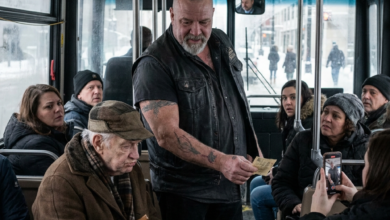
A Tattooed Biker Knocked an Old Man’s Lunch Tray Across the Nursing-Home Dining Room—Then a Red Allergy Card Was Found Beneath the Wrong Plate
Part 2 — The Grandson Who Always Arrived Before Lunch
I first met Cole Mercer on a Tuesday morning eleven months before the tray hit the floor. He arrived at Briarwood at 11:42, carrying a black helmet beneath one arm and a paper sack beneath the other, then asked why his grandfather’s allergy warning was missing from the whiteboard outside Room 214.
I had not noticed.
The warning still appeared in Walter’s electronic chart, but a housekeeper had cleaned the board after a room inspection and failed to rewrite it. That should not have affected his care because the kitchen, nursing station, and medication system all carried separate alerts.
Cole did not find that reassuring.
“Systems are just people standing in a line,” he said. “One looks away, the whole line opens.”
He wrote PEANUT ALLERGY—ANAPHYLAXIS on the board himself.
The letters were ugly but impossible to miss.
That was Cole. He entered every room like a threat and left behind some small correction nobody wanted to admit had been necessary. He tightened Walter’s loose wheelchair brake, replaced a frayed call cord, brought nonslip socks for a resident whose family lived in Oregon, and once spent an hour repairing the bent bird feeder outside memory care.
He never called any of that kindness.
He called it maintenance.
Cole owned Mercer Cycle and Machine near Route 66, a narrow motorcycle shop that smelled of hot rubber, coffee, solvent, and old leather. His riding club, the Iron Lanterns, was not an outlaw club despite what several Briarwood families assumed from the men’s beards and motorcycles. Most members were mechanics, veterans, truck drivers, welders, or retired firefighters.
Their rule was simple: if one rider’s family needed help, nobody arrived alone.
Walter had helped create that rule.
Long before age reduced him to a wheelchair, he ran a small machine shop behind his Tulsa home. He taught Cole to weld, rebuild carburetors, sharpen tools, and stop a job when something smelled wrong.
“Your nose hears trouble before your ears do,” Walter used to say.
The line sounded foolish until the day it saved his life.
Walter’s peanut allergy had first appeared when he was thirty-six. He ate two bites of pie at a church supper, developed hives, and collapsed before anyone understood what was happening. Emergency treatment saved him, but severe food allergies were discussed differently in 1979. Some relatives called it sensitivity. Others thought he was being difficult.
Walter never did.
Neither did Cole.
Cole’s mother, Diane, was Walter’s only daughter. She struggled for years with alcohol dependence, unstable relationships, and stretches when she vanished without warning. Cole spent most of his childhood in Walter and Evelyn Mercer’s house, sleeping in a converted sewing room and waking before school to the rasp of metal from the backyard shop.
Walter became the reliable man in his life.
He was not gentle in the ordinary sense. He believed apologies should include repaired damage. He considered lateness a kind of theft. When fourteen-year-old Cole took his truck without permission and damaged a fence, Walter made him replace every board by hand.
But he showed up.
Every time.
When Cole was nine, Walter suffered his second major allergic reaction after eating barbecue sauce made with peanut butter. Cole remembered the sound more than the sight: his grandfather dragging air through a throat that was narrowing by the second, Evelyn shouting for the injector, a kitchen chair scraping backward, then the distant siren refusing to arrive quickly enough.
Cole held Walter’s hand beneath the table.
The old man’s fingers went cold.
Afterward, Walter taught him how to use an epinephrine auto-injector. Cole practiced with an empty trainer until he could do it in darkness. He began reading labels, questioning restaurant sauces, and carrying Walter’s emergency card whenever they traveled.
It was too much responsibility for a child.
Cole carried it anyway.
By seventeen, he was broad-shouldered, angry, and capable of turning any insult into a fight. He dropped out of school after Diane disappeared again and spent eighteen months drifting between construction crews and county jail. Walter drove four hundred miles to bring him home after the last arrest.
He did not lecture him in the car.
At a gas station outside Amarillo, Walter handed Cole a coffee and said, “You can keep becoming what happened to you, or you can build something else.”
Cole stared through the windshield.
“What if I don’t know how?”
“I taught you tools.”
That was all.
Cole finished his equivalency diploma, apprenticed in a motorcycle shop, and eventually opened his own place. When Evelyn died and Walter’s legs weakened from diabetes and nerve damage, Cole converted the downstairs bathroom, installed rails, and moved into the back bedroom of Walter’s house.
For six years, he was caregiver, grandson, driver, cook, and the person who checked every ingredient.
Then Walter fell.
It happened while Cole was leading a charity ride outside Oklahoma City. Walter tried to reach the bathroom alone, fractured his hip, and remained on the floor until a neighbor heard him calling.
Cole left the ride before the first fuel stop.
At the hospital, Walter made the decision neither man wanted. He needed rehabilitation, then long-term nursing support. Cole could rebuild an engine blindfolded, but he could not safely lift a grown man three times a night while running a business.
Briarwood had a good rehabilitation wing, a quiet courtyard, and a dietary program that claimed experience with severe allergies.
Cole read every document.
Twice.
On Walter’s admission day, he handed me a red folder containing allergy records, emergency instructions, photographs of the injector, and a list of foods that had caused previous reactions. He placed two unexpired auto-injectors in Walter’s bedside cabinet and kept two more in his vest.
“I don’t need you to like me,” he said. “I need you to believe the red card.”
I thought he was being dramatic.
Eleven months later, I watched peanut sauce run across our dining-room floor.
Part 3 — The Tuesday the System Broke
The morning of the incident began with three ordinary failures.
At 7:18, the dietary label printer stopped working. At 8:05, a kitchen aide named Rachel called in sick because her daughter had a fever. At 9:30, a temporary employee named Simon was moved from dishwashing to tray assembly without receiving the full allergy briefing.
None of those failures alone should have endangered Walter.
Together, they opened the line.
The kitchen manager, Denise Holloway, printed resident names on a backup office printer, then cut the sheets into strips. Allergy cards were still supposed to be placed beneath the appropriate plates by a licensed dietary aide. Walter’s red card read SEVERE PEANUT ALLERGY—SEPARATE PREPARATION AREA.
Room 118 belonged to Arthur Bell, a retired music teacher recovering from a stroke. His daughter had requested peanut-glazed chicken because it was one of the few meals he still ate with enthusiasm.
The two trays were prepared on different counters.
They left the kitchen correctly.
The switch happened upstairs.
A transport aide parked the cart outside the dining room while helping a resident who had dropped her oxygen tubing. During those ninety seconds, Arthur stood from his assigned seat and moved to the window table because sunlight hurt his eyes. A volunteer rearranged the place cards to match the new seating positions.
She moved the printed names.
She did not see the colored dietary cards beneath the plates.
Walter’s printed ticket was placed above Arthur’s peanut meal. Arthur’s name went onto Walter’s plain chicken.
The volunteer was Mrs. Helen Dunne’s daughter, Marjorie—the same woman who later raised her phone and demanded Cole be arrested. She had been helping at Briarwood for four years. She knew most residents, meant no harm, and believed she was fixing a seating mistake.
One small correction.
The wrong system.
At 11:44, Cole’s Harley entered the circular drive. I heard the low V-twin rhythm through the front windows, followed by silence, the tick of cooling pipes, and boots crossing the wet pavement.
He normally arrived at 11:35.
Traffic had delayed him nine minutes.
Those nine minutes mattered.
Walter was already seated. His usual red allergy card was not visible because it remained beneath the plate, hidden by the rim. The printed name on top looked correct. Molly had compared Walter’s wristband with the paper ticket and served the tray.
The process appeared complete.
Cole entered carrying two coffees, one black and one with exactly one packet of sugar. He greeted Walter, placed the cups on the side table, and caught a smell he knew from forty-three years earlier.
Warm peanuts.
He stopped.
Walter’s spoon was already rising.
Cole dropped his helmet. One step. Two. Three.
Then impact.
The tray flew.
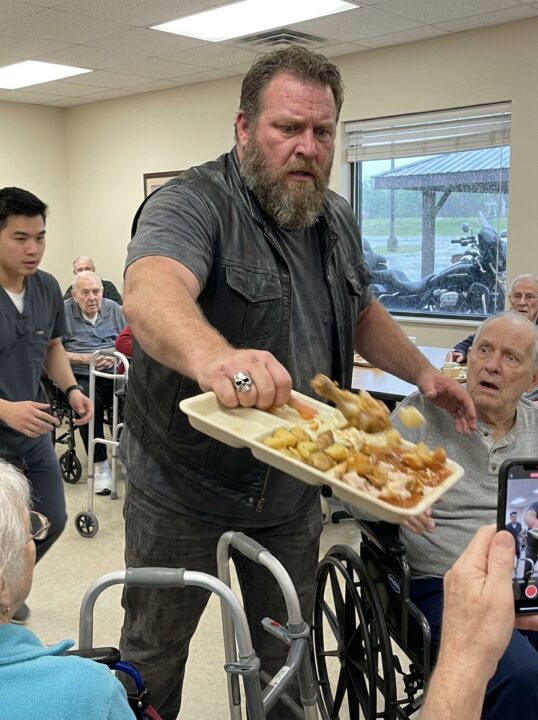
Molly shouted. Marjorie screamed that Cole had assaulted his grandfather. Leon ran from the lobby. A piece of ceramic slid beneath Mrs. Dunne’s walker, and Walter’s wheelchair rolled backward until it struck the table behind him.
Cole shoved the remaining food away with his bare hand.
“Did you swallow?”
Walter looked offended more than frightened. “You ruined my lunch.”
“Did you swallow?”
“No.”
“Touch your mouth?”
Walter hesitated.
Cole saw the answer.
A smear of sauce marked Walter’s thumb. Before Cole entered, Walter had steadied the plate when it shifted, then wiped his hand against his lip. He had not swallowed the chicken, but skin and mucous-membrane contact could still trigger a reaction in someone with his history.
Cole removed the injectors from his vest.
Leon ordered him to stand.
“Not yet.”
“That isn’t a request.”
“Then you’ll have to move me.”
The Iron Lanterns often joked that moving Cole required a truck and written notice. Leon was strong, but he was not foolish. He waited for me.
I smelled the sauce.
Then Walter coughed.
Once.
The room changed.
His lower lip was swelling. Redness spread from his chin toward his right cheek. He pulled at the collar of his cardigan, and his breath developed a thin whistle.
Cole removed the blue safety cap from the injector.
I checked Walter’s pulse and ordered Molly to call emergency services. His blood pressure began dropping. We had entered the stage Cole had feared since childhood.
He pressed the injector against Walter’s outer thigh through the fabric.
A sharp click.
Walter jerked.
Cole held it in place and counted slowly, his voice steady even as his free hand trembled against the wheelchair.
“One. Two. Three.”
Marjorie lowered her phone.
Denise reached the overturned tray and found the red dietary card stuck beneath the broken plate. It bore Arthur Bell’s name.
Across the room, Arthur had eaten half of Walter’s plain chicken and was complaining that the cook had forgotten the glaze.
That was the moment the entire mechanism became visible.
The wrong printed name had been moved.
The allergy card had stayed.
Paramedics arrived within seven minutes. Walter’s breathing improved after the epinephrine, but his blood pressure remained unstable. They placed him on oxygen, started an intravenous line, and prepared to transport him for observation because biphasic reactions can return after initial recovery.
Cole climbed into the ambulance.
Leon touched his arm. “Police are coming.”
Cole handed him the empty injector.
“Tell them where I went.”
Walter, still wearing an oxygen mask, reached toward his grandson.
Cole took his hand.
The ambulance doors closed.
Many people assumed the crisis had ended because Walter was alive and the switched trays had been identified.
They were wrong.
The video had already left the building.
Marjorie’s first forty seconds showed only Cole entering, striking the tray, pushing the table, and refusing security’s commands. It did not show the peanut card. It did not capture Walter’s swelling lip. It ended before the injector appeared.
She had sent it to her brother with the message: This biker attacked his grandfather at Mom’s nursing home.
Her brother posted it publicly.
By the time Cole reached Saint Francis Hospital, hundreds of thousands of strangers had watched him knock food away from a helpless old man.
They did not know about the allergy.
They did not wait to learn.
Part 4 — The Forty Seconds That Lied
The video spread because it required no patience.
A huge tattooed man entered a nursing-home dining room. An old man raised a spoon. The biker struck the tray. Residents recoiled. An aide stepped between them.
Cruelty fit inside forty seconds.
The truth needed longer.
By three o’clock, Cole’s shop number had been posted online. Strangers left messages calling him an abuser, a coward, and a parasite preying on his grandfather. Someone identified the Iron Lanterns from a blurred symbol on his helmet and accused the club of intimidating nursing-home residents.
Briarwood’s corporate office issued a statement saying an “incident involving a visitor” was under investigation.
They did not mention the tray error.
Their attorney told them not to.
At the hospital, Walter stabilized. He had received treatment quickly enough to prevent full airway closure, but doctors kept him overnight for observation. Cole sat beside the bed wearing jeans stained with gravy and peanut sauce.
He did not check his phone.
Earl “Rivet” Cole—no relation despite the surname—did. He was sixty-one, a retired welder, and the Iron Lanterns’ road captain. By four o’clock, six riders had gathered in the hospital parking garage.
They wanted to respond.
One suggested posting Walter’s medical record. Another wanted to ride to Briarwood and demand a public correction. A younger member named Mason had already typed the volunteer’s name into a social-media post before Earl took his phone away.
Cole listened without moving.
“No names,” he said.
“They’re hanging you out,” Mason replied.
“Still no names.”
“That woman posted the video.”
“She made a mistake.”
“So did the kitchen.”
“And Pop nearly died. We fix that first.”
Cole’s voice remained low, but the brotherhood split around the decision. Half the men believed silence protected the nursing home. The others understood what Cole meant: exposing Marjorie would only send the same mob toward a new target.
Earl asked what Cole wanted.
“Walter safe. Kitchen fixed. Video corrected.”
“And you?”
Cole looked through the glass at his grandfather.
“I’m standing.”
That answer did not satisfy anyone.
The police interviewed Cole shortly after five. Leon had provided the injector, security footage, witness statements, and photographs of the mislabeled tray. No assault charge was filed. The officer called Cole’s intervention reasonable under an immediate medical threat.
The internet did not receive that report.
It received a second clip.
This one showed Cole refusing Leon’s order and saying, “You’ll have to move me.” Removed from context, it made him look even more threatening.
By evening, reporters were waiting outside Mercer Cycle and Machine. One attempted to question Diane Mercer, Cole’s mother, after finding her address in public records. Diane had been sober for six years but remained fragile under pressure. She called Cole from her apartment crying, convinced her past would now be dragged into the story.
That was the first time I heard anger break his control.
Not in the dining room.
Not when security approached him.
Not when strangers called him violent.
When they frightened his mother.
Cole stepped into the hospital stairwell and phoned Earl. “Get her somewhere quiet.”
“Done.”
“No bikes outside. No show.”
“Understood.”
Three Lanterns drove ordinary cars to Diane’s apartment, closed her curtains, disconnected the doorbell, and stayed until morning. Brotherhood did not always sound like engines.
Sometimes it sounded like a kettle boiling in a small kitchen while an old woman tried not to relapse.
At Briarwood, we began the internal review. I watched security footage from the kitchen corridor, dining-room entrance, and service station. The camera above the dining cart showed Marjorie moving the paper place cards after Arthur changed seats.
She did not touch the plates.
She did not know separate dietary cards remained underneath.
When I called her, she could barely speak.
“I was helping.”
“I know.”
“I almost killed him.”
“No. Several safeguards failed.”
“I posted the video.”
“Yes.”
That was different.
Marjorie removed her original post, but copies had already spread beyond her control. She offered to record a correction. Briarwood’s attorney advised her to wait until the investigation ended.
Cole heard about the delay the next morning.
He finally looked at the video.
Walter watched him from the hospital bed.
In the clip, the biker appeared exactly as strangers described him: large, sudden, aggressive. The camera could not smell peanuts. It could not show the childhood memory that crossed the dining room with him. It could not explain why his hand moved before his mouth formed words.
Walter studied his grandson’s face.
“You look mean.”
Cole glanced at him. “I was in a hurry.”
“You always look mean in a hurry.”
“You were trying to eat poison.”
“The gravy looked decent.”
Cole’s jaw tightened, then released.
Walter reached for the water beside his bed. His hand shook from medication and exhaustion, so Cole held the cup.
“You saved me,” Walter said.
“That’s the job.”
“Whose job?”
Cole did not answer.
Walter drank, then pushed the cup away.
“The boy I raised would have hit that tray.”
Cole looked toward the rain on the hospital window.
“The man you raised knew why.”
That was the first truth no video captured.
Cole had not acted against Walter.
He had acted from forty-three years of knowing him.
Part 5 — What Was Hidden Beneath the Plate
Briarwood held a family meeting two days later. Walter insisted on attending, though he still tired easily and carried a second injector clipped to his wheelchair pouch.
Cole pushed him into the conference room.
Across the table sat Denise from dietary services, Administrator Paul Kendrick, Marjorie, Arthur Bell’s daughter, Leon, Molly, and me. Corporate counsel joined through a speakerphone. Three Iron Lanterns waited outside because Cole had asked them not to crowd the room.
The tension felt worse than the dining hall.
Marjorie spoke first.
“I moved the names.”
Nobody interrupted.
“Mr. Bell changed seats. I thought the staff had made a mistake, so I moved the printed place cards. I didn’t know there were other cards under the plates.”
She turned toward Walter.
“I am sorry.”
Walter studied her for several seconds.
“You tried to help Arthur.”
“Yes.”
“You got it wrong.”
“Yes.”
“Then learn the right way.”
Marjorie began crying.
Cole slid a box of tissues toward her.
It was such a small motion that most people missed it. I did not.
The meeting uncovered eight failures, not one. The label printer had no tested backup procedure. Temporary staff received incomplete allergy training. Printed resident names were separable from dietary warning cards. Trays could remain unattended. Volunteers were allowed to rearrange place cards. Staff verified the top ticket but not the hidden card. Walter’s table lacked the red visual marker Cole had requested. Finally, the emergency injector in the dining room had been placed in a cabinet whose key was carried by one nurse.
Cole’s personal injector saved time.
Possibly several minutes.
Corporate counsel apologized and offered to discuss compensation privately. Cole pushed a legal pad across the table instead.
On it were five demands.
Allergy alerts had to be attached directly to trays, not placed beneath plates. Severe-allergy meals required two staff signatures. Volunteers could not move meal labels. Emergency epinephrine had to remain accessible to trained staff. Every employee, including temporary workers, needed scenario-based allergy training.
Paul looked at the list. “Your attorney prepare this?”
“My grandfather did.”
Everyone turned toward Walter.
Before nerve damage and diabetes weakened his legs, Walter had spent thirty-seven years designing quality-control systems for aircraft components. His machine shop work had not merely involved welding. He built procedures intended to prevent one overlooked part from becoming a failure in the sky.
The old man had reviewed Briarwood’s policies from his hospital bed.
That was another twist in the story people thought belonged only to Cole.
Walter was not a passive victim. He understood exactly how systems broke.
“Blaming one woman is cheap,” he said. “Fixing the line costs money.”
The speakerphone went silent.
Cole sat behind him with both arms folded. He said nothing because Walter did not need him to speak.
Briarwood accepted four demands immediately. Corporate counsel resisted the training requirement, citing cost and staffing time.
Walter looked at Cole.
Cole opened his vest and removed a folded check from an inside pocket. The Iron Lanterns had voted the previous night to donate the first year’s training cost from their emergency fund, on the condition that Briarwood implement the program permanently afterward.
The brotherhood had been tested.
They could have used the money to defend Cole’s name, hire a publicist, or threaten legal action. Instead, they placed it where the failure began.
Paul stared at the amount.
“You did this after what happened here?”
Earl’s voice came through the partially open door.
“We did it because of what happened here.”
Corporate lost its final excuse.
The corrective video was recorded that afternoon.
Marjorie sat beside Walter. I explained the tray switch and confirmed that Cole had recognized the allergen before Walter swallowed the food. Leon stated that no assault had occurred. Denise described the peanut-glazed meal and accepted responsibility for the failed identification process.
Cole refused to appear.
Reporters wanted the large biker beside the old man. The contrast made better footage. Cole said the correction should be about the facts, not his face.
Walter disagreed.
“You made the mess,” he said. “Sit in the picture.”
“I saved you.”
“You also put potatoes on Mrs. Dunne’s shoes.”
“They washed.”
“She says they still smell like gravy.”
Walter won.
Cole sat beside him wearing the same plain leather vest. The camera began rolling. He looked uncomfortable enough to prefer a highway crash.
The reporter asked why he struck the tray instead of warning Walter.
“There wasn’t time.”
“How did you know it contained peanuts?”
“I smelled the sauce.”
“Were you afraid?”
Cole glanced at Walter.
“Yes.”
The reporter waited for more.
None came.
Then Walter leaned toward the microphone.
“My grandson has been checking my food since he was nine years old. People saw his hand move and decided they knew his heart. They didn’t even know what was on the spoon.”
That sentence changed the story.
The correction reached millions of viewers. News outlets placed both clips side by side. People who had condemned Cole deleted posts, offered apologies, or claimed they had suspected the truth all along.
Cole read almost none of them.
One message mattered.
It came from a woman in Missouri whose father lived in assisted care with a sesame allergy. She had shown the story to his facility, discovered their allergy cards could also become separated from printed names, and persuaded administrators to change the system.
Then messages came from Kansas, Ohio, Arizona, and Georgia.
Other facilities reviewed their procedures.
One tray had hit the floor in Tulsa.
The sound traveled farther than anyone expected.
Part 6 — The Promise Inside the Leather Vest
The public thought Cole’s vigilance began with Walter’s two allergic reactions.
There was one more reason.
Evelyn Mercer—Walter’s wife and Cole’s grandmother—had made him promise.
During her final week in hospice, eleven years earlier, she called Cole to her bedside while Walter slept in a chair. Cancer had reduced her voice to a whisper, but her instructions remained exact.
“Your grandfather pretends he reads labels.”
“He does read them.”
“He forgets his glasses.”
Cole smiled. “That too.”
“He trusts people when they sound confident.”
“I know.”
Evelyn gripped his wrist.
“Don’t let him eat first.”
Cole stopped smiling.
She meant that whenever a sauce, pie, cookie, or unfamiliar meal was served, someone else should verify it before Walter tasted it. Evelyn had performed that quiet ritual for thirty-nine years.
After she died, Cole inherited it.
The folded card he carried inside his leather vest was not merely a medical instruction sheet. On the back, in Evelyn’s handwriting, were six words:
CHECK HIS PLATE. HE TRUSTS TOO EASY.
Cole had laminated the card with packing tape. Sweat, rain, and eleven years of riding had softened its edges. He kept it behind the left breast panel of his vest, close enough to feel when he leaned over the Harley’s tank.
That was the strange detail I had noticed during Walter’s admission. Cole repeatedly touched the inside of his vest whenever dietary staff explained their procedures. I assumed he was impatient.
He was touching Evelyn’s promise.
Walter did not know the note still existed until the family meeting ended. Cole showed it to him in the courtyard while the Iron Lanterns waited near their motorcycles.
Walter read the words twice.
“She wrote like a mechanic,” he said.
“She lived with one.”
“She trusted you.”
Cole folded the card again. “She gave orders.”
“That was how she trusted people.”
Walter looked toward the bikes. Rainwater remained in the seams of the seats, and the afternoon light reflected from chrome in broken strips.
“I put too much on you.”
Cole’s expression closed. “No.”
“You were nine.”
“You were dying.”
“I survived.”
“Because somebody moved.”
Walter rested both hands on his wheelchair.
A long time passed.
“I’m sorry you had to become that somebody so young.”
Cole looked toward the circular drive, where Earl was pretending not to watch.
“I got good at it.”
“That doesn’t make it fair.”
“No.”
The word landed without anger.
Walter reached toward him. Cole took his hand, the same way he had beneath the kitchen table forty-three years earlier and inside the ambulance two days before.
Neither man said anything else.
They did not need to.
Briarwood’s new allergy system began the following week. Red alerts were fixed to tray handles with tamper-resistant clips. Two employees initialed each restricted meal. Severe-allergy residents received matching red table markers and wristbands. Emergency kits were moved to accessible stations.
Cole attended the first training session.
Not as an instructor.
As the person seated in the back who interrupted whenever the demonstration moved too slowly.
The trainer asked staff to practice recognizing anaphylaxis. Cole insisted they also practice responding when the symptoms were unclear, when a resident could not speak, and when the top label contradicted the allergy card.
“You don’t get the clean version,” he told them. “You get noise.”
Then he struck an empty tray onto a padded mat.
Several employees jumped.
“That’s the noise,” he said. “Now find the danger.”
Nobody forgot that lesson.
Part 7 — Tuesdays at Briarwood
Walter returned to Briarwood five days after the incident.
The Iron Lanterns escorted him.
Cole had tried to prevent that. He wanted a quiet arrival without reporters or motorcycles blocking the entrance. Earl agreed, then interpreted “quiet” to mean only eight Harleys instead of the usual twenty.
Their engines rolled into the circular drive one at a time, deep V-twin pulses shaking rainwater from the awning. Residents gathered near the windows. Mrs. Dunne waved both arms. Arthur Bell sat beside her, still complaining that Walter’s plain chicken had been the worst meal of his life.
Cole opened the transport van and lowered Walter’s wheelchair.
No club formation.
No speeches.
Just eight men in worn leather walking beside an old machinist while staff held the doors.
Marjorie waited in the lobby. She had removed the video, recorded the correction, and resigned from volunteer meal service. Walter asked her to stay at Briarwood.
“Help with the garden,” he said. “Tomatoes don’t have name cards.”
She laughed through tears.
Walter’s first meal back was served on a tray with a red clip fixed to the handle. Denise and Molly checked it together. I read the ingredients aloud. Cole smelled the gravy, examined the label, and took one bite of chicken.
Everyone watched him chew.
He swallowed.
“Needs salt.”
Walter took his fork. “Everything here needs salt.”
The dining room began breathing again.
After that, Cole still arrived before lunch every Tuesday, but the ritual changed. He no longer entered expecting to find a failure. A staff member met him with the tray record, and Walter inspected the red clip himself.
Cole tasted the first bite.
Walter complained about the seasoning.
Then they drank coffee.
Months later, Briarwood offered Cole a place on its resident-family safety council. He refused three times. Walter accepted for him on the fourth.
Cole brought Earl to the first meeting because, as he put it, “One ugly biker looks like a problem. Two looks like a committee.”
The program developed from that meeting was eventually shared with twelve elder-care facilities across Oklahoma. Each location conducted a tray-switch drill using colored cards, conflicting labels, and staff distractions.
They called it the Mercer Check.
Cole hated the name.
Walter loved it.
A year after the incident, I found them in the courtyard beneath the elm tree. Walter’s health had declined. His hands shook, and he sometimes forgot the date, but he still recognized the sound of Cole’s Harley before it turned from South Peoria Avenue.
That afternoon, Cole parked, removed his helmet, and carried in two coffees.
Walter looked at the cup.
“What’s in mine?”
“One sugar. No peanuts.”
“You check?”
“Every time.”
Walter nodded, satisfied.
A few weeks later, he died in his sleep with Cole beside him. There was no dramatic final sentence, only the quiet release of a hand that had held the same grandson through childhood, jail, recovery, business, caregiving, and one terrible lunch.
At Walter’s memorial, the Iron Lanterns placed an empty red meal clip beside his photograph.
Cole tucked Evelyn’s handwritten card inside the inner pocket of his grandfather’s best jacket before the burial. He kept a copy in his own vest.
Every Tuesday afterward, he continued riding to Briarwood.
Not to inspect Walter’s tray.
He brought coffee to Arthur, repaired loose wheelchair brakes, attended the safety council, and ate lunch beside residents whose families lived too far away to visit during the week.
Before anyone took a first bite, Cole still glanced across the table.
Habit.
Promise.
Maintenance.
Outside, his black Harley cooled beneath the awning. Inside, silverware touched plates, coffee cups settled onto saucers, and a red clip held each allergy warning exactly where it belonged.
No tray ever had to hit the floor again.
Follow the page and leave COLE for more biker stories about rough-looking riders whose quickest choices reveal their quietest promises.