A Tattooed Biker Grabbed a Fifteen-Year-Old Boy’s Backpack Outside a Prison Gate — Then He Found a Year of Evidence Proving His Own Club Helped Send an Innocent Man Away
Eli did not trust me.
Good.
He had spent a year learning that adults asking questions often disappeared before answers became inconvenient.
He gathered every page from the pavement, shoved them into his torn backpack and walked toward the bus stop.
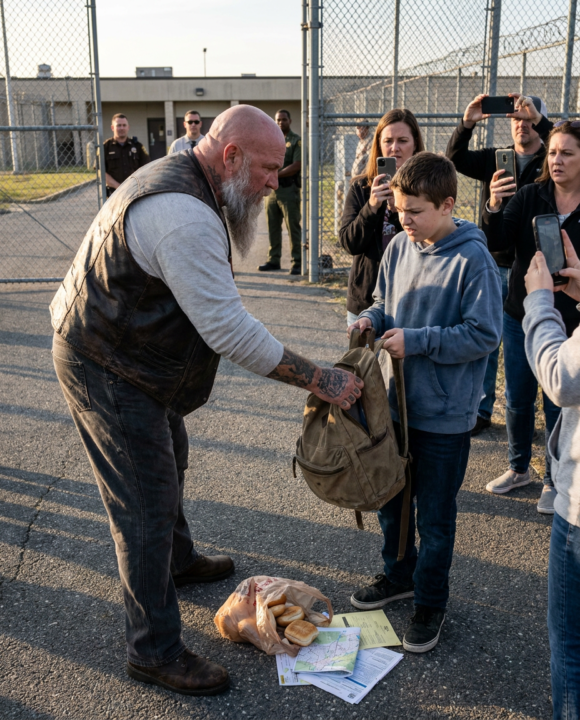
I followed at a distance.
He noticed.
“Stop.”
“I’m offering a ride.”
“No.”
“The bus is forty minutes.”
“I know.”
“It’s starting to rain.”
“I know.”
“You carry an umbrella?”
“No.”
“You enjoy suffering?”
He turned.
“Do bikers always ask this many questions?”
“Only when we’re trying to annoy somebody.”
That almost earned a smile.
Almost.
The rain started before the bus arrived.
Cold November rain.
We stood beneath the narrow shelter.
I kept six feet between us.
Respect matters more after you have already embarrassed somebody.
Eli held the plastic bag of food against his chest.
“What’s the bread for?”
He looked toward the prison.
“Samuel likes cinnamon rolls.”
“They let you send food?”
“No.”
“Then why bring it?”
He shrugged.
“Used to think maybe they’d change their mind.”
“For eight months?”
“Yes.”
“What happens to it?”
“Sometimes I eat it. Sometimes I give it away.”
That hurt more than it should have.
A ritual with nowhere to go.
“What did Samuel do for you after the fire?”
“Nothing.”
“Nothing?”
“He checked on us.”
“That’s something.”
“He helped Mom find another apartment.”
“Also something.”
“He fixed our porch once.”
“Again—”
“He didn’t want anything.”
There it was.
Eli spoke like he had memorized the defense.
Six years ago, Samuel Ortega had carried a nine-year-old boy out of fire.
Four years later, police arrested him for the armed robbery of a small wholesale electronics store.
No one was injured.
The prosecution’s case relied on several pieces of evidence: a vehicle resembling Samuel’s truck, partial physical evidence the defense disputed, and witness testimony placing him near the store late that night.
Samuel had prior convictions from his twenties.
Burglary.
Auto theft.
He had served time.
That mattered to the jury.
Eli hated that part.
“They heard ‘ex-con’ and stopped listening.”
I did not tell him juries were more complicated than that.
He was fifteen.
He was also not entirely wrong.
“What does Samuel say?”
“That he was home.”
“Alone?”
“Mostly.”
“Mostly?”
“He drove his neighbor to work earlier.”
“Which neighbor?”
“Mrs. Keller.”
“In your files?”
“Yes.”
“She testify?”
“No.”
“Why?”
“She was in the hospital by trial.”
“Still alive?”
“Yes.”
“Did you talk to her?”
Eli looked at me.
That answer was obvious.
“Yes.”
“What did she say?”
“That Samuel dropped her at 10:55.”
“And robbery?”
“11:32.”
“How far?”
“Twenty-eight minutes if you speed.”
“That doesn’t clear him.”
“I know.”
The speed of his reply impressed me.
He was not building a fantasy.
He understood gaps.
“What else?”
He hesitated.
Then asked, “Why do you care?”
Fair.
I looked at the prison fence.
“Because I recognize Harold Vance.”
His face changed.
“You know him?”
“Yes.”
“How?”
“Club used him as a witness once.”
Eli stared.
“When?”
“Six years ago.”
“Before Samuel’s trial?”
“Yes.”
His eyes narrowed.
“You told police he was reliable?”
I felt something unpleasant form in my stomach.
“I don’t know exactly what was said.”
“You called them.”
“Somebody from the club did.”
“Who?”
“I need to check.”
Eli stood.
The bus had not arrived.
He was angry now.
“You people do that.”
“Do what?”
“Say you need to check.”
“Sometimes checking is better than guessing.”
“Then everybody forgets.”
“I won’t.”
“You don’t know that.”
He was right again.
I took out my phone.
“Give me your number.”
“No.”
“Fine. Take mine.”
He didn’t.
I wrote it on the back of a fuel receipt.
“Call if you want.”
He stared at it.
Then took it.
The bus arrived.
He climbed aboard.
Before the doors closed, he looked at me.
“You really know Harold?”
“Yes.”
“Then ask him why he said 11:40.”
The doors shut.
I stood in the rain.
That night I called Bear.
Then Atlas.
Then three former club officers.
Nobody remembered exactly who first contacted Harold.
By midnight, we found the answer.
Me.
I had.
Six years earlier.
A completely different case.
One panicked call.
One favor.
One introduction to a detective.
And somehow that path had carried Harold’s name into another investigation.
Not guilt.
Not proof.
But a link.
Enough to make me stop sleeping.
The next morning, I drove to Harold Vance’s house.
Not alone.
That mattered.
I brought Bear.
Not because I expected trouble.
Because a giant biker confronting an elderly witness about testimony could become intimidation very quickly, even without intent.
Harold was seventy now.
Thin.
Retired warehouse supervisor.
Reading glasses attached to a cord around his neck.
He opened the door, saw us and sighed.
“Oh, hell.”
“Good morning to you too.”
“You still ride with those lunatics?”
“Yes.”
“Then no.”
“I haven’t asked anything.”
“That’s never stopped you.”
Fair.
We explained we were trying to understand a timeline from an old case.
No threats.
No accusations.
No telling him what answer we wanted.
We asked whether he remembered Samuel Ortega.
He did.
Barely.
“Guy from the electronics place?”
“Yes.”
“You testified.”
“I did.”
“What did you see?”
Harold frowned.
“A truck.”
“Whose?”
“Looked like his.”
“What time?”
He immediately said, “Around eleven forty.”
Too immediately.
I glanced at Bear.
“You remember after six years?”
“It was in the statement.”
“That isn’t what I asked.”
Harold’s expression hardened.
“I’m not changing testimony.”
“Didn’t ask you to.”
“Then what?”
“Where did eleven forty come from?”
He looked at me.
“Clock.”
“What clock?”
“The pharmacy sign.”
That detail appeared in Eli’s notes.
I had seen it.
The digital pharmacy sign across from the electronics warehouse displayed time and temperature.
Problem was, Eli had found maintenance records.
The sign had been running eleven minutes fast that month.
If Harold read 11:40, actual time could have been 11:29.
That seemed small.
It wasn’t.
Other evidence depended on sequencing.
“What did police ask you?” Bear said.
Harold rubbed his forehead.
“I don’t know.”
“Did they ask whether you were sure?”
“Probably.”
“Were you?”
Harold’s face changed.
There.
Doubt.
“I saw a pickup.”
“What color?”
“Dark.”
“Samuel’s was blue.”
“Dark blue.”
“Model?”
“I don’t know.”
“Driver?”
“Couldn’t see.”
“What made you think Samuel?”
Harold looked irritated.
“They showed me a picture.”
My chest tightened.
“When?”
“After.”
“After what?”
“After I said I saw a truck.”
Bear went silent.
I asked carefully.
“Did you identify Samuel independently?”
Harold stared toward his living room window.
“No.”
That did not automatically make the conviction wrongful.
But it mattered.
“What about the time?”
“I remember the sign.”
“Did anybody verify it?”
Harold shook his head.
Then something else surfaced.
He said investigators treated him like a credible witness partly because of prior cooperation with local police.
That prior cooperation had been our case.
My case.
Six years earlier, one of Iron Harbor’s riders, Cody Lane, had been falsely accused of smashing windows at a rival garage. Harold had seen Cody miles away at the relevant time.
I called the detective.
I pushed.
Hard.
“Harold’s solid,” I had said.
I remembered that sentence.
Not because Harold was dishonest.
Because I wanted somebody to listen.
It worked.
Cody was cleared.
Then Harold’s name entered a mental category among officers.
Reliable citizen witness.
Later, when he reported a dark truck near the electronics warehouse, investigators gave his identification extra weight.
None of that was illegal by itself.
None of it meant the police conspired.
But it showed how trust transfers.
One case bleeds into another.
A rushed confidence becomes an assumption.
An assumption becomes something written in a report.
Written things look stronger later.
I felt sick.
“Why are you asking now?” Harold said.
“A kid.”
“What kid?”
“Boy Samuel saved.”
Harold’s shoulders fell.
“Oh.”
“You remember the fire?”
“Read about it.”
“He’s been collecting evidence.”
“For what?”
“Appeal.”
Harold looked toward the floor.
“I didn’t lie.”
“I know.”
“Don’t make it sound like I lied.”
“I won’t.”
That mattered.
False certainty and intentional deception are not the same thing.
Harold sat down.
“I said what I thought I saw.”
Bear nodded.
“That may be exactly what needs to be said.”
We left without asking him to recant.
We gave him the name of an attorney later.
He could speak through counsel.
Proper process mattered more now.
I called Eli.
He answered after three rings.
“You checked?”
“Yes.”
Silence.
“What happened?”
“Harold remembers the truck.”
“That’s bad.”
“He did not see the driver.”
Eli said nothing.
“He got the time from the pharmacy sign.”
“I know.”
“I know you know.”
“Did he know it was wrong?”
“No.”
“Did police?”
“Not sure.”
Another silence.
Then:
“So I was right.”
“About one detail.”
“That’s enough.”
“No.”
His voice hardened.
“What?”
“One detail is never enough when you’re trying to overturn a conviction.”
“You don’t believe me.”
“I believe you found something important. That is not the same as proving everything.”
He hung up.
Fifteen-year-olds hate caution when they have spent a year alone.
I understood.
Still, caution was what kept help from turning into another mistake.
Then Bear called.
He had found something else.
One of Eli’s handwritten statements came from an elderly neighbor named Mrs. Keller.
She said Samuel dropped her at work before the robbery.
Her original interview had been summarized but never used at trial because she became medically unavailable.
Bear found the old case index.
The full recorded interview might still exist.
That changed the ground under us.
We did not hire a lawyer immediately.
First, we talked to Eli’s mother.
Her name was Caroline Parker.
Thirty-eight.
White.
Home health aide.
Single parent.
Exhausted.
She had no idea her son had been visiting Green Ridge every Saturday.
That conversation went badly.
Again, fair.
She stared at Eli across their kitchen table.
“Eight months?”
He looked down.
“Eight months?”
“Yes.”
“You told me debate club.”
“I went sometimes.”
“What does that mean?”
“Not every Saturday.”
Caroline looked at me.
“You knew?”
“For one week.”
“And you let him go?”
“He was already going.”
“That is not an answer.”
“No.”
She was angry at me because fear needs somewhere to land.
I accepted it.
Then she saw the backpack.
She knew about some papers.
Not all.
Eli had been interviewing neighbors.
Former coworkers.
People who remembered Samuel.
He took buses across town.
Recorded dates.
Photocopied public records at the library.
Used birthday money for printing.
Caroline sat down slowly.
“You did all this?”
Eli nodded.
“Why didn’t you tell me?”
“Because you said there was nothing we could do.”
Her face broke.
She had said it.
Years earlier.
After the appeal failed.
Not because she believed Samuel was guilty.
Because she was poor, overwhelmed and raising a child who still woke from fire nightmares.
Adults sometimes say hopeless things because hope is expensive.
Children can remember them as instructions.
Caroline opened the thickest folder.
Inside was a page titled:
PEOPLE WHO CHANGED THEIR MEMORY
That title bothered me.
Memory does not behave like a camera.
Eli had noted discrepancies.
One neighbor originally said Samuel’s truck was home at midnight, then years later said “maybe.”
A clerk said the robber was six feet tall, then testified “six-two to six-four.”
Samuel was five-eleven.
Another witness heard a vehicle leave but never saw it.
Eli had collected everything.
Some useful.
Some not.
Some contradictory.
Exactly what real evidence looks like.
Messy.
We contacted an appellate attorney named Rebecca Shaw.
Early forties.
Black.
Former public defender.
No patience for dramatic nonsense.
Bear liked her immediately.
She reviewed the case.
Then Eli’s file.
For three hours.
At the end, she closed the binder.
“This kid did work adults should have done carefully years ago.”
Eli looked at me like he had won.
Rebecca immediately added:
“That does not mean Samuel is innocent.”
His face fell.
“It means there are questions worth investigating.”
That mattered.
She identified four areas:
Harold Vance’s identification.
The incorrect pharmacy clock.
Mrs. Keller’s missing recorded interview.
And a set of warehouse access records Eli had discovered through a former employee.
Those records suggested another man with access to a similar company vehicle had been in the area.
Not proof.
But new context.
Rebecca also found something Eli had missed.
Samuel’s original defense attorney had requested surveillance footage from a gas station two blocks away.
The request appeared in court paperwork.
The footage was never entered.
No clear explanation why.
Potentially destroyed.
Potentially irrelevant.
Potentially important.
This was no longer a teenager’s private crusade.
It became a legal case.
That should have made Eli happy.
Instead, he became angrier.
“You all finally care because a biker looked at it.”
Rebecca shook her head.
“I care because I reviewed the record.”
“If I brought it—”
“You’re fifteen.”
“So?”
“So the system should not require a fifteen-year-old to become an investigator.”
That silenced him.
Not because she insulted him.
Because she named what had happened.
Adults had let the burden fall downward.
Caroline cried quietly.
Eli stared at his backpack.
Then I told him the part I had not yet said clearly.
“My club helped create the confidence around Harold.”
He looked up.
“What does that mean?”
Six years earlier, I had pushed Harold as a reliable witness in Cody’s case.
Police knew him.
Trusted him.
When Samuel’s case came, his statement carried weight partly because he had a history of helping.
Again, not enough to cause a conviction by itself.
But part of the chain.
Eli’s face went cold.
“So this is your fault.”
Every rider in the room went still.
I could have defended myself.
Said the cases were unrelated.
Said Harold told the truth as he remembered it.
Said prosecutors, investigators, defense counsel and jurors made independent decisions.
All true.
None useful yet.
I answered:
“I was one link.”
Eli stared.
“That’s not the same.”
“No.”
“What’s the difference?”
“A chain has more than one link.”
His eyes filled.
“Samuel lost six years.”
“I know.”
“No, you don’t.”
He stood.
“You went home.”
That sentence stayed.
He was right.
Whatever my involvement was, I went home.
Samuel did not.
Six years before Samuel Ortega’s conviction, I nearly went to prison myself.
Not for something I did.
That detail matters.
I was thirty-eight.
Running a motorcycle repair shop with two partners.
One night, somebody broke into a rival garage and destroyed thousands of dollars of equipment.
We had argued with the owner the week before.
Publicly.
Loudly.
I had threatened to sue him.
He told police I threatened worse.
Suddenly our club became the obvious story.
Bikers.
Feud.
Damage.
Easy.
A detective questioned me.
Then Cody.
Then Bear.
I remember the feeling when people stop asking whether you did something and start asking why.
Language changes.
“When you went there…”
“When you broke the window…”
“What made you angry enough…”
You start correcting the grammar of your own accusation.
Harold Vance saved Cody from being charged.
He had seen Cody at a convenience store fifteen miles away.
Receipt timestamp.
Security camera.
Harold’s word.
The timeline collapsed.
That case died.
I never forgot the relief.
Maybe that was why, when police later called Harold “solid,” I felt proud.
Our witness.
Good man.
Reliable.
I never imagined confidence could migrate into another case.
That was my deeper wound.
Not guilt exactly.
Recognition.
I knew what it felt like to watch an assumption harden around you.
And I knew what it felt like when one witness cracked it open.
Samuel never got that crack.
Or if he did, nobody widened it.
Rebecca took the case pro bono with support from an innocence-focused nonprofit.
That process was slow.
Months.
Eli hated every week of it.
He still went to Green Ridge.
Now sometimes I went with him.
The prison still did not allow him inside because he was not an approved family visitor and Samuel had restrictions on his list.
We worked through the proper channels.
Rebecca submitted requests.
Eventually Samuel learned that Eli had been coming.
His response arrived through his attorney.
Tell that boy to stop bringing bread.
He needs to be in school.
Eli laughed when he read it.
Then cried.
Rebecca later arranged a legal visit where Eli could see Samuel through proper authorization with Caroline present.
The first meeting lasted forty-five minutes.
We waited outside.
When Eli came out, his face looked older.
“What did he say?” I asked.
“Nothing useful.”
“That sounds like Samuel.”
“How do you know?”
“I don’t.”
He almost smiled.
Then:
“He said I wasted a year.”
“Did you?”
“No.”
“Then?”
“He said I should’ve been playing basketball.”
“You like basketball?”
“No.”
“Then Samuel is wrong.”
“Yeah.”
Weeks later, the old gas station surveillance question produced nothing.
Footage had been overwritten long ago.
Dead end.
The warehouse access records were admitted as new supporting material but not definitive.
Mrs. Keller’s old interview was recovered from archived digital evidence.
That mattered.
Her statement had been summarized incompletely.
She said Samuel dropped her at 10:55 p.m.
Then she added something absent from the trial summary:
He told her he was going straight home because his truck’s alternator light was on.
Eli had found a repair receipt.
Samuel bought an alternator the next morning.
Still not innocence.
But consistent.
Then came Harold.
Through counsel, Harold signed an affidavit clarifying that he saw a dark pickup near the warehouse but never identified the driver, and that his time estimate relied on the pharmacy display.
A technician’s archived maintenance note confirmed the sign was eleven minutes fast.
The prosecution had not knowingly presented false testimony.
The defense had not checked the clock.
A tiny factual error sat inside a large human decision.
Rebecca found one more issue.
The prosecution’s timeline placed Samuel’s truck leaving the scene just before 11:40.
If Harold’s actual observation happened closer to 11:29, it overlapped differently with another witness’s sequence.
The “tight” timeline shown at trial was less tight.
Suddenly pieces that once reinforced each other began to separate.
That is how wrongful confidence sometimes breaks.
Not with one dramatic piece.
With enough small pieces refusing to fit the old picture.
Eli carried his backpack to every attorney meeting.
Rebecca eventually told him to stop.
“Why?”
“Because I scanned everything.”
“What if you lose it?”
“I have three backups.”
“What if—”
“Eli.”
He stopped.
“You’re allowed to put it down.”
He looked confused.
Rebecca repeated:
“You are allowed to put the backpack down.”
I watched his hands loosen from the straps.
For one year, that bag had contained Samuel’s future.
At least in Eli’s mind.
No wonder he never let anybody touch it.
The appellate hearing took place fourteen months after I first met Eli outside the prison gate.
By then, he was sixteen.
Taller.
Still skinny.
Backpack replaced, though he kept the old one in his room.
Samuel Ortega had served six years and four months.
The legal issues became more complicated than any viral story would like.
There was no single moment where a judge slammed a desk and announced corruption.
Instead, Rebecca argued cumulative error and new evidence undermining confidence in the original verdict.
The state defended the conviction.
That matters.
Prosecutors argued that even correcting Harold’s timeline did not automatically eliminate other evidence.
They were right about that narrow point.
Rebecca argued the other evidence had been presented as a mutually reinforcing chain and the corrected timeline weakened key links.
The judge asked questions.
Lots of them.
Harold testified.
Calmly.
He admitted uncertainty.
He said he had never intended to identify Samuel personally.
He apologized for sounding more certain at trial than he felt now.
Rebecca asked whether anyone pressured him to lie.
“No.”
Important.
Whether I pressured him before the appeal.
“No.”
Important again.
Then came Mrs. Keller’s recorded interview.
Then records.
Then testimony from a former investigator about how witness information moved between cases.
My name came up.
Iron Harbor came up.
I testified.
I hated it.
Not because I feared trouble.
Because I had to say aloud how easily I had once used the words:
Harold’s reliable.
Rebecca asked:
“What basis did you have?”
“He helped clear our rider in another case.”
“Did that make him reliable in every future observation?”
“No.”
“Did you understand that then?”
“No.”
Silence.
“What do you understand now?”
“That confidence is not evidence.”
That sentence ended up in the local paper.
I hated that too.
People online made me sound profound.
I wasn’t.
I was late.
The judge did not rule that day.
Weeks passed.
Eli returned to the prison gate anyway.
Now he stood there with me sometimes.
Still carrying bread.
“Why bring it?” I asked.
“Habit.”
“Samuel still can’t eat it.”
“I know.”
“You going to stop?”
“No.”
Fair.
Then Rebecca called.
The conviction had been vacated.
Not a declaration of innocence yet.
Vacated.
The state could retry.
Eli did not celebrate.
Good instinct.
A month later, after reviewing the remaining evidence, the prosecutor’s office moved to dismiss the charges rather than retry.
Samuel Ortega was legally free.
The announcement spread quickly.
Too quickly.
Reporters wanted the boy.
The biker club.
The “wrongful conviction twist.”
Rebecca controlled what she could.
Caroline refused interviews involving Eli.
Samuel declined all media before release.
The public reversal happened anyway.
The same local outlets that once summarized Samuel as a convicted robber now had to report that the conviction had been vacated and charges dismissed.
Some people apologized.
Some insisted dismissal did not prove factual innocence.
Legally, that distinction exists.
Eli hated hearing it.
Rebecca told him:
“You wanted the system to look again. It looked again.”
“That’s not enough.”
“It may never feel enough.”
“What about six years?”
Rebecca did not lie to him.
“Nothing returns them.”
That was the hardest truth in the story.
Freedom does not refund time.
On release morning, thirty motorcycles lined the road outside Green Ridge.
Not blocking traffic.
Not revving engines.
No stunt.
No intimidation.
Just riders.
Samuel had no family waiting.
His mother died while he was inside.
His sister lived across the country and had not spoken to him in years.
His apartment was gone.
Job gone.
Furniture gone.
Everything that waits six years develops a different owner.
Eli stood closest to the gate.
Seventeen by then.
He carried the same clear plastic bag.
Cinnamon rolls.
I looked at it.
“You really did it.”
He shrugged.
“Eight months.”
“You came longer than eight.”
“Before I met you.”
“Still.”
The gate opened.
Samuel walked out carrying a clear property bag.
Forty-three years old now.
Latino.
Short dark hair gone gray at the temples.
Lean.
Face older than his age.
He stopped when he saw the motorcycles.
Then he saw Eli.
Everything else disappeared.
Eli walked forward.
Not running.
Samuel did not either.
For a second they simply stood there.
Then Samuel looked at the bag.
“You still bringing those stupid rolls?”
Eli started crying.
“So you remember.”
Samuel laughed.
Then hugged him.
No cameras close.
We kept reporters back.
That moment belonged to them.
Afterward, Samuel looked at me.
“You Rook?”
“Yes.”
He stared.
“You the one who started trouble?”
“Probably.”
Eli wiped his face.
“He means the witness thing.”
“Still probably.”
Samuel walked toward me.
I expected anger.
I deserved some.
He said:
“You testified.”
“Yes.”
“About your mistake.”
“Yes.”
“Why?”
“Because it was true.”
He nodded.
No forgiveness speech.
No handshake yet.
That was real.
He had a right not to make my conscience comfortable.
Then Bear opened the back of a pickup.
Inside were Samuel’s first belongings as a free man.
Work clothes.
Boots.
Basic toiletries.
Not gifts piled theatrically.
Things Rebecca and a reentry coordinator had confirmed he needed.
Samuel looked overwhelmed.
“Where am I going?”
That was the next problem.
Freedom without housing is a thin kind of freedom.
Our garage had a back room.
Old storage.
Small bathroom nearby.
Window.
Heat.
Not glamorous.
We renovated it.
Properly.
Permits.
Smoke detector.
Bed.
Desk.
Lock.
Samuel could stay temporarily while reentry services helped him plan.
He looked at me.
“Charity?”
“Rent.”
“How much?”
“Help around the garage.”
He almost smiled.
“That legal?”
“Probably more legal than most things Bear suggests.”
Bear objected.
Good sign.
Samuel agreed.
Two years later, the backpack hangs in our garage.
Not on the main wall.
Not like a trophy.
Eli hated that idea.
Instead, it sits inside a glass-front cabinet near the office.
The torn zipper is still there.
One strap repaired with black thread.
Inside are copies of the original documents.
Not confidential materials.
Just what Eli chose to preserve.
Witness notes.
Maps.
Timelines.
A pharmacy-sign photograph.
And one plastic bread bag, folded flat.
Samuel added that himself.
By then, Eli was seventeen.
He worked afternoons at Iron Harbor Garage after school.
Not because we owed him.
Not because he was a mascot for the story.
Because he liked engines.
Badly.
At first.
He could organize evidence like an attorney and still install a motorcycle battery backward.
Samuel laughed for ten full minutes the first time.
“I saved you from a fire for this?”
“You didn’t save me from electricity.”
“Apparently should have.”
Samuel worked beside him.
Slowly rebuilding.
Not the old life.
A new one.
He had difficulty sleeping.
Crowds bothered him.
Doors locking unexpectedly bothered him more.
He hated being photographed.
He hated anyone saying “at least you’re free now.”
Freedom was good.
It was not a magic eraser.
Rebecca connected him with reentry counseling.
He found full-time work at our garage after six months.
Not out of pity.
He was an excellent fabricator.
Turned out prison shop programs had sharpened skills he already had.
He moved from the back room after eighteen months into a small apartment.
Still came to the garage every morning before seven.
Coffee.
Work.
Arguments with Bear.
Ordinary life.
That became the thing he valued most.
Ordinary.
One afternoon, I found Samuel standing at the glass cabinet.
Looking at Eli’s old backpack.
“You hate that thing?”
I asked.
“No.”
“Then what?”
He touched the glass.
“He carried this for a year?”
“Yes.”
“He was fourteen when he started?”
“Yes.”
Samuel closed his eyes.
“Kid should’ve been worried about girls.”
“He seems uninterested.”
“Sports?”
“Also no.”
“Video games?”
“Sometimes.”
Samuel shook his head.
“He shouldn’t have done this.”
I agreed.
“He shouldn’t have needed to.”
Samuel looked at me.
“That’s different.”
“Yes.”
For a while, we stood there.
Then he pointed at one page.
Harold Vance.
“You know what I hated most?”
“What?”
“Not him.”
That surprised me.
“He was wrong.”
“Partly.”
“Yeah.”
Samuel nodded.
“But people are wrong every day.”
He looked at the file.
“What killed me was everybody stacking wrong on top of wrong until it looked like truth.”
That sentence stays with me more than anything I ever said in court.
Stacking wrong.
A truck looked similar.
A clock was wrong.
A witness sounded confident.
A prior conviction shaped expectations.
A defense investigation missed something.
A statement summary lost detail.
None alone had to become six years.
Together, they did.
Then Samuel asked:
“You still blame yourself?”
I answered truthfully.
“Some.”
“Don’t.”
That surprised me more.
“You should hate me more.”
“I don’t know you enough.”
Fair.
“But you were one phone call.”
“Yes.”
“You did not convict me.”
“No.”
“You helped create a witness reputation.”
“Yes.”
“You admitted it.”
“Yes.”
“Then do something better with that.”
That was all.
No absolution.
Something more useful.
Instruction.
A year later, Iron Harbor started funding a small legal-aid transportation program.
Not an innocence project.
We were not qualified.
We paid bus vouchers and rides for families visiting incarcerated relatives, attending legal appointments or meeting reentry counselors.
Eli suggested it.
“Why transportation?”
Bear asked.
“Because I stood outside for eight months.”
That answered it.
We named nothing after Samuel.
Nothing after ourselves.
No press release.
Rebecca helped set up proper boundaries.
The club paid.
Local nonprofits administered.
Boring.
Useful.
Perfect.
The symbolic ending came on a Saturday in October.
Same season I first met Eli.
Samuel and I drove to Green Ridge.
Not to visit anyone.
Eli came too.
He had recently turned eighteen.
The prison had approved a meeting for a reentry-program orientation Samuel volunteered to speak at.
We stood outside the gate.
Same concrete.
Same fence.
Same bench.
Eli carried a plastic bag.
I looked at it.
“No.”
He smiled.
“Yes.”
Cinnamon rolls.
“For who?”
“Us.”
We sat on the bench.
Three men.
One old biker.
One wrongfully convicted mechanic.
One kid who was no longer a kid.
Eli opened the bag.
Samuel took one.
Then stared at the gate.
“I used to see visitors leave from inside.”
Eli looked at him.
“I used to see visitors go in from outside.”
They laughed quietly.
Two sides of the same fence.
Then Eli reached into his backpack—new one now—and pulled out a folded piece of paper.
“What’s that?” Samuel asked.
“The first statement I ever collected.”
He handed it over.
It was from Mrs. Keller.
Handwritten.
Shaky.
Samuel read.
His eyes filled.
“You kept the original?”
“Yes.”
“Why?”
“Because nobody listened the first time.”
Samuel folded it carefully.
Then gave it back.
“No.”
“What?”
“You keep it.”
“Why?”
“Because you found it.”
Eli looked at me.
I shook my head.
Not my moment.
Then Samuel reached into his jacket.
He removed an old laminated visitor rejection slip.
Eli stared.
“What is that?”
“One of yours.”
“How?”
“Officer gave it to me after release.”
Apparently, staff had retained some old rejected request paperwork linked to visitation inquiries.
Samuel had one copy.
Eli’s name.
Request denied.
Relationship not approved.
He handed it over.
“You stood outside because paper said you weren’t family.”
Eli looked down.
Samuel continued.
“Paper was wrong about that too.”
Eli cried.
Immediately.
No dignity.
Good.
Samuel hugged him.
I looked away because some moments deserve a horizon.
Later, we framed the rejection slip and Mrs. Keller’s statement together.
Not publicly at first.
Eli chose the location.
Above his workbench at the garage.
Two pieces of paper.
One said he did not belong.
One helped prove he had been right to keep showing up.
Underneath, Samuel wrote:
SOME DOORS ARE WRONG BEFORE PEOPLE ARE.
Bear complained the grammar was strange.
Nobody cared.
Years passed.
Eli became a certified mechanic.
Then started night classes in criminal justice.
That surprised us.
“You want to be a cop?” Rook—me, apparently talking to myself according to Bear—asked once.
Eli shook his head.
“Maybe investigator.”
“For defense?”
“Maybe.”
“Law school?”
He shrugged.
“Too expensive.”
Rebecca heard that and laughed.
“We’ll revisit that.”
Samuel stayed at the garage.
Not because he had nowhere else.
Because eventually it became his place.
He built custom exhaust brackets.
Repaired frames.
Mentored younger mechanics.
Never became a motivational speaker.
Never wanted to.
Sometimes customers recognized him from old news stories.
He hated it.
Eli usually rescued him.
“Your bike is leaking oil,” he would say loudly.
Conversation over.
The old prison gate became smaller in memory.
But I still think about the first day.
Fifteen-year-old kid.
Plastic bag of bread.
Backpack full of paper.
Eight months outside.
One year collecting statements.
And me grabbing the strap because I wanted answers faster than he trusted me enough to give them.
I was wrong to do that.
Good intentions do not erase humiliation.
Eli remembers.
So do I.
But sometimes a bad first action can become the beginning of a better second one.
Not because it was secretly right.
Because you correct course.
You step back.
You listen.
You admit your link in the chain.
That became the deepest lesson.
We like stories where the biker sees what everyone else misses.
This was not that story.
Eli saw it first.
For a year.
He saw contradictions.
Dates.
Forgotten witnesses.
A wrong clock.
A man everybody else had already filed away under guilty.
We were late.
Very late.
Our role was not to rescue.
It was to believe the kid enough to put adult resources where his persistence had already pointed.
That is different.
Important difference.
Samuel spent six years and four months in prison.
No ending makes that disappear.
A room behind a garage does not return birthdays.
Thirty motorcycles at a gate do not restore nights.
A dismissed case does not make memory gentle.
But life continued.
Not as repayment.
As continuation.
Eli once asked Samuel whether he regretted running into the burning house.
Samuel said:
“Every time my knee hurts.”
Eli laughed.
Then Samuel added:
“But I’d do it again.”
“Why?”
“You were nine.”
“That’s not an answer.”
“It’s enough.”
Maybe it is.
At fifteen, Eli stood outside a prison gate for eight months with cinnamon rolls that never reached the man he came to see.
At seventeen, he stood at the same gate with thirty motorcycles behind him and watched Samuel walk out.
At eighteen, he sat beside Samuel on the bench and finally ate the bread with him.
That is the image I keep.
Not the hearing.
Not the court.
Not the cameras.
A plastic bag passed between two people who had waited too long to share what was inside.
Our club keeps no plaque calling ourselves heroes.
We keep the backpack.
The rejected visitor slip.
The first handwritten witness statement.
And one note Samuel added years later:
THE BOY KEPT SHOWING UP WHEN ADULTS HAD ALREADY DECIDED THE STORY WAS OVER.
That is accurate.
Painfully.
And beneath it, Eli added his own line:
THEY WERE LATE. BUT THEY CAME BACK.
I asked him once if that line was about us.
He said:
“Partly.”
“What’s the other part?”
He looked at Samuel working across the garage.
“Him.”
Freedom came back.
Trust came back.
Work came back.
Not all at once.
Not completely.
But enough.
Sometimes justice is dramatic.
Sometimes it is a judge’s order.
Sometimes it is a corrected witness statement.
Sometimes it is one teenager who refuses to stop asking why the clock did not match.
And sometimes it is thirty motorcycles idling quietly outside a prison gate while a seventeen-year-old boy holds a bag of cinnamon rolls he has been trying to deliver for nearly two years.
Follow this page for more unforgettable biker stories about misunderstood people, buried truths, stubborn loyalty, and the rough-looking strangers who sometimes discover that the bravest person in the story was already standing there before they arrived.