Part 2: A Tattooed Biker Carried a 79-Year-Old Woman Out of Church Mid-Hymn — Minutes Later, a Heart Monitor Revealed What Everyone Had Failed to See
Part 2 — The Signs Between the Hymns
I did not ride with Grandma to the hospital in an ambulance.
I rode in the passenger seat of Graves’s county response SUV while he drove toward a rendezvous point on Hillsboro Road, one hand steady on the wheel and the other touching the radio whenever dispatch spoke.
Grandma lay reclined behind us with my uncle supporting her shoulders. Graves had placed adhesive pads beneath her blouse and connected them to a compact cardiac monitor. The green line on its screen moved unevenly.
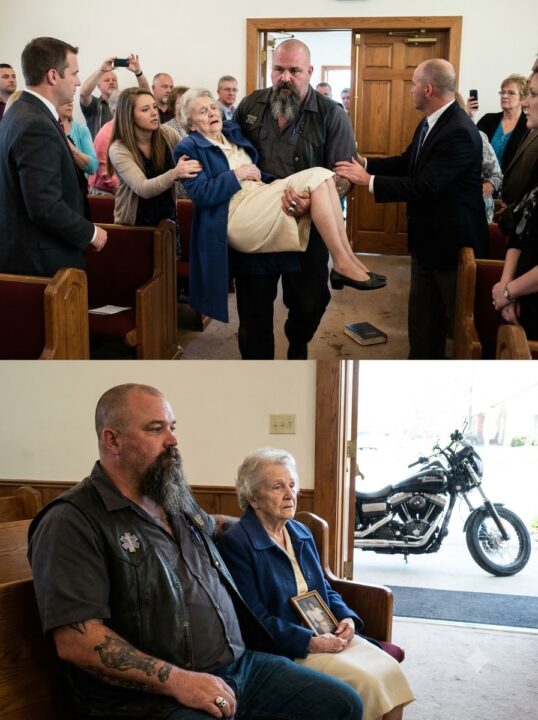
I did not understand the pattern.
He did.
“Cardiac alert,” Graves told dispatch. “Seventy-nine-year-old female, suspected acute coronary syndrome, rapidly declining, atypical presentation. Notify Williamson Medical. I need ALS at Mack Hatcher.”
His language changed in that vehicle. The biker who had answered our shouting with one-word commands became precise. He checked Grandma’s breathing, asked questions, noted her responses, and kept his voice calm even when the monitor alarm changed.
She said her chest did not hurt.
That confused me.
Graves shook his head. “It doesn’t always.”
Grandma complained about her back and asked why her teeth ached. She apologized for causing trouble. Graves told her to save her breath.
Then she looked at the old photograph behind his identification card.
“Ruth Mercer,” she whispered. “Alto section.”
Graves did not look back.
“You knew my wife?”
Grandma closed her eyes. “I knew her last Sunday.”
His fingers tightened around the steering wheel.
The ambulance met us beside a closed hardware store three minutes later. Graves had already transmitted the information. Two paramedics opened the rear doors while a third examined the monitor.
The lead medic looked at Graves. “How long?”
“Symptoms started at least twenty minutes before I reached her. Syncope at 10:31. Pulse irregular.”
“You run a twelve-lead?”
“Single-lead only. She was moving.”
They transferred Grandma to the stretcher. The medic attached more wires, waited for the tracing, and immediately called for the cardiac catheterization team.
That was the moment I stopped being angry.
Not relieved.
Not yet.
Only ashamed that the man we had treated as an attacker had understood what was happening while the rest of us sang around her.
Graves helped load Grandma into the ambulance but did not climb inside. His authority ended at the transfer. He stepped back, closed the doors, and gave the attending paramedic his handwritten notes.
I grabbed his leather vest before the ambulance pulled away.
“Come with us.”
“No.”
“She knew your wife.”
“That’s got nothing to do with her heart.”
“It has something to do with you.”
He removed my hand gently. “Go with your grandmother.”
The ambulance left.
Graves remained beside the county SUV, staring at the old photograph in his identification holder.
I learned later that he had not attended Grace Covenant to worship. He was returning from a twenty-four-hour EMT shift when his Road King developed an electrical fault two miles from the church. His closest friend, Marcus “Stone” Callahan, was bringing a trailer.
Graves went inside because the morning was cold.
He chose the last pew because it faced the door.
That was his explanation.
Stone called it a lie.
According to Stone, Graves had parked outside Grace Covenant on the same Sunday every October for thirteen years. Some years he remained across the road. Other years he entered the parking lot, shut off the Harley, and left before the opening hymn ended.
That morning was the first time he stayed.
Stone found him near the hardware store after the ambulance departed. He was sixty-one, broad across the chest, with a long gray beard tied near its end and the voice of a man who had swallowed road gravel.
“You went inside,” Stone said.
“Bike quit.”
“Battery’s new.”
“Wire came loose.”
“Wire’s tight.”
Graves opened the SUV’s medical compartment and began replacing supplies he had used.
Stone did not ask again.
The Iron Lantern Riders were not an outlaw club. Most were mechanics, truck drivers, veterans, welders, and retired linemen. They rode benefit runs and escorted unclaimed veterans to burial, but years of suspicion had taught them not to explain themselves to people who had already decided what leather meant.
Graves was their road captain.
He was also the only active EMT among them.
That surprised everyone at Grace Covenant. It should not have. Under his plain leather cut, Graves carried trauma shears, nitrile gloves, a CPR mask, and a county radio. His saddlebags held a bleeding-control kit and a compact automated defibrillator.
Those were not decorations.
Graves had worked emergency calls for eleven years.
He had pulled a teenage driver from a smoking pickup on Interstate 65. He had spent forty minutes kneeling in broken glass beside a pregnant woman after a winter collision. He once stabilized a rival motorcycle club member who had threatened him at a bar two weeks earlier.
He never spoke about those rescues.
When a local reporter later asked why he had become an EMT at forty-four, Graves gave the same answer three times.
“Needed useful hands.”
The reporter wanted more.
Graves did not give it.
At Williamson Medical Center, doctors found a severe blockage in one of Grandma’s coronary arteries. Because her symptoms had been recognized early and the cardiac team had been alerted before she reached the emergency entrance, she went directly toward treatment.
A cardiologist explained that older women can experience heart attacks without the crushing chest pain many families expect. Jaw discomfort, unusual fatigue, nausea, cold sweating, shortness of breath, and pain in the back may be the warning.
Grandma had displayed nearly all of them.
We had explained every one away.
Coffee.
Indigestion.
The cold sanctuary.
Her arthritis.
Her age.
Graves had looked at the same details and seen a clock counting down.
The procedure opened the artery in time. Grandma survived, but the cardiologist said another fifteen or twenty minutes could have meant far more heart damage—or no recovery at all.
I called Grace Covenant from the waiting room.
Pastor Warren answered.
“She’s alive,” I said.
The pastor exhaled.
Then he asked about Graves.
I looked through the emergency-room windows. The biker was not there.
But the video of him carrying Grandma had already reached the internet.
Part 3 — The Video Without the Heart Attack
The first clip lasted nineteen seconds.
It began after Graves lifted Grandma from the pew. It showed her pushing weakly against him while people shouted. It showed Daniel grabbing his shoulders. It showed Pastor Warren blocking the doors and Graves saying, “Move.”
The clip ended before Grandma collapsed.
Its caption claimed that a biker had tried to abduct an elderly woman from a Tennessee church.
By noon, the video had been shared thousands of times. Strangers identified Graves from an old charity ride photograph. Others located the Iron Lantern clubhouse and posted its address.
Nobody mentioned the county EMT badge hidden beneath his vest.
The camera angle never showed it.
A second video appeared that afternoon. It showed Graves forcing the sanctuary door open with Grandma in his arms, then placing her inside a dark vehicle.
To people who did not know about the cardiac monitor, the radio call, or the ambulance interception, it looked worse than the first.
Church members began receiving calls.
Some defended him. Others said that even if Grandma had become ill, Graves should have waited for trained responders.
He was a trained responder.
Facts moved slowly.
Fear had a motorcycle.
The Iron Lantern clubhouse sat inside an old transmission shop near Columbia Avenue. By evening, thirteen bikers had gathered beneath fluorescent lights while the clipped video played on a phone.
Grudge Malloy wanted to ride to the church.
Bishop Reed wanted Pastor Warren to issue a statement immediately. A younger prospect named Cole had found the teenager who posted the first video and wanted permission to confront him.
Stone shut the garage door.
Graves stood beside a stripped-down engine, cleaning blood-pressure cuff adhesive from his fingers with shop soap.
“No church,” he said.
Grudge struck the workbench. “They’re calling you a kidnapper.”
“Let them.”
“They posted the shop.”
“So lock the gate.”
“Your face is everywhere.”
“Ugly before the video.”
Nobody laughed.
Cole held up his phone. “Kid who posted it lives six miles away.”
Graves looked at him. “Why do you know that?”
“He put his school on his profile.”
“You contact him?”
“Not yet.”
“You do, hand me your patch.”
Cole’s face changed.
Being told to surrender a patch was not a casual warning. It meant Graves believed the prospect could shame the club.
“He lied about you,” Cole said.
“He recorded what scared him.”
“He cut off the truth.”
“He didn’t have it yet.”
Grudge stepped closer. “You protecting him?”
Graves rinsed his hands. “I’m protecting us from becoming the thing he thinks he filmed.”
The room went quiet.
That was the first test of the brotherhood.
Several members had spent years being judged before anyone knew their names. Now their road captain had been publicly branded a criminal for saving a life, and his answer was to keep every motorcycle away from the church.
They obeyed.
Barely.
At Grace Covenant, the congregation faced its own division. Pastor Warren wanted to publish a statement confirming that Grandma had suffered a medical emergency. The church attorney advised waiting until the family approved the release of her health information.
Daniel wanted Graves arrested for using excessive force.
“You didn’t feel how he pushed through us,” he told me.
“He was carrying Mom.”
“He wouldn’t answer questions.”
“He was counting her pulse.”
“He had no right to take her in his vehicle.”
“He got her to the ambulance.”
Daniel’s anger was not only about Graves. My uncle had been seated beside Grandma when her symptoms started. She had asked him to loosen the collar of her coat. She had said her jaw hurt.
He offered her a mint.
That small mistake followed him through the hospital corridors.
Blaming Graves gave it somewhere else to stand.
Officer Naomi Bell of the Franklin Police Department reviewed the videos, interviewed witnesses, and contacted county emergency services. She confirmed Graves’s credentials and downloaded the dispatch recording.
The recording changed everything.
Graves could be heard requesting an ambulance before he picked Grandma up. He identified her symptoms, estimated her age, and reported that she was becoming unstable. When dispatch advised that the nearest advanced-life-support ambulance was delayed south of a blocked railroad crossing, Graves arranged the intercept.
He had not acted without a plan.
He had acted because the plan could not wait.
Officer Bell visited the clubhouse the next morning. Eleven bikers stood outside when her cruiser entered the yard.
Graves walked toward her alone.
“You arresting me?”
“No.”
“Need a statement?”
“Yes.”
He held out his wrists anyway.
Bell looked at them. “For a man who recognized a cardiac emergency from across a church, you’re not reading this situation well.”
“Reading what people expect.”
“That get tiring?”
“Got used to it.”
Inside the shop office, Graves described Grandma’s symptoms. He admitted moving her without family consent after determining that her condition was life-threatening. He explained the delay, the rendezvous, and the transfer.
Officer Bell asked why he had chosen to carry her instead of treating her inside the sanctuary.
“Needed her near the monitor. Needed the doors clear. Needed the ambulance to find one patient, not three hundred people.”
“You could have explained.”
“She was crashing.”
“Seven words might have prevented a fight.”
“Seven seconds might’ve cost muscle.”
“Heart muscle?”
Graves nodded.
Then he said the sentence that appeared in every later report.
“Every second matters.”
Officer Bell closed her notebook but did not leave.
“My father ignored jaw pain for two days,” she said. “Thought it was a tooth.”
Graves looked at her.
“He died at fifty-eight.”
“Sorry.”
“You probably saved that woman.”
“Probably isn’t a discharge.”
The hospital confirmed Grandma was awake.
Only then did Graves’s shoulders lower.
Officer Bell noticed.
“Why this woman?”
“Same as anybody.”
“That isn’t what she said.”
Graves’s eyes hardened.
Bell placed a printed transcript on the desk. The ambulance crew had documented Grandma’s first coherent sentence after stabilization.
Tell Gabriel I remember Ruth.
Stone, standing beyond the office door, removed his glasses.
Graves folded the transcript once and placed it in his shirt pocket. His scarred hands remained steady.
His voice did not.
“Interview over?”
Officer Bell nodded.
Graves walked into the garage, passed twelve men who knew not to touch him, and stood beside his silent Harley.
The false story online was beginning to collapse.
The older one was just waking up.
Part 4 — The Woman We Failed During the Last Hymn
Ruth Mercer had been forty-two when she died.
She sang alto at Grace Covenant, taught third grade, and kept a roll of peppermints in every coat she owned. She was small enough to disappear beside Graves in photographs but stubborn enough to stop him from walking away from arguments he needed to finish.
She was also the only person who called him Gabriel.
Fourteen years earlier, on the second Sunday of October, Ruth complained that her bra felt too tight around her back. She had been tired for several days and felt sick after climbing the church steps.
Graves wanted to take her home.
Ruth stayed because the choir was short two altos.
During the final hymn, she rubbed her jaw. Eleanor Whitcomb, then sixty-five, stood one row behind the choir and saw her miss a line.
Ruth smiled.
Eleanor smiled back.
That exchange became the sharpest memory of both families.
After the service, Ruth sat in the front pew and said she needed air. Graves found her bent forward with both arms crossed beneath her chest.
He knew something was wrong.
He did not know what.
At the time, Graves repaired heavy equipment. He had no medical training beyond an old CPR class. He lifted Ruth and started toward the doors.
People stopped him.
One church member thought she had fainted and insisted she should remain flat. Another brought water. Someone suggested anxiety. Pastor Warren called 911 and told Graves that moving her could make things worse.
Graves tried to carry her anyway.
Warren blocked the same doors he blocked fourteen years later.
That was not cruelty.
It was confidence without knowledge.
Ruth opened her eyes and asked Graves to stop frightening everyone. He put her down because she asked him to.
The ambulance arrived eleven minutes later.
Ruth suffered cardiac arrest before reaching the hospital. Paramedics restored a pulse, but the damage to her heart was severe. She died the next morning.
Graves never returned to the choir loft.
He did return to the church parking lot.
At first, he came angry.
He demanded to know why nobody recognized the warning signs. Pastor Warren admitted he did not know. Eleanor said she had suspected Ruth might be having a heart problem but doubted herself because Ruth had denied chest pain.
Graves looked at Eleanor and asked one question.
“How long did you suspect?”
She answered honestly.
“Maybe a minute.”
He left before she finished speaking.
One minute became fourteen years in Eleanor’s mind.
She had worked as a bookkeeper, not a nurse. She had no authority, no training, and no certainty. Yet she could not forget that she had seen Ruth’s gray face and chosen politeness over interruption.
The day after the funeral, Eleanor made an appointment with the county training center. She completed CPR and basic first-aid classes at sixty-five.
Then she did something nobody knew.
She established a small emergency-training grant through the Ruth Mercer Memorial Fund.
The first recipient was Gabriel Mercer.
Graves had applied to an evening EMT program six months after Ruth died. He could afford the tuition, but he had stopped working enough hours to remain beside her hospital bed and settle her debts. Stone submitted his name for assistance without telling him who funded it.
The approval letter said only that an anonymous local donor believed “useful hands should never be stopped by an empty wallet.”
Graves hated accepting help.
Stone told him the money was already paid.
He enrolled.
His first night in class nearly ended his EMT career before it began. The instructor projected a slide showing atypical heart-attack symptoms in women: pressure in the upper back, nausea, jaw pain, cold sweat, fatigue, and shortness of breath.
Graves left the room.
Stone found him in the parking lot with both hands wrapped around the handlebars of his Harley.
“She had every one,” Graves said.
Stone did not deny it.
“I put her back down.”
“She asked you.”
“I listened.”
“You didn’t know.”
“That don’t give back the morning.”
Stone waited until Graves’s breathing slowed.
“You quitting?”
Graves looked toward the classroom.
“No.”
He returned inside.
For eleven years, he answered emergency calls without knowing Eleanor had paid the first tuition bill. She continued contributing anonymously, funding first-aid courses for ushers, teachers, and restaurant workers across Williamson County.
Grace Covenant received one offer every year.
Pastor Warren declined the first three because the church already had two physicians in the congregation. After another member collapsed during a weekday meeting, he accepted. Eleanor completed each refresher course.
That was why she recognized the medical bag when Graves opened it beside the SUV.
It was why she knew how quickly he had assessed her.
And it was why she spoke Ruth’s name.
Grandma told me everything from her hospital bed the day after her procedure. Her voice remained thin, but her memory was clear.
“Gabriel thinks I failed Ruth,” she said.
“Did you?”
“I was afraid of being wrong.”
“That isn’t the same as failing.”
“When somebody is dying, the difference can become small.”
I did not know how to answer.
Pastor Warren stood near the window. He had heard the same confession.
He carried his own version.
After Ruth’s death, he kept a copy of the emergency report inside his desk. The report did not accuse him, but one sentence had been underlined in blue ink.
Husband attempted to move patient toward exit but was advised to wait.
Warren had underlined it himself.
He believed Graves had returned to punish him.
Instead, Graves saved the woman who had doubted herself beside Ruth.
Grandma asked me to call him.
He refused.
She sent Stone a message.
Graves still refused.
Then she asked Pastor Warren to visit the clubhouse and tell Graves who had paid his tuition.
The pastor drove there alone.
Twenty motorcycles were parked outside. Men in leather watched him cross the yard. Stone opened the door but did not invite him farther.
“I need Gabriel,” Warren said.
“You and half the internet.”
“It concerns Ruth.”
Stone’s expression changed. “Careful.”
Pastor Warren held out a sealed envelope containing the original grant documents.
Graves appeared behind Stone.
Warren looked at the man he had once stopped at the church doors.
“Eleanor funded your EMT training.”
Graves did not move.
Warren handed him the envelope.
“She believed Ruth died partly because we waited. She wanted the next person to meet someone who wouldn’t.”
Graves opened the first page.
His name appeared beneath Eleanor’s signature.
For eleven years, he had carried strangers toward help using skills purchased by the woman he had blamed for remaining silent.
The last stranger was Eleanor herself.
Part 5 — When the Full Video Reached the Church
Graves visited Grandma after midnight.
He came without his leather vest. A charcoal work shirt covered most of his tattoos, but nothing could make him look small in the hospital doorway.
Grandma was awake.
I offered him my chair. He shook his head. Pastor Warren stood and moved toward the hall.
Graves stopped him.
“Stay.”
The pastor sat again.
For several seconds, nobody spoke. Hospital air moved through the vent. A monitor beeped beside Grandma’s bed. Graves looked at the woman he had carried through three hundred frightened people.
“You paid my school.”
Grandma nodded.
“Why anonymous?”
“You would have returned the check.”
“Yes.”
“That is why.”
“You kept paying.”
“There were other students.”
“Why me first?”
Grandma touched the blanket where wires disappeared beneath her gown. “Because I watched you hold Ruth’s hand after the doctors stopped trying. You kept asking what you should have known. I thought someone ought to help you learn it.”
Graves’s jaw tightened.
“You could’ve told me.”
“You were angry.”
“Still am.”
“I know.”
“At you?”
Grandma considered the question. “Some days.”
That answer surprised him.
She continued. “Other days you were angry at Pastor Warren. Then at the ambulance. Then at Ruth for finishing the hymn. Mostly, I think you were angry at the man who put her down when she asked.”
Graves looked toward the window.
Grandma did not rescue him from the truth.
He had spent fourteen years replaying that movement: Ruth in his arms, church members offering advice, her embarrassed voice asking him not to make a scene, and his decision to lower her onto the pew.
“She trusted me,” he said.
“She loved you. That is not the same as knowing what was happening inside her artery.”
“I should’ve carried her out.”
“Yes.”
Pastor Warren lowered his head.
Graves looked at him. “You should’ve moved.”
“Yes,” Warren said.
No defense.
No sermon.
Only the word Graves had waited fourteen years to hear.
Grandma reached toward him. “And I should have said the words out loud.”
“What words?”
“I think she’s having a heart attack.”
Graves finally took the chair.
Grandma’s fingers rested near his wrist but did not touch him. “We all knew pieces. Nobody was willing to sound foolish by putting them together.”
“You don’t owe me tuition for that.”
“I know.”
“Then why?”
“Because guilt sitting still becomes rot.”
Graves looked at her for a long time.
Then he removed a county EMT pin from his shirt pocket and placed it on the blanket. Its surface was scratched. The clasp had been repaired with thin wire.
“First one they gave me,” he said.
Grandma picked it up.
“Keep it.”
“No.”
“I didn’t save Ruth.”
“You saved me.”
“That doesn’t trade.”
“I did not ask it to.”
Graves’s shoulders lowered.
The hospital door opened. Officer Bell entered with a laptop and the teenage boy who had recorded the first video.
His name was Ethan Cole. He was seventeen. His father had brought him to speak with Graves after investigators confirmed that he had cut the footage before posting it.
Ethan remained near the door.
“I’m sorry,” he said.
Graves did not answer.
Ethan explained that he began recording after hearing Grandma protest. He stopped when the crowd moved into the parking lot because his mother pulled him back. He uploaded the clip before learning what happened.
“Why?” Graves asked.
“I thought people should see.”
“See what?”
“You taking her.”
“Why?”
Ethan swallowed. “I thought you were hurting her.”
“Did you know?”
“No.”
“Then you didn’t show what happened. You showed what you guessed.”
Ethan lowered his eyes.
Graves could have humiliated him. Half of Tennessee seemed ready to do it for him.
Instead, he turned the laptop toward the boy.
Officer Bell had obtained the sanctuary’s security recording. It showed the minutes before Graves stood. Grandma rubbed her jaw. She removed her coat. Her hymnal trembled. Graves watched her, moved closer, checked her wrist, and called dispatch before lifting her.
The audio captured his words at the door.
“She doesn’t have time.”
The full recording continued into the parking lot. It showed Graves opening his medical bag, connecting the monitor, and requesting cardiac interception while the congregation surrounded him.
Ethan watched the entire sequence.
“What do you want me to do?” he asked.
Graves tapped the replay button.
“Post the part you missed.”
The full video appeared the next morning without dramatic music or a defensive speech. Ethan included the dispatch recording and a brief statement from Grandma authorizing release of her medical information.
Public opinion reversed quickly.
Too quickly for Graves.
The same strangers who had called him a criminal now called him an angel, a hero, and proof that appearances deceive.
He disliked the new labels almost as much as the old one.
“Yesterday I was an abductor,” he told Stone. “Today I’m a saint.”
“Could grow wings.”
“Could remove your front teeth.”
Stone smiled. “There he is.”
The club did not celebrate. Instead, Graves asked its members to attend the next emergency-response course at Grace Covenant.
Grudge objected.
“That church let people call you a criminal.”
“So learn in their building.”
“They should come here.”
“Then we become two rooms pretending the other one’s the problem.”
Grudge muttered but enrolled.
Thirty-two bikers entered Grace Covenant the following Saturday. Some church members moved away when they saw the leather vests. The men noticed.
They took the back rows anyway.
Pastor Warren opened the course by standing beside the same doors he had blocked twice.
He removed the decorative table that narrowed the exit. Then he gave every usher a key to the side entrance and posted the church’s emergency address beside each phone.
No speech followed.
Graves approved of that.
During the practical session, Grandma’s empty chair remained near the front. The instructor reviewed atypical cardiac symptoms, emergency calls, CPR, and defibrillator use.
Graves demonstrated on a training mannequin.
His scarred hands moved carefully.
Nobody interrupted.
Part 6 — The Debt Hidden Inside the Vest
Grandma returned to Grace Covenant six weeks later.
She walked slowly with a cane. Daniel held one elbow, and I held the other. When the congregation began applauding, she raised a hand and told them to stop.
“I survived a procedure,” she said. “I did not win an election.”
People laughed because she allowed them to.
Graves sat in the last pew.
He wore the same plain leather vest, but something had changed beneath its left inner seam. Stone had sewn a narrow piece of blue cloth inside it.
The fabric came from one of Ruth’s old choir robes.
Graves had kept the robe sealed inside a plastic storage box for fourteen years. After the hospital visit, he cut a strip from the hem and asked Stone to attach it where nobody could see.
Stone’s sewing was crooked.
Graves left it that way.
Grandma sat beside him instead of returning to her usual pew. Several people turned to look. Graves stared forward.
“You’re in my seat,” he said.
“I paid for it.”
“You paid tuition.”
“Interest.”
He moved six inches.
That was all the invitation she needed.
After the service, Pastor Warren brought out the emergency report from Ruth’s collapse. Graves had avoided reading the full document because he believed he knew what it contained.
He did not.
A handwritten note on the final page recorded that Eleanor had ridden in the ambulance behind Ruth. She remained at the hospital until Graves’s friends arrived. She had also given emergency staff Ruth’s medication list after retrieving it from the church office.
Graves looked at Grandma.
“You stayed?”
“You did not know me.”
“You stayed all night.”
“You were alone.”
“Why didn’t I remember?”
“You were watching her door.”
Another judgment Graves had carried for fourteen years broke quietly.
He had remembered Eleanor as the woman who hesitated.
He had forgotten the woman sitting at the end of the hospital corridor with his coat folded across her lap.
Grandma handed him the scratched EMT pin he had left in her room.
“I said keep it,” he told her.
“I did. Until I could return it here.”
She pinned it inside his vest beside the strip of Ruth’s choir robe.
The silver disappeared when the leather closed.
No one outside Graves’s circle would know it was there.
That suited him.
The Iron Lantern Riders funded two cardiac-response kits for community buildings along rural roads where ambulance delays were common. Grace Covenant purchased its own defibrillator and placed it near the sanctuary doors.
No club name appeared on the cabinet.
No plaque carried Graves’s name.
When a reporter asked why he refused recognition, he pointed toward the emergency kit.
“Machine doesn’t work better with my picture on it.”
Ethan, the teenager who posted the clipped video, joined the church’s safety team. Graves required him to finish the same first-aid course before touching any equipment.
Ethan passed.
Then Graves made him take it again.
“You don’t trust me?” the boy asked.
“Trust gets people comfortable.”
“What do you want?”
“Competent.”
Ethan returned the following Saturday.
Daniel came too. My uncle had stopped defending the mint he gave Grandma. He carried one in his pocket for weeks, rubbing the paper wrapper whenever guilt rose.
At the second class, he threw it away.
Graves saw him.
Neither man spoke.
Sometimes that was how forgiveness looked among men who did not know how to name it.
Part 7 — The Door Graves No Longer Avoided
One year after Grandma’s heart attack, Graves arrived at Grace Covenant before the first hymn.
Twenty Iron Lantern motorcycles rolled into the parking lot behind him. Their V-twin engines settled into a low uneven rumble, then stopped one after another beneath the October trees.
No one watched from behind curtains.
Pastor Warren stood beside the open doors.
He moved before Graves reached them.
Grandma waited in the fourth pew wearing the same blue wool coat. She had completed cardiac rehabilitation, changed her breakfast habits, and developed an irritating habit of asking everyone over sixty whether their jaw hurt.
Graves sat beside her.
“You warm?” he asked.
“No.”
“Nauseous?”
“No.”
“Back?”
“Gabriel.”
He stopped.
She smiled. “I’m fine.”
Graves checked her face before believing it.
The choir began Ruth’s favorite hymn. I stood with the altos, looking toward the last pew out of habit.
It was empty.
Graves remained beside Grandma through every verse.
Halfway through the service, a motorcycle engine started outside. A club member had received an emergency call from his wife and needed to leave. The sound passed beneath the stained glass, deep and uneven, then faded toward Columbia Avenue.
Nobody flinched.
After the final prayer, Pastor Warren asked Graves to remain. A small framed photograph rested on a table near the doors. It showed Ruth in her blue choir robe, laughing at something beyond the camera.
Graves stared at it.
“No plaque,” he said.
“No plaque.”
“No hero speech.”
“No speech.”
“Then what’s it doing here?”
Pastor Warren turned the frame around.
The back contained the original sentence from Eleanor’s anonymous tuition grant.
Useful hands should never be stopped by an empty wallet.
Graves read it once.
He gave the photograph to Grandma.
“You keep it.”
“She was your wife.”
“You remembered her when I couldn’t remember anything but losing her.”
Grandma held the frame against her coat.
Outside, Ethan waited beside Graves’s Harley. The teenager had bought an old motorcycle that did not yet run and wanted Graves to inspect it.
Graves looked at the rusted machine secured to a trailer.
“Bad fuel system,” he said.
“You haven’t started it.”
“Don’t need to.”
“Can it be fixed?”
Graves glanced toward Stone, who was already unloading tools.
“Everything costs.”
“I have three hundred dollars.”
“Not money.”
Ethan understood.
He spent the next six Saturdays cleaning the clubhouse, restocking first-aid kits, and attending emergency-response drills. The motorcycle ran on the seventh.
Graves did not let him ride it until the eighth.
Grandma watched from a folding chair while the boy crossed the empty lot in first gear. Stone shouted instructions. Grudge complained about the clutch. Pastor Warren held a helmet and tried not to look nervous.
The scene would have seemed impossible a year earlier.
No one photographed it.
That made it better.
Before leaving, Graves helped Grandma into Daniel’s car. His hands were broad enough to surround her forearm, yet he held her as if checking the pressure on something fragile.
She touched the front of his leather vest.
“Do you still carry Ruth?”
Graves opened the left side just enough to reveal the crooked strip of blue cloth and the scratched EMT pin.
“Every call.”
Grandma nodded.
“Good.”
Graves mounted the Road King. The engine turned over with one deep pulse, then another. Twenty bikers followed him from the church lot, their taillights forming a red line toward Hillsboro Road.
At the exit, Graves looked once at the open sanctuary doors.
This time, nobody stood in his way.
Follow the page and leave GRAVES below for more stories about misunderstood bikers whose quiet actions save lives before explanations arrive.