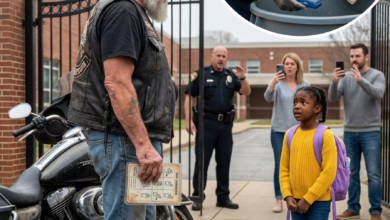
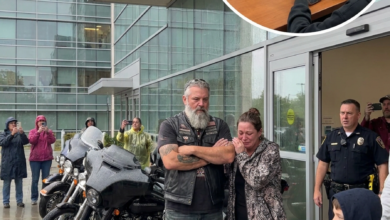
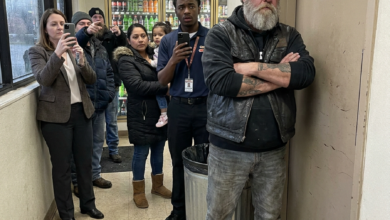
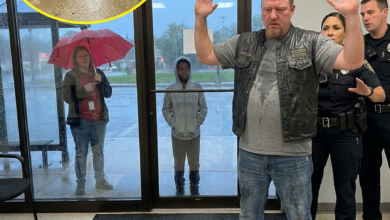
Part 2: A Tattooed Biker Blocked the Bride from Entering Her Wedding Car—Then One Unopened Envelope Exposed the Promise Her Family Had Buried for Eleven Years
Part 2 — The Biker Marianne Trusted
Ava did not open the envelope beside the Packard.
She carried it back into St. Luke’s and entered the small bridal room behind the sanctuary, still wearing her mother’s veil. Grant followed. So did Thomas, Grant’s mother, the wedding coordinator, and two deputy sheriffs who had arrived expecting a violent intruder.
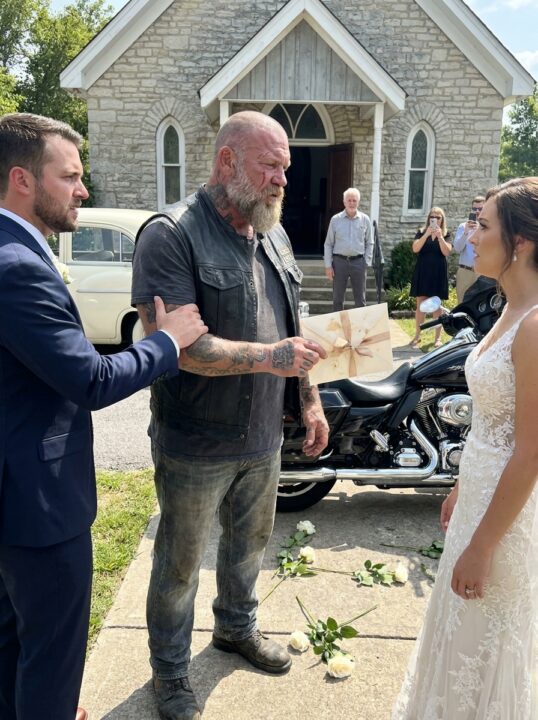
Rook remained outside.
I stayed because Ava caught my wrist and said, “Photograph everything.”
That was unusual. Most brides wanted cameras lowered when a private disaster began. Ava wanted evidence.
She placed the envelope on the dressing table. Blood from Rook’s knuckles marked one corner, while the faded blue ribbon had darkened from eleven years of sweat, rain, and road dust.
Thomas reached for it.
Grant stopped him.
“Let her read it.”
“You don’t understand who that man is.”
“Then explain.”
Thomas looked toward the deputies as if hoping their presence would restore his authority. “Silas Mercer has a record. Assault. Burglary. Driving under the influence. He spent four years in prison.”
Every statement was true.
None was complete.
Rook grew up outside Knoxville with an alcoholic father and a mother who disappeared before he turned nine. At sixteen, he stole a truck after his father broke his jaw. At nineteen, he joined three older men in burglarizing a warehouse. At twenty-four, he drove drunk and put his Harley through the window of an abandoned hardware store.
The courts gave him four years.
He served every day.
What Thomas did not mention was that Rook had been sober for twenty-six years, that he ran a motorcycle repair shop employing former inmates, or that his club—the Black Rooks—organized funeral escorts and transported medicine after tornadoes.
He also omitted Marianne.
Ava untied the ribbon, but before she broke the seal, the church secretary entered carrying the photograph that had fallen outside.
It showed a much younger Marianne beside Rook at a Tennessee roadside overlook. Marianne wore denim overalls and held a motorcycle helmet beneath one arm. Rook had shoulder-length hair, fewer tattoos, and an expression I had never seen on his face outside.
He was smiling.
Around their necks hung matching silver lockets shaped like halves of the same compass.
Ava touched her mother’s face in the photograph. “Dad?”
Thomas closed the door.
“Your mother made mistakes before we met.”
Rook’s voice came from the hallway.
“I was one of them?”
He had entered quietly, escorted by Deputy Lena Brooks. Blood darkened the cloth wrapped around his knuckles, but he kept his hands visible.
Thomas turned. “You were never invited inside.”
Deputy Brooks answered for him. “Mrs. Whitaker requested his presence.”
Ava had not yet grown accustomed to her married name. Hearing it now made her flinch.
Rook stopped near the wall, leaving space between himself and everyone else. His leather creaked when he folded his arms. The room smelled faintly of gasoline, rain, and old tobacco, although I never saw him smoke.
Ava held up the photograph.
“What were you to my mother?”
Rook looked at Thomas.
Then he answered.
“My sister.”
The room went still.
Marianne Caldwell had been born Marianne Mercer.
Rook was four years older. They shared a mother but had different fathers, a detail Thomas later used to pretend they were barely family. In childhood, however, they had been inseparable. Marianne hid beneath Rook’s bed when their mother’s boyfriends fought. Rook walked her to elementary school, stole food when the refrigerator was empty, and slept against her bedroom door when strangers stayed overnight.
When he went to prison, Marianne wrote every week.
Rook kept those letters in a metal ammunition box beneath his bunk. Other inmates mocked him until one tore a page and Rook broke the man’s nose. That fight added six months to his sentence.
Marianne still wrote.
She attended his release with a thermos of coffee and the same blue ribbon tied around its handle.
Then she met Thomas Caldwell.
Thomas was a young attorney from a respected Franklin family. He disliked Rook’s record, his motorcycles, and the way Marianne became less polished around her brother. Thomas tolerated him through the engagement, then offered a condition after the wedding.
Rook could remain in Marianne’s life if he never visited their home, never spoke about prison, and never arrived wearing club colors.
Rook refused.
Marianne tried to maintain both relationships. For several years, she succeeded. Rook met baby Ava secretly at diners and public parks. He carried her once around the repair shop while Marianne laughed because the infant kept pulling his beard.
When Ava was three, Thomas discovered the visits.
An argument followed.
Rook broke a kitchen chair after Thomas called Marianne “prison trash.” He never touched Thomas, but the shattered chair gave Thomas the story he needed. He obtained a restraining order, moved Marianne to another neighborhood, and told relatives Rook had threatened the child.
Marianne kept contacting her brother.
Quietly.
The faded hospital bracelet around Rook’s wrist came from the year she underwent surgery for a congenital heart condition. Thomas was away at trial. Marianne called Rook because she was afraid she would not wake after anesthesia.
Rook sat outside her room all night.
She fastened the duplicate bracelet around his wrist and made him promise he would answer if she ever called again.
Eleven years earlier, at 10:43 on a stormy April night, Marianne called.
Rook answered.
Part 3 — What Happened on the Natchez Trace
Marianne had discovered that Thomas was intercepting her mail.
Not all of it. Only letters addressed to Rook, legal papers she kept outside the house, and a series of envelopes she had written for Ava.
One was marked for Ava’s college graduation.
One for her first home.
One for the day she became a mother, if she chose to.
And one for her wedding.
Marianne had lived with heart disease since childhood. She was not expecting to die that spring, but she understood that her damaged valve could fail without much warning. Writing the letters gave her a way to speak beyond whatever time she was given.
She stored them with an attorney in Columbia.
When that attorney retired, the packet was returned to the Caldwell house by mistake. Marianne retrieved it before Thomas could destroy it and called Rook.
“Meet me at the Trace bridge,” she said.
Rook was forty-three then, sober fifteen years and running Mercer Cycle Works outside Nashville. He left the shop on his black Harley in the middle of a thunderstorm.
Marianne drove south in the Packard.
The same ivory Packard now waiting outside Ava’s wedding.
The old car had belonged to Marianne’s grandmother. It had no airbags, unreliable wipers, and a steering column that vibrated above fifty miles an hour. Rook repeatedly told Marianne to stop driving it in bad weather.
She told him to mind his own motorcycle.
They met beside a closed ranger station. Rain hammered the metal roof while Marianne transferred the milestone letters into Rook’s leather saddlebag.
She had one instruction.
“You give each one to Ava yourself.”
Rook looked at the labels. “Thomas will have me arrested.”
“Probably.”
“You could leave him.”
Marianne stared through the rain toward the Packard.
“Leaving isn’t the same as escaping.”
Rook did not understand then. Neither did I when he told us inside the bridal room.
Marianne had spent years mistaking Thomas’s control for stability. He chose her clothes for legal dinners, corrected her grammar in front of friends, monitored household money, and decided which relatives were respectable enough to see Ava.
He never struck her.
He did not need to.
Marianne had started gathering financial records and speaking privately with a divorce attorney. The letters were not only keepsakes. One contained the location of an account she had created for Ava, funded with money inherited from her grandmother.
Thomas did not know about it.
Marianne handed Rook the blue-ribbon envelope last.
“This one matters most.”
“They all matter.”
“This one has to reach her before she gets into her wedding car.”
Rook frowned. “That’s specific.”
“She’ll understand.”
Marianne climbed into the Packard. Rook followed on his Harley because the rain had worsened and her left taillight had failed.
Five miles north of the bridge, the Packard began drifting.
Rook flashed his headlight.
Marianne did not respond.
The car crossed the center line, corrected violently, then struck the guardrail. Its rear end lifted and turned across the wet road. Rook laid his Harley down to avoid hitting the driver’s door.
Leather tore.
Metal screamed.
The motorcycle slid beneath the guardrail while Rook rolled across the pavement. His helmet cracked against a post, and the scar along his temple began that night.
He stood anyway.
The Packard had stopped at an angle above a drainage ditch. Steam rose from the hood. Marianne was conscious but unable to move her left arm.
Rook forced open the door.
She told him she could not breathe.
He cut the seat belt with a shop knife, supported her neck, and called emergency services. Then an approaching pickup lost traction.
Rook heard it before he saw it.
He dragged Marianne from the driver’s seat and placed his own body between her and the road. The pickup struck the Packard, pushing it into the ditch. A piece of chrome cut through Rook’s vest and opened his shoulder.
Marianne’s blood covered his chest because he held her against him until the ambulance arrived.
That was the image witnesses remembered: an enormous tattooed biker kneeling beside a wrecked car, holding Thomas Caldwell’s injured wife.
By the time paramedics loaded Marianne into the ambulance, Thomas had arrived.
He saw Rook.
He saw the motorcycle.
And he decided what had happened before anyone spoke.
Thomas struck him in front of the deputies.
Rook did not hit back.
At the hospital, Marianne underwent emergency surgery. The crash had not caused her collapse. A tear in her aorta had occurred moments before the Packard drifted. Doctors said she might have died on the road if Rook had not followed her.
She lived for seven hours.
Thomas refused to let Rook enter the room.
Rook sat on the floor outside intensive care with rainwater inside his boots and blood drying beneath his leather cut. Marianne’s nurse, Lena Brooks—the same woman who later became a Williamson County deputy—recognized the hospital bracelet Marianne had placed around his wrist years earlier.
She allowed him in for two minutes.
Marianne was weak, medicated, and breathing through an oxygen mask.
She touched the inside of his vest.
“The letters?”
“Safe.”
“Ava?”
“Thomas has her.”
Marianne closed her eyes.
Rook leaned closer.
She whispered, “Don’t let him choose what she knows.”
Those were her last words to him.
Thomas told Ava the motorcyclist who caused the wreck had escaped prosecution because investigators lacked evidence. He never used Rook’s name. He allowed Ava to imagine a faceless criminal.
The official report contradicted him. Road marks, vehicle damage, and medical evidence cleared Rook completely.
But Ava was eighteen, grieving, and dependent on her father.
She never read it.
Three days after the funeral, Rook brought the letters to the Caldwell house. Thomas met him at the gate with two deputies and the restraining order.
Rook held up the blue-ribbon envelope.
Thomas said Ava wanted nothing from him or Marianne’s “final manipulations.”
Rook asked to hear that from Ava.
Thomas refused.
Rook returned the following week. Then the month after that. He mailed copies of the other letters. They came back unopened.
Finally, Thomas moved Ava to Boston for college and changed every contact number.
Rook delivered none of the letters.
He kept them inside a waterproof steel box bolted to the frame of his Harley.
Every mile.
Every year.
Waiting for a wedding.
Part 4 — The Letter Ava Opened
Back inside St. Luke’s, Ava stared at her father.
“You told me the rider killed her.”
Thomas adjusted his cuff as if preparing to address a jury. “I told you a motorcycle was involved.”
“You let me believe it.”
“You were eighteen. You had just lost your mother.”
“So you gave me someone to hate.”
Thomas looked toward Rook. “He was safer to hate than she was.”
Ava’s hand stopped over the seal.
Grant asked, “What does that mean?”
Thomas sat in the corner chair. For the first time that day, he appeared older than sixty-two.
Marianne had planned to leave him.
Thomas discovered the divorce consultation after her death. He also found a copy of the trust documents establishing Ava’s private account. If Ava learned the truth, Thomas feared she would remember every argument, every locked drawer, and every occasion when Marianne asked to visit Rook but was told family peace mattered more.
He feared Ava would blame him.
So he simplified the story.
Marianne died in a storm.
A reckless biker was present.
The brother she loved disappeared.
Thomas became the grieving widower who protected their daughter from further pain.
Ava broke the envelope’s seal.
Rook turned away.
He had carried the letter for eleven years but had never opened it. The corners had bent against tools and highway vibration. Once, after a wreck outside Little Rock, paramedics cut away his vest. He regained consciousness while a nurse was reaching toward the envelope.
He tore out his IV trying to stop her.
The letter belonged to Ava.
No one else.
She unfolded four handwritten pages and began reading silently. Halfway down the first page, she covered her mouth.
Grant knelt beside her.
Ava shook her head and continued alone.
When she reached the second page, she looked toward the chapel window, where the Packard remained visible beyond the glass.
That was why Marianne had specified the wedding car.
When Ava was eight, Marianne once tried to leave Thomas. She packed a suitcase, placed Ava in the Packard, and started the engine. Thomas stood in front of the car and told Ava her mother was destroying the family.
Ava began crying.
Marianne stayed.
For ten years, she carried shame over allowing her frightened child to make an adult decision. In the letter, she told Ava that love should never require a woman to surrender her own voice simply to keep everyone else comfortable.
She did not tell Ava to abandon Grant.
She wrote something more careful.
Before you enter the car, ask whether the man beside you makes room for your truth—even when that truth inconveniences him. If the answer is yes, take his hand. If the answer is no, do not let flowers, guests, money, or fear put you inside.
Ava lowered the page.
Grant rose and stepped away from her.
For one terrible second, I thought he was leaving.
Instead, he opened the bridal-room door and dismissed the guests gathered in the hallway. He told his brothers to put away their phones. He asked the deputies to remain only if Rook wanted medical help.
Then he returned and sat on the floor across from Ava.
“We don’t leave until you decide,” he said.
Thomas laughed without humor. “You’re letting a dead woman run your marriage.”
Grant looked at him.
“No. I’m letting my wife speak.”
That was the moment Rook stopped viewing him as another version of Thomas.
Ava continued reading.
Marianne apologized for the years when Ava confused silence with strength. She explained the trust account. She included the attorney’s name, account numbers, and a key taped beneath the final page.
Then came the line that changed Rook’s place in Ava’s life:
Silas Mercer is my brother, your godfather, and the first man who ever stood between me and danger without asking me to become smaller afterward.
Ava read the sentence twice.
Rook kept his back against the wall.
She asked why he never told her.
“Your father had an order.”
“You’ve broken laws before.”
“Yes.”
“But not that one?”
Rook rubbed his bleeding knuckles against his jeans. “Breaking it would’ve made his story true.”
Ava asked about the other letters.
Rook looked outside.
“They’re on the bike.”
He removed a key attached to a small rook-shaped charm. Deputy Brooks escorted him to the Harley while the rest of us waited.
Rook returned carrying a dented black case. It was scratched, water-stained, and reinforced with two steel straps.
Inside lay five envelopes.
Ava’s college graduation.
Her first home.
Her first great loss.
The day she doubted herself.
Her wedding.
The first four had never reached her.
Thomas stood so quickly that the chair struck the wall.
“Those documents belong to my family.”
Rook placed one enormous hand over the box.
“No.”
Thomas moved toward him.
Grant stepped between them.
This time, the groom was facing the other direction.
Ava opened the graduation letter. A photograph fell into her lap: Marianne and Rook sitting on the hood of the Packard, Ava asleep between them as a toddler.
On the back, Marianne had written:
Two people loved you here. One of them may be forced to love you from a distance.
Ava stared at Rook.
“Did you know what these said?”
“Not a word.”
“You carried them anyway?”
“Promised.”
Eleven years of hatred shifted inside the room.
Not vanished.
Shifted.
Then Deputy Brooks quietly revealed the next problem: Thomas’s original restraining order had expired years earlier. Rook could have contacted Ava after she turned twenty-one.
He had chosen not to.
Ava’s face hardened again.
“Why?”
Rook looked toward her father.
The answer was not inside Marianne’s letter.
It was inside Rook’s past.
Part 5 — The Promise Rook Nearly Broke
Rook had found Ava once.
She was twenty-two, newly graduated, and working at a design studio in Boston. He rode north with the black case inside his saddlebag and waited across from her office for three hours.
Then Ava emerged beside Thomas.
She was laughing.
Rook had not seen her smile since she was a child. From across the street, she looked safe, successful, and close to the father he believed she had chosen.
He followed them to a restaurant.
He never entered.
“Why not?” Ava asked.
“Because I didn’t know if giving you the truth would help you or just make me feel better.”
“That wasn’t your choice.”
“No.”
The admission came without defense.
Rook looked at the floor.
“I made the same mistake he did. Thought protecting you gave me the right to choose.”
Thomas seized upon it. “At least he admits he abandoned you.”
Rook’s head lifted.
“I stayed away. I didn’t abandon her.”
“What’s the difference?”
“An abandoned man quits carrying the letters.”
Thomas had no answer.
Rook continued.
After Boston, he asked three people to watch over Ava from a distance. One was Marianne’s former attorney. Another was Deputy Brooks. The third was my mother, who had remained friends with Marianne and quietly sent Rook copies of Ava’s public milestones.
That revelation stunned me.
My mother died two years earlier. Among her papers, I remembered seeing Christmas cards addressed only to “S.M.” I had assumed they belonged to an old school friend.
They were updates for Rook.
He knew when Ava started her business. He knew about the apartment fire that destroyed her first studio. He knew when she met Grant and when Grant proposed beside the Harpeth River.
He had attended neither celebration.
But he had been nearby during the fire.
Ava remembered a group of bikers arriving with blankets and boxes after the building burned. One huge rider repaired the damaged wheel on her delivery van, refusing payment and leaving before she learned his name.
Rook.
He had been within ten feet of her.
Ava sat down.
“You could have spoken.”
“You were shaking. Didn’t need another ghost.”
Minor details returned one by one.
The anonymous check that kept her studio open had come from the Black Rooks’ emergency fund.
The mechanic who refused to charge Grant for repairing the Packard’s damaged transmission worked at Mercer Cycle Works.
The silver rook left at Marianne’s grave every April came from the charm Rook wore on his vest.
He had stayed distant.
He had never disappeared.
Grant asked how Rook learned about the wedding.
My mother’s final package had contained a newspaper clipping about the engagement. After she died, the updates stopped. Rook searched online until he found the wedding registry and learned the date.
He left Wichita Falls at 2:00 the previous morning.
His Harley developed an electrical fault near Little Rock. Rather than lose time waiting for a tow, he repaired it beneath a gas-station light using wire from a damaged road sign and a pair of pliers.
He rode through rain.
He crossed Tennessee before sunrise.
He reached St. Luke’s forty seconds before Ava entered the Packard.
The timing looked dramatic only because he had almost failed.
Ava approached him.
She touched the hospital bracelet around his wrist.
“You kept this too?”
“Your mom said answer when she called.”
“She can’t call now.”
Rook looked at Marianne’s handwriting.
“Still listening.”
Ava opened the letter marked The day you doubt yourself. She read only the first paragraph before handing it to Grant.
Thomas moved toward the door.
Ava stopped him.
“Did you destroy anything Mom left me?”
Thomas said he had acted as a grieving father.
“That isn’t an answer.”
He admitted finding two earlier notes in Marianne’s desk: a birthday letter and a recorded message. He destroyed the letter. The recording remained inside a locked file cabinet in his home office.
Ava removed the Packard key from Grant’s pocket and placed it on the table.
“We’re not going to the reception.”
Thomas stared at her. “Three hundred people are waiting.”
“They can eat.”
“You’ll humiliate both families.”
Ava looked at Rook’s damaged hand, the case of unopened letters, and Grant sitting patiently on the floor.
“My mother spent eighteen years afraid of embarrassing people.”
She removed Marianne’s veil.
“I’m done.”
Ava, Grant, Rook, Deputy Brooks, and I drove to Thomas’s house in the Packard. Thomas followed in his sedan, calling attorneys on the way.
The Black Rooks arrived behind us.
Twenty-seven Harleys rolled into the Caldwell neighborhood, their low V-twin engines shaking windows. Neighbors came outside expecting violence. Instead, the riders parked in one silent line and remained beside their motorcycles.
Rook entered alone.
Thomas unlocked the office file cabinet.
Inside lay Marianne’s old cassette recorder, financial documents, the destroyed birthday letter in six torn pieces, and a sealed envelope addressed to Thomas.
He opened his own letter.
Marianne had known.
She knew he intercepted her mail. She knew he feared Rook because Rook represented a life she had lived before Thomas taught her to be ashamed of it. She wrote that control did not become love simply because it wore a suit and paid the mortgage.
Thomas read the final paragraph twice.
Then he sat behind his desk and covered his face.
Rook did not mock him.
He gathered the pieces of Ava’s torn birthday letter and placed them inside a folder.
As they left, Thomas spoke.
“You always hated me.”
Rook stopped at the doorway.
“No. I hated what she became around you.”
Thomas looked smaller behind the desk.
“Is there a difference?”
“Yeah.”
Rook walked away without explaining it.
Outside, Ava held the cassette recorder. Grant opened the Packard’s rear door, but she did not enter.
She went to Rook’s Harley instead.
“Take me to the reception.”
Rook looked at her wedding dress.
“You’ll ruin that thing.”
“It’s already dirty.”
“No helmet.”
Hawk, the Black Rooks’ road captain, removed a spare from his bike.
Grant took Ava’s bouquet from the Packard and climbed into the passenger seat beside me. He did not protest when his bride chose the motorcycle.
The engines started.
For the first time, Rook carried his goddaughter down the road.
Part 6 — The Ride Marianne Never Saw
The wedding reception had been arranged at a restored tobacco barn six miles outside Franklin. Guests were already spreading rumors when the first Harley entered the gravel lane.
Twenty-seven motorcycles followed.
Grant arrived in the Packard behind them.
Ava rode at the center with both arms around Rook’s waist, her white dress gathered above heavy borrowed boots. Rain spots marked the skirt. Her mother’s veil was gone, but the blue ribbon from the envelope had been tied around the back of her helmet.
People stepped outside.
Phones rose again.
Then Grant climbed from the Packard and opened the reception doors for his wife.
He did not ask her to explain.
That mattered.
Ava crossed the room beside Rook. Thomas arrived fifteen minutes later but remained in his car until the meal had begun. When he finally entered, no one confronted him. Rook’s brothers did not surround him or threaten him.
They simply made space for Ava.
After dinner, she asked the band to stop.
She placed Marianne’s cassette recorder near the microphone. The tape hissed for several seconds before her mother’s voice filled the barn.
Marianne sounded younger than any of us remembered.
She wished Ava a happy nineteenth birthday. She spoke about burned pancakes, mismatched socks, and the time Ava tried to rescue a frog by hiding it inside the kitchen sink. She never mentioned Thomas or Rook.
Near the end, her voice grew quiet.
“Sweetheart, if someone ever tells you love requires silence, remember that silence is only peaceful for the person who benefits from it.”
The recording clicked off.
No one applauded.
Ava stood beside Grant while guests lowered their eyes. Rook waited near the exit with his helmet beneath one arm.
Thomas approached him.
I expected another accusation.
Instead, he held out the matching half of Marianne’s compass locket. He had kept it in his desk for twenty-eight years.
“This was hers.”
Rook examined it but did not take it.
Thomas placed it on the table.
“I did love her.”
Rook’s jaw moved beneath his beard. “I know.”
The answer appeared to hurt Thomas more than blame would have.
Ava asked Rook to join the father-daughter dance.
He refused.
“I’m not your father.”
“No. You’re the man Mom trusted to get here.”
Rook looked toward Grant.
Grant nodded.
The band began a slow Tennessee waltz. Rook placed one scarred hand carefully against Ava’s shoulder blade, terrified of tearing the dress. He moved with the rigid concentration of a man disarming machinery.
Ava laughed.
The sound broke something open inside him.
His eyes filled, but no tears fell. He lowered his forehead briefly against the top of her helmet-tangled hair and kept moving.
Thomas watched from the edge of the floor.
Halfway through the dance, Ava extended one hand toward him.
He hesitated.
Then Thomas stepped forward.
Rook released her and moved aside.
Ava danced with her father for the final minute, not because the letters were forgiven and not because the past had been repaired, but because choosing distance or closeness now belonged to her.
When the song ended, she returned to Grant.
Rook picked up Marianne’s locket.
He fastened its half beside the silver rook on his vest.
The two pieces did not fit perfectly anymore.
They still pointed in the same direction.
Part 7 — The Envelope Beneath the Leather
Ava did not cut Thomas from her life that night.
She established boundaries he could no longer rename as protection. They attended counseling separately. Months passed before she entered his house again, and he never regained control of Marianne’s trust.
The account had grown untouched for eleven years.
Ava used part of it to open a workshop for women rebuilding their lives after financial control. The workshop occupies an old service garage near Franklin, where the sound of sewing machines mixes with impact wrenches from the motorcycle shop next door.
Rook helped renovate it.
He refused payment.
Every April, Ava rides with him to the Natchez Trace bridge. Grant follows in the Packard, which now carries a repaired left taillight and a laminated copy of Marianne’s letter inside its glove compartment.
They stop beneath the ranger-station roof.
Ava reads one page aloud.
Rook drinks bad road coffee and pretends not to listen.
Thomas joined them once. He stood apart at first, then placed flowers beside the guardrail. Rook did not invite him closer, but he poured a second cup of coffee and left it on the hood of the Packard.
Thomas drank it.
That was all they managed.
It was enough for that morning.
Grant and Ava are still married. The old wedding photographs show scattered roses, frightened guests, and a huge biker kneeling in the road with blood across his knuckles.
My favorite image came later.
Ava sits behind Rook on the Harley, her white dress stained by gravel, her helmet tied with faded blue ribbon. Grant drives beside them in the Packard with one hand raised through the window.
No one in that photograph looks polished.
Everyone looks free to choose.
Rook now keeps Marianne’s remaining letters in Ava’s workshop safe. Only the wedding envelope stays with him. Ava repaired the torn corner and sealed it inside a clear protective sleeve.
It rests in the inner pocket of his leather cut, directly over his heart.
Last October, on Ava and Grant’s anniversary, Rook parked outside St. Luke’s Chapel at the exact place where he had blocked the wedding car. The afternoon was quiet. No guests waited. No phones appeared.
Ava arrived carrying two coffees.
“You were forty seconds from missing me,” she said.
Rook looked toward the road.
“Had time.”
“Barely.”
“Still counts.”
She handed him a coffee and touched the envelope beneath his vest.
“Why keep carrying it? You delivered it.”
Rook started the Harley. Its V-twin settled into a deep, uneven pulse beneath them.
“Some promises don’t end when they arrive.”
Ava climbed behind him.
The Packard followed as they turned toward the Natchez Trace, a faded blue ribbon moving against black leather until the motorcycles became small beneath the Tennessee trees.
Rook kept his word.
Follow our page for more biker stories about feared riders, hidden promises, and the quiet love carried beneath weathered leather.