A Schoolgirl Threw a Lunchbox Into a Biker’s Face Outside Her Brother’s School: When Security Grabbed Her, He Opened the Second Box He Had Packed for the Boy
I threw a metal lunchbox into the biker’s face because I believed he had been terrorizing my twelve-year-old brother—then security pinned my arms while the biker calmly opened an identical box bearing my brother’s name.
The corner struck him above the right eyebrow.
It made a sound I still hear whenever a cafeteria tray falls—the flat clang of metal against bone, followed by the gasp of nearly two hundred students waiting outside Roosevelt Middle School in Tulsa, Oklahoma.
The biker did not fall.
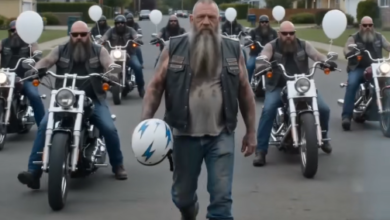
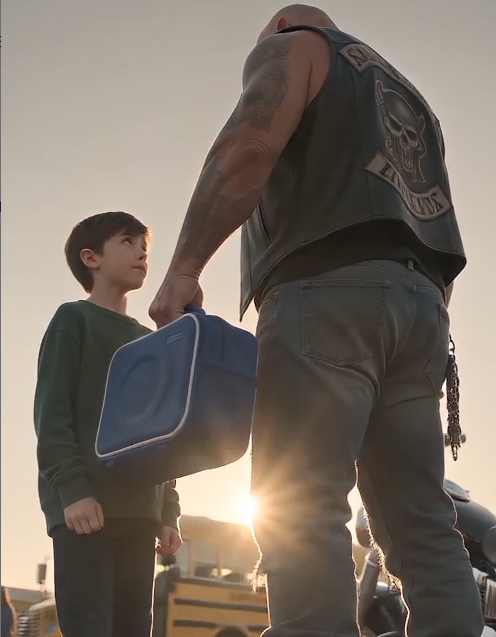
He was six-foot-four and close to 285 pounds, with a shaved head, a black-and-gray beard hanging over a plain leather vest, tattooed forearms and hands scarred by wrenches, asphalt or fights. His black Harley idled beside the curb, its V-twin shaking the chrome while tomato soup ran down his cheek from the lunchbox I had thrown.
Security officer Daniel Price caught me before I could reach him.
“Let me go!” I screamed. “He’s been following my brother!”
The biker wiped soup from his eye.
He did not threaten me. He did not raise those enormous scarred hands. He simply looked past my shoulder toward the school doors as if I were not the person he had come to see.
That frightened me more.
My name is Hannah Brooks. I was seventeen, a senior at the high school sharing Roosevelt’s athletic field, and for three weeks my little brother Noah had been returning home hungry. His lunch disappeared almost every day. Bruises darkened his ribs. Once, I found a strip of black leather inside his backpack and a note written in block letters:
FRONT GATE. FRIDAY. BRING WHAT YOU TOOK.
When I asked Noah who wrote it, he stared at the floor.
“The big biker,” he whispered.
Our mother worked double shifts at Saint Francis Hospital. Our father had been dead for five years, and somewhere during those years I had quietly decided that protecting Noah belonged to me.
So when I saw that Harley outside the gate on Friday—and the huge man holding Noah’s blue lunchbox—I ran before asking a single question.
Students surrounded us with phones raised. Someone shouted that the biker had grabbed a child. Another person said he had a knife. Officer Price twisted my arms behind me while a second guard moved toward the biker.
“Hands where I can see them,” the guard ordered.
The biker’s name was Raymond Dawson, though the men who rode with him called him Hammer. A silver skull ring sat on his left hand. A faded chain hung from his jeans. Beneath the leather and gasoline, he smelled strangely of dish soap and toasted bread.
Hammer slowly opened both hands.
One was empty.
The other held a yellow paper napkin folded into the shape of a small bird.
Then Noah came through the doors.
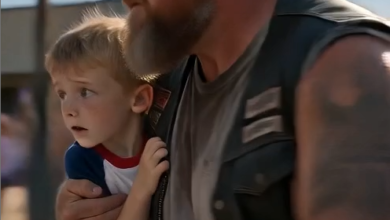
He was pale, thin for twelve and wearing the green sweatshirt he used whenever he wanted to hide his body. He saw soup on Hammer’s vest, the bent lunchbox on the pavement and me struggling against security.
“Hannah,” he said. “What did you do?”
“What did I do?” I shouted. “He’s been taking your food. He’s been hurting you.”
Noah’s face changed.
Hammer crouched beside his Harley and opened the right saddlebag. Inside sat a second blue metal lunchbox, identical to the one I had thrown. He placed it on the curb, clicked open the dented silver latches and lifted the lid.
A turkey sandwich with the crusts removed.
Green apple slices rubbed with lemon so they would not turn brown.
A thermos of tomato soup.
Two oatmeal cookies.
And another yellow napkin, folded into a bird.
On the inside of the lid, written in thick black marker, were the words:
NOAH BROOKS — SEAT 14.
My brother sank to his knees.
Hammer slid the box toward him without looking at me.
“First one got ruined,” he said. “Good thing I packed two.”
Noah began crying before he touched the food.
The crowd fell silent, but I was still looking at his bruises. I was still looking at the leather strip in his backpack and the threatening note. I was still certain some part of this enormous stranger belonged to whatever had been happening to my brother.
“Tell them,” I said. “Tell them what he did.”
Noah wiped his face with his sleeve.
“He didn’t bully me.”
“Then who did?”
My brother looked toward the line of school buses.
Three boys had stopped beside the last one. The tallest wore an expensive red jacket and had my brother’s missing backpack hanging from one hand.
Hammer saw him too.
His jaw tightened, but his voice remained low.
“Kid,” he said, “put the bag down.”
The boy laughed.
Then five more Harleys turned onto the school road, their engines rolling against the brick buildings like distant thunder. The tall boy’s smile vanished. Officer Price reached for his radio. Students backed toward the fence.
Noah gripped Hammer’s sleeve.
“Please,” he whispered. “Don’t tell them whose son he is.”
Hammer looked at the motorcycles coming through the gate, then at the frightened bully holding my brother’s backpack.
That was when I understood the biker had not brought two lunches because he expected me to destroy one.
One lunch was for Noah.
The other had been packed for the boy who kept stealing his food.
And the men arriving on those motorcycles included that boy’s father.
Part 2 — The Man Who Packed the Crusts Separately
The five riders stopped thirty feet from the school doors, killed their engines and left behind a silence filled with ticking metal. None approached until a lean Black man in his late sixties removed his helmet and walked toward Hammer with a slight hitch in his left leg.
His name was Isaiah Cole, but the Iron Haven Riders called him Preacher. He wore no threatening skulls, only a weathered club patch and a small embroidered flag above his heart. His silver hair was pulled back at the neck, and the fingers of his left hand were artificial.
Preacher studied the soup on Hammer’s vest.
“Ray?”
“Girl misunderstood.”
I flinched at the understatement. I had thrown a steel box hard enough to open his eyebrow.
The tallest boy beside the bus dropped Noah’s backpack. His name was Cole Madden, fourteen years old, eighth-grade linebacker, honor-roll student until that semester and son of Victor “Crow” Madden, the broad biker climbing from the third Harley.
Crow saw Cole.
Then he saw my brother.
Finally, he noticed the bruises visible where Noah’s sweatshirt had risen above his waist.
“What happened?” Crow asked.
Nobody answered immediately.
Cole looked at Hammer as if a verdict had already been delivered. “He threatened me yesterday.”
Hammer nodded. “I did.”
Officer Price stepped closer. “What exactly did you say?”
“Told him if he put another hand on Noah, he’d answer at the front gate.”
Crow’s boots struck the pavement hard enough to turn heads. “You threatened my boy without coming to me?”
“Came to you twice.”
“You said kids were having trouble. You never accused Cole.”
“I asked you to look.”
“That’s not the same thing.”
“No,” Hammer said. “Looking would’ve been better.”
The sentence landed quietly, yet Crow’s face reddened. Two riders shifted between them, not touching either man, but ready.
I wanted Hammer exposed. Instead, every answer complicated him.
Officer Price asked why he had been meeting Noah. Hammer pointed toward the leather strip found in my brother’s backpack. It was not a threat or a piece torn from someone’s vest. It was a practice strap cut from an old saddlebag, marked with six rows of stitches.
Noah had been learning to sew.
That sounded absurd until Hammer opened the other saddlebag. Inside were thread spools, needles, small scissors, three more folded napkin birds and a stack of lunch bags labeled with children’s first names.
For nine months, the Iron Haven Riders had been supplying anonymous lunches to students who arrived without food. The school counselor identified the numbers. The riders never received full names unless a family gave permission.
Noah was Seat 14.
Hammer prepared his lunch personally because Noah had severe food anxiety after our father died. Dad’s last morning at home had begun with a turkey sandwich. Since then, Noah could eat one only if the crusts were removed and the bread was cut diagonally.
I had never told Hammer that.
Noah had.
They first met behind Dawson Recovery & Transmission six weeks earlier, after Noah followed a stray dog into the garage yard. Hammer returned him to school, noticed that the boy’s lunchbox was empty before ten in the morning and asked one question.
“Did you eat it, or did somebody need it more?”
Noah told him he had given it away.
That was partly true.
Cole Madden had been taking lunches from sixth graders near the bus lane. He chose children unlikely to fight back and called it a joke. Noah started bringing two sandwiches so Cole could take one without emptying the whole box.
Then Cole began demanding both.
Hammer noticed because Noah came to the garage every afternoon pretending to look for the dog. He never asked for food. He sat on an overturned bucket, watched Hammer repair motorcycles and stared whenever the men opened their lunch containers.
Hammer began placing a sandwich near him without comment.
Noah always divided it.
Half for himself.
Half wrapped in a napkin and hidden inside his backpack.
“For whom?” I asked.
My brother looked toward a smaller boy standing behind the school counselor. His name was Mateo Ruiz. His mother cleaned offices at night, and his father had been deported the previous spring. Mateo often arrived without breakfast. Cole knew it.
That was why Noah refused to report him.
If teachers searched bags or started calling parents, Mateo feared questions about his family. Cole had used that fear to keep both boys quiet.
Hammer discovered the truth after finding Noah behind the garage, trying to stitch his torn backpack with the leather needle. He did not march into the school and frighten everyone. He contacted the counselor. He called Crow. He asked the club president to handle the matter privately.
Nothing changed.
The counselor said Noah denied being harmed. Crow insisted his son was not a bully. Officer Price saw no incident on camera because Cole operated beside the blind spot behind Bus Seven.
Hammer kept packing lunches.
He also taught Noah to repair the bag because, as he told me later, “A kid who learns his hands can fix one thing might believe they can fix the next.”
The folded yellow birds came from Hammer’s late daughter. Her name had been Annie. She used to fold napkins that way for every school lunch he packed.
That explained the birds.
It did not explain Seat 14.
When I asked, Hammer closed the saddlebag.
“Old number,” he said.
Preacher looked at him sharply.
Crow did too.
For the first time, I sensed that both men knew the number, and neither wanted it spoken in front of the school.
Officer Price released my arms. My wrists throbbed. Hammer’s eyebrow continued bleeding, but he refused the nurse until Noah finished eating.
Cole remained beside the bus, trying to look defiant. Hammer picked up the dented lunchbox I had thrown and set it on a bench.
“You hungry?” he asked.
Cole’s eyes flicked toward the spilled sandwich.
Crow stared at his son. “Answer him.”
The boy’s jaw trembled.
“No.”
His stomach answered for him.
The sound was small, almost lost beneath the chain rattling against Hammer’s jeans. Yet every rider heard it.
Hammer took the sandwich from Noah’s box and held it out.
Noah pushed it back toward him.
“The other one was for Cole,” he said.
That surprised me. It surprised Crow more.
Hammer had learned that Cole was stealing lunches because there was rarely food in his own house. Crow’s trucking business had failed. The family’s electricity had been disconnected twice. Cole wore expensive clothes bought the previous year, but he had been hiding canned food inside his football locker for his eight-year-old sister.
Hunger did not excuse what he had done.
Hammer knew that.
But he had not come to punish only the hand that took the food. He had come to find out why it kept reaching.
Crow walked toward his son, shame and anger fighting across his face. Hammer stepped between them.
“Not here.”
“You don’t tell me how to raise my boy.”
“No,” Hammer said. “I’m telling you not to make him afraid of going home.”
The club members heard it.
So did the school.
Crow removed his leather cut and threw it onto his Harley.
“You choosing his kid over mine?”
Hammer glanced at Noah, then at Cole.
“They’re both kids.”
Crow struck him.
Part 3 — The Punch Nobody Returned
Crow’s fist caught Hammer on the mouth.
One blow.
Hard.
Hammer staggered against the bench. The bent lunchbox fell, its latches snapping open beside his boots. Students screamed. Phones rose again, greedy for a cleaner version of the story than the one I had ruined.
Hammer straightened.
Blood shone along his lower lip. His shoulders rolled forward, and for a second I saw what everyone had expected when the Harleys entered the gate: an enormous tattooed man preparing to tear another man apart.
Preacher stepped between them.
“Ray.”
Hammer’s hands remained open.
Crow swung again.
This time Preacher caught his wrist with the artificial hand, pivoted and drove him against the side of the bus without striking him. The other riders did not pile in. They formed a wall between the men and the children.
Crow cursed Hammer, the school, his son and the club.
Cole stood frozen.
That was the cruelest part. His expression told me this was not the first time he had watched his father lose control, only the first time the audience had been large enough to stop pretending.
Officer Price radioed for police. The principal ordered students inside, but no one moved until Hammer pointed toward the doors.
“Go.”
His voice was quiet.
They obeyed.
Cole tried to walk away with the crowd. Noah caught his sleeve—not violently, just enough to stop him.
“You tore Mateo’s backpack,” Noah said. “You hit me. You have to tell them.”
Cole looked toward his father.
Crow was still fighting Preacher’s grip.
“I can’t.”
Hammer picked up the yellow napkin bird that had fallen onto the pavement. One wing was stained with soup.
“Can’t and won’t are different roads,” he said.
Cole stared at him. “You went to prison.”
The accusation struck more deeply than the punch.
A murmur passed through the parents. Phones swung back toward Hammer.
He did not deny it.
Eighteen years earlier, Hammer had been convicted of aggravated assault. He had nearly killed a man outside a Tulsa roadhouse and served five years at Mack Alford Correctional Center. The victim had permanent damage in one hand. Hammer’s daughter was eleven at the time.
I learned those details from the whispers around me before I learned why.
Crow used them immediately.
“You want this man judging my family?” he shouted. “Ask him where his little girl grew up while he played tough in prison.”
Hammer’s face emptied.
Preacher warned Crow to stop.
He did not.
“Ask him why Annie stopped visiting. Ask him what she wrote before she died.”
Hammer crossed the distance so quickly that Officer Price reached for his baton. He grabbed Crow by the vest and drove him against the bus.
The metal panel boomed.
Children behind the windows screamed.
Hammer’s fist rose.
It was large enough to end the conversation, perhaps the club, perhaps whatever remained of his life after prison.
Then Noah said his name.
Not Hammer.
“Mr. Dawson.”
The fist stopped.
Noah held out the folded napkin bird.
Hammer released Crow.
Police cars entered the gate less than a minute later. Witnesses gave five conflicting versions before the first officer closed his door. Some said Hammer attacked Crow. Some insisted Crow attacked first. A few described a motorcycle gang surrounding children.
The video told the truth, but not enough of it.
Crow demanded Hammer’s arrest. Officer Price confirmed that Hammer had shoved him against school property. Because Hammer’s record included violent assault, police placed him in handcuffs while they reviewed the footage.
He did not resist.
Noah did.
My brother stepped between Hammer and the cruiser, clutching the second lunchbox to his chest. “You can’t take him.”
An officer asked him to move.
Noah refused.
Hammer crouched as far as the cuffs allowed. “Seat Fourteen.”
Noah looked at him.
“What do hands do?”
“Fix things.”
“What else?”
My brother swallowed. “They don’t become the thing that hurt you.”
Hammer nodded toward me.
“Go with your sister.”
It was the first time he had trusted me with Noah after I attacked him.
I felt smaller than I had ever felt.
Cole Madden approached the police before they placed Hammer in the car. His father ordered him back, but Preacher stepped in front of Crow.
The boy told the officers everything.
He had taken fourteen lunches in three weeks. He had shoved Noah into the brick wall behind Bus Seven. He had threatened Mateo. He had ripped Noah’s backpack when Noah tried to photograph him.
Then he revealed something none of us expected.
The note in Noah’s bag had not been written by Hammer.
Cole wrote it.
He wanted Noah at the front gate because Crow had told him Hammer would be expelled from the Iron Haven Riders if another parent accused him of threatening children. Cole planned to provoke a confrontation, film it and make the biker look violent.
“Why?” I asked.
Cole stared at the pavement.
“Dad said Hammer was trying to destroy us.”
Crow shouted that his son was confused.
Cole continued anyway. His father had ordered him to deny everything, even after Hammer found the stolen lunches in Crow’s garage. Crow believed the club would remove him if members learned he could not feed his children or control his temper.
He was right about the second part.
Not the first.
Preacher removed the small president’s patch from Crow’s vest while Crow watched from beside the police car.
“You do not lose brothers because you are hungry,” Preacher said. “You lose them when you teach your son to make another child carry your shame.”
The officers released Hammer after reviewing the videos. Crow had thrown the first punch. Hammer declined to file charges, but the school issued Crow a trespass notice and contacted child welfare after Cole admitted he feared going home.
That should have been the climax.
The bully confessed. The biker was cleared. The father was removed. Noah finally ate.
But when Hammer bent to retrieve the damaged lunchbox, a photograph slipped from behind its loose inner panel.
It showed fourteen children sitting inside a yellow school bus.
A young Hammer stood beside the driver.
On the back, someone had written:
Route 11 — Seat 14 survived.
One child’s face had been circled in blue ink.
It was my father.
Part 4 — The Boy in Seat Fourteen
My father, Michael Brooks, died when I was twelve and Noah was seven. A drunk driver crossed the center line on Highway 11 outside Tulsa and struck his pickup before sunrise.
That was the story I knew.
What I did not know was that he had almost died on the same highway twenty-seven years earlier.
Hammer would not explain at the school. He put the photograph back into the bent lunchbox, gave Noah the remaining cookies and asked Preacher for a ride because police would not allow him to move the Harley until the gate cleared.
Preacher looked at me.
“You should come to the garage.”
Dawson Recovery & Transmission stood off Route 66 in a brick building stained by forty years of exhaust. Inside, old engines rested on stands, coffee burned in a metal pot and photographs covered a wall above Hammer’s workbench.
Most showed motorcycles.
The center row showed children.
Preacher took down a framed newspaper clipping dated October 17, 1999. A school bus carrying fourteen Roosevelt students had lost its brakes on Highway 11 during heavy rain. It struck a guardrail, rolled onto its side and slid into a drainage channel already filling with storm water.
Hammer was twenty-nine, driving a tow truck three vehicles behind it.
He stopped before anyone else.
The bus had landed with its folding door against the ground. Water entered through the broken windows. Diesel spread across the ditch. The driver’s shoulder was crushed, and the emergency exit had twisted shut.
Hammer used a tow chain to pull open the rear frame.
He went inside.
The children sat in numbered seats. Some could move. Others were trapped beneath bags, glass and bent seat supports. Hammer crawled through rising water and pushed them toward the opening one at a time.
Seat 14 held a skinny eleven-year-old boy named Michael Brooks.
My father.
A steel rail had pinned his right ankle. Hammer could not lift it. He cut the seat apart with a hacksaw while the water climbed above my father’s chest.
Michael panicked and struck him repeatedly.
Hammer kept cutting.
When the rail finally shifted, another surge of water rolled through the bus. Hammer pushed my father toward the exit but became trapped beneath the loosened seat.
Michael could have climbed out.
Instead, he turned around.
An eleven-year-old boy went back through muddy water, caught a 250-pound tow operator by the leather collar and screamed until two firefighters reached them.
They both survived.
One girl did not.
Her name was Sarah Wynn. She had been sitting in Seat 3. Hammer passed her twice because she appeared unconscious and he could still hear other children calling. When he returned, the roof above her seat had collapsed.
For years he counted every child he saved in the order he brought them out.
He always counted Sarah last.
My father visited Dawson’s garage every October after the crash. Hammer taught him engines, then welding, then how to ride. When Dad married our mother, Hammer stood outside the church but refused to enter because he believed families should not have to explain the ex-con-looking stranger in leather.
He was not an ex-con yet.
That came later.
Annie Dawson was ten when the bus crashed. Hammer returned home covered in diesel, blood and ditch water. She watched him scrub his hands for nearly an hour because he could still feel Sarah’s fingers slipping from them.
A year later, Annie began folding yellow napkins into birds.
One for each lunch.
One for each child her father had brought home.
She placed the first bird in my father’s lunchbox during a weekend at the garage. He kept it for sixteen years.
The photograph inside Hammer’s lunchbox had belonged to him.
After Dad died, our mother returned some of his old garage belongings to Hammer. She never told us about the bus because Dad had disliked being called the child from Seat 14. He wanted the story to belong to the girl who did not return.
Noah found the photograph during his first visit to the garage.
That was why Hammer recognized our surname.
That was why he removed the crusts.
Dad had eaten his sandwiches the same way. He taught me to do it for Noah, but I had never known who first packed them for him.
The coincidence felt too neat until Preacher showed me Dad’s notes, written across service invoices and tucked inside an old toolbox. Michael had stayed close to Hammer for years.
Then Annie died.
She was sixteen, intelligent and sharp-tongued, with her father’s dark eyes. At school she defended a boy mocked for stuttering. Three older students cornered her behind a convenience store. They filmed themselves cutting off part of her braid and shoving her into a trash bin.
Annie survived the assault.
Hammer almost destroyed the man he blamed for it.
One attacker’s father found the video and deleted it before police arrived. He called Annie a liar. Hammer confronted him outside the roadhouse. The argument became a beating. Hammer broke the man’s jaw, ribs and hand.
He did not stop when the man fell.
That was why he went to prison.
Annie visited twice, then stopped. Not because she hated him. Because every visit convinced her that her pain had turned her father back into the frightened man inside the flooded bus—the man who believed saving someone meant punishing whoever caused the danger.
While Hammer was incarcerated, Annie developed an addiction to the pain medication prescribed after the assault. She entered treatment, relapsed and died from an overdose at nineteen.
Crow’s words outside the school had aimed at the deepest wound he knew.
Ask him what she wrote before she died.
Preacher opened a cabinet beneath the workbench and removed a metal lunchbox.
Its paint had once been red. Fire had blackened one corner. Inside were fourteen folded napkin birds and a sealed envelope addressed to Hammer.
He had never opened it.
Part 5 — The Lunch Packed for the Bully
Annie’s letter had remained sealed for nineteen years because Hammer believed he knew what it contained.
Blame.
Maybe forgiveness, which frightened him more.
My father had retrieved the letter from Annie’s treatment center after her death. He brought it to the prison but Hammer refused to accept it. Dad kept trying after the release, leaving it on the workbench, beneath Hammer’s helmet and once inside the refrigerator.
Hammer always returned it unopened.
“He thought suffering was the last thing he could still do for her,” Preacher said.
Noah stood beside the workbench holding the yellow bird from school.
“Open it.”
Hammer stared at him.
My brother did not lower his eyes this time. “You told me hands fix things.”
The garage went quiet. Even the air compressor stopped.
Hammer sat on a wooden stool and lifted the envelope. His scarred thumbnail worked beneath the flap with surprising care.
The letter was four pages.
He read without moving except once, when his mouth tightened. At the end, he folded the pages along their original creases and returned them to the envelope.
“What did she say?” I asked.
Hammer handed the letter to Noah.
Annie did not excuse the boys who attacked her. She did not excuse the father who erased evidence. She did not excuse Hammer’s violence.
But she explained the napkin birds.
During her treatment, Annie volunteered in a school kitchen. She noticed that children without lunches often pretended they were not hungry. They picked fights, stole food or mocked the children who had what they needed.
One boy took sandwiches every Monday.
Teachers called him a bully.
Annie discovered he was feeding a younger sister living in the same motel room.
She began packing two lunches for him.
Her letter asked Hammer to do one thing if he ever left prison:
Feed the child before deciding which child he is.
Below the sentence she had drawn a small bird.
Hammer had never read those words, yet somehow he had been obeying them.
After release, he started packing anonymous meals at the garage. First five each Friday. Then twenty every week. The Iron Haven Riders donated money, bread, fruit and fuel. Dad helped persuade Roosevelt’s counselor to create the seat-number system so children could receive food without public labels.
Hammer never told anyone the idea came from Annie because he believed it did not. He thought he was copying something my father once said.
But Dad had been quoting her letter.
Annie’s words had traveled through another man for nineteen years before returning to her father.
That explained the extra lunch.
Hammer knew Cole had hurt Noah. He had seen the bruises, recovered the stolen backpack and heard Mateo’s account. He also found Crow’s youngest daughter eating dry cereal from a paper cup behind the club garage.
So on Friday morning, Hammer packed two identical boxes.
Noah’s sandwich had turkey.
Cole’s had peanut butter because Hammer remembered the boy was allergic to eggs and disliked deli meat. The soup I threw had been Cole’s. The napkin bird belonged to him too.
Hammer had been carrying a meal to the boy he planned to hold accountable.
Not instead of accountability.
Before it.
Cole and his sister stayed temporarily with their aunt after child welfare interviewed the family. Crow entered an anger-management program and sold one of his motorcycles to cover rent and groceries. The Iron Haven Riders suspended him, but they did not abandon his children.
Every afternoon, a different rider left food at the aunt’s house.
No club vests.
No engines shaking the windows.
Just bags on the porch.
Cole received a ten-day suspension. He wrote apologies to Noah and Mateo, replaced both backpacks with money earned cleaning the club garage and attended counseling twice a week.
Noah did not forgive him immediately.
Hammer did not ask him to.
“Forgiveness ain’t a hallway pass,” he said. “Nobody gets to demand it because they’re tired of consequences.”
At the first restorative meeting, Cole could barely speak. His father sat on the opposite side of the room, accompanied by Preacher. I attended with Noah and our mother.
Cole admitted that he had been hungry for months. He hated the students who opened full lunchboxes and complained about bruised apples. When Noah offered him food without making him beg, gratitude felt too much like weakness.
So he made Noah afraid.
“I wanted it to look like I took the food because I could,” he whispered. “Not because I needed it.”
Noah touched the repaired seam on his backpack.
“You could’ve just asked.”
Cole nodded.
“I didn’t know how.”
My brother looked at Hammer. “Teach him.”
That was the moment I realized Noah had understood something the adults were still approaching from opposite sides.
He did not ask Hammer to teach Cole kindness.
He asked him to teach Cole how to ask.
The next Saturday, Hammer placed two empty lunchboxes on his workbench. He handed Cole a marker and told him to write the names of two foods his sister would actually eat.
Cole wrote slowly.
Macaroni.
Oranges.
Hammer packed them without comment.
Then he gave the boy a third box.
“What’s this one for?” Cole asked.
“You.”
“I ate already.”
“Tomorrow comes.”
Cole looked at the box for a long time.
Hammer turned away first, offering dignity the only way he knew—by pretending not to witness the exact second a frightened child accepted help.
Crow arrived near closing time.
He had no vest. No motorcycle. He carried a grocery bag and Annie’s letter, which Preacher had allowed him to read.
He apologized to Noah.
Then to Cole.
Finally, he faced Hammer.
“I used what happened to Annie because I knew it would make you lose control.”
“Almost worked.”
“You should’ve hit me.”
“No.”
“I hit you.”
Hammer cleaned a wrench with a red rag. “You did.”
Crow waited for absolution.
Hammer gave him work instead.
He pointed toward three cases of canned soup beside the door.
“School delivery leaves at six.”
Crow carried every case.
Part 6 — Saturdays Behind Dawson’s Garage
The lunch program changed after that Friday.
It no longer operated only through anonymous seat numbers. Families could still request privacy, but older students were invited to pack meals, repair lunchboxes and help manage supplies behind Dawson’s garage every Saturday morning.
Hammer called it Seat Fourteen.
The school wanted a more uplifting name.
He refused.
“Names don’t need to sound happy,” he said. “They need to bring people back.”
Noah became the youngest regular volunteer. He sat at Annie’s old folding table, cut sandwich crusts and taught new children how to turn yellow napkins into birds.
Cole worked across from him.
At first, they barely spoke. Trust returned in crumbs: a borrowed marker, a shared roll of tape, a joke neither admitted was funny. Three months passed before Noah allowed Cole to carry a packed box to Mateo’s apartment.
Crow came every week too. He completed counseling, found work maintaining delivery trucks and spent six months earning permission to attend club meetings again.
The Iron Haven Riders never restored his officer patch.
Preacher said brotherhood could forgive a man without pretending he had not failed.
Hammer’s eyebrow healed into a thin white scar. I offered to replace the lunchbox I had destroyed, but he hammered the dent outward, repaired the hinge and returned it to me.
“Still opens,” he said.
Inside, he had placed the soup-stained napkin bird.
I began helping on Saturdays after my hospital volunteer shift. Hammer never mentioned the attack unless someone asked about the scar.
Then he would say, “Girl had an arm.”
He refused to let shame become my permanent identity, just as he refused to let hunger become Cole’s.
On the anniversary of the bus crash, fourteen motorcycles rode slowly along Highway 11. They stopped beside the drainage channel where weeds now covered the old tire marks.
No speeches.
Fourteen lunchboxes stood along the guardrail.
Hammer placed a fifteenth beneath Sarah Wynn’s name on the memorial marker.
Noah set Dad’s photograph inside it. Cole added an orange. I folded the yellow napkin bird.
When we finished, Hammer rested one hand on Seat 14’s battered blue box.
“Everybody gets fed,” he said.
Then the riders started their engines.
Part 7 — The Box Waiting at the Gate
Four years later, Noah graduated from Roosevelt High School.
He had grown taller than me, though he still removed sandwich crusts when he was nervous. Mateo graduated beside him. Cole sat two rows away, wearing a blue honor cord for completing six hundred hours of community service with Seat Fourteen.
Our mother cried before the first name was called.
I had returned from nursing school for the ceremony, and when we stepped outside, thirty-eight motorcycles lined the far curb. Their engines were off. Their riders stood beside them holding blue lunchboxes.
Hammer waited at the school gate.
His beard was almost entirely gray. Arthritis had bent two fingers on his right hand, and the white scar above his eyebrow remained visible whenever he removed his sunglasses.
Noah approached him with his diploma.
Hammer inspected it as if it were a repair invoice.
“Spelling right?”
“Yes.”
“School owe you money?”
“Probably.”
Hammer grunted.
Noah handed him a new metal lunchbox. Painted on the lid was a yellow bird flying above the number fourteen.
Hammer opened it.
Inside were a turkey sandwich with the crusts removed, green apple slices rubbed with lemon, tomato soup, two oatmeal cookies and a photograph of the first Saturday crew behind Dawson’s garage.
Cole had written on the back:
For the man who fed me before deciding who I was.
Hammer read it once.
Then he closed the box.
Across the parking lot, a small sixth-grade boy stood alone beside the summer-school bus. His clothes were clean but too large. He watched the lunchbox the way hungry children watch food while trying not to move their eyes.
Hammer noticed.
He always noticed.
He walked over, crouched until they were nearly level and placed the box on the curb between them.
“Turkey okay?”
The boy nodded.
“Soup’s hot.”
Another nod.
Hammer slid the box forward, then turned away before the child opened it.
Noah watched him leave. “You didn’t tell him your name.”
“Didn’t need mine.”
Hammer climbed onto his black Harley. The other riders followed, engines starting one by one until the school windows trembled with the deep rhythm of V-twins.
Before pulling away, he looked back at me.
“You still throwing lunchboxes?”
“Only when necessary.”
A corner of his mouth lifted.
Then he rode west along Route 66, the empty saddlebag bouncing lightly behind him while the boy at the gate unfolded a yellow napkin bird.
Follow our page for more unforgettable biker stories about misunderstood riders, quiet sacrifices and the compassionate hearts hidden beneath leather and road-worn scars.