A NURSING HOME MANAGER ORDERED A BIKER AWAY FROM A 92-YEAR-OLD MAN, THEN HE KNELT AND LIFTED A WORN GRAY COAT
Part 1
THE MANAGER ORDERED A BIKER AWAY FROM A 92-YEAR-OLD MAN. THEN HE KNELT IN FRONT OF THE WHEELCHAIR AND LIFTED A GRAY COAT.
On the Saturday before Christmas, Ben Walker carried a grocery bag into Cedar Run, a nursing home outside Duluth, Minnesota. A paper star hung crooked over the common-room door. Someone had left a tray of sugar cookies on a table beneath it, close enough to the radiator that the frosting had gone soft. Ben had already signed in that morning with his motorcycle club. This time he’d come alone.
Marla Reed, the activities manager, spotted him halfway across the room. She set down the roll of tape she’d been using to fix the star and pointed toward the hall.
“Your group’s visit is over. Get away from him.”
Ben was still several feet from the man by the window. He stopped anyway.
“I checked in at the desk,” he said.
“For the group visit. We don’t let strangers wander back here in gang jackets.”
The woman closest to the cookie tray took her hand off the plate. Across the room, a man who’d been showing his grandson how to fold a paper napkin looked up and left it half folded.
Ben could hear the radiator clicking. The seams on his worn gloves felt stiff from the cold, and the grocery bag had drawn a red line across the side of one finger where the glove had split. He shifted the bag to his other hand and left the aisle clear. Beyond the glass, his cruiser was parked on a dry strip of pavement between two dirty piles of plowed snow.
“He wants to be left alone,” Marla told the room. “I already asked you to respect that.”
Tessa Brooks, the nurse who’d met Ben at the desk, stopped in the doorway. She was carrying a clean mug by the handle.
“He asked to see what Ben brought,” she said.
Marla looked at the man. He was sitting in his wheelchair with one hand resting on the metal rim. His gray wool coat was buttoned crookedly, with the bottom button hanging free. Ben had noticed that coat from across the room that morning. Up close, he could see the sleeves were a little long.
“Would you like me to leave?” Ben asked him.
The man turned his chair far enough to face Ben. One wheel squeaked.
“You came all the way back,” he said. “I’d like to see the bag.”
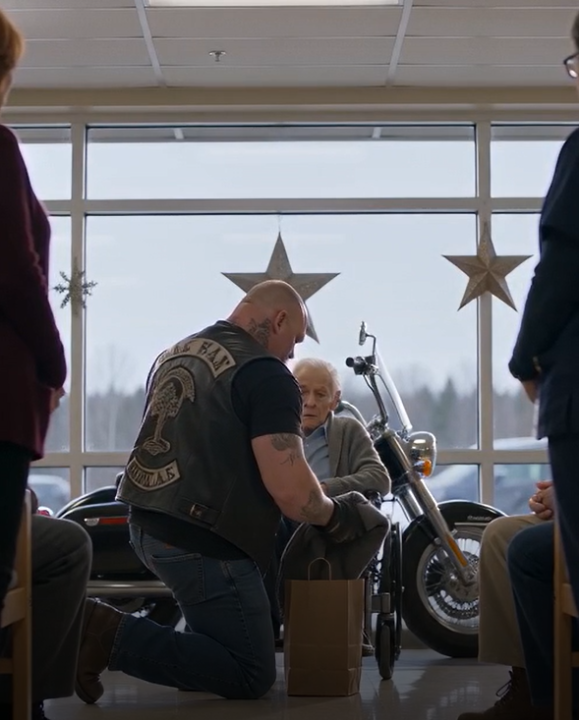
Ben set it down and took off his right glove. He folded the top of the paper outward so it wouldn’t snag what was inside. His own knees had been stiff all day, but he got down on one so the man wouldn’t have to crane his neck. Then he slipped both hands under the folded bundle.
“I’ve had this a long time,” he said.
He lifted a gray wool coat out of the bag. It had a dark repair near the cuff, and one shoulder had faded more than the other. For a second the man just looked. Then he took his hand off the wheel and reached toward the coat.
Part 2
His fingertips found the cuff and rubbed once against the darker yarn.
“Turn that over,” he said.
Ben turned it. On the inside, where nobody would see it when the coat was worn, the repair made a crooked little square. He’d looked at that square a thousand times. He’d even brought the coat to a tailor once to ask how she would go about saving it. She’d told him it was holding up fine and sent him home with a bag to keep the moths out.
“Ellen did that on the bus,” the old man said. “She’d been after me to let her fix it, and I kept forgetting to take it off. So she fixed it with my arm still in it.”
Ben had tried to think of what he would say if he ever got here. He’d had fifteen years. Most of the things he’d come up with started with sir and got worse from there.
“Walter Hale?” he asked.
The man looked up. “Who’s asking?”
“Ben Walker. I had a motorcycle that wouldn’t start.”
Walter studied his face. Ben took off his other glove, mostly because he needed somewhere to look while he waited.
“Did you ever get it started?” Walter asked.
Ben laughed. The sound came out sharper than he meant it to. “Next afternoon. Loose ground wire.”
“I figured it was something cheap. You looked like a man who couldn’t afford anything expensive to go wrong.”
He’d been twenty-nine and working the late shift at a machine shop. It had been early December, cold enough that the weather report at work had said five degrees and the man on the radio had sounded relieved it wasn’t going lower. Ben’s bike had quit near a bus stop at the edge of a commercial strip. He’d gotten it off the road, taken off his oil-stiff work jacket to get at the tools, and set it across the seat. When he came back from the stop to try the starter one more time, the jacket had slipped into a gutter full of slush.
It was a stupid detail. For years, it was the one he left out when he told the story.
“I thought I could fix it in five minutes,” he said.
“You told me that twice.”
“I was trying to convince myself the second time.”
Walter smiled. His thumb still rested on the old cuff. The coat he wore now had nearly the same weight and color, but from that close Ben could see differences. The collar sat higher. Its buttons were a shade lighter. He’d brought the old one here hoping for a match, and he still felt a little stunned to be looking at two of them.
Marla picked up the roll of tape. For a second Ben thought she might slip out. Instead she took a step closer.
“Mr. Hale, I can get your coat put away if you’re tired.”
Walter kept his thumb where it was. “I’ll tell you when I’m tired.”
Tessa set the mug on the table beside him. Somebody turned the television down. Ben heard the familiar twinge in his knee before he felt it and moved a little so he could keep holding the coat where Walter could reach it.
“Ellen made this in 1975,” Walter said. “Did you know that?”
Ben shook his head.
“Then tell me what you found in it,” Walter said. “I’ve wondered whether it was still there.”
Part 3
Ben reached into the left pocket. He knew the spot where the lining had separated from the wool and the corner where the card always caught. He’d had it in his wallet for years, but he’d put it back in the coat that morning before he rode over a second time.
Walter watched him pull it free.
“Library card,” Ben said.
“Could’ve been worse. I thought I left a twenty in there.”
“You did better than a twenty.”
There was a pale blue block across the top of the card and Walter’s name below it. On the back was an old phone number for a library branch that shut down the following spring. Ben had driven to the building with the coat folded in a laundry basket. He’d found the book return covered with a sheet of plywood and a notice telling patrons where to take materials. The staff at the other branch had listened to him, taken his number, and explained that they couldn’t give out anybody’s address.
“I used to work near that branch,” Walter said. “They knew which books I wanted before I did.”
“Were you living near there?”
“Across town. I took two buses home.”
Two buses. Ben had always pictured him stepping down in front of a warm house.
The night he gave Ben the coat, Walter had been sitting on a bench under the shelter light with his hands in his pockets. Ben remembered trying to hide his shaking by crossing his arms. Walter asked how long he’d been out there. Ben said ten minutes. Walter looked at the steamed-up glass and asked again.
“I don’t know,” Ben had finally said.
Walter got up. It took him two tries to get the coat off because the cuff caught on his watch. Ben told him to keep it. Walter held it open and waited until Ben put an arm through.
“Here comes my bus,” he said.
“I’ll bring it back. Where do you live?”
Walter was already at the curb. Ben remembered the driver opening the doors and Walter putting one foot onto the step. He’d taken a few useless strides after the bus when it pulled out, then stopped. The sleeves covered half his hands. The heat that was already in the wool had felt better than the heat from a radiator because he didn’t have to stand anywhere special to keep it.
“How long did you wait?” Walter asked.
“Another twenty minutes. A friend came in his truck. I still had your coat on when he took me home.”
“Good.”
For years Ben had tried to get to that word. He’d put his number on a bulletin board where the old bus route ended. He’d asked a former driver, who remembered an older man with a gray coat and could tell him where the man used to change buses. He’d left another note at the library. At some point he’d started giving the coat a quick shake every winter before he put it back in its bag. He could still go looking, but there was nowhere new to go.
“Why’d you keep the card in the pocket today?” Walter asked.
“I wanted you to see where I found it.”
Walter took it. He ran the edge along his thumb, the same slow motion he’d used on the cuff. Then he looked down at the coat on his lap.
“How long were you outside after you got off the bus?” Ben asked.
Walter didn’t answer right away. He set the card beside the mug, squared it with the edge of the table, and looked at Ben again.
“Long enough that Ellen was waiting up,” he said. “I ought to tell you what happened after that.”
Part 4
Walter said his transfer had been late. By the time he got home, Ellen was standing in the kitchen in her robe, with the porch light on and both hands around a mug.
“The first thing she asked was where the coat was. I told her it was on a fellow at a bus stop. She made me tell her the whole thing while she got the kettle going.”
“Was she mad?”
“By the time I finished talking, she was. I’d had a cough for a few days. I’d told her it was getting better so she’d let me go do what I had to do.”
Ben knew what was coming a little before Walter said it. Walter had felt worse over the next few days. His wife finally got him to the hospital. He had pneumonia and spent two weeks there. When he was able to come home, he was weak enough that Ellen borrowed a shower chair from a neighbor.
“You got that sick after you gave me your coat?”
“I got sick after a lot of things,” Walter said. “I gave you the coat that night. Both of those things happened.”
Ben lowered his head. Walter had spent part of December in a hospital while Ben went back to work, paid for a ground wire, and bought a proper winter jacket on sale. For most of those years, he’d imagined telling a story that ended with both of them getting home fine.
“I would’ve given it back if I knew,” he said.
“I know.”
“I mean right there. I would’ve handed it to you on the bus.”
Walter leaned forward far enough for Ben to see a little white stubble beneath his chin. “You looked colder than I was,” he said. “I had a bus coming. You were waiting on a truck you couldn’t see. If you want to know whether I’d do it again, I would.”
From the hall came the sound of a service cart, its wheels bumping softly over a threshold. Marla moved back to let the cart through and asked the aide to leave the cookie tray for another few minutes. Then she came back to the window and put the roll of tape down.
“When you came in,” she told Ben, “I thought you’d come straight back from the lot.”
“I signed the book.”
Tessa took a folded visitor slip from her scrub pocket. “I brought him in. I also wrote down that Walter asked him to return.”
Ben looked at her. “You wrote that down?”
“Walter told me he didn’t want me to forget.”
Walter was busy trying to pick up his mug without setting the card aside. Tessa slid it onto the dry end of the table, where he could see it, and waited while he took the handle.
Marla looked at the slip long enough that Ben could tell she’d seen her own initials. She had marked the request when she’d passed the desk earlier. The truck with the club’s presents had already gone by then. Ben waited for her to say she hadn’t understood who he was. She folded the slip the way Tessa had and handed it back.
“I remembered signing it after I saw your patch,” she said. “By then I’d already told you to leave. I didn’t want to take it back in front of everybody.”
Ben heard the half-folded napkin crackle behind him. The people in the room were close enough to hear her now.
“Take it back where you said it,” Walter told her.
Marla swallowed. Ben could see her looking for the easiest person in the room to address. Then she looked directly at him.
Before she could speak, Walter tugged one of the buttons on the coat he was wearing. “And Ben,” he said, “you should know why there are two.”
Part 5
Walter let go of the button. It fell back against his chest with the faint tap of hard plastic on wool.
“Ellen was mad about the coat for about a week,” he said. “Then she wanted to know if you had anybody to come get you. I told her I thought so. She said that sounded like something I’d made up to keep her from asking again.”
Ben grinned despite himself. “Was it?”
“Mostly.”
Marla asked for a moment. She stood where she’d been when she pointed toward the hall and said she had sent Ben away after he had been signed in and invited to visit. She apologized to him, then turned to Walter.
“I told everyone you wanted to be left alone. You hadn’t said that.”
“I say it plenty,” Walter said. “Just ask me first.”
The grandfather by the table finished folding his napkin. Somebody went back to the television and raised the volume one click. Marla asked Walter whether he wanted a plate of cookies. He picked two. Ben saw her turn the plate so he could reach them himself.
“Show me this one,” Ben said when they’d been left to talk.
Walter held out his sleeve. The cuff had the same turn at the edge, but the stitching was a little looser. Ellen had saved the paper pattern in a tin with spare buttons and an old pair of eyeglasses. Years after the night at the bus stop, she took the pattern out and made him a second coat. Walter told Ben he’d offered to buy one at a store.
“She said she didn’t want to spend the next winter looking at me in a coat that stopped halfway down my wrists.”
“Did she ever see the first one again?”
Walter shook his head. Ellen had died before he moved into Cedar Run. He wore her second coat by the window most days because the window was drafty and he liked to see who was coming and going. The chair gave him a good view of the parking lot if people kept the gift boxes off the sill.
“This morning,” Ben said, “I saw you wearing it while we were bringing things in. Tessa called you Walter Hale. I thought she might’ve been speaking to somebody behind you.”
“I heard you ask her to say it again.”
“I went all the way home for the coat. I still sat in the lot a while before I came in.”
“What for?”
“Same reason I took so long to look at your face. I thought I’d be wrong again.”
Walter set one cookie on the edge of Ben’s paper bag. “Better eat that before you get up. Somebody’ll put it away.”
Ben ate it on one knee. It was the first thing he’d had since a gas-station coffee, and he could feel the sugar sticking to a molar. He asked Walter whether he could leave the old coat with him. Walter said yes, then asked him to fold it so the cuff with the repair was on top.
Tessa came back when Ben was getting to his feet. She had a visitor form and a pen on a string. She asked Walter whether he wanted Ben’s name added for another visit. Walter looked toward the lot.
“You ride when it’s this cold?”
“When it’s dry. I bring the truck when it isn’t.”
Tessa wrote down Saturday. Ben asked if there was a regular time that wouldn’t interfere with family visits. Tessa put the pen down and looked at Walter first.
“You can tell him,” Walter said.
“Walter hasn’t had a personal visitor in four years,” she said.
Part 6
The first thing Ben thought of was the cookie Walter had put on the edge of his paper bag. He had done it casually, like a man accustomed to feeding people who came over and forgot to eat.
“Four years?” Ben asked.
“My sister-in-law used to come,” Walter said. “She can’t drive anymore. We talk on the phone when she can find hers.”
Ben nearly said the club could fill the room next weekend. He thought of the way Walter had placed the library card square to the edge of the table. A full room was easy to offer. He’d just spent fifteen years trying to have one conversation.
“Is one visitor enough?” he asked.
“One who comes back is plenty.”
He came back the next Saturday in his truck, with a paper bag of doughnuts on the floor where the heater could reach them. Walter ate half of one and wrapped the other half in a napkin for later. Ben told him about his shop, the friend who’d picked him up that night, and the club that had brought the presents. Walter asked why somebody who could fix engines was called Patch.
“That was my work on a riding jacket after I tore it on a fence,” Ben said. “I fixed it with a piece off a seat cover.”
“Did it hold?”
“Still wearing it.”
After that, they took the same route past the fish tank and down the south hall on days the sidewalks were bad. Walter told Ben which resident had painted the picture beside the elevator. He told him where the afternoon sun was warmest. Once he asked Ben to leave the wheelchair where it was for ten minutes so they could watch a delivery driver figure out which entrance was unlocked. They laughed when the man found the right door and discovered he’d left the package in the truck.
In February, Ben had to cover a shift. He called to tell Walter he couldn’t come.
“Are you calling to ask if one of your friends can take your turn?” Walter asked.
“I was going to ask what you’d think of that.”
“I’d think you’ve got friends. Let’s see if you’ve got any who play cribbage.”
Ben sent Ray, who could play, and whose wife sent banana bread. Walter beat him twice. The following Saturday, Ray asked to come back. By spring, the North Pine Riders had a list of people Walter wanted to see and a simple agreement that the person whose name was down called ahead. Some weeks Walter sent word that he wanted a short visit. Once he canceled because he had a ball game to listen to and didn’t want Ray telling him how to manage the bullpen.
Ben heard from the nursing home director in March. After reviewing what had happened at Christmas, the director took Marla off visitor coordination and assigned sign-ins and visit questions to the front desk. Marla still ran activities. When she wanted to invite Walter to a sing-along, Ben heard her ask him directly. Walter declined and asked if he could have the extra sheet music for a resident who couldn’t get out of bed. Marla brought two copies.
That May, on a day warm enough to open the windows, Ben found Walter waiting by the front doors in Ellen’s second coat. He had an old photograph on his lap.
In it, a woman with her hair tied up was sitting in a motorcycle sidecar. Walter stood beside her, skinny as a nail, with his sleeves rolled to the elbow.
“Ellen?” Ben asked.
Walter nodded. “She had one rule about going for a ride,” he said. “You may want to hear it.”
Part 7
“She picked the way home,” Walter said. “If you tell a woman you’re taking her out, you can let her pick how long it takes.”
Ben asked whether Walter wanted to go in a sidecar himself. Walter looked at him over the photograph.
“I’ve been waiting for you to ask.”
They talked it through before anybody brought a bike around. Walter wanted to know whether he could get in and out without someone lifting him under the arms. His care team helped him plan a transfer, and Ray brought his sidecar rig for Walter to look at while it was parked. There was room for Walter’s feet and enough support for him to sit comfortably. The first time, he wore a fitted helmet and asked for a slow loop around the private drive. Ben walked out to the far turn and watched him point down the longer branch when Ray slowed.
Walter picked the way home.
After that came visits that had nothing to do with the coat. Walter helped Ray’s granddaughter repair a cribbage board after she snapped a peg. When Ben’s shop flooded under the back door in a thaw, Walter wanted to know how high the water came, then asked the same question every Saturday until Ben admitted he hadn’t fixed the door yet. By the third winter there was a picture on the common-room wall of Walter sitting in the sidecar, one gloved hand resting on its edge. He complained they’d caught him with his mouth open.
“You were giving directions,” Ben said.
“Well, did he take them?”
“Eventually.”
Walter saw somebody from the club every week for three years. On days when he was tired, the person stayed long enough to say hello and put the coffee where he could reach it. When there was a heavy snowfall and Ben couldn’t get the truck out, Linda from the club walked over after her shift at the pharmacy. Walter kept asking what they’d done with the piece of paper they used to remember whose turn it was. Ben finally showed him the photograph of it taped inside the shop cabinet. The names had been crossed out and written over so often that the bottom corner was nearly black.
Toward the end of the third winter, Walter asked Ben to open the dresser drawer. The first coat was folded inside. Ben had seen him wear it once, to see whether it still fit across the shoulders. It did. Walter had taken it off before lunch because there was tomato soup.
“I’d like to wear that one when they bury me,” Walter said.
Ben rested his hand on the drawer pull. He’d opened plenty of drawers at Cedar Run. Spare socks, a deck of cards, reading glasses. He kept holding on to this one.
“You tell Tessa?”
“I told my niece. She called last week. She’s got it written down.”
Ben lifted the coat and set it across Walter’s knees. Walter found the cuff without looking.
“Did Ellen know you never regretted giving it away?” Ben asked.
“She knew.” Walter ran his thumb over the repair. “When she made the second one, she said if I gave that away too, she’d make a third. She had yarn left.”
Ben drew a breath, waited, and drew another. He’d once thought of Ellen standing in the kitchen as the person who had lost something on his account. He could picture her now trying to thread a needle on a moving bus because her husband kept forgetting to take his coat off.
Walter looked at the wardrobe across from the bed. “The other one,” he said. “I’ve asked them to put your name on it.”
Part 8
Ben opened the wardrobe and found the second coat on a wooden hanger. Someone had looped a paper tag over it. The name was written in the block printing Tessa used to mark mugs before a family gathering.
“You’re still wearing it,” he said.
“I’ll wear it Saturday if it’s cold.”
“All right.”
Ben left it on the hanger. They spent the rest of the visit sorting a tin of cribbage pegs, putting the good ones in one compartment and the bent ones in another. Walter made him put a crooked brass peg back with the good ones because it was the only piece heavy enough to keep the score sheet from lifting when the window was cracked.
Walter died the following month. His niece called Ben in the morning, while he was standing outside the shop with a cup of coffee and the key in his hand. She asked him whether he wanted to come when they brought the first coat to the funeral home. He said he would.
He’d never met her in person. She was a little older than he was, with Walter’s light eyes and the same habit of tucking her thumb under something she wanted to hold steady. At the funeral home she unfolded the coat just far enough to make sure they’d brought the one with the darker repair.
“He told me to check the cuff,” she said.
“That’s the one.”
She asked Ben whether he was sure. He turned the cuff over and showed her the square on the inside. Then he folded it back the way Walter liked it, with the repair where you could see it. Walter was buried in the coat Ellen had made him in 1975.
After the service, Tessa met Ben at Cedar Run with the second coat. She’d taken it off the hanger and put it in a plain paper bag. He could see the edge of the collar under the folded top.
“Are you going to wear it?” she asked.
“I don’t think it’ll fit.”
“It might over a T-shirt.”
It didn’t. Ben tried it once at home. He got one arm in and realized he’d pull the stitches loose if he tried the other. He took it off carefully and hung it near the back door. For a few days he caught himself checking the forecast on Friday night, as if he still had to decide whether to take the truck on Saturday.
A week later, Ray stopped by with half a loaf of banana bread. He set it on the bench and said he was going to Cedar Run. A man down the hall from Walter had watched them play cribbage a few times and had asked if Ray could show him how to count a hand.
“You want to come?” Ray asked.
Ben went. He signed in at the desk. In the common room, Marla was helping two residents choose where to set up the card table. She asked the man who wanted to learn cribbage whether he’d rather play there or by the window. He chose the window. Ben recognized the little squeak the chair made on the way over. It came from a loose strip in the floor, right where he’d spent three years thinking it came from a wheel.
When he got home, he found the library card on the dresser. He’d kept it at Walter’s request. Ben turned it over, read the number for the branch that had closed, and carried it to the back door. He slipped it into the left pocket of Ellen’s second coat. The lining was sound. It went right in.
Follow the page for more stories like Ben and Walter’s.