A Nine-Year-Old Tried to Hire a Biker Club With His Piggy Bank—Then Their President Recognized the Mother Everyone Planned to Shame
The nine-year-old had pedaled fifteen miles to hire thirty bikers with forty-three dollars in coins, but when he showed our president his mother’s photograph, the hardest man in the room forgot how to breathe.
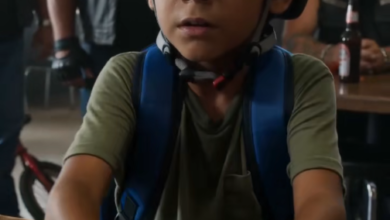
The boy came through the door of the Rusted Anchor at 11:17 on a Saturday morning, pushing a bicycle too small for him and carrying a ceramic pig beneath one arm.
My name is Wade Nolan, though everyone in the Harbor Saints Motorcycle Club calls me Mack. I was behind the bar changing a syrup line when the front wheel struck the threshold and the kid nearly went down with it.
His cheeks were red from the July heat. Sweat had soaked through the back of his green T-shirt, one shoelace was wrapped around his ankle, and dried blood marked the outside of his left knee. A blue backpack hung from one shoulder.
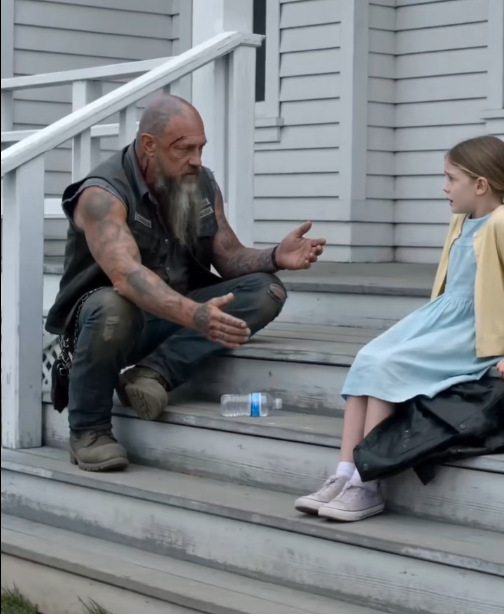
Every conversation stopped.
The Rusted Anchor wasn’t technically a biker bar, though no one had explained that distinction to the cracked leather booths, the smell of motor oil, or the fourteen Harleys parked outside. We served burgers, coffee, and beer depending on the hour. That morning, twenty-two club members were discussing a charity ride.
Then a child pushed his bicycle between the tables.
A young prospect named Colby stood first.
“You lost, buddy?”
The boy looked around at the beards, tattoos, leather cuts, and heavy boots. His lower lip trembled, but he shook his head.
“I came to hire you.”
A few men smiled because they assumed he was playing.
The boy didn’t.
He walked to the bar, lifted the ceramic pig with both hands, and placed it in front of our club president. White tape covered a crack across its back. Through the slot we could see folded bills mixed with coins.
Hank Callahan stared at it.
Hank was fifty-six, six-foot-four, and broad enough to block the beer cooler when he leaned against the counter. His gray beard reached his chest, old prison ink covered his knuckles, and a pale scar divided his upper lip. Even people who knew him sometimes lowered their voices when he entered.
The boy had ridden fifteen miles to find him.
“My name is Noah Ruiz,” he said. “My mom graduates tomorrow.”
Hank waited.
“From what?”
“Nursing school.”
“That’s good.”
Noah nodded, but his eyes filled.
“I need you to come.”
Nobody laughed now.
Hank rested both hands on the counter without touching the pig. “Why us?”
Noah swallowed hard enough for me to see it.
“Because people know she went to prison. Some parents call her Jailbird Nurse. I heard them say they’re going to laugh when she walks across the stage.”
His voice cracked. He wiped his face angrily with his wrist.
Then he pushed the pig closer.
“I want to hire you so nobody dares laugh at her.”
The refrigerator compressor clicked off behind me. In the sudden quiet, I could hear loose coins settling inside the ceramic body.
Hank pulled out the stool beside him.
“Sit down, son.”
“I’m not supposed to take drinks from strangers.”
“Smart.”
“I can pay.”
“That doesn’t make us less strange.”
Hank asked me for an unopened bottle of water, then slid it across the counter without breaking the seal. Noah checked the cap before drinking. That small act told me his mother had taught him caution even if she hadn’t managed to teach him that fifteen miles of county road was too far for a child to ride alone.
Hank asked whether an adult knew where he was.
Noah looked down.
There it was.
The first problem wasn’t the graduation. It was a missing nine-year-old sitting in our bar.
We called the county sheriff, then the number written on an emergency card inside Noah’s backpack. His aunt answered on the third attempt. She thought he was riding bicycles with a boy two streets away. His mother was at graduation rehearsal and had left her phone inside a locker.
Noah began to cry when he realized we might send him home before making a deal.
Hank didn’t tell him to stop.
He opened a bag of pretzels, poured them onto a clean plate, and asked how much money the pig contained.
“Forty-three dollars and eighteen cents.”
“How long did that take?”
“Three years.”
“What were you saving for?”
Noah glanced toward the battered bicycle leaning beside the jukebox.
“A better bike.”
Hank lowered his eyes.
The boy had spent three years saving for a way to leave—and offered all of it to make sure his mother didn’t walk alone.
“What’s your mother’s name?” Hank asked.
“Elena Ruiz.”
Hank’s fingers stopped beside the pig.
It was subtle. I might have missed it if I hadn’t known him for twenty-one years.
“Do you have a picture?”
Noah removed a phone from his backpack. The screen was cracked, and the case had once been red. He found a photograph of a dark-haired woman in light blue nursing scrubs, kneeling beside him on an apartment balcony.
Hank took one look.
The color drained from his face.
He gripped the edge of the bar as if the floor had shifted beneath him. His scarred knuckles turned white, and his mouth opened without producing sound.
“Hank?” I said.
He enlarged the photograph with trembling fingers.
Elena wore a thin silver chain around her neck. Hanging from it was a bent motorcycle key polished smooth by years of touch.
Hank had once carried that key.
Twelve years earlier, before he became president of our club, police found it beside an empty charity deposit bag. It had helped send Elena Ruiz to prison.
I knew part of that story.
I knew Hank had been questioned. I knew Elena confessed. I knew she received a felony conviction while Hank walked free.
What I didn’t know was why.
Hank handed the phone back and asked Noah where the graduation would be held.
“Franklin County Civic Auditorium.”
“Who runs the nursing program?”
Noah opened a folded program taken from his backpack. A woman’s photograph appeared above the title Dean of Nursing.
Dr. Vivian Cross.
Hank stared at her face for several seconds. Then he removed his reading glasses, folded them, and placed them beside the pig.
“The woman who reported your mother twelve years ago,” he said quietly, “is handing her the diploma tomorrow.”
Noah looked confused.
I wasn’t.
I remembered Vivian Cross. Back then, she directed the care facility where Elena worked and controlled the charitable account whose money vanished.
Hank pushed away from the bar.
“Call Simone,” he told me.
Simone Reed was the club’s attorney.
“What do I tell her?”
Hank looked once more at Elena’s photograph.
“Tell her I’m done letting that woman carry my conviction.”
Part 2
Sheriff’s Deputy Amos Bell arrived before Noah’s aunt. He questioned the boy gently, checked his scraped knee, and reviewed the route he had taken. Noah had followed Old Mill Road, crossed a narrow bridge without a shoulder, and spent almost two hours pedaling beneath ninety-degree sun.
When his aunt Maribel rushed through the door, she hugged him first and scolded him second.
“You could’ve been killed.”
“I wore my helmet.”
“That is not the point.”
“It’s part of the point.”
Even Hank smiled at that.
Maribel tried calling Elena again, but the rehearsal coordinator had collected every graduate’s phone to prevent disruptions. Elena believed Noah was safe at his aunt’s house. We agreed not to alarm her until Maribel could explain the situation face-to-face.
Hank wrapped Noah’s bicycle chain, adjusted the seat, and loaded the bike into our pickup. Before they left, Noah picked up the ceramic pig.
“You didn’t say yes.”
Hank crouched beside him.
“We don’t take jobs from children.”
Noah’s shoulders dropped.
“We accept invitations.”
The boy looked up.
“Does that mean you’ll come?”
“It means your mother decides.”
Noah considered this, then nodded. He understood a boundary many adults ignore: help given without consent can become another kind of control.
He held out the pig anyway.
Hank pushed it back.
“Buy the bike.”
“What about your fee?”
“Your invitation covered it.”
After they left, Hank locked the front door and turned the sign to CLOSED. The charity meeting ended without anyone voting. Nobody objected.
He carried a metal toolbox from his office and placed it on the bar. Beneath spare keys, tax receipts, and an old revolver he legally owned but rarely carried was a sealed manila envelope.
The postmark was twelve years old.
Elena Ruiz had mailed it from the Franklin County Detention Center three days before entering her guilty plea.
Hank had never shown it to us.
The letter inside contained only seven lines.
Hank,
They have the key and the security footage. Cross says if I fight this, she will make sure they charge both of us. With your record, you will not come home for a long time.
Grace needs one parent outside.
I can survive three years.
She cannot survive losing you.
Take care of your daughter.
Do not come to court.
At the bottom, Elena had written: You did not steal that money. Neither did I.
Hank’s daughter Grace had been seven at the time. Her mother had died from an overdose eleven months earlier, leaving Hank as the child’s only legal parent. He had two prior theft convictions from his twenties and was still on supervised release.
A third felony charge could have taken him away for years.
Elena had known that.
“She confessed to save you from something neither of you did?” Colby asked.
Hank folded the letter along its old creases. “She confessed because Cross built the evidence around me.”
The missing money belonged to an employee-funded assistance program at Ashwood Senior Living. Nurses, aides, mechanics, and kitchen staff contributed small amounts from each paycheck. The fund paid for emergencies—a broken furnace, a child’s dental surgery, gas money for someone traveling to a parent’s funeral.
That year, Hank’s motorcycle club had held a ride that raised $18,640 for the fund. Hank personally delivered the locked deposit bag to Ashwood after the banks closed.
Elena, then a twenty-six-year-old nursing assistant and evening payroll clerk, signed for it.
By morning, $11,000 had vanished.
Security footage showed Hank entering the office corridor after midnight.
His motorcycle key was found beneath Elena’s desk.
What police didn’t know was that Vivian Cross had called Hank and claimed Elena needed his signature on a donor form. When he arrived, the office was dark. Cross met him in the corridor, took his key ring to open a storage cabinet, then returned it before sending him away.
The footage had no audio.
It showed Hank entering.
It did not show Cross borrowing his keys.
Elena discovered the missing money the next morning. Before she could contact an outside auditor, Cross reported the theft and named Hank as the likely suspect.
Then she offered Elena a choice.
Confess to taking the funds alone, or Cross would tell police Elena and Hank planned it together.
“She knew Elena wouldn’t let Grace lose another parent,” I said.
Hank nodded.
“Why didn’t Elena tell police?”
“She did.”
The investigating detective interviewed Cross first. By the time Elena spoke, the key, footage, missing cash, and Hank’s record had built a story stronger than her denial. Her court-appointed attorney warned that a jury might convict both of them.
Cross offered to support a reduced sentence if Elena admitted sole responsibility.
Elena took the plea.
She served twenty-eight months.
Hank remained free to raise Grace.
“Why didn’t you confess?” Colby asked.
The room tightened.
Hank did not defend himself.
“Cowardice.”
He said the word without decoration.
“I told myself Grace needed me. Then I told myself Elena chose it. Then I told myself reopening the case would only make her sentence worse. Every year I found a better excuse.”
He opened the metal box again. Inside were twelve returned envelopes, one mailed on every anniversary of Elena’s sentencing.
After her release, she moved twice. The letters never reached her.
“You could have found her,” I said.
“Yes.”
“Did you try?”
“Not hard enough.”
That was the truth.
Hank had rebuilt his life, opened a towing company, raised his daughter, and eventually become president of the Harbor Saints. Elena rebuilt hers under the weight of a felony she had accepted to protect him.
The fact that Hank felt ashamed did not reduce her burden by an ounce.
Simone arrived carrying a legal pad and an expression that discouraged small talk. She read Elena’s letter twice, then examined the graduation program.
“We cannot storm a ceremony,” she said.
“No one said storm.”
“You have twenty motorcycles outside.”
“Fair.”
Simone explained that Hank could sign a sworn statement, but his delayed admission would invite questions. The old case had ended in a plea, and the statute for the theft itself might have expired. Proving Cross stole the money would require records that possibly no longer existed.
“What can we do by tomorrow?” I asked.
Simone looked toward the folded program.
“Attend quietly, if Elena invites you. Protect her graduation from becoming Hank’s absolution ceremony. On Monday, we petition for records.”
Hank glanced at the closed door through which Noah had left.
“What if Cross tries to humiliate her?”
“Then we document it.”
“What if she withholds the diploma?”
“Then I speak to the college attorney.”
“And if people laugh?”
Simone’s face softened slightly.
“Then your club learns the difference between intimidation and presence.”
Hank picked up Elena’s prison letter.
For twelve years, it had served as proof of what she had done for him.
By morning, it would become evidence of what he had failed to do for her.
Part 3
Elena came to the Rusted Anchor that evening.
She did not arrive willingly.
Maribel drove, Noah sat in the back seat, and Deputy Bell followed because Elena had demanded to know why a motorcycle club was discussing her child. She entered wearing dark blue scrubs and shoes marked with the pale dust used on hospital floors.
The first thing she saw was Noah’s repaired bicycle.
The second was Hank.
Her face closed.
“No.”
Hank remained seated at the far end of the bar. He had removed his club cut and placed it over the chair, perhaps hoping to look less imposing. It didn’t work.
Elena pointed toward Noah. “Get your things.”
“Mom—”
“Now.”
Hank did not ask her to stay. He did not use Noah’s request to corner her. He simply placed the old letter on the bar.
Elena recognized the envelope.
She stopped walking.
“You kept it.”
“Yes.”
“You didn’t answer.”
“I wrote.”
“You knew the prison address.”
Hank absorbed that.
“I was ashamed.”
“You were free.”
No one in the room moved. There was no version of this conversation in which our loyalty to Hank entitled us to interrupt her.
Elena approached the bar but did not touch the letter.
“I gave you one instruction. Take care of Grace.”
“I did.”
“Then we’re even.”
“We were never even.”
Her expression sharpened. “Don’t do this the night before my graduation.”
Simone stepped forward and introduced herself. She explained that Hank wanted to sign a sworn affidavit admitting the circumstances surrounding Elena’s plea and cooperate with any review.
Elena laughed once.
Not because anything was funny.
“Tomorrow, I walk across a stage after six years of night classes, twelve-hour shifts, background reviews, probation reports, and instructors asking whether patients should trust someone like me. You appear now and decide this is the moment for truth?”
Hank lowered his eyes.
“No.”
“You already decided.”
He looked up. “I decided I’ll tell it when you say.”
That stopped her.
No speech. No plea for forgiveness. He surrendered the timing.
Elena sat at the nearest table, though her body remained angled toward the door. Maribel took Noah outside so the adults could talk. Deputy Bell stayed near the entrance.
Simone asked about Vivian Cross.
Elena had known Cross would preside over the ceremony when she entered the program. Franklin Community College had hired Cross four years earlier after she became a respected nursing administrator. Elena considered transferring, but the next closest accredited program was seventy miles away.
She stayed.
Cross rarely addressed her directly. When she did, it was through formal warnings, extra documentation requirements, or questions about “professional character.”
Elena met every requirement.
She disclosed her conviction before admission. She underwent a suitability review, supplied letters from employers and counselors, completed clinical rotations without incident, and graduated near the top of her class.
The nursing board would still review her application before licensing.
Graduation did not erase that obstacle.
Three days earlier, Cross had submitted a late “professional concern” alleging Elena had failed to disclose details of the old theft. The college attorney rejected the claim because Elena’s disclosure was complete, but Cross arranged for Elena’s name to be read last rather than in alphabetical order.
“She wants me alone on that stage,” Elena said.
Noah had overheard two students’ parents discussing it after rehearsal. One called her the “jailbird graduate.” Another said Cross should refuse to pin her.
That was why he rode to us.
“He thinks people will laugh,” Elena whispered.
Hank’s hands curled against his knees.
Elena saw it. “You don’t get to frighten them.”
“I know.”
“No engines during the ceremony. No blocking doors. No threats. No club spectacle that makes Noah believe fear earns respect.”
Hank nodded.
“If you come,” she continued, “you sit down. You clap for every graduate. You do not make my day about prison.”
Hank nodded again.
Elena studied the men around her. “All of you understand?”
We answered yes.
Only then did she invite us.
Simone asked whether Elena wanted the affidavit delivered to the college before the ceremony. Elena said no. Cross might attempt to postpone her participation while an investigation began.
“After I cross the stage,” she said. “Not one minute before.”
That should have settled it.
Then Deputy Bell’s radio sounded.
A dispatcher reported a complaint at Elena’s apartment. A man had been seen trying the rear door and photographing the windows. A neighbor provided a vehicle description.
Dark red sedan.
Franklin Community College parking permit.
Elena’s face went still.
Cross drove a dark red sedan.
Deputy Bell asked everyone to remain while another unit checked the building. The man was gone when officers arrived, but the rear door showed fresh marks around the latch.
Noah’s piggy bank sat on the kitchen counter.
Beside it was a printed copy of Elena’s criminal record.
Someone had entered the apartment and left it where her son would find it.
The graduation was no longer the only concern.
Hank stood, reached for his cut, then stopped when Elena looked at him.
She expected rage.
He picked up his phone instead.
“Simone,” he said, “tell us exactly what the law allows.”
That was the moment I knew he had changed.
Not enough to repair twelve years.
Enough to avoid creating one more crime in Elena’s name.
Part 4
Police documented the apartment, collected the printed record, and obtained footage from a neighbor’s doorbell camera. The man entering the building wore a baseball cap and kept his face down, but the red sedan was visible for eleven seconds.
It did not belong to Vivian Cross.
It belonged to her adult son, Eric.
Eric Cross worked in campus security.
By midnight, the college placed him on administrative leave. He claimed he had gone to Elena’s building to deliver a document and denied entering her apartment. The doorbell recording showed him wearing gloves.
Deputy Bell told Elena not to return home that night.
She refused Hank’s offer of the apartment above my garage but agreed to stay with Maribel. Two club members parked across the street with Elena’s permission and strict instructions not to approach anyone. They kept a written log and called the police when an unfamiliar vehicle circled twice.
Nobody played hero.
By morning, the story had begun leaking online.
Someone posted that an “ex-con nursing student” had recruited a motorcycle gang to intimidate her college. A cropped photograph showed Hank outside the Rusted Anchor with Noah, making it appear that the boy was surrounded.
The original photograph had been taken through our front window.
The caption omitted the bicycle, the piggy bank, and Deputy Bell standing just outside the frame.
Elena called Hank at six thirty.
“You said no spectacle.”
“We haven’t left the bar.”
“Then who posted this?”
Hank studied the image. Reflected in the glass behind Noah was a red sedan.
Cross’s car.
The picture had been taken before Eric entered Elena’s apartment.
Vivian Cross herself had followed Noah to the Rusted Anchor.
That answered how she learned the club was involved. It opened a larger question: how had she known Noah was coming?
Noah gave the answer by accident.
Two days earlier, he had used a school library computer to search for “biker club near Franklin Ohio.” A teaching assistant saw the page and asked why. Noah said he wanted people to attend his mother’s graduation.
The assistant was Dr. Cross’s niece.
What looked like a child’s secret plan had never been secret.
Cross saw a threat because the club connected Elena to the one man who could reopen the past.
At nine that morning, Simone met with the college president and general counsel. She brought Hank’s affidavit, Elena’s letter, photographs of the apartment damage, and a request that Cross be removed from the ceremony pending an ethics review.
Elena attended the meeting by video.
She wanted only two things: permission to graduate with her class and assurance that Eric Cross would not be working security.
The college granted both.
They refused to remove Vivian from the stage without additional evidence tying her to the break-in or original theft.
Elena accepted the decision. Hank did not like it, but he kept quiet.
The ceremony began at three inside the Franklin County Civic Auditorium. We arrived in groups of four, parked legally, and shut off every engine before entering the main drive.
Thirty-one Harbor Saints attended.
No procession.
No revving.
No formation around the doors.
Some wore leather cuts over clean shirts. Others left their vests in the saddlebags because Elena had asked us not to turn her graduation into a club event. Hank wore a dark suit borrowed from me, though the sleeves ended too far above his wrists.
Each biker carried one white carnation.
Noah held the final flower.
People noticed us. Parents whispered. A security guard approached Hank and asked whether we intended to disrupt the ceremony.
“No,” Hank said. “We’re here for a nurse.”
The guard looked doubtful but let us enter.
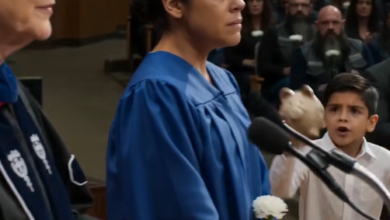
We took seats in the last two rows. When graduates began crossing, we applauded for every name exactly as Elena requested. Hank clapped for students he had never met. Noah sat beside him with the ceramic pig on his knees.
Elena’s chair stood at the end of the front row.
Dr. Vivian Cross walked to the podium wearing academic robes and a silver nursing pin. She spoke about integrity, trust, and the moral responsibility of caregivers.
Hank stared at the floor.
When the first student’s name was called, the room settled into a rhythm: name, applause, handshake, photograph.
Elena waited.
Her name should have appeared after Daniel Young. Instead, Cross closed the folder.
“Please join me in congratulating the Franklin Community College nursing class.”
Music began.
Elena remained seated.
For several seconds, the audience did not understand. Then heads turned toward the lone graduate in blue standing near the edge of the stage.
Noah rose.
“Mom?”
His voice carried farther than he intended.
Elena looked toward the back rows.
Cross leaned toward the microphone. “One candidate’s credentials remain under administrative review.”
That statement was false. The college attorney had confirmed Elena’s clearance in writing that morning.
Simone stood from the aisle.
Before she could speak, Noah lifted the ceramic pig and began walking toward the stage.
Hank reached for him, then stopped. Security moved from both walls. The auditorium filled with whispers.
Noah climbed three steps before an usher blocked him.
“I paid for people to come,” he said, loud enough for the first rows to hear. “You still didn’t call my mom’s name.”
Cross’s face tightened.
“Noah,” Elena whispered. “Go back.”
He looked at the hundreds of people watching him.
Then he turned toward Hank.
The boy had asked bikers to make sure no one laughed.
Now the only person standing between his mother and humiliation was nine years old.
Hank rose from his seat.
Thirty men behind him started to follow.
He lifted one hand.
Every biker remained seated.
Then Hank walked down the aisle alone.
Part 5
Security met Hank halfway to the stage. He stopped before they asked, removed both hands from his pockets, and looked toward Simone.
She carried the documents forward.
“This is not a protest,” she told the auditorium manager. “The candidate was cleared in writing. Your dean is contradicting the college’s legal determination.”
The college president, seated behind the faculty, stood immediately. He approached Cross and asked for the folder.
She resisted.
“Her character review is incomplete.”
“No,” Simone said. “It was completed yesterday.”
Cross looked toward Hank. “That man is a convicted thief with ties to a criminal motorcycle organization.”
Hank could have denied it.
He didn’t.
“I was a thief,” he said. “But not that night.”
The room quieted.
Elena closed her eyes. This was the spectacle she had feared, yet Cross had created it by erasing her name.
Hank looked at Elena rather than the audience.
“May I tell them?”
She did not answer immediately.
Then she nodded.
Hank turned toward the college president. His voice remained low, forcing the room to listen instead of rewarding it with a performance.
“Twelve years ago, your dean accused me of stealing eleven thousand dollars from an employee hardship fund. Elena Ruiz accepted a felony plea so prosecutors would stop pursuing me.”
People began murmuring.
Hank continued.
“She believed my daughter would enter foster care if I went back to prison. I let her do it. That is my shame, not hers.”
Cross struck the podium with her palm. “This is an admitted criminal attempting to rewrite a closed case.”
“No,” Simone replied. “He is a witness submitting a sworn statement.”
She handed the affidavit to the college president.
Cross tried to leave the stage.
Deputy Bell stepped through a side entrance with two investigators. They did not arrest her. They asked her to remain available for questioning regarding Eric’s entry into Elena’s apartment and the evidence recovered that morning.
That evidence had changed.
At seven, while preparing the auditorium, a maintenance worker found a flash drive inside Cross’s faculty office copier. Eric had used the machine to print Elena’s criminal record. The drive contained the document, the cropped photograph from the bar, and scanned financial records from Ashwood Senior Living.
One file was an old internal ledger.
Elena recognized it.
The ledger showed the employee assistance account held the full deposit at 8:06 the morning after Hank delivered it. The money had not vanished overnight as Cross claimed.
It had been transferred in three electronic payments over the following week.
Each payment went to a consulting company owned by Cross’s brother.
The records had remained on Cross’s drive because she was preparing material to threaten Elena, never realizing one page contradicted the story that secured the guilty plea.
The truth had survived through the arrogance of the person who buried it.
Cross denied creating the transfers. She blamed a former accountant and called the files unreliable. Investigators escorted her away from the podium for an interview.
No one cheered.
That mattered.
Elena did not need a crowd celebrating another woman’s fall. She needed the ceremony to continue.
The college president returned to the microphone. He apologized for the interruption and announced a brief recess. After consulting Elena and Simone, he offered to hold a separate recognition ceremony.
Elena refused.
“My class waited for me,” she said. “I can wait five minutes for them.”
When the graduates returned to their seats, Cross’s chair remained empty. The associate dean took the folder. The program resumed from the point where it had stopped.
Then Elena’s name was called.
She rose slowly.
Some people stood. Others remained seated. A few parents who had whispered earlier stared at their hands.
Our club stayed seated because that was what Elena requested.
But we clapped.
We clapped until she reached the stage, accepted the diploma cover, and received the nursing pin she had earned. The associate dean whispered something that made Elena’s face tighten. I learned later that she had said, “We should have protected you sooner.”
At the bottom of the stairs, Noah waited with the white carnation.
He handed it to his mother.
“I’m sorry I rode that far.”
“You will be.”
“Are you still graduating?”
She looked at the diploma.
“Yes.”
“Did they laugh?”
Elena glanced toward the back rows where thirty bikers sat with flowers resting across their knees.
“No.”
Hank approached only after she motioned to him.
He stopped several feet away.
Elena looked at his borrowed suit, his exposed wrist tattoos, and the old motorcycle key hanging from the silver chain around her neck.
“You recognize this?” she asked.
“I thought the police kept it.”
“They returned it after sentencing.”
“Why wear it?”
“For a long time, to remember what it cost me.”
“And now?”
She removed the chain.
Hank expected her to hand him the key. Instead, Elena placed it inside Noah’s ceramic pig through the coin slot.
The metal struck the coins with a hard, final sound.
“Now it belongs with the money he tried to spend protecting me.”
Hank’s eyes filled, but he did not reach for her.
“I’m sorry.”
“I know.”
“Can you forgive me?”
“Not today.”
He nodded.
It was not the answer he wanted.
It was the first honest thing she had been allowed to give him without sacrifice.
Part 6
The old theft case did not disappear when the ceremony ended. Real justice moved slower than motorcycles and carried more paperwork.
Investigators verified the ledger against archived bank records. The transfers led to a dissolved consulting company connected to Vivian Cross’s brother, who admitted he had created invoices but never performed the listed work.
Cross was charged with fraud, tampering with records, obstruction, and conspiracy related to the apartment intrusion. Eric accepted a plea for unlawful entry and evidence tampering.
Elena’s conviction required a separate process.
Simone filed a motion to vacate the plea using the financial records, Hank’s affidavit, and proof that Cross had withheld exculpatory information. The county prosecutor did not oppose the request after reviewing the bank archives.
Four months after graduation, Elena returned to the same courthouse where she had once been sentenced.
This time, Noah sat beside her.
Hank waited in the back row.
The judge vacated the conviction and dismissed the charge. He spoke carefully, acknowledging that no order could return the years Elena lost or erase the consequences of the record.
Elena did not cry until she reached the hallway.
Noah hugged her around the waist.
Hank stayed where he was.
She eventually crossed the corridor and handed him a folded document. It was a copy of the dismissal order.
“You should have one,” she said.
“I don’t deserve one.”
“It isn’t forgiveness. It’s proof.”
“Of what?”
“That telling the truth late is still better than dying with it.”
The state nursing board completed Elena’s review six weeks later. With the conviction vacated and her clinical record intact, she received her registered nurse license.
Her first job offer came from a private clinic that wanted publicity.
She declined it.
She accepted a night-shift position at Franklin County Medical Center, where she had completed her final clinical rotation. The pay was ordinary, the schedule was difficult, and nobody asked her to appear in an advertisement.
That suited her.
The Harbor Saints did not turn Elena into a mascot for redemption. We did not put her face on charity posters or tell strangers that our club had saved a nurse.
The child had come to us.
The mother had saved herself.
Hank began depositing money each month into a legal-aid fund for applicants whose old convictions complicated professional licensing. He made the first contribution anonymously.
Elena found out because Noah recognized the handwriting on a receipt.
She did not ask Hank to stop.
Noah’s ceramic pig went into a glass cabinet at the Rusted Anchor. The crack remained beneath the white tape, and every coin stayed inside, including the old motorcycle key.
Above it, we placed no dramatic plaque.
Just a small card:
NOT FOR HIRE.
On Saturdays, Noah visited with Elena’s permission. He swept the garage, learned how to patch bicycle tubes, and completed his homework at the end of the bar.
Hank bought him a new bicycle.
Noah refused it.
“I already saved for one.”
The club president looked toward the pig in the cabinet. “You spent your savings.”
“No. You didn’t take it.”
The boy was right.
So Hank drove him to a bicycle shop and waited while Noah counted out forty-three dollars and eighteen cents. Hank quietly paid the difference only after arranging with the owner to let Noah work it off by cleaning display racks for four Saturdays.
The new bicycle was red.
A proper helmet came with it.
On the first ride home, six bikers followed behind Noah at a distance. They did not surround him or block traffic. They simply stayed far enough back to watch every intersection.
Fifteen miles had brought him to us alone.
He never had to ride them alone again.
Part 7
A year after the graduation, Franklin Community College invited Elena to speak to a new nursing class. She almost refused when she learned the lecture concerned professional ethics.
Then Noah asked whether the bikers could come.
“Only if they sit quietly,” she said.
We knew the rule.
Elena stood at the same podium Vivian Cross had used. She did not describe herself as innocent from birth or claim prison had made her noble. She admitted signing a false confession, even for reasons she believed were protective.
“I thought sacrifice and silence were the same thing,” she told the students. “They aren’t. Silence lets the person with the most power write everyone else’s story.”
Hank listened from the back row.
Afterward, he approached her with Grace, his now nineteen-year-old daughter. Grace had known parts of the story but never met the woman who kept her father out of prison.
Elena looked at the young woman for a long moment.
“You were seven,” she said.
Grace nodded. “Dad said you kept me from foster care.”
“I kept him outside. What he did with that chance was his responsibility.”
“He raised me.”
Elena glanced at Hank. “Good.”
Grace hugged her only after asking permission.
Hank turned away while it happened.
That evening, we returned to the Rusted Anchor. Noah’s pig remained inside the cabinet, its white tape yellowing at the edges. Beside it sat Elena’s first nursing badge, placed there after she received a permanent hospital ID.
Noah was ten now. He could reach the highest shelf behind the bar if he stood on his toes, though we still did not let him touch the glasses.
He asked Hank whether the club could attend his elementary school promotion in the spring.
“You afraid somebody will laugh?” Hank asked.
“No. Mom works that day, and somebody should take pictures.”
Hank nodded.
“That we can do.”
When the day arrived, only four of us attended. Elena had taught us that support did not have to arrive with thirty engines every time.
Hank carried the camera.
Noah crossed the small stage in a clean white shirt, spotted the silver beard in the third row, and grinned before his name was finished.
Outside, he climbed onto the red bicycle he had bought with his own savings. Elena adjusted his helmet strap, then handed him a small wrapped box.
Inside was the ceramic pig.
She had asked us to remove it from the cabinet.
The coins and bent motorcycle key still rattled inside.
“What am I supposed to save for now?” Noah asked.
Elena looked toward Hank, Grace, and the handful of bikers waiting beside their motorcycles.
“Something you want,” she said. “Not something you think you have to fix.”
Noah placed the pig carefully in his backpack.
Then he pedaled home with his mother’s car ahead of him and four Harleys rumbling behind.
This time, he wasn’t hiring anyone.
Follow our page for more biker stories about quiet courage, complicated redemption, and the people who finally show up when it matters.