A Dead Biker’s Rescue Dog Chased a Stranger’s Harley Into the Next Town—Then the Rider Removed His Helmet
For seven months, Atlas ran to the roadside whenever a Harley’s V-twin reached our valley, waiting for a dead biker to turn into the driveway—until one strange motorcycle passed and the dog refused to let it disappear.
Atlas was an eight-year-old German Shepherd mix with a black saddle, tan legs, a torn right ear, and the kind of eyes that made strangers lower their voices around him.
He had been trained for volunteer search-and-rescue work.
He could follow a scent through wet timber, locate a person beneath collapsed debris, and distinguish a frightened child from the adult standing beside them. Before the fire, he had worked beside his owner, Silas “Ridge” Morgan, during three flood searches and more missing-person calls than I could count.
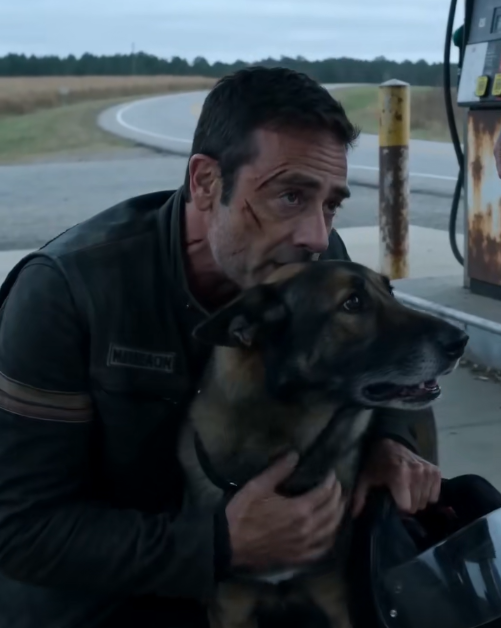
After the fire, he did only one thing.
He waited.
My name is Wade Bennett, though the Iron Lanterns call me Hollow. I was fifty-eight that winter, president of our club, and temporary owner of a dog who had never accepted the word temporary.
Atlas lived with me because Silas was supposed to be dead.
Seven months earlier, Morgan & Price Cycles burned to its foundation on the edge of Dunlow, Tennessee. Fire investigators found Silas’s wallet, his steel-toed boots, part of his leather vest, and enough blood near the paint room to convince everyone he had been trapped inside.
No intact body was recovered.
The heat brought down the roof, and several containers inside the fabrication area ruptured before firefighters could enter.
For three days, Silas was listed as missing.
Then local news began using the word dead.
We held a memorial without a coffin.
Atlas sat beside Silas’s empty boots throughout the entire service.
Afterward, I took the dog home.
Every V-twin that passed my property brought him running. He would stand behind the fence, ears forward, nose working through the exhaust, waiting for a familiar helmet to turn toward him.
Most motorcycles continued down the highway.
Atlas always watched until the sound vanished.
Then he returned to the porch.
That Saturday began the same way.
I was replacing a porch-board screw when a dark blue Harley Road King came through the valley. The bike was unfamiliar, but the idle carried an uneven double beat, as though one cylinder paused half a breath longer than the other.
Atlas lifted his head.
He did not bark.
His entire body went rigid.
A delivery driver had failed to latch the front gate after leaving a package. Before I understood what Atlas had noticed, he struck the gate with one shoulder and forced it open.
“Atlas!”
He reached the highway ditch before I crossed the yard.
The blue Harley was already several hundred yards away. Atlas ran along the grass verge, not into traffic, his head low and tail straight behind him.
I started my motorcycle without fastening my vest.
By the time I reached the road, Atlas had disappeared around the curve.
The Harley rider must have seen him because the bike slowed briefly near the old quarry entrance. Atlas gained ground.
Then the rider accelerated.
That made no sense.
Most riders would stop for a dog chasing them. This one looked over his shoulder twice and continued toward Harpers Crossing, the next town almost eight miles east.
Atlas kept running.
I followed with my hazard lights on, using the bike to shield him from traffic whenever the shoulder narrowed. I shouted his name until my throat hurt.
He did not look at me once.
At mile four, his stride became uneven.
At mile six, blood appeared on one front paw.
Still he ran.
The Road King finally turned from the highway beside an abandoned gas station outside Harpers Crossing. Its faded canopy leaned toward a closed diner, and weeds grew through cracks in the pavement.
The rider stopped near the empty pumps.
Atlas crossed the gravel so fast his injured paw barely touched the ground.
I expected him to attack.
Instead, he slammed his body against the rider’s leg and made a sound I had never heard from him before—half cry, half howl, pulled from somewhere deeper than training.
The rider remained seated.
Gloved hands gripped the handlebars.
Atlas jumped against the fuel tank, paws scraping the dark paint. He pressed his muzzle beneath the man’s arm and began shaking from his shoulders to his tail.
“Step away from the dog,” I said.
The rider slowly shut off the engine.
In the sudden silence, I heard Atlas whining and the hot exhaust ticking beneath the frame.
The man removed his gloves.
The left hand was scarred.
Two fingers would not straighten completely.
Then he lifted the helmet.
His hair was shorter. Burn scars climbed from his collar along the right side of his neck and jaw. A pale graft crossed his cheek, changing the face I had known for twenty-three years.
But the eyes were Silas Morgan’s.
Alive.
Atlas climbed onto him as far as an eighty-pound dog could climb. Silas dropped to one knee and buried both hands in the fur around the dog’s neck.
“I’m sorry,” he kept saying. “I’m sorry, buddy. I’m sorry.”
I could not move.
For seven months, I had carried his casket photograph in my wallet. I had signed the memorial register. I had helped his sworn brother take inventory of the ruined shop.
Now the dead man was kneeling ten feet from me while his dog tried to crawl inside his chest.
“You’re alive,” I said.
Silas looked up.
Fear arrived before relief.
He stood, still holding Atlas by the collar, and searched the highway behind me.
“Did anybody follow you?”
“No.”
“Did you call the club?”
“Not yet.”
His burned hand closed around my wrist.
“Don’t.”
“What happened?”
Silas glanced toward the direction of Dunlow.
Then he said the one name I least expected.
“Bishop put me in that fire.”
Nolan “Bishop” Price was Silas’s business partner.
His vice president.
His sworn brother.
And the man who had stood beside me at the memorial and promised Atlas that we would never stop looking after him.
Silas tightened his grip.
“If Bishop learns I’m alive before the state investigator sees what I found, he’ll burn the rest of you with me.”
Part 2
I wanted to call Silas a liar.
That would have hurt less.
Nolan Price had joined the Iron Lanterns nineteen years earlier. He earned the road name Bishop because he carried an old chess bishop inside his vest and claimed every problem could be solved by moving diagonally around it.
Silas sponsored him into the club.
They worked together, rode together, and stood beside each other during divorces, funerals, surgeries, and one flood evacuation that left both men sleeping on the floor of our clubhouse for nine days.
When Silas opened Morgan Cycles, Bishop arrived with a toolbox and stayed without asking for wages.
Five years later, Silas added his name to the business.
Morgan & Price Cycles became the only shop within fifty miles willing to repair farm equipment on Monday, touring bikes on Tuesday, and a single mother’s broken alternator after closing because her children needed school transportation.
Silas handled fabrication.
Bishop handled accounts, insurance, and suppliers.
I trusted them both.
That trust became part of the trap.
Silas stood beneath the abandoned gas-station canopy with Atlas leaning against his legs. Up close, I saw the skin graft continuing beneath his shirt and a compression glove covering part of his right wrist.
“You’ve been alive seven months,” I said.
“Yes.”
“And you let us bury you.”
“I watched the memorial online.”
My fist closed.
Atlas moved between us.
Silas saw it.
“You should hit me.”
“I’m considering it.”
“I would.”
“Start talking.”
The strange Harley did not belong to him. It had been loaned by a veterans’ transitional garage outside Knoxville, where Silas had spent part of his recovery doing small repair work under another name.
He had not planned to pass through Dunlow.
An attorney representing him arranged a meeting in Harpers Crossing with a state fire investigator and an insurance-fraud examiner. Silas was supposed to surrender voluntarily the following morning after presenting evidence his attorney had recovered.
He chose the neighboring town because he believed Bishop still watched the roads near our clubhouse.
“Then why ride a Harley that sounds like your old one?”
Silas looked at the blue Road King.
“I rebuilt the top end.”
The pause between cylinders was not identical to his destroyed black Electra Glide, but Atlas had heard the hands behind the machine.
Maybe he smelled the same oil.
Maybe the dog recognized Silas when the rider looked back.
Training explains many things.
It does not explain everything.
I checked Atlas’s paw. One pad was torn, and gravel had lodged along the edge. The injury needed cleaning, but it was not severe enough to stop him from pressing against Silas every time his owner shifted.
“Why didn’t you call me?” I asked.
“I tried.”
“When?”
“Eleven days after the fire.”
“I received nothing.”
“I called the clubhouse landline.”
“Who answered?”
Silas did not need to say it.
Bishop often opened the clubhouse before morning rides.
According to Silas, Bishop answered and remained silent long enough to recognize his voice. Then the call ended.
Thirty minutes later, a dark SUV appeared outside the rural clinic where Silas had been treated under a temporary John Doe file.
He left through a laundry entrance.
“That could have been anybody,” I said.
“I know.”
“You ran because of one vehicle?”
“No. I ran because of what was on the news.”
Three days after Silas regained consciousness, local reporting on the fire changed. Investigators found evidence suggesting the blaze had been intentionally set.
Accelerant containers were purchased using Silas’s business account.
The alarm system had been disabled with his access code.
A recent insurance amendment increased coverage on specialized equipment.
A bank transfer appeared to move company money into an account connected to Silas.
Bishop told investigators Silas had been unstable, angry about debt, and talking about burning the shop before creditors took it.
Then Bishop supplied a voicemail.
A voice resembling Silas said, “If I lose this place, nobody gets it.”
Silas denied recording it.
Investigators could not locate him.
The story shifted again.
The missing owner believed dead in the fire became the missing owner suspected of setting it.
“If you were innocent, you should have gone to police,” I said.
“I know.”
“Then why didn’t you?”
He touched the scar on his jaw.
“When I woke up, I couldn’t remember my dog’s name.”
That slowed my anger.
Silas had been found nearly a mile from the shop by a produce truck driver who saw him walking along a drainage road before collapsing. His wallet was gone, his clothes were burned, and facial swelling made identification difficult.
The driver took him toward the nearest emergency department, but a storm had closed the direct route. Silas ended up at a small hospital in another county.
He inhaled smoke, suffered burns across his shoulder and neck, and sustained a head injury.
For days, he gave no reliable name.
Fragments returned out of order.
Atlas.
The shop.
A door locking.
Bishop standing outside the paint room.
By the time memory became clear enough for Silas to identify himself, the arson evidence already pointed toward him.
He panicked.
Running was the wrong choice.
He admitted that before I could say it.
A shelter volunteer eventually connected him with Mara Bell, a criminal-defense attorney who arranged medical care, preserved his account, and contacted state investigators through controlled channels.
She told him to stop moving.
He did.
For four months, Silas lived at a confidential recovery residence while Mara gathered records and negotiated his surrender.
“Why today?” I asked.
He opened the Road King’s locked saddlebag.
Inside was a weatherproof evidence case.
“The truck Bishop forgot about.”
A tow truck had been parked behind Morgan & Price Cycles on the night of the fire. It belonged to a customer and carried a dashboard camera with parking-mode recording.
Bishop sold the truck for parts four days after the blaze.
Mara had traced it.
The memory card survived.
Silas did not show me what was on it.
He closed the saddlebag.
“You weren’t supposed to find me,” he said.
Atlas rested his head against Silas’s leg.
I looked at the dog’s bleeding paw.
“No,” I said. “He was.”
Part 3
We moved inside the abandoned diner because anyone passing the highway could see us beneath the gas-station canopy.
The side door had been unlocked, though the electricity was disconnected. Dust covered the tables. A calendar from three years earlier remained near the kitchen, and sunlight entered through a crack in the plywood over one window.
Silas carried Atlas inside.
The dog was capable of walking, but Silas refused to put him down.
I found a first-aid kit in my saddlebag, rinsed Atlas’s paw with bottled water, removed the gravel, and wrapped it loosely until a veterinarian could examine it.
Atlas watched Silas throughout.
When Silas moved, the dog’s ears moved.
When he sat, Atlas placed both front paws over one boot.
“Tell me about the fire,” I said.
Silas stared at the boarded window.
The shop had closed early because of freezing rain. Only Silas and Bishop remained. They argued in the office over financial records Silas had discovered inside a supplier folder.
Several vendor payments had been redirected.
Equipment loans had been refinanced without Silas’s knowledge.
Bishop had also changed the insurance policy and submitted an operating agreement giving himself control of the company if Silas died, disappeared, or became legally incapacitated.
Silas confronted him.
Bishop denied everything.
Then he cried.
That detail was difficult for Silas to repeat.
Bishop said gambling had put him in debt. He owed money to people who were threatening his family. He had intended to borrow from the company and restore it before Silas noticed.
Silas told him they would call Denise and the bank in the morning.
The business might fail.
Bishop would lose his office.
But Silas promised to stand beside him while he faced it.
That was the last offer of brotherhood Bishop received.
He chose the money.
When Silas turned toward the file cabinet, Bishop struck him behind the ear with a short torque wrench. Silas fell against the desk but did not lose consciousness.
They fought.
Not like men in movies.
Two middle-aged mechanics slipped on paperwork, collided with furniture, and struggled for breath. Silas’s head wound blurred his vision. Bishop drove him backward into the paint-preparation room and pulled the steel door shut.
The lock was outside.
Silas heard the bolt slide.
Then came the smell.
Solvent.
Bishop had already placed open containers along the west wall.
“He planned it before the argument,” I said.
“Yes.”
Silas pounded the door.
Bishop stood outside.
Through the wired-glass window, Silas saw his sworn brother holding Silas’s leather vest and wallet.
“He said something?”
Silas nodded.
“What?”
“He said they’d believe I did it.”
Then Bishop walked away.
Flame moved beneath the door seconds later.
The fire climbed faster than Silas expected because fumes had collected in the ventilation system. He wrapped his shirt around his face and broke the lower wall panel with a steel mixing paddle.
Behind it was a narrow service chase carrying pipes toward the rear drainage trench.
He crawled.
Part of the ceiling dropped.
A heated pipe burned his shoulder and neck. He remembered reaching cold air. After that came fragments: mud, weeds, headlights, and the truck driver shouting for him to stop walking.
“What about the blood they found?”
“Mine. From the office and door.”
“The boots?”
“Bishop took a pair from my locker.”
“And the vest?”
“Same.”
Bishop constructed two possible endings.
If authorities believed Silas died, Bishop controlled the company and pursued the fire claim.
If they discovered Silas lived, the financial records and planted evidence made him look like an owner who burned his failing shop and fled.
The plan did not require perfection.
It needed only confusion arriving before truth.
I asked about the money transfer.
Forged authorization.
The access code?
Bishop knew it.
The accelerant purchase?
Placed using a vendor login they shared.
The voicemail?
A sentence assembled from recordings Silas had sent during earlier arguments. A forensic audio specialist working with Mara identified irregular breaks in background noise.
Each explanation sounded possible.
Together, they sounded almost too complete.
That troubled me.
“Why should I believe you?”
Silas looked at Atlas.
“You shouldn’t because of him.”
The dog lifted his head.
“You shouldn’t because we’re brothers. Bishop used that.”
He removed a small digital recorder from the evidence case but did not hand it to me.
“Believe what can be proven.”
That was the Silas I remembered.
He had never asked a customer to trust a repair without showing the damaged part.
The tow-truck camera provided the first independent proof.
Mara had extracted three usable clips. One showed Bishop moving fuel containers behind the shop two hours before the fire. Another showed him carrying Silas’s vest toward the paint room after Silas normally would have been wearing it home.
The final clip showed Bishop leaving through the rear lot alone.
He paused beside the tow truck.
Then he called someone and said, “He won’t walk out.”
Audio quality was poor, but the words were recoverable.
The recording did not prove every allegation.
It changed the case.
Mara had also obtained a copy of the original operating agreement from the bank. The version Bishop submitted after the fire contained pages created months later.
Silas was returning because the evidence finally gave him a way to enter custody without vanishing beneath the story Bishop built.
He was still afraid.
So was I.
My phone vibrated.
Boone’s name appeared.
I had missed seven calls.
Before I could answer, a message arrived:
Bishop wants to know why Atlas’s GPS collar is in Harpers Crossing.
I looked at the dog.
After the fire, I had attached a tracker to his collar because he kept trying to reach the highway.
Club officers had access to the location app.
Bishop was one of them.
Silas stood.
Outside, a motorcycle engine approached the abandoned gas station.
Then another.
And another.
Part 4
Five Iron Lanterns entered the lot.
Bishop was not among them.
Boone led the group, followed by Eddie, Marcus, Travis, and a prospect named Cal. They spread across the parking area after seeing my bike beside the strange Road King.
Nobody had drawn a weapon.
We did not carry them to club meetings or routine rides.
But their posture told me they expected trouble.
I stepped from the diner.
Boone removed his helmet.
“Where’s Atlas?”
“Inside.”
“Why?”
“Because he followed that Harley.”
“Who’s riding it?”
Silas appeared behind me.
Every man stopped.
Travis whispered his road name.
Eddie crossed himself.
Boone took one step forward, then another, studying the scars as though a closer angle might reveal a cruel resemblance rather than the man we had buried.
Silas did not speak.
Atlas moved past his leg and stood between them.
Boone’s helmet fell from his hand.
He reached Silas first.
The embrace lasted less than three seconds.
Then Boone shoved him backward.
“You let us think you were dead.”
“I know.”
“We searched that fire.”
“I know.”
“You watched your own memorial?”
“Yes.”
Boone raised one fist.
Atlas growled.
Boone lowered it.
The dog had already chosen the boundary.
The others surrounded Silas with questions. Where had he been? Why had he stayed away? Was he under arrest? Had Bishop known?
That final question silenced everyone.
I explained only what Silas authorized: attempted murder, financial fraud, planted evidence, an attorney, and a scheduled surrender.
Travis immediately turned toward his motorcycle.
“I’m going back.”
“No,” I said.
“He tried to burn a brother alive.”
“Stand still.”
“You expect us to do nothing?”
“I expect you not to destroy evidence, threaten a suspect, or give Bishop a reason to claim Silas controls an armed club.”
The words reached him.
Barely.
He remained beside his bike.
Bishop called again.
This time, I answered on speaker.
“Where are you?” he asked.
“Harpers Crossing.”
“Why?”
“Atlas ran.”
“Is he hurt?”
One thing about betrayal is that it does not erase every true feeling. Bishop had helped train Atlas. He had slept on my floor beside the dog after Silas’s memorial.
His concern sounded real.
That made what came next worse.
“He found somebody,” I said.
Silence.
“Who?”
“A rider.”
“What rider?”
“Dark blue Road King.”
The line remained open.
I heard breathing.
Then Bishop said, “Bring the dog home.”
Not Is Silas alive?
Not Who did he find?
Bring the dog home.
He knew.
Silas looked at me.
I ended the call.
Within five minutes, Mara Bell arrived in a gray sedan with State Fire Investigator Owen Price—not related to Bishop—and two Tennessee Bureau of Investigation agents. They had already been traveling toward Harpers Crossing for the planned meeting.
Mara was furious that Silas had left the recovery property alone.
She became more furious when she saw six bikers, a tracked dog, and the evidence case sitting inside an unlocked diner.
She ordered everyone away from it.
That was sensible.
Investigators photographed the case, confirmed the seal, and transferred it into their custody. Silas provided his statement. An agent examined his injuries and photographed scars consistent with hospital records.
Then Silas was placed in handcuffs.
Atlas lunged.
I caught his collar.
“It’s all right,” Silas said.
The dog did not believe him.
Neither did I.
Mara explained that the outstanding material-witness and investigative hold required Silas to be processed. Depending on what prosecutors decided, he might face an arson charge temporarily.
Silas had returned voluntarily.
That mattered.
It did not make the cuffs disappear.
Before entering the vehicle, he knelt beside Atlas.
“I’m coming back.”
Atlas pressed his forehead against Silas’s chest.
The dog had heard promises before.
He released Silas only when the man used the old search command.
“Hold home.”
Atlas sat.
The state vehicle left.
None of us followed.
Mara remained long enough to tell us the most useful thing we could do was preserve messages, avoid Bishop, and say nothing publicly.
Boone asked whether Bishop would be arrested.
“When evidence supports it.”
“We have a recording.”
“You have a portion of a recording that must be authenticated.”
“We have Silas.”
“You have an injured man making an allegation.”
Her voice stayed calm.
“This works only if you let the evidence become stronger than the club.”
We returned to Dunlow before sunset.
Bishop was waiting inside the clubhouse.
He stood beneath Silas’s memorial photograph, arms folded, wearing the vest Silas had once sponsored.
His gaze dropped to the blood-stained bandage around Atlas’s paw.
Then he looked at me.
“What did the dog find?”
I closed the clubhouse door behind us.
“Why don’t you tell me?”
Part 5
Bishop denied everything.
He denied knowing Silas was alive. He denied tracking Atlas beyond receiving an automatic location notification. He denied financial theft, insurance manipulation, and every detail of the fire.
He also denied recognizing the Road King.
Nobody had accused him of recognizing it.
That mistake changed Boone’s face.
Bishop saw it.
The room tightened.
I told everyone to keep their hands visible.
Club discipline can become theater if men confuse loyalty with violence. That night, we had no right to detain Bishop, search him, or punish him for an accusation still being investigated.
We did have the right to suspend his access.
I asked for his clubhouse keys.
He refused.
Boone repeated the request.
Bishop looked toward the other members, expecting someone to stand beside him.
Nobody did.
He removed the keys and dropped them on the table.
“You believe a ghost over me?”
“I believe there’s an investigation.”
“He burned his own shop.”
“Then evidence will show it.”
“He emptied the accounts.”
“The bank says those transfers used your office terminal.”
His eyes shifted.
Only slightly.
Enough.
“How would you know what the bank says?” he asked.
I had guessed.
Bishop understood too late.
Travis moved forward.
I stopped him with one arm.
Bishop laughed, but sweat had gathered above his collar.
“You think Atlas found him because of engine noise? Silas trained that dog to follow him anywhere. He could’ve staged the whole thing.”
“Then why were you afraid of where the collar stopped?”
“I wasn’t.”
“Your voice was.”
He left without another word.
Two unmarked vehicles followed him from the county road.
Investigators had not asked us to provoke a confession. I would not pretend our meeting solved the case. Bishop’s reaction became one small piece in a larger file.
The stronger evidence came from records.
The tow-truck footage was authenticated. Metadata showed it had been recorded on the night of the fire and had not been edited.
A bank specialist confirmed that several disputed transfers originated from Bishop’s authenticated device.
The alarm company recovered a server log showing the system was disabled using Silas’s code from a browser session associated with Bishop’s phone.
The forged operating agreement contained a digital font not released until three months after the document’s stated date.
Then investigators found the original audio files used to construct the threatening voicemail.
Bishop had stored them inside a cloud folder labeled for shop advertising.
No single discovery proved attempted murder.
The physical evidence helped.
Fire patterns supported ignition outside the paint room. Scrape marks remained around the external door bolt. A section of the service chase contained Silas’s blood and burned fabric, confirming his escape route.
Hospital records documented injuries consistent with crawling beneath heated piping.
The produce driver identified Silas.
Mara delivered everything through the proper channels.
Four days after Atlas found him, prosecutors withdrew the pending arson allegation against Silas while the broader investigation continued. He was released under conditions requiring him to remain available and avoid the burned shop property.
I picked him up.
Atlas sat in the truck beside me.
When Silas emerged from the county building, the dog did not run.
He had learned what locked doors could do.
He waited until Silas opened the passenger door.
Then Atlas climbed across my lap, knocked the gear selector into neutral, and buried his face beneath Silas’s chin.
I let them stay that way.
Bishop was arrested the following morning.
Charges included attempted murder, aggravated arson, evidence tampering, forgery, theft, and insurance fraud. His attorney entered a plea of not guilty.
That was his right.
The club did not gather outside the courthouse. We did not post threats. We did not turn his arrest into entertainment.
Silas asked us not to.
“He was my brother,” he said. “Don’t make what he did the club’s excuse to become something worse.”
The Iron Lanterns voted to revoke Bishop’s membership after a formal hearing held without him at his attorney’s request. We documented the decision and removed his access to club property.
His patch was not burned.
It was sealed in an evidence-style bag and placed in a locked cabinet until the criminal case concluded.
Silas attended the vote.
He did not speak.
Afterward, he walked outside and vomited beside the garage.
Betrayal did not become painless when the truth arrived.
It became specific.
Bishop had used Silas’s access code because Silas trusted him.
He knew where the spare boots were because they changed beside each other.
He knew which evidence investigators would accept because he helped build the business records.
Every piece of trust became a tool laid out before the crime.
Atlas followed Silas onto the porch and lay across his feet.
For the first night since the fire, the dog slept without lifting his head when motorcycles passed.
Part 6
The criminal case lasted more than a year.
Some charges changed. Others were combined. Bishop eventually entered a negotiated plea after prosecutors presented the authenticated recording, financial evidence, and fire-scene analysis.
He admitted setting the fire, falsifying records, and locking Silas inside the paint-preparation room.
He did not publicly explain why he chose death over confession.
Money was part of it.
Fear was part of it.
Pride completed what both had started.
The insurance company denied Bishop’s claim and cooperated with investigators. Remaining shop assets entered court-supervised receivership. Creditors were paid from what could be salvaged.
Silas recovered neither the old building nor every tool.
Exoneration does not rebuild a workshop.
It also does not restore seven months.
His right hand remained weak. Skin grafts tightened whenever cold weather arrived. Smoke damage reduced his stamina, and sudden metallic bangs could send him outside before he realized he had moved.
He began counseling.
So did three members of the club.
Men who claim brotherhood often understand grief better than betrayal. Death leaves an empty chair. Betrayal leaves the chair occupied by every memory you can no longer trust.
Silas returned to repair work gradually.
At first, he adjusted brakes at the veterans’ garage that had loaned him the blue Road King. Later, he rented one bay behind a tire store in Dunlow.
He named it Hold Home Garage after the command he gave Atlas before entering custody.
No sign explained the name.
People who needed to know already did.
Atlas’s paw healed in two weeks. The dog regained the weight he lost after the fire and resumed short search exercises, though Silas retired him from difficult field work.
Their first training session took place behind the new garage.
Silas hid in a wooded drainage area while Boone released Atlas with the search command. The dog found him in forty-three seconds.
He did not bark.
He leaned against Silas and refused to return.
Silas laughed for the first time since coming home.
The sound was rough and incomplete.
It was still laughter.
The dark blue Road King remained part of the story. The veterans’ garage offered to sell it to Silas at cost, but he declined.
“That bike brought Atlas back to me,” he said. “It belongs where somebody else gets another start.”
Before returning it, he repaired the uneven idle.
Atlas watched from the doorway.
When the engine settled into a smooth rhythm, the dog tilted his head as if something familiar had vanished.
Silas shut it down.
“Wrong sound now, buddy.”
Atlas placed one paw on his boot.
The sound had never been the promise.
The man was.
Part 7
One year after Silas returned, Hold Home Garage opened its second service bay.
The building was smaller than Morgan & Price Cycles. The roof leaked near the parts room, the customer chairs did not match, and Silas’s name was the only one on the lease.
He preferred it that way.
Atlas spent most afternoons on a rubber mat beside the open bay door. His muzzle had begun turning gray. A retired search harness hung above him, cleaned but never repainted.
Every time a Harley approached the valley road, Atlas still lifted his head.
He listened.
He no longer ran.
At closing time, Silas rolled his tool cart against the wall, washed his hands, and tapped twice on the doorframe.
Atlas stood.
They left together.
One evening, I arrived as Silas was lowering the garage door. A V-twin sounded beyond the trees, carrying that familiar uneven pause between cylinders.
Atlas walked to the edge of the lot.
Silas stopped behind him.
The motorcycle appeared around the curve.
It was the dark blue Road King.
A young veteran from the transitional garage rode it now. He raised one hand while passing.
Atlas watched until the taillight disappeared.
Then he turned around.
Silas was already there.
The dog crossed the lot slowly and pressed his head against the scarred hand waiting for him.
For seven months, Atlas had run toward every engine because he believed one of them might bring his owner home.
Now he let the motorcycles pass.
Home closed the garage beside him every night.
Follow our page for more biker stories about loyal dogs, broken brotherhood, and the engines that sometimes bring the missing home.