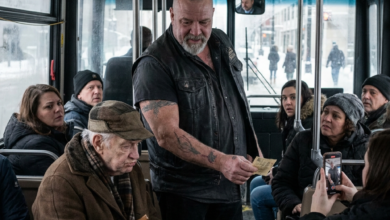
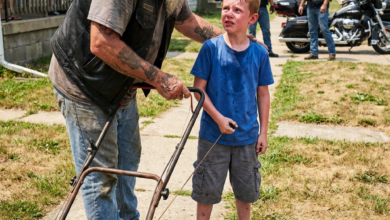
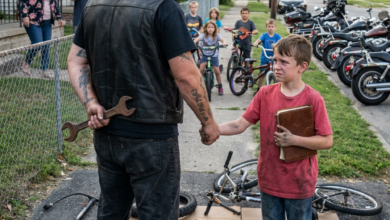
A Mother Ordered a Tattooed Biker to Remove His Leather in the Middle of a Children’s Playground — Then Her Autistic Son Reached From a Plastic Tunnel for the Only Weight He Would Accept
Part 2 — The Boy Who Counted Every Fence Post
My name is Erin Walsh, and by the afternoon I ordered a stranger to remove his leather in front of fifty people, I had already spent eight years learning how quickly the world confused my son’s distress with bad behavior.
Milo was autistic. That was not a tragedy, a secret, or a puzzle I expected strangers to solve. He was a child who remembered every exit number between Flagstaff and Phoenix, could identify birds from their wingbeats, and refused to eat toast if it had been cut into an odd number of pieces.
He also experienced sound, heat, touch, and sudden change more intensely than many people around him understood.
On good days, Willow Bend Park belonged to him.
He walked the fence first. Twenty-seven posts on the north side. Nineteen beside the baseball field. One bent post near the cottonwood tree that he touched twice because, according to him, “damaged things need a second count.”
After the fence, he climbed the red ladder, crossed the bridge, and crawled through the blue tunnel exactly three times.
Then he sat beneath the slide and drew road maps.
That Sunday should have followed the same pattern. I had checked the city calendar for festivals, reserved a quiet picnic table, packed his headphones, and brought the weighted lap pad his occupational therapist had helped us incorporate into routines when Milo chose firm pressure.
I still forgot the lap pad in the car.
Parents of disabled children are often described as warriors, as though love gives us perfect memory, endless patience, and tactical control over public parks. It does not. Sometimes love is a tired woman holding two juice boxes and realizing the thing her child needs is locked inside a Honda twelve minutes away.
Milo’s father, Noah, used to carry everything.
He rode an old brown Harley until Milo was four, though he never started it when our son was outside. Noah would roll the motorcycle halfway down the driveway before turning the engine over. When he came home, he shut it off at the corner and coasted the last thirty yards.
Milo loved the machine when it was silent.
He traced the chrome. Spun the cool mirrors. Counted the bolts around the derby cover. But whenever the engine ran, he watched from inside through two panes of glass.
Noah understood that difference.
“He doesn’t hate motorcycles,” he once told a neighbor. “He hates surprises that shake his bones.”
Noah died when a delivery truck crossed the center line on Interstate 17. He had been driving our family car, not riding. That detail mattered only because people saw old photographs of him in leather and assumed the motorcycle had killed him.
For months after the funeral, Milo slept beneath Noah’s riding jacket.
It was too large and smelled of cedar soap, road dust, and the peppermint gum Noah kept in every pocket. Milo did not use it every night. He chose it during thunderstorms, fireworks, and the awful weeks when grief changed the shape of our home without asking permission.
Then an electrical fire destroyed our apartment.
We escaped. The jacket did not.
Milo never mentioned it again.
At Willow Bend, he seemed content until the riders arrived. The first eleven motorcycles rolled toward the far curb slowly. Their sound was deep but predictable, and Milo pressed his headphones over his ears while watching.
The twelfth rider was younger than the rest.
He wore a new-looking leather cut and rode too close to Bear’s rear tire. Later, I learned his name was Travis Cole, though the club called him Colt. He was a prospect, not yet a full member, and desperate to prove he belonged.
Bear pointed toward the fire lane.
Colt misunderstood. He restarted his bike to move it.
The engine backfired.
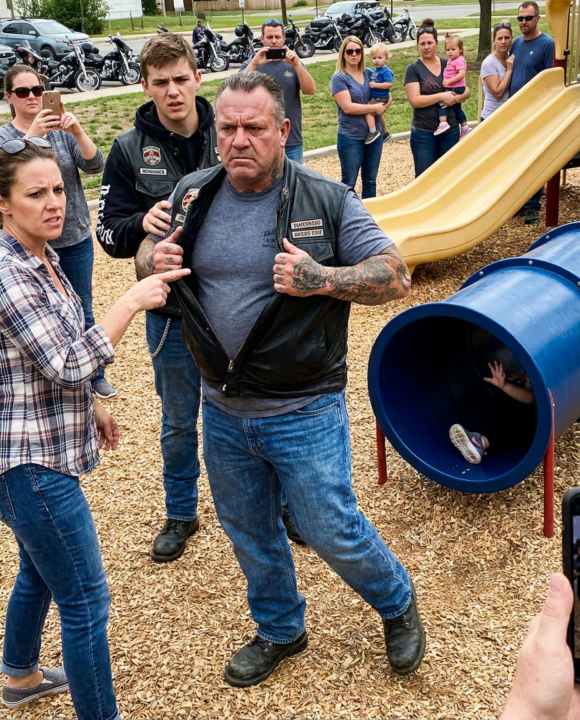
Milo’s body reacted before thought could catch up. He ran across the mulch, climbed into the blue tunnel, and curled at its center. The tunnel had two exits, but its curved design kept us from seeing one another directly.
I tried our familiar phrases.
“Mom’s here.”
No answer.
“You are safe.”
His heels struck the wall.
“Do you want headphones?”
He screamed.
Children gathered. Adults followed. Every voice added another layer. Even kindness became noise.
Bear recognized that before anyone else.
“Everybody back up,” he said.
His voice was not loud, but the men behind him obeyed. They moved toward the motorcycles and shut down a second engine someone had left idling.
Bear removed a key ring from his belt so it would stop rattling.
That small action told me he was watching Milo, not merely watching the emergency.
When I leaned toward the ventilation hole, I heard one word.
“Heavy.”
I looked across the mulch.
Bear’s riding jacket was the thickest object in reach.
I asked him to remove it.
The crowd heard an accusation. His brothers heard disrespect. Bear heard a request.
That difference brought my son out.
It also opened a history the biker had carried beneath his leather for twenty-three years.
Part 3 — The Jacket at the Mouth of the Blue Tunnel
Colt moved between us before Bear could answer.
He was perhaps thirty, lean and restless, with a red beard and a fresh Stone Ridge patch that had not yet softened around the seams. Guilt had made him defensive.
“He already killed the engine,” Colt said. “What else do you want?”
“His jacket.”
“You serious?”
“My son asked for something heavy.”
Several parents exchanged looks. I knew those looks. They meant they had decided panic had made me irrational.
A woman near the swings touched my shoulder. “Honey, maybe wait for the paramedics.”
Sirens were already approaching from Route 66.
That sound reached the tunnel.
Milo kicked the wall again.
Bear stepped around Colt. “Does he have a weighted vest?”
“In my car.”
“How far?”
“Other side of the field.”
“Can somebody get it?”
“My keys are in my pocket, but he may follow if I move away. Or he may think I left.”
Daniel, a father I had never met, offered to run. I handed him the keys and described the gray bag beneath the passenger seat. He sprinted across the baseball field.
Bear looked toward the tunnel. “Does he choose deep pressure?”
“Sometimes. Only if he asks.”
“Then we don’t wrap him.”
“No. We offer it.”
Bear nodded once.
He removed the silver skull rings from his fingers and handed them to an older rider. His chain wallet came next. Then he unfastened his leather cut.
Colt caught the shoulder.
“Bear.”
“Not now.”
“You said nobody touches the colors.”
Bear studied the dark opening where my son had disappeared.
“Rules are tools, brother. Wrong tool, wrong day.”
He slipped off the cut.
Beneath it, he wore a thick black riding jacket reinforced at the shoulders. Despite the afternoon heat, the leather remained cool on the shaded side. Bear turned it inside out before lowering it toward me.
That was when I saw the patch.
A four-inch square of faded blue cloth had been stitched over the inner chest pocket. Small yellow stars covered the fabric. The sewing wandered unevenly around the edges, doubled back in two places, and ended in a knot large enough to catch a fingertip.
An orange foam earplug sat in the pocket below it.
So did a laminated communication card.
I looked at Bear.
“My boy made the card,” he said.
“Is he autistic?”
Bear’s jaw shifted beneath the beard.
“Yeah.”
Colt stared at him. “You said Eli was gone.”
“I said he doesn’t ride with me.”
A paramedic crossed the mulch. Bear lifted one palm and pointed toward me, making it clear that I should speak first.
I explained Milo’s communication, the request for weight, and our plan. The paramedic agreed to wait nearby while monitoring the heat inside the tunnel. Nobody would force an extraction unless Milo faced immediate physical danger.
That gave us minutes.
Not many.
The plastic was warming in the sun.
I lay on my stomach at one entrance. Bear lowered himself at the other, far enough back that Milo would not feel trapped between two adults.
“Jacket’s here,” I said. “You can touch it.”
No answer.
Bear pushed one sleeve into the tunnel using two fingers.
“Leather,” he said.
His voice was different now. Softer. Almost flat.
Milo’s kicking slowed.
“Black leather,” Bear continued. “Heavy. Cold inside. No person coming in.”
Milo understood exact promises.
Bear did too.
One small hand appeared around the curve.
The crowd inhaled as though it were one body. Bear looked over his shoulder, pressed a finger to his lips, and every biker turned toward the onlookers.
They did not threaten anyone.
They simply created a line.
Broad shoulders and leather backs blocked the raised phones without confronting the people holding them. Children could still see their parents. Paramedics still had access. Milo gained privacy.
His fingers touched the sleeve.
He pulled.
The jacket moved six inches inside.
Stopped.
Moved again.
I heard Milo breathing through his mouth. Fast. Uneven. Still frightened.
“More?” I asked.
He tapped the tunnel floor once.
Our signal for yes.
Bear pushed the rest of the jacket forward. He kept his scarred hands visible, then backed away until his boots touched the border around the mulch.
The leather disappeared around the bend.
For almost a minute, nothing changed.
Then the screaming ended.
The silence frightened me at first. I called Milo’s name and heard fabric shifting across plastic.
“I’m here,” he whispered.
My legs nearly gave out.
“Can I come closer?”
“No.”
“Okay.”
“Jacket stays.”
“Jacket stays.”
The paramedic checked her watch. The temperature remained concerning, but Milo was communicating. She gave us another minute.
Bear sat cross-legged on the mulch. Without the leather, his tattooed arms were completely exposed. Names, dates, flames, and a small blue puzzle-piece tattoo covered his right forearm, though a thick black line had later been drawn through the symbol.
Milo’s shoes appeared first.
He backed out of the tunnel wrapped in Bear’s jacket like a dark shell. Only the top of his blue cap and both sneakers were visible.
Nobody reached for him.
I sat beside the exit.
He leaned against me without releasing the leather. His breathing slowed. One hand slid inside the lining and found the faded blue patch.
He traced a yellow star.
Bear looked away.
Colt noticed.
“What is that cloth?” I asked.
Bear did not answer immediately.
Milo lifted one corner and found a name written beneath it in faded marker.
ELI MERCER — ROOM 8.
Bear closed his eyes.
Colt stepped toward him. “Brother, you told us Eli was dead.”
Bear opened his eyes again.
“No,” he said. “I told you I lost him.”
The paramedic arrived with Milo’s weighted lap pad, carried by the father who had run to my car. I offered it to Milo.
He shook his head.
“Bear jacket.”
“It belongs to him.”
Milo looked toward the tattooed stranger.
Bear placed both empty hands on his knees.
“Borrow it,” he said.
Milo studied him, then asked the question that opened the next part of Bear’s story.
“Did Eli come out?”
Bear’s beard moved as he swallowed.
“Not for me,” he said. “Not that day.”
The adults thought he meant a tunnel.
He did not.
Part 4 — The Blue Cloth Sewn Over Bear’s Heart
Eli Mercer was thirty-one and alive.
He lived in Albuquerque, restored vintage radios, and spoke to his father every Thursday at precisely 7:10 p.m. Their calls usually lasted eleven minutes. Sometimes twelve.
Bear told me that while sitting on the curb in a faded T-shirt, his jacket still wrapped around my son.
The paramedics had checked Milo from a respectful distance. His temperature was coming down. His breathing had steadied. He drank from a straw without uncovering his head.
The immediate crisis had passed.
The older one had not.
Eli was diagnosed as autistic when he was seven, in 1997, at a time when Bear knew the word mainly from a pamphlet his wife brought home. Bear worked nights repairing heavy equipment. He drank after shifts and rode all weekend with men who mistook his silence for strength.
He loved his son.
He did not understand him.
Those truths existed together.
Eli covered his ears when Bear started the Harley. Bear told him to get used to it. Eli refused denim, meat with sauce, school assemblies, and rooms where fluorescent lights hummed. Bear treated each need as a challenge that could be overcome through pressure.
Not the kind Milo had chosen inside the tunnel.
The other kind.
Shame.
When Eli had a meltdown at a county fair, eleven-year-old Eli crawled beneath a concession trailer and refused to come out. Bear shouted. Then he crawled under and tried to drag him by the ankle.
His wife stopped him.
People watched.
Someone laughed.
Bear struck the man.
The fight resulted in aggravated-assault charges because the man fell against a metal barrier and suffered a fractured skull. Bear served fourteen months. His wife divorced him. Eli stopped asking when his father would return.
“I blamed the stranger,” Bear said. “Blamed the fair. Blamed the judge. Blamed the noise.”
He glanced toward Milo.
“Kid under that trailer blamed himself.”
After prison, Bear tried to buy his way back into Eli’s life. New bicycle. Video games. Expensive headphones. Each gift arrived with an expectation attached.
Eli returned them.
Bear resumed drinking.
The Stone Ridge Riders were different then. Harder. Less patient. A few members encouraged him to disappear into road miles and whiskey. Others, including a rider named Samuel “Preacher” Bell, refused.
Preacher had a daughter with cerebral palsy. He understood the exhaustion of fighting systems, but he did not excuse Bear’s violence.
“You want your boy back,” Preacher told him, “stop making the boy responsible for finding you.”
Bear entered treatment two weeks later.
Sobriety did not earn immediate forgiveness. It gave him enough clarity to stop demanding it.
For five years, he sent Eli one card each birthday. No questions. No guilt. No requests to meet.
At seventeen, Eli mailed something back.
A square of blue cloth with yellow stars.
It came from the weighted lap blanket he had used in elementary school. Eli had stitched the edges himself and written a note on the back:
This helped because it did not ask me to act grateful. Try being like this.
Bear sewed the cloth inside his jacket.
Over his heart.
The yellow thread wandered because Eli insisted on finishing the seam himself during their first meeting after six years apart. They sat in a quiet diner outside Albuquerque before opening hours. Bear did not hug him. Eli had asked him not to.
They drank cocoa.
For eleven minutes.
That was the beginning of Thursday calls.
“Why did Colt think he was dead?” I asked.
Bear looked toward his brothers.
Because a month earlier, Eli had asked Bear to stop discussing him with new riders. At a club meeting, Colt noticed the child’s cloth and asked whether Bear had lost a son.
Bear replied, “Yeah.”
To him, it meant he had lost years, trust, birthdays, school mornings, and the right to call himself a good father without qualification.
Colt heard death.
Bear never corrected him.
The riders had come to Willow Bend because Eli had designed a set of visual communication boards for public playgrounds. Bear’s group raised money to manufacture them. The first board was supposed to be presented to the city that afternoon.
It was strapped inside Preacher’s saddlebag.
The white ribbons on the motorcycles were not decoration. Each carried one printed word selected by autistic adults who consulted on the project: WAIT, SPACE, QUIET, HELP, YES, NO, FINISHED.
The bikers had planned to park across the street and walk the signs in.
Colt’s backfire had violated Bear’s first instruction.
Engines off before entering the park.
“We came here claiming we wanted kids like yours to feel safer,” Bear said. “Then we brought the thing that drove him into a hole.”
“It was an accident,” Colt muttered.
Bear’s eyes hardened. “Accident tells us how it happened. Doesn’t tell us what we do next.”
Colt removed his leather cut.
For a second, I thought he was surrendering it in shame. Instead, he placed it over the hot section of the tunnel roof, shading the plastic above where Milo had been trapped.
Another rider did the same.
Then another.
Within moments, eleven leather cuts covered the tunnel and climbing platform, blocking the afternoon sun. The men stood in their T-shirts, tattoos exposed, while Milo watched from beneath Bear’s jacket.
The crowd had once believed I was forcing a biker to undress as punishment.
Now an entire brotherhood was removing its leather because one child needed the playground cooler and quieter.
A woman still held up her phone.
Preacher stepped between her camera and Milo.
“Ma’am,” he said, “the boy got through something hard. He doesn’t owe the internet a performance.”
She lowered it.
Bear looked at the fading blue cloth beneath Milo’s fingers.
Then my son did something none of us expected.
He opened the jacket.
Only a few inches.
“Bear can sit,” he said.
The biker lowered himself beside us.
Not touching.
Not speaking.
Just close enough to be included.
Part 5 — What the Riders Built Without Starting an Engine
The city postponed the presentation.
Bear insisted.
“This isn’t our day anymore,” he told the parks coordinator. “Put the board up when the family can leave without fifty people staring.”
I appreciated that more than the donation.
Milo kept Bear’s jacket for forty-three minutes. During that time, the riders moved every motorcycle to the parking lot across Willow Bend Road by rolling them manually.
No engines.
Eleven large men pushed nearly nine thousand pounds of metal beneath the Arizona sun while Colt walked alone at the rear. Sweat darkened his shirt. He never complained.
When Milo finally loosened the jacket, Bear did not reach for it.
“Finished?” he asked.
Milo tapped the ground twice.
No.
“More time?”
One tap.
Yes.
Bear waited.
A playground is usually treated as a place where children must move. Run. Climb. Slide. Laugh loudly enough to reassure adults they are having fun.
That afternoon, the most important thing anyone did at Willow Bend was wait.
Milo eventually placed Bear’s jacket on the mulch between them. He smoothed one sleeve and turned the lining outward so the blue patch remained visible.
“Eli made stars wrong,” he said.
Bear studied the uneven shapes.
“He likes them that way.”
“Stars have five points.”
“Most do.”
“That one has six.”
“Eli said it needed an extra exit.”
Milo considered that.
Then he pointed toward the blue tunnel.
“Tunnel has two.”
“Was that enough?”
Milo shook his head.
Bear did not tell him he had been brave. Milo disliked that word when used for things he had no choice but to endure.
Instead, Bear said, “Two wasn’t enough today.”
Milo nodded.
The parks coordinator, a woman named Denise, overheard. Three months earlier, the city had rejected a proposal to add a side opening to the tunnel because the structure met existing safety standards.
Bear asked for the proposal.
He did not promise to fix the playground. He asked to read the refusal.
The Stone Ridge Riders included welders, mechanics, an electrician, two retired teachers, and one attorney who mostly handled divorces but knew how to make municipal offices answer letters. They spent the next month working with autistic adults, parents, playground designers, and safety inspectors.
They did not build a homemade opening into public equipment.
They raised funds for a professionally designed replacement tunnel with three visible exits, shade panels, and a quiet alcove beside it. The communication board was installed nearby at a height children could reach.
Eli revised its design after hearing what happened.
The new board included a picture of a heavy blanket and the words PRESSURE, SPACE, and NOT YET. It did not assume every child wanted the same support.
Bear showed us a video of Eli testing the icons.
He was tall like his father but thin, with close-cropped brown hair and yellow headphones resting around his neck. He spoke directly to the camera.
“Ask first,” Eli said. “If a person cannot answer, reduce demands. Do not turn support into restraint.”
Bear watched the video twice.
So did I.
Colt requested permission to apologize to Milo. I asked my son.
Milo said, “No talking.”
Colt wrote a note instead.
He did not say the backfire was unavoidable. He wrote: I made unexpected noise. I am sorry. I will shut off before the corner next time. You do not have to answer.
Milo kept the note beside his road maps.
Bear’s club held its fundraiser in a high school parking lot two miles from the nearest neighborhood. Riders arrived in scheduled groups rather than one roaring column. The event included a quiet viewing hour when motorcycles remained off and children could touch mirrors, seats, leather, and cool engine parts without sudden sound.
Milo wanted to attend.
He inspected Bear’s Harley for seventeen minutes.
Then he pointed at the ignition.
“Off.”
Bear handed him the key.
“You check.”
Milo confirmed it twice before touching the chrome.
Bear stood beside him without placing a hand on his shoulder.
The other riders followed his example.
That was how the brotherhood changed—not through a speech, a patch, or a viral photograph, but through dozens of small pauses in which men accustomed to being heard learned when silence mattered more.
Part 6 — Eleven Minutes Every Thursday
Bear became part of our Thursdays by accident.
Eli called him at 7:10. Milo began asking whether “the star man” was on the phone. Bear requested Eli’s permission before introducing them.
Their first conversation lasted four minutes.
Milo asked why one embroidered star had six points. Eli repeated the answer about needing an extra exit. Then both men became silent.
Bear tried to fill the space.
Eli stopped him.
“We’re still talking.”
After that, Milo occasionally joined the Thursday call. He showed Eli road maps. Eli showed him radios with their casings removed. Neither demanded eye contact, quick answers, or polite endings.
When Milo was finished, he said, “Call complete.”
Eli answered, “Complete.”
Bear listened.
The replacement tunnel opened the following spring. It was green instead of blue, which Milo initially refused to enter. Adults whispered that the whole project had failed.
Bear did not coax him.
He sat beside the first entrance with his jacket folded across his knees.
Milo circled the structure. Counted the exits. Touched each shade panel. Read the communication board from top to bottom.
Then he sat beside Bear.
They stayed there for twenty-eight minutes.
On our third visit, Milo entered one end and immediately came out another. On the fifth, he stopped inside for six seconds. On the eighth, he crawled through the full length while Bear waited outside.
Nobody cheered.
Milo had asked them not to.
At the tunnel opening, he said, “Jacket not needed.”
Bear nodded. “Okay.”
Milo touched the blue patch once anyway.
Bear continued visiting Willow Bend, but he parked across the road and shut off his Harley before turning the corner. The other Stone Ridge riders did the same.
Residents sometimes complained that the bikers were trying to claim the park. They did not know the men were cleaning litter before sunrise, replacing damaged communication cards, and checking the quiet alcove for broken glass.
Bear never corrected them.
He had stopped collecting proof that he was a better man.
One Thursday, Eli came from Albuquerque.
Bear waited near the playground with both hands buried in his pockets. When Eli stepped out of the car, his father did not approach until Eli lifted one arm.
Their hug lasted two seconds.
Bear’s eyes closed.
Dry.
Eli inspected the tunnel and found the six-point star Milo had drawn beneath the communication board. He touched its extra point.
“Exit,” Milo explained.
“I know.”
Bear stood behind them in the old leather jacket, his beard nearly white in the afternoon sun.
For the first time, the blue patch over his heart was no longer carrying only what he had lost.
Both boys had come out.
In their own time.
Part 7 — The Jacket Hanging Beside the Tunnel
Three years have passed since the day I ordered Bear to undress in the middle of Willow Bend Park.
Milo is eleven now. He still counts the fence posts. He still uses headphones, direct language, planned exits, and weight when he chooses it. He still has overloads.
Bear never describes those moments as failures.
The Stone Ridge Riders continue shutting down their engines before the corner. New members learn the rule on their first day.
Colt teaches it.
He is a full member now, though the backfire remains part of his story. When someone calls it an embarrassing mistake, he corrects them.
“It was a responsibility,” he says.
Each April, the riders hold a quiet playground morning. No speeches. No roaring arrival. Children examine motorcycles with the keys removed while autistic adults lead the event and decide what accommodations are offered.
Bear’s jacket hangs on a wooden stand beside the tunnel.
It is not presented as treatment. It is simply available, along with weighted lap pads, ear defenders, picture cards, shaded seating, and space.
Children choose.
Or they do not.
The blue cloth remains sewn inside.
Eli added another patch beneath it last year. Milo designed it: a black motorcycle beside a green tunnel, with six uneven stars overhead.
Bear pretended the sewing was crooked.
Milo told him perfection was “not a safety requirement.”
Eli laughed for almost a minute.
Bear did too.
Sometimes new parents recognize him from the old phone video. Only twelve seconds circulated online: me pointing angrily, Bear removing his leather, bikers stepping between the camera and the tunnel.
Without context, it looked like a confrontation.
Bear never asked for the clip to be corrected. He cared only that Milo’s face was not visible.
On warm afternoons, he sits near the third tunnel exit with road coffee between his boots. Children stare at his tattoos. Parents sometimes stare longer.
Milo crawls through the tunnel, emerges beside him, and checks the jacket stand.
“Still heavy?” he asks.
Bear lifts the leather with both hands.
“Still heavy.”
“Good.”
Then the boy continues toward the fence, counting every post and touching the damaged one twice.
Bear watches until he reaches twenty-seven.
Across Willow Bend Road, a Harley waits beneath the cottonwood trees. Its engine remains silent.
The jacket stays near the tunnel.
Follow the page for more quiet-hearted biker stories from the road. Drop BEAR below to receive the next full story.