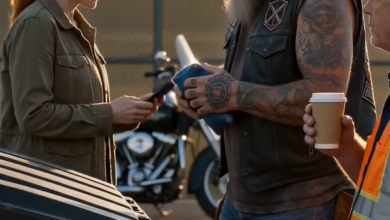
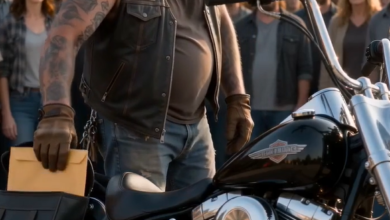
A MAN FILMED A CRYING GIRL FOR LAUGHS—THEN A BIKER REMOVED HIS GLOVES AND THE DINER WENT SILENT.
A MAN FILMED A FIVE-YEAR-OLD SOBBING OVER WORMS—THEN A HUGE BIKER TOOK OFF HIS GLOVES AND KNELT IN THE RAIN.
At the Maple Table diner in Bell Creek, Ohio, Nate Carter had nearly finished cutting his daughter’s pancake when Lucy spotted something through the window. It was Saturday, just after ten. Rain tapped the glass above sixty cooling breakfasts, and his five-year-old was wearing yellow boots she insisted belonged on the wrong feet.
Outside, earthworms covered the wet sidewalk between the diner and a narrow lawn.
Lucy asked to help them. Nate followed her out with a napkin still tucked into his belt. She crouched beside the door, coaxing a worm onto a maple leaf, when Grant Ellis stepped beneath the awning. The neighborhood merchants’ event coordinator had a phone in one hand and a paper coffee cup in the other.
“They’re just worms. Stop crying,” Grant said when somebody’s shoe landed beside her leaf.
She flinched. He pointed his camera.
“Put this little performance online.”
Two customers laughed. Nate felt the familiar pressure to make his child easier for strangers to tolerate. He reached for an apology before he reached for her.
Then Frank “Oak” Carter came through the door.
Nate’s father was sixty-one, broad enough to fill the doorway, with a shaved head, a long gray beard, and tattooed forearms below a black short-sleeved leather biker jacket. A silver acorn inside a broken circle covered its back. Rain darkened his jeans. He smelled of leather and the engine oil that never quite left his hands.
He said nothing to Grant. He only looked at Lucy’s closed fists.
Grant moved his coffee out of Oak’s way, as though protecting it from an animal.
“Look, I’m trying to keep this entrance clear. Your group can’t turn the place into a clubhouse.”
Nate glanced back. A server had stopped carrying toast. Faces gathered behind the window. Grant looked reasonable standing upright in his clean navy raincoat, while Lucy was muddy and the big man beside her had scarred knuckles.
“We should go inside,” Nate said.
Lucy tucked her hands beneath her elbows. That hurt him more than her crying had.
Oak slowly pulled off one worn glove, finger by finger. Then the other. He tucked them into his belt and lowered his enormous frame onto one knee, leaving the doorway open behind him. Lucy watched his bare hand settle on the concrete beside hers.
“Show me,” he said.
She opened a fist. An empty leaf clung to her palm.
“They want to go home.”
Oak did not smile at the people watching. He did not tell her she was making a fuss. He picked up a broad leaf and eased its edge beneath a moving worm. Lucy’s shoulders lowered a fraction. Grant’s phone dipped, then came up again.
Behind the glass, the men who had ridden in with Nate began leaving their tables. Oak lifted the leaf, looked toward the diner door, and spoke loudly enough to carry through the rain.
“Brothers, I need a hand.”
Part 2
The first chair scraped backward before Oak finished lowering his hand.
Then another moved. Nate saw a man with a gray ponytail fold his napkin beside his plate. A welder named Ray set down half a biscuit. Near the kitchen, somebody asked for the check and somebody else answered, “Put mine with his.”
Nobody gave a speech.
They came outside carrying whatever leaves they could find beneath the maple near the parking lot. One man had a replacement knee. Another leaned against the window while he worked his way down. They wore the same black short-sleeved leather jackets, but they lowered themselves with sixty different combinations of grunts and complaints.
“Nobody told me there’d be floor work,” Ray said.
“You should’ve read the invitation.”
Lucy looked toward Nate.
“Are they mad?”
“No, baby.”
“Because Grandpa called them?”
Nate couldn’t answer immediately. His father was guiding the first worm onto damp soil beneath a shrub, above the shallow water collecting at the lawn’s edge.
“Like that?” Lucy asked.
Oak nodded. “Gently.”
She found another leaf.
For several seconds, Grant kept his phone upright, apparently waiting for the joke to improve. Then he looked along the sidewalk. Two men had moved toward the far end, away from the door. Others spread into the little courtyard connecting the diner to the empty storefront next door.
“You’ve got to be kidding,” he said.
Nate had heard himself use that tone the previous Tuesday. Lucy had stopped on the walk to preschool because a beetle was upside down. He had been late opening the repair shop. He’d told her everything couldn’t be an emergency.
She had carried that sentence home.
“Watch the door,” Oak told the men nearest him. “Give folks room.”
Ray shifted immediately. A woman with a cane stepped through, and three bikers pulled their boots out of her path before she had to ask.
Grant lowered the phone.
“This is a business entrance.”
“Still is,” Oak said.
Nate knelt beside his daughter. Water worked through the knee of his jeans, unpleasant and immediate. His leaf was too small. The worm slipped off, and Lucy caught it on hers before he could try again.
“Not fast, Daddy.”
“Okay.”
“You have to wait till it’s on.”
“Okay.”
She watched his second attempt. This time she nodded.
Nate counted heads because he couldn’t quite believe the sight. Fifty-eight other men, his father, and himself. Sixty riders, spread along the wet pavement outside a diner while a little girl in backward boots explained where the softer dirt was.
Grant stepped farther beneath the awning and made a call.
“Yes, the Maple Table. There’s a motorcycle group creating a situation out front.”
Nate’s leaf stopped halfway to the grass.
Through the window, Ellen Shaw, the diner owner, appeared beside the register. Her eyes moved from the people outside to the phone pressed against Grant’s ear.
She took a folded sheet from beneath the counter and headed for the door.
Part 3
The sheet was their breakfast reservation.
Ellen held it beneath the awning, keeping her thumb over a corner that wanted to curl in the damp. Nate recognized his father’s blocky handwriting beside the number sixty.
“They’re my guests,” she told Grant.
“I didn’t say they weren’t eating here.”
“You said they couldn’t turn this into a clubhouse. They booked the room three weeks ago.”
“And now they’re outside disrupting the frontage.”
Ellen looked along the building. A man carrying a takeout bag passed between two kneeling riders without slowing down.
“What can’t you get to?” she asked.
Grant’s face tightened. “That’s not the point.”
Nate kept working, but his shoulders had begun to climb toward his ears. He knew Grant had helped organize last year’s sidewalk sale. He also knew people remembered photographs longer than explanations.
His repair shop had four employees. Their jackets carried the acorn patch. One bad clip would put all four of their livelihoods into somebody else’s argument.
“Dad,” he said quietly.
Oak looked up.
“Maybe we move around the corner.”
His father glanced at Lucy, then at the worms stretching across the concrete.
“Are they around the corner?”
Nate looked down.
“No.”
Oak returned to his leaf.
Across the street, a delivery van pulled away. A compact patrol vehicle came into the space it left several minutes later. Officer Dana Ruiz stepped out without hurrying. Nate stood, expecting his daughter to follow him.
She stayed crouched beside her grandfather.
Grant reached Ruiz first.
“I called because I thought someone should check. The little girl’s been very upset. When I asked them to keep the entrance clear, they surrounded the place.”
“Who’s responsible for her?” Ruiz asked.
“I am,” Nate said.
He wanted his voice to sound steady. It came out sharper than he intended.
Ruiz looked at the jackets, then the ground. She took one careful step sideways so her shoe wouldn’t land on a worm.
“What’s going on?”
Lucy raised her leaf.
“They’re trying to cross.”
“I see that.”
“You can use mine when I’m done.”
The officer crouched far enough to see her face, keeping some distance.
“Are you here with your dad?”
Lucy pointed at Nate, then Oak. “And his dad.”
Grant opened a video on his phone.
“Watch this. You’ll understand why I called.”
He held it toward Ruiz. Nate heard crying, his own unfinished apology, and Grant saying that the entrance needed to stay clear. Nothing before that. No laughter. No invitation to put Lucy online.
It looked worse than Nate had feared.
Then Mia, the young server who had stopped with the toast, stepped outside holding a different phone.
“Before you watch his,” she said, “there’s something you need to hear on mine.”
Part 4
Mia didn’t turn her screen toward the crowd.
She showed Ellen first.
Nate watched the owner’s mouth flatten. Mia was nineteen and had worked there since winter. He knew that because Lucy had once asked why the girl did homework beside the pie case.
“Why were you recording?” Ruiz asked.
“For our anniversary breakfast video. Grant asked me to get the window tables before the food came.”
“So you were filming the riders?”
“From inside. Then Lucy went out. I kept the phone in my hand.”
Grant reached toward it. Mia brought it against her apron before his fingers got close.
“I wasn’t giving it to you.”
“That’s footage for the merchants’ page.”
Ellen put out a hand, stopping the exchange without touching either of them.
“You asked my employee to help with your promotion. You didn’t hire her.”
Mia played the recording for Ruiz and Nate beneath the awning. The angle was awkward. A reflection of the ceiling fan floated across Grant’s face. Part of the scene disappeared behind a hanging fern.
The sound was clear enough.
“They’re just worms. Stop crying.”
Then the laugh.
“Put this little performance online.”
Nate heard the two customers join in. He heard himself inhale to apologize. Watching his own shoulder turn away from Lucy was harder than listening to Grant.
“The doorway was open,” Mia said. “She wasn’t in it.”
Ruiz watched a little longer, until Oak knelt. Then she handed the phone back.
“Please keep the original,” she said. “I may need to clarify what was reported.”
Grant tucked his own phone against his coat.
“I was joking. This has gotten ridiculous.”
“Did her dad think it was funny?” Ellen asked.
Nate shook his head.
Grant glanced toward the lawn. Lucy was showing Ray a worm beneath the edge of his boot. Ray lifted his foot carefully, as though somebody had asked him to move a piano.
“Nobody touched her,” Grant said.
“Nobody said you did,” Ruiz replied.
That left him without the defense he had prepared.
The officer asked the riders to keep the walking route open. Oak pointed to the gap they had already left. Ellen confirmed she wanted them there. There was no dramatic order, no punishment delivered in the rain. Ruiz stayed a few minutes, took the information she needed, and walked back to her vehicle.
Nate felt himself loosen, then saw Lucy studying the wet hem of her grandfather’s jacket. Inside its edge was a faded yellow handprint, no bigger than a biscuit.
“You still have it,” she said.
Oak lifted the corner so she could see.
“Said I would.”
Nate knew about the handprint. He had helped clean paint off the kitchen floor the day Lucy made it. He had never asked why his father kept wearing a jacket with a child’s mistake inside it.
Now Lucy traced one yellow finger without touching the leather.
“Does that mean you remembered the promise?”
Part 5
“Every bit,” Oak said.
Nate waited. Rain dripped from the end of his father’s beard. At the other end of the sidewalk, two riders were arguing softly about whether a leaf with a hole in it counted as useful equipment.
“What promise?” Nate asked.
Lucy looked between them, uncertain whether she had shared something private.
Oak held the jacket open a little longer.
“Ask her.”
“Grandpa said,” Lucy began, “if I was helping and somebody laughed, I could find him.”
“When did he say that?”
“When we did the paint.”
Nate remembered the afternoon differently: a community-room table covered with newspaper, thirty children painting flowerpots, his father arriving late from a plumbing repair. Lucy had pressed her hand against the inside of Oak’s open jacket while trying to stand up.
Nate had scolded her for not watching.
Oak had told him the jacket would survive.
“Why were people laughing?” Nate asked.
Lucy folded the edge of her leaf.
“At school. Because I put the ant outside in a cup.”
He remembered that, too. She had asked to carry a paper cup in her backpack for several days afterward. He’d told her there were enough things in there already.
“You didn’t tell me,” he said.
“I did. When we were driving.”
His stomach pulled tight. There had been a supplier on speakerphone. He had said something encouraging without hearing what she meant.
Oak eased the jacket closed.
“She asked if growing up meant you had to quit caring about small things.”
Nate looked at the yellow handprint, now hidden again.
“What did you tell her?”
“Told her growing up ought to make you better at helping.”
Lucy found a worm beside Nate’s knee. He held his leaf still while she guided it aboard.
He had spent years admiring the way his father showed up for people. Oak had started the club’s Saturday repair crew with four men and a borrowed trailer. They fixed porch steps and leaking sinks for neighbors who couldn’t afford repairs. The breakfast that morning was Ellen’s thank-you for rebuilding the loose handrail behind her kitchen.
Nate had helped with that handrail. Somehow he’d found it easier to give a whole Saturday to a stranger’s problem than five minutes to his daughter’s.
“I thought you wanted her to toughen up,” he told his father.
Oak glanced at the rain running down Lucy’s sleeve.
“She’s out here doing the work.”
He left the rest unsaid.
Nate moved closer to his daughter.
“I should’ve listened in the car.”
“You had the man on the phone.”
“I could’ve called him back.”
She considered that, then handed him a better leaf.
Behind them, Ellen’s phone rang. She listened, turned away from Grant, and held the screen toward Nate.
“He posted it,” she said.
Part 6
The caption said a motorcycle group had occupied the sidewalk while a child cried outside a local business.
It didn’t name Lucy. It showed her face.
Nate watched six seconds of his daughter folding into herself, followed by a cut to men in black jackets surrounding the front window. The sound of Grant laughing had disappeared. So had the empty path through the entrance.
“Take it down,” Nate said.
Grant spread his free hand.
“It shows what happened.”
“It shows my little girl.”
“You’re all out in public.”
Nate wanted to grab the phone. The urge embarrassed him almost as much as his earlier silence. He put his own hands into his pockets.
“I’m asking you as her father.”
Ellen held her screen where Grant could see it.
“You posted that through the merchants’ account?”
“It’s an update about today’s breakfast event.”
“Then update it accurately.”
He looked past them at the men on their knees.
“We had prospective sponsors driving through this morning. I needed a usable photograph of the storefront. Instead I’ve got this.”
He waved at the wet jackets, the leaves, the little girl.
There it was. Nate had wondered why a man who claimed to be clearing a doorway had spent so much time pointing a camera at it. Grant had been arranging a picture. Lucy had refused to fit inside it.
Mia stepped beside Ellen.
“You told me not to include the jackets in the window shots.”
“Because we needed variety.”
“You said sponsors wouldn’t want that crowd in the picture.”
Ellen stared at him.
“That crowd rebuilt my handrail.”
Grant’s jaw shifted. “You know what I meant.”
“I do now.”
The rain softened. Nate heard Lucy ask whether worms had favorite houses. Ray said he’d never received a complaint from one. She gave him a doubtful look and kept searching.
Nate didn’t want that small conversation drowned out by an argument.
“Ellen, can you help me get the video removed?”
“Yes.”
She called Denise, the merchants’ committee chair, who had rung her about the post. Nate waited beneath the awning and watched his father work. Oak hadn’t abandoned Lucy to come defend himself. He had left that job to adults who could manage it.
Within several minutes, the post vanished. Ellen asked Denise to keep a record of it and arrange a correction. She did not ask Mia to upload Lucy’s distress as a counterattack.
Grant stared at his screen.
“You made this into something it wasn’t.”
Nate pulled his hands out of his pockets.
“You filmed her crying. You decided what to make it.”
From the sidewalk, Oak called Nate’s name.
Lucy was looking toward the far corner of the courtyard, where the rainwater was still running downhill.
“Daddy,” she said, “there are more over there.”
Part 7
Nate followed her pointing finger.
The first stretch of sidewalk was nearly clear. Beyond the maple, more worms lay across the shallow concrete slope between two planting beds. Nobody had noticed them from the diner windows.
He looked at his watch. Almost forty minutes had passed since Lucy first crouched outside.
“How many?” he asked.
She couldn’t count them. Neither could he.
His phone buzzed. Julia had finished her shift at the rehabilitation center and was coming to pick up Lucy. He answered with rain dripping off his nose.
“How’d breakfast go?” she asked.
“Different than expected.”
“Everything okay?”
He looked along the sidewalk at sixty men who had meant to spend the morning on their motorcycles.
“Getting there.”
He told her enough that she wouldn’t be alarmed when she arrived. Then he put the phone away and found two broad leaves beneath the maple.
“I’ll take that end,” he told Lucy.
She followed him.
The rescue became less orderly as knees grew stiff. Men traded places, stood to stretch, then lowered themselves again. One used the low courtyard wall as a seat. Another borrowed a folded towel from Ellen. The man with the replacement knee discovered he could reach farther sitting backward on a diner chair.
Lucy asked him if that was cheating.
“Absolutely,” he said.
She laughed for the first time.
Nate looked up so fast his leaf tipped. He steadied it before the worm slipped. His daughter was already explaining to the man on the chair that cheating was probably allowed if his leg hurt.
Ellen brought towels and cups of water. Customers took photographs from the awning. Oak didn’t object to pictures of himself, but when a woman raised her phone toward Lucy, Nate stepped closer.
“Please leave her face out.”
The woman lowered it.
“Of course.”
It was a small sentence. Nate wondered why he’d treated saying it as something difficult.
Julia arrived near the end of the hour in wrinkled blue scrubs, her hair pinned up with a plastic clip. She stopped beside the parked motorcycles and looked from the wet men to her dry car seats.
“I brought the wrong vehicle.”
Nate laughed, tired and relieved.
Lucy ran two steps toward her, then remembered the ground and slowed down.
“Mommy, watch where you step.”
Julia looked down immediately.
“Thank you for telling me.”
Nate felt those five ordinary words settle somewhere uncomfortable and useful.
By the time they finished, his jeans were soaked through both knees. They hadn’t saved every worm. Lucy saw one that didn’t move, and Oak stayed beside her while she looked at it.
“We missed that one,” she said.
“We did.”
“But we didn’t miss these.”
She pointed toward the planting bed. Oak nodded.
As the riders began standing, Grant approached Nate with his phone held low.
Behind him, Ellen opened the diner door and announced that the coffee was fresh. Nobody had to buy breakfast twice. The men filed inside in damp, uneven groups, holding the door for one another, leaving a collection of used leaves beneath the maple. Nate saw Ray pause to straighten the chair he’d borrowed. Another rider wiped water from the seat before returning it. They were already making themselves useful again, without waiting to be thanked.
“Can we talk without everyone listening?” Grant asked.
Part 8
Nate stepped a few feet away, keeping Lucy in sight.
Grant looked at the riders wiping their hands on paper towels.
“I don’t want this following me around.”
Nate waited.
“I volunteer a lot of hours for this street.”
“Then you understand what people give up to help.”
Grant rubbed a thumb across the edge of his phone.
“It was a bad joke.”
“You could’ve stopped after it.”
“I know.”
“You could’ve stopped before calling the officer. Or before posting her.”
Grant looked down.
Nate didn’t enjoy watching him search for an answer. He had imagined feeling triumphant if the man ever ran out of excuses. Instead he was wet, hungry, and tired of an adult needing more care than the child he’d mocked.
“I want the correction,” Nate said. “No picture of my daughter. No suggestion that she caused any of this.”
“Denise said the committee will handle it.”
“Good.”
“Will you tell your father I wasn’t trying to start something?”
Nate looked toward Oak. His father was holding a towel while Lucy rubbed each small finger separately, copying the way he’d removed his gloves.
“You can speak to him yourself.”
Grant didn’t move toward them then.
Ellen called Nate inside before they left. Mia sat beside the register with her phone on the counter. She had saved the full recording and the message asking her to film the breakfast. Ellen had spoken to Denise about both.
“I told him where you were sitting,” Ellen said. “When he asked for a cleaner window picture, I thought he meant the dishes.”
Her cheeks colored.
“I should’ve asked what he was talking about.”
Nate nodded. He understood the ease of accepting an explanation that let a person keep working.
“Thank you for asking now.”
The correction appeared that afternoon. Nate read it at the kitchen table while Lucy slept on the couch. It said the riders had been invited, that access had remained open, and that the crying child had been helping move worms from the pavement. The earlier post had misrepresented the situation and had been removed.
There was no photograph.
At the committee meeting the following Thursday, Ellen and Mia attended together. Grant lost access to the account and the role of managing that summer’s promotions. Denise told Nate the decision by phone afterward. Grant’s volunteer work did not excuse using the committee’s platform to ridicule a child and mislead its neighbors.
Nate thanked her. Then he went back to changing the washer in the kitchen faucet.
Lucy sat nearby drawing a row of bent figures beneath blue rain. She had given every jacket a silver dot and every figure an enormous leaf.
“Is that Grandpa?” Nate asked, pointing at the largest one.
“That’s you.”
He looked again.
Beside the figure, she had drawn a little girl with both her hands open.
“Can you give it to Grandpa?” she asked. “But tell him there’s one rule.”
Part 9
Three Saturdays later, Nate took Lucy back to the diner.
The sun was out. Her boots were on the correct feet, although she insisted that had been an accident. She carried her picture in a plain folder because she didn’t want the corners bent.
Oak was already outside, sitting on the low wall with a coffee. His black leather jacket lay open over his knees. The yellow handprint showed near the lining.
Lucy put the folder beside him.
“For the clubhouse.”
“I’ll find a place.”
“Somewhere low.”
Oak looked at her.
“So kids can see it,” she explained.
He nodded as though she had corrected an important measurement.
“Somewhere low.”
Nate sat on the other side. For a while they listened to the sounds from Ellen’s kitchen: plates settling into stacks, the service bell, Mia asking somebody whether they wanted their eggs again or their money back.
Then Grant came around the corner carrying a cardboard box of event supplies. He slowed when he saw them.
Nate felt his body prepare for another argument.
Grant set down the box well away from the door.
“Lucy?”
She looked at Nate. He stayed beside her.
“I said something mean,” Grant told her. “Then I put a video up that I shouldn’t have posted. I’m sorry.”
She studied his face.
“It’s not there now?”
“No.”
“Don’t put me there again.”
“I won’t.”
Nate didn’t tell her to forgive him or give him a hug. She turned back to her grandfather’s picture. Grant picked up the box and went inside.
The apology didn’t restore his committee role. It didn’t make Nate comfortable around him. It was still better than another excuse, and Nate let it remain that size.
Oak opened the folder. His thumb rested beside the big figure Lucy had said was her father.
“Looks like a good morning,” he said.
“It was wet,” Lucy told him.
“That, too.”
Nate looked at his father’s scarred hands. He remembered all the mornings those hands had fixed something without explaining why it mattered. He’d mistaken his father’s quiet for a belief that feelings should be kept out of the way.
Now he knew better.
On the walk home, Lucy stopped beside a beetle stranded on its back near a driveway. Nate had a grocery list in his pocket and a faucet part to return before noon.
He stopped with her.
“Can we?” she asked.
He found a leaf by the curb and handed it over.
She crouched. He waited while she turned the beetle, then watched it disappear beneath the grass. Nobody was taking pictures. His father wasn’t there to show him what to do.
Lucy stood and brushed her palms together.
“We got time?”
Nate took her hand.
“We’ve got time.”
Follow this page for more stories about ordinary people choosing kindness, and the small moments our children remember long after everyone else has gone home.