Part 2: A Little Girl Pulled a Biker’s Beard Hair by Hair While Adults Tried to Drag Her Away — The Ninth Hair Revealed the Counting Game Her Dead Father Had Left Behind
Part 2 — The Brother Aaron Refused to Abandon
Ray Dawson met my husband nineteen years before Maggie pulled the first hair.
Aaron was twenty-eight and working nights as a paramedic in Flagstaff. Ray was thirty-seven, recently released from county jail, drinking again, and repairing motorcycles behind a body shop that paid him in cash because its owner did not ask for paperwork.
Their first meeting happened beneath an overpass on Interstate 40.
Ray’s Harley had thrown a drive belt at two in the morning. He had no phone, no tools beyond a folding knife, and no intention of accepting help from the ambulance that stopped behind him.
Aaron was returning from a transfer.
He pulled over anyway.
Ray told him to leave.
Aaron opened the ambulance’s side compartment and asked, “You planning to intimidate the motorcycle into fixing itself?”
Ray disliked him immediately.
That was usually how Aaron began lasting friendships.
The broken belt was not a medical emergency, but Aaron noticed blood on Ray’s right hand. Ray had punched a road sign after the Harley failed. Two knuckles were split, and one finger sat at an angle it had not been designed to hold.
Aaron cleaned the cuts.
Ray cursed him.
Aaron splinted the finger.
Ray threatened to remove the splint.
Then Aaron noticed Ray’s breathing.
It came too fast. His pupils were wide. His eyes kept moving toward passing headlights, and each blast of a truck’s air brakes made the muscles in his neck lock.
“You afraid of traffic?” Aaron asked.
“No.”
“Good. Then you’re having a completely unrelated panic attack under a highway.”
Ray stood.
The movement almost dropped him.
Aaron sat beside the guardrail and refused to call the episode weakness, madness, or drunkenness. He simply told Ray to name one sound, one physical sensation, and one thing that remained true.
Ray would not cooperate.
Aaron began counting objects for him.
One ambulance.
Two boots.
Three lanes.
Four open doors.
By nine, Ray’s breathing had slowed.
Aaron arranged a tow, bought him burnt gas-station coffee, and gave him the number of a veterans’ counselor even after learning Ray had never served.
“Panic doesn’t check résumés,” Aaron said.
Ray kept the card for seven months before calling.
His panic attacks began after a prison assault he never described in detail. Confined rooms, clanging steel, fluorescent lights, and locked doors could push him back into a place his body remembered even when his mind knew he was elsewhere.
Hospitals carried all four triggers.
Aaron learned that slowly.
He also learned Ray had been sober for nearly a year when a shop customer persuaded him to drink after work. One beer became three. Three became a week. When Aaron found him sleeping behind the body shop, he did not give a speech.
He brought coffee.
Then he took Ray to a meeting.
The Cinder Ridge Riders entered the picture months later. Their president, Malcolm “Preacher” Boone, had known Ray before prison and refused to return his patch until he completed treatment, repaid two people he had injured, and showed up sober for one year.
Ray accused Aaron of interfering.
Aaron replied, “Correct.”
Ray received his patch back fourteen months later.
He rode directly from the clubhouse to Aaron’s apartment and placed it on the kitchen table. Aaron was bathing his infant daughter in the sink because their hot-water heater had failed.
Maggie was three months old.
She grabbed Ray’s beard.
At the time it was only five inches long and mostly black. Maggie closed both fists around it and refused to release him.
Aaron laughed until he had to sit down.
Ray did not.
“What do I do?” he asked.
“Count.”
“To what?”
“Until she quits.”
She released him at nine.
From then on, nine belonged to them.
When Maggie cried during thunderstorms, Aaron let her hold his shorter beard and counted nine slow breaths. When she received vaccinations, he offered nine loose beard hairs and claimed each one contained a worry she could remove.
She rarely pulled them.
Most times, touching the beard was enough.
The ritual was ridiculous.
That was why it worked.
Fear expects seriousness. Aaron gave it something small and strange.
Ray watched the game many times. He pretended not to.
On club rides, Aaron used the same count whenever Ray’s panic surfaced near tunnels, emergency rooms, or the barred windows of old county buildings. He never told the other brothers why Ray sometimes stopped.
He simply pulled over.
“Need fuel,” Aaron would say.
Everyone knew the tanks were full.
Nobody challenged him.
Aaron became the bridge between Ray and the club. When younger bikers mocked therapy, Aaron shut them down. When Ray’s temper returned, Aaron did not excuse it. When Ray withdrew, Aaron parked outside his shop until the garage door opened.
Brotherhood, Aaron believed, was not agreeing with a man.
It was refusing to abandon the work required to keep him alive.
Ray eventually began volunteering at road-safety events with Aaron. He carried trauma supplies in his Harley’s saddlebag. He learned to direct traffic, speak to injured riders, and identify the moment a frightened person stopped hearing ordinary language.
He also learned the nine-count.
Then Aaron died before asking him to use it.
Part 3 — The Call at Mile Marker 418
Aaron died during a January storm on Route 89.
Ice had formed where the highway curved through a shaded rock cut north of Flagstaff. A pickup slid sideways. A minivan struck the guardrail while avoiding it. Then three more vehicles entered the curve before traffic stopped.
Aaron was off duty.
He and Ray had been riding in Preacher’s truck after collecting parts from Page. Their motorcycles remained home because snow had been forecast, a decision Aaron mentioned repeatedly whenever Ray complained about being trapped in a pickup.
They reached the pileup six minutes after it began.
Aaron identified himself as a paramedic and took control until county units arrived. Ray and Preacher moved drivers uphill. They shut off ignitions, placed warning triangles beyond the bend, wrapped blankets around two children, and kept spectators away from leaking coolant and broken glass.
A woman remained trapped in the minivan.
She was conscious but frightened.
Aaron crawled through the rear hatch.
Then another truck lost traction.
The impact did not look severe from where Ray stood. Metal moved. Glass fell. The minivan shifted several feet against the guardrail.
Inside, a roof support collapsed.
Aaron’s radio went silent.
Ray ran toward him.
Preacher caught the back of his leather cut.
“Wait.”
Ray swung around. “Let go.”
“Vehicle’s moving.”
“He’s in there.”
“So is she.”
Ray struck Preacher’s arm away.
Two firefighters reached the minivan first and stabilized it. Ray stood ten feet away, fists closed, boots sliding on ice as he listened for Aaron’s voice.
Nothing.
The rescue took twenty-three minutes.
The woman survived.
Aaron did not.
At the hospital, Laura and Maggie arrived while doctors were still attempting resuscitation. Maggie heard an oxygen cylinder fall outside the trauma room. The metallic crash came seconds before a physician closed the door and approached us.
That sound stayed with her.
Ray remained in the waiting room.
He wanted to leave. The fluorescent lights hummed. A supply cart struck the wall. Security doors opened and locked. Each noise pressed him backward through years.
Aaron was not there to count.
Preacher tried.
“One chair,” he said.
Ray told him to stop.
“One door.”
“Stop.”
“Three brothers.”
Ray shoved him.
Not hard.
Hard enough.
Preacher stepped back, hurt showing more clearly than anger.
Ray walked out before Laura and Maggie returned from saying goodbye. He mounted a club brother’s motorcycle in freezing rain and rode until the highway patrol found him two counties away.
For fourteen months, he did not visit us.
At first, I thought he blamed himself.
Later, I thought he blamed Aaron.
I was partly right about both.
Ray attended the funeral but stood beyond the last row. He kept his helmet on. After the service, he left before Maggie could see him.
The Cinder Ridge Riders carried Aaron’s casket.
Ray did not.
That absence divided the club.
Several younger members said Hammer had abandoned his brother twice—once at the wreck when firefighters ordered him back, and again when Aaron’s family needed him. Crow Ramirez wanted Ray’s patch removed. Two others stopped bringing work to his garage.
Preacher defended him until even that defense sounded tired.
“Grief explains distance,” Crow said. “Doesn’t make it loyalty.”
Ray heard.
He returned his cut voluntarily.
For three months, the leather vest hung in Preacher’s clubhouse office. The small blue strip carrying Aaron’s name had not been sewn inside it yet.
Laura had made that strip from one of Aaron’s work shirts. She mailed it to Ray with a sealed letter found in Aaron’s motorcycle toolbox.
Ray refused both.
The envelope returned unopened.
I sent it again.
It returned.
Preacher delivered it to Dawson’s shop and placed it on the welding bench. Ray threw it into a drawer without reading it.
He believed the letter contained forgiveness.
He did not want it.
Forgiveness would mean Aaron had expected to die. It would also remove the punishment Ray had chosen for himself.
Months passed.
Then Ray’s voice changed.
He became hoarse. At first, the brothers blamed welding fumes, road dust, cold air, and years of shouting over engines. When he began coughing and struggling to swallow, Preacher scheduled a medical appointment without asking permission.
Ray missed it.
Preacher scheduled another.
Ray missed that too.
A scan eventually revealed a small mass near Ray’s larynx. The doctor said it might be benign, but a biopsy was necessary.
Ray heard only one word.
Hospital.
Preacher returned his leather cut on the condition that Ray attend the procedure. Inside it, Preacher had sewn Aaron’s blue strip. He also placed the unopened letter in the inner pocket.
Three club brothers escorted Ray to St. Joseph’s.
Ray entered.
He registered.
Then he chose the chair closest to the exit and began preparing to run.
That was when Maggie heard the metal cart.
Her panic moved first.
Ray’s followed.
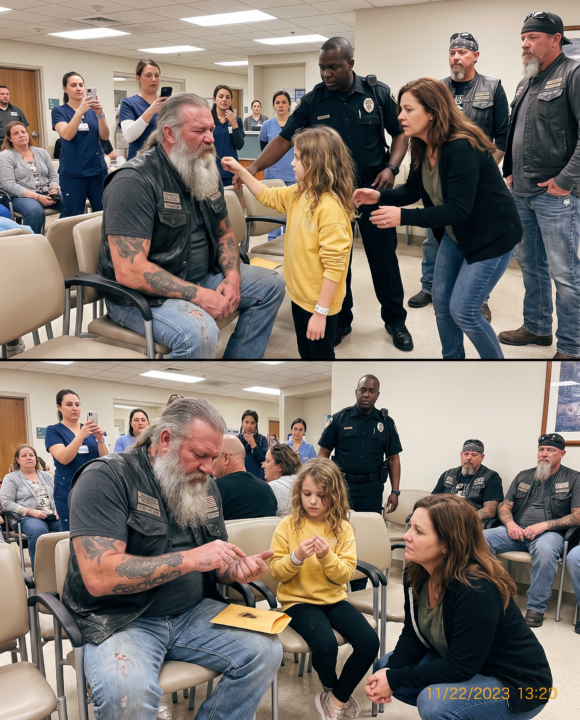
The little girl crossed the waiting room because she recognized the blue cloth inside his vest. She called him by the name Aaron used in stories.
Then she asked for nine.
Ray could have refused.
Instead, he leaned down.
Part 4 — The Ninth Hair Was for Ray
The first eight hairs helped Maggie return to the room.
The ninth did something else.
It exposed Ray.
By then, half the waiting room was recording. Security Officer James Bell stood within arm’s reach. Two nurses waited near the radiology doors, and the Cinder Ridge Riders remained spread across the chairs like a wall of leather and restrained bad decisions.
Maggie held eight beard hairs.
Ray held the sealed letter.
His right hand shook hard enough to move the envelope.
Maggie noticed.
Children notice what adults spend years hiding.
“You’re scared too,” she said.
Ray glanced toward the exit.
“No.”
Maggie frowned. “Daddy said you lie about that.”
Preacher coughed into one fist to hide something that might have been laughter.
Ray did not appreciate it.
“Your turn,” Maggie said.
She pointed at his beard.
Ray leaned closer.
Maggie pulled the ninth hair.
Pain tightened the skin beneath his left eye, but it was not the hair that made him close it.
“Nine,” she said.
Then she placed her small hand over the envelope.
“Open.”
Ray shook his head.
Maggie waited.
She had inherited that from Aaron—the ability to remain still until another person became uncomfortable enough to tell the truth.
Ray opened the envelope.
Inside were two pages and a photograph.
The picture showed Aaron, Maggie, and Ray beside a roadside lemonade stand five years earlier. Maggie sat on Ray’s Harley wearing an oversized helmet. Aaron stood behind her, holding up nine fingers.
Ray looked away from it.
The letter began without sentiment.
Hammer, if you’re reading this, somebody finally ignored your first three no’s.
Preacher recognized Aaron’s voice in the sentence and sat down.
The rest was written several months before the pileup, after Aaron learned that paramedics from his unit were updating emergency contact letters. He had written one for Laura, one for Maggie, and one for Ray.
Aaron did not predict his death.
He predicted Ray’s response to it.
You’ll decide that disappearing protects Laura and Maggie from the man who was with me when I died. That is garbage. You know it, and I know it.
Ray stopped reading.
Maggie tapped the page.
“More.”
He continued.
Aaron reminded him that Maggie knew the nine-count. He explained that if she ever approached Ray during a panic attack, Ray must let her finish the ritual even if it hurt, looked strange, or made adults interfere.
Then the letter turned.
The count is not only hers. I taught it to you first. If she reaches nine and you’re still planning to run, let her count you back too.
Ray’s fingers tightened around the paper.
The final lines were shorter.
One sound. One touch. One thing still here.
Stay long enough to learn what happens next.
There was no forgiveness.
Aaron had known better.
He left Ray an instruction.
Maggie took his hand.
“One sound,” she said.
Ray listened.
“The air vent.”
“One thing you feel.”
He looked down at her fingers around his scarred knuckle.
“Your hand.”
“One thing still here.”
His answer took time.
“Me.”
Maggie nodded. “Now we stay.”
The radiology nurse came for her.
At the same moment, a technician opened the door to escort Ray toward the biopsy unit.
Maggie’s breathing quickened again.
Ray’s did too.
They looked at each other across the waiting room.
Then Maggie held up the nine beard hairs.
“I’ll go if you go.”
Ray’s voice was almost gone.
“Deal.”
The hospital allowed him to walk beside Maggie as far as the MRI preparation area. Her mother remained on the other side. Ray did not enter the scan room, touch medical equipment, or pretend expertise he did not have.
He only counted.
Nine ceiling lights.
Eight floor seams.
Seven blue tiles.
Six slow breaths.
When the door closed, he stayed where Maggie could see his boots through the lower glass panel.
She completed the scan.
Then Ray went upstairs for his biopsy.
Preacher accompanied him. The other brothers waited downstairs with Laura and me.
For two hours, nobody spoke much.
The online video had already begun spreading. Its first version ended before the letter opened. It showed a child pulling a biker’s beard, security intervening, and club members standing as tension rose.
Comments invented the rest.
Some accused Ray of frightening Maggie. Others accused Laura of neglect. One claimed the Cinder Ridge Riders had staged the scene for attention.
Crow wanted to post the letter.
Laura refused.
“It belongs to Maggie and Ray.”
Crow argued that Hammer’s name was being destroyed.
Preacher looked toward the biopsy doors.
“Name grows back.”
He pointed to the nine hairs in Maggie’s pocket.
“Some things don’t.”
The club remained silent.
They let the wrong story spread.
For once, Ray’s brothers protected him by refusing to defend him publicly.
Part 5 — What the Cameras Had Not Seen
Ray’s biopsy found early-stage laryngeal cancer.
The doctor believed treatment had a strong chance of success. Ray heard the word cancer, stared at the floor, and asked how soon he could return to welding.
The doctor said that was not the first question.
Ray said it was his.
Treatment required radiation, follow-up imaging, voice rest, and more visits to the hospital he had avoided for nearly two decades.
Ray missed none of them.
Maggie made sure of that.
Before each appointment, she called Preacher’s phone and asked whether Hammer was “staying.” If Ray considered canceling, Preacher placed the call on speaker.
Maggie never pleaded.
She counted.
“One appointment.”
Ray grunted.
“Two boots.”
“Kid.”
“Three brothers.”
“I’m going.”
“Four open doors.”
Ray usually hung up there.
He always went.
Maggie’s MRI did not show a tumor or structural problem. Her fainting episodes were eventually linked to dehydration, missed meals, and anxiety intensified by grief. Her doctors created a treatment plan that involved counseling, regular nutrition, and gradual exposure to the medical settings she feared.
Ray participated only when invited.
He never called himself her healer.
He knew better.
He was a familiar beard, a steady chair, and someone who did not tell her to stop feeling afraid.
The viral hospital video changed after Laura released a short statement.
She did not share Aaron’s full letter. She explained only that Ray was a trusted friend, Maggie had initiated a family grounding ritual, and the biker remained still because interrupting the count could worsen her panic.
The hospital security footage confirmed that Ray never grabbed, restrained, or encouraged her to harm herself. He kept both hands visible and asked adults not to touch her suddenly.
The correction received fewer views.
That no longer surprised us.
A week later, the woman who filmed the original video visited Dawson’s shop. Her name was Patricia Lane. She was fifty-two and had been waiting for her husband’s cardiology appointment.
Patricia apologized.
Ray wrote his answers on a notepad because radiation had made speaking painful.
You filmed what you saw.
She said, “I should have waited.”
Ray wrote:
Everybody should. Nobody does.
Patricia asked whether he wanted her to delete the video.
He shook his head.
Then he wrote:
Add the ninth hair.
She posted a new version with Laura’s permission. It began with the chaos but continued through Maggie’s final count. Aaron’s private letter remained unread on camera. Only three sentences appeared in Laura’s voice:
One sound. One touch. One thing still here.
The video did not portray Ray as a hero.
It showed two frightened people helping each other remain in the same building.
That mattered more.
During treatment, Ray’s beard began thinning. Radiation affected the hair near his neck, and doctors asked him to trim it to keep irritated skin clean.
He resisted.
The beard had become part of the count. It also concealed scars, softened the shape of his jaw, and carried years of road dust, shop smoke, rain, and memories.
Maggie solved the problem.
She arrived at the garage carrying child-safe scissors and a small wooden box.
“You’re losing it anyway,” she said.
Ray looked offended.
“Some of it,” Laura corrected.
Maggie asked permission before touching him.
Ray nodded.
She cut nine small locks from the bottom of his beard while Preacher counted. Ray placed them inside the box with the nine hairs from the hospital.
Maggie labeled two envelopes.
One said HERS.
The other said HIS.
She divided the hairs evenly, discovered nine could not be split into equal whole numbers, and gave Ray the extra one.
“Why do I get five?” he asked through his roughened voice.
“Because you’re harder to calm.”
Preacher laughed openly that time.
Ray’s treatment lasted seven weeks.
On the final day, twenty-three Harleys waited outside St. Joseph’s Medical Center. Their engines remained off because several patients were sensitive to noise.
The riders did not block doors.
They did not carry banners.
They stood beside their motorcycles while Ray emerged with a hospital wristband around one arm and Aaron’s blue shirt strip visible inside his cut.
Maggie waited near the curb.
She held up nine fingers.
Ray held up five beard hairs.
Neither of them counted aloud.
They no longer needed to.
Part 6 — Nine Chairs Beside the Exit
Ray returned to St. Joseph’s every month, even after treatment ended.
He helped the hospital create a volunteer program for patients and family members who struggled in waiting rooms. The volunteers were not therapists. They received training, followed staff instructions, and understood that a calm presence could never replace professional care.
The Cinder Ridge Riders paid for the training.
Nine club members completed it first.
Hospital administrators hesitated over their leather cuts, tattoos, and heavy boots. Ray offered to have everyone wear plain shirts.
A pediatric nurse disagreed.
“Children should see that safe people don’t all look the same.”
The leather stayed.
Readable club insignia were covered inside clinical areas, but the men did not hide who they were.
Preacher learned card tricks.
Crow carried noise-reducing headphones in his saddlebag.
A younger prospect named Eli became skilled at assembling miniature building blocks while saying almost nothing. Children trusted him because he never asked them to smile.
Ray occupied the chair nearest the exit.
Always.
He said a person considering escape should not be forced to cross an entire room before deciding to stay.
Beside his chair stood a small wooden box containing blank paper slips. Children and adults could write one sound, one sensation, and one thing still present.
Nobody had to sign a name.
Every few months, Ray and Maggie opened the box with a hospital counselor. They removed identifying details and turned the slips into small laminated counting cards.
Nine cards went into every volunteer’s pocket.
Ray’s voice recovered slowly.
It remained rougher than before, little more than gravel pressed through a narrow opening. Maggie liked it.
“You sound more like a Harley now,” she told him.
Ray considered that acceptable.
His beard returned unevenly. One patch beneath his jaw remained thin, giving Maggie a visible reminder of where the original count had happened.
She never pulled it again.
She asked first.
Then she usually held one end between two fingers and counted without removing anything.
The game changed as she did.
Aaron’s letter remained inside Ray’s vest behind the blue strip carrying his name. The fold lines softened. The ink faded at the edges.
Ray read it before every scan.
Stay long enough to learn what happens next.
So he stayed.
Part 7 — The Tenth Thing Still Here
Four years later, Maggie no longer crawls beneath hospital chairs.
She still dislikes metal carts striking doors. She still notices ambulance sirens before anyone else. Fear did not vanish because a biker let her pull nine hairs from his beard.
It simply stopped making every decision.
Ray remains cancer-free.
He rides the same black Harley to St. Joseph’s on the second Tuesday of each month. The V-twin goes quiet near the patient entrance, and he rolls the last few yards so the engine will not disturb anyone inside.
His beard is mostly gray now.
The thin patch never filled in.
New security officers sometimes ask why a massive tattooed biker spends afternoons in the pediatric waiting area. James Bell, the officer who nearly separated Maggie from him, usually answers.
“He counts.”
Ray still chooses the chair nearest the exit.
A frightened child may sit several seats away. A tired parent may stare at the floor. Sometimes nobody approaches him for hours.
He stays anyway.
Maggie is twelve now. She visits after school with Laura and helps refill the grounding cards. She keeps her original envelope at home.
Ray keeps his.
On the anniversary of Aaron’s death, the Cinder Ridge Riders travel to mile marker 418. They park beyond the curve and leave one ambulance-blue ribbon against the guardrail.
Ray does not make speeches.
Preacher counts nine motorcycles.
Laura counts nine slow breaths.
Maggie counts the people still standing beside her.
One year, she reached ten.
Ray raised an eyebrow.
“The game stops at nine.”
“It used to.”
“What’s ten?”
Maggie touched the blue strip inside his vest.
“Someone who stayed.”
Cold wind moved across the highway. A truck sounded its horn beyond the rock cut, and Ray’s old panic tightened one hand around the Harley grip.
Maggie noticed.
She always does.
“One sound,” she said.
“The horn.”
“One thing you feel.”
“The handlebar.”
“One thing still here.”
Ray looked at Aaron’s daughter, his club brothers, the waiting motorcycles, and the road that had taken one man while leaving others with the work of remembering him.
“Us.”
Maggie nodded.
The engines started one by one.
This time, Ray did not ride away first.
Follow our page for more biker stories about misunderstood riders, quiet promises, and the children who discover gentleness beneath weathered leather.