A Little Girl Handcuffed a 285-Pound Biker to a School Fence and Called Police—Then Officers Found the Candy She Carried for the Father She Couldn’t Save
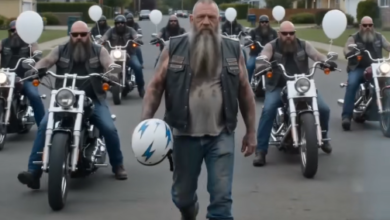
Thirty-six Harleys were ready to leave Roosevelt Elementary when a little girl chained their enormous road captain to the fence, burst into tears and begged strangers to call police.
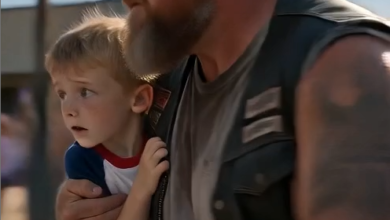
From the school steps, I saw Lily standing beside Hammer Dawson with her backpack open at her feet. The contrast stopped everyone: a ten-year-old child in a purple coat, a towering biker in black leather, and a pair of steel handcuffs connecting his left wrist to the school gate.
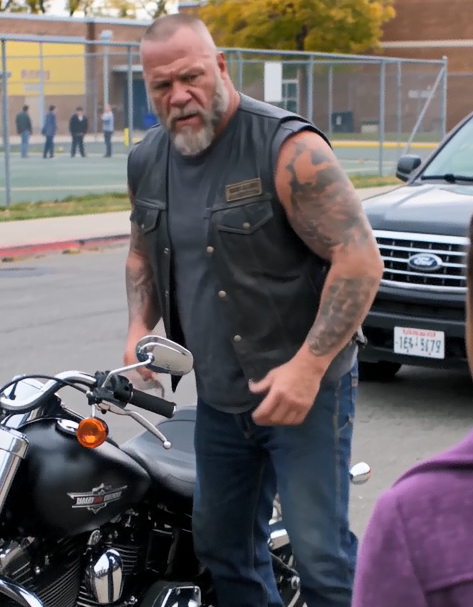
Hammer could have frightened her into releasing him. He outweighed her by more than two hundred pounds and had thirty-five club members behind him.
He did nothing.
He leaned against the fence and stared at his Harley as if he had forgotten why it was there.
The motorcycle idled near the curb, its V-twin rumble shaking the metal gate. Boone Mercer moved toward Lily, but Hammer lifted his free hand.
“Back off, brother.”
Boone stopped. “She cuffed you.”
“I noticed.”
“What happened?”
Hammer tried to answer, but the words came slowly. His gaze drifted. Sweat darkened the collar of his shirt, and the key in his right hand kept falling because his fingers would not close around it.
Lily watched the key hit the pavement.
She began crying.
Parents arriving for the charity assembly saw a child in distress and assumed the biker had caused it. Phones rose. Teachers moved students indoors. Someone called 911 and reported that a young girl had restrained a suspicious man beside the school.
Lily did not correct them.
She kept repeating, “Make him stay.”
I pushed through the crowd and recognized my husband’s old handcuffs. Marcus had carried them during his years as a school resource officer. After his death, I locked them in a box with his badge, service photographs and the watch removed from his wrist at the hospital.
Lily had found the key.
She had also filled her backpack with candy.
For two years, I thought the candy was an ordinary childhood habit. She kept pieces in her desk, coat pockets and soccer bag. She offered them to teachers who looked tired and became upset when I threw old ones away.
I never understood the pattern.
Marcus lived with diabetes. On the morning he died, he experienced a low-blood-sugar emergency, became confused and tried to drive despite obvious warning signs. No one reached him before his truck left the road.
Lily had been eight.
She remembered the trembling hand, the distant eyes and the stubborn promise that he was fine.
Hammer showed her all three.
He had spent the morning helping the Iron Lanterns deliver winter coats and backpacks. He laughed with children, carried boxes and refused the breakfast offered by the cafeteria staff because the convoy was running late. None of that alone explained what happened; his doctors would review the full circumstances later.
What mattered to Lily was what she saw next.
Hammer dropped his keys. He picked up the wrong one. He stared at the motorcycle controls without moving. When she asked whether he needed the school nurse, he told her he was riding home.
She stood between him and the Harley.
He tried to step around her.
She pulled her father’s handcuffs from her backpack.
By the time I arrived, one cuff circled Hammer’s wrist and the other held him to the fence. Lily was crying so hard that strangers mistook her terror for evidence against him.
The first officer approached Hammer with caution.
“Did you touch this child?”
“No.”
“Why did she restrain you?”
Hammer looked at Lily. “Ask her.”
The officer crouched. “What did he do?”
“He tried to ride.”
“That’s all?”
Lily shook her head. “His hand.”
The school nurse entered the circle, noticed Hammer’s condition and called for immediate medical support. Leon killed the Harley’s engine. The sudden silence seemed to widen the parking lot.
Hammer’s cuff rattled once.
Lily opened both hands and revealed the candy she had been protecting.
“Daddy needed it,” she whispered. “But I was too late.”
The officer’s face softened. She knew Marcus. Many officers in Albuquerque did.
She looked at the engraving on the handcuffs, then at Hammer’s shaking wrist.
A dead father’s cuffs. A living biker. The same warning signs.
When paramedics confirmed that Hammer required urgent treatment for dangerously low blood sugar, no one cheered. There was no triumphant reveal, because the truth exposed something painful beneath Lily’s quick thinking.
For two years, she had believed her father died because she had not been prepared.
Hammer looked at the candy in her palm and understood before I did.
He had known Marcus too.
The officer unlocked the cuff from the fence, but Hammer stopped her before she removed it from his wrist.
“Let the kid do it.”
Lily stepped closer with the key.
Hammer lowered his voice.
“You weren’t late this time.”
Her knees folded beneath her.
I caught her before she reached the pavement, and Hammer—still cuffed, still trembling—reached out with his free hand as though he could catch her too.
Leave HAMMER below if you want to learn whose handcuffs Lily carried and why the biker recognized her father’s name.
Part 2 — The Things Lily Kept in Her Backpack
My name is Ava Walker, and for two years after Marcus died, I checked Lily’s schoolwork, lunch and winter gloves without once examining what she carried at the bottom of her backpack. I believed I was respecting her privacy. In truth, I was avoiding every object that might prove grief had continued growing where I could not see it.
Beneath her reading folder and pencil case were thirty-seven pieces of candy, each wrapped separately and arranged inside a plastic sandwich bag. Beside them lay Marcus’s retired handcuffs, the spare key, a photograph of him in uniform and a folded note that read, I will be ready.
The note was written in purple marker.
Lily had been carrying that bag for months.
Marcus was thirty-nine when he died. He had worked as a school resource officer before transferring to traffic safety, where he spent more time teaching than arresting anyone. He visited elementary classrooms, helped children cross Central Avenue and kept a drawer of granola bars for students who arrived without breakfast.
He also lived with diabetes.
Our family understood his treatment plan, but Lily was never responsible for managing it. Marcus carried appropriate supplies, monitored himself and worked with his medical team. Most days his condition occupied less space in our lives than school schedules or laundry.
The morning of his death was different.
He slept through an alarm, skipped part of breakfast and became confused while searching for his keys. I asked whether he was all right. He insisted he was running late and needed to leave.
Lily stood at the kitchen table holding a wrapped candy left from Halloween.
She later told me she almost gave it to him.
Almost became a wound.
Marcus drove less than four miles. His truck crossed an empty shoulder and struck a utility barrier. No one else was injured, but he died before reaching the hospital.
Doctors explained that a medical emergency had likely impaired him. They also explained that no single action from an eight-year-old child could have controlled what happened.
Lily heard the words.
She did not believe them.
She began saving candy. At first, one piece. Then three. Then enough to fill every pocket she owned. She asked teachers whether their hands ever shook. She watched drivers in parking lots and became frightened whenever someone dropped keys.
I took her to counseling. We talked about guilt, trauma and the difference between remembering warning signs and accepting responsibility for every adult around her. Lily nodded through the sessions.
Then she hid Marcus’s handcuffs in her backpack.
Hammer entered our lives because the Iron Lanterns were holding their annual Keys Down charity ride at Roosevelt Elementary. The club had raised money for winter coats, school supplies and an after-school meal program. Thirty-six motorcycles lined the far curb while children watched from behind the fence.
Hammer was their road captain.
From the outside, he was exactly the sort of man parents warned children not to approach. He stood six-foot-four, nearly 285 pounds, with a shaved head, weathered face, beard streaked black and gray, and tattoos covering his arms. His boots were scarred from years of pavement, and a chain wallet struck his jeans when he walked.
Yet children moved toward him.
Hammer knelt when they spoke. He asked before shaking hands. When one autistic boy covered his ears at the motorcycles, Hammer raised a fist and thirty-six engines went quiet.
Marcus had taught him that signal.
They met seven years earlier after Marcus stopped the Iron Lanterns near a school crossing. Hammer was weaving slightly at low speed. Marcus initially suspected fatigue or alcohol, but when Hammer removed his glove, Marcus noticed the tremor and confusion.
He took Hammer’s keys.
Hammer argued.
Marcus locked the motorcycle to a roadside fence until medical help arrived.
That part of the story sounded so similar to Lily’s action that I first believed Leon was trying to comfort us by inventing it. Then he showed me an old photograph: Marcus standing beside Hammer’s Harley, holding the keys while Hammer sat angrily on the curb.
On the back, Marcus had written:
Better mad than dead.
Hammer kept the photograph inside his saddlebag.
After that day, he and Marcus became unlikely friends. Marcus helped the Iron Lanterns design safer school convoys. Hammer repaired an old motorcycle Marcus planned to restore but never finished. When Marcus died, the club rode behind the funeral procession with their engines barely above idle.
Lily remembered the motorcycles.
She did not remember Hammer.
Hammer remembered her.
He recognized Marcus’s eyes before he recognized the handcuffs.
Part 3 — The Morning Hammer Would Not Admit He Was Fading
The morning of the charity ride began before sunrise at an all-night diner east of Albuquerque. The Iron Lanterns met for coffee, route checks and breakfast before riding to the school. Hammer usually ate with them and confirmed that he carried his medical identification and personal supplies.
That morning, a delivery truck blocked the club’s reserved lane. Two riders arrived late. Boone discovered a loose saddlebag bracket, and Hammer spent twenty minutes helping repair it.
His breakfast went cold.
He told Leon he would eat at the school.
At Roosevelt Elementary, Hammer unloaded cartons, posed for photographs and helped a custodian move folding tables. The cafeteria offered food, but he said the convoy needed to leave before traffic increased.
No single missed meal fully explains a medical emergency, and Hammer’s clinician later reviewed several contributing factors with him. The club never turned the event into a simple warning that one behavior always caused one result.
What mattered was that Hammer’s condition began changing, and he did not stop.
Leon noticed him rubbing his hands together. Boone noticed his jokes had disappeared. A teacher saw him lean against the fence but assumed his knees hurt.
Lily saw something else.
She was waiting near the gate while I spoke with her principal. Hammer passed her carrying his helmet. The first time he dropped his keys, she picked them up and handed them back.
“Thank you, short stack.”
“My name is Lily.”
“Thank you, Lucy.”
She frowned. “Lily.”
Hammer nodded as though he understood, then walked toward the wrong motorcycle.
That was the second warning.
Lily followed.
Hammer tried one key in Boone’s red Harley, stared at it and muttered something she could not hear. His right hand shook against the ignition.
“Mr. Hammer?”
He turned too slowly.
“My dad did that.”
Hammer looked past her. “Your dad ride?”
“Your hand.”
“I’m fine.”
Those two words changed her.
Lily stepped between Hammer and the motorcycle. “Go to the nurse.”
“Need to get these boys home.”
“You can’t ride.”
Hammer placed one large hand on the handlebar. “Move aside, kid.”
He did not threaten her. He did not raise his voice. But to Lily, I’m fine sounded exactly like Marcus in our kitchen.
She opened her backpack.
The handcuffs were old but functional. Marcus had taught her years earlier never to play with them, never close them around a person and never use them without an adult. Trauma took that lesson and bent it around a new fear.
Lily hooked one cuff through the fence.
Hammer stared at her.
“What are you doing?”
“Stopping you.”
She closed the second cuff around his wrist before he understood.
The click carried across the parking lot.
Hammer pulled once. The chain-link fence rattled. Lily stepped back, suddenly aware of what she had done to the largest man she had ever touched.
Then she started crying.
Boone heard the fence and ran toward them. Several parents saw Lily’s tears, Hammer’s cuffed wrist and the dark line of bikers behind him.
“What did he do?” a father shouted.
Nothing Hammer said would have sounded trustworthy then. His words were becoming thick, his balance uncertain and his face unnaturally pale.
Boone reached for Lily.
Hammer’s free hand struck Boone’s chest—not hard enough to hurt him, only enough to stop him.
“Leave her.”
“She chained you like a dog.”
“She’s scared.”
“Of you.”
Hammer looked at the candy spilling from Lily’s backpack. Even through the confusion, he understood something did not fit.
Leon arrived and saw the medical bracelet beneath Hammer’s glove. He killed the nearest Harley and shouted for the school nurse.
Parents heard only shouting. More phones appeared. A teacher moved children indoors. The principal called police after receiving a report that a biker had been restrained by a crying student.
Lily picked up the cuff key but could not make her hands steady enough to use it.
“Call the police,” she sobbed. “They stopped Daddy’s truck after. They can stop him before.”
That sentence silenced Leon.
He knew exactly who she was.
Marcus had once described Lily as the child who could turn a two-minute bedtime story into a forty-minute cross-examination. He had carried her photograph inside his wallet during every shift.
Leon crouched but did not touch her.
“Your dad was Marcus Walker?”
Lily nodded.
Hammer’s head lifted.
“Marcus?”
Then his knees weakened.
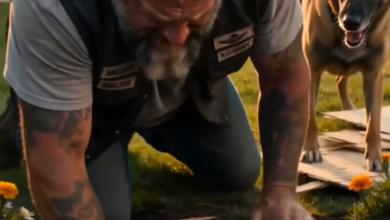
The cuff held his left arm against the fence while Leon and Boone supported his weight from the other side. They lowered him carefully onto the pavement. The heavy biker who had terrified parents seconds earlier now sat beneath a child’s purple backpack, unable to remember which motorcycle belonged to him.
The nurse arrived, assessed him and requested emergency help. She asked whether he could respond and safely follow instructions. Lily offered the candy, but the nurse took control of the situation and used the school’s established emergency protocol while paramedics were on the way.
This distinction mattered later.
Lily recognized danger.
Trained adults handled the medical response.
The first police officer saw Hammer seated against the fence and Lily crying beside him. She separated the crowd, checked on the child and asked who had closed the cuffs.
“I did.”
“Why?”
“He was going to ride.”
The officer looked toward the Harley.
Lily pointed at Hammer’s hand.
“It was doing what Daddy’s did.”
The officer recognized Marcus’s old badge number engraved on the cuff.
Her name was Dana Cole.
She had worked with him.
Part 4 — The Officer Who Knew the Engraving
Officer Cole held the cuff in one gloved hand and traced the small engraving near its hinge. M. WALKER. Marcus marked every piece of issued equipment because he lent things during training and hated losing track of them.
“How did you get these?” she asked Lily.
“They were Daddy’s.”
“Does your mother know you have them?”
Lily looked at me.
That answer was no.
Cole did not scold her in front of the crowd. She asked for the key, confirmed the cuff had not injured Hammer’s wrist and waited until paramedics stabilized him before unlocking it.
Hammer stopped her.
“Kid closes it,” he said. “Kid opens it.”
Cole shook her head. “She has done enough.”
Hammer looked at Lily. His speech remained slow, but his intention was clear.
“I want her to know she can let go.”
Cole considered that, then placed the key in Lily’s palm and guided her without turning the moment into a game. Lily inserted it. The cuff opened.
Steel released steel.
Hammer’s hand dropped gently into his lap.
Paramedics continued treating him and transported him for evaluation. Before the ambulance doors closed, he asked Cole to bring Lily closer.
I almost refused.
Cole reminded me we could remain beside her.
Hammer looked at the candy in Lily’s fist.
“Your dad gave me my keys back once.”
Lily’s lips parted.
“He knew Daddy?”
“Your father chained my bike to a fence.”
“Why?”
“Same reason you chained me.”
Lily began crying again, but these tears were quieter.
Hammer raised his wrist, where a pale line marked the cuff.
“Marcus kept me alive long enough to get mad at him.”
The ambulance doors closed.
The parking lot remained filled with people who no longer knew what story they had recorded. The little girl was not escaping a dangerous biker. The biker had not attacked anyone. The handcuffs were neither a toy nor evidence of abuse.
They were a child’s desperate attempt to interrupt repetition.
Officer Cole took my statement. When she learned Lily had carried the cuffs without permission, she explained gently that recognizing an emergency and getting adults was important, but physically restraining someone could create new danger.
Lily stared at the pavement.
“I asked him to stop.”
“I believe you.”
“He didn’t.”
“I believe that too.”
Cole knelt to Lily’s height. “You found help. Next time, that is the part you do first.”
“Would you have stopped him?”
“Yes.”
“You came after.”
Cole did not lie. “This time, you saw it before we did.”
That answer respected Lily without making her responsible for future lives.
The video online had already spread. The first clip showed Lily crying beside a cuffed biker. The second showed Boone charging toward her. A third began when Hammer pushed Boone back.
Without context, each clip suggested a different crime.
The school issued a short statement saying no child had been harmed and that a medical emergency had occurred. It requested privacy.
Privacy did not come.
Reporters called. Strangers praised Lily as a hero. Others criticized me for letting her carry handcuffs. Some accused the bikers of staging the scene for publicity.
The Iron Lanterns refused interviews.
Leon said only, “A child noticed our brother needed help. The rest belongs to the family.”
That night, Lily placed Marcus’s cuffs on our kitchen table. Beside them she emptied every piece of candy from her pockets, backpack and bedroom drawer.
There were eighty-four.
Some had expired. Some had melted and hardened again. One remained wrapped in orange paper from the Halloween before Marcus died.
Lily touched that one.
“This was the kind I almost gave Daddy.”
I sat beside her.
“You were eight.”
“I had it.”
“You did not know what was happening.”
“I knew his hand shook.”
“You were not his doctor. You were not his partner. You were his child.”
She looked toward the handcuffs.
“Then why did I know with Hammer?”
Because trauma had trained her to watch. Because memory could sharpen a child while also cutting her. Because sometimes being right did not make the burden fair.
I told her the only answer I could.
“You recognized a warning. But you were never supposed to carry the whole emergency.”
Lily pushed the eighty-four candies toward me.
“Then help me put them somewhere adults can find them.”
Part 5 — The Photograph in Hammer’s Saddlebag
Hammer returned to the school three days later, riding in the passenger seat of Leon’s truck. His clinician had not cleared him to ride, and the club had removed his Harley keys before he left the hospital.
He complained.
Nobody listened.
The Iron Lanterns parked Hammer’s motorcycle inside their clubhouse under a sheet. Boone attached a cardboard tag to the handlebar that read ASK LEON, knowing Hammer hated asking anyone for anything.
When Hammer entered the school office, Lily was waiting with me, Officer Cole and the counselor. The retired handcuffs rested inside a clear evidence-style pouch, though no criminal case existed.
Hammer sat across from her.
For the first time, Lily saw him without his leather vest. He wore a faded gray shirt, and the absence of black leather made his shoulders appear less like armor.
“Are you mad?” she asked.
“Yes.”
Her face fell.
Hammer continued. “At myself.”
“You told me you were fine.”
“Wasn’t.”
“You tried to ride.”
“Did.”
“You called me Lucy.”
“Don’t know any Lucy.”
Lily almost smiled.
Hammer placed a photograph on the table. It showed Marcus beside Hammer’s Harley seven years earlier, holding a set of motorcycle keys. Hammer sat on the curb with his arms folded, furious and pale.
On the back were Marcus’s words:
Better mad than dead.
Lily read them twice.
Hammer explained that Marcus had noticed him drifting near a school crossing. He stopped the club, took the motorcycle keys and locked the Harley to a fence until help arrived.
“I called your dad every name I knew.”
“Bad words?”
“Mostly.”
Officer Cole coughed to hide a laugh.
“Then what?”
“Then he stayed.”
Marcus waited through the medical assessment, loaded Hammer’s motorcycle onto a trailer and drove him home. Later, Hammer repaired Marcus’s neglected Harley in exchange.
The friendship lasted until Marcus died.
Hammer attended the funeral at the back of the room because he did not want the club’s presence to overwhelm us. He sent money anonymously to Lily’s school lunch account after learning Marcus sometimes paid for hungry students.
The Keys Down charity ride was named after him.
I had never known.
Marcus’s old motorcycle remained unfinished in the Iron Lanterns’ garage. Hammer had preserved it exactly as Marcus left it: gas tank removed, front wheel on a stand and a coffee ring on the workbench beside it.
“Why didn’t you tell us?” I asked.
Hammer rubbed his wrist where Lily had cuffed him. “Your grief wasn’t a door I had permission to open.”
That answer made me look away.
Lily picked up the photograph. “Daddy saved you.”
“Your dad stopped me.”
“Same thing.”
Hammer nodded. “Sometimes.”
Then he addressed what Lily had done without turning it into a heroic stunt. He told her the handcuffs could have injured either of them. The motorcycle could have fallen. Boone might have frightened her or reacted badly.
“You get an adult,” he said. “You call for help. You don’t grab somebody my size.”
“You didn’t listen.”
“No.”
“What if the adult doesn’t listen?”
Hammer glanced at Cole.
The officer answered. “You keep calling. You move away from the vehicle. You tell another adult. You do not carry this alone.”
Lily looked unconvinced.
Hammer reached into a paper bag and removed his motorcycle keys. Leon immediately took them away.
“Not cleared,” Leon said.
Hammer sighed. “Demonstration, brother.”
Leon held the keys himself while Hammer spoke.
“Keys are permission. If my hands shake, my words stop making sense or my brothers think I’m unsafe, these come away from me. No debate.”
Boone stood near the door. “Even if you fight?”
“Especially if I fight.”
The Iron Lanterns had adopted a new protocol after the incident. Before each ride, designated partners checked in with one another. Any rider showing concerning changes stopped and sought appropriate help. Medical information remained private, but asking for assistance was no longer treated as weakness.
They called it Marcus’s Rule.
Lily objected. “Daddy didn’t follow it for himself.”
Hammer’s face tightened.
“No,” he said. “That’s why we have to.”
The counselor asked Lily whether she wanted Hammer’s apology.
Lily shook her head.
“I want him to promise.”
Hammer leaned forward. “What promise?”
“That if your hand shakes, you don’t touch the bike.”
Hammer extended his scarred hand but stopped before reaching hers.
Lily placed her palm against it.
Her hand was steady. His was steady now too.
“I promise,” he said.
Part 6 — The Day the Club Put Its Keys on the Table
The next Iron Lanterns meeting began with thirty-six sets of motorcycle keys arranged across a wooden table. No engines. No speeches. Only metal rings, worn leather fobs and the quiet embarrassment of men accustomed to presenting strength as silence.
Hammer stood at one end.
“I lied to a kid,” he said.
Boone frowned. “You were confused.”
“I told her I was fine.”
“You didn’t know.”
“I knew something was wrong.”
That distinction changed the room.
The club had always maintained motorcycles carefully. Tires, brakes, lights and fuel were checked before every ride. Human beings received less attention because asking a brother whether he was safe to ride felt intrusive.
Marcus’s Rule changed that.
Riders paired up. Anyone could call Keys Down without punishment or mockery. The affected rider’s motorcycle stayed parked until the concern was addressed appropriately.
The rule covered more than diabetes. Exhaustion, medication effects, illness, emotional distress or any condition that impaired safe riding could stop a convoy.
The machine was no longer the only thing inspected.
At Roosevelt Elementary, Officer Cole and the school nurse developed an age-appropriate safety lesson. Children learned to recognize when an adult might need help without being told to diagnose anyone. The message was simple: move away from vehicles, alert a trusted adult and call emergency services when appropriate.
Lily helped revise the lesson.
She crossed out a sentence calling her fearless.
“I was scared,” she said. “That’s why I did it.”
The counselor replaced fearless with attentive.
Lily accepted that.
The candies were moved from her backpack into supervised emergency locations managed by trained adults. Her therapist helped her understand that she did not need to prepare for Marcus’s death to happen again every day.
The handcuffs presented a harder choice.
Part of me wanted them destroyed. Lily wanted to keep them. Officer Cole suggested placing them in a locked display inside the school’s safety room alongside Marcus’s photograph.
Hammer objected to displaying the story as if a child restraining an adult were the lesson.
So the cuffs remained in a locked case at home.
Lily stopped carrying the key.
Several weeks later, the Iron Lanterns invited us to their clubhouse. Marcus’s unfinished Harley stood in the center of the garage, dustless beneath bright work lights.
Hammer handed Lily a small wrench.
“Your dad planned to rebuild it.”
“Can it run?”
“Eventually.”
“Who gets it?”
Hammer looked at me. “That’s the family’s decision.”
We chose not to sell it. On the first Saturday of every month, Lily, Hammer and several club members worked on the motorcycle. She learned the names of parts, but more importantly, she learned that finishing her father’s machine did not mean finishing his life for him.
Some tasks belonged to memory.
Others belonged to us.
The first time the rebuilt engine started, Lily covered her ears and laughed. Hammer stood beside the bike without mounting it.
He held the keys out to Leon.
“Check me.”
Leon asked several questions. Hammer answered clearly. His hands were steady. Only then did Leon return the keys.
Lily watched the exchange.
Adults could stop one another.
That was the part she had needed to see.
Part 7 — What the Candy Could Not Fix
A year after the incident, Roosevelt Elementary held another winter charity drive. The Iron Lanterns arrived in pairs instead of one roaring convoy, reducing noise near the classrooms. Hammer rode near the center, where Leon and Boone could watch him.
Lily was eleven.
She no longer carried candy in every pocket. One piece remained inside her backpack—not as medical preparation, but because she liked caramel.
Marcus’s retired handcuffs stayed locked at home.
Before the bikers left, Hammer stood beside the school fence and handed his keys to Lily.
She stared at them. “Why?”
“Check.”
“I’m not a doctor.”
“Didn’t ask you to be.”
She looked at his hands. Steady. His eyes. Focused. His speech. Clear. Then she turned toward Leon.
“You check him.”
Hammer smiled.
That was the correct answer.
Leon completed the club’s routine, returned the keys and gave the signal. Thirty-six engines started one by one.
Lily stood behind the fence with me. She no longer watched every rider as if one missed sign would make another person disappear. She waved when Hammer rolled past.
He did not accelerate immediately.
At the corner, he stopped, looked back and lifted one fist.
Keys Down.
The engines fell quiet.
Hammer removed his glove and held up an open, steady hand.
Lily answered with hers.
Years later, she would tell people that everyone praised her for saving a biker, but that was not how she remembered it. She remembered being terrified. She remembered a steel cuff clicking shut and believing she could prevent death if only she prepared hard enough.
What helped her was not the praise.
It was watching adults finally carry their share.
Marcus’s photograph now hangs in the Iron Lanterns’ clubhouse beside the rebuilt Harley. The picture shows him holding Hammer’s keys with an annoyed smile. Beneath it sits a small wooden bowl where riders place their keys whenever someone calls the rule bearing his name.
No one argues beside that bowl.
Hammer still rides, though he no longer leads every convoy. On difficult mornings, he hands Leon the keys before anyone asks.
Lily visits the garage sometimes. She touches the coffee ring Marcus left on the workbench but never wipes it away.
The old candy from Halloween remains sealed inside a small box at home. Not because Lily still believes it could have changed the past.
Because she finally understands it could not.
On the second anniversary of the parking-lot incident, Hammer brought her a new purple backpack. The first one had split at the zipper from years of carrying too much.
He did not ask what she put inside.
Lily showed him anyway: two library books, a pencil case, a soccer jersey and one ordinary lunch.
Nothing else.
Hammer lifted the backpack carefully.
“Lighter.”
Lily nodded.
“So are you,” he said.
She looked toward the school fence where she had once chained him, then toward the Harley waiting beyond it.
“Your keys?”
Hammer opened his palm.
Leon had them.
Only then did Lily smile.
Follow our page for more biker stories about misunderstood courage, quiet rescues, and ordinary people who notice danger before everyone else does.