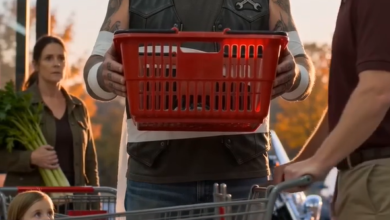
A Little Girl Asked a Tattooed Biker to Fix Her Broken Necklace—Then He Recognized the Silver Rose Her Wealthy New Family Had Tried to Bury
I read the name twice.
Vivian Mercer.
My receptionist, June, had worked the registration table at her foundation’s winter coat drive. A photograph from that afternoon was still taped beside our appointment calendar.
Vivian stood in the center, smiling between two women holding apartment keys.
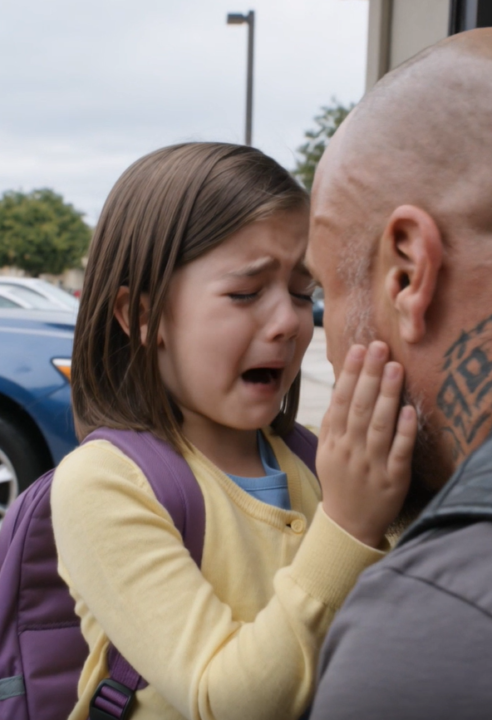
I looked from that picture to Lily.
“Tell me what you mean by locks.”
She pressed her lips together.
The housekeeper stepped closer.
“My name is Rosa Alvarez,” she said. “I brought her.”
“From the house?”
“From school. Her mother asked me to bring her past this address. There’s a pharmacy next door. I told them we needed toothpaste.”
Lily had seen the painted swallow above our entrance. She had recognized it from an old photograph her mother kept. While Rosa checked the address, Lily’s chain caught in her backpack zipper.
Now the broken link lay on my knee.
An ordinary accident.
Everything around it was wrong.
“Is her mother hurt?”
“I don’t know,” Rosa said. “I clean downstairs. They stopped letting me upstairs last Friday.”
June reached for the phone.
I stopped her long enough to say, “Emergency services. Tell them exactly what she said.”
Not my motorcycle friends.
Not somebody who owed me.
The right people.
Lily flinched at the word emergency.
“Will Mommy be in trouble?”
“No,” I said, then corrected myself. “We’re asking somebody to check on her.”
I wouldn’t start with a promise I couldn’t keep.
June brought Lily water in a paper cup. I placed the rose on a clean towel and closed the damaged link with two small pliers.
My hands remembered the work.
My head kept fighting it.
Seven years was enough time for a necklace to be sold, given away, copied. A little girl could repeat something without understanding it. A frightened woman could misunderstand a closed door.
And Mara had left me a letter.
I still had it.
Some nights, I could recite it.
Then Lily asked whether I had a dog named Pickles.
I looked up.
“Used to.”
“Mommy says he snored like a lawn mower.”
Pickles had died five years earlier.
There were no pictures of him on our website.
Rosa watched me swallow.
“She talks about this place,” she said. “When nobody’s listening.”
The patrol officer arrived before I could answer. He crouched several feet from Lily, introduced himself as Officer Price, and asked her questions without supplying the answers.
I stayed quiet.
That was harder than anything I had done all day.
Lily described a room with yellow curtains, a blue teapot, and a window that opened only a little.
“My mommy sleeps there.”
Price asked who opened the door.
“Daddy. Sometimes Grandma.”
Then a silver SUV stopped outside.
The man climbing out wore boat shoes without socks and the expression of someone arriving to correct a billing error.
Rosa whispered his name.
Daniel Mercer.
He looked through my window, saw Lily, and smiled.
How had he found her before anyone had called him?
Seven years earlier, Mara used to bring dinner to the shop after her bookkeeping shift.
We ate from cardboard cartons at my drawing desk. She took the chair with the good back; I sat on an overturned bucket because I kept forgetting to order another chair.
She called that our dining room.
On her twenty-seventh birthday, I gave her a rose I had made from silver scraps at a jeweler’s bench a friend let me borrow.
It had six petals.
The sixth folded inward because my pliers slipped. Beneath it, I scratched a backward N.
Mara refused to let me straighten either mistake.
“How would I know it was yours?”
She kept flowers in a chipped blue teapot. After its lid broke, we glued it shut with the lid crooked, leaving only the spout and a narrow gap for stems.
“Terrible teapot,” I told her.
“Excellent vase.”
Three weeks later, I came home to an empty closet.
Her letter said the baby wasn’t mine.
That was the part I never told June.
Now Daniel Mercer stood in my doorway, asking Lily to come to him.
“She’s had a difficult morning.”
“She’s staying here while the officer speaks with her,” Price said.
Daniel noticed the uniform properly for the first time.
His smile changed shape.
He explained that Mara was under medical supervision after a period of emotional exhaustion. Lily had misunderstood arrangements intended to keep her mother safe.
He said it gently.
He said my shop name as though it tasted unpleasant.
I asked whether Mara could speak to the officer.
“Of course.”
He took out his phone, stepped aside, then returned with it still dark.
“She’s sleeping.”
Price asked for the address anyway.
Daniel gave it.
A second officer arrived. June took Lily into our front consultation room with the door open. Daniel moved toward her, and I stood without thinking.
Six-foot-four can look like a threat even when you only stand up.
His eyes dropped to my hands.
I opened them.
Price noticed.
“Mr. Mercer, stay beside me.”
Daniel asked Rosa whether her employment contract allowed her to transport Lily to unauthorized destinations.
Rosa’s shopping bag trembled against her leg.
“I followed her mother’s request.”
“That isn’t possible.”
The words came too fast.
Price turned.
“Why not?”
Daniel adjusted his watch.
“Because my wife doesn’t know this man.”
I felt something small and ugly move beneath my ribs.
“She knew me seven years ago.”
Daniel looked at the repaired necklace.
For the first time, he stopped managing his face.
Then his phone rang.
He put it on speaker before answering, apparently certain the voice would help him.
“Mother.”
A woman spoke over airport announcements.
“I’m in Denver, Daniel. What happened?”
Vivian Mercer had been out of Texas for nine days.
Lily’s first accusation suddenly looked less certain.
But if Grandma wasn’t there to turn the key, who had been doing it?
Vivian called the officer back on a separate line.
She sent an itinerary, photographs from a rehabilitation center where her sister was recovering, and the name of the driver collecting her at the airport.
There was no mystery about where she had been.
There was a mystery about what she knew.
“Mara agreed to a quiet recovery period,” Vivian said.
Price asked whether the bedroom door could be opened from inside.
A pause.
“I would need to ask Daniel.”
Daniel was standing ten feet away.
He began explaining an old house, sticky hardware, a latch awaiting replacement.
Price stopped taking notes.
He looked at Rosa.
“Have you seen that door?”
“Last Thursday.”
“Could you open it?”
“Not without the key.”
The second officer left to join another unit at the Mercer house. Daniel insisted on going with them.
Price told him he could travel separately.
I wanted to follow.
Instead, I sat beside Lily while she picked the paper seam off her water cup.
“Did Mommy really have a dog with you?”
“Yes.”
“Was he a good one?”
“Mostly.”
She considered that.
“Mommy says mostly counts.”
It was a Mara sentence.
I had spent seven years hating her for leaving, and now her voice kept arriving through a child who might have been mine.
June put a hand on the back of my chair.
I hadn’t realized I was rocking.
Almost an hour passed.
Price took a call outside. Through the window, I watched him turn away from the street to listen.
When he returned, he spoke to Lily first.
“Your mother is out of the room. Someone is taking care of her.”
“Can she come here?”
“We’re working out where you can see her.”
No sirens reached us.
No dramatic announcement.
Just a little girl setting down a cup with both hands because she was suddenly too tired to hold it.
I learned later that Mara had answered through the bedroom door. She had said clearly that she wanted to leave.
The officers found an exterior keyed lock.
The inside handle turned without releasing it.
A locksmith opened it.
Mara walked out wearing socks and carrying an empty flower vase.
The blue teapot.
Daniel told the officers a key had always been available to her. Asked where, he said Rosa handled household arrangements.
Rosa was still sitting beside our reception desk.
She hadn’t had access upstairs in eight days.
Then Vivian called me.
Not the shop.
My personal number.
“I understand this is upsetting, Nathan.”
Only Mara called me Nathan.
“Where did you get this number?”
“I’ve had it for years.”
She said it before thinking.
I listened to the airport announcement behind her, then to her breathing.
If she had known how to reach me all this time, why had she let me believe Mara was gone forever?
Mara asked to see Lily before she asked for anything else.
A family advocate arranged it in a quiet room away from the shop. Rosa went with the child. I waited outside until someone told me Mara wanted me there.
I had imagined seeing her again in grocery stores, at traffic lights, once in an airport after two beers.
None of those versions included a paper bag containing her shoes.
She stood when I entered.
Her hair was shorter. There were new lines beside her mouth.
She looked at my beard.
“You went gray.”
“You took a while.”
It was cruel.
I heard it after I said it.
She lowered her eyes, and I wished I could take the words back without pretending the years hadn’t happened.
Lily sat between us, tracing the rose.
“Did you fix Mommy too?”
Neither of us answered quickly enough.
Mara touched her daughter’s knee.
“He fixed the chain, honey.”
An advocate took Lily to choose a snack. Mara waited until the door closed.
Then she said, “I was leaving him.”
She had packed documents inside an old accordion folder and asked Daniel for her identification and Lily’s birth certificate.
That afternoon, the upstairs room became a place of recovery.
Her phone disappeared.
The staff received instructions through Daniel.
Vivian called twice, asking whether she was taking enough time to rest. Mara said Daniel stood beside the bed during both calls.
“Did you tell her you couldn’t leave?”
“I said I needed the door open.”
“What did she say?”
“That it was only temporary.”
Mara turned her palms upward.
“She thought she was calming me down.”
There was more.
Eighteen months earlier, Mara had inherited money from an aunt. Daniel’s construction business had been struggling. He began asking for loans, then guarantees, then signatures on documents he said were routine.
Mara had worked in bookkeeping.
Eventually, she stopped signing.
An independent adviser contacted her about an authorization she didn’t remember giving.
That was why she started copying papers.
“The folder’s still in the house,” she said.
“Where?”
“Behind Lily’s old art.”
Investigators recovered it with other material from the room. I didn’t see the original documents. Mara’s lawyer later showed us copies she was permitted to share.
There were transfers.
A guarantee carrying a signature Mara disputed.
And payments from the Mercer foundation to a company supplying Daniel’s projects.
Vivian’s initials appeared beside two approvals.
Her travel records had cleared her of turning the key that week.
They had cleared her of nothing else.
Mara’s lawyer arranged a place for her and Lily to stay while the immediate arrangements were sorted out. I offered money, a room, my truck.
Mara chose the truck ride.
It wasn’t forgiveness.
It was transportation.
As we left, she handed me a folded copy of one more document.
A payment acknowledgment from seven years earlier.
My name was printed across the top.
Why did it say I had been paid to leave?
The amount was eighteen thousand four hundred dollars.
I read it while standing beside my truck.
My name.
An address where I had never lived.
A signature that borrowed the first letter of mine and invented the rest.
“I never saw this.”
Mara watched my face as if she had practiced looking for a lie.
“Daniel showed it to me.”
“When?”
“Before Lily was born.”
The parking lot seemed to tilt.
Daniel hadn’t entered her life three years ago, when they married. He had been there before she left me.
A family friend.
Someone who helped with financial problems.
Someone whose mother knew people.
I asked whether she had ever tried calling.
She looked toward the building where Lily was waiting.
“We need to talk somewhere else.”
Before we could, my phone began vibrating.
June.
Then my landlord.
Then a customer sending a screenshot with no message attached.
Daniel had posted a statement.
He named my shop. He described a confused child, an unstable former boyfriend, and a private family matter being exploited for attention.
He included an old photograph of me beside a broken window.
The window was mine.
I had smashed it with a chair after discovering my former business partner had emptied our account. I paid for it, paid the fine that followed, and spent years wishing I had walked outside instead.
Daniel left those details out.
He included photographs of Lily taken through my shop window.
That was worse.
I called June.
“Don’t answer anybody.”
Two appointments canceled before dinner.
A man rang to ask whether my friends were planning to surround the Mercer house. I told him no. He sounded disappointed.
My riding buddy Leon arrived with takeout and three men behind him.
“We’ll sit outside your place.”
“No.”
“Nate.”
“Bring June dinner. Help her close.”
He stared at me, then nodded.
Later, Daniel’s attorney sent a demand that I stop contacting the family. Mara’s lawyer took over communications. I followed her advice and made no attempt to go to the house.
Still, I hated how easily the old photograph explained me to strangers.
Big man.
Bad temper.
Leather vest.
Story finished.
That evening, June found a small envelope pushed beneath our back door.
Inside was a copy of Mara’s original goodbye letter.
Across the bottom, someone had written: Ask her who really got paid.
I called the officer handling the matter and left it where it was until he told me how to preserve it.
Then I sat on the floor.
The handwriting in the letter was Mara’s.
I had never doubted that.
But the payment acknowledgment wasn’t mine.
When Mara called, I asked one question.
“Did somebody pay you?”
She didn’t hang up.
That would almost have been easier.
“Yes,” she said.
What had she agreed to do for it?
We met the next morning in her lawyer’s office.
Lily stayed with Rosa in the waiting room, building a tower from paper cups. Every few minutes, we heard one fall.
Mara laid both hands on the table.
“I took the money.”
The lawyer let the silence sit.
Daniel had offered eighteen thousand four hundred dollars to cover Mara’s medical bills, an apartment deposit, and time away from work.
He said Vivian was helping.
He showed her messages supposedly sent by me.
Threats.
Demands.
A photograph of the shop window I had broken.
One message said I wanted payment before I would stop looking for her.
Another said the baby would ruin my life.
“I knew you could get angry,” Mara said.
I looked at my hands.
She continued before I could turn that sentence into an excuse for everything else.
“But I also knew you. I should have called somewhere you couldn’t miss me.”
“Why didn’t you?”
“Because I was scared. Because the money solved things I couldn’t solve. Because after I wrote the first lie, telling the truth meant admitting what I’d done.”
There it was.
No beautiful explanation.
She had written that the baby wasn’t mine because Daniel told her it would make me leave her alone.
And because part of her wanted a clean break from the life everybody around her kept calling unsafe.
“Did you think the baby was mine?”
“Yes.”
I pushed my chair back.
In the waiting room, Lily laughed as the cups fell again.
I stood beside the window until the sound stopped hurting.
Mara didn’t ask me to understand.
She explained that she had tried later. A letter through Vivian. An email sent to an address Daniel supplied. Both produced replies saying I wanted nothing to do with either of them.
Daniel stayed helpful.
He found her work.
He attended school events.
By the time she married him, Lily was three and called him Daddy.
“I thought he was the person who stayed.”
Mara’s lawyer placed the old payment acknowledgment beside her account statement.
The money had gone to Mara.
The document bearing my forged signature had convinced her I had taken a separate payoff.
The same amount.
One payment made to look like two.
Over the following days, investigators began examining the messages and records. There was no instant announcement that every lie had been proved.
There was enough to keep going.
Vivian finally agreed to meet Mara with lawyers present.
She admitted forwarding letters to Daniel because she believed he was handling a volatile situation.
She admitted approving a lock after he described Mara as a danger to herself.
“Did you ask her?” I said.
Vivian looked at Mara.
Not at me.
“No.”
The foundation’s board called an open accountability meeting after donors began asking about the transfers. Daniel said he would attend and explain everything.
Mara wanted to go.
Her lawyer asked what she wanted from it.
“For him to say it where people can hear.”
Then Vivian brought a box of Mara’s belongings from the house.
On top sat the blue teapot.
Why had Daniel asked twice whether it had been thrown away?
The meeting took place in a rented community room.
No chandeliers.
No Mercer portrait above a fireplace.
Folding chairs, bottled water, a microphone that squealed when somebody touched its cable.
The board had an outside accountant present. Lawyers sat along one wall. An investigator attended after Mara’s attorney notified him that Daniel intended to make statements about the confinement and disputed records.
Lily wasn’t there.
June stayed with her and Rosa.
That was the first condition Mara made.
Daniel arrived in a navy suit and shook hands as though he were hosting.
He nodded to me.
I kept my hands around a paper cup.
Vivian opened with a prepared statement about failures of oversight.
Mara interrupted.
“Say the door.”
Vivian looked up.
“You approved a lock on my bedroom door. Say that.”
The room went still.
Vivian set down the page.
“I approved a lock on Mara’s bedroom door.”
Daniel leaned toward his microphone.
“Based on medical advice.”
Mara’s lawyer asked him to identify the person who had advised an exterior lock that Mara could not release.
He referred to private records.
She asked whether he would provide them to investigators.
His answer grew longer.
The accountant moved to the payments. Daniel said they were temporary advances, badly described in the books.
A donor asked why Mara’s disputed authorization had been used to support one of them.
Daniel said Mara had been forgetful.
Mara looked down at her lap.
I recognized the movement.
Seven years earlier, when a customer talked over her, she used to fold a receipt until it became a little white square.
This time, there was no receipt.
Only her fingers.
Daniel kept talking.
He said she had never been prevented from leaving.
“There was a key available.”
The investigator raised his head.
“Where?”
Daniel glanced at Vivian, then at the box beside Mara.
“In that blue teapot. On her bedside table. She knew it was there.”
My paper cup collapsed in my hand.
Water ran over my knuckles.
Mara looked at me.
Then at the pot.
The chipped spout.
The crooked lid.
The old pale seam.
I set the cup down.
“Show us.”
Daniel frowned.
“What?”
“How you put a key in it.”
Mara’s lawyer lifted the teapot from the box and placed it on the table.
Daniel reached for the lid.
It didn’t move.
He tried again.
I heard the microphone pick up his ring against the ceramic.
“That lid’s been glued shut for seven years,” I said.
He turned the pot, looking at the narrow opening beside the spout.
Too narrow for the key shown in the officers’ photographs.
Nobody applauded.
A chair scraped.
Daniel said there must have been another container.
Mara spoke quietly.
“You told them you didn’t know what was in that room.”
He looked at her.
For a moment, his host’s smile came back.
“You never understood what it took to keep you there.”
Then he stopped.
The microphone remained on.
The investigator stood and asked to speak with him outside. His lawyer stood too.
The teapot stayed between us, holding nothing.
How many years had we lost because somebody sounded certain?
Certainty didn’t finish the case.
Records did.
Interviews.
The lock.
Messages recovered from devices and accounts.
Instructions sent to staff.
The documents Mara had copied before she was shut upstairs.
The public meeting gave investigators another statement to examine. It didn’t replace the work that followed.
That work took months.
So did the family proceedings, the financial investigation, and the slow process of separating Mara’s life from Daniel’s.
I learned patience in waiting rooms.
I learned to keep copies.
I learned that a person can tell the truth and still be asked the same question six different ways.
Daniel eventually admitted to confinement and financial wrongdoing in court. The consequences weren’t a single dramatic sentence delivered while we all watched.
There were separate decisions.
Separate losses.
A business that folded.
Money recovered in pieces.
Orders intended to keep Mara and Lily safe.
Vivian resigned from the foundation. Its new board brought in outside oversight and began reviewing the payments she had approved.
She wanted Mara to understand that she hadn’t known everything.
Mara told her knowing less hadn’t made the door open.
Their relationship remained unfinished.
So did ours.
The paternity test confirmed what the rose had suggested.
I read the result alone in my truck because I didn’t trust myself to make a sound I would recognize.
Then I went inside and helped Lily finish a puzzle.
She didn’t suddenly call me Dad.
Sometimes she called me Nate.
Sometimes Mr. Nate, when she wanted something.
Once, after a bad dream, she called Daniel’s name and cried because she had said it.
Mara held her.
I sat outside the bedroom with a glass of water until someone wanted it.
There were things Lily missed about the old house.
The pool.
A kitchen drawer full of stickers.
A man who had sometimes made pancakes shaped like rabbits.
We let her miss them.
We didn’t ask her to make the story easier for us.
Mara rented a small place near Lily’s school and returned to bookkeeping. I replaced the shop’s old waiting-room chair with a little table Lily could draw on.
Leon assembled it backward.
Lily supervised the repair.
On Saturdays, when she stayed with me, my Harley remained parked until another adult could watch her. Most afternoons, we walked to the corner store instead.
She liked choosing oranges one at a time.
She could make a ten-minute errand last forty.
I stopped checking my watch.
Mara and I began talking without lawyers in the room. Some conversations ended badly. A few ended with coffee.
She apologized without asking when it would be enough.
I stopped treating every ordinary mistake as proof she would leave again.
Neither happened all at once.
One rainy afternoon, Lily brought the necklace to my workbench.
I had replaced the weak chain. The rose was unchanged.
Six petals.
One folded.
My backward N beneath it.
“Can you fix this part too?” she asked.
I touched the bent silver.
“I can.”
She thought about it.
Then she pulled the pendant back.
“Mommy says that’s how we knew.”
I put down the pliers.
Outside, rain tapped the shop window. June turned our sign around. Somewhere behind us, Mara set flowers in the blue teapot.
Lily slid her hand into mine.
“Can we leave this one crooked?”