A Boy Poured His Father’s Ashes Into My Harley — Then I Started the Engine for the Last Ride We Had Promised Him
The boy uncapped my Harley’s fuel tank and poured his father’s ashes inside while forty bikers watched, too stunned to move—and when I closed the cap instead of stopping him, his mother screamed my name.
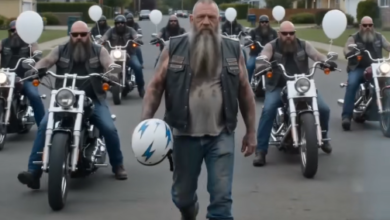
I’m Ray Dawson, though almost nobody in the Iron Vale Motorcycle Club calls me that. To them, I’m Hammer—a fifty-six-year-old former Army mechanic with a shaved head, a gray beard hanging halfway down my chest, scarred knuckles, and enough faded ink on my arms to make strangers move their children to the other side of the sidewalk.
That Saturday morning, forty Harleys stood in two black rows outside our clubhouse on old Route 66 in Albuquerque, New Mexico. Chrome flashed beneath a hard blue sky. Leather creaked. Boots scraped the gravel. The air smelled of gasoline, hot rubber, and the bitter coffee Boone always brewed strong enough to clean engine parts.
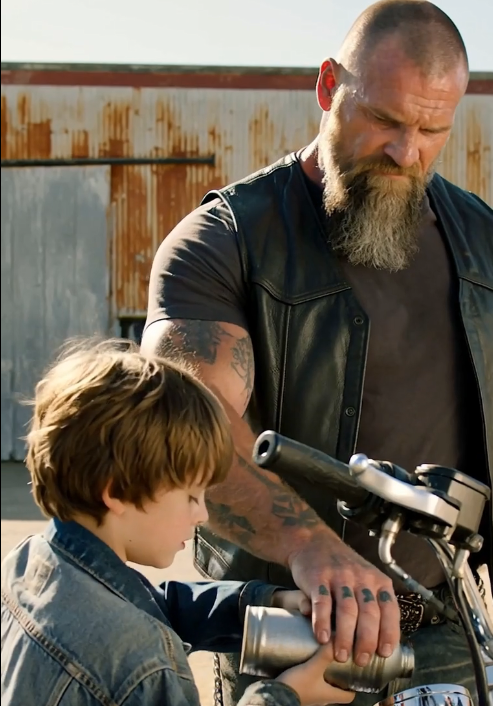
In the middle of it all stood eleven-year-old Eli Mercer.
He looked too small to be holding a human life.
The container in his hands was not an elegant funeral urn. It was a dented steel canister his father, Danny, had once used for carburetor jets. Someone had polished it, but the old scratches remained. A strip of blue tape crossed the lid, and DAD had been written on it in a child’s uneven black marker.
Danny Mercer had been my closest friend for twenty-three years. He had also helped me build the custom Harley parked beside us, a long, low, midnight-blue machine with a hand-shaped tank, scratched chrome, and an engine whose uneven idle sounded like a tired heart refusing to stop.
Three months earlier, Danny had died before we finished it.
Cancer does not care how strong a man’s hands are. It does not care how many roads he has ridden or how many brothers wait outside his hospital room pretending not to be afraid. It simply takes a little each day until the bed contains somebody you recognize only by his eyes.
Eli approached the motorcycle before any of us understood his intention. His mother, Sarah, thought he wanted to touch the tank. I thought he was going to place the canister on the seat for a photograph.
Instead, he unscrewed the gas cap.
“Kid,” Boone said quietly.
Eli lifted the container.
Gray ashes slid into the opening.
The sound was almost nothing—a dry whisper against painted steel—but every biker in that yard heard it. Conversations died. A wrench slipped from someone’s hand and struck concrete. Sarah pushed through the line of men, her face turning white.
“Eli, stop!”
He did not.
He shook the last dust from the canister and tapped its rim twice against the tank, the same way Danny used to tap cigarette ash from his glove before Sarah made him quit smoking. Then Eli lowered his arms and stared at me.
Nobody touched him.
Not Boone. Not Preacher. Not Leon, who had once broken up a bar fight by carrying two grown men outside under his arms. Forty bikers stood frozen because the boy had just poured our brother into a fuel system Danny and I had spent six years building.
Sarah grabbed Eli by the shoulders.
“What have you done?”
Eli’s chin trembled, but he did not cry. “What he asked me to.”
She looked at me as if I could repair this, too.
Maybe she expected anger. Everyone did. That motorcycle was the last machine Danny and I had built together, and putting ash in its tank could clog the lines, choke the carburetor, scar the cylinders, or leave us stranded miles from help.
I walked to the Harley.
Eli stepped back.
I looked inside the empty canister and saw one folded corner of paper trapped beneath its rim. Then I looked at the fuel tank, at Danny’s fingerprints still buried somewhere beneath the clear coat, and at the boy trying to stand the way his father had taught him.
I closed the gas cap.
Sarah whispered, “Ray, don’t.”
I swung my leg over the saddle.
The club held its breath.
Then I turned the key.
The starter caught. The engine coughed once, twice, and erupted into a deep V-twin thunder that rolled across the yard, rattled the clubhouse windows, and sent a flock of pigeons tearing off the roof.
Eli’s face changed.
He knew that sound.
Before I released the clutch, the folded paper fell from the empty canister—and the first line, written in Danny’s failing hand, told me this ride had never been meant for me alone.
Want to know what Danny wrote in that hidden note and why Eli had to pour the ashes into that exact Harley? Drop RIDE in the comments — I’ll share more soon.
Part 2 — The Motorcycle Danny Refused to Finish Without His Son
Danny Mercer never joined the Iron Vale because he loved motorcycles. He joined because, at twenty-seven, he needed someplace where men could sit beside him without asking why he had stopped speaking.
We met at a county impound auction in 2003. I had just come home from my second deployment with a damaged left ear, a duffel bag, and the unpleasant habit of checking every rooftop before entering a parking lot. Danny was bidding on a wrecked Harley frame that looked as though it had been dragged behind a freight train.
He raised his card against me three times.
“You don’t want that frame,” I told him.
“Neither do you.”
“I can repair it.”
“So can I.”
Neither of us believed the other.
He won the frame by twenty dollars. I found him outside an hour later trying to lash it into the bed of a borrowed pickup with a clothesline. I gave him two proper straps. He gave me half a gas-station sandwich, and by sunset we had made the kind of friendship men often build accidentally—one insult, one tool, and one unfinished job at a time.
Danny was lean where I was broad, fast where I was methodical, and careless only when something belonged to him. He could hear a bad bearing through a running engine from across a garage, but he would drive his own truck for six months with the oil light glowing.
We built motorcycles behind a tire shop near Central Avenue. The place had a corrugated roof, one working fan, and a radio that received either old country music or Spanish baseball commentary depending on which corner you stood in. On summer afternoons, the shop became so hot that our tools burned bare fingers.
Danny never complained.
He had already survived worse.
His father disappeared when Danny was eight. His mother worked nights cleaning offices and slept with unpaid bills spread across her bed. By fourteen, he was repairing lawnmowers for grocery money. By seventeen, he could rebuild an engine but still had to ask a neighbor to show him how to tie a necktie for graduation.
That history made him suspicious of promises.
It also made him keep every one he gave.
When Sarah became pregnant, Danny changed. Not dramatically. Men like us rarely do anything dramatically unless a machine is on fire. He simply began leaving the garage before midnight. He stopped carrying cash because every loose dollar went into a coffee tin marked ELI. He sanded the sharp corners off a wooden stool so his son could sit beside him safely.
When Eli was four, Danny placed a child-sized pair of hearing protectors over the boy’s ears and brought him into the shop.
The kid hated loud noises. He hated grease on his fingers. He asked questions without waiting for answers and collected discarded washers as if they were coins from an ancient kingdom.
Danny loved every second.
The midnight-blue Harley began as another wrecked frame. Danny found it in Española, half buried under tarps behind a closed repair shop. Its front fork was bent, the tank was rusted through, and mice had built a nest inside the saddle.
Most of the club saw scrap.
Danny saw inheritance.
“We build this one slow,” he told me. “Eli gets a hand in every piece.”
The boy was six then. He could not lift most of our tools, so Danny found smaller jobs: sorting bolts, holding a flashlight, selecting paint chips, marking measurements in a notebook. Some marks were wrong. Danny never erased them. He drew the correct figures beside his son’s and dated both.
The fuel tank became special.
Danny had shaped it himself from two halves of steel, hammering and rolling them until the curves matched the picture Eli had drawn. The boy wanted the machine to look “like midnight right before the stars show up.” We mixed blue and black paint until he approved, then added flecks of silver so faint they appeared only in direct sunlight.
Under the tank, hidden where nobody could see it, Eli scratched three letters into bare metal.
DAD.
The build took six years because Danny refused to hurry it. We could have completed it in one winter. Instead, he waited for Eli to become old enough to understand each step.
Then Danny started dropping tools.
At first, he blamed numb fingers. Next came the headaches. Then his right leg began dragging after long hours at the bench. Sarah forced him to see a doctor.
The diagnosis arrived on a Wednesday.
Glioblastoma.
The surgeon gave him numbers. Danny hated numbers that could not be repaired. He returned to the garage the following morning, removed the Harley’s tank, and began polishing it with a hand that no longer held steady.
He told only me and Sarah.
The club learned when he collapsed beside the lift.
For the next year, Iron Vale changed without discussing it. Boone drove Danny to radiation. Leon repaired the Mercers’ roof. Preacher stocked their freezer and pretended the groceries had been donated by a church that did not exist. I worked on the Harley whenever Danny had strength enough to sit nearby.
But we never finished it.
One afternoon, I asked why.
Danny studied the open frame for a long time. “Because if we finish, then the next thing is goodbye.”
I had no answer.
A week before he entered hospice, he made me wheel the Harley onto his driveway. The engine still needed tuning, the rear brake line was temporary, and the tank had never held fuel. Eli sat behind him on a milk crate while Danny rested one hand on the handlebar.
“No matter what happens,” Danny told the boy, “we complete what we started.”
Eli nodded.
Danny looked at me over the motorcycle.
There was a request in his eyes, but he did not speak it. Not then.
On the morning he died, Sarah called me before sunrise. By the time I reached their house, Danny’s room was quiet. Eli sat on the floor outside the door, holding the notebook filled with six years of wrong measurements and corrected numbers.
He did not look up.
“He never got his ride,” the boy said.
That was when I thought the story ended.
I was wrong.
Part 3 — The Day Forty Bikers Nearly Broke Their Promise
We finished the Harley eleven weeks after Danny’s funeral.
Nobody announced the workday. Boone arrived first, carrying a box of wiring connectors. Leon came with new brake lines. Preacher brought breakfast burritos, though he ate two before anyone else removed a tool from the cabinet. By nine, every bay in the Iron Vale garage was occupied.
Danny’s workbench remained untouched.
His half-empty coffee jar sat beside a worn micrometer. His gloves lay palms down beneath the pegboard. Someone had covered the bench with clear plastic after he died, but dust still found its way beneath the edges.
Eli came every Saturday.
He spoke little and worked hard. Grief had stripped something boyish from him. He no longer collected washers or asked whether chrome made a motorcycle faster. He checked measurements twice. He cleaned tools before returning them. When one of us made a joke, his smile appeared late, as if it had traveled from someplace far away.
Sarah watched from the office.
She wanted Eli near people who had loved his father. She also feared we were teaching him to live inside a memory. I understood both.
The first time the engine started, Eli stood beside me with his father’s hearing protectors over his ears. I turned the key, opened the choke, and pressed the starter.
The motor rolled but did not catch.
Boone checked the ignition. Leon checked the fuel. I checked everything twice because failure feels personal when the dead once held the same tools.
On the fourth attempt, the engine fired.
The sound filled the garage. It struck the sheet-metal walls and came back larger. Eli grabbed my arm, and for one second his face was six years old again.
“That’s him,” he said.
I knew what he meant.
Danny had chosen the exhaust himself—deep, uneven, stubborn at idle. The Harley did not purr. It argued. Every pulse sounded like Danny clearing his throat before telling someone their work was wrong.
We laughed.
Then Eli cried.
Not loudly. He removed the hearing protectors, placed them on the bench, and folded over with both hands against his stomach. Sarah reached him first. I shut down the engine, and forty bikers suddenly found urgent reasons to inspect walls, floors, or open toolboxes.
Danny’s absence had become audible.
The memorial ride was scheduled for the first Saturday in October. We planned to take the Harley west from Albuquerque on Route 66, climb toward the red cliffs near Laguna, then stop at a ridge where Danny had once proposed to Sarah beside a motorcycle that leaked oil on both their boots.
The club would ride in formation. I would pilot Danny’s custom machine. Eli and Sarah would follow in Boone’s truck. At the ridge, we would scatter Danny’s ashes into the desert wind.
That was the plan everyone knew.
But Danny had made another plan.
On the evening before the ride, Sarah found Eli sitting in the garage beside the steel canister. He had placed Danny’s notebook on his lap and was turning the same page back and forth.
She asked if he was afraid of the ceremony.
“No.”
“Do you want to keep some of the ashes?”
“No.”
“Then what is it?”
He closed the notebook. “Dad told me something.”
Sarah waited.
Eli said nothing more.
She called me after he went to bed. Her voice carried the exhaustion of a woman who had spent a year answering questions no mother should have to answer.
“Ray, did Danny ask Eli to do something?”
“Not that I know.”
“Would you tell me if he had?”
“Yes.”
That answer was true, but incomplete. I remembered Danny’s eyes on the driveway. I remembered the request he had not spoken.
Before dawn, I arrived at the clubhouse and found Eli already there with Sarah. The steel canister rested against his chest. He wore Danny’s old denim jacket, sleeves rolled four times. His shoes were dusted white from the gravel.
Sarah looked angry.
“He hid the urn in his backpack.”
Eli corrected her. “It isn’t an urn.”
Nobody challenged him.
The club began gathering shortly after sunrise. Engines arrived in waves, each one shaking the glass in the clubhouse windows. Men and women embraced Sarah, knelt to speak with Eli, then stepped away because grief makes even good people clumsy.
I inspected the Harley. Fuel full. Lines clear. Tire pressure correct. Brake lever firm. Danny’s notebook was strapped inside the left saddlebag.
At eight thirty, Preacher called the formation.
That was when Eli moved.
He slipped between Leon and Boone, walked directly to the Harley, and climbed onto the right footboard. By the time I realized what he was reaching for, he had opened the tank.
Sarah shouted.
The lid came off the steel canister.
Ashes fell.
For half a second, nobody breathed. Then everyone breathed at once.
Boone lunged forward, but I caught his chest with one hand.
“Don’t.”
“He’s dumping Danny into the fuel!”
“I see it.”
“Then stop him.”
I watched the boy tap the canister against the tank. His hands shook violently, but he did not spill the container or look away.
“No,” I said. “Let him finish.”
Sarah seized Eli when he stepped down. “Your father would never ask this.”
“He did.”
“You could destroy the engine!”
“It’s his motorcycle.”
“It’s yours too!”
That stopped him.
Eli’s face collapsed for one instant. Then he forced it still and turned toward me.
“You promised him.”
I felt every member of Iron Vale watching.
Danny and I had built our brotherhood around a simple rule: no man’s final request was carried out blindly if it harmed the living. We had refused drunken last rides, dangerous processions, and one widow’s request to bury her husband with a loaded pistol. Loyalty did not mean stupidity.
Ash in a fuel tank could kill an engine on the highway. If the bike seized in formation, riders behind me could collide. Forty people might pay for one man’s symbolism.
Leon stepped close. “Hammer, we drain it.”
Boone nodded. “Pull the tank. Flush the lines. We ride tomorrow.”
Sarah hugged Eli from behind while he struggled against her arms.
“No!” he shouted. “He said today!”
The yard changed after that. Not louder. Harder.
Some club members agreed with Leon. Others believed delaying the ride would break Danny’s wish. A few thought Eli had invented the request because he could not accept the scattering ceremony. Nobody said that where the boy could hear.
Then the folded paper fell from the canister.
It landed beneath the Harley.
I bent down, picked it up, and recognized Danny’s handwriting before opening it. The letters leaned left because his right hand had been failing. Several words were blurred as if water had touched the ink.
Or tears.
At the top, he had written my road name.
HAMMER—IF THE KID HAS THE COURAGE, DON’T TAKE IT FROM HIM.
Below that came three paragraphs.
By the second, my hand was shaking.
By the third, I understood why Danny had refused to let us finish the Harley while he was alive—and why the final ride could not begin with his ashes scattered safely into the wind.
Part 4 — The Letter Hidden Under the Ashes
Danny had written the note nineteen days before he died.
He began without greeting, apology, or sentiment. That was his way.
Hammer,
If you’re reading this, Eli did it. Don’t yell at him. Sarah might. Boone definitely will. Tell Boone to shut up for thirty seconds.
Boone read that line over my shoulder and muttered, “Still bossy.”
Nobody laughed.
The note continued.
The kid thinks this is about carrying me. It isn’t. Not really. It’s about making him choose to finish something after finishing starts to hurt.
That motorcycle belongs to him more than it ever belonged to me. He drew the tank. He sorted the first bolts. He scratched DAD underneath because he thought machines needed to know who built them.
I told him that when I couldn’t ride, he could put a little of me in the tank and let the engine carry what the wind couldn’t. He asked if that would hurt the bike. I said maybe. He asked why we would do it. I told him because some promises cost something, or they’re only plans.
I stopped reading.
Sarah loosened her grip on Eli. The boy remained against her but turned his face toward the motorcycle.
Leon looked at the gray residue around the filler neck. “How much did he tell you to use?”
“All of it,” Eli whispered.
Sarah closed her eyes.
The canister had contained less than half of Danny’s ashes. The funeral home had divided them at his request, though none of us knew why. Sarah believed the second container was for a private scattering.
The letter explained that too.
Sarah has the rest. Take her and the kid to the ridge. When you get there, don’t decide for them what goodbye is supposed to look like.
Then came the part addressed directly to me.
You and I spent twenty-three years fixing machines because they’re easier than people. A machine tells you where it hurts. A man will sit beside you for a decade and never say a word.
I’m saying it now.
You kept me here longer than the doctors did. You gave my son a room full of uncles. You gave Sarah people who will answer the phone at three in the morning, even if half of them shouldn’t be trusted with indoor plumbing.
Take the bike.
Let it cough. Let it choke. If it dies, push it. If it ruins every line I installed, replace them. Just don’t clean me out before the ride.
I want one trip inside the machine my boy and I built.
I lowered the page.
The clubhouse yard remained silent except for engines cooling. Metal clicked. Somewhere across Route 66, a truck changed gears, the sound stretching thin in the morning air.
Sarah took the letter from me and read it herself.
When she reached the end, she pressed the paper to her mouth. Eli watched her carefully, waiting to learn whether his father’s promise would be honored or overruled.
Leon crouched beside the Harley and examined the fuel tank.
“We can’t send forty bikes behind it,” he said. “Not if it might seize.”
He was right.
Boone objected anyway. “Danny asked for the ride.”
“And Danny isn’t the one who’ll hit Hammer at sixty miles an hour.”
“I won’t hit him.”
“The twelve riders behind you might.”
Their voices rose. Others joined. The club divided along a line nobody wanted to see: promise against safety, grief against responsibility.
Preacher removed his glasses and wiped them on his shirt. “We give Danny his ride without gambling anybody else.”
“How?” Boone asked.
Preacher looked at me. “Hammer rides out alone.”
Sarah said, “No.”
I understood her fear. If the engine stalled in traffic, if ash clogged the petcock while I crossed an intersection, if the bike locked suddenly on the highway, Danny’s final trip might collect another passenger.
Eli stepped away from his mother.
“I ride with him.”
Every head turned.
“No,” Sarah and I said together.
“But Dad said the bike belongs to me.”
“It does,” I told him. “That doesn’t make you old enough to die on it.”
“I’m not asking to die.”
“Neither was Danny.”
The words landed too hard.
Eli recoiled. Sarah stared at me with open anger. I wanted to take the sentence back, but grief does not allow repairs that simple.
The boy dropped the empty canister.
It struck the gravel and rolled beneath a parked bike.
“You’re all liars,” he said. “You kept saying he was our brother. You kept saying nobody rides alone. Now he asks for one thing and you’re scared of getting dirty.”
Boone moved toward him, but Eli ran behind the clubhouse.
Nobody followed immediately.
We had all faced accidents, gunfire, bad diagnoses, bankruptcies, divorces, and prison gates. Yet an eleven-year-old had just named the one fear none of us could admit.
We were not afraid of ash.
We were afraid the Harley would stop.
Because if it stopped, Danny’s last request would end on the side of the road like every unfinished promise he had spent his life refusing to make.
I folded the letter and placed it inside my vest.
Then I walked into the garage.
For twenty minutes, I said nothing. I studied the fuel path, the old-style petcock, the carburetor bowl, and the spare clear filter Danny had insisted we install even though Boone called it ugly. Some of the ash would settle. Some might travel. The risk was real, but manageable at low speed with a chase truck, tools, spare fuel, and distance between riders.
When I returned to the yard, I found Eli behind the building, seated against the wall with both knees drawn to his chest.
“Your dad taught you how to plan a route?” I asked.
He refused to look up. “Yes.”
“Then plan one without the interstate. No speeds above forty. Boone’s truck follows with straps and a trailer. The bikes stay fifty yards back.”
His head rose.
“You’re taking him?”
“I’m taking both of you.”
“I can ride?”
“In the truck until we reach the old frontage road. After that, you sit behind me for one mile. One. You wear full gear, and your mother decides.”
Sarah had followed me. Her face said no before her mouth opened.
Then Eli looked at her.
He did not beg. He simply held out Danny’s notebook—the one containing his crooked childhood measurements beside his father’s corrections.
Sarah opened it.
On the final page, Danny had written one more line:
THE LAST MILE BELONGS TO ELI.
Sarah’s shoulders dropped.
She knelt, pulled her son against her, and whispered something none of us heard.
When she stood, she faced me.
“One mile,” she said. “Slow.”
I nodded.
Leon reorganized the formation. Boone brought the trailer. Preacher distributed bright cloth strips for added spacing. Every rider checked every brake, tire, and fastening twice.
The club had not chosen the promise over safety.
We chose to carry both.
At nine forty-three, I mounted the midnight-blue Harley and turned the key. The motor rolled slowly. Ash and gasoline rested together inside the tank Danny and Eli had shaped with their own hands.
The engine coughed.
Stopped.
Behind me, forty bikers lowered their heads.
I opened the choke, waited five seconds, and tried again.
This time, the engine caught.
The V-twin thundered beneath me.
From somewhere inside Boone’s truck, Eli shouted, “That’s him!”
And the entire club started its engines.
Part 5 — The Mile That Belonged to Eli
We did not ride like a parade.
There was no tight formation, no synchronized sweep through intersections, no wall of chrome designed to make traffic stop and stare. Leon led half a mile ahead, warning us by radio about loose gravel and construction. I rode alone in the center. Boone’s truck followed with Sarah and Eli, towing an empty motorcycle trailer. The rest of Iron Vale came behind at a distance wide enough to hold an eighteen-wheeler.
The Harley sounded wrong before we reached the city limit.
Not dangerously wrong. Not yet. The motor missed once under light throttle, recovered, then stumbled again near a red light. Each hesitation moved through my boots and up my spine.
I knew that machine better than I knew my own heartbeat.
Ash was traveling.
At the intersection of Central and Unser, the engine dropped to one cylinder. The bike bucked. I pulled the clutch and kept it alive with careful throttle while the light remained red.
A minivan stopped beside me. Two children pressed their faces to the glass, fascinated by the tattooed old man fighting a motorcycle that seemed determined to throw him.
I could almost hear Danny.
Too rich, Hammer. Quit drowning it.
I adjusted the choke.
The light changed.
The second cylinder fired, and the Harley moved.
We crossed Albuquerque block by block, avoiding the interstate and following the old ribbon of Route 66 west. Neon motel signs passed overhead, some restored and some left to bleach in the desert sun. The morning wind carried dust, fryer oil, and the metallic smell of rain that never arrived.
At every stop, I expected silence.
At every stop, the engine kept arguing.
Boone’s voice came through my helmet speaker. “Temperature climbing.”
“I see it.”
“We can trailer.”
“No.”
“That isn’t Danny talking. That’s you being stubborn.”
“Danny taught me.”
“You were stubborn before you met him.”
He had me there.
Near Rio Puerco, the engine began starving for fuel. I switched the petcock to reserve, though the tank was nearly full. The motor surged, failed, and surged again.
I signaled.
We rolled onto the shoulder.
The club stopped far behind. Nobody crowded the machine. Nobody spoke while I removed my gloves and knelt beside the fuel filter. Gray material had collected against the screen.
Danny had reached the line.
Boone approached with tools. “We clear it?”
The letter had said not to clean him out before the ride. Clearing the filter would remove some ashes, but leaving it blocked would end the trip.
Eli climbed from the truck before Sarah could stop him.
“Is Dad stuck?”
Boone looked away.
I motioned the boy closer. “Part of him is.”
“Can we push him through?”
“Not without hurting the engine.”
Eli stared at the gray sediment. “Then take that part out and put it back in the can.”
The solution was obvious because children are sometimes better at grief than adults. They do not pretend symbols are the people they represent.
I removed the filter and rinsed it into the steel container with a little gasoline. Sarah watched without flinching. A month earlier she would have objected to her husband’s ashes being mixed with fuel and road dirt. Now she held the can steady while I worked.
We installed a spare filter.
The engine started on the first attempt.
Thirty miles later, we reached the turnoff to the ridge. The paved road narrowed into an old frontage route running beside the railroad tracks. Red cliffs rose against the horizon. Freight cars moved west in the distance, slow and dark against the sand.
This was where Eli’s mile began.
Sarah helped him into Danny’s old riding jacket, which Boone had altered to fit. Leon checked the helmet strap. Preacher checked it again. I explained where to place his feet, how to hold the belt around my waist, and why he must never lean away from a turn.
Eli listened without interrupting.
Before climbing on, he touched the fuel tank.
“You okay, Dad?”
The engine idled beneath his palm.
I looked at Sarah.
She nodded once.
Eli mounted behind me. His arms could not reach around my chest, so he gripped the leather handles Boone had sewn to my belt. The club remained parked. This mile was not theirs.
I eased onto the road.
Ten miles per hour.
Then fifteen.
The Harley’s exhaust rolled softly across the desert. The surface beneath us was cracked and patched, but the sky opened in every direction. A hawk circled above the telephone lines. Dry grass bent in the wash of a passing freight train.
Halfway there, Eli tapped my side.
I slowed.
“Can he hear us?” he asked through the helmet speaker Sarah had installed.
“I don’t know.”
“What do you think?”
“I think your dad heard things nobody said.”
Eli considered that.
Then he leaned toward the tank.
“We finished it,” he said.
Three words.
The Harley kept running.
At the ridge, Sarah waited beside Boone’s truck with the second container of ashes. The club parked in a long line below us, close enough to witness but far enough to leave the family space.
Sarah opened the urn.
Wind pulled strands of hair across her face. She handed the container to Eli, but he shook his head.
“You do it.”
“We do it together.”
They stood beside the motorcycle. One held each side.
I expected them to scatter everything.
They did not.
Sarah released a small stream into the wind. Ash moved over the ridge, pale against the red earth, then vanished. Eli watched until the air cleared.
“Enough,” he said.
His mother looked surprised. “You want to keep the rest?”
He touched the motorcycle’s tank. “Some is riding. Some is here. Some comes home.”
Sarah closed the container.
That was Danny’s real final request—not that his remains be placed in steel, gasoline, or desert wind, but that nobody force his son to choose one place for a father who had filled every part of his life.
Boone turned away and rubbed both hands over his face.
Leon pretended to inspect a tire.
Preacher removed his bandanna and bowed his head.
I stood beside the Harley, listening to hot metal contract.
Tick.
Tick.
Tick.
Then the clear fuel filter darkened again.
The engine would not make the return trip without being drained.
Eli saw it before anyone spoke.
“Is the ride over?”
I looked at the road behind us, then at forty bikers waiting below.
“No,” I said. “The motorcycle’s part is.”
Part 6 — Nobody Rode Home Alone
We loaded the midnight-blue Harley onto Boone’s trailer.
Some might think that ruined the ending. People prefer stories in which the machine reaches the final destination beneath its own power, the sun sets at the right moment, and nobody has to touch a wrench.
Danny would have hated that kind of lie.
A machine can fail and still finish its work.
The club formed two lines around Boone’s truck. Sarah sat in the passenger seat holding the remaining ashes. Eli rode in the back beside the empty steel canister and Danny’s notebook. I took Boone’s bike, an old black touring Harley that pulled left and smelled permanently of wet leather.
Before we left, Eli stopped me.
“What happens to Dad in the tank?”
“We drain the fuel at the shop.”
“Do you throw it away?”
“No.”
“Promise?”
I looked at him carefully. That word had become heavy between us.
“Promise.”
The return ride was louder than the journey out. Not because anyone raced or revved the engines, but because the full club closed formation around the trailer. Danny’s motorcycle traveled in the center, held upright by orange straps, its midnight paint flashing whenever sunlight crossed the silver flecks.
Drivers pulled over to watch.
At a gas station near the edge of Albuquerque, an old man removed his cap. A waitress came out of a roadside diner and stood with both hands against her apron. Two construction workers paused beside a trench.
They did not know what they were seeing.
Maybe they thought it was a funeral procession. Maybe they thought the motorcycle on the trailer belonged to someone who had crashed. Maybe they saw only a group of large, tattooed riders surrounding a grieving family.
All were true in pieces.
Back at the clubhouse, we rolled the Harley into Danny’s old bay. I disconnected the fuel line and drained the gasoline through several layers of fine filter material. Gray residue collected slowly.
Eli sat on the floor and watched every drop.
We worked until midnight.
Sarah brought sandwiches. Leon found a clean glass jar. Boone labeled it without being asked: DANNY — FIRST RIDE. Preacher suggested we should not store gasoline indoors. For once, everybody listened to him.
We allowed the fuel to evaporate safely in a protected outdoor tray, then gathered the remaining ash. Mixed with it were tiny grains of desert dust and dark specks from the motorcycle’s tank.
Eli studied the result.
“He got dirty.”
“Your father was usually dirty,” I said.
That earned the smallest smile.
We placed the ash back inside the steel canister. Eli added one object before closing it: the clogged fuel filter from the roadside. Sarah raised an eyebrow but did not object.
The Harley needed more than cleaning. Ash had reached the carburetor bowl. The plugs were fouled. A section of fuel hose had begun deteriorating and would have failed within months whether Danny had traveled through it or not.
For six Saturdays, Eli and I rebuilt the fuel system.
I made him perform the work Danny would have assigned. He removed the tank bolts. He labeled the lines. He cleaned the carburetor passages with hands still small enough to reach places mine could not.
Whenever he became frustrated, I opened Danny’s notebook.
The pages showed the truth: mistakes had always been part of the motorcycle. Wrong measurements. Crooked sketches. Reversed numbers. Danny had preserved every error beside its correction because he wanted Eli to see that building something did not require getting it right the first time.
On the seventh Saturday, the Harley started cleanly.
Eli stood beside it, no hearing protection now. The sound no longer broke him.
It simply filled the room.
Sarah arrived carrying a small wooden box made from the same walnut Danny had used for the bike’s handgrips. Inside was the remaining ash from the ridge and the steel canister from the ride.
“What do we do with them?” she asked.
Eli looked at me.
I looked at him.
He had grown tired of adults choosing what grief should mean.
“You decide,” I said.
He placed the steel canister inside the left saddlebag. The wooden box went home with his mother.
Some riding.
Some waiting.
Some home.
Part 7 — The Passenger in the Left Saddlebag
The midnight-blue Harley remained registered in Sarah’s name until Eli turned sixteen.
I kept it at the clubhouse, covered but never hidden. Every month, I started the engine and let it warm until the cylinders settled into that uneven rhythm Danny had chosen. Every month, Eli checked the clear fuel filter.
At twelve, he learned to polish chrome without scratching it.
At thirteen, he rebuilt the front brake caliper.
At fourteen, he was tall enough to sit on the saddle with both boots touching the floor. Sarah found him there one evening after everyone else had gone home, his hands resting on the bars and the steel canister secured inside the saddlebag.
She did not tell him to get down.
At fifteen, Eli asked me whether his father had been afraid to die.
I could have protected Danny’s legend. I could have said no, because biker clubs sometimes confuse courage with the absence of fear.
Instead, I told the truth.
“He was terrified.”
Eli stared at the motorcycle. “He never looked scared.”
“He practiced when you weren’t watching.”
The boy nodded as if that answer fit something he had always known.
On his sixteenth birthday, Sarah brought him to the clubhouse before sunrise. The entire Iron Vale club was waiting. Forty motorcycles stood in two rows just as they had on the day he poured his father into the tank.
The midnight-blue Harley waited at the front.
It was not legally or practically the right machine for a new rider, so we had built Eli a smaller one to train on. Danny’s custom Harley would remain under my control until the kid had enough miles to respect its weight.
Eli understood.
He did not ask for the keys.
Instead, I handed him Danny’s notebook.
Inside the cover, I had mounted the folded letter that began with my road name and ended with a request for one final trip. Beneath it, Sarah had added a photograph taken at the ridge: Eli behind me, one mile of cracked road ahead, the red cliffs rising beyond us.
Boone presented him with a plain leather vest. No club patch. Those had to be earned. But over the heart, Sarah had sewn a small midnight-blue strip bearing three silver letters.
DAD.
Eli ran his thumb across it.
Then he opened the Harley’s left saddlebag and removed the dented steel canister. He had grown large enough to hold it in one hand, but he carried it with both.
“Are we taking him?” I asked.
“Just for the first mile.”
He secured the canister again.
We rode west after sunrise. Eli followed on his training bike while I piloted the Harley he and Danny had built. Sarah rode in Boone’s truck. Iron Vale stretched behind us, engines rising and falling across old Route 66.
At the entrance to the frontage road, the club stopped.
Eli rode beside me.
For one mile, father, son, and motorcycle traveled together again—one in the saddle, one inside the left bag, and one alive in every bolt they had measured twice.
At the ridge, Eli shut off his engine.
I shut off mine.
The desert became still.
He placed one palm against the midnight-blue tank and listened to the metal ticking as it cooled.
“Same time next year?” I asked.
Eli smiled.
“Until he says we’re done.”
The wind moved over the ridge. Somewhere inside the saddlebag, the steel canister touched the frame with one soft click.
Danny was still riding.
Follow our page for more powerful biker stories about brotherhood, sacrifice, and the quiet promises carried for miles after the people who made them are gone.