A Boy Locked a 285-Pound Biker Inside a Church Storage Room—When the Door Finally Opened, His Dead Father’s Last Recording Explained Why
The ten-year-old boy locked a 285-pound biker inside our church storage room, pocketed the only key, and stared down twenty-three furious adults because he knew Ray Dawson planned to disappear before hearing one dead man’s voice.
I was standing six feet away when the lock clicked.
My name is Mara Ellis. I was forty-three then, the administrator at Grace Community Church on the western edge of Joplin, Missouri, where Interstate 44 hums beyond the cemetery and every old window vibrates when a convoy of Harleys passes the frontage road.
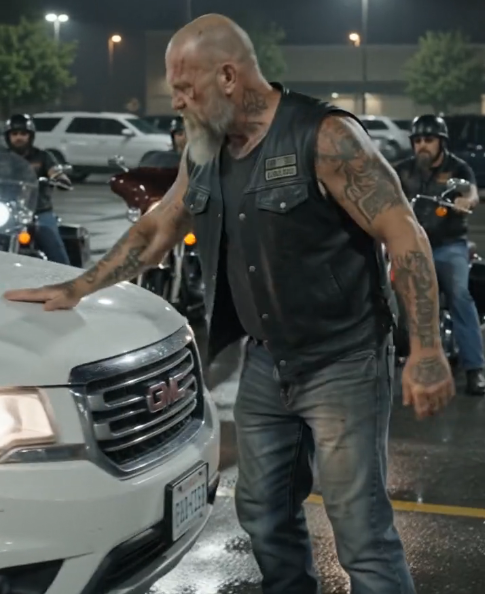
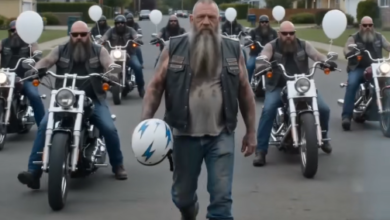
That Sunday, twelve motorcycles sat outside our fellowship hall. Their engines had gone quiet, but the smell of warm oil, wet leather and exhaust still followed the riders inside.
Ray “Hammer” Dawson had come alone.
He was fifty-six, six-foot-four, nearly 285 pounds, with a shaved head, a thick black-and-gray beard and tattooed forearms wider than Caleb Holt’s legs. A plain black leather cut hung from his shoulders. No club patch. No road name. Only pale stitch marks where something important had been removed.
Most people noticed those empty places.
Caleb noticed Ray’s packed saddlebags.
His father, Danny Holt, had ridden beside Ray for eighteen years. Danny had been dead eleven months, and the memorial lunch in our fellowship hall was supposed to end with several voice messages he had recorded before cancer took away his strength.
Ray stayed through the prayer. He stood through the photographs. He even carried three folding tables without being asked.
Then Pastor Warren announced the recordings.
Ray reached for his gloves.
Caleb saw him.
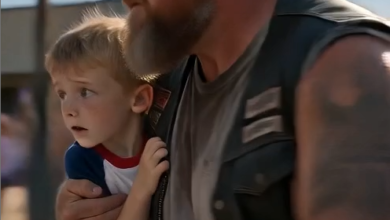
The boy slipped away from his aunt, followed Ray down the education wing and called through the open storage-room door, “Uncle Hammer, Dad’s helmet is on the top shelf.”
Ray stepped inside.
Caleb pulled the door shut.
Click.
For two seconds, nobody understood what had happened. Then Ray tested the knob from inside, Caleb backed against the opposite wall, and his aunt Hannah screamed his name.
People came running. The pastor demanded the key. Two bikers in black leather moved toward the boy, their boots pounding hard enough to shake dust from the hymnbook shelves.
Caleb closed one fist around the little brass key.
“No.”
Hannah tried to pry open his fingers. Caleb twisted away and struck the wall with his shoulder.
Behind the door, Ray spoke once.
“Don’t grab him.”
His voice was low, almost calm. That frightened the church elders more than shouting would have.
One man reached for his phone. Another suggested calling the police. A deacon ran for a pry bar, while three members of Ray’s former club argued over whether the hinges could be removed without splintering the frame.
Ray could have broken that door himself.
We all knew it.
Instead, he sat down on the other side. I heard leather creak, then the dull knock of his shoulders touching the wall.
“Caleb,” he said. “Open it.”
“You’ll leave.”
“That’s my business.”
“Dad said you’d say that.”
The hallway went still.
Caleb removed an old digital recorder from beneath his sweater. Gray tape held its battery cover in place, and a label in Danny’s handwriting had nearly peeled from the back.
Ray had seen it before.
His boots scraped the floor inside the storeroom.
“Where’d you get that?”
“Dad’s toolbox.”
“Give it to Mara.”
“No. You always leave when his voice starts.”
That was true. Ray had walked out during Danny’s funeral slideshow. He had missed the first memorial ride. Whenever Caleb played one of his father’s messages, the biggest man in the room found a door before Danny finished the first sentence.
But this recording was different.
Caleb had heard eleven seconds of it.
Just enough to hear his father say Ray’s name—and just enough to discover the strange instruction Danny had left for his son if the biker tried to run again.
I knelt beside Caleb and asked what his father had told him to do.
The boy looked at the locked door.
Then he pressed Play.
Static crackled through the tiny speaker. A man coughed. Somewhere in the background, a Harley idled with the uneven heartbeat Danny had loved.
Then his dead father spoke.
“Caleb, if Hammer is locked in that old room, you did it right.”
Nobody moved.
From behind the door came one rough sound, as though Ray Dawson had forgotten how to breathe.
But Danny’s next words did more than explain why a child had imprisoned a biker inside a church. They threatened to expose who had taken $18,400 from the Iron Lanterns, why Ray surrendered his patch and what really happened during the final night Danny rode beside him.
Want to know what Danny confessed on that recorder and why Ray planned to leave Missouri before sunset? Drop RECORDING in the comments—I’ll share more soon.
Part 2 — The Man Who Always Left Before Danny’s Voice Ended
To understand why Caleb used that brass key, you need to understand what Ray Dawson had become during the eleven months since Danny Holt died.
Around Joplin, people knew Ray before they knew his name. They recognized the midnight-blue Harley-Davidson Road King parked outside Dawson Fleet Repair, the metallic knock of his boots across the diner floor and the thick beard that turned silver around his mouth. Parents drew children closer when he entered a gas station. Men who liked to sound brave lowered their voices when he passed.
Ray rarely corrected anyone’s first impression.
He had spent six years in the Army, three months in county jail after a bar fight in his twenties and fourteen sober years avoiding the bourbon that had nearly taken everything else. The tattoos across his hands came from different versions of him. A black wrench marked the mechanic. A small compass belonged to the soldier. The initials O.D. on his right wrist belonged to Owen Dawson, his eight-year-old son, who had died when the Joplin tornado tore through their neighborhood in 2011.
Danny Holt entered Ray’s life eleven days after that storm.
Ray had been sleeping inside his damaged repair shop because his house no longer had a roof and his marriage had collapsed beneath a loss neither parent knew how to carry. He ignored calls, stopped eating and kept Owen’s small red bicycle leaning against the shop wall as if the boy might return to claim it.
Danny arrived on a battered black Harley with two coffees and no useful advice.
He stayed.
On the first night, Danny slept on the concrete floor between a tire rack and Ray’s office. On the third, he repaired a section of roof. On the sixth, he took the bottle Ray had been hiding inside an air-filter box and poured it into a bucket of used coolant.
Ray swung at him.
Danny ducked.
Then he made breakfast.
That was how their friendship worked. Danny had a narrow face, restless hands and a mouth that never stopped until someone needed silence. Ray was built like a loading dock and could pass an entire afternoon using only four words. Together, they rode charity escorts, recovered stranded motorcycles and delivered groceries after storms without putting their names on anything.
When the Iron Lanterns motorcycle club formed in 2014, Danny became its secretary. Ray became road captain. Danny kept records, remembered birthdays and convinced twenty men who distrusted paperwork to create an emergency fund for injured riders and local families.
Ray kept everybody alive on the highway.
Caleb was born two years later.
His mother, Andrea, died from complications after an undetected heart condition when he was three, leaving Danny to raise him with help from his older sister Hannah. Ray never called himself family, but he installed Caleb’s car seat, repaired the furnace and learned which dinosaur-shaped chicken nuggets the boy would eat.
Caleb called him Uncle Hammer before he could pronounce Dawson.
Their life held until Danny’s hands began failing him.
At first, he blamed old injuries. He dropped sockets at the shop. His fingers went numb during long rides. Then came the abdominal pain, the weight loss and a diagnosis that used too many words to say there would not be enough time.
Pancreatic cancer.
Danny lasted thirteen months.
During treatment, Grace Community Church became the center of his smaller world. Hannah sang in the choir. Caleb attended the after-school program. Pastor Warren let Danny use the sound booth to record messages for the birthdays, graduations and ordinary bad days he knew he would miss.
There were twenty-six files.
Danny labeled each one in black marker: FIRST DAY OF MIDDLE SCHOOL. FIRST BROKEN HEART. WHEN YOU THINK I FORGOT YOU. WHEN YOU NEED TO HEAR A BAD JOKE.
The twenty-sixth had no title.
Ray helped wire the microphone for the first session, then refused to stay. Danny accused him of cowardice. Ray called him a loudmouthed corpse. They nearly came to blows in the sanctuary until Caleb appeared carrying three juice boxes and asked whether dead people still got thirsty.
After that, neither man fought inside the church.
They saved it for the parking lot.
Danny wanted Ray included in some recordings. Ray refused. He said Caleb deserved his father’s voice without another man crowding the room.
Danny knew that was not the real reason.
Ray could repair a seized transmission while gasoline ran over his wrists. He could hold pressure on a stranger’s wound until paramedics arrived. Yet hearing Danny speak about a future he would never see made his scarred hands shake.
So Ray developed a habit.
He left.
At Danny’s funeral, he disappeared before the final prayer. During the memorial ride, he turned off on Route 66 before the group reached the cemetery. On Caleb’s tenth birthday, the boy played a recording about courage, and Ray walked into the garage halfway through Danny’s first sentence.
Caleb began watching doors whenever his father’s voice played.
What none of us knew was that Ray had already made plans to leave Joplin permanently. He had sold the repair shop to his foreman, rented a room outside Amarillo and packed everything that mattered into two saddlebags and a dented Army duffel.
He told nobody except Cole Mercer, the new road captain of the Iron Lanterns.
Cole did not try to stop him.
He and Ray had barely spoken in nine months.
The empty stitch marks on Ray’s vest explained part of that silence. After Danny entered hospice, $18,400 disappeared from the Iron Lanterns’ emergency account. Ray had access. Ray admitted taking it. Ray refused to explain where it went.
The club gave him one choice.
Return the money or surrender his patch.
Ray removed the Iron Lantern emblem himself. He laid it on the garage workbench, handed Cole his road-captain rocker and walked out while twenty-two men watched.
Danny died six days later.
From then on, the town saw an intimidating former biker visit a fatherless boy, leave anonymous grocery envelopes and disappear each time grief entered the room. The Iron Lanterns saw a man who had stolen from them. Ray saw only debts he could never finish paying.
Caleb saw something simpler.
Every person who left him had a reason.
They still left.
That Sunday, when Ray’s saddlebags appeared packed and Danny’s final unlabeled recording surfaced, the boy decided one adult was going to stay in the room long enough to hear the truth.
Even if he had to lock him there.
Part 3 — Twenty-Three Adults Outside an Old Wooden Door
The crisis in the education wing lasted fourteen minutes, though memory has stretched it into something much longer.
Hannah stood beside Caleb, trembling with anger and embarrassment. She was thirty-eight, an elementary-school counselor who had carried her brother through chemotherapy appointments and then taken responsibility for his son. She loved Ray, but she did not trust the silence around him.
“Give me the key,” she said.
Caleb shook his head.
“You cannot lock people in rooms.”
“He does it to himself.”
The answer landed harder than the boy intended.
Ray heard it through the door.
So did everyone else.
The Iron Lanterns had gathered behind Pastor Warren. Cole stood first, a lean fifty-year-old mechanic with a gray ponytail and an old burn scar climbing the left side of his neck. Beside him was Maria Alvarez, a fifty-four-year-old emergency nurse who rode a red Street Glide and had once stitched Ray’s forearm at a picnic table because he refused to visit urgent care.
Both had come for Danny.
Neither expected to confront Ray.
Cole wrapped his hand around the doorknob. “Hammer, step back. We’re opening it.”
“No.”
“You planning to live in there?”
“Boy wants me to hear something.”
Cole glanced toward the recorder in Caleb’s hand. His expression changed, but only for a second.
Hannah noticed.
“You know what’s on this?”
“No.”
“That wasn’t a no.”
“I knew Danny made another file. Didn’t know where it went.”
Pastor Warren admitted Danny had given him the recorder three weeks before his death. After the funeral, it vanished during renovation of the sound booth. One of our volunteers had found it inside a wooden toolbox donated for the church yard sale.
Caleb recognized the gray tape.
He took it before anyone tested the files.
“Stole it,” Hannah said.
“Borrowed,” Caleb answered.
“That is not better.”
A church trustee returned with a pry bar. The old storage door opened inward, with exposed hinges on Ray’s side. We could have broken the frame, but Ray warned us the top jamb had split. Forcing it might bring part of the plaster wall down onto Caleb.
That sounded exaggerated.
Then dust trickled from the ceiling when Cole struck the door with his shoulder.
Ray had noticed what the rest of us had not.
“Everybody back,” he ordered.
The old road captain was still inside him. The Iron Lanterns obeyed before remembering they no longer had to.
Caleb held up the recorder. “I’ll slide it under.”
The gap was too narrow.
I found an audio cable in the church office, connected the recorder to a portable speaker and placed it outside the door. Ray would hear Danny with the rest of us. He objected at once.
“This ain’t a show.”
Caleb sat cross-legged on the carpet. “Then don’t leave.”
Ray’s chain wallet rattled behind the door as he shifted. He could not see the boy, but he knew that tone. Danny had used it whenever a man twice his size said something stupid.
“Like father, like son,” Ray muttered.
Caleb pressed Play again.
The recording began with the same cough and the same idling engine.
“Caleb, if Hammer is locked in that old room, you did it right. Pastor Warren showed you the brass key when you were six, and I’m betting you remembered. Before Hannah starts yelling, open the door as soon as this message ends. Hammer won’t hurt you. He’ll probably want to murder me, but I’ll already be dead, so that works out.”
A few people laughed.
Ray did not.
Danny continued. His voice was weak, yet the old mischief remained beneath it.
“Ray, sit down. I know you’re standing.”
A dull thump came from inside the storeroom.
Ray had sat.
“If you walked out during the other files, I forgive you. If you packed that ugly blue bike and planned to disappear after my memorial, I expected it. You’ve been running since Owen died, brother. You just learned how to make running look like service.”
Ray said nothing.
Maria covered her mouth.
The recorder carried a faint metallic sound, then Danny breathing through pain.
“Caleb, there are things about your uncle you were too young to hear. There are things about me I was too proud to say. We’re fixing both today.”
Hannah reached for the Stop button.
Caleb blocked her hand.
Danny admitted the missing $18,400 had not been taken by Ray.
He had taken it.
Three months before hospice, Danny received a final denial from his health insurer for a specialized pain procedure and home equipment. But the money was not for him. Most of it paid an overdue balance from Andrea’s hospitalization that threatened the small house he was trying to leave Caleb. If the lien proceeded, Hannah would inherit a child, a mortgage and medical debt she could not manage.
Danny had access to the emergency account.
He transferred the money, intending to replace it after selling his Harley and tools.
Ray discovered the withdrawal before the club did.
“He told me to confess,” Danny said through the speaker. “I told him I would. Then the cancer reached my liver, and courage got expensive.”
Ray sold two motorcycles, his enclosed trailer and most of Owen’s remaining tools. He returned nearly all the money in small deposits, but the club discovered the original transfer first.
Danny begged Ray to stay silent until he could speak to Caleb.
Ray did more than stay silent.
He claimed the theft.
Cole stepped away from the door as if someone inside had shoved him.
Maria whispered, “You let us strip your patch for him.”
Ray finally spoke.
“Keep listening.”
The message was not finished.
Danny explained that the money was only the first secret. On the final night they rode together, he made Ray promise to do something far harder than surrender a club emblem.
He made Ray promise to let everyone believe he had abandoned a dying man on the highway.
Part 4 — What Happened at Mile Marker Eleven
Everyone in Joplin’s riding community knew the public version of Danny’s last ride.
It happened seven weeks before his death. Doctors had told him not to ride again. Medication slowed his reactions, the cancer had weakened his legs and he could no longer hold the clutch for long without pain.
Danny insisted on one final trip.
Not a thousand-mile farewell. Not a dramatic run to the coast. He wanted to ride eleven miles west on Route 66, drink bad coffee at the Crossroads Diner and return before dark.
Ray refused.
Danny threatened to give his Harley to a teenager who watched repair videos online and called every wrench “the twisty thing.”
Ray agreed.
The Iron Lanterns planned to escort them, but Danny cancelled the group ride that morning. He said he wanted only his road brother beside him.
They left at 4:20 in the afternoon.
At 5:03, a driver saw Danny’s motorcycle stopped near Mile Marker Eleven. Ray’s Road King was gone. Danny sat against the guardrail, unable to stand, with blood on his shirt from a ruptured tumor and his phone several yards away in the grass.
A trucker called 911.
Danny survived the night, but he never rode again.
The Iron Lanterns learned Ray had left him on the shoulder. Cole confronted him in the hospital parking lot. Ray said Danny had ordered him to go and offered nothing more.
Cole struck him.
Ray did not strike back.
That silence became its own confession.
Rumors spread. Some said the two men had argued over money. Others believed Ray panicked when Danny collapsed. The missing emergency funds surfaced days later, making every ugly explanation sound reasonable.
Even Hannah believed Ray had chosen the club scandal over her brother’s final ride.
But Danny’s recording carried the rest.
“We reached the diner,” he said. “I drank half a coffee and threw up behind the ice machine. Hammer wanted an ambulance. I told him no. That wasn’t brave. It was stupid.”
On the return ride, they stopped near an abandoned service station. Danny’s pain sharpened. He knew something was wrong, but he also saw a voicemail on Ray’s phone from Hannah.
Caleb had collapsed during soccer practice.
The school could not reach Danny. Hannah was forty miles away at a counseling conference. Caleb had a dangerous fever and a history of febrile seizures. An ambulance was taking him to Freeman Hospital, but he kept asking for his father.
Danny could not reach the hospital quickly.
Ray could.
“I ordered Hammer to go to you,” Danny told Caleb. “He refused. So I lied. I said the pain had eased. I told him Cole was five minutes behind us. Then I called him a coward for choosing a dying man over a scared boy.”
There had been no escort behind them.
Danny waited until Ray turned east, then tried to mount his bike.
He collapsed beside the guardrail.
Ray reached the hospital in twelve minutes. He stayed outside Caleb’s treatment room because school officials would not release medical information to him. When Hannah arrived, he slipped away without explaining why his boots were still wet from kneeling beside the boy after he vomited.
By then, Cole had found Danny.
The brotherhood saw Ray at the hospital while his closest friend lay alone on the highway. Nobody asked why.
Ray never told them.
“Why?” Cole shouted toward the door. “Why the hell would you let us believe that?”
Ray’s answer came quietly.
“Danny asked.”
On the recording, Danny explained his demand. Caleb already blamed himself for the strain of his father’s illness. If the boy learned Danny had been left alone because Ray raced to reach him, he might connect his own fever to his father’s collapse.
Danny would not allow that burden near his son.
Ray promised.
It was the kind of promise bikers liked to describe as sacred until it began costing them something.
This one cost Ray almost everything.
Cole accused him of abandoning Danny. Ray accepted it. The club investigated the money, and Ray claimed that too. Hannah stopped inviting him into the house. Caleb heard fragments in grocery-store aisles and school parking lots: thief, coward, false brother.
Still, Ray arrived every Tuesday.
He left groceries on the porch, repaired whatever had broken and sat with Caleb in the garage until the boy asked about his father. Then Ray found a reason to leave.
On the recording, Danny inhaled slowly.
“Caleb, Ray didn’t leave me for money. He left because I sent him to you. If you want to blame someone, blame your father for lying beside a highway and thinking he could outstubborn cancer.”
Caleb’s head lowered.
Hannah put her arm around him.
“But don’t blame yourself,” Danny added. “That’s the reason we kept this buried. Your fever didn’t put me against that guardrail. Cancer did. Pride helped.”
The hallway remained silent except for the speaker’s faint electrical hiss.
The false climax should have ended there. Ray was exonerated. Danny had confessed. The club knew the missing money and final ride were not what they had believed.
But the recording still had nine minutes remaining.
Danny’s tone changed.
“Now, Hammer, we get to the part you’re actually afraid of.”
From behind the door came the sound of Ray standing.
His shoulder struck the wood.
“Turn it off.”
Caleb’s finger hovered over the button.
Ray hit the door once, hard enough to shake the frame.
“Caleb.”
The boy flinched.
Then Danny’s recorded voice cut through Ray’s warning.
“If he asks you to stop this, don’t.”
Caleb drew the recorder against his chest.
Ray could have torn the door apart. His hand closed around the inside knob. We heard the old wood groan.
Then he released it.
“Play it,” he said.
The final secret was not about Danny’s money, his illness or Mile Marker Eleven.
It was about Owen Dawson—the eight-year-old boy Ray had spent fourteen years trying not to survive.
Part 5 — The Father Danny Refused to Replace
Danny’s voice softened whenever he said Owen’s name.
The Iron Lanterns knew Ray had lost a son in the tornado. They knew the broad facts: Ray had been working across town, his wife and child had sheltered in their bathroom, and only his wife was pulled out alive.
What almost nobody knew was what happened afterward.
Ray blamed himself for taking the truck that morning, leaving his wife without transportation when the warnings began. He blamed a jammed storm-shelter door. He blamed the contractor who had promised to reinforce the house.
Mostly, he blamed the father who had not been there.
His marriage ended within a year. He stopped speaking to Owen’s mother because hearing her voice returned him to the debris field. He stored Owen’s toys in the repair shop, kept the child’s red bicycle inflated and started taking overnight rides whenever sleep became dangerous.
Danny once found him at three in the morning beside a quarry outside Webb City.
Ray’s Harley was running.
Ray stood near the edge.
Danny parked without speaking. He did not wrestle him away or deliver a speech. He sat on the gravel, opened two gas-station coffees and complained that Ray’s engine sounded like a washing machine filled with bolts.
Ray became angry enough to step away from the drop.
Danny stayed beside him until sunrise.
For years afterward, he showed up on the anniversary of the tornado with the same terrible coffee. Sometimes Ray spoke. Sometimes he repaired a motorcycle while Danny sat on a bucket.
That history explained why Danny trusted him with Caleb.
It also explained why Ray kept running.
“Brother,” Danny said on the recording, “you think staying near my boy means stealing my place. You’re wrong. A child can miss his father and still need the man who remembers him.”
Ray leaned his forehead against the storage door.
I could see the wood bend slightly beneath his weight.
Danny told Caleb about the things Ray would never mention: the first bicycle he repaired after the tornado belonged to a boy from their neighborhood; the school supply drives funded through cash Ray told everyone came from club dues; the tiny plastic dinosaur he carried inside a hidden pocket because Caleb had given it to him at age four.
Caleb reached beneath Ray’s folded gloves on the floor outside the door.
A green plastic triceratops had fallen from the left glove.
The boy held it up.
Hannah stared.
Ray had carried it for six years.
Danny’s message continued. “Hammer won’t be your new dad. Don’t ask him to be. He’ll hear replacement when you mean love, and that thick skull will send him halfway to Texas.”
Ray’s packed saddlebags suddenly made sense.
Caleb looked at me. “Amarillo.”
I asked how he knew.
He said Ray’s foreman had called the house looking for a forwarding address. Caleb had found a motel receipt inside a grocery envelope Ray left on the porch.
That was the first reason he locked the door.
The second lay deeper in Danny’s recording.
Weeks before his death, Danny had asked Ray to become Caleb’s emergency guardian if anything happened to Hannah. Ray signed the papers, then removed his name the following morning.
Danny was furious.
Ray said a former drunk with a jail record and no family had no business standing second in line for a child. Danny called him a mechanic, a veteran, a sober man and the only person Caleb trusted to fix nightmares without pretending nightmares could be fixed.
Ray still refused.
Danny did not force him.
Instead, he recorded one last request.
“Caleb, I’m not telling you to hold Hammer here forever. Nobody stays because a door is locked. I need him to stay until he understands what leaving will do.”
The speaker caught Danny moving closer to the microphone.
“Ray, my boy has lost his mother. He’s losing me. If you disappear without letting him say goodbye, he’ll believe he drove away another man. You know what that belief does. You’ve carried it fourteen years.”
No one looked toward Caleb.
We looked at the door.
Ray’s broad shadow darkened the gap beneath it. His boots had not moved.
Danny coughed for nearly twenty seconds. When he recovered, his voice was thinner.
“You don’t owe Caleb a father. You don’t owe me a replacement life. I’m asking for Tuesday afternoons, bad repairs he could do himself and one adult who doesn’t flinch when he says my name.”
Ray’s fist struck the wall once.
Not in anger.
It sounded like a man reaching for something solid in the dark.
The recording should have ended. Instead, Danny addressed the Iron Lanterns.
“If Cole is there, tell him Ray’s patch did not belong on your workbench. Put it back where you found it.”
Cole stared at the blank spaces on Ray’s vest.
Danny confessed he had asked Ray to take the blame until the mortgage issue could be resolved. He expected to live long enough to repay the money and clear Ray’s name. When his health collapsed, shame delayed him again.
“That part is mine,” Danny said. “Brotherhood didn’t fail because you questioned missing cash. It failed when you decided silence meant guilt and stopped asking what pain might be protecting.”
Cole lowered his face.
The words cut both ways.
Ray should have trusted his club. Danny should have confessed sooner. The Iron Lanterns should have investigated more carefully. Hannah should have asked why Ray reached Caleb’s hospital before anyone else.
There was no single villain to forgive.
Only people who had each kept the fragment that hurt least.
Then Danny spoke directly to his son.
“Open the door now, buddy.”
Caleb stood.
His legs had gone stiff from sitting on the carpet. He took the brass key from his pocket and placed it in the lock, but before turning it, he asked the question every adult had avoided.
“Will you still leave?”
Ray did not answer immediately.
Leather moved on the other side. A chain touched the floor. When he finally spoke, the roughness had left his voice.
“Open it, Caleb.”
“That isn’t an answer.”
“No.”
One word.
Caleb turned the key.
The door opened three inches, stopped and pressed against Ray’s boot. He moved aside slowly.
Dust clung to his beard. His eyes were red, though his cheeks were dry. A broken wooden music stand lay beside him, its metal stem bent where his hand had closed around it during the recording.
Caleb expected Ray to step into the hallway.
Instead, Ray lowered himself onto one knee inside the storeroom.
They were almost eye level.
Ray removed the packed motorcycle key from his pocket and placed it in the boy’s hand beside the brass church key.
“Hold this until I quit running.”
Caleb closed his fingers around both.
Then Danny’s voice returned from the speaker.
The recording had not ended.
“Good,” he said faintly. “Now somebody tell Hammer to look on the top shelf.”
Everyone looked up.
Behind a stack of Christmas decorations sat Danny Holt’s black motorcycle helmet—and inside it was the one thing Ray had believed died with his son.
Part 6 — The Red Bicycle Bell Inside Danny’s Helmet
Cole climbed onto a folding chair and brought down the helmet.
It was the same one Danny wore on his final ride, scratched along the left side where it struck the guardrail. Hannah had assumed the club kept it. The club thought she had taken it home.
Inside lay a small red bicycle bell wrapped in an oil-stained cloth.
Ray recognized it before Cole finished unwrapping it.
Owen’s bicycle had carried that bell.
Months after the tornado, Ray discovered it missing from the red frame in his repair shop. He accused looters, then quietly blamed his former wife. The loss seemed small beside everything else, but grief often chooses one ordinary object to carry a weight it was never built to hold.
Danny had taken it.
His recording explained why.
On the night Ray stood near the quarry, Danny went back to the repair shop and removed the bell. He feared Ray had turned Owen’s bicycle into an altar he would eventually follow his son into. Danny planned to return the bell when Ray stopped treating survival as betrayal.
He waited too long.
“I stole that too,” Danny admitted. “Apparently dying doesn’t improve a man’s recordkeeping.”
A strained laugh moved through the hallway.
Ray did not laugh.
He held the little bell in his palm and pressed its lever with one thumb.
The ring was thin and bright.
It did not belong among the heavy boots, leather cuts and men who had spent years pretending that grief respected size.
Caleb touched the bell once.
“Was it his?”
“Yeah.”
“Can I see the bike?”
Ray looked at him.
“Someday.”
Caleb shook his head. “Tuesday.”
Ray’s beard moved around the beginning of a smile. “Tuesday.”
Cole approached with the old Iron Lantern patch in his hand. He had carried it beneath his vest for nine months, though he told us later he never understood why. Perhaps part of him had always expected the truth to call Ray home.
He held it out.
Ray did not take it.
“Danny said put it back,” Cole told him.
“Danny said plenty.”
“I was wrong.”
“So was I.”
“You protected him.”
“I shut you out.”
Cole nodded. “That too.”
The two men stood close enough to fight and tired enough not to. Finally, Cole placed the patch on a folding table beside the broken music stand.
No ceremony.
No applause.
Brotherhood could not be restored with cloth and stitching. It would return through smaller things: answered phone calls, shared tools, apologies without witnesses and the first ride on which nobody turned away at Mile Marker Eleven.
Ray picked up his vest but left the patch on the table.
“Not today,” he said.
Cole accepted that.
Hannah asked whether Ray still intended to move to Texas. He glanced toward Caleb, who held both keys in one hand and Owen’s bicycle bell in the other.
“Cancelled the room.”
“You paid a deposit.”
“I’ve wasted more.”
That afternoon, the Iron Lanterns carried Ray’s duffel out of the church and unpacked his saddlebags in the parking lot. They found three shirts, a shaving kit, shop manuals, a photograph of Owen and Caleb’s unfinished pinewood derby car wrapped inside a towel.
No one teased him about the toy car.
Maria took the Texas map from his saddlebag, folded it into a paper airplane and threw it across the parking lot.
It landed beneath Cole’s Harley.
For the first time in eleven months, Ray stayed while one of Danny’s recordings played to the end.
Then he rewound it.
And listened again.
Part 7 — Tuesday Afternoons and the Door Ray No Longer Used
Ray did not become Caleb’s father.
Danny had been clear about that, and Ray respected dead men when their instructions made sense.
He became the man who arrived every Tuesday at 4:15.
Some weeks, he and Caleb worked on the pinewood derby car. Other weeks, they sat in the repair shop beside Owen’s red bicycle while Caleb asked questions Ray answered badly but honestly.
Was Dad scared?
Yes.
Did he know he was dying?
Yes.
Did he ever want to leave?
Sometimes.
Why didn’t he?
“You,” Ray said.
The Iron Lanterns returned the missing money to Ray, but he refused it. The club placed it in a fund for children who lost parents, under three names: Andrea Holt, Danny Holt and Owen Dawson.
Ray eventually let Maria sew the Iron Lantern emblem back onto his vest. He declined the road-captain rocker. Cole kept that job.
Ray chose a smaller patch instead.
It carried no rank.
Only Danny’s road name.
On the first anniversary of the church-door incident, we gathered at Grace Community for another recording. Caleb had decided his father should not be the only person leaving messages for the future.
He placed Ray in the sound booth, set the microphone between them and asked what they should record.
Ray stared through the glass at me.
“Your idea,” he told Caleb.
The boy pressed the button.
“This is for when I think Uncle Hammer might leave again,” he said. “He hasn’t yet.”
Ray shifted in his chair.
Caleb continued. “If he does, the brass key is still in Pastor Warren’s desk.”
“You’re not locking me up twice.”
“Then don’t run.”
Ray looked at the microphone for a long moment.
“Deal.”
They recorded twelve minutes of chain rattles, bad jokes and Danny stories. Before leaving, Caleb rang Owen’s red bicycle bell once near the microphone.
The small sound filled the sanctuary.
Outside, eleven Harleys waited along the curb. Ray started his Road King, but he did not lead the group immediately. He watched until Caleb secured his helmet and climbed onto the passenger seat behind Cole for the slow memorial ride to Mile Marker Eleven.
Ray raised two fingers.
Cole returned the signal.
Their engines settled into a deep, uneven rhythm, and the group rolled toward Route 66 beneath a pale Missouri sky.
The church storage door remained open behind them.
Follow our page for more unforgettable biker stories about misunderstood riders, loyal brotherhood and the quiet promises powerful enough to bring a broken man home.