A Biker Threw His Wedding Ring Into the Ohio River While His Wife Begged Him to Stop—Then He Unwrapped His Bandaged Hand
My husband pulled off his wedding ring before thirty strangers, told me he could no longer wear something that hurt him, and threw it into the Ohio River while I stood there crying.
The ring vanished without a splash I could hear.
There was too much wind on the Louisville waterfront that Saturday morning, too much traffic groaning across the bridge and too many Harley engines ticking as they cooled behind us. Yet I can still remember the small flash of gold turning once in the gray light before the river swallowed it.
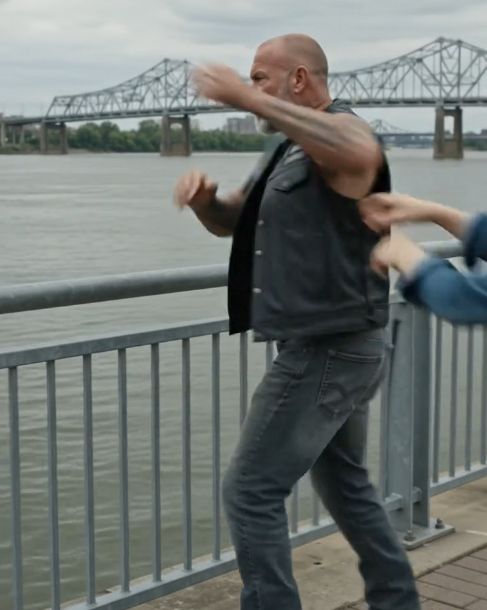
My husband, Marcus “Bear” Hale, did not watch where it landed.
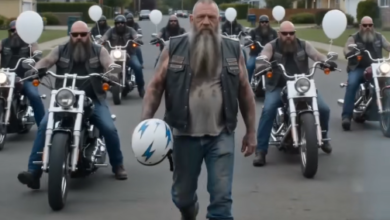
He stood six-foot-four and nearly 280 pounds, wearing faded jeans, black motorcycle boots and the plain leather cut he had owned longer than some of the riders gathered behind him. His shaved head made the scar above his left eyebrow more visible, and his gray beard moved in the wind while his tattooed hands remained strangely still.
One of those hands was wrapped from knuckles to wrist in clean white gauze.
The other was empty.
“Marcus,” I said. “What did you just do?”
He looked at me, but he did not answer.
That silence broke something open inside my chest.
We had been married twenty-eight years. That ring had been on his hand when he held our first apartment key, when he buried his mother, when he sat beside my hospital bed during sixteen rounds of chemotherapy and when he carried me into our house because my legs would not hold me after the final treatment.
Now it was at the bottom of the river.
A young couple near the railing had already raised a phone. An older woman stepped closer to me and asked whether I needed help. Behind Bear, twelve members of the Iron Ridge Riders stood beside their motorcycles, looking like a wall of leather, tattoos and uncomfortable secrets.
None of them appeared surprised.
That frightened me more than the ring.
Bear had been acting differently for six weeks. He took telephone calls in the garage. He stopped wearing his ring at night. Twice, I caught him rubbing the pale skin beneath it, then closing his fist when he saw me watching.
Three days earlier, I found a receipt from a jewelry shop folded inside his vest. The price had been blacked out. So had the description.
When I asked him about it, he said, “Saturday.”
Nothing else.
Now Saturday had come, and the man who once slept in a hospital chair for eighty-seven nights had brought me back to the same river where he proposed, removed the symbol of our marriage and discarded it in front of strangers.
“Tell me this isn’t what it looks like,” I whispered.
Bear glanced toward the riders.
One of them, Luis “Doc” Alvarez, lowered his eyes. Another man named Ransom turned away completely. I interpreted their silence the only way a terrified wife could.
They already knew he was leaving.
I stepped toward the railing, as though I might somehow see the ring through thirty feet of moving water. Bear caught my elbow with his bandaged hand.
I pulled away.
“Don’t touch me.”
Pain crossed his face, but he released me immediately.
The woman beside us began recording. Her husband pointed at Bear and said, “You throw away twenty-eight years, and that’s all you’ve got to say?”
Bear’s jaw tightened.
“You’re angry at the wrong thing,” he said.
That only made the man angrier.
I stared at the gauze around Bear’s hand. Beneath the lowest edge, I noticed a thin black cord running into his sleeve. Something solid pressed against his palm under the bandage—something he had been hiding even before we left home.
“Open your hand,” I said.
Bear did not move.
Then I saw the riders begin forming a loose half-circle behind him. Doc removed his sunglasses. Ransom reached into a saddlebag and pulled out a small wooden box.
I thought it contained divorce papers.
Bear slowly began unwinding the bandage.
What he revealed beneath it did not erase the sight of our wedding ring falling toward the Ohio River—but it changed the meaning of every secret he had kept during the six weeks before that morning.
Want to know what Bear concealed beneath the gauze and why twelve bikers helped him throw away his wedding ring? Drop RING in the comments—I’ll share more soon.
Part 2 — The Cheap Gold Ring He Refused to Replace
I met Bear in 1996 at a twenty-four-hour diner near Bardstown Road, though he was still Marcus then and weighed thirty pounds less. He worked nights repairing steel joints beneath the George Rogers Clark Memorial Bridge and arrived each morning smelling of welding smoke, river water and coffee scorched on a burner.
I was twenty-eight, divorced once and working the breakfast shift while completing bookkeeping classes at night. The first thing I noticed about Marcus was not his size or his motorcycle. It was the way he moved every sugar dispenser to the edge of the table before leaving so I would not have to reach across the booth.
He ordered two eggs, rye toast and coffee.
He tipped exactly three dollars.
For seven weeks, that was our entire relationship.
Then a drunk customer grabbed my wrist after I refused to serve him another beer. Marcus rose from the corner booth, but he did not swing a fist or make a threat. He merely stood between us, folded his thick arms and said, “She answered you.”
The man left.
Marcus sat down and finished his cold eggs.
I asked whether he always frightened people so politely. He told me only people who needed frightening. That was the first time I laughed in front of him, and it was the first time I saw his face soften.
Four months later, he took me to the Ohio River after my evening class. He had no flowers, no restaurant reservation and no speech. He parked his old Harley near the overlook, removed one glove and offered me a small velvet box stained with chain grease.
Inside were two plain ten-karat gold bands from a pawn shop.
One was slightly too large. The other carried a shallow dent near its edge. Marcus had spent three nights polishing them in his garage, but he could not remove every mark left by whoever had worn them before us.
“I can’t buy you a beginning nobody touched,” he said. “I can promise the rest is ours.”
I married him eleven weeks later.
Those cheap bands became witnesses to our life. Mine gathered scratches from file cabinets and grocery carts. His flattened along one side after a steel beam trapped his hand during a bridge repair. When the emergency-room nurse offered to cut it off, Bear refused until a coworker freed the finger with soap, ice and language I will not repeat.
He wore that ring through everything.
It remained on his hand when we lost our rented house in a flood and slept for two months inside his motorcycle shop. It remained when my father died, when Bear’s younger brother disappeared into addiction and when Iron Ridge voted Bear into the club after he spent three winters repairing older riders’ motorcycles without accepting payment.
He never became club president. He disliked speeches and distrusted men who enjoyed hearing their own voices. He became road captain instead—the rider responsible for bringing everyone home.
Before each ride, Bear counted helmets twice. If a prospect fell behind, the entire line slowed. If an older member needed to stop, Bear announced that his own motorcycle had developed a problem so no one would embarrass the man by asking questions.
His body frightened people.
His habits protected them.
For our tenth anniversary, I suggested buying better rings. By then I managed payroll for a medical equipment company, and Bear supervised a bridge-maintenance crew. We could afford something made for us rather than pawned by strangers.
He closed his fist around the old band.
“This one knows the route.”
That ended the discussion.
The ring became so closely tied to him that I noticed its absence before I noticed the changes in his face. During the first weeks of my illness, when every conversation ended with a new test or a more frightening possibility, Bear sometimes removed it while washing his hands at the hospital. He always put it back before returning to my room.
I once asked why.
“Need you to see it,” he said.
I understood. The ring meant he had not gone anywhere.
My diagnosis came three days after my fifty-third birthday. Stage III inflammatory breast cancer. The doctor explained treatment in careful sections—chemotherapy, surgery, radiation, more medication—but all I heard was the word aggressive.
Bear sat beside me with one scarred hand over mine.
His ring pressed into my skin.
When the oncologist left, I asked whether he was frightened. Bear studied the floor for a long time before answering.
“Yeah.”
That single word helped me more than false courage would have.
He did not promise I would survive. He promised I would never enter a treatment room alone.
He kept that promise for twenty-two months.
Bear learned how to drain surgical tubes, measure medication, wash my hair without tugging the thin strands and recognize when my silence meant nausea rather than fear. He slept in chairs, repaired other patients’ walkers and once threatened a vending machine after it kept my three dollars.
The Iron Ridge Riders helped in ways I did not understand until much later. Doc drove me to radiation when Bear had pneumonia. Ransom rebuilt our porch steps into a ramp without mentioning the word wheelchair. Twelve motorcycles appeared outside our house after my final infusion, their engines silent until I raised one hand from the window.
Bear stood beside me that morning.
His wedding ring was still there.
Four years later, when I heard the words no evidence of disease, he pressed that same ring against his mouth. The metal had lasted through the worst thing our marriage had ever carried.
That was why I could not understand how he could throw it away.
Part 3 — Six Weeks of Closed Fists and Locked Garage Doors
The first sign was a red line beneath Bear’s wedding ring.
I saw it one night while he washed dishes. He had pushed the band toward his knuckle, exposing a narrow circle of irritated skin. When he noticed me looking, he slid the ring back into place.
“What happened?”
“Soap.”
Bear blamed soap for another week.
Then the skin cracked.
He began wrapping his finger in a small adhesive bandage before putting the ring over it. That made the swelling worse, though he would not admit it. Each evening, I found traces of clear ointment on the bathroom sink and white flakes of dead skin beside the faucet.
“Take the ring off,” I told him.
“I’m fine.”
“You’re bleeding.”
“I’ve had worse.”
That was Bear’s answer to every injury from a cracked rib to an infected tooth. Pain became acceptable the moment he found something more serious to compare it with.
I called him stubborn.
He called me observant.
Neither of us said what the ring had represented during my treatment or why removing it frightened us both.
Two weeks later, Bear began sleeping without it. He placed the band on his nightstand beside his keys, but by morning it would be back on his swollen finger.
I woke before dawn one Tuesday and saw him sitting on the edge of the bed, turning the ring beneath the lamp. His shoulders were bent. The skin around his finger had become dark red and blistered.
“Marcus.”
He closed his fist.
That movement stayed with me.
Cancer had taught me to distrust hidden pain. A new ache could become a scan; a scan could become a telephone call; a telephone call could divide a life into before and after. When the person I loved began concealing an injury, my mind did not move toward a harmless explanation.
It went straight to loss.
Bear finally visited a dermatologist after I threatened to schedule the appointment myself. He returned with his hand wrapped and said the doctor believed he had developed contact dermatitis.
“From what?”
“They’re testing.”
“Did you tell them about the ring?”
He walked into the garage.
I followed, but he had already started the air compressor. The noise ended our conversation.
What I did not know was that the dermatologist suspected a delayed allergy to nickel in the ring’s old gold alloy. Years of sweat, welding residue and soap had slowly worn the surface. Bear’s body had tolerated the metal for decades, then stopped.
The doctor ordered him to remove it until testing confirmed the cause.
Bear refused.
Within three days, the rash spread across two fingers and into his palm. Small blisters broke beneath his gloves while he worked. He told me the gauze protected an old welding burn.
I wanted to believe him.
Then the telephone calls began.
Bear spoke quietly in the garage after dinner. If I entered, he hung up. Twice, he rode away before sunrise without telling me where he was going. Doc and Ransom started visiting while I was at work, though neither left a message.
On a Thursday afternoon, I found an envelope from Hartwell & Son Jewelers beneath Bear’s vest. Inside was a receipt for $3,840. The item description and customer notes had been blacked out with permanent marker.
My first thought was that he had purchased me something expensive.
My second was that no gift required this much secrecy.
The date on the receipt made everything worse. Bear had placed the order on the morning of my oncology appointment, three hours after the doctor confirmed I had remained cancer-free for four years.
He had barely spoken during the drive home.
I thought he was overwhelmed. Now I wondered whether my recovery had freed him from a responsibility he had carried longer than he wanted.
That thought humiliated me.
Bear had never treated me like a burden, but illness changes the way a person interprets love. Every glass of water becomes a debt. Every canceled plan becomes evidence. Every exhausted sigh can sound like regret if you already fear someone stayed only because leaving a sick spouse would look cruel.
I began watching him too closely.
He changed the passcode on his phone. He measured my ring finger while I slept—or at least I believed that was what he was doing when I woke and felt a strip of paper slide from my hand. He removed an old photograph from our bedroom, the one taken beside the river after his proposal.
When I asked where it had gone, he said Ransom needed it.
“Why?”
“Saturday.”
That word again.
The following Monday, Bear came home with his entire right hand wrapped from knuckles to wrist. He no longer wore his wedding ring.
The empty place on his finger looked obscene.
“What did the doctor say?”
“Metal.”
“What does that mean?”
He placed his keys on the counter. “Means I can’t wear it.”
I waited for the rest.
It did not come.
“Then we’ll have it coated,” I said. “Or resized. We’ll find something.”
Bear shook his head. “No more repairs.”
He meant the ring.
I heard the marriage.
That night, he slept in the garage, claiming the ointment smelled too strong. I lay awake inside our bedroom and watched the empty space where his body should have been.
The next morning, he asked me to ride with him on Saturday.
“Where?”
“The river.”
“Why?”
He looked at the bandage. “Need to finish something.”
I nearly refused.
Instead, I put on the denim jacket I had worn during our first motorcycle ride and climbed onto the Harley behind him. Bear’s body felt rigid beneath my hands. Twelve Iron Ridge riders followed us through Louisville, their engines filling the streets with a low, disciplined thunder.
No one told me why they were there.
At the waterfront, strangers turned to watch us park. Ransom carried a wooden box beneath one arm. Doc held Bear’s old proposal photograph inside a flat envelope.
Bear led me to the railing.
He removed the old ring from his vest pocket.
I began crying before he said a word.
“I can’t keep wearing something that hurts us,” he told me.
Then he threw it into the river.
Part 4 — What He Hid Beneath the White Gauze
For several seconds after Bear threw the ring, I saw only his hand.
Empty.
The pale groove around his finger was raw and swollen. Blisters had opened across the knuckle, leaving patches of shiny pink skin beneath the morning light.
I had been so focused on the disappearing gold that I had not understood what his hand was showing me.
The ring had hurt him.
Literally.
Bear turned away from the river and began unwinding the gauze. The first loop came loose around his wrist. Then another. Beneath the bandage, a black cord crossed his palm and disappeared beneath several more layers.
The man recording us accused Bear of trying to frighten me.
Doc stepped between them.
“Give him ten seconds,” he said.
Bear continued unwrapping.
His hand shook.
I had seen those hands steady a motorcycle in crosswinds, carry me from a bathtub after surgery and hold pressure over a stranger’s wound after a highway crash. I had never seen them tremble over a piece of cloth.
When the final layer fell away, two rings rested against his palm, tied to the black cord.
They were simple bands, darker than polished white gold and wider than our old rings. One was sized for Bear’s thick finger. The smaller one held a thin line of rose gold through its center.
I stared without understanding.
Bear removed the larger band from the cord.
“Medical-grade platinum,” he said. “No nickel.”
He had rehearsed more words. I could see them failing behind his eyes.
The crowd grew silent.
Bear turned the ring so I could see its inner surface. Tiny letters had been engraved inside, but my eyes were wet and the words blurred.
He handed it to me.
JUNE 18 — STILL HERE.
June 18 was not our wedding anniversary.
It was the date my oncologist had first said no evidence of disease.
The smaller ring carried the same date. Beneath it were two additional words.
STILL US.
My knees weakened.
Bear caught me with his uninjured arm, though I had told him not to touch me only moments earlier. This time I held on.
“You bought two,” I said.
His beard moved as he swallowed. “Wasn’t replacing yours without asking.”
“Then why throw the old one away?”
Bear looked toward the river.
“Because I spent six weeks trying to save it.”
The dermatologist had confirmed the allergy. A jeweler attempted to seal the old ring with a protective inner sleeve, but the aged alloy was too thin along one side. Coating could wear away. Resizing would expose more nickel. Every proposed repair created another chance for the rash to return.
Bear tried wearing the band over gauze.
He tried a silicone liner.
He tried clear medical lacquer until his skin became infected beneath it.
Doc had found him one evening inside the clubhouse bathroom, using pliers to force the swollen ring over his knuckle.
“He thought taking it off meant failing you,” Doc said.
I looked at Bear.
He did not deny it.
Ransom opened the wooden box. Inside lay our river photograph, restored and mounted above a narrow strip of darkened gold.
The strip had been cut from the inner edge of Bear’s old ring before he threw it. A jeweler had removed enough of the original metal to preserve its dents and assay marks, then sealed it behind glass where it could no longer touch his skin.
Bear had not discarded every piece.
But the ring itself had gone into the water.
Or so I still believed.
“Why make me watch you throw it?” I asked.
His voice dropped. “Because cancer kept making us save painful things just because they’d been with us a long time.”
I pulled away far enough to see his face.
Bear glanced at the surgical scar beneath the neckline of my shirt, then immediately looked back into my eyes.
He was not speaking about my body.
He was speaking about fear.
During my treatment, we had saved pill bottles long after they emptied. Appointment cards filled a kitchen drawer. Bear kept every hospital wristband, every parking receipt and even the shoes I wore during my final infusion.
We called those objects proof.
In truth, some had become anchors.
The old wedding ring had joined them. Bear continued wearing it because it had survived my cancer, as though removing it might tempt the disease to return or insult the years it represented.
“The ring didn’t keep me alive,” I whispered.
Bear nodded. “You did that.”
“My doctors helped.”
“Yeah.”
“You helped too.”
His eyes lowered.
The woman who had offered to protect me stopped recording. Her husband put his phone into his pocket.
Bear held out the smaller new ring. He did not place it on my finger.
“Ellen Hale,” he said, his voice rougher than the river wind, “I stayed because I chose you. Sick. Well. Angry. Scared. I’m asking again.”
“Are you proposing to your own wife?”
“Looks that way.”
“You threw your ring into a river before asking?”
“That part went better in my head.”
Laughter moved through the riders, quiet and relieved. Even I laughed, though tears were running down my face.
Then Bear turned the new ring again.
Along the outside edge, almost invisible until the light struck it, the jeweler had copied the shallow dent from our original pawn-shop band.
The scar remained.
Only the metal had changed.
I held out my hand.
Before Bear could slide the new ring onto my finger, a small boy near the railing pointed toward the river and asked the question none of the adults had considered.
“Did that biker just litter?”
Bear closed his eyes.
Ransom coughed into one fist.
Doc smiled for the first time that morning.
“Not exactly,” he said.
Part 5 — The Brother Waiting Beneath the Bridge
Thirty feet below us, a small maintenance boat drifted beside the bridge pilings.
I had seen it when we arrived but paid no attention. Louisville’s waterfront always carried work crews, patrol boats and fishermen. This boat looked ordinary except for the man standing near its stern in an orange safety vest over a black leather cut.
His name was Walter “Mack” Dugan, a retired commercial diver and the oldest member of Iron Ridge.
He held a long-handled net.
Bear had not thrown the ring blindly. The old band was attached to nearly invisible fishing line, the same black cord that had held the new rings beneath his bandage. The line passed over the railing and down toward Mack’s boat.
The dramatic flash had been real.
The disappearance had not.
Mack raised the net. Something gold glinted inside.
The little boy near us cheered.
“You cheated,” I told Bear.
“Planned.”
“You let me believe it was gone.”
“For eleven seconds.”
“It was longer than eleven.”
Doc checked his watch. “Twenty-three.”
Bear glared at him.
That was the closest Iron Ridge came to laughter while I was still deciding whether to kiss my husband or push him into the river after the ring.
Mack brought the old band ashore fifteen minutes later. Water darkened his sleeves, and his gray ponytail had escaped its tie. He placed the ring inside the wooden box beside the sealed strip of gold.
Bear looked confused.
“I thought we agreed to melt it.”
Mack shrugged. “You agreed. I didn’t.”
The Brotherhood had voted without Bear to preserve the original ring. Ransom intended to mount it behind the restored proposal photograph inside a clear case. The metal could remain part of our home without touching Bear’s skin.
I ran my thumb over its battered edge.
The rash had left dried blood inside the band. That sight hurt more than watching it fall. Bear had continued forcing the ring onto an infected finger because he believed endurance proved devotion.
I knew something about that mistake.
During chemotherapy, I had hidden symptoms from Bear because I did not want another treatment delayed. I smiled through fevers, lied about numbness in my feet and once collapsed beside the washing machine after insisting I could manage the stairs alone.
Bear had been furious.
“You don’t protect me by getting hurt in private,” he told me then.
Now I repeated his own words.
He studied the pavement.
“Sounds smarter when you say it.”
“No, it sounds exactly as irritating.”
The twelve riders remained nearby, pretending not to listen. They inspected mirrors, adjusted gloves and examined motorcycles that did not need attention.
I asked when they had learned about the rings.
Six weeks earlier, Bear had shown Doc the rash after his hand swelled during a club ride. Doc was a former Navy corpsman—not a dermatologist, despite his road name—but he recognized that the metal might be causing the reaction.
Bear swore him to secrecy.
Doc kept the promise for forty-eight hours, then told Ransom because Bear needed someone to recommend a jeweler. Ransom told Mack because they needed the original ring photographed and measured. Mack told the club treasurer because Bear’s plan became more expensive each time he attempted to add something.
Within a week, every Iron Ridge member knew.
Nobody told me.
“I thought you were helping him leave me,” I said.
Twelve large men suddenly looked interested in the river.
Ransom cleared his throat. “We’re not good at normal secrets.”
“What is a normal secret?”
“Surprise birthday. Christmas gift. Things where nobody throws jewelry.”
Bear accepted the criticism without defending them.
The jeweler had been involved too. Samuel Hartwell, seventy-one, had recognized Bear because his own wife received treatment at the same cancer center. She had died two years before my diagnosis.
When Bear requested the engraved date, Samuel asked why it was not our anniversary.
Bear answered, “It’s the day we got more anniversaries.”
Samuel reduced the price, though Bear refused to accept the discount. The amount on the receipt included both rings, the restoration of our photograph, the platinum allergy testing and a contribution Bear made toward a ring Samuel was crafting for another cancer survivor who could not afford it.
That explained the blacked-out description.
It did not explain the passcode on Bear’s phone.
He pulled the device from his vest and handed it to me. The new code was June 18. Inside were photographs of ring designs, medical articles about nickel allergy and eleven failed recordings of the speech he had tried to make beside the river.
In the first recording, Bear looked directly into the camera and forgot my name.
In the second, he said, “Ellen, twenty-eight years is—” before swearing and stopping.
In the fifth, a motorcycle started outside the garage and drowned out every word.
In the final attempt, he sat alone beneath one work light, his infected hand unwrapped on the table.
“I don’t know how to ask her to marry me when she already did,” he said to the camera. “I just need her to know I ain’t thanking her for surviving. That makes it sound like she did it for me. I’m asking what we do with the time she fought to keep.”
The recording ended there.
I returned the phone.
“That was the speech,” I said.
Bear shook his head. “Wasn’t finished.”
“It is now.”
Ransom handed Bear the smaller platinum ring. Bear held it before me once more, waiting.
I let him wait long enough to understand that twenty-three seconds could feel cruel.
Then I said yes.
He slid the ring onto my finger.
I placed the larger ring on his healed left hand, careful not to touch the irritated skin. It fitted perfectly.
The Iron Ridge Riders did not cheer. Bear would have hated that. They started their motorcycles one by one, letting the low V-twin rhythm fill the space where strangers had expected a marriage to end.
Before we left, I looked at the people who had filmed us.
The older woman apologized. Her husband offered to delete his video.
I asked him to send it to me first.
He had captured the ring falling, my face breaking and Bear unwrapping the gauze. He had also captured the moment every rider lowered his phone rather than turning our marriage into public entertainment.
I wanted that part.
Not because it made the misunderstanding harmless.
Because it showed exactly how love had looked from the outside: brutal, careless and final—until the bandage came away.
Part 6 — The Date Inside the New Metal
Bear’s hand took another month to heal.
The dermatologist ordered him to keep the new ring off until the broken skin closed completely. Bear protested until I threatened to wear mine on a chain too.
For four weeks, both platinum bands hung together from the black cord around my neck.
Every morning, Bear checked that they were still there. Every evening, I checked his palm for blisters. Neither of us called those gestures romantic. They were simply what remained after fear stopped pretending to be strength.
The old ring returned from Hartwell & Son inside a sealed shadow box. Samuel mounted it beneath our river photograph, with the preserved strip of gold below it. The original band looked smaller behind glass than it had on Bear’s hand.
Its importance had never come from its size.
Ransom hung the box in our hallway. Bear wanted it in the bedroom, but I chose the wall beside the front door where we would see it whenever we left home and whenever we returned.
Under the ring, Samuel installed a brass plate.
It did not carry our wedding date.
It read:
WHAT HURTS MAY STILL BE HONORED.
I worried the sentence sounded too polished for Bear.
He admitted Samuel wrote it.
“I said, ‘Keep the old stuff without letting it eat your hand.’”
“That sounds more like you.”
We added Bear’s version to the back.
The video from the waterfront circulated farther than I expected. Someone had posted the first eighteen seconds, ending immediately after Bear threw the ring. Without the remainder, it looked like a tattooed biker publicly discarding his marriage while his friends watched.
Comments called him cruel. Some called me weak for crying. Others invented affairs, secret families and club rituals that did not exist.
Bear refused to respond.
“People like the wrong story,” he said.
I persuaded the man who recorded the scene to upload the complete video. It showed the bandage, the platinum rings and Mack’s boat retrieving the original band. The public anger shifted into praise almost as quickly as it had formed.
Bear distrusted that too.
“They didn’t know me when they hated me,” he said. “Don’t know me now.”
Still, something useful came from the attention. Samuel received dozens of requests from people whose old rings caused allergic reactions after years of comfortable wear. Several were cancer survivors whose treatment had altered their skin sensitivity. Others had tolerated nickel until age, moisture or damage exposed more of the alloy.
Bear agreed to one interview, but only if the dermatologist and Samuel explained the medical details.
When the reporter asked what lesson he hoped strangers would learn, Bear looked toward me.
“No lesson,” he said. “Get a rash checked.”
That line appeared beneath his photograph.
Iron Ridge printed it on a coffee mug and presented it to him at the clubhouse. Bear threw the mug at Ransom. Ransom caught it, filled it with coffee and returned it the following week.
The club also created a small fund through Samuel’s shop to help couples replace rings that could no longer be worn safely. They named it New Metal.
Bear objected to the name.
He lost the vote.
On June 18, one year after the river scene, the twelve riders gathered outside the cancer center. They carried no signs and made no speeches. Each man wore a narrow black cord around one wrist.
Bear and I walked through the front doors together.
Inside the infusion room, we met three patients receiving replacement rings through the fund. One was a sixty-eight-year-old widow who wanted her late husband’s band reshaped into a pendant because arthritis had swollen her fingers. Another was a young father whose chemotherapy made his skin react to the inexpensive ring he had worn since college.
The third was a woman named Carolyn.
Her husband had died before her treatment ended. She carried both their rings inside a pill bottle because she feared losing them. Samuel placed the bands into a small sealed frame she could keep beside her bed.
Carolyn asked Bear whether throwing his ring had been difficult.
He considered the question.
“Letting go was easy,” he said. “Knowing what to keep took longer.”
That evening, we returned home and stood before the shadow box. Bear touched the new ring on his finger, then the glass covering the old one.
No allergy.
No open skin.
Nothing discarded.
Only changed.
Part 7 — The Ride Back to the River
Two years after Bear threw his wedding ring from the overlook, Iron Ridge returned to the Ohio River for our thirtieth anniversary.
There were no strangers waiting with phones that morning. Only twelve motorcycles, Samuel Hartwell, Mack’s maintenance boat and a small group of people whose rings had been replaced through New Metal.
I wore the same denim jacket.
Bear wore the same leather cut, though his beard had become whiter and the scar above his eyebrow seemed deeper. The platinum ring remained on his left hand without redness, swelling or gauze.
Inside it, June 18 was still legible.
He parked beside the railing and killed the Harley. The engines behind us went quiet in sequence until the river became the loudest thing we could hear.
“Not throwing this one,” I said.
“Wasn’t planning to.”
“You weren’t planning to throw me in either, were you?”
Bear looked toward Mack’s boat below. “Net’s too small.”
I struck his arm.
The gathering was not a second wedding. We had already repeated our vows privately in Samuel’s jewelry shop on the day Bear’s hand healed. The only witnesses had been Samuel, Doc and the store’s elderly security guard, who slept through most of it.
This gathering was for the date inside the rings.
June 18.
Still here.
Samuel had made a narrow metal capsule from the harmless outer portion removed during restoration of Bear’s old band. Inside it, we placed copies of two pieces of paper: my final chemotherapy schedule and the dermatologist’s warning that Bear must stop wearing the original ring.
One document marked the end of treatment.
The other marked the end of needless endurance.
Mack secured the capsule beneath a new bench overlooking the river. Nothing entered the water this time. The old gold remained above it, sealed beneath the seat where strangers would rest without knowing what it meant.
Bear tightened the final bolt.
Carolyn sat on the bench first. The framed rings of her late husband rested inside her bag. Beside her sat the young father from the cancer center, his medical-grade band catching the morning light.
No speeches were planned.
Ransom attempted one anyway.
He stood before the motorcycles holding several folded pages. Bear stared at him until he returned them to his pocket.
“Fair,” Ransom said.
Doc passed around coffee. Samuel showed me photographs of seven more completed rings. Mack pretended he had not carved three tiny words beneath the bench.
I found them when I bent to inspect the capsule.
STILL ON ROUTE.
Bear claimed he disliked the phrase.
He traced it twice with one finger.
Before we left, I walked with him to the railing. The river moved below us with the same heavy current that had swallowed the old ring for twenty-three frightening seconds.
“I truly thought you were leaving,” I told him.
“I know.”
“You could have explained before throwing it.”
“Would’ve ruined the surprise.”
“It nearly ruined your face.”
Bear nodded. “That part I understood.”
I took his left hand. The new ring felt cool against my palm, its copied dent resting beneath my thumb. It did not pretend the old metal had never existed. It carried the scar forward without carrying the harm.
Behind us, motorcycles began to start.
Bear looked toward Iron Ridge and counted every rider, an old habit he never abandoned. Twelve helmets. Twelve machines. Samuel and Carolyn in a car. Mack walking toward the dock.
Then he counted me.
“Everybody here,” he said.
We climbed onto the Harley. I wrapped my arms around his waist and placed my ringed hand over his.
Bear led the riders away from the river, not toward a new life or a clean beginning, but back into the same imperfect marriage we had already chosen through sickness, silence, misunderstanding and time.
The old ring remained behind glass near our front door.
The new rings traveled with us.
Follow our page for more powerful biker stories about misunderstood actions, enduring marriages and the quiet promises hidden beneath leather, scars and bandages.