A Biker Threw a Veteran’s Prosthetic Leg From a Mountain Cliff — Then the Entire Club Looked Down and Saw What Waited Below
Hammer lifted my prosthetic leg above his head and threw it over the mountain railing while thirty veterans watched, leaving me seated on the ground with one leg and no way to stand.
For two seconds, nobody moved.
Then everyone started shouting.
My name is Marcus Reed. I was forty-eight years old, a former Army staff sergeant, and the left leg Hammer threw into that Colorado canyon had been part of me for almost twelve years.
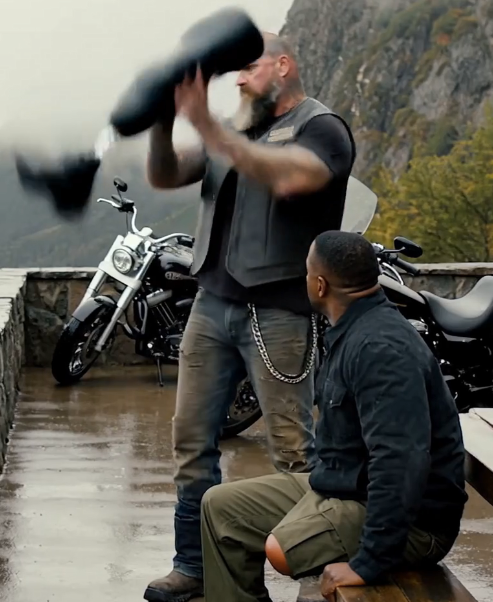
It carried scratches from airports, machine shops, hospital corridors, motorcycle rallies, and every place where strangers stared before deciding whether to look away.
I had crossed finish lines on it.
I had stood beside friends’ graves on it.
I had learned to ride again because of it.
Ray “Hammer” Dawson knew all of that.
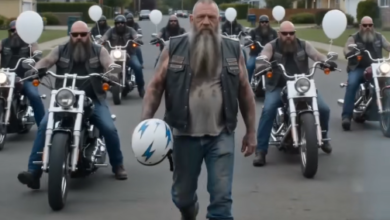
He was fifty-six, six feet four inches tall, and close to 285 pounds, with tattooed forearms, scarred knuckles, a shaved head, and a long salt-and-pepper beard. His plain leather vest made him look harder than he was, though at that moment, I did not care what kind of man hid beneath it.
I wanted to hit him.
We had stopped at a veterans’ retreat along the San Juan Mountains outside Durango after completing the safest section of a memorial ride. Rain had passed an hour earlier, leaving the stone path damp and the mountain air cold enough to sting my lungs.
I stepped from my three-wheeled Harley and felt the prosthetic shift.
A small click came from beneath the socket.
Hammer heard it.
He knelt before I could stop him, placed two scarred fingers against the supporting section, and asked me to sit on a nearby bench.
“I’m fine.”
“No.”
“You a prosthetist now?”
“No.”
“Then move.”
He did not.
Several veterans gathered around us. Boone Mercer crouched beside Hammer while Leon Brooks steadied my shoulder. Beneath the wind and the ticking engines, Hammer asked me to remove the prosthesis so he could examine it without loading my weight onto it.
I refused twice.
Then the device clicked again.
Louder.
I removed it.
Hammer ran his thumb along a line near the connection point. It looked like a scratch, one of hundreds. He asked when it had appeared.
I lied.
“Today.”
He looked at me.
“Marcus.”
“Couple weeks.”
The muscles in his jaw tightened.
A certified prosthetist had warned me months earlier that the aging assembly needed replacement. Insurance covered part of the cost, but not enough. I had continued using it while appealing the decision because veterans become skilled at pretending delay is not the same thing as denial.
Hammer stood with my prosthetic in both hands.
“Give it back.”
“No.”
“You don’t get to decide that.”
“You walk on this again, it may decide for you.”
Then he turned toward the overlook.
Boone understood first.
“Hammer, don’t.”
I pushed myself upright against Leon, balancing on my remaining leg while fury burned hotter than the pain in my hip.
“Ray.”
He looked back once.
Then he threw.
The prosthetic passed over the railing, rotated beneath the gray sky, and vanished from sight.
I lunged toward him.
Leon caught me before I fell. Veterans rushed Hammer. A Gold Star father called him a disgrace. One woman pulled out her phone while another demanded someone retrieve the leg.
Hammer did not defend himself.
He simply pointed down.
The overlook stood above a lower terrace accessible by a switchback path. Thirty feet below us, club members had stretched a recovery net between two railings. My old prosthetic lay inside it, undamaged by the fall.
Beside the net stood Maya Patel, the certified prosthetist who had fitted me for what I believed was only a temporary repair trial.
At her feet rested a black case.
My name was attached to it.
Hammer had not thrown away my ability to walk.
He had thrown away my last excuse to keep trusting something already breaking beneath me.
But the new prosthesis inside that case was not the largest secret the Iron Lanterns had kept. Beneath its polished socket, the club had engraved the names of thirty-one people who had each surrendered something to pay for it.
One name belonged to a dead man.
Hammer’s younger brother.
The medic who had once kept me alive long enough to lose only one leg.
Want to know what Hammer’s brother did for me and what the club sacrificed to buy the replacement? Drop STEP in the comments — I’ll share more soon.
Part 2 — The Leg I Refused to Retire
I lost my left leg outside Kandahar when I was thirty-six.
People often ask what happened with the careful curiosity reserved for injuries they can see. I give them the short answer.
A vehicle was hit.
I survived.
The details belong to the men who were there and the families of those who did not return.
What mattered afterward was the silence.
Hospitals are never truly quiet, but there is a silence that settles inside a person when everyone has finished explaining what is gone. Doctors discussed healing. Therapists discussed strength. Visitors discussed gratitude as if survival were a debt I had to repay by appearing optimistic.
My wife, Denise, discussed practical things.
Rent.
Stairs.
Our daughter’s school recital.
Whether the bathroom door needed widening.
She never asked me to feel lucky.
That saved us.
The first prosthesis hurt. The second fit better. The third became the leg Hammer later threw over the railing.
It was not the most advanced device available, but it was dependable. Its socket had been revised several times as my body changed. The exterior showed wear from a decade of work, travel, and stubbornness.
I became attached to it in ways I did not admit.
It was present when I first stood without parallel bars. It carried me into my daughter Kayla’s high-school graduation. It rested beside the bed when Denise died from a brain aneurysm seven years after I came home.
That night, I sat on the floor with the prosthetic beside me because I could not make myself put it on.
Three days later, I wore it to her funeral.
Machines acquire meaning when they remain through human absence.
That does not make them immortal.
Maya Patel had told me the assembly needed replacing. She was direct without being cruel, which made her difficult to ignore.
“The materials have a service history,” she said. “Wear does not become harmless because it is familiar.”
She showed me areas requiring monitoring. She adjusted the fit and submitted documentation. Insurance approved portions of a replacement but left expenses beyond what I could manage without draining the savings intended for Kayla’s nursing program.
I postponed.
Then I postponed again.
I told Maya I would limit difficult terrain. I told Kayla the clicking sound came from a loose cosmetic cover. I told myself a veteran who had survived Afghanistan could manage one aging piece of equipment.
Pride sounds reasonable when it uses your own voice.
I met Hammer through the Iron Lanterns’ veteran rides. I had adapted my Harley into a stable three-wheel touring setup and returned to riding after years away. The club did not treat the motorcycle as therapy or advertise my participation as inspiration.
They checked whether I needed space to mount.
Then they complained that I drank their coffee.
That was enough.
Hammer and I argued from the first day.
He rode at the front with the discipline of a man who viewed every mile as a responsibility. I questioned his route choices. He questioned my maintenance habits. We agreed on little beyond safe spacing, strong coffee, and the uselessness of speeches delivered beside folding chairs.
I did not know he had been watching my gait.
He noticed when I shortened my stride at the end of rides. He saw me use the motorcycle seat to unload pressure from the socket. During one stop near Santa Fe, he heard the first faint click.
“Get it checked.”
“It was checked.”
“Get it checked again.”
“You paying?”
He went quiet.
I believed I had won.
I had given him an idea.
Part 3 — The Brother Whose Name I Had Buried
Hammer’s younger brother was named Thomas Dawson.
We called him Doc, though he was an Army medic rather than a physician. He was twenty-nine when our convoy was hit and still had the ability to sound annoyed while working inside chaos.
I remembered his hands.
Steady.
That was the detail that returned in dreams. Not the noise or smoke. His hands pressing where they needed to press, checking my breathing, speaking in short instructions while other soldiers established security.
“Stay with me, Reed.”
“I am.”
“That wasn’t a request.”
He kept talking until evacuation arrived.
Thomas came home seven months later. We exchanged occasional messages but never became close in civilian life. That happens more than people understand. Someone can occupy the most important hour of your existence and still remain outside your daily world.
He died in a motorcycle collision six years later.
A pickup entered an intersection against the light outside Tucson. Thomas had no time to avoid it.
I attended the funeral but did not meet Hammer.
There were too many people. Too many uniforms. Too many relatives receiving stories about Thomas from strangers who knew versions of him they had never seen.
I left his unit coin beside the guest book.
Hammer kept it.
Years later, he recognized my name on an Iron Lanterns registration form. He did not tell me about Thomas immediately. He watched me ride three events before introducing himself properly.
“My brother called you Reed,” he said.
Many men had called me Reed.
Then he placed the unit coin on the table.
The room became smaller.
“You’re Thomas’s brother.”
“Yeah.”
“He saved my life.”
“He said you pulled two men from the vehicle before he reached you.”
“That doesn’t change what he did.”
“No.”
That was the beginning of our friendship.
Neither of us wanted gratitude to become its foundation. I refused to let Hammer repay his brother’s actions, and he refused to pretend Thomas’s death erased every obligation he felt toward the men who served beside him.
We compromised by arguing about motorcycles.
When he learned about the prosthetic replacement, he called Maya without my permission. She disclosed nothing until I gave written consent for him to participate in financial planning.
I did so because I wanted him to understand the cost and stop asking.
He understood the cost.
He did not stop.
The club created a fundraiser under the ordinary name Mountain Mobility Project. They never used my photograph. They never mentioned combat, loss, or any private medical details.
The Iron Lanterns sold spare parts, restored an old touring bike for auction, worked weekend repair shifts, and contributed from their own savings.
Leon sold a guitar he had owned since college.
Boone gave up the down payment he had saved for new exhaust pipes.
Cutter, who rarely donated anything without complaining, surrendered a collection of vintage fuel caps and spent two months pretending he had always hated them.
Hammer sold Thomas’s Harley.
That was the secret no one wanted to tell me.
The motorcycle had been repaired after the crash, though Hammer never rode it. It remained beneath a cover in the rear of his shop, cleaned twice a year and started every spring.
Selling it produced enough to close the remaining gap.
When I learned that later, anger returned.
“You had no right to sell your brother’s bike because of me.”
“It was mine.”
“That isn’t the point.”
“No,” Hammer said. “The point is it was built to move. It hadn’t moved in six years.”
He kept one piece.
A narrow metal badge from beneath the seat, bearing Thomas’s initials.
Maya incorporated it inside the new prosthetic’s cosmetic cover where it would not affect structure, safety, fit, or function.
I would not discover it until the mountain.
Part 4 — The Plan Beneath the Overlook
A prosthesis cannot be purchased like a pair of boots.
Measurements matter. Alignment matters. Socket fit changes with the body. Components must match the user’s needs, activity, weight, gait, and environment. Adjustments require trained professionals.
The Iron Lanterns did not build my leg.
They paid the portion that stood between me and the device Maya’s clinical team had already prescribed, fabricated, fitted, tested, and approved.
The surprise was ownership.
Not medicine.
Maya scheduled what she called a series of repair assessments. During those visits, she scanned my residual limb, evaluated my gait, made trial adjustments, and fitted a temporary test socket. I assumed she was gathering evidence for another insurance appeal.
Partly true.
She was also completing the replacement.
“You lied to me,” I told her later.
“I answered every clinical question honestly.”
“You let me think it was a loaner.”
“I let Hammer manage his surprise. I managed your care.”
“Did you know about the cliff?”
Her expression tightened. “I knew about a controlled retirement demonstration involving a recovery net on private property. I did not approve any unsafe stunt.”
That distinction mattered.
The veterans’ retreat outside Durango owned the overlook and lower terrace. Club members received permission to use the area, closed the connecting path temporarily, and installed the recovery net under staff supervision.
The old leg was never thrown into an open wilderness area.
It fell thirty feet into a secured net.
No littering.
No risk to anyone below.
The new prosthesis waited inside its protective case on the lower terrace with Maya and a physical therapist present. A wheelchair and crutches were also available. Nobody expected me to descend without proper support.
It was elaborate.
It was also unnecessary.
Hammer could have handed me the new leg inside a clinic.
I asked why he chose the mountain.
His answer came later.
“Because you would’ve kept the old one in your closet.”
He was right.
“You would’ve worn it again,” he continued.
Possibly right.
“You needed to watch it leave your hands.”
That part angered me.
He was turning my attachment into theater.
But Hammer had asked me a question two months earlier after the prosthetist warned me again.
“What will make you stop wearing it?”
“When it breaks.”
“That may be too late.”
“Then take it from me first.”
I had spoken sarcastically.
Hammer heard permission.
Not legal permission to do anything he wanted. Not moral permission to humiliate me. But enough of an opening for a man who understood direct gestures better than careful conversations.
The club debated the plan.
Leon called the throw disrespectful.
Boone called it memorable.
Maya called it acceptable only if the old leg was removed voluntarily, declared unsafe after inspection, and recovered without damage.
Hammer agreed to every condition.
On the mountain, I removed the prosthesis myself.
That detail disappeared from the first video.
The clip started with Hammer holding it.
From the camera angle, it looked as though he had ripped the leg from my body and thrown it into a canyon.
By evening, strangers online accused him of attacking a disabled veteran.
Some threatened his repair shop.
Irony travels quickly.
The same men who had spent months paying for my new leg now appeared to have destroyed the old one out of cruelty.
Hammer refused to release my medical information to defend himself.
He waited for me.
Part 5 — The Case With My Name on It
Leon supported me to the switchback entrance. A wheelchair waited there, but I chose crutches because anger made me unwilling to sit.
The lower terrace lay thirty feet beneath the overlook and less than two hundred yards along a graded path. By the time I reached it, my shoulders burned.
Maya stood beside the black case.
My old prosthesis rested inside the recovery net. She had already examined it without loading it.
“The visible line is a structural crack,” she said. “You do not use this again.”
I looked at Hammer.
He said nothing.
Maya opened the case.
The new prosthesis was not flashy. No patriotic paint. No eagle, flag, or slogan. I had rejected decorative designs during what I believed were test fittings.
Its socket matched the final trial shape. The components had been selected for stability, varied terrain, and my everyday needs. The exterior was dark graphite with one narrow silver line.
Thirty-one names had been engraved inside the removable cosmetic cover, where they would remain private during ordinary use.
The names belonged to contributors who chose to be listed.
Leon Brooks.
Boone Mercer.
Maya Patel.
Employees from Dawson Heavy Repair.
Veterans from the retreat.
At the bottom appeared Thomas Dawson.
“That isn’t fair,” I said.
Hammer finally spoke. “What isn’t?”
“He didn’t pay for this.”
“He put you on the helicopter.”
“That was his job.”
“Yeah.”
“You sold his motorcycle.”
“Yeah.”
“To pay for me.”
“To pay for part of a leg.”
“It’s the same thing.”
“No.”
His refusal to enlarge the gesture made it heavier.
I touched Thomas’s initials inside the cover. The small badge from his Harley rested behind them, sealed away from any functional component.
Maya completed the fitting.
She checked the socket, alignment, comfort, and movement. Adjustments took nearly an hour. The crowd waited without pushing me to stand.
When Maya approved, I rose between parallel support rails installed on the terrace.
The first step felt unfamiliar.
New devices do not become part of a person in one dramatic moment. My weight shifted differently. The knee response felt controlled but new. Muscles accustomed to compensating had to learn another pattern.
I took three steps.
Stopped.
Took two more.
Hammer remained outside the rails.
“You going to catch me?” I asked.
“If you ask.”
“I’m not asking.”
“Then no.”
I reached the end.
A cheer began behind us. I raised one hand.
Silence returned.
I did not want applause for walking. I had walked for years. The achievement belonged to the people who built, fitted, funded, and safely delivered the device—not to an inspirational version of me strangers preferred.
I turned toward Hammer.
“Retrieve the old leg.”
“It’s unsafe.”
“It’s still mine.”
He nodded.
That answer repaired something.
The club carried the old prosthesis back in its case. I decided where it went.
Not Hammer.
Not the internet.
Me.
Both things could remain true: he protected me from a dangerous failure, and he crossed a line by making the decision public before I understood the full plan.
Brotherhood survived because he accepted both.
Part 6 — The Piece That Did Not Go on the Wall
Back in Flagstaff, Hammer offered to display the cracked prosthesis in the clubhouse.
I refused.
My old leg was not a trophy, warning sign, or inspirational artifact. It had been part of my private life and carried medical wear no stranger needed to examine over drinks.
I asked Maya’s team to remove any components eligible for responsible recycling. The cracked structural section could not be reused.
I kept the socket.
It sat in my garage for six months before I understood Hammer had been right about one thing: if the entire device had remained usable, I might have tried wearing it again.
Eventually, I cut a small nonstructural section from the exterior shell with help from a qualified technician. We mounted that harmless piece inside a plain wooden box.
No photographs.
No story card.
Only one sentence:
FAMILIAR IS NOT THE SAME AS SAFE.
The box stayed in my workshop, not the clubhouse.
The Iron Lanterns turned the fundraiser into the Second Step Fund. It helped veterans and other riders cover mobility expenses, transportation to fittings, temporary lodging near clinics, and other costs not fully covered elsewhere.
The club never selected components or gave medical advice.
Professionals did that.
The bikers carried boxes, organized fundraisers, repaired vans, and learned when to stay out of decisions that belonged to patients.
Hammer attended every planning meeting.
He spoke less than anyone.
During the first year, the fund assisted four people. None received a public surprise. Every recipient controlled what information was shared and how equipment was presented.
Leon made that rule.
I supported him.
Hammer did too.
Brotherhood learns if it is worthy of the name.
Part 7 — The Step Beyond the Guardrail
Three years after Hammer threw my old leg, we returned to the veterans’ retreat.
The recovery net was gone. The lower terrace remained, bordered by stone, grass, and the same guardrail where the first video had been recorded.
My new prosthesis had required adjustments over the years. Sockets change. Bodies change. Good care continues after the emotional reveal ends.
Maya remained my prosthetist.
She still disliked Hammer’s cliff idea.
He still called it a controlled demonstration.
I called it both generous and ridiculous.
The Iron Lanterns parked above the terrace and shut down their engines. Mountain wind moved through the pines while hot metal ticked beneath us.
Hammer approached with two cups of coffee.
“You hear any cracks?” he asked.
“No.”
“Clicks?”
“No.”
“Lies?”
“Plenty.”
He handed me the coffee.
We walked toward the overlook. My stride was not perfect. It did not need to be. I used the railing where the path narrowed and rested before the incline.
Hammer adjusted his pace without announcing it.
At the lower terrace, a young Marine waited with his wife and a certified prosthetist. The Second Step Fund had covered travel and lodging while his new device was fitted.
No crowd surrounded him.
No motorcycles formed a dramatic background.
We introduced ourselves, placed the supply envelope in his hand, and stepped away.
He did not owe us his story.
That was the part we had finally learned.
On the climb back, I stopped beside the recovery point where my old prosthesis had landed.
“Thomas would’ve laughed,” I said.
“At the throw?”
“At me trying to chase you on one leg.”
Hammer looked toward the mountains.
“He laughed at most things.”
“Not when he worked.”
“No.”
The steadiness of Thomas’s hands returned to me. Then the memory loosened, allowing other details through—his bad jokes, exhausted eyes, and the way he complained about sand entering everything he owned.
A human being again.
Not only the medic from my worst hour.
At the motorcycles, Hammer started his Harley. The V-twin settled into a deep rhythm while the other riders prepared to leave.
I mounted my trike.
My prosthetic held.
We rolled down the mountain in a disciplined line, leaving enough space for every rider to choose his own road.
Nothing waited in the canyon now.
Follow our page for more unforgettable biker stories about wounded veterans, misunderstood gestures, tested brotherhood, and the quiet sacrifices hidden beneath the roar of every ride.