A Biker Smashed Through My Storefront on a Crowded Saturday—Then I Realized Who Was Trapped Inside and Why He Owed Me Nothing
The biker brought a steel tire iron through my shop window at 12:17 on a crowded Saturday, and while half of downtown screamed that he was robbing me, I was the only man there who knew I had given him a reason to hate me.
The sound was not like glass breaking in a movie. It was heavier. Meaner. The first blow made the front window of Bell & Finch Jewelry Repair bow inward without giving way, and the second punched a white spiderweb through the painted gold letters my father had put there thirty-eight years earlier. People on Franklin Street scattered from the sidewalk. A woman dropped her paper cup. Someone shouted for the police. Three phones rose above the crowd before a single person asked why the man was doing it.
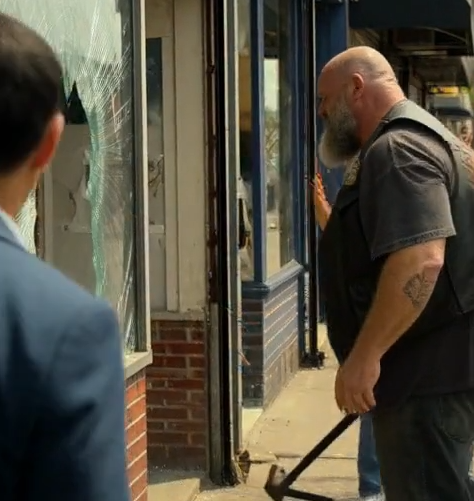
I stood across the street holding a white takeout bag and the keys that could have opened that door.
And for perhaps three terrible seconds, I believed he had come back for revenge.
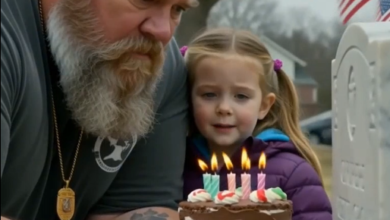
He was impossible to mistake for anyone else. Six feet four, close to 280 pounds, shaved head, thick salt-and-pepper beard, faded black T-shirt, scarred motorcycle boots, and a weather-beaten leather cut stretched across shoulders wide enough to block half my window. Dark ink ran from both wrists to beneath his sleeves. A bent silver skull ring flashed each time he raised the tire iron. Behind him, parked crooked against the curb, a black Harley Road King ticked as its engine cooled.
The name stitched above the left pocket of his cut read WADE.
I already knew that name.
Twenty-six minutes before he shattered my window, I had ordered Wade Mercer out of my store.
But the people gathering around him did not know that yet. They saw a huge biker attacking a locked jewelry shop while its owner was absent. They saw watches in illuminated cases, velvet trays beneath the counter, and a man who looked exactly like the warning their parents had given them about strangers.
What they did not see was the thin gray ribbon of smoke curling along the ceiling behind the display lights.
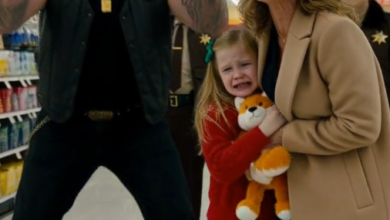
They also did not know that my eight-year-old granddaughter, Lily, was still inside.
I wish I could tell you I understood everything the instant I saw that smoke. I did not. Fear rarely arrives as a clean thought. It comes as pieces: the takeout bag slipping from my hand, a container of tomato soup bursting open on the pavement, my keys cutting into my palm, and the memory of Lily sitting in the back office with purple headphones over her ears.
Then Wade struck the window again.
A man in a University of Tennessee sweatshirt grabbed his shoulder. “Hey! Get away from there!”
Wade twisted free without swinging at him. That mattered later. At the time, all I saw was an enormous man turning fast enough to make everyone step back.
“There’s a kid inside!” he roared.
Nobody moved.
The man in the sweatshirt stared at him as if that sentence were part of the robbery. A young woman beside the bus stop kept filming. Someone behind me said the biker probably had an accomplice inside. Another person shouted that police were coming. On the corner, the pedestrian signal chirped steadily, absurdly cheerful above the confusion.
I pushed off the curb.
“That’s my shop!” I yelled. “That’s my granddaughter!”
My voice disappeared beneath the next impact.
The tempered glass finally fractured into thousands of dull squares, but the security laminate held them together like ice on a frozen pond. Wade dropped the tire iron, pulled a small orange rescue punch from a pouch on his belt, and drove it into the lower corner. The pane sagged. He seized the edge with both hands and pulled until a section tore away from the frame.
Blood appeared across his right palm.
He did not look at it.
Wade stripped off his leather cut, draped it over the jagged sill, and shoved his shoulders through the opening. The broken pane scraped across the back of his shirt. People screamed at him to stop. The man in the orange sweatshirt raised his phone and said he had Wade’s face recorded.
Wade looked back only once.
“Call the fire department,” he said. “Tell them smoke, child trapped, rear room.”
Then he disappeared inside my shop.
Only after he vanished did the alarm begin.
It was an old system installed before I bought the building from my father, and the siren had a thin, warbling sound that never seemed urgent during the twice-yearly tests. That afternoon it screamed through the broken storefront while pale smoke thickened above the watch displays. The fluorescent lights remained on, turning the haze the color of dirty cotton.
I reached the sidewalk and jammed my key into the front lock. My hands shook so badly that the teeth scraped the brass plate three times before finding the slot.
“Lily!” I shouted.
The door opened six inches and stopped against something on the other side. Later, the fire investigator showed me what had happened. Heat had warped the plastic housing on a display transformer, and part of the fallen sign bracket had wedged beneath the door closer. At that moment, I thought the lock was jammed. I put my shoulder against the glass and shoved.
Nothing.
From inside came three heavy crashes, followed by Wade’s voice.
“Lily! Get down low!”
My stomach turned at the sound of him using her name.
I had never introduced them.
“Wade!” I yelled through the gap. “How do you know her name?”
He did not answer.
The smoke lowered another foot.
I could see the shop exactly as I had left it less than ten minutes earlier: the cracked brown vinyl stool beside the engraving bench, a mug of coffee gone cold near the register, Lily’s yellow cardigan hanging from a cabinet knob, and the coloring pencils she had arranged from darkest to lightest across my desk. Nothing looked like the beginning of a disaster. There were no flames at the front. No dramatic wall of fire. Just an ordinary room slowly being erased.
That made it worse.
The back office sat beyond a narrow passage between the polishing room and the safe. When I went out, Lily had been in there coloring a picture of a motorcycle because she had seen Wade’s Harley through the front window. She wore headphones because the polishing wheel frightened her, and I had pulled the office door shut to keep the noise out.
The door had a faulty privacy latch.
I had promised my daughter I would replace it.
I had not.
“Grandpa?”
Lily’s voice came faintly through the smoke.
Then she coughed.
Every person on the sidewalk went quiet.
The man who had tried to grab Wade lowered his phone. The woman near the bus stop stopped filming and covered her mouth. A siren sounded somewhere beyond Second Street, still distant and trapped behind the Saturday traffic.
I dropped to my knees and reached through the narrow opening at the front door, though there was nothing my fingers could touch.
“Stay low, honey,” I shouted. “Mr. Wade is coming to you.”
It was the first time I called him Mr. Wade.
Inside, a metal shelf collapsed.
The sound brought the crowd back to life. Two men joined me at the door. We pushed together until the closer arm snapped and the opening widened enough for me to crawl through. Smoke rolled out at knee height. My eyes burned before my head passed the threshold.
A hand seized the back of my shirt and dragged me onto the sidewalk.
I turned, furious, and saw a woman in navy scrubs kneeling behind me. Her name was Dana Polk. She worked at the dental office upstairs and had come down when she heard the glass break.
“You go in standing up, you’ll drop before you reach the counter,” she said. “Let him bring her out.”
Let him.
The man I had humiliated in front of my granddaughter was now somewhere inside a building I was afraid to enter.
That truth hurt more than Dana’s grip.
Four minutes can be measured in dozens of ways. By a clock, it is almost nothing. By a grandfather listening to a child cough behind a locked door, it becomes a country he may never cross. I heard the approaching engine of Clarksville Fire Rescue. I heard people yelling directions. I heard the old clock in my display window strike twelve thirty even though it had been seven minutes fast since March.
Then I heard Wade swear.
It was not loud. It was one harsh word from deep in the rear of the shop, followed by the ripping noise of wood separating from wood.
“Wade!” I called.
“Door’s stuck!”
“Lift the handle first!”
“I did.”
The office door had swollen every humid summer since 1998. To open it, I normally pulled the knob upward and drove my hip into the frame. Lily could not manage it alone. I had known that. I had left her behind it anyway because I expected to be gone for eight minutes.
A firefighter rounded the corner carrying a Halligan bar. Two others dragged a hose across the street. The captain pushed through the crowd, took one look at the smoke, and began issuing orders. Somebody moved me backward. Somebody else asked whether there were compressed-gas cylinders inside. I told them about the small oxygen bottle used for soldering and saw the captain’s expression change.
The danger became larger in an instant.
The bottle was kept beneath the rear workbench, six feet from Lily’s office door.
“There’s a man inside,” Dana told him. “He went through the window.”
“Firefighter?”
“No. Biker.”
The captain looked at me.
“He has my granddaughter.”
He did not ask why a biker had entered before the alarm. He pulled on his mask and signaled his crew.
But before they reached the doorway, Wade emerged from the smoke on his knees.
At first I saw only his left arm, blackened with soot and braced against the floor. Then his head appeared below the smoke layer. His beard was gray with dust. Blood ran from the heel of his hand to his elbow. He was crawling because the air above him had become too thick to breathe.
Lily was under his chest.
He had wrapped her in his leather cut and fastened the front snaps around her as if the vest were a crude sleeping bag. Her small face pressed against the inside lining. One of Wade’s arms remained beneath her shoulders. The other pulled them both forward a few inches at a time.
“Take her,” he rasped.
The firefighters reached through the doorway and lifted Lily first. I grabbed for her, but the captain stopped me until the medic checked her airway. Her face was streaked with soot, and one purple headphone still hung around her neck. She was conscious. She was crying. Those two facts were the most beautiful things I had ever witnessed.
“Grandpa,” she whispered, “Mr. Wade broke the bad door.”
The firefighters hauled him out next.
Wade tried to stand. His right knee folded beneath him, and he hit the sidewalk hard enough to make the crowd flinch. He waved away the first medic, pointing toward the building instead.
“Back wall,” he said between coughs. “Flame under the bench. Small cylinder on the left.”
The fire captain nodded and sent two crew members through the opening. The rest of us were pushed beyond the hose line. Within seconds, dark smoke poured from the front window with enough force to hide the gold lettering completely.
The robbery everyone thought they were witnessing had become a rescue no one had understood soon enough.
Yet misunderstanding does not disappear the moment truth arrives. It stumbles. It argues. It looks for a way to preserve itself.
Two police officers arrived while the medics were treating Wade on the curb. They had been dispatched for a burglary in progress, possibly involving a weapon. The tire iron lay beside the broken window. Half a dozen people had recorded him using it. One officer approached with his hand near his holster and ordered Wade to place both hands where they could be seen.
Wade lifted his uninjured hand.
The other remained wrapped in gauze.
“He broke the window,” the man in the orange sweatshirt said. “I saw the whole thing.”
“So did I,” another person added. “He had some kind of metal bar.”
“He saved the girl,” Dana snapped.
The first officer glanced from Wade to Lily, then to me. “Sir, is this your business?”
“Yes.”
“Did you give him permission to enter?”
The correct answer should have been immediate.
Instead, I hesitated.
It may have lasted only a second, but Wade noticed. So did the officer. So did Lily, sitting beneath an oxygen mask on the rear step of the ambulance.
That hesitation remains the ugliest thing I did that day.
“No,” I finally said. “I didn’t give permission.”
The officer stepped closer to Wade.
“But he saw the smoke,” I added quickly. “My granddaughter was trapped. He got her out.”
“Did he take anything?”
“No.”
“Was there an earlier confrontation between you two?”
There it was.
The question must have come from the emergency call. One of the witnesses had told dispatch that the biker might have returned after an argument with the owner. The officer had probably heard it before he ever stepped from his cruiser.
Wade looked at the pavement.
I looked at my granddaughter.
“Yes,” I said.
The officer waited.
I could have softened it. I could have said there had been a misunderstanding over service. I could have blamed the crowded shop, the expensive inventory, or years of theft reports circulated among downtown business owners. Every one of those explanations contained enough truth to hide inside.
But Lily was watching me through clear plastic.
“I threw him out.”
The officer’s expression did not change. “Why?”
I felt the entire sidewalk listening.
“Because I thought he looked dangerous.”
Nobody said anything.
Even the sirens seemed quieter behind me.
To understand what that admission meant, you have to understand the store. Bell & Finch was not a luxury jeweler with guards at the door. We repaired school rings, changed watch batteries, soldered broken clasps, and engraved names on retirement plaques. My father had opened it in 1988 with a secondhand workbench and six hundred dollars borrowed from my uncle. We knew our regulars by their wrists. We kept peppermint candies beside the register. My reputation depended on treating ordinary objects as if they were priceless because, to the people bringing them in, they usually were.
I had spent thirty-eight years telling myself I could judge what was valuable.
That Saturday proved how badly I could misjudge a man.
Wade had entered shortly before noon, while three customers waited at the counter and Lily colored in the office doorway. The Harley’s exhaust had announced him before the bell did: a deep V-twin rumble that vibrated through the glass cases, then cut abruptly. A few seconds later, his boots crossed the threshold.
The room changed around him.
A woman retrieving her mother’s pearl necklace stepped closer to her husband. An elderly customer slipped his wallet into the inside pocket of his coat. My hand moved beneath the counter toward the silent alarm button, although Wade had done nothing except remove his sunglasses.
He smelled of gasoline, worn leather, and black coffee.
“Afternoon,” he said.
His voice was calm. Mine was not.
“Can I help you?”
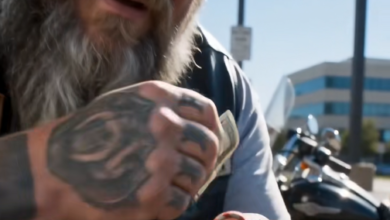
He took a small cloth pouch from his pocket. The movement exposed more of the tattoos on his knuckles: four faded letters on one hand, a swallow and a broken compass on the other. He opened the pouch and placed a thin gold wedding band on the counter.
“I need a chain for this,” he said. “Something strong. Twenty inches if you’ve got it.”
I did not touch the ring.
“Pawn shop is two blocks east.”
“I’m not selling it.”
“I didn’t say you were.”
“You thought it.”
The accusation embarrassed me because it was accurate. That embarrassment turned into irritation, the way shame often does when a person has not learned how to hold it.
One of the waiting customers whispered that she would come back later. I heard the door open behind her.
Wade heard it too.
“This a bad time?” he asked.
“We’re busy.”
“I can wait.”
“I think it would be better if you tried somewhere else.”
He studied me for a moment. Not angrily. That would have been easier. He simply looked at my hand resting below the counter, then glanced toward the red panic button hidden beside the receipt printer.
“You asking me to leave?”
I remember swallowing.
“Yes.”
Lily pulled one side of her headphones away from her ear.
“Grandpa,” she said, “he didn’t do anything.”
The store became so quiet I could hear the battery clock above the repair bench ticking.
I told Lily to go back into the office.
Wade slid the wedding ring into its pouch. His fingers were rough and marked by old cuts, but he handled that small circle of gold with extraordinary care. Before returning it to his pocket, he rubbed his thumb once across an engraving on the inside.
Then he looked at Lily.
“Your grandpa owns the door, peanut,” he said. “He gets to decide who comes through it.”
He put on his sunglasses and left.
He did not threaten me. He did not curse. He did not knock over a display or rev his engine in anger. He stood beside his motorcycle for nearly a minute, drinking from a dented thermos while traffic passed. Then he placed the thermos in his saddlebag and walked toward the pharmacy at the end of the block.
I told myself I had protected my customers.
Lily knew better.
“You were mean to him,” she said.
“You don’t know people the way adults do.”
“He only wanted a necklace.”
“A chain.”
“That’s what I meant.”
I closed the office door harder than necessary. “Finish your picture. I’m getting our lunch.”
Those were nearly the last careless words I ever spoke to her.
My original plan was to wait inside for the delivery driver, but the order tracker showed him parked across Franklin Street. The Harvest Market had closed half the block, and he refused to circle around. I could see his white hatchback beside the bank. Lily’s soup and grilled cheese were already twenty minutes late.
“I’ll be right across the street,” I told her. “Eight minutes, maximum.”
“Can I come?”
“You said your ankle hurt.”
“It doesn’t hurt that much.”
“Stay here. Lock the front after me.”
She rolled her eyes in the way only an eight-year-old can. I turned the deadbolt from outside. Lily remained in the rear office with the faulty latch, and her headphones went back over her ears.
The fire investigator later traced the smoke to an extension cord beneath my polishing bench. I had plugged a small space heater into the same strip as the ultrasonic cleaner and the old mini-fridge. The heater should not have been running in October, but the back office was always cold and Lily had complained about her hands. The cord overheated where a cabinet leg had pinched the insulation.
It smoldered beneath a stack of cardboard shipping boxes.
No flames were visible when I crossed the street.
Wade saw the first smoke because he had stopped beside his Harley to take a call from his wife. The front door was locked. He knocked. No one answered. Then he remembered the little girl coloring behind the counter.
The security footage from the pharmacy showed what happened next.
At 12:15:42, Wade walked quickly toward my shop. At 12:15:56, he tried the front handle. At 12:16:03, he cupped both hands around his eyes and looked through the glass. At 12:16:11, he ran to the side alley and found the rear service door bolted. At 12:16:28, he called 911.
He waited for thirty-four seconds.
Then Lily appeared in the narrow interior window of the office door and slapped both palms against the glass.
That was when Wade ran to his motorcycle for the tire iron.
He did not know I was across the street. He did not know firefighters were less than four minutes away. He knew only that a child was visible behind smoke and that the nearest locked door belonged to a man who despised him.
So he broke it.
At the curb, the police officer listened to my account while Wade sat with an oxygen mask pressed to his face. His right palm needed nine stitches. A shard of glass had cut the back of his upper arm. He had also aggravated an old knee injury when he kicked the office door below the latch.
The officer asked Wade whether he wanted to file a complaint about being refused service.
Wade pulled the mask aside.
“No.”
“You understand there are witnesses to the earlier exchange?”
“I understand.”
“You also understand the business owner has acknowledged it?”
Wade looked toward me. “Man made a call about his property. Bad call. Still his call.”
There was no forgiveness in his voice.
There was no cruelty either.
Just fact.
The officer nodded toward the broken window. “And you decided to go through it anyway.”
“Kid outranked the door.”
Those were the only six words Wade offered in his own defense.
The fire was contained before it reached the gas cylinder. Damage to the shop was significant but not catastrophic. Smoke blackened the ceiling and ruined several velvet display liners. Water reached the base of two antique cabinets. The front pane, custom lettering, door closer, office frame, wiring, and a section of the rear wall all needed replacement.
My granddaughter needed something harder to price.
At Tennova Healthcare, doctors treated Lily for mild smoke inhalation and kept her under observation for several hours. She did not require intubation. Her blood oxygen improved quickly, but every time a cart rattled past the room, she reached for my hand.
My daughter, Sarah, arrived still wearing her hospital badge and pale-blue scrubs.
She hugged Lily first.
Then she asked me one question.
“Why was she locked inside?”
I began explaining the delivery driver, the closed street, the eight-minute estimate, and the way Lily’s ankle had hurt earlier. Sarah let me speak until I ran out of excuses.
“You left her in a locked shop with faulty wiring and a door you knew stuck.”
“Yes.”
“And the man who saved her was the man you threw out.”
I looked at the floor.
“Yes.”
Sarah did not slap me or raise her voice. She simply removed Lily’s overnight bag from the chair beside me.
“You don’t get to turn this into a story about how grateful we are,” she said. “You have to remember what you did before he became useful to you.”
That sentence followed me for months.
Wade was treated in the emergency department two rooms away. I learned that only because Lily heard his voice in the hallway and asked a nurse whether “the motorcycle man” was all right. The nurse told us he was receiving stitches and a chest X-ray.
Lily insisted on seeing him.
Sarah looked at me. “You’re going with her.”
Wade sat on the examination bed without his shirt, his tattooed shoulders nearly touching the privacy curtain on either side. The cuts on his arm had been cleaned. His right hand was bandaged from wrist to knuckles. A disposable brace circled his knee. Without the leather cut, he seemed less like the figure the crowd had feared and more like a tired fifty-four-year-old man holding himself very still because breathing hurt.
A woman stood beside him.
She was small, silver-haired, and wore a green cardigan buttoned to the throat. A gold chain hung around her neck, but there was no ring on it.
When we entered, she looked at Lily and covered her mouth.
Wade’s expression tightened.
“You okay, peanut?”
Lily nodded. “They gave me grape juice.”
“Good stuff?”
“No. It tasted purple.”
The corner of his mouth moved.
Lily held out the motorcycle picture she had been coloring. The lower edge was damp and stained with soot. She had drawn a huge black bike beneath a red sun, and beside it stood a man whose beard reached his knees.
“That’s you,” she said.
“Beard’s about right.”
“You forgot this.”
She opened her other hand.
Inside lay the little cloth pouch containing the wedding ring.
Wade stared at it.
The pouch must have fallen from his pocket while he crawled beneath the smoke. Lily had found it inside the leather cut wrapped around her. She had kept it closed in her fist all the way to the hospital.
The silver-haired woman took one step toward her.
“That’s mine,” she said softly.
Her name was June Mercer, Wade’s wife of thirty-one years. Rheumatoid arthritis had swollen her knuckles so badly that she could no longer wear her wedding band. Wade had taken it to my store because their anniversary was the following Tuesday. He wanted to put the ring on a chain and return it to her during dinner.
He had not entered to sell stolen jewelry.
He had not been casing my display cabinets.
He had walked into Bell & Finch because his wife’s ring mattered to him, and I had treated the most valuable thing he carried like evidence of a crime.
Lily placed the pouch in June’s palm.
“He kept it safe,” she said.
June looked at Wade’s bandaged hand. “Looks like somebody else kept it safe.”
Nobody spoke for a few seconds.
I wanted to apologize. I had rehearsed possible words during the elevator ride, but every version sounded designed to make me feel better. Saying I had been scared would make Wade responsible for my fear. Saying I had misread him would turn prejudice into a minor clerical mistake. Saying I was not usually like that would be a lie Lily had already seen through.
So I told him the plainest truth I had.
“I saw your clothes before I saw you.”
Wade looked at me.
“I decided what you were before you opened that pouch,” I continued. “Then you went back into my shop for Lily after I made it clear you weren’t welcome there. I don’t have an excuse.”
He flexed the fingers of his uninjured hand.
“No,” he said. “You don’t.”
June glanced at him, but she did not correct him. I respected her for that.
I swallowed. “I’m sorry.”
Wade looked toward Lily’s smoke-stained drawing.
“Be different next time.”
That was all.
Not forgiveness.
An instruction.
By evening, the first video had reached thousands of people in Clarksville. It showed Wade striking my window but ended before he entered. The caption called him an armed biker attacking a family-owned jewelry shop. A second video captured him crawling out with Lily. For several hours, both versions circulated at the same time.
People chose the one that matched what they already believed.
Some called Wade a hero. Others claimed the rescue had been staged after a robbery went wrong. A local account posted his nineteen-year-old mug shot from a bar fight in Kentucky. Someone found my store’s business page and filled it with one-star reviews. Strangers called me a racist, a coward, and worse. A few threatened to break the replacement window before it had even been ordered.
Wade hated all of it.
He refused television interviews. He asked the motorcycle club whose patch appeared on the back of his cut not to organize a ride past my store. When a fundraiser for his medical bill exceeded nine thousand dollars, he requested that the organizer stop taking donations and send the remainder to the Clarksville Fire Rescue smoke-alarm program.
People tried to turn him into a symbol.
He insisted on remaining a man.
That distinction mattered.
Wade had made serious mistakes in his life. The old bar-fight arrest was real. He had spent twenty-eight days in county jail after breaking another man’s jaw outside a bowling alley. He had been sober for seventeen years, but not because one emotional motorcycle ride had magically changed him. He attended meetings on Thursday nights, carried his sponsor’s number inside his wallet, and still left family gatherings when arguments grew too loud.
He worked as an elevator mechanic and had no formal rescue training beyond workplace fire drills, a motorcycle first-aid course, and the emergencies ordinary riders sometimes encountered on highways. He entered my shop not because he was fearless.
He entered while afraid.
June told me that later.
“He called me before he broke your window,” she said. “I heard the alarm operator telling him to wait for firefighters. Wade said, ‘There isn’t time.’ Then the phone hit the pavement.”
“What did you tell him?”
“I told him not to be stupid.”
“Did he hear you?”
“He usually does.” She looked at the temporary plywood covering my storefront. “Listening is different.”
The city fire inspector cited me for the overloaded circuit, the blocked rear access, and the unrepaired office latch. My insurer covered part of the smoke damage but challenged several items because of the electrical violations. Business stayed closed for five weeks. Repair estimates grew from eighteen thousand dollars to nearly thirty-two thousand.
I deserved the financial consequences.
Lily did not deserve the nightmares.
For weeks she refused to close her bedroom door. The smell of toast sent her into the hallway. She stopped wearing the purple headphones because she believed they had kept her from hearing the fire. Sarah arranged counseling, and I attended when asked. The therapist told me not to force Lily to retell the event for adults who wanted an inspiring story.
That included me.
So we spoke about ordinary things. School lunches. Multiplication. Whether Wade’s beard was naturally gray or had turned that way from smoke. Slowly, the disaster became something that had happened to her rather than the only thing people saw when they looked at her.
Wade’s recovery was slower than the news reports suggested. The cut in his palm damaged a tendon near his thumb and kept him away from work for seven weeks. His knee required physical therapy. Smoke irritated his lungs enough that climbing stairs left him coughing.
He never sent me a bill.
That almost made the guilt worse.
Three days after the fire, I drove to his house with a temporary twenty-inch gold chain, June’s cleaned wedding ring, and an invoice marked paid. Their home stood off Dover Road behind a chain-link fence and two maple trees. Wade’s Harley rested beneath a gray cover in the driveway.
He opened the door with his bandaged hand held against his chest.
“I didn’t order house service,” he said.
“I know.”
June appeared behind him. “Let the man breathe, Wade.”
“I am breathing.”
“Loudly.”
She invited me inside.
Their living room contained no shrine to motorcycles and none of the threatening objects my imagination might once have supplied. There were grocery coupons on the coffee table, a basket of unfolded laundry on the sofa, and a stack of library books beside June’s chair. Family photographs covered one wall. In nearly all of them, Wade stood at the edge of the frame as if his size required him to make room for everyone else.
I gave June the ring.
The temporary chain was not the quality I wanted, but it was the best one available while my suppliers and equipment were inaccessible. She fastened it and touched the wedding band resting below her collarbone.
“It’s perfect,” she said.
“It isn’t,” I replied. “The clasp is too small for your hands. I’m ordering a magnetic safety clasp and a heavier chain.”
Wade leaned against the doorway.
“How much?”
“Nothing.”
“I pay for my own things.”
“You paid.”
His face hardened. “Saving the kid isn’t money.”
“I know.”
“Then don’t use her to settle a debt.”
That stopped me.
I had imagined the free chain as restitution. Wade saw the danger I did not: if I treated his rescue as payment, I could turn Lily into a transaction and declare the account closed. He had not gone into the fire so I would owe him. He had gone because she was there.
I placed an invoice on the coffee table.
The total was one dollar.
“Then pay me,” I said.
June laughed first.
Wade stared at the paper, reached into his pocket, and dropped four quarters beside it.
“Need a receipt?”
“I’ll mail it.”
“You better.”
That was the beginning of something, though I would not call it friendship yet.
Friendship is too clean a word for two men connected by one man’s failure and the other’s refusal to let a child pay for it.
The shop reopened on the Monday before Thanksgiving. The new front window carried the same gold lettering as the old one, though I left one tiny section of the original cracked glass inside a frame beside the register. Not as a trophy. Not as proof that a hero had visited.
It was there to remind me what a window can distort.
Our first customer was the woman who had stepped away from Wade when he entered on the day of the fire. She brought a broken bracelet and spent ten minutes telling me she had always known he was trying to help. I remembered her husband pulling her toward the door before Wade spoke.
I said nothing.
Our third customer asked whether I could point out exactly where Wade had crawled.
I refused.
By lunchtime, two tourists had taken selfies beside the framed glass. I moved it behind the counter.
At 3:40, a familiar Harley stopped outside. The engine shut down, and Wade remained seated for several seconds. His right hand was no longer bandaged, though a red scar crossed the heel of his palm. He wore the same leather cut, now repaired where the window had torn it.
People inside the shop noticed him.
I noticed them noticing.
That was my next test.
I walked to the door and opened it before he could decide whether to enter.
“Afternoon,” I said.
He looked past me at the customers.
“You sure?”
“No,” I admitted. “But come in anyway.”
Wade stepped across the threshold.
No one left.
He placed a small brass watch on the counter. It belonged to June’s father and had not run in twelve years. He wanted to know whether it could be repaired for Christmas.
I examined the movement. “Maybe.”
“That jeweler talk for expensive?”
“That’s jeweler talk for maybe.”
Lily emerged from the back room.
Her new office door had no lock. The hinges swung outward, the smoke detector above it was wired directly to the alarm panel, and an illuminated exit sign pointed toward the rear entrance. She still carried the soot-stained motorcycle picture in a plastic folder.
“Mr. Wade!”
He turned.
She crossed the shop and hugged him around the waist.
Wade went completely still.
His arms remained at his sides for a moment, as if he was afraid those large tattooed hands might frighten her. Then he rested one palm lightly against the back of her head.
“You staying out of trouble, peanut?”
“No.”
“Good.”
Lily looked at the watch. “Is Grandpa fixing that for you?”
“He’s trying.”
“He’s good at fixing things.”
Her words struck me harder than she knew.
Some things, yes.
Others required more time.
A month later, the fire department invited Wade and Lily to a council meeting. Wade refused twice before June convinced him to attend. He stood behind the last row in a clean black shirt while officials read a commendation full of polished language that made him uncomfortable.
When they called his name, he walked forward without his leather cut.
Lily carried it behind him.
The department had cleaned the smoke from the vest, but they left one torn section visible near the shoulder. Inside the lining, Lily and June had sewn a small purple patch shaped like a door. Across it were three words:
KID OUTRANKS DOOR.
The room laughed when Wade saw it.
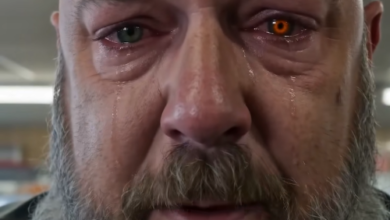
Then he lowered his head for a long time.
He did not give a speech. When the mayor handed him the commendation, Wade leaned toward the microphone and said, “Check your smoke alarms. Fix your doors. Don’t wait.”
He looked at me during the final sentence.
I understood.
In the months that followed, Wade sometimes stopped at the shop without bringing jewelry. He drank coffee on the repair stool and complained that mine tasted like hot axle grease. I learned he preferred three sugars but denied it if anyone asked. He learned that I listened to baseball games while engraving because the announcers’ voices reminded me of my father.
We argued.
He thought I charged too little for difficult repairs and too much for watch batteries. I thought his habit of parking half on the curb made the street look like his personal garage. He never allowed me to call him a hero. I never again pretended the fire had erased what came before it.
That was important.
A rescue does not cancel an insult. An apology does not purchase forgiveness. What happened between us remained uneven, uncomfortable, and real.
The following October, almost one year after the fire, Lily and I stayed late to finish a retirement plaque. Rain tapped against the new window. At 6:12, the deep sound of a Harley rolled down Franklin Street and stopped outside.
Wade came in carrying a white takeout bag.
“Soup,” he said. “Grilled cheese. Figured Bell men shouldn’t be trusted to cross streets for lunch.”
“It’s dinner.”
“Same street.”
He placed the bag on the counter and checked the smoke alarm above the office. He did this every time he visited. Then he tested the rear door, pressing the crash bar until it opened onto the alley.
Lily watched him.
“Mr. Wade?”
“Yeah?”
“Were you scared when you broke the window?”
He glanced at me before answering.
“Terrified.”
“You didn’t look scared.”
“Looking and being aren’t the same thing.”
She considered that.
“Grandpa thought you were bad.”
“I know.”
“He doesn’t anymore.”
Wade picked up one half of a grilled-cheese sandwich. “Your grandpa’s still learning.”
I expected Lily to defend me.
Instead, she nodded. “He learns slow.”
Wade laughed so suddenly that he started coughing. I handed him water. Lily laughed too, and for the first time the sound of his cough did not pull the color from her face.
Outside, headlights moved across the rain-dark street. Their reflections slid over the replacement window, briefly covering the framed piece of cracked glass behind my counter.
Wade finished eating, pulled on his leather cut, and headed for the door. The purple patch Lily had sewn inside was visible only for a second before the leather folded closed.
I called his name.
He looked back.
“Thank you,” I said.
I had told him those words before, but that night they were no longer an attempt to obtain forgiveness. They were simply true.
Wade nodded once.
Then Lily ran from the back room with his gloves, which he had left beside the register.
“You forgot these.”
He took them with his scarred hand.
“No,” he said. “I knew somebody would notice.”
The bell above the door rang as he stepped outside. A moment later, the Harley started, its low engine note filling the wet street before gradually fading toward Riverside Drive.
Lily stood beside me at the window.
The first time Wade Mercer approached that glass, I saw a threat.
The second time, I saw a man destroying my property.
Only afterward did I understand that he had seen the person behind the window long before any of us truly saw him.
Follow our page for more biker stories about frightening first impressions, hidden courage, and the moments that permanently change ordinary lives.