A 9-Year-Old Girl Brought a Birthday Cake to a Grave With No Flowers at a Veterans Cemetery—The Biker at the Next Grave Asked Whose It Was, and She Said, “My Grandpa’s, but I Never Met Him”
Part 2 — Sixty-Eight Candles
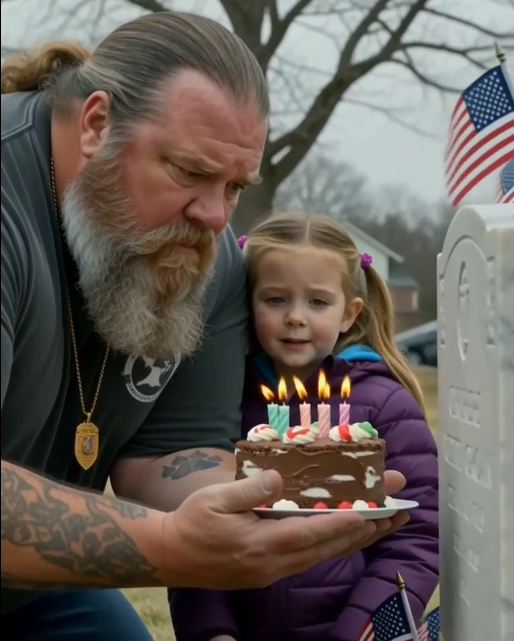
The candles were still burning when Josie’s mother ran up behind Mark.
She was in her late thirties, in a fleece vest, with car keys in her fist. She grabbed Josie by the shoulders and pulled her back so hard the girl stumbled.
“Josie, what did I tell you about strangers?”
“Kristen,” Mark said. His voice was strange. Thin. “Take her to the car.”
“Who is this man?”
Mark didn’t answer.
So I did.
“Ma’am, my name is Frank Kowalski,” I said. “I’m Mark’s father.”
Kristen stared at me. Then she laughed. It was short and frightened.
“Mark’s father died in Ensenada, Mexico, ten years ago. In a motorcycle accident. I’ve seen the death certificate. I’ve seen the urn.” She pointed at the headstone. “We had a funeral.”
I looked at my son.
Mark was looking at the grass.
“Take her to the car,” he said again, quieter.
Kristen dragged Josie away between the headstones. The girl twisted around once to look back at me. Her eyes were wet. They were gray-green, like my mother’s.
Then it was just me and Mark, and nine candles guttering in the wind on top of a chocolate cake.
“Ten years, Dad,” he said finally. “Where the hell have you been?”
I didn’t have a good answer.
Here’s the truth. In June 2016, after a drunken fight with Mark that ended with me doing something I’ll get to later, I got on my Harley and rode south. I didn’t stop until I hit Baja California. Outside Ensenada, a cattle truck ran me off the road at night. I broke my pelvis and both arms and spent four months in a little hospital in San Quintín run by nuns who didn’t speak English.
When I got out, I didn’t call anyone.
I told myself my family was better off. I worked fishing boats out of Kodiak, Alaska, for six years. Then I rode back east, alone. I picked up welding jobs and slept in motels. I’d only been back in Pennsylvania eighteen months. I visited Danny Reyes’s grave every Memorial Day and every birthday.
Not once did I look at the stone beside his.
And standing there with Mark, I had to admit something worse.
About six years ago, my VA disability checks just stopped. Twelve hundred dollars a month, gone. I called once from a pay phone in Kodiak and got put on hold for forty minutes. Then I hung up and never called again. I figured I’d screwed up some paperwork, or that I didn’t deserve it anyway.
I never asked why.
What kind of man disappears for ten years and doesn’t even wonder if anyone thinks he’s dead?
Mark straightened his tie.
“Go home, Dad,” he said. “Wherever that is. You don’t get to walk back in now.”
He walked back toward the parking lot.
My phone buzzed thirty seconds later. It was an unknown number.
This is Kristen. Mark says you’re a con man using a dead veteran’s name. If you come near my daughter again I’m calling the state police.
A con man using a dead veteran’s name.
My own name.
Was there anyone left who’d believe I was me?
Part 3 — Swatara Creek
Thirty-five years ago, Swatara Creek near Jonestown smelled like wet stones and the Off! bug spray Carol made us wear.
I was thirty-three, a staff sergeant at Fort Indiantown Gap. Mark was twelve, skinny and sunburned, with a fishing rod twice his size.
We’d caught nothing all morning, and he didn’t care. He just liked sitting next to me on the big rock.
In two days I was shipping out to Saudi Arabia with my unit. Desert Shield. Nobody knew yet it would become a war.
Mark had been quiet all morning. Finally he asked, “Are you coming back?”
I pulled my dog tags out from under my T-shirt. Two tags on a beaded chain. I unhooked the short chain and slid one tag off.
“Soldiers wear two,” I said. “If something happens, one stays with you and one goes home. So you keep this one. And I’ll come back for it.”
He put it around his neck and didn’t take it off for a year.
He was wearing it when I got off the bus at the Gap the next spring. He ran across the parking lot and hit me so hard I nearly fell over.
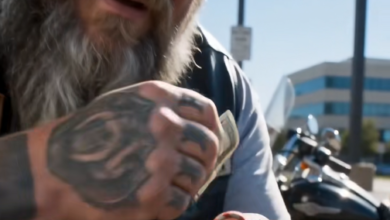
That night Carol traced the tattoo on my left forearm with her finger. I’d gotten it in Fayetteville when we were twenty. It was a bear paw, for my nickname, Bear, with a curly C inside it for her.
“My Bear came home,” she whispered.
Carol kept one photo of me with that tattoo in a heart-shaped locket. She wore it every day.
Mark wore my dog tag.
I wore the other one.
I still do.
Back then, I didn’t know my son would someday need that tag to tell a lie.
Part 4 — The Urn
Mark called me three days later. Kristen had given him my number.
“Dad. Can we talk? Just us. I’m sorry about the cemetery.”
We met at the Cracker Barrel in Hershey. He was already in a booth when I got there, his eyes red-rimmed, as if he hadn’t slept. He stood up and hugged me. It was stiff at first. Then he held on.
“I thought you were dead,” he said into my shoulder. “For ten years I thought you were dead.”
He had brought a folder.
“I know how this looks,” he said. “So I’m just going to show you everything.”
The first page was an Acta de Defunción, a Mexican death certificate from the Civil Registry in Ensenada, Baja California, dated October 2016. Francisco José Kowalski, masculino, 58 años. Causa: politraumatismo. Accidente de motocicleta.
The second was a receipt from a funeral home in Ensenada for cremation.
The third was a letter from the U.S. Consulate in Tijuana acknowledging the report of death of a U.S. citizen abroad.
“I didn’t do any of this, Dad,” Mark said. “Mom did.”
I looked up.
“After you left, she got a call from somebody in Mexico. A nurse, or a cop, I don’t know. Said a gringo biker had died in a crash outside Ensenada and they’d found your dog tag on him.” Mark’s voice cracked. “Mom flew down to Tijuana by herself. She came back with an urn and these papers. She identified you. She buried you at the Gap with full honors. I was a pallbearer, Dad.”
He wiped his eyes.
“Mom handled the VA paperwork, the insurance, all of it. Two years later she started forgetting things. Now she’s in memory care in Lebanon. Some days she doesn’t know who I am.” He shook his head. “If she made a mistake about who was in that urn, I can’t ask her. She can’t answer.”
It made sense. A grieving wife, a stranger’s ashes, and Mexican paperwork nobody checked. Now she had dementia and couldn’t explain any of it.
“I just want my dad back,” Mark said quietly. “Can we start there?”
I left that Cracker Barrel almost believing him.
Almost.
But one thing didn’t sit right.
He’d said they found my dog tag on the dead man.
I reached under my shirt and touched the single tag I still wore. It hadn’t left my neck in thirty-five years, not in Kodiak, not in that hospital in San Quintín.
And the other one I’d given to a twelve-year-old boy on a rock at Swatara Creek.
So what dog tag did they find in Mexico?
Part 5 — Fiduciary
My old platoon sergeant from Desert Storm, a retired master sergeant named Luis Ortega, now works as a veterans’ benefits counselor at the VFW post in Lebanon. I hadn’t talked to him in twenty years.
I showed up at his office on a Tuesday. He looked at me like I’d risen from the dead.
“Bear? They told us you died in Mexico.”
“So I hear.”
Luis spent two days making calls. He had friends at the VA Regional Office in Philadelphia. He filled out my request for my own VA records, and when that got stuck, he called his congressman’s office.
What came back made him take off his reading glasses and rub his eyes.
“Frank,” he said. “In 2016, the VA received a report of your death, with a Mexican death certificate and a consular report. They stopped your disability compensation and started paying your surviving spouse, Carol Kowalski, Dependency and Indemnity Compensation. That’s about seventeen hundred a month. Plus your Survivor Benefit Plan annuity from your military retirement, another twenty-one hundred.”
“That’s Carol’s money.”
“It goes to Carol.” Luis tapped the paper. “But in 2018, when she was diagnosed with dementia, the VA appointed a fiduciary to manage her benefits.” He looked up. “Mark Kowalski.”
He turned the page.
“There’s more. The person who filed the original death report with the consulate in Tijuana, as informant, wasn’t Carol.”
The name was Mark A. Kowalski, son.
“He told me Carol did everything,” I said.
“Carol was home in Pennsylvania the whole time.” Luis slid over a photocopy of her passport record, which a friend at the State Department had confirmed. “She never left the country in 2016.”
Over the next week, Luis and a lawyer he knew from the American Legion pulled the rest.
There was a Prudential life insurance policy on me, for $400,000. I’d bought it in 1998 when I retired and forgotten all about it. Beneficiary: my son. It paid out in full in January 2017.
The VA payments into Carol’s fiduciary account came to roughly $3,800 a month for nine years. That was more than $400,000.
Carol’s bank statements, which the VA requires fiduciaries to report, showed that money moving every single month into an account for Kowalski Insurance Group, Mark’s agency in Hershey. That was the same agency that had been on the verge of bankruptcy in 2016.
Meanwhile, Carol had been moved in 2020 from a private memory care home to a Medicaid-funded nursing facility in Lebanon with four patients to a room. Her son had told the VA it was “for her comfort.”
“Eight hundred thousand dollars,” Luis said quietly. “And he let your wife go on Medicaid.”
The lawyer had one more thing. It was a 2016 email from Mark’s work account, recovered from an old Yahoo backup that was part of a lawsuit filed by a former employee years ago.
To: a Tijuana address. Subject: Documents. Need acta de defunción + cremation receipt, Ensenada, for Francisco José Kowalski. Age 58. Will pay balance on delivery.
My son had bought my death.
I drove to the Lebanon nursing home that afternoon. Carol was in a wheelchair by the window, tiny and silver-haired, holding a heart-shaped locket in her lap.
She looked up at me with no recognition at all.
Then my left sleeve slid up, and she saw my forearm.
She reached out with one shaking finger and traced the bear paw. And the C.
“Bear?” she whispered.
Before I could answer, two Pennsylvania state troopers walked into the room behind me.
Part 6 — Identity Theft
“Mr. Kowalski,” the older trooper said, “or whoever you are. Step away from the patient, please.”
Mark had filed a criminal complaint that morning with the Pennsylvania State Police. It said an “unknown individual” had been impersonating his late father, Frank J. Kowalski. It said this man had visited the family’s grave to “manipulate a nine-year-old child.” It said he’d been “accessing a deceased veteran’s VA records” and “attempting to gain access to an elderly dementia patient for financial exploitation.”
He’d attached the Mexican death certificate, the consular report, and photos of the headstone.
“Sir,” the trooper said, “the United States government says Frank Kowalski is dead. Do you have identification?”
I had a Pennsylvania driver’s license from 1998 that had expired in 2016. I had an Alaska fishing license. I had a VA ID card that had been flagged as deceased.
They arrested me for identity theft and attempted theft by deception from a care-dependent person.
I spent the night in the Lebanon County Correctional Facility. They took my fingerprints, but the trooper said matching them to my 1976 Army enlistment prints would take “weeks, maybe months, through the FBI.”
My Harley was impounded.
The Lebanon Daily News ran a story the next morning. Biker Arrested for Impersonating Dead Veteran at Nursing Home. It used my booking photo.
Kristen got an emergency protection order keeping me away from Josie.
The nursing home banned me from Carol’s floor.
Luis Ortega came to see me in the jail visiting room. He looked exhausted.
“The VA Inspector General opened a case,” he said. “But Mark’s lawyer is already arguing you’re a drifter who stole Frank Kowalski’s identity in Mexico. Picked his wallet off his body, maybe. Learned his story. He says it’s the perfect con, coming back after ten years to claim a dead man’s pension.”
“I’ve got the tattoo, Luis.”
“Tattoos can be copied.” He rubbed his face. “We need something more.”
Then Luis lowered his voice.
“And Frank, there’s one other thing Mark’s lawyer keeps saying. That ‘the real Frank Kowalski’ was a violent drunk who beat his son the night he disappeared. He’s got a police report from June 2016, with a picture of Mark’s face.” Luis looked at me. “Is that true?”
I looked down at my hands on the steel table.
For ten years, I’d been running from that question.
Part 7 — June 2016
I told Luis the truth, in a jail visiting room, with my hands flat on the table.
“It’s true.”
June 2016. I’d been drinking for two days straight. Mark came to my house to tell me he’d found out I’d been skipping my PTSD appointments at the Lebanon VA. He was trying to help. I called him a disappointment. I said he’d never be half the man I was.
He said, “At least I’m not a drunk.”
I swung at him. I caught him across the cheek with my left hand, the hand with the bear paw on the forearm. It split the skin over his cheekbone. He needed four stitches at Good Samaritan Hospital.
Kristen called the police. I was gone before they got there.
That’s why I rode to Mexico. That’s why I never called anyone. I told myself my family was safer if I disappeared.
And there was one more thing.
“I knew, Luis,” I said.
“Knew what?”
“That they thought I was dead.” I made myself look at him. “Six years ago, when the checks stopped, I called the VA from Kodiak. A woman put me on hold, then came back and said, ‘Sir, our records show that veteran is deceased.’ I hung up.”
Luis stared at me.
“You knew for six years?”
“I thought it was the best thing I’d ever done for them,” I said. “Let them have the money. Let Mark be free of me. Let Carol remember the man in the locket instead of the drunk who hit her son.” My voice cracked. “I didn’t know Carol was in a Medicaid ward. I didn’t know Mark was spending it on his business. I thought dead was the one useful thing I could be.”
Luis sat back in his chair for a long time.
“So Mark committed fraud,” he said slowly, “and you let him. By keeping your mouth shut.”
“I didn’t know it was fraud. I thought he really believed I was dead.”
“Did you check?”
I didn’t answer.
He was right. I hadn’t checked. I’d been too ashamed of what I’d done to my son to find out what my son had done afterward.
We were both guilty of something. Neither of us was clean.
Luis finally stood up.
“Veterans Day is Tuesday,” he said. “There’s a ceremony at Indiantown Gap National Cemetery. The Lebanon County Veterans Council organizes it. They read the names of local veterans who died in the past ten years. WGAL livestreams it.” He paused. “Guess who chairs the council.”
“Mark.”
“Mark Kowalski, local businessman and Gold Star son. He reads your name every year. He gets choked up. People love him for it.”
“And I’m in jail.”
Luis smiled thinly.
“Not if your fingerprints come back by Monday,” he said. “I called in some favors at the FBI’s CJIS division in West Virginia.”
Could a sixty-eight-year-old drunk who’d hit his son prove he was still alive in front of a crowd that had buried him?
Part 8 — Veterans Day
The fingerprints came back Monday at 4:52 p.m.
Positive identification. Kowalski, Frank Joseph. U.S. Army. Enlistment record 1976.
The State Police dropped every charge against me by 6 p.m. A trooper drove me to the impound lot himself. He shook my hand before I got on my bike.
“Welcome back from the dead, Sergeant.”
On Tuesday morning, Indiantown Gap National Cemetery was cold and gray, with a thin November wind snapping the flags.
Three hundred people stood in the assembly area in front of a small stage. There were veterans in VFW caps, families with flags, and a high school band. A WGAL news camera was set up on a tripod beside the podium.
Mark Kowalski stood at the microphone in a dark overcoat with a small American flag pin. Kristen and Josie sat in the front row.
He read the names of local veterans who had passed. Then he paused, and his voice thickened.
“And, as I do every year, I’ll read one more. My father, Sergeant First Class Frank J. Kowalski. Desert Storm veteran. Died in 2016 in Mexico.”
People nodded sympathetically. Somebody squeezed his shoulder.
That’s when the motorcycles came up the cemetery road.
There were sixty of them, Desert Storm vets, Vietnam vets, Iraq and Afghanistan vets from every riding group between Harrisburg and Allentown. They rolled in slowly, two by two, and parked along the edge of the assembly area. They cut their engines one at a time and stood beside their bikes in silence.
I walked up the center aisle with Luis Ortega and a woman in a navy blazer named Special Agent Dana Whitfield from the VA Office of Inspector General.
Mark saw me.
He held on to the podium.
“Folks,” he said into the microphone, his voice shaking, “I’m sorry. This man was arrested last week for impersonating my father. He’s a con artist. My father died in Mexico. His remains were cremated there. The Mexican authorities sent us his dog tag. I wear it every single day.”
He reached under his shirt and pulled out a chain. On the end hung a single stamped steel tag.
He held it up to the crowd and the camera, tears in his eyes.
“This came home from Ensenada. In a plastic bag. With his ashes.”
I stopped ten feet from the stage.
“Mark,” I said. My voice carried across the cold air. “Read what’s on it.”
He looked down at the tag in his hand.
“Read it out loud,” I said. “Those tags list blood type and religion. Read me the religion line.”
His lips moved.
“Catholic,” he said.
“Mine says No Preference,” I said. I pulled my own tag out from under my shirt and held it up. “I was baptized Catholic. In 1989 I changed it to No Preference, on the new tag I got before Desert Shield. You got the old Catholic one the day before I left, on a rock at Swatara Creek, when you were twelve years old.”
The crowd murmured.
“That tag never went to Mexico, son,” I said quietly. “It’s been around your neck for thirty-five years.”
Agent Whitfield stepped forward and held up a printout for the WGAL camera.
“The consular report Mr. Kowalski filed in Tijuana in 2016 stated that the deceased was identified by ‘a U.S. military dog tag found on the body.’ The tag he’s holding was issued in 1989 to Staff Sergeant Frank Kowalski. It was never returned from anywhere.” She paused. “Because Mr. Kowalski never gave it up.”
Three hundred people turned to look at the man at the podium.
Mark’s face crumpled.
“I didn’t have a choice!” he blurted into the microphone. “The agency was going under, Mom needed care, and you were gone, Dad. You hit me and you left. So I made you dead. It was the only useful thing you ever—”
He stopped.
It was the same thing I’d told Luis in the jail visiting room. Dead was the one useful thing I could be.
In the front row, Josie stood up, clutching her mother’s hand. She looked at her father on the stage, then at me.
Then she walked straight past the podium and stood beside me.
Was she choosing a side?
Part 9 — Sixty-Nine Candles
She wasn’t choosing a side. She took my hand and held up her other one toward her father.
“Daddy,” Josie said, “come down. Please.”
Mark came down off that stage. He was crying. Agent Whitfield met him at the bottom of the steps and walked him to a government sedan parked behind the band.
He was indicted in federal court in Harrisburg on charges of theft of government funds, false statements to a federal agency, and wire fraud for the Prudential claim. He pleaded guilty to all of it in March. He was sentenced to five years in federal prison and ordered to pay back more than $800,000. His insurance agency was sold to cover part of it.
Kristen came to see me the week after he was sentenced. She brought Josie and a box of Mark’s old things.
“He’s not a monster, Frank,” she said quietly. “He was drowning. And he was still angry at you.”
“I know,” I said. “I gave him a lot to be angry about.”
The VA corrected my records in January. The Army restored my retirement pay. Every dollar of back benefits went straight into a trust for Carol’s care. In February, she moved into a private room at a good memory care home in Hershey, with a window facing the gardens.
She doesn’t always know who I am. But every afternoon, when I sit beside her chair, she reaches over and traces the bear paw on my forearm with one finger.
“My Bear,” she says. “You came home.”
I tell her yes.
I’ve been sober fourteen months now. I go to the VA in Lebanon every Tuesday. I talk about Basra, Danny Reyes, the night I hit my son, and ten years of running.
I write to Mark every week at FCI Schuylkill. For five months he didn’t answer.
Then, in June, an envelope came back.
There was no letter inside. Just a single stamped steel dog tag on a beaded chain. KOWALSKI FRANK J. CATHOLIC.
On a scrap of paper, in Mark’s handwriting:
You came back for it. Like you said.
The VA removed the headstone at Indiantown Gap in April. The cemetery director offered to have it destroyed.
Josie asked if she could keep it instead.
It sits in my backyard now, under the maple tree, as a garden stone. Josie planted marigolds around it.
On my sixty-ninth birthday, she came over after school with a homemade chocolate cake, lopsided and covered in too much frosting.
There were sixty-nine candles on it. She’d counted them twice.
She set it down on the old headstone in the garden, right across 1958 – 2016. Then she lit every candle with a long barbecue lighter, one at a time, while I cupped my hands around them so the wind wouldn’t blow them out.
“Make a wish, Grandpa,” she said.
I looked at her, my granddaughter, with my mother’s gray-green eyes, standing in my backyard on the day I was supposed to have been dead for ten years.
“I already got it,” I said.
She rolled her eyes, the way nine-year-olds do. Then she grinned, leaned over the cake, and helped me blow.
If Frank and Josie’s story stayed with you, follow our page. We’ve got plenty more biker stories coming, and the next one might hit even harder than this.