A Biker Showed His Scar to the Children Mocking His Daughter’s Burned Face—Then Her Mother Learned Why His “Scar” Had Never Healed
The morning my nine-year-old daughter tried to hide her burned face beneath a winter scarf, her biker stepfather walked into her fourth-grade classroom, rolled up his sleeve, and showed twenty-three children a scar none of us had ever seen before.
My daughter’s name is Lily Bennett, and until that January morning, she had never called Mason Cole her father in front of anyone.
At home, sometimes.
When she was sleepy, sick, or frightened by thunder, the word slipped out before she could catch it. “Dad, can you check the window?” Or, “Dad, will you leave the hallway light on?”
In public, he was always Mason.
Maybe she feared loving him too openly would make him disappear. The first man she had called Dad had taught her that fathers could vanish, but not before leaving something behind.
Lily’s scar began above her left eyebrow, crossed her cheek, and narrowed near the corner of her mouth. Children stared before they learned not to. Adults tried not to stare and usually made it worse.
By fourth grade, the questions had changed into cruelty.
One boy called her “melted candle.” Two girls began covering one side of their faces whenever Lily walked past. Someone drew a crooked face on her desk and wrote, “MONSTER MAP.”
That last word followed her home.
She stood before the bathroom mirror that night with both hands pressed against her cheeks. Then she asked me whether people could get a new face when they grew up.
The next morning, she refused to leave her bedroom.
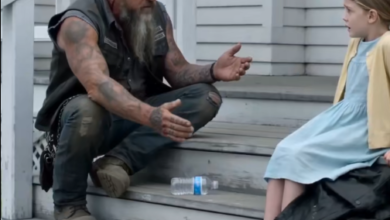
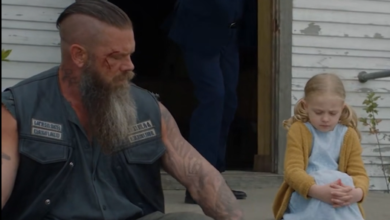
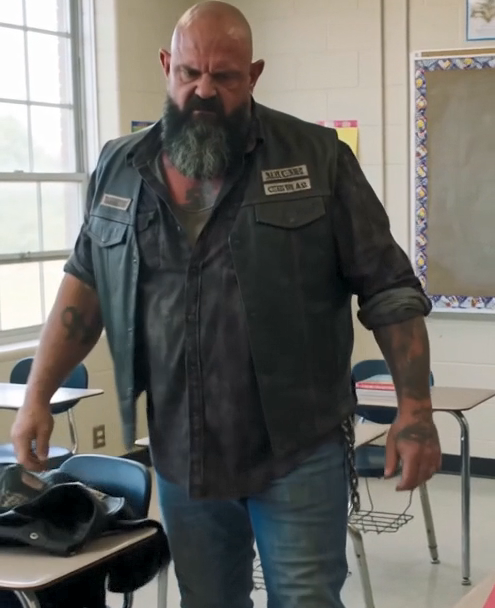
Mason sat outside her door in his Iron Order leather cut, his six-foot-four frame folded against the narrow hallway wall. He was forty-three, nearly 270 pounds, with a shaved head, a thick black-and-gray beard and tattoos covering both hands. His Harley stood in the driveway, ticking as its engine cooled.
To strangers, Mason looked like the kind of man a school would call security about.
To Lily, he was the man who cut the crusts from sandwiches because the rough edges bothered her scar.
He stayed outside her door for twenty-six minutes. No lecture. No demand. He simply placed his bare forearm across his raised knee and waited.
I noticed a strip of dark, uneven skin disappearing beneath his right sleeve.
“Mason,” I whispered, “what happened to your arm?”
He pulled the sleeve down.
“Old road,” he said.
Then Lily opened the door.
An hour later, Mason walked beside her through the entrance of Franklin Elementary in Springfield, Missouri. His boots struck the tile with a heavy rhythm. Conversations stopped. A receptionist stared at the Iron Order name on his back, then reached slowly toward the telephone.
Mason signed the visitor sheet.
“My daughter forgot something,” he said.
“What?”
“Her map.”
Inside Room 14, Lily stood beside her desk with her hair covering the left side of her face. The boy who had called her a melted candle stared at Mason’s tattoos. One girl whispered that Lily had brought a gang member to scare them.
Mason heard her.
He did not raise his voice.
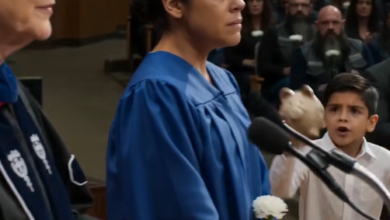
He took off his leather cut, laid it over the back of Lily’s chair and rolled his right sleeve past his elbow. A large red-and-brown mark twisted across his forearm, rough-looking and irregular, close enough to Lily’s scar that my breath caught.
“This,” he told the class, “is a map.”
No one moved.
“Every scar marks a place where somebody survived. My daughter has a map on her face. That doesn’t make her broken. It means she has already been somewhere hard—and came back stronger than any of you know.”
Lily slowly moved her hair behind her ear.
The room went silent.
Then Mason lowered his arm and looked at the words scratched into her desk. His scar seemed fresh around the edges. Too fresh.
And when the school nurse reached toward it, he stepped back.
I thought Mason was protecting Lily’s secret that morning.
I did not yet understand that he was hiding one of his own—or that the mark he had shown those children had not come from any motorcycle accident.
Part 2 — The Man Who Always Left the Hallway Light On
I met Mason three years earlier at a grocery store off West Kearney Street, although he would later insist we had first met in the parking lot.
I remembered fluorescent lights, a broken jar of pasta sauce and a large tattooed man kneeling beside Lily with a roll of paper towels. Mason remembered my daughter standing between two parked cars, unable to move because a motorcycle had started nearby.
Both versions were true.
Lily was six then. The sudden crack of an engine made her drop the small bag she was carrying and cover the scarred side of her face. Before I could reach her, Mason shut down his Harley. The V-twin rumble disappeared, leaving only the metallic ticking of hot pipes.
He took off his sunglasses.
“Too loud?” he asked.
Lily nodded.
Mason rolled the motorcycle backward by hand until it was farther away. He did not ask what had happened to her face. He did not bend close or use the soft, false voice adults sometimes use with frightened children.
He simply pointed at the groceries scattered near her shoes.
“Your oranges are making a break for it.”
Lily laughed.
It was a small sound, but I had learned not to measure important things by volume.
Mason was a welder at a fabrication shop and a seven-year member of the local Iron Order chapter. On Thursday nights, he worked on motorcycles in a garage behind a small brick clubhouse. On Saturdays, the club sometimes delivered groceries, repaired wheelchair ramps or escorted funeral processions for riders who had no family left.
They were loud men.
Leather creaked when they moved. Chains struck denim. Their hands smelled of gasoline, coffee and the black soap mechanics use to remove grease from cracked skin. Some had records. Some carried old anger like an extra tool in a saddlebag.
Mason was not the loudest.
That made him the one people watched.
His road name was Atlas, not because he claimed to carry the world, but because he once rode forty miles with a broken saddlebag bracket strapped across his shoulders. The name stuck. Mason pretended to hate it, though he answered whenever someone called.
The first time he came to our apartment, Lily watched him remove his boots at the door without being asked. The second time, he repaired the loose hinge on her bedroom closet. The third time, she showed him the box where she kept every school photograph facedown.
“Why don’t you look at them?” he asked.
“My bad side is in them.”
Mason studied her face for a moment.
“Which side is that?”
She pointed.
He moved to the other side of the room and looked again. “Still don’t see it.”
Lily frowned because she understood he was being kind, and kindness embarrassed her when it arrived too quickly.
Mason never tried that line again.
Instead, he learned the practical geography of her fear. She disliked restaurants where people sat on her left. She avoided swimming because water darkened her scar. She would not wear ponytails, even in Missouri heat. When strangers asked what happened, she looked at me and waited for rescue.
Mason began sitting on her left in public.
No announcement. No explanation.
He simply occupied the place where staring eyes usually landed.
We married eighteen months after meeting him. There were eleven people at the courthouse and nineteen motorcycles outside because his club brothers had ignored his request to keep things small. Lily wore a pale yellow dress and kept her hair loose across one cheek.
After the ceremony, Mason crouched beside her.
“I signed a paper with your mom,” he said. “It doesn’t make me anything to you that you don’t choose.”
Lily looked toward the motorcycles.
“Does it make me a biker?”
“No.”
“Can I still have a helmet?”
“Absolutely.”
She called him Dad for the first time two weeks later after waking from a nightmare. Mason was standing in the hallway in sweatpants, holding a baseball bat because her scream had pulled him from sleep.
The word stopped both of them.
He did not celebrate. He did not correct her.
He checked beneath the bed, opened the closet and left the hallway light on.
By the beginning of fourth grade, Lily seemed steadier. She joined the science club. She read announcements during morning assembly, although she always turned her right side toward the audience. Her teacher, Ms. Ramirez, told me she had begun raising her hand again.
Then a new boy named Carter moved into her class.
He was not cruel at first. He was curious in the careless way children can be when they have not learned that another person’s body is not public property.
“What happened?”
“Does it hurt?”
“Can you feel it?”
Lily answered the first question with the sentence we had practiced: “It happened when I was little, and I don’t want to talk about it.”
Carter accepted that for two days.
Then he began asking other children what they thought had happened. Fire. Dog attack. Car crash. Halloween makeup that never washed off.
Each guess made Lily smaller.
Ms. Ramirez moved Carter’s seat and called his parents. The principal scheduled a kindness lesson. For one week, things improved.
Then a photograph from the class holiday concert appeared in a group chat. Someone enlarged Lily’s face and added a flame beside it.
By January, she was eating lunch in the nurse’s office.
Mason learned only part of this because Lily asked me not to tell him everything. She worried he would arrive at school with twenty bikers and make the situation worse.
“He won’t,” I told her.
“You don’t know his club.”
“I know your dad.”
She looked down when I used the word.
The night someone carved “MONSTER MAP” into her desk, Mason came home late from the clubhouse. He wore his riding jacket zipped to his throat even though the kitchen was warm. When he reached for a coffee cup, he winced.
“What happened?” I asked.
“Caught my arm on something.”
He would not show me.
The next morning, he left before sunrise and returned with a pharmacy bag containing gauze, ointment and plastic wrap. I assumed he had burned himself welding. Mason had dozens of small marks on his hands from hot metal and grinding sparks.
But he carried the bag into the garage.
Later, I found a folded piece of paper beneath his coffee mug. It was a photocopy of Lily’s third-grade school portrait. Someone had traced the outline of her scar in red ink.
I thought Mason was planning to confront the school.
I was wrong.
He was planning to stand beside her.
Part 3 — Twenty-Three Children and One Rolled Sleeve
On the morning Lily refused school, Mason did not tell her to be brave.
That word had been used against her too often. Doctors called her brave before procedures. Relatives called her brave when they wanted to ask invasive questions. Teachers called her brave after placing her in situations that never should have required courage.
Mason sat outside her bedroom and said, “You don’t have to be brave today.”
From behind the door, Lily answered, “Then I’m not going.”
“Maybe.”
That surprised her enough to open the door.
She wore pajamas and the blue scarf wrapped across the lower half of her face. Her eyes moved to Mason’s leather cut, then to the keys hanging from his belt.
“You said maybe?”
“Yeah.”
“Mom says I have to.”
I stood at the end of the hallway and resisted the urge to interfere.
Mason leaned his head against the wall. “Your mom says you need an education. She didn’t say you have to walk into a room believing what those kids wrote.”
Lily touched the scarf.
“They all look at it.”
“I know.”
“You don’t.”
“I did the first day.”
Her eyes sharpened.
Mason did not soften the truth. “I saw the scar. Then I saw you chase three oranges under a truck. The second thing lasted longer.”
Lily almost smiled.
Then she noticed the edge of the mark beneath his sleeve.
“What happened to you?”
Mason looked down as though he had forgotten it was there.
“Road got rough.”
“Was it your motorcycle?”
He paused.
“Something like that.”
That answer would trouble me later. In the moment, it gave Lily a bridge.
She dressed.
We drove to Franklin Elementary instead of taking Mason’s Harley. He sat in the passenger seat because his arm seemed stiff. During the twelve-minute ride, Lily kept looking at his sleeve.
“What if they laugh at you too?”
“They probably will.”
“Aren’t you scared?”
“No.”
She knew him well enough to hear the lie.
The principal, Ellen Price, met us near the office. She was a careful woman who wore bright scarves and documented every conversation. She had suspended Carter from recess, contacted parents and arranged meetings, but the cruelty kept shifting shape. When one insult was stopped, another appeared online or in a whispered joke.
Mrs. Price looked at Mason’s vest.
“I appreciate you coming,” she said, “but we need to discuss how this conversation will be handled.”
“No threats,” Mason answered.
“Of course.”
“No club talk.”
“Good.”
“No naming kids.”
Mrs. Price relaxed slightly. “Exactly.”
Mason added, “But I’m not covering my ink.”
Her eyes moved toward the school logo on the wall. “Some parents may find the imagery concerning.”
The visible tattoos across Mason’s hands were an anchor, a wrench, Lily’s birth month flower and the coordinates of the courthouse where we married. None contained profanity. None mattered once someone saw leather and formed a story around it.
“I’m not here for the parents,” he said.
We entered Room 14 shortly after morning attendance. Ms. Ramirez had arranged the desks in a half circle. Lily stayed close enough to Mason that her shoulder touched his hand.
The children recognized him from pickup. Several had seen him sitting on his Harley across from the crossing guard. Carter looked at the Iron Order lettering and whispered something to the boy beside him.
Mason heard.
He removed his cut and placed it on a chair.
The room seemed to breathe again.
Then he rolled up his sleeve.
The mark covered most of his right forearm. It was mottled red, brown and pale at the center, with irregular edges that pulled the eye along its length. I had seen burn scars. Lily had undergone multiple grafts before kindergarten. Mason’s mark looked convincing from a few feet away.
Still, something about it bothered me.
The surface seemed too uniform. The color sat beneath the skin in a pattern that resembled shadow more than damaged tissue. Near his elbow, a faint purple guide line remained.
Mason turned his arm so every child could see.
“This is a map,” he said.
A girl near the window asked, “A map to where?”
“A place I got out of.”
He pointed to one end of the mark. “This part says something hurt.”
Then he indicated the clean skin around it. “This part says it stopped.”
Nobody laughed.
Mason looked toward Lily, not the children. “A scar isn’t the bad thing happening. It’s what stayed after the bad thing couldn’t finish the job.”
Ms. Ramirez pressed her lips together.
Carter shifted in his seat.
Mason continued. “My daughter has a map on her face. It means she survived something before most of you could tie your shoes. You don’t have to pretend you don’t see it. You do have to remember there’s a person carrying it.”
He did not call Lily stronger than every child in the room exactly as we had discussed, but then Carter stared at the floor and Mason changed course.
“Actually,” he said, “she is stronger than everybody who needed to make her feel small.”
Lily moved her hair behind her left ear.
It was the first time she had done that at school.
Carter’s face turned red. His teacher did not force an apology. I was grateful. An apology demanded under the gaze of a 270-pound biker would have belonged to fear, not understanding.
Instead, Carter asked, “Does your scar hurt?”
Mason glanced at his arm. “Today? Yeah.”
Lily looked up.
The honesty mattered more than the speech.
Then another child raised her hand. “Does Lily’s hurt?”
“Sometimes,” Lily answered before Mason could speak. “When it gets cold. And when people point.”
The girl lowered her finger.
A boy near the bookshelves said his father had a surgery scar across his chest. Another child spoke about stitches beneath her chin. Ms. Ramirez let the conversation move naturally until the room stopped orbiting Lily and began seeing how many bodies carried evidence.
For eight minutes, it worked.
Then the school nurse entered.
Mrs. Price had asked her to check Mason’s arm because she thought the mark looked irritated. Nurse Daugherty stepped closer and reached toward the pale center.
Mason pulled away.
“It’s fine.”
“That doesn’t look fully closed.”
“It is.”
“Mr. Cole, if you have an untreated burn—”
“I don’t.”
The answer came too quickly.
Lily heard it.
So did I.
Mason rolled his sleeve down and reached for his cut. His face remained still, but a muscle moved beside his jaw.
The classroom lesson ended without another word. Outside, Mrs. Price thanked us and asked Mason to wait while she handled a phone call from Carter’s mother.
Someone had already sent her a photograph.
In it, Mason stood above the seated children with tattoos exposed and his Iron Order vest hanging behind him. The angle made his open hand look like a fist. The caption said a biker gang member had entered Franklin Elementary to intimidate nine-year-olds.
By noon, the photograph had reached a local parenting page.
By one, parents were calling the district.
By two, three club brothers were parked across the street.
They had not come because Mason asked.
They came because someone online had posted our home address.
The school locked its front doors.
Lily watched the motorcycles through the office window and whispered, “I knew I would make everything worse.”
Mason crouched beside her.
“No,” he said. “This part is mine.”
That was when Mrs. Price returned carrying the pharmacy bag Mason had left in the classroom.
A receipt had slipped out.
It was not from a hospital.
It was from a tattoo studio.
Part 4 — The Name We Never Used in Our House
Mrs. Price handed the receipt to me without reading it aloud.
Black Lantern Tattoo, Commercial Street.
Custom scar study. Three sessions. Color correction. Protective film.
The final appointment had been the previous night.
I looked at Mason’s covered arm. He did not deny it.
“You told Lily it came from the road.”
“I said the road got rough.”
“You let her think it was an accident.”
His eyes shifted toward our daughter.
Lily stood near the office window, watching three Iron Order riders speak with the school resource officer. She had not seen the receipt yet.
“Not here,” Mason said.
Anger moved through me so quickly that I welcomed it. Anger was easier than understanding why my husband had paid someone to place a false burn scar on his body.
“You walked into a classroom and talked about surviving,” I whispered. “You used her scar.”
“I carried it.”
“That isn’t the same.”
“No.”
He did not defend himself.
That made me angrier.
Before I could continue, the office secretary called Mrs. Price to the front entrance. Carter’s mother had arrived with a reporter from a local television station. She claimed her son had been threatened by a motorcycle club.
The three bikers across the street became nine within twenty minutes.
Their engines announced them one at a time. A deep rumble. Then silence. Boots struck pavement as the men dismounted and formed a loose line near the sidewalk.
None crossed school property.
Mason called the chapter president, a former Army mechanic named Joel “Bishop” Mercer.
“I told you not to come,” Mason said.
Bishop’s voice carried through the phone. “You told us someone posted your address.”
“My family’s inside a school.”
“That’s why we’re outside.”
“You’re making the picture worse.”
“We don’t leave a brother standing alone.”
Mason looked at Lily.
“Sometimes standing beside me means leaving.”
The line went quiet.
Brotherhood sounds simple when it is printed across a patch. On difficult days, it becomes a choice between the help you want to give and the help somebody can safely receive.
Bishop ordered the riders back to the clubhouse.
Two refused.
One of them was Mason’s closest friend, Andre “Needle” Washington, a Black tattoo artist with silver at his temples and fine-line ink covering both hands. Needle stood beside his maroon Road King and stared through the office window.
When his eyes met mine, he looked away.
I knew then who had made the mark.
Mason stepped outside alone. The reporter raised a microphone before he cleared the doors.
“Did you threaten children while wearing gang insignia?”
“No.”
“Why did nine bikers surround the school?”
“They didn’t.”
“They were across the street.”
“That isn’t surrounding.”
“Is the scar you displayed connected to a violent incident involving your motorcycle club?”
Mason stopped.
It was the opening he could have used. He could have told the truth and turned the story into an act of devotion. People would have shared it. The same parents calling him dangerous might have called him a hero by dinner.
Instead, he said, “Ask the school about the kid getting hurt.”
The reporter glanced at Lily through the glass. “Was your stepdaughter attacked?”
Mason’s expression changed at the word stepdaughter.
“No.”
“Then what happened to her face?”
He took one step toward the camera.
The school resource officer moved between them.
Mason stopped immediately. “That isn’t your story to take.”
The reporter used those six seconds that evening. They cut away before Mason stepped back. The segment showed his size, his tattoos and his refusal to explain Lily’s scar.
It did not show what explanation would have cost her.
For seven years, I had told strangers that Lily was injured in a kitchen accident. It was easier. People heard “accident” and stopped searching for someone to blame.
There had been no accident.
When Lily was two, her biological father, Caleb, came home angry after drinking. I was packing a bag because I had decided to leave him. Lily began crying in her high chair while we argued.
Caleb lifted a saucepan from the stove.
The water inside had just boiled.
I still remember the small domestic sounds around what happened: the refrigerator motor, a cartoon playing in the living room, the click of the burner as I turned it off. Trauma does not always preserve the moment you want. Sometimes it saves everything surrounding it and leaves a hole in the center.
He threw the water toward me.
Lily was between us.
She survived.
Caleb went to prison after accepting a plea agreement. I moved, changed my number and removed every photograph that contained his face. Lily knew only that her first father had hurt us and could not live with us anymore.
She did not know the details.
Mason learned them before our third date. I told him in the parking lot behind a diner because I could not bear to say the words across a candlelit table.
He sat on the curb beside his Harley and listened.
When I finished, he asked one question.
“Does he know where you live?”
Not what did you do. Not why did you stay. Not whether I had exaggerated.
Only whether we were safe.
Caleb’s name returned to our house on the afternoon of the school incident.
A certified envelope waited in our mailbox. The Missouri Department of Corrections had scheduled a parole hearing. Caleb had completed enough of his sentence to request supervised release.
Mason read the first page in the garage while Lily slept upstairs.
His newly tattooed arm was wrapped in clear film. Ink and fluid gathered beneath it, making the false scar look wet.
“You knew this was coming?” I asked.
He nodded.
“How long?”
“Three weeks.”
“And you didn’t tell me?”
“I was waiting until after Lily’s school meeting.”
“You don’t get to decide when I learn that man may be released.”
“I know.”
“You keep saying that.”
“Because you’re right.”
I took the letter from him. My hands shook hard enough to rattle the paper.
Then I saw a second envelope on his workbench. It was addressed to the parole board.
Mason had written a statement.
Not about revenge.
Not about what he would do if Caleb approached our family.
He had described Lily’s mornings. The silicone cream she still used in winter. The way camera flashes made the grafted skin appear brighter. The medical appointments Caleb had never paid for. The years our daughter spent learning that strangers’ curiosity did not entitle them to her history.
At the end, Mason had written: “She is not the evidence of his worst day. She is a child building a life he has no right to interrupt.”
I lowered the letter.
“Why the tattoo?”
Mason looked at the plastic covering his arm.
“Because his mark was the only one she had.”
That answer should have explained everything.
It did not.
Not yet.
Part 5 — The Scar That Was Chosen
Needle came to our house after dark.
He parked his motorcycle at the curb and walked up without his club vest. That was deliberate. He was not arriving as Mason’s brother. He was arriving as the man who had put a permanent lie beneath my husband’s skin.
He carried a folder.
Inside were sketches, color tests and the photocopy of Lily’s school portrait I had found beneath Mason’s coffee mug. Needle had traced the general shape of her scar, then changed every line so Mason’s mark would resemble hers without becoming an exact copy.
“He asked for the same side,” Needle said.
Lily’s scar was on the left. Mason’s tattoo was on his right forearm.
“He changed his mind,” Needle continued. “Said he wanted it where she could see it when he held her hand.”
Mason stood at the kitchen sink with his back to us.
I asked how long they had planned it.
“Since October,” Needle answered.
Three months.
The bullying had begun with questions in September. By October, Mason had noticed Lily turning family photographs facedown again. He asked Needle whether ink could resemble grafted skin.
Needle refused.
“I told him a child’s scar wasn’t a design,” he said. “Told him pain didn’t become noble because a biker paid cash for it.”
“What changed your mind?”
Needle opened the folder to a drawing in Lily’s handwriting.
It showed three stick figures. Mine had long hair. Lily’s had a red line across its face. Mason’s figure stood apart with tattoos on both arms but smooth skin underneath.
Across the bottom, she had written: MOM AND MASON HAVE NORMAL FACES.
The picture had been an assignment about family resemblance.
Mason found it in the recycling bin.
Needle agreed to create the tattoo, but only after talking with a burn-recovery counselor he knew through a veterans’ group. The counselor warned that copying Lily’s scar could turn her body into a symbol for Mason’s feelings. So they changed the design. It would look related, not identical.
A map from the same country.
The first session laid muted browns and pale tones. The second added irregular texture through shading. The final session placed red along the edges so it would appear new and tender when Mason entered the school.
“You timed it?” I asked.
Mason turned from the sink. “I wanted it to hurt.”
Needle closed the folder.
That sentence chilled me until Mason explained.
“I didn’t want to stand there with old ink and tell her pain passes. I wanted her to ask if it hurt and be able to say yes.”
“You could have shown them any scar.”
“No.”
“You already have scars.”
He had one beneath his chin from a motorcycle spill and another across his thumb from a welding accident.
“Not where she could see it,” he said. “Not one they’d understand without me explaining her.”
The truth was both smaller and larger than the story I had imagined. Mason had not survived a fire. His motorcycle had never trapped him beneath burning metal. There was no heroic accident hidden in his past.
He had sat in Needle’s chair for eleven hours across three sessions while a machine drove pigment into his skin.
He chose the mark.
That did not make it a burn scar. It did not give him Lily’s experience. Mason understood that better than I did in my anger.
“It isn’t the same as hers,” he said. “I know.”
“Then why call it a scar?”
“I didn’t.”
“You called it a map.”
He nodded.
“Because maps can be drawn.”
Lily had been standing halfway down the stairs.
None of us heard her until she asked, “So it’s fake?”
Mason’s shoulders tightened.
Needle stepped quietly toward the door. I stopped him. If he left, it would make the truth look shameful. He remained beside the coat rack with his hands clasped.
Lily descended the last three steps. Her hair covered her left cheek again.
“Was there no motorcycle accident?” she asked.
“No,” Mason said.
“You lied.”
“Yes.”
He did not hide behind careful wording.
Lily looked at me. “Did you know?”
“Not until today.”
She faced Mason again. “Why would you want a scar?”
“I didn’t want yours.”
The answer came fast.
“I wanted you to see somebody who chose to stand where people were staring.”
“That doesn’t make sense.”
“I know.”
“You told my class you survived.”
Mason lowered himself to one knee so his eyes were beneath hers.
“I survived being a coward about loving you.”
I almost interrupted. Lily did not.
Mason continued, his voice rough. “For three years, I kept saying you could decide whether I was your dad. That sounded respectful. Sometimes it was. Sometimes it was me leaving a door open so I wouldn’t get hurt if you never chose me.”
Lily watched him.
“The tattoo was me closing my side of that door,” he said. “You can call me Mason forever. You can be angry forever. But I’m your father for as long as you’ll let me do the work.”
He unwrapped the clear film.
The skin beneath was swollen and glossy with ointment. Up close, the mark was unmistakably tattooed. Tiny needle patterns lived inside the shading. Near his wrist, Needle had hidden a small line shaped like a road turning toward a house.
Lily touched the clean skin beside it.
“Does it come off?”
“No.”
“Even if I don’t like it?”
“No.”
“That was dumb.”
“Probably.”
Needle coughed to hide a laugh.
Lily studied the mark for a long time. Then she lifted her hair and exposed her scar. She placed her cheek near Mason’s forearm without pressing the tender skin.
The two maps did not match.
They were never supposed to.
“Mine happened to me,” she said.
“Yes.”
“You picked yours.”
“Yes.”
“That means mine is more real.”
“Way more.”
Lily considered this.
Then she asked the question that broke whatever remained between them.
“Did you pick me too?”
Mason’s jaw moved, but no sound came out at first.
Finally, he nodded.
“Every day.”
Lily wrapped both arms around his neck. Mason kept his tattooed arm lifted so it would not touch her back, protecting the wound he had chosen while holding the child he had not made but had decided to raise.
From the doorway, Needle turned his face away.
His club brothers later claimed dust had gotten in his eyes.
Nobody believed him.
Part 6 — What the Club Did With Its Hands
The school district investigated Mason for two weeks.
They found no threats, no physical contact and no evidence that the Iron Order riders had entered school property. Mrs. Price acknowledged that Mason had followed every instruction given before the classroom visit.
Still, the photograph online had done damage.
Some parents demanded that club clothing be banned. Others wanted Mason barred from campus. A few defended him so aggressively that their words created another fight Lily never requested.
Mason refused interviews.
When a television producer offered to film him and Lily comparing their scars, he hung up. When a local website called the tattoo “the ultimate stepdad sacrifice,” he asked them to remove Lily’s photograph.
They did not.
Needle filed a copyright complaint over the photograph taken inside his studio that someone had copied from his private page. Bishop contacted an attorney. Two younger club members wanted to confront the reporter outside the station.
Mason stopped them.
“You want to help?” he asked. “Use your hands.”
The next Saturday, twelve Iron Order members met at the clubhouse without motorcycles. One brought woodworking tools. Another carried paint. Needle brought drawing paper. Bishop arrived with a list from Franklin Elementary.
The school needed privacy panels for the nurse’s office, repairs to three library shelves and a wheelchair-height planter for the spring garden.
They built everything.
No cameras.
The district would not allow the men on campus as a group, so they delivered the finished pieces on a flatbed before sunrise. Mason stayed home. He knew his presence would turn useful work into another argument.
Lily helped him change the protective dressing over his tattoo.
Each morning, the red faded. The surface settled. What had looked like an open injury became obviously intentional ink.
She remained angry with him for the lie.
Children are allowed to hold two truths at once more easily than adults. Lily could understand why Mason did it and still dislike being deceived. She stopped calling him Dad for six days.
He did not pressure her.
He packed lunches, checked homework and left the hallway light on.
On the seventh morning, Lily stood before the bathroom mirror. I watched from the doorway as she pulled her hair behind her ear.
“This is my map,” she whispered.
Mason heard from the hall.
He did not enter.
At school, Carter apologized without being ordered. He did not make a speech. He handed Lily a new black marker and offered to help clean the words from her desk.
The carving could not be erased completely.
The custodian sanded the surface, but pale grooves remained beneath the varnish.
Lily traced them once.
Then she covered the marks with a map of Missouri for her state-history assignment.
Part 7 — Picture Day
Caleb’s parole request was denied.
The board did not base its decision on Mason’s tattoo or the school story. They considered his prison record, missed treatment requirements and refusal to accept full responsibility for what he had done.
He could apply again.
That knowledge remained inside our house like a locked drawer. We did not open it every day, but we knew it was there.
With help from a child therapist, I told Lily the truth about her injury in language she could carry. I did not give her every detail. I gave her ownership.
Her scar had not come from a random accident.
A grown man had acted violently. Her mother had taken her to safety. Doctors had helped her heal. The man had been punished. None of it was her fault.
Lily asked whether Mason knew.
“Yes.”
“Before he married you?”
“Yes.”
She thought for a while.
“So he knew what my real dad did, and he still wanted us?”
The word still hurt to hear.
“Mason didn’t want us despite what happened,” I said. “He wanted the life we could make after it.”
Spring picture day arrived three months after the classroom visit.
I expected Lily to wear her hair loose. Instead, she asked me to braid it behind both ears. The scar remained fully visible from eyebrow to mouth.
Mason waited outside Franklin Elementary beside his black Harley. He wore a long-sleeved shirt, though the morning was warm.
Lily walked toward him carrying the envelope of school photographs.
“Did they turn out bad?” he asked.
She handed him one.
Her chin was slightly raised. Her smile pulled unevenly at the scarred corner of her mouth. Nothing had been retouched.
Mason studied the picture.
“Which side?” he asked.
Lily understood the old question.
She pointed to her whole face. “This one.”
He slid the photograph into the clear window inside his wallet.
Then Lily reached for his sleeve and rolled it above his elbow. The tattoo had healed into a muted trail of browns, pale ridges and thin red shadows. It no longer looked exactly like a burn.
It looked like what it was.
A decision.
Lily placed two fingers on the little road Needle had hidden near Mason’s wrist.
“This goes home,” she said.
“Yeah.”
“Both ways?”
“Every time.”
She climbed onto the motorcycle behind him and fastened her helmet. Mason waited until her arms were secure around his waist before starting the engine.
The V-twin shook the morning air.
Lily did not cover her face.
They turned onto West Kearney Street, one chosen scar beside one survived scar, following the same road home.
Follow our page for more powerful biker stories about misunderstood riders, chosen families, hidden scars, and the quiet love carried beneath leather.