A Biker Gang of 50 Threw a Quinceañera for a Foster Teen Whose Family Never Came—Then 200 Leather-Clad Strangers Asked Her for a Dance
Fifty motorcycles surrounded the parish hall, two police cruisers waited across the street, and inside, a fifteen-year-old foster girl in a borrowed white dress kept staring at the empty chair where her mother had promised to sit.
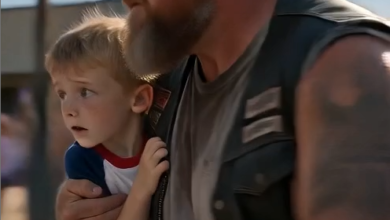
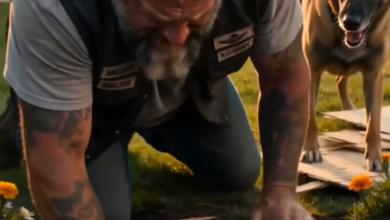
My name is Miguel Ortega, but nearly everyone in the Iron Harbor Riders calls me Migs. I was forty-nine that summer, with a gray beard, a left knee that clicked whenever rain approached, and enough ink on my forearms to make cautious parents pull their children closer in grocery-store aisles. I had spent twenty-six years repairing diesel engines beside Interstate 35 in San Antonio, Texas, and twenty-two years riding a black Harley Road King that sounded like loose thunder rolling beneath a steel bridge.
I had seen men bleed without making a sound. I had watched brothers bury brothers, fathers lose sons, and veterans freeze when fireworks cracked over parking lots.
But I had never seen fifty bikers become completely silent until the moment Marisol Vega looked at us and asked, “What if nobody comes?”
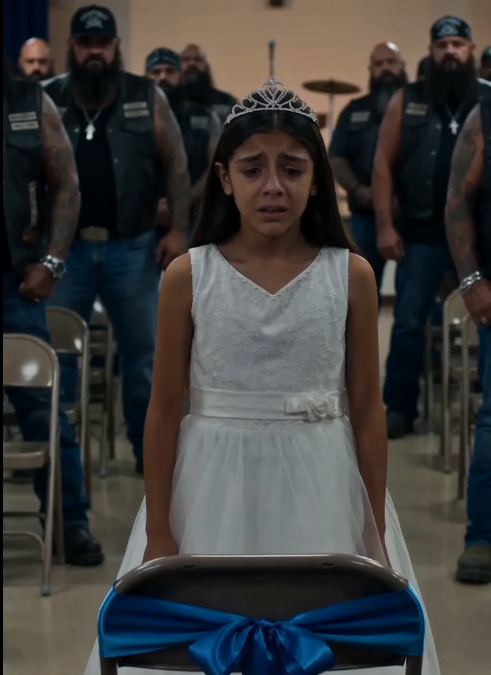
She stood in the middle of St. Agnes Parish Hall with a silver plastic tiara resting crookedly in her dark hair. The gown had been altered three times by the wife of one of our road captains, yet it remained slightly too large around her narrow shoulders. White satin gloves covered the small scars she had made by digging her fingernails into her palms whenever she became frightened.
Behind her waited fifteen tables, fifteen candles, a three-tiered cake, a rented sound system, and enough handmade paper flowers to cover every hard year of her childhood.
Near the dance floor stood one empty chair.
That chair had been Marisol’s idea.
She had tied a pale blue ribbon around its back because blue was her mother’s favorite color—or at least it had been when Marisol was seven and still remembered being somebody’s daughter instead of another case number moving through Bexar County’s foster-care system. Her mother had called two weeks earlier after nearly four years of silence. She said she was sober. She said she had changed. Most important, she said she would come.
Marisol believed her.
Some hopes survive things they should not.
The rest of us had been told not to make promises. Her caseworker, Ms. Alvarez, reminded us that reunifications were complicated, addiction was complicated, and family was the one subject where good intentions could still cut a child open. We understood. Most men in our club had their own history with broken promises.
So we did not tell Marisol her mother would arrive.
We only kept looking toward the door.
Outside, engines ticked as they cooled. Fifty Harleys filled the church lot in uneven rows, their chrome spotted by a light afternoon rain. Local residents had started gathering on the sidewalk because nobody in that neighborhood had ever seen that many tattooed men wearing leather cuts outside a quinceañera.
Some thought we had come to cause trouble.
They did not know we had spent six weeks building the party one paycheck, one favor, and one sleepless night at a time. They did not know that the towering biker guarding the cake had frosted every rose himself, or that the scar-faced former Marine beside the entrance had learned a father-daughter waltz from online videos because Marisol had no father to dance with.
They did not know why fifty grown men were afraid.
At 6:10 p.m., Marisol’s classmates began arriving with their parents. At 6:25, the priest checked the sidewalk. At 6:40, Ms. Alvarez quietly stopped answering Marisol’s questions.
Her mother’s chair remained empty.
Then the phone rang.
Ms. Alvarez listened for less than a minute. Her shoulders lowered, and she closed her eyes before turning toward me.
I knew.
Marisol knew too.
She removed her tiara, placed it carefully on the empty chair, and whispered, “I’m sorry you all wasted your money.”
Then she walked toward the kitchen before anyone could see her cry.
The fifty of us stood there in our boots and leather, surrounded by decorations made for a girl who had stopped believing she deserved them. Our president, Raymond “Bear” Bell, watched her disappear through the kitchen door. Bear was six-foot-five, nearly three hundred pounds, and had a prison number tattooed beneath the sleeve on his right arm from a life he rarely discussed.
He picked up his phone.
“Call everyone,” he said.
We thought he meant the rest of our club.
We were wrong.
Because forty minutes later, while Marisol sat alone beside a mop sink trying to unzip her own dress, a sound rose beyond the church walls—a rolling, multiplying thunder that seemed to shake the rain from the roof.
It was not fifty motorcycles returning.
It was two hundred coming for her.
Part 2 — The Girl Who Kept a Dress in a Grocery Bag
I met Marisol six weeks before her quinceañera, although at the time I did not know anything about the party she carried around inside her head.
The Iron Harbor Riders had volunteered to repair a passenger van belonging to Casa Esperanza, a foster residence housed in a converted brick convent on the west side of San Antonio. The van had failing brakes, a cracked radiator, and a transmission that slipped whenever the driver climbed a hill. The state funding available for repairs could cover the brakes or the radiator, but not both, and certainly not the transmission.
Bear heard about it from his sister, who worked nights as a pediatric nurse.
By Saturday morning, twenty-three motorcycles were parked outside the residence. The children watched from behind the blinds while men with braided beards, neck tattoos, chain wallets, and scarred hands unloaded tools from saddlebags and pickup trucks.
We frightened them.
That part mattered.
Adults often romanticize the way children respond to bikers, as if every frightened child immediately discovers the gentle soul beneath the leather. Real children are smarter than that. They do not trust a stranger simply because he smiles. Foster children especially learn to measure people by what they do after the smile disappears.
Marisol stayed farthest from us.
She was fourteen, small for her age, with thick black hair she usually tied into a low ponytail. She wore an oversized gray hoodie despite the Texas heat and carried a grocery bag wherever she went. When one of our prospects tried to offer her a doughnut, she shook her head and moved behind a porch column.
“She thinks you’re cops,” a younger boy told us.
“Why?” I asked.
“Because you came in a group.”
That answer stayed with me.
For three weekends we worked on the van beneath the brutal June sun. Bear rebuilt the transmission with parts donated by a salvage yard. I replaced the radiator. Other members repaired the air-conditioning, installed new seat belts, and painted over a line of rust along the rear doors. Nobody asked the children for photographs. Nobody made them pose beside us. We arrived, worked, ate road sandwiches, and left.
On the fourth Saturday, Marisol brought me a plastic cup filled with ice water.
“You missed a bolt,” she said.
She pointed beneath the van. She was right.
That was our first conversation.
The second happened after rain forced us into the residence’s recreation room. I was looking for a dry rag when I saw her grocery bag resting beneath a folding chair. Part of a white sleeve stuck from the opening. I assumed it was clothing donated to the residence, but Marisol snatched the bag away before I could touch it.
“Sorry,” I said. “Wasn’t trying to snoop.”
Her expression changed when she realized I meant it. She sat on the floor ten feet away, took out the garment, and unfolded it across her knees.
It was a secondhand quinceañera dress.
The bodice was missing several beads. The skirt had a rust-colored stain near the hem, and one zipper tooth had torn loose from the fabric. Still, Marisol handled it as though it had come from a glass case.
“My roommate found it at a church sale,” she said. “It cost nine dollars.”
“Looks expensive.”
“It isn’t.”
“I said it looks expensive.”
She almost smiled.
Marisol had been sketching quinceañera dresses since she was eleven. She drew ballrooms with chandeliers, tables covered in flowers, and cakes tall enough to require staircases. She knew how a quinceañera was supposed to begin, how the father changed his daughter’s flat shoes for heels, how the celebrant received a final doll, how fifteen candles honored the people who had helped guide her life.
She knew every ritual.
She had nobody to perform them.
Her father had never been listed on her birth certificate. Her mother, Yolanda, had struggled with addiction and disappeared after repeatedly missing court-ordered visits. An aunt in Corpus Christi had taken Marisol for eight months, then returned her to the system after losing her apartment. By fourteen, Marisol had lived in eight foster placements, two group homes, and one emergency shelter.
Every new address had taken something from her. A box of drawings. A favorite book. A pair of earrings that had belonged to her grandmother.
The grocery bag never left her hands.
“You having a party?” I asked.
She looked down at the damaged zipper. “Girls like me don’t get these.”
She did not say it bitterly. That made it worse.
I told Bear about the dress while we tightened the final bolts beneath the van. He slid out on a mechanic’s creeper, wiped grease from his hands, and stared toward the recreation-room window.
Bear’s real name was Raymond Bell. He had spent six years in prison during his twenties after a bar fight left another man badly injured. He never tried to make that history sound noble. After his release, he worked construction, got sober, found a motorcycle club willing to make him earn trust slowly, and spent the next three decades paying forward chances he believed he had not deserved.
“What does one of those parties cost?” he asked.
“More than we’ve got.”
“That wasn’t my question.”
When Bear put something that way, the matter was usually settled.
That evening, fifty Iron Harbor members crowded into the back room of our clubhouse. The air smelled of coffee, leather, and the brisket our treasurer had forgotten in the oven. I placed Marisol’s situation on the table without using her full name or revealing details protected by the foster system.
We needed a dress altered, a hall, music, food, decorations, transportation, a cake, a photographer, and adults who understood the cultural meaning of the ceremony. We had forty-three days.
Our treasurer studied the club account and laughed once.
“We can afford napkins.”
“Good,” Bear said. “Napkins are covered.”
Nobody laughed after that.
Each member placed what he could on the table. Twenty dollars. Fifty. A hundred. One man emptied a coffee can filled with quarters he had been saving for motorcycle tires. Another offered the money set aside for new exhaust pipes. Our oldest member, Sal “Doc” Jiménez, raised one scarred hand.
“My sisters know quinceañeras,” he said. “All nine of them.”
That was how it began.
Not with fifty men pretending they could replace a family, but with fifty men admitting they did not know enough—and asking women from the community to show us how to honor a girl properly.
By midnight, we had napkins.
We also had a plan.
Part 3 — Fifty Men Learning to Waltz
The first problem was permission.
Ms. Alvarez listened without interrupting as Bear and I explained the idea in her office. She was a Mexican American woman in her early forties who had spent long enough in child welfare to recognize both good intentions and the damage they could cause.
“You cannot turn her into a charity spectacle,” she said.
“We won’t.”
“No social-media fundraising with her face. No interviews. No strangers learning her case history. No promises about becoming her family.”
Bear leaned forward, causing the metal chair to complain beneath him.
“We’re offering a birthday party.”
“You’re offering an abandoned child the appearance of permanence,” she replied. “Then what happens Monday?”
That question silenced us.
A party lasted one night. Marisol’s life would continue after the balloons deflated, after the cake hardened, and after the men who had filled the hall climbed back onto their motorcycles.
Bear looked at me. Then he looked at Ms. Alvarez.
“We show up Monday.”
“And the Monday after that?”
“We show up then too.”
She did not approve the plan that day. She gave us paperwork, background-check requirements, visitor policies, transportation rules, and a list of boundaries thick enough to stop men who only wanted a dramatic weekend project.
Nobody stopped.
Thirty-eight members had clear background checks within two weeks. Seven others accepted that their old convictions prevented direct access to the residence and volunteered behind the scenes. Five completed additional screening because they hoped to become long-term mentors.
The brotherhood was tested before we bought a single balloon.
Some members resented the scrutiny. A rider named Kenny argued that we were being treated like criminals after offering help. Bear let him speak, then placed the application back in front of him.
“This isn’t about your pride,” he said. “The kid has had enough adults making things about themselves.”
Kenny completed every page.
The second problem was money. We organized repair days, washed cars beside a grocery store, sold smoked ribs, and auctioned motorcycle parts we had spent years collecting. Nobody used Marisol’s photograph. The signs simply said we were raising funds for a local girl’s fifteenth birthday.
People donated because they trusted the men asking.
Others donated because they wanted to see what fifty bikers could possibly know about a quinceañera.
The answer was very little.
Doc’s sisters educated us quickly. They explained that this was not merely a large birthday party with a fancy dress. It marked a girl’s passage into young womanhood, traditionally witnessed by family and community. Every ritual carried weight, and using those rituals carelessly would turn Marisol’s dream into a costume.
So we listened.
Doc’s eldest sister, Elena, became our unofficial commander. She was five-foot-two and could silence Bear with one look. She taught us to make tissue-paper flowers, corrected our pronunciation, rejected three decoration themes, and informed us that motorcycle skulls would not appear on the cake.
Bear had already ordered twelve.
He canceled them.
Our road captain, Tiny Walsh, stood six-foot-six and weighed nearly three hundred twenty pounds. He was assigned to learn cake decorating because he owned the steadiest hands in the club. Every Tuesday night he practiced piping buttercream roses onto cardboard circles while the rest of us tried not to stare.
He became good.
I handled music with Marisol. We met in the Casa Esperanza recreation room under staff supervision, and she built a playlist on an old tablet. She wanted cumbia, Tejano music, and songs her mother had played when they cleaned apartments together.
She also chose a traditional waltz.
“Who will you dance with?” I asked.
She shrugged. “Maybe nobody. That part is usually the dad.”
I told Bear.
The following Thursday, fifty bikers reported to a dance studio owned by Doc’s niece. Motorcycle boots thudded across polished wood while she tried to teach us the basic box step. Men who could maneuver eight-hundred-pound touring bikes through mountain curves kept colliding with one another at walking speed.
Bear broke a decorative plant.
Kenny stepped on my foot nine times.
Tiny practiced with a broom until the handle snapped.
We returned the next week.
Marisol did not know about the lessons. She knew only that the club was helping with her party and that Ms. Alvarez had approved the event after we agreed to long-term mentoring commitments. Even then, the girl held her excitement like a match in strong wind.
She selected pale blue and silver for the decorations. She chose vanilla cake with strawberry filling. She asked for one table near the dance floor to remain partly empty in case her biological relatives came.
“Anybody specific?” I asked.
“My mom.”
I kept my face still.
Marisol had written letters to Yolanda for years without receiving an answer. Then, three weeks before the party, one of those letters finally reached her through a treatment program in Austin. Yolanda called the residence and asked to speak with her daughter.
The conversation lasted twelve minutes.
Afterward, Marisol ran into the courtyard, holding the phone to her chest as if it were a living thing.
“She’s coming,” she said. “She promised.”
From that moment, every detail of the quinceañera became connected to her mother. Marisol changed the ribbon color on the reserved chair to Yolanda’s favorite shade of blue. She selected a song her mother remembered. She even saved the role of placing the tiara upon her head.
We could give Marisol a dress, a cake, and fifty terrible dancers.
We could not give her Yolanda.
Ten days before the party, another problem hit. The event hall canceled our reservation after the manager learned that motorcycles and club members would be involved. He claimed there had been a scheduling error, but our deposit was returned before Bear finished reading the email.
That evening, the club meeting became ugly.
A few members wanted to park all fifty motorcycles outside the venue and demand an explanation. Others suggested exposing the manager online. Bear remained at the head of the table while voices rose around him.
Then he struck the tabletop once with his palm.
“No threats. No mob. No kid gets her party built on somebody else’s fear.”
The room quieted.
We had ten days, no venue, and less than four hundred dollars remaining. The cake required refrigeration. Rain was forecast. Casa Esperanza was too small, and county policy prevented a crowd that large from gathering there.
Doc called St. Agnes Parish.
Father Thomas offered us the parish hall for free, provided we repaired its broken side door, replaced two emergency lights, cleaned the kitchen, and promised not to rev the motorcycles during Mass.
We finished everything in three nights.
By the final evening, Bear was sitting alone beneath a ladder, staring at the empty hall. Paper flowers covered the walls. Tiny’s cake waited inside the refrigerator. Fifty chairs faced a dance floor we had polished with old T-shirts.
“You think she’ll like it?” Bear asked.
“Yeah.”
“You think her mother comes?”
I did not answer.
Bear rubbed both hands over his beard.
“Then we better be ready if she doesn’t.”
Part 4 — The Call That Emptied the Room
On the afternoon of the quinceañera, rain began falling shortly after three.
It was not a dramatic Texas storm, just a cold gray drizzle that darkened the pavement and collected on the motorcycles parked outside St. Agnes. The riders arrived early wearing rain-spotted leather. They carried trays of food beneath trash bags, boxes of flowers under their jackets, and folded tablecloths inside saddlebags.
Nobody complained.
At Casa Esperanza, Elena and two other women helped Marisol dress. The repaired white gown now fit perfectly. Tiny had sewn missing beads around the bodice during breaks at his welding job, though he threatened me with bodily harm if I ever told anyone.
Marisol wore her grandmother’s earrings. They were not the original pair she had lost during a placement move; Doc’s sisters found similar ones at an antique shop. She turned them gently between her fingers while staring at herself in the mirror.
“Do I look like somebody’s daughter?” she asked Elena.
Elena did not offer a sentimental answer.
“You look like Marisol,” she said. “That’s enough.”
We transported her to the church in a donated vintage sedan because Ms. Alvarez correctly decided that placing a girl in a formal dress on the back of a Harley during rain was a terrible idea. Twenty motorcycles rode ahead at a respectful speed. Thirty followed behind.
People stepped from stores to watch us pass.
When Marisol entered the parish hall, the entire club stood. Not because we had rehearsed it, but because none of us knew what else to do. She stopped beneath the doorway, one gloved hand touching her mouth.
The hall did not look expensive. The ceiling tiles were stained. Half the chairs did not match. The silver tablecloths had been purchased from three different discount stores, and the paper flowers revealed fingerprints if you looked closely.
Marisol looked at it as if we had built a palace.
“You did this?”
Bear crossed his arms. “We had help.”
“All of it?”
“Except the ceiling stains.”
She laughed.
That sound allowed fifty men to breathe again.
The ceremony began at five. Marisol received a Bible from Ms. Alvarez, a bracelet from her foster mother, Rosa, and a final doll repaired by one of the riders’ wives. Tiny rolled out the cake, keeping both tattooed hands beneath the tray as if carrying something explosive.
Classmates arrived. Teachers came. Casa Esperanza staff filled one table. A few local residents entered cautiously, then relaxed when they saw children dancing between men in motorcycle boots.
The reserved chair remained empty.
Every few minutes, Marisol glanced toward it.
At 5:45, she asked whether Austin was far. At 6:00, she wondered if the rain had slowed traffic. At 6:10, she carried a glass of water to the place reserved for Yolanda and set it beside the untouched napkin.
The first dance was scheduled for 6:30.
At 6:24, Ms. Alvarez’s phone rang.
She walked into the hallway before answering, but through the partly open door I saw the muscles around her mouth tighten. She asked three questions, wrote something on her palm, and leaned against the wall.
When she returned, she looked directly at me.
“Yolanda left the treatment program yesterday,” she whispered. “Nobody knows where she is.”
“Does Marisol need to know now?”
“She already knows.”
Marisol stood ten feet away.
A foster child becomes skilled at reading rooms because rooms often decide her future before anyone tells her. She had seen Ms. Alvarez’s expression, my lowered eyes, and the phone still clutched in her hand.
“She isn’t coming,” Marisol said.
Ms. Alvarez moved toward her. “We don’t know exactly what happened.”
“She isn’t coming.”
“No.”
The music continued for another three seconds before Doc reached the speaker and turned it off. Conversations faded. Rain tapped against the high windows.
Marisol looked around the hall.
She saw the cake, the decorations, her classmates, and fifty bikers pretending not to watch her break. Perhaps that kindness felt like another burden. People had worked so hard, and she believed she had failed by not being happy enough.
“I’m sorry,” she said.
Bear took one step forward. “You’ve got nothing to apologize for.”
“You spent all this money.”
“That was our decision.”
“You should give the food to somebody else.”
“It’s yours.”
“I don’t want it.”
She removed the tiara before anyone had placed it on her head and set it on her mother’s chair. Then she lifted the front of her gown and walked quickly toward the kitchen.
Rosa started after her, but Ms. Alvarez raised one hand. Too many adults rushing behind her would feel like pursuit.
I waited thirty seconds and entered through the other kitchen door.
Marisol was not in the kitchen. I found her inside the janitor’s closet beside the service exit, sitting on an overturned bucket near a mop sink. Her gown covered most of the floor. She had removed one glove and was fighting with the zipper at the back of her dress.
“Need help?” I asked.
“No.”
I remained by the door.
“You can leave,” she said.
“I can.”
“Then why aren’t you?”
“Bear would make me help clean the kitchen.”
She gave a small, angry breath that was almost a laugh.
For several minutes, neither of us spoke. I listened to water passing through pipes behind the wall. She picked at one loose bead on the dress.
“I knew she wouldn’t come,” she said at last.
“You hoped.”
“That’s stupid.”
“No. It’s expensive.”
She looked up.
“Hope costs something,” I said. “Doesn’t make it stupid.”
Her face tightened. “Everybody out there feels sorry for me.”
“Some probably do.”
“I don’t want that.”
“Then don’t take it.”
“What am I supposed to take?”
“The cake. Tiny worked hard.”
This time she actually laughed, but it collapsed almost immediately. She covered her face with both hands.
“I wanted one night,” she whispered. “Just one night where I looked like I belonged to somebody.”
I could repair an engine in darkness. I could disassemble a transmission by touch. I had no tool for that sentence.
In the hall, Bear stood beside Yolanda’s empty chair. He had spent years hiding fear beneath silence, but I saw it in the way his right hand repeatedly opened and closed.
He picked up his phone and called the president of another motorcycle club.
“What do you need?” the man asked.
Bear looked toward the kitchen.
“People,” he said. “Every decent one you know.”
Then he gave the address.
Part 5 — When Two Hundred Engines Answered
The first engines reached us at 7:08 p.m.
Marisol and I were still near the janitor’s closet when a low vibration traveled through the floor. At first I thought thunder had moved closer. Then came the unmistakable rhythm of large V-twins turning from the main road into the church lot.
One engine became ten.
Ten became fifty.
The sound kept growing.
Marisol lowered her hands. “What’s happening?”
“I don’t know.”
That was the truth. Bear had not told me about the call, and none of us imagined how far it would travel. He contacted one club president. That man contacted four others. Riders texted brothers in Austin, New Braunfels, Boerne, Seguin, and Corpus Christi. Some were eating dinner. Some had already taken off their boots. Others were working late when their phones lit up.
The message was short: Foster kid. Fifteenth birthday. Family didn’t show. Empty dance floor.
Come clean. Come respectful.
By the time the first motorcycles entered the lot, more were already heading down Interstate 35 in the rain.
I helped Marisol stand. She refused to put the tiara back on, but she followed me into the kitchen. Through the swinging door, we watched people in the hall turn toward the windows.
The two police officers across the street switched on their headlights.
Father Thomas hurried outside, followed by Bear. Rain struck his black shirt and clerical collar as motorcycles poured into every available space around the parish hall. Riders parked along the curb, beside the school fence, and in the overflow lot behind the rectory.
They came in leather vests, riding jackets, denim, and rain gear. Their clubs did not always get along. Some had histories Bear would never excuse. But he had been clear about the rules.
No colors displayed aggressively. No alcohol. No weapons. No arguments. No making the child afraid.
Anyone unwilling to honor those rules stayed outside.
A police sergeant approached Bear near the entrance.
“What exactly is this?” she asked.
“A birthday party.”
“For whom?”
Bear pointed through the glass.
Marisol had stepped into the hallway. Behind her, the pale dress spread across the tile like a pool of white water. Her face showed equal parts alarm and disbelief.
The sergeant looked from her to the arriving riders.
“How many did you invite?”
“One,” Bear admitted.
Within twenty minutes, the parish hall held nearly two hundred bikers. Some stood because we ran out of chairs. Others waited beneath the covered walkway, dripping rainwater onto the concrete and peering through the open doors.
They did not know Marisol’s last name. They did not know the details of her mother’s addiction or the number of homes she had lived in. They knew only that a girl had dressed for a dance and believed nobody had come for her.
That was enough.
The crowd frightened her at first. Bear understood before anyone else. Instead of bringing two hundred strangers toward Marisol, he ordered everyone to remain where they were. Then he walked alone to the kitchen doorway.
“Boss,” he said gently, “we got a few late guests.”
“A few?”
“Word got loose.”
“Why are they here?”
Bear glanced at the packed hall. Men built like refrigerators were trying to hide behind one another so they would not overwhelm a fifteen-year-old girl.
“They heard we needed dancers.”
“I don’t know them.”
“No. You don’t owe them anything.”
That mattered. Bear did not tell her the riders were her new family. He did not announce that they had replaced the people who failed to arrive. Children in the system hear adults claim them too quickly and leave them just as fast.
He offered a choice.
“You can go back to Casa Esperanza,” he said. “We’ll pack the cake. Or you can stay and make two hundred old men prove those dance lessons weren’t a waste.”
Marisol peered around him.
Tiny stood nearest the dance floor, holding a tray of untouched cake slices. Behind him waited Black riders, white riders, Latino riders, veterans, mechanics, nurses, roofers, teachers, retired firefighters, grandfathers, and men still trying to become people their younger selves would have trusted.
One older biker had ridden from Corpus Christi with an oxygen tube beneath his nose.
Another had wrapped plastic grocery bags over his boots to keep the rain out.
Marisol stepped into the hall.
The room fell silent.
She looked at her mother’s chair, still decorated with the pale blue ribbon. Then she walked toward it, picked up the tiara, and held it against her chest.
“Who puts this on?” she asked.
Nobody answered immediately. The honor had been reserved for Yolanda.
Rosa, her foster mother, began to rise from her chair, then stopped. She had cared for Marisol for eleven months but never demanded the title of mother. She waited for the girl to decide.
Marisol crossed the floor and held the tiara out to her.
“You stayed,” she said.
Rosa’s hand shook as she accepted it.
“Yes.”
“You always stay.”
“Yes.”
Rosa placed the tiara in Marisol’s hair. It tilted slightly to the left. Neither of them corrected it.
Doc started the music.
Bear approached for the traditional dance, but he did not offer his hand until Marisol nodded. The enormous former prisoner and the slender girl in white moved awkwardly into the center of the floor. His boots looked absurd beside her silver shoes.
For the first eight counts, Bear stared at his feet.
Then Marisol whispered something.
He looked at her, and the corner of his mouth lifted.
Later I asked what she had said.
“You dance like a refrigerator.”
She was right.
When their song ended, Bear stepped away. Tiny approached next. Then Doc. Then me. We formed a line, each rider asking the same question.
“May I have this dance?”
Marisol answered yes.
Again.
Again.
Again.
The playlist shifted from waltz music to cumbia, then Tejano, then songs selected by the teenagers. Riders who had practiced formal steps for weeks abandoned them completely. Leather creaked. Chains rattled. Boots struck the floor out of rhythm.
Marisol danced until her hair fell loose from its pins.
She danced with fifty men who had built the party and scores more who had arrived after hearing only that she might be alone. She spun beneath tattooed arms. She laughed when Tiny attempted a turn and crashed into a table of paper flowers.
The blue-ribbon chair remained empty.
But Marisol never did.
Part 6 — Fifteen Candles and a Sixteenth Promise
Near ten o’clock, Elena dimmed the hall lights for the candle ceremony.
Fifteen small candles waited on a table near the cake. Traditionally, each flame honored a person who had shaped the celebrant’s life. Marisol had prepared only six names: her grandmother, a former teacher, Ms. Alvarez, Rosa, her roommate Kendra, and Yolanda.
The ninth candle was supposed to be her mother’s.
Marisol stood before it for a long time.
The crowd remained quiet. Two hundred bikers who had roared into the neighborhood now listened to the faint hiss of rain against glass. Tiny held the lighter but made no move to help.
Finally, Marisol picked up the blue candle.
“My mom couldn’t come,” she said.
Nobody offered an excuse for Yolanda. Nobody booed her, cursed her, or turned an ill woman into a villain for an easy emotional ending. Addiction had already taken enough from Marisol. It did not deserve the power to turn her love into shame.
“She gave me my first name,” Marisol continued. “It means sunflower. My grandma told me that.”
She lit the candle.
“I hope she gets better.”
Rosa lowered her head. Bear stared at the floor.
Marisol moved to the remaining candles. She had no names prepared for them, so she began choosing people from the room.
One was for Elena, who repaired her dress.
One was for Tiny, who made the cake.
One was for Doc, whose sisters taught us what the ceremony meant.
One was for Father Thomas, who opened the hall after another venue closed its doors.
The fourteenth was for the fifty Iron Harbor Riders.
At the final candle, Marisol paused.
“This one is for everybody who came when they didn’t have to.”
Two hundred leather-clad men stood around a foster girl while she brought the match to the wick. In that small flame, the silver decorations trembled against the walls.
The party should have ended there.
Instead, Bear made one more promise.
He did not make it publicly. He waited until the hall was mostly empty, the motorcycles had departed, and Marisol sat barefoot on the edge of the stage eating leftover cake directly from a paper plate.
“Got something for you,” he said.
She looked suspicious. “Another biker?”
“Ran out.”
He gave her a small black notebook. On the first page were fifty names and telephone numbers, each belonging to a club member who had passed the required screening. Beside every name was one practical skill.
Math tutoring. Driving lessons. Job applications. Auto repair. College forms. Cooking. Carpentry. Emergency pickup.
At the bottom, Bear had written one rule: Ask staff first. We still show up.
Marisol turned the pages slowly.
“Is this for real?”
“Monday will tell.”
That Monday, twelve riders reported to Casa Esperanza to repair a fence damaged by the storm. The following week, I began helping Marisol with algebra. Tiny taught a cooking class. Kenny drove three foster teenagers to a school career fair after their scheduled transportation failed.
The party had cost us almost everything in the club account.
Showing up afterward cost more.
It required Saturdays, gasoline, background renewals, training, patience, and the humility to accept when a child did not want help. A few members drifted away. Others discovered that consistent care was quieter and harder than arriving in a dramatic procession.
Most stayed.
Months later, Rosa filed a petition to become Marisol’s permanent guardian. She had delayed because she feared Marisol would interpret the offer as pressure, and because caring for a teenager with years of disrupted attachments required more than affection.
Marisol accepted on one condition.
“The club still comes around?”
Bear answered, “Only if invited.”
She nodded. “You’re invited.”
The guardianship hearing took place the following spring. The courtroom could not hold fifty bikers, let alone two hundred, so the judge allowed only Bear, me, Ms. Alvarez, and two Casa Esperanza staff members inside.
The others waited outside the courthouse.
When Rosa and Marisol emerged, fifty engines started—not revving, not roaring, just turning over one by one until the stone steps vibrated beneath our boots.
Marisol was no longer wearing a white gown. She wore jeans, sneakers, and Bear’s oversized club sweatshirt. The sleeves covered her hands.
She walked down the steps between Rosa and Ms. Alvarez.
Then she raised both arms.
The parking lot erupted.
Part 7 — The Chair We Never Put Away
Five years have passed since that night at St. Agnes.
Marisol is twenty now. She attends community college and works part-time at a youth center helping teenagers complete the same scholarship and housing forms that once frightened her. She still calls Rosa “Rosa” in public and “Mom” when she forgets to guard herself.
Yolanda returned to treatment twice. The second time lasted. Her relationship with Marisol remains careful, slow, and private. There was no magical reunion beneath balloons, no apology strong enough to erase eight placements, and no promise trusted immediately.
They drink coffee together some Sundays.
That is what recovery looks like in their case—not a clean ending, but two people learning to remain seated when the conversation becomes uncomfortable.
The Iron Harbor Riders still host a dance every year at St. Agnes for teenagers in foster care. We stopped calling it a charity event after Marisol told us the phrase made the kids sound like projects. Now it is simply the Fifteen Lights Dance, open to any teenager who wants music, food, and adults willing to cheer without demanding gratitude.
We keep one chair near the dance floor.
It is the same mismatched wooden chair that waited for Yolanda. The pale blue ribbon has faded almost gray. We considered replacing it, but Marisol refused.
“That chair isn’t about who didn’t come anymore,” she said. “It’s for whoever still might.”
Bear is sixty-three now. His beard has gone almost entirely white, and his right hand shakes when he holds small objects. He still attends every dance. He no longer tries the waltz because his knees cannot be trusted, but he stands beside the floor and waits.
Every year, one teenager eventually asks him.
Every year, he says yes.
At the most recent dance, Marisol arrived late from work. She wore no tiara, carried no flowers, and did not enter with two hundred motorcycles behind her. She simply walked through the side door holding a grocery bag filled with donated shoes for the girls who had none.
Bear saw her first.
“Boss,” he said.
She hugged him before he could prepare for it.
Then Doc started the old waltz.
Marisol led Bear onto the floor. His steps had not improved. His boots remained heavy, his shoulders stiff, and his eyes fixed nervously on the ground.
“You still dance like a refrigerator,” she told him.
Bear nodded. “Reliable appliance.”
She laughed loudly enough for the entire hall to hear.
Outside, rows of Harleys rested beneath the parking-lot lights. Inside, foster teenagers ate cake, ruined rented shoes, and watched tattooed men argue about dance steps. The old blue-ribbon chair stood near the wall.
Nobody sat there alone.
Follow our page for more biker stories about the rough-looking riders who quietly show up when an empty chair says more than words ever could.
TITLE: Fifty Bikers Built a Foster Teen the Quinceañera Her Family Wouldn’t Attend—Then a Call from the Parish Hall Sent 200 Motorcycles Into the Rain for Her
SEO DESCRIPTION: A foster teen’s family skips her quinceañera, so 50 bikers build the celebration—and 200 riders arrive to fill her empty dance floor.
VIDEO PROMPT 1 — BASED ON PART 1 VERSION 1
10-second video, 4 scenes, no POV. Real-life cinematic video style, high-quality realistic footage, natural handheld camera movement, authentic everyday-life atmosphere, rainy evening at a modest San Antonio parish hall. Scene 1: A frightened 15-year-old Latina American foster girl, slim, long dark hair, borrowed white quinceañera gown and crooked silver tiara, faces one empty chair tied with a blue ribbon while 50 intimidating bikers wait behind her. Scene 2: Raymond “Bear” Bell, a 58-year-old Black American biker, 6’5″, nearly 300 pounds, shaved head, gray beard, tattooed neck and forearms, plain black leather vest with no readable patches, faded jeans and heavy boots, watches her place the tiara on the chair. She whispers, “Nobody came.” Scene 3: Worried guests film discreetly as Bear strides toward the exit with a tense but compassionate expression; people fear he is angry. Scene 4: Bear raises his phone and says, “Call everyone.” A mysterious engine rumble begins outside while the girl turns toward the doors. Do not reveal who is arriving. No text, logo, readable patches, weapons, violence, gore, or dramatic injury.
Promts 3 — Teaser 1
Fifty tattooed bikers built a quinceañera around one empty chair, but when the foster girl placed her tiara on that chair and apologized, even the hardest men in the hall stopped breathing.
Marisol Vega had carried a damaged white dress inside a grocery bag for three years. She knew girls in stable families received cakes, flowers, and a father’s first dance. Girls who had survived eight foster placements learned not to expect anyone.
Then the Iron Harbor Riders found out.
For six weeks, men with scarred knuckles and roaring Harleys repaired the dress, rented a parish hall, baked a cake, and secretly learned to waltz. Marisol allowed herself one dangerous hope: her biological mother had called from treatment and promised to attend.
A blue ribbon marked her chair.
At 6:24 p.m., Marisol’s caseworker received a call. Her mother had disappeared from treatment the previous night. Marisol understood before anyone spoke. She removed her tiara, placed it on the empty chair, and whispered, “I’m sorry you wasted your money.”
She hid beside a mop sink and began unzipping her gown.
Out in the hall, Bear—the enormous club president everyone in the neighborhood feared—picked up his phone. His voice contained no anger when he issued a three-word order.
“Call everyone. Now.”
Then a low thunder began beyond the rain-soaked walls, growing louder by the second—and nobody inside knew whether it was coming to save Marisol’s night or destroy it.