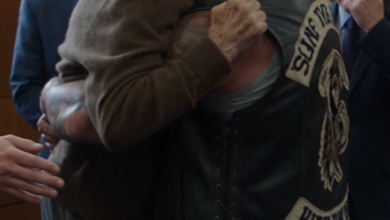
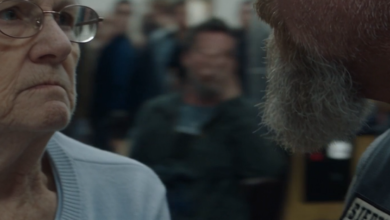
A Biker Dragged A 13-Year-Old Boy Away From His Friends And Threw Him On His Motorcycle In Broad Daylight — Everyone Thought It Was A Kidnapping Until They Learned What He Was Really Saving Him From
Part 2
The biker’s name was Sal, and the boy was his nephew, Danny.
Nobody on that street corner knew that. They just saw a stranger grab a kid. But Sal had known Danny since the day he was born — had held him as an infant, taught him to ride a bike, slipped him twenties on his birthday. Sal was Danny’s uncle, his late father’s older brother, and he loved that boy more than just about anything left in his life.
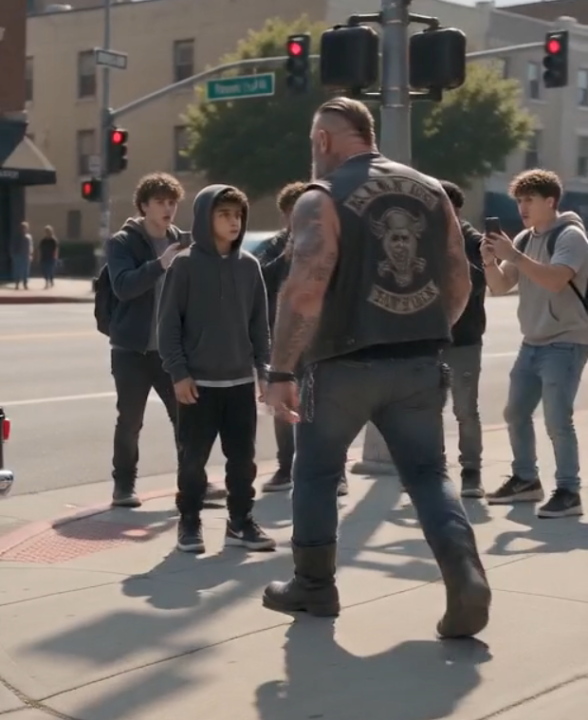
To understand why Sal did what he did, you have to understand who Sal used to be.
Sal grew up in the same neighborhood Danny was growing up in now. Same streets. Same corners. And when Sal was about Danny’s age — thirteen, fourteen — he’d stood on a corner just like that one, with a group of older boys, and gotten pulled into a life that took him twenty years to climb back out of.
It started small. It always does. Holding something for somebody. Running a package down the block for easy money. Being a lookout because nobody suspects a kid. The older guys made him feel chosen, made him feel like family, made him feel like somebody finally saw something in him. And by the time Sal understood what he’d actually signed up for, he was in too deep to just walk away.
He sold drugs through his teens and into his twenties. He did things he won’t talk about. He did time — real time, hard time. He lost years. He lost his own father, who died while Sal was locked up, ashamed of what his son had become. He came out the other side of all of it a different man, but a broken one, with a record that followed him and a list of regrets that didn’t fit in one saddlebag.
The thing that saved him, in the end, was a man at a halfway house who taught him to fix motorcycles. Gave him a trade. Gave him a reason to get up. Gave him, for the first time in his life, an honest thing to be good at. Sal built a whole new self around that grease and chrome, and he never forgot that one man with a wrench had reached down and pulled him onto solid ground.
So Sal had spent the years since watching the corners. Watching the neighborhood kids. Knowing the signs, because he’d lived every one of them. And dreading the day he’d see those signs on somebody he loved.
Then he saw them on Danny.
Part 3
Danny’s father — Sal’s younger brother — had died when Danny was eleven. Heart attack, sudden, too young. And that loss had knocked the floor out from under Danny the way it knocks the floor out from under any boy who loses his dad at that age.
Danny’s mother did everything she could. She worked two jobs to keep them afloat, which meant she was gone a lot, which meant Danny had a lot of empty hours and a hole in his chest where a father used to be. And the streets are very, very good at finding boys with empty hours and holes in their chests.
There was a crew that worked Danny’s neighborhood. Older boys, some grown men behind them, running exactly the kind of operation Sal had run twenty years before. And they’d started circling Danny. Sal had seen it building for weeks — the new sneakers Danny’s mother couldn’t have bought him, the cash in his pocket, the way he’d started talking, the older “friends” who’d appeared out of nowhere. The way Danny had started carrying himself, trying to look hard, trying to look like he belonged to something.
Sal knew every single sign because he’d worn every single one of them at the same age.
He’d tried talking to Danny. Gently, at first. Took him for rides, took him to the shop, tried to plant the idea of a different life. Danny brushed him off. Thirteen-year-olds don’t think anything can touch them, and the crew was offering Danny everything he was starving for — money, status, a father-shaped sense of belonging — and Sal’s quiet talks couldn’t compete with that.
Then Sal heard, through people who still knew things, that it was about to happen for real. That the crew was going to put Danny to work that very week. Hand him his first real package. Cross the line that, once crossed, doesn’t get uncrossed. The line Sal had crossed at the same age and spent twenty years paying for.
Sal had a choice. He could keep being gentle and watch his nephew walk through the same door he’d walked through. Or he could do something drastic, something that would look terrible, something that might cost him.
He chose his nephew over how it would look.
Part 4
That’s the corner you all filmed.
Sal rode straight to it the afternoon he got the news. He saw Danny standing with the crew — saw, with his own eyes, money changing hands, saw Danny in the middle of it being welcomed, being made one of them. Saw his brother’s son one step from the cliff.
And Sal didn’t deliberate. He couldn’t. There was no time for another gentle talk. So he did the only thing that would physically remove Danny from that corner that day: he walked into the middle of a drug crew, in broad daylight, grabbed his nephew, and dragged him out.
Understand what that took. Sal walked up on a working crew — dangerous men — and pulled their newest recruit right out of their hands in front of everybody. That’s not a safe thing to do. Men have been hurt for far less. Sal knew it. He did it anyway, because the alternative was losing Danny to the exact life that had nearly destroyed him.
To the street, it looked like a kidnapping. To the crew, it was an insult and a challenge. To Danny, in that moment, it was his uncle ruining everything, humiliating him in front of the only people who’d made him feel important since his dad died.
Danny was furious. He cussed Sal out the whole ride. Told him he hated him. Told him he didn’t understand, that those were his friends, that he had it handled, all the things a thirteen-year-old says when an adult has just yanked him back from an edge he can’t see.
Sal let him yell. He just rode. He took Danny to the one place he knew might reach him.
His motorcycle shop.
Part 5
Sal didn’t lecture him at the shop. He’d learned, the hard way, that lectures don’t work on a boy like Danny, because they hadn’t worked on a boy like Sal.
Instead, he told Danny the truth. All of it. The whole ugly story he’d never told his nephew before — the corners, the packages, the prison, the years lost, his own father dying ashamed of him. He rolled up his sleeves and showed Danny the tattoos he’d gotten inside and told him what each one really meant. He told Danny about the friends from that life who were dead now, and the ones still locked up, and the ones who’d never gotten out from under it.
“Those boys on the corner aren’t your family,” Sal told him. “I know it feels like it. It felt like it to me too. But family doesn’t hand a thirteen-year-old a package and let him take the fall. I’m your family. And I’m not gonna stand here and watch you walk into the exact fire that burned me, when I’m the one person alive who knows the way out.”
Danny didn’t soften right away. But Sal didn’t need right away. He needed Danny off that corner and somewhere else, somewhere with a different door open.
So he opened the door he had. He put a wrench in Danny’s hand.
He started teaching the boy to fix motorcycles. Same as that man at the halfway house had done for him twenty years before. After school, weekends, Danny came to the shop — at first because Sal basically made him, and Danny’s mother, when she heard the whole story, backed Sal completely. But slowly, something shifted. It turned out Danny was good at it. Had a feel for engines. And there is something that happens to a boy with a hole in his chest when he discovers he can take a dead machine and bring it back to life with his own two hands. It fills something. It gives him a thing to be proud of that doesn’t require hurting anybody.
The cash from the crew had made Danny feel important for a minute. The first engine he rebuilt himself made him feel important in a way that lasted.
Part 6
It wasn’t instant and it wasn’t clean.
The crew didn’t just let Danny go. There was pressure. There were a couple of bad weeks where Danny wavered, where the pull of the easy money and the older boys’ approval fought against the slow, unglamorous work of the shop. Sal weathered all of it. He showed up at Danny’s school. He showed up at the corner when he had to and stared down men half his age. He made it clear, to the crew and to Danny both, that this boy was spoken for, and that to get to Danny they’d have to come through an uncle who had absolutely nothing left to lose and knew their whole game from the inside.
They backed off. Boys like Danny are common; an uncle willing to walk into a working corner and drag his nephew out by the collar in daylight is not. Not worth the trouble. They moved on to easier recruits, which is its own kind of heartbreak, but Sal could only save the one boy that was his to save.
And he saved him. Danny left the crew. For good.
He kept coming to the shop. By the time he was sixteen, Sal had put him on the payroll — a real job, real wages, the kind of money that comes with grease under your nails and nothing to be ashamed of. Danny got good. Better than good. Customers started asking for the kid. Sal would stand at the back of the shop and watch his brother’s son work, and he’d have to turn around sometimes so Danny wouldn’t see his face.
Because Sal was watching the thing he’d wanted his whole life. A do-over. Not for himself — that ship had sailed twenty years ago. But for the boy. A version of Sal’s own story where somebody reached in at thirteen instead of letting it run all the way to prison. Sal couldn’t go back and pull his younger self off that corner.
But he could pull Danny off this one.
Part 7
Danny’s a grown man now. He works at the shop still — co-owns it, actually. Sal made him a partner. The sign out front has both their names on it.
The police, by the way, did come, the night all those videos got turned in. Mine included. They showed up at Sal’s shop ready for a kidnapper and found a tattooed biker calmly explaining that the “victim” was his nephew, asleep upstairs, and that the boy’s own mother had thanked him on her knees. It got sorted. The videos that were supposed to convict him mostly got deleted, except a few that the people who’d filmed them kept, sheepishly, after they learned the truth — kept as a reminder of how wrong the eyes can be about a man.
The kid who filmed the first half of this is one of those people. Still has the video. Still thinks about that corner every day.
Sal doesn’t talk about it much. He’s not a talker. But somebody asked him once, at the shop, why he did it — why he risked the arrest, the crew, the whole thing, to grab one kid off one corner.
He wiped his hands on a rag and looked over at Danny, bent under the hood of somebody’s bike, whole and safe and his.
“I pulled him out of the mistake I made,” Sal said. “Somebody should’ve pulled me. Nobody did. So I did it for him.” He went back to his work. “That’s the whole reason I’m still here, far as I can tell. To be the guy nobody was for me.”
Some men grab a kid and you call the cops.
Some men grab a kid and save his life.
If this one reached you, follow the page — there’s always another brother worth telling about.