A Biker Carried a Young Bride Out of Her Wedding While Guests Called the Police—Then She Revealed the One Message That Brought Him There
I had a twenty-four-year-old bride in my arms, her white dress dragging across the church steps while seventy wedding guests screamed that I was kidnapping her, when she pressed her face against my leather vest and whispered, “Please don’t put me down.”
The first police siren reached us before I made it to my Harley.
People remember the siren. They remember the bride’s mother running through the church doors without her shoes, the groom shouting my name, and three men in matching gray suits trying to block the sidewalk. What most of them did not remember was that Lily Hart never asked me to stop.
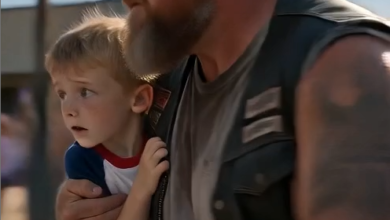
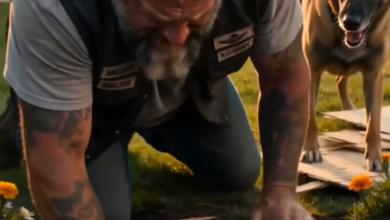
My name is Raymond Mercer, though everybody at the Iron Lanterns clubhouse calls me Bear. I was fifty-four that October, six-foot-four, nearly 280 pounds, with a gray beard reaching my chest and enough old ink on my arms to make strangers decide what kind of man I was before I opened my mouth.
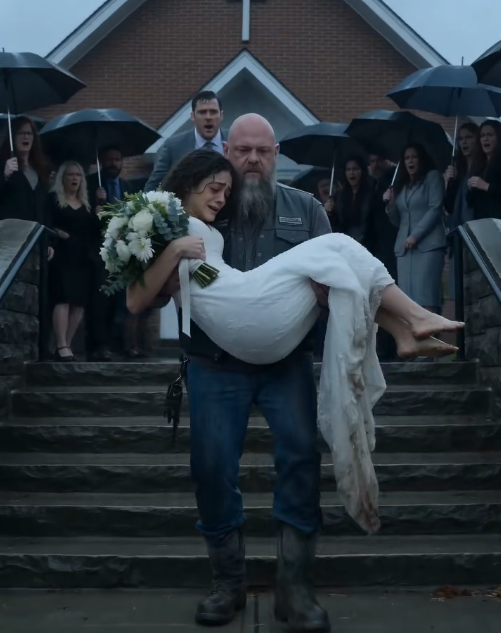
That afternoon, wearing my weathered leather cut, black T-shirt, riding boots, and rain-spotted jeans, I looked exactly like the kind of man people expected to ruin a wedding.
Maybe that was why nobody listened when I said, “Ask the bride.”
Lily’s fingers tightened around my shoulder.
“She’s confused!” the groom shouted from the doorway. “Somebody stop him!”
His name was Carson Vale. Thirty-two years old. Clean haircut. Expensive suit. A family with its name on three commercial buildings in Westbridge, Ohio. He had the polished voice of a man accustomed to being believed on the first try.
I had met him twice.
The first time, he shook my hand while looking at my tattoos.
The second time, he told Lily she had outgrown people like me.
A deputy’s cruiser turned across the church lawn and stopped crooked beside the curb. Officer Elena Ruiz stepped out before the wheels had fully settled. Her hand stayed close to her holster, but she did not draw it.
“Put her down,” she ordered.
“I will,” I said. “When she tells me to.”
That made the crowd louder.
Someone shouted that I had a weapon. I didn’t. Someone else said I belonged to a gang. We were a registered riding club that spent more weekends replacing veterans’ roofs than fighting anybody, but that truth did not travel as fast as a frightened guest with a phone.
Carson came down the steps, his face red beneath the careful wedding-day makeup someone had applied for photographs.
“That man is obsessed with her,” he told Ruiz. “He isn’t family.”
Lily moved her face away from my vest.
Rain had loosened several dark curls from the pins above her veil. Mascara had collected beneath one eye, and there was a pale indentation around her wrist where a bracelet had recently been removed.
Officer Ruiz saw it.
So did I.
“Miss,” Ruiz said, keeping her voice level, “do you know this man?”
Lily nodded.
“Did he remove you from the church against your will?”
Her mouth opened, but no sound came out.
Carson stepped closer. “She has panic attacks. I can explain.”
Ruiz lifted one palm toward him.
“I asked her.”
That was the first quiet moment we had been given.
Lily looked at the crowd behind us: her mother clutching the doorframe, Carson’s father speaking rapidly into a phone, the pastor standing beneath the carved wooden cross, and guests holding their cameras high enough to catch every second of her humiliation.
Then she looked at me.
Her voice was barely louder than the rain.
“I called him.”
Carson stopped moving.
I set Lily carefully on her feet, though I kept one hand near her elbow because her knees were shaking. The hem of her dress was soaked gray. One of her satin shoes was missing, and the skin across her heel was bleeding.
Ruiz moved between us and the church.
“What did you call him for?”
Lily swallowed.
My phone was still in the inside pocket of my vest. At 1:17 that afternoon, twenty-eight minutes before she was supposed to say her vows, one message had appeared from a number I had not seen in nearly eight months.
There had been no greeting.
No explanation.
Only thirteen words.
If you still think of me as your daughter, come before I say yes.
I had ridden eleven miles through cold rain, called the two people I trusted most, and entered St. Matthew’s while the organist was finishing the processional.
I had not touched Lily until I stood at the end of the aisle and asked one question.
“Do you want to leave?”
She had looked toward her mother.
Then toward Carson.
Then back at me.
“Yes.”
Her legs folded beneath her before she managed another word, so I caught her.
That was the moment the guests saw.
That was the moment their videos began.
Officer Ruiz listened while rain gathered along the brim of her cap. She asked Lily whether she wanted medical help, whether she felt threatened, and whether she wished to go somewhere away from both Carson and me.
Lily looked past her toward a silver sedan parked across the street.
A Black woman in a navy raincoat stood beside it, holding a closed umbrella and a leather document case. Next to her was Boone, my club’s vice president, his hands visible and his expression calm.
Carson recognized the woman.
The color left his face.
“You brought a lawyer?” he asked.
I had.
Her name was Denise Ward, and she had spent sixteen years helping people leave homes where every door technically remained unlocked.
But Lily had not yet told us why she believed she needed one.
She reached inside the fitted pocket sewn beneath the skirt of her wedding dress and removed a folded piece of paper, damp from her trembling hand.
Carson took one step toward it.
Officer Ruiz stopped him.
Lily unfolded the page, glanced at the signatures near the bottom, and said the words that changed the scene from a ruined wedding into something much darker.
“He said my mother loses her house if I don’t marry him today.”
Part 2
Officer Ruiz did not react the way the crowd expected. She did not arrest Carson because Lily had made an accusation, and she did not declare the wedding a crime while guests were filming. She separated people, requested another unit, and moved Lily beneath the stone awning beside the parish office.
Real life slows down when everyone wants it to become a movie.
Names must be taken. Statements must be separated. Nobody gets to solve another person’s life by looking angry enough.
Denise approached only after Ruiz invited her over. She identified herself, showed her bar card, and asked Lily whether she wanted Denise to represent her.
Lily said yes.
Carson tried to follow.
Ruiz told him to remain beside the steps.
He obeyed, but the expression he gave Lily was not heartbreak. I had seen heartbreak. It is loose and bewildered. Carson’s face was tight with calculation, as though something he owned had moved beyond his reach.
I learned later that Officer Ruiz noticed the same thing.
While another deputy collected identification, I stood several yards away with Boone. My leather vest was wet, my beard was dripping onto my shirt, and my right hand would not stop shaking.
Boone noticed.
“Easy, brother.”
“I’m easy.”
“You look ready to bite through brick.”
“I said I’m easy.”
He moved half a step closer. Boone had known me for nineteen years, which meant he understood that sometimes standing near me was the only argument I would accept.
Through the office window, I saw Lily sit in a wooden chair. Denise crouched beside her rather than standing over her. Ruiz brought a wool blanket from the cruiser, and Lily wrapped it around her shoulders, covering most of the wedding dress.
Her mother, Marlene Hart, remained outside.
She was forty-nine, small and usually precise, the kind of woman who ironed pillowcases and arrived ten minutes early for dentist appointments. That afternoon, she stood barefoot on wet stone, looking at the daughter she had helped dress for a wedding that had just fallen apart.
I had known Marlene since Lily was eleven.
Her husband, Daniel, had been my closest friend.
Daniel Hart and I met when we were both twenty-two and repairing conveyors at a paper mill outside Dayton. He had clean hands, a new marriage, and plans written on graph paper. I had two driving-under-the-influence arrests, a couch in my sister’s basement, and a motorcycle held together with borrowed parts.
He should not have trusted me.
He did anyway.
Daniel helped me get sober without ever calling himself my sponsor. He would arrive at four in the morning with coffee and sit on the garage floor until my hands stopped shaking. Years later, when I opened a small fabrication shop, he became my first employee and then my partner.
Lily grew up sweeping our floor for quarters.
She called me Uncle Ray until she was fourteen, when Daniel was killed by a driver who crossed the center line on State Route 48.
After the funeral, she stopped using “uncle.”
She simply called me Ray.
But on Father’s Day, she left a card on my workbench.
Inside, she had written, You are the closest thing I still have.
I kept that card in the locked drawer beneath my welding gloves.
For six years, I attended school conferences when Marlene had late shifts, repaired whatever broke at their house, and taught Lily to drive in my dented Ford pickup. When she graduated, I stood behind Marlene and shouted loudly enough to embarrass her.
When she entered nursing school, I helped buy her textbooks.
I never tried to replace Daniel.
I just kept showing up.
Then Carson arrived.
At first, he was generous in ways that were difficult to criticize. He paid a plumbing bill at Marlene’s house. He arranged a better-paying administrative job for Lily at one of his family’s assisted-living facilities. When Marlene’s mortgage fell behind after a surgery kept her from working, Carson introduced her to a company that could “restructure” the debt.
Every kindness created one more reason Lily felt rude for saying no.
The changes came slowly.
Carson disliked her nursing classmates because they were “immature.” He said the Iron Lanterns embarrassed her professionally. He objected to my criminal record, though my last arrest had occurred before Lily was born.
He never ordered her to stop speaking to me.
He made every conversation cost her something afterward.
Eight months before the wedding, Lily came to my shop alone. She sat at Daniel’s old drafting table and told me she was engaged.
I asked whether she was happy.
She said, “Everyone else is relieved.”
I should have understood.
Instead, I told her relief was not the same as love. I said Carson collected gratitude and called it affection. My voice rose. Hers did, too.
She accused me of judging a man who had helped her mother when I could not.
That landed because it was partly true.
Marlene needed nearly $38,000 to bring the loan current and cover medical bills. I had offered everything I could without closing the shop, but it had not been enough. Carson’s family company had stepped in.
Lily left angry.
Two days later, my calls stopped reaching her. Messages showed as delivered, then eventually did not. Marlene told me Lily needed space.
So I gave it.
That was my mistake.
Outside the church, Marlene finally walked toward me. Rain had darkened the shoulders of her pale blue dress, and one stocking was torn beneath the knee.
“What have you done?” she asked.
“Answered her.”
“You humiliated her in front of everyone.”
I looked through the parish-office window. Lily sat beneath the blanket, her bare feet together, while Denise read the wet document.
“She looked humiliated before I arrived.”
Marlene flinched.
Then she whispered, “You don’t know what happens now.”
Before I could ask what she meant, Carson’s father crossed the lawn carrying a black binder.
He handed it to the second deputy and said the papers inside proved Lily had agreed to every arrangement voluntarily.
Part 3
The binder contained more than wedding plans.
There were copies of Marlene’s mortgage, notices of default, invoices from the rehabilitation center where she had recovered after spinal surgery, and a transfer showing that a Vale-controlled company had purchased the lien on her house.
There was also a prenuptial agreement.
Lily’s signature appeared on every page.
Denise studied the documents at a desk inside the parish office while Officer Ruiz recorded Lily’s statement. I waited in the hallway because Lily had asked me to stay close, though Ruiz had correctly decided that my presence during the interview could influence what she said.
The office smelled of wet wool, copier toner, and the cinnamon candles somebody had lit for the wedding.
Through the wall, I heard Lily speak in fragments.
Carson had proposed five months after his company acquired the lien.
He told her the debt would disappear once they were married.
When she asked for the promise in writing, he said contracts between future spouses were insulting.
Then the pressure changed.
If Lily postponed the wedding, Carson said the company might resume foreclosure. If she embarrassed him publicly, he could no longer guarantee Marlene’s position at a Vale-owned clinic. If Lily returned to nursing school, he said she would be neglecting the family they were about to build.
None of those statements sounded like a threat when repeated alone.
Together, they formed a room without visible walls.
Lily had attempted to cancel twice. The first time, Carson drove her to her mother’s house, placed the foreclosure notice on the kitchen table, and asked whether she wanted Marlene packing boxes because of “premarital nerves.”
The second time, Marlene cried until she could not breathe.
So Lily apologized.
The wedding continued.
I sat on a narrow bench beneath a bulletin board covered in children’s drawings. Boone stood at the end of the hall, watching Carson through the glass door.
A younger club member named Travis arrived during the interview. He was twenty-six, hot-tempered, and wearing his anger openly.
“Say the word,” he muttered.
“What word?”
“We get him away from her.”
“He is away from her.”
“You know what I mean.”
I looked at him.
“No.”
Travis’s jaw shifted. “Bear, he bought her mother’s house to trap her.”
“And if you touch him, tomorrow’s story becomes about bikers attacking a groom.”
“He deserves—”
“Stand still.”
He did.
That may not sound like much, but restraint is sometimes the hardest thing a man can contribute. Travis stood against the wall with his fists closed while Carson accused us of intimidation outside.
We let the police hear every word.
After nearly an hour, Ruiz came into the hallway.
She said Lily had not described physical force sufficient for an immediate arrest. Financial and emotional coercion could matter, but the documents would need review, and civil remedies moved differently from criminal charges.
Carson was free to leave.
So was Lily.
The wedding, of course, was over.
That should have been the false ending: bride rescued, ceremony stopped, villain exposed.
It wasn’t.
When Lily emerged from the office, Carson was waiting under the awning with an expression so calm that it frightened me more than his shouting had.
He did not approach her.
He spoke to Marlene.
“The loan grace period ends at five.”
Marlene covered her mouth.
Denise checked her watch. It was 3:08 p.m.
“What happens at five?” Ruiz asked.
Carson’s father answered. “The company files the final foreclosure documents.”
Lily went pale.
Denise turned toward her. “Did anyone disclose a deadline to you in writing?”
Lily shook her head.
Carson gave a small shrug. “She knew the wedding was today.”
There it was.
Not a confession. Not enough for handcuffs. Just the machinery beneath the flowers.
Marlene grabbed Lily’s hands.
“Please,” she said. “We can still fix this.”
Lily stared at her mother.
For one awful second, I thought Marlene was asking her to return to the altar.
Maybe Lily thought so, too.
Then Marlene reached into the front of her dress and removed a small brass key attached to a safety pin.
“I’m sorry,” she whispered.
The key opened a locked drawer in Marlene’s bedroom. Inside, she said, was every letter Carson had told her to hide from Lily, along with the original loan correspondence and an old phone he believed she had thrown away.
Carson’s calm expression vanished.
“Marlene,” he said.
She stepped behind Officer Ruiz.
The second deputy moved toward Carson as a precaution, and Boone quietly placed himself between Travis and the church doors.
Denise asked what was on the phone.
Marlene began to cry, though she still managed to answer.
“Voicemails. From him. He said if she walked away, he’d make sure she watched me lose everything.”
Lily released her mother’s hands.
Not violently.
She simply let them go.
That hurt Marlene more.
We drove to the Hart house in three vehicles. Ruiz explained that Marlene could retrieve her own property, but police would not conduct a search without proper authority. Denise asked everyone to preserve the phone, avoid deleting anything, and photograph the drawer before removing its contents.
Carson followed in his car until Ruiz warned him that Lily had requested no contact.
At the house, Marlene found the drawer already open.
The letters were gone.
The old phone remained, but its screen was shattered and the battery had been removed.
A muddy footprint marked the bedroom carpet beneath the window.
Somebody had reached the house before us.
Then Lily looked at the empty drawer and said, “Carson knew about the key.”
Only three people had known it existed.
Marlene.
Carson.
And the woman who had helped Lily fasten her wedding dress that morning.
Lily’s maid of honor.
Her best friend, Allison.
Part 4
Allison did not answer Lily’s calls.
She had left the church during the police interviews, telling another bridesmaid that the scene had triggered a migraine. Her car was no longer in the parking lot, and by the time Ruiz requested that another officer check her apartment, nobody was home.
Lily sat at her mother’s kitchen table wearing the church blanket over her wedding dress. Broken glass from the old phone lay inside a clear evidence bag on the counter.
She looked smaller than she had at eleven.
I hated that thought because it made me want to decide things for her, and too many people had already done that.
Denise asked whether Lily wanted to remain at the house.
“No.”
“Do you have somewhere you choose to go?”
Lily looked at me but did not answer immediately.
That pause mattered.
“I have the apartment above the shop,” I said. “Door locks from inside. Denise can stay. I’ll sleep at the clubhouse.”
Lily nodded. “There.”
Marlene closed her eyes.
She understood that she was not included in the decision.
On the way out, Lily stopped beside my truck. My Harley remained at the church because Boone had correctly decided that a soaked bride in a full gown did not need a motorcycle ride added to her day.
“I thought you’d ignore the message,” she said.
“I almost didn’t see it.”
“No. I mean after what I said at the shop.”
I opened the passenger door, then waited.
“You were angry.”
“I told you that you weren’t my father.”
“I’m not.”
Her face tightened.
I continued before she could turn away.
“But you asked whether I still considered you my daughter.”
Rain ticked against the truck roof.
“That answer was easy.”
She climbed inside without speaking.
At the shop, Denise helped Lily change into sweatpants and a flannel shirt we kept for customers caught in bad weather. The wedding dress lay across the apartment sofa, white fabric stained by mud along the entire train.
Boone brought food nobody ate.
Officer Ruiz arrived after her shift ended, wearing jeans and a dark sweater. She made it clear that she was visiting as a private person and had already turned over the official matter to investigators.
She carried a paper grocery bag.
Inside were a toothbrush, socks, a phone charger, and inexpensive slippers.
“I spent six months in a motel with my daughter,” she told Lily. “People remembered legal advice. Nobody remembered I didn’t have clean socks.”
Lily hugged the slippers to her chest.
Ruiz stayed only ten minutes.
That small visit did more than any speech could have done.
At 8:40 p.m., Allison called.
She did not call Lily.
She called me.
Her voice was shaking so badly I placed the phone on the table and turned on the speaker with her permission. Denise began writing notes.
Allison admitted she had taken the letters. Carson had called while the police were at the church and told her Marlene wanted the drawer cleared before “the biker people” reached the house. Allison had believed him because Marlene had spent months defending the marriage.
She had entered through the back door using a key Lily once gave her to water plants.
Then she listened to one of the voicemails.
In it, Carson told Marlene that Lily would marry him because “girls with dead fathers eventually choose the man who controls what remains.”
Allison stopped believing him.
She had not destroyed the documents.
She had hidden them inside a twenty-four-hour laundromat locker on Sycamore Avenue because Carson’s cousin was waiting near her apartment.
Denise told her to remain in a public place and contact the assigned detective. Nobody from our club went near her. Boone wanted to. Travis begged to.
I told them both to stay put.
By 10:15, police had retrieved the letters and the missing battery. A digital-forensics technician would handle the phone. Denise examined photographs of the original loan papers.
That was when she saw the irregularity.
The company listed as the current lienholder was Vale Residential Recovery LLC. The notarized assignment appeared valid, but one exhibit referenced a parcel number that did not match Marlene’s property.
At first, Denise assumed it was a clerical error.
Then she checked another page.
The payment history ended three months before the supposed transfer, even though Marlene had made two later payments directly to her bank.
Denise made three calls. The bank’s after-hours department would confirm little, but one representative stated that the mortgage remained in an internal review process and had not been sold to the company named in Carson’s binder.
The paper that had ruled Lily’s life might not represent any real debt at all.
Carson had not purchased Marlene’s house.
He had purchased information about her fear, then built paperwork convincing enough to weaponize it.
At 11:03, Detective Marcus Bell arrived at the shop. He reviewed what Denise had gathered and warned us that determining fraud would take time.
Then he placed the black wedding binder on the table.
One page bore Lily’s signature as a witness to the mortgage assignment.
The date showed she had signed it four months earlier.
Lily stared at the signature.
“That’s mine,” she said.
Denise asked whether she remembered the document.
Lily’s face changed.
Carson had brought a stack of insurance forms to her office after lunch one day. He marked the signature lines with yellow tabs and stood beside her while she signed.
She had never been given copies.
The document had been placed beneath those forms.
The evidence did not merely suggest emotional pressure anymore. It suggested a signature obtained through deception and used to support a false financial claim.
Bell closed the binder.
“We can work with this.”
Lily looked relieved for half a second.
Then someone knocked three times on the metal shop door.
Every biker in the room stood.
A woman’s voice came through the steel.
“Raymond, it’s Marlene.”
I opened the door.
Lily’s mother stood alone, holding a narrow wooden box I recognized from Daniel’s funeral.
She placed it in Lily’s hands.
“Your father left instructions for Ray,” she said. “I hid those, too.”
Part 5
The box contained no money, secret deed, or miraculous solution.
Daniel was a machinist. He trusted objects more than speeches.
Inside were his wedding ring, the brass caliper he carried at work, three photographs, and a sealed envelope with my name written in block letters.
The envelope had been opened.
Marlene admitted she had read it years earlier.
Daniel wrote the letter during a hospital stay six months before his death, when doctors were investigating a heart rhythm problem that eventually proved manageable. He had not expected to die in a highway collision, but becoming a father had made him prepare for possibilities he once ignored.
Most of the letter concerned practical matters.
The final paragraph concerned Lily.
Ray, if I’m gone, don’t make decisions for her just because you’re scared. Teach her to check her own oil, let her hate you when she needs to, and show up if she asks. Especially when asking costs her something.
There was one more line beneath his signature.
She may call you Dad one day. Don’t make her feel disloyal if she does.
I read the paragraph twice.
Then I folded the letter.
Lily sat beside me at the workbench, turning Daniel’s wedding ring between her fingers.
“Why did you hide this?” she asked her mother.
Marlene looked at the floor.
“Because he trusted Ray with the part of you I wanted to believe belonged only to us.”
It was an ugly answer.
It was also honest.
After Daniel died, Marlene had watched Lily run toward me whenever something broke. A flat tire. A failed exam. A boy who frightened her at a party. Marlene knew I was helping, but grief does not always separate help from replacement.
When Carson began telling her that my influence kept Lily attached to a rougher life, he was speaking into a fear already waiting for him.
Marlene wanted the house because Daniel had repaired its porch, marked Lily’s height on the pantry frame, and died believing the mortgage would someday be paid. Carson recognized that keeping the building mattered more to her than examining the papers attached to it.
He did not create every weakness.
He mapped them.
Then he used them.
Lily listened without interrupting. When Marlene finished, Lily placed Daniel’s ring back in the box.
“I can’t go home with you tonight.”
“I know.”
“I don’t know when I can.”
Marlene nodded.
“I know that, too.”
She left the box and walked out alone.
Nobody stopped her.
By noon the next day, the story had spread across local Facebook pages. The most popular video began with me lifting Lily from the church floor and ended before Officer Ruiz asked whether she knew me.
The caption called me “a biker who stormed a wedding and stole the bride.”
Another video included Lily saying she had called me, but it had fewer views.
Truth is often longer than the clip people prefer.
The shop received threats, praise, interview requests, and two cancellations from customers who did not want their trucks serviced by “an outlaw operation.” Someone threw a brick through the front office window after midnight.
Travis wanted to post everything we knew.
Denise refused.
“A criminal investigation isn’t content,” she said. “And Lily’s worst day doesn’t belong to your page.”
That ended the discussion.
Carson’s attorney issued a statement saying the wedding had been disrupted by an unstable family acquaintance. It described Lily as emotionally distressed and claimed all financial documents were legitimate.
Then the old phone was recovered.
The battery Allison returned still worked.
Most recordings were damaged, but three voicemails remained accessible. Carson never explicitly said, “Marry me or lose the house.” He was too careful for that.
Instead, he said things like:
The board’s patience depends on whether our families become one.
Your daughter can end this uncertainty whenever she chooses.
And, in the final message:
If she embarrasses me Saturday, I promise she’ll remember what it cost you.
Detective Bell told us those messages mattered when combined with the questionable documents and deceptive signature. Investigators obtained warrants for business records and electronic communications.
Two weeks later, Carson was charged with multiple financial offenses connected to more than Marlene’s house.
That was another turn none of us expected.
Investigators alleged that Vale Residential Recovery had approached several homeowners already struggling with medical bills or delinquent taxes. The company exaggerated its authority, collected improper “stabilization” payments, and used threats of displacement to obtain signatures.
Lily had not been the first vulnerable person Carson pressured.
She was simply the first one he tried to marry.
His father claimed ignorance. Whether that was entirely true became the subject of a separate investigation. Carson entered a plea of not guilty, posted bond, and was ordered to have no contact with Lily or Marlene.
The charges did not restore everything.
Marlene still owed legitimate money to the bank. Her home was still under review. Lily remained unemployed because she refused to return to a facility connected to the Vale family. Legal proceedings moved slowly, and online strangers continued calling her either a liar or a helpless child.
Rescue, I learned again, does not end when the door opens.
It begins there.
Lily spent the next month in the apartment above my shop. She met with a counselor, reopened her nursing-school application, and changed her phone number. Denise helped her seek a protective order based on the documented pattern of coercion and threats.
I fixed the broken office window.
Boone installed a better camera.
Travis stood in the parking lot during every press visit, doing the difficult work of saying nothing.
One evening, I found Lily at Daniel’s drafting table, still wearing the inexpensive slippers Ruiz had brought. The wedding dress had been cleaned and sealed inside a garment bag.
“You keeping it?” I asked.
“For now.”
“Why?”
She ran one finger along the zipper.
“Because I want to decide what happens to it.”
That answer told me she was getting stronger.
Then she pushed a small envelope across the table.
Inside was a card she had found while packing her apartment.
It was the Father’s Day card she had written years earlier.
At the bottom, beneath the sentence I remembered, she had added words I had never noticed because the ink was pale.
If I ever stop calling, please come find me.
Part 6
I did not frame the card.
That would have turned it into a relic, and Lily was alive.
I placed it in my wallet, behind my motorcycle registration, where it bent a little more each week. Every time I saw the worn corner, I remembered that promises are rarely kept through grand gestures. Most are kept through ordinary repetition.
On Tuesday mornings, I drove Lily to counseling because the bus route required two transfers. On Thursdays, she attended evening classes, and Boone left a container of whatever his wife had cooked outside the apartment door.
We did not ask for reports.
Some nights Lily joined us downstairs. Other nights she locked the apartment, turned off the lights, and needed the building to be quiet.
We learned both were forms of progress.
Marlene began counseling separately. She sold several pieces of jewelry to hire an attorney and cooperated with investigators even when doing so exposed her own decisions. The bank eventually approved a repayment plan based on the legitimate balance rather than Carson’s fabricated figures.
Lily did not immediately forgive her.
Marlene kept showing up anyway.
Every Sunday at four, she brought coffee and sat on the shop’s front bench for twenty minutes. If Lily came down, they spoke. If she did not, Marlene left the cup beside the stairs.
For six Sundays, Lily stayed upstairs.
On the seventh, she opened the door.
I watched from the welding bay as mother and daughter sat three feet apart, each holding a paper cup. They did not hug. Marlene spoke. Lily listened. Then Lily said something I could not hear.
Marlene nodded.
Twenty minutes became forty.
That was enough.
Officer Ruiz visited once more in uniform, this time to return Lily’s satin shoe. A church custodian had found it beneath the final pew.
The heel was broken.
Lily laughed when she saw it, which surprised all three of us.
“Everybody online says he carried me because I collapsed,” she told Ruiz.
“You did collapse.”
“Because my shoe snapped.”
Ruiz glanced at me. “He left that detail out.”
“I had bigger details.”
Lily placed the shoe on Daniel’s drafting table.
The object changed meaning again. It had looked like evidence of panic, then injury, then helplessness. To Lily, it became proof that her body had stopped cooperating at precisely the moment her voice finally did.
Carson’s case continued. His attorneys delayed hearings and challenged the recordings. I will not pretend justice arrived cleanly or quickly.
But the wedding never resumed.
That mattered.
Nine months after the church, Lily was accepted back into nursing school. She chose a program in Dayton, forty minutes away, and rented a small apartment with another student.
The morning she moved, I carried three boxes down the stairs.
She carried the wooden box containing Daniel’s ring.
Before closing the truck, she looked toward my Harley.
“You know you could’ve just taken my hand that day.”
“You fell.”
“I stumbled.”
“You were wearing curtains and one shoe.”
She laughed.
Then her expression softened.
“When I texted you, I didn’t know what I wanted you to do.”
“Neither did I.”
“You came anyway.”
“That part I understood.”
She hugged me beside the truck, slowly and without cameras.
For the first time since the wedding, nobody misunderstood what they were seeing.
Part 7
A year after I carried Lily from St. Matthew’s, I returned to the church.
I did not arrive during a wedding.
The parish had agreed to host a legal-aid clinic for people facing housing pressure, financial coercion, and unsafe relationships. Denise organized it. Officer Ruiz arranged for a victim-services coordinator to attend.
The Iron Lanterns set up folding tables and carried boxes.
That was our entire assignment.
Lily arrived wearing navy nursing scrubs, her hair tied behind her head, and Daniel’s wedding ring on a chain beneath her shirt. She was working clinical rotations three days a week and complaining about sleep like every other nursing student.
Marlene came separately.
They entered together.
The same pastor who had watched me carry Lily through the doors greeted us near the aisle. He apologized for shouting that day.
“So did everybody,” I said.
“I thought you were taking her.”
“I was.”
He waited.
“Where she asked to go.”
That distinction had taken me a year to understand fully.
Near the altar, Lily placed a cardboard box filled with prepaid phones donated by the club. Each one came with a charger, emergency numbers, and instructions prepared by the legal-aid team.
No dramatic speeches followed.
People drank bad coffee. Children drew on scrap paper. Denise reviewed documents beneath fluorescent lights while rain tapped softly against the stained-glass windows.
Before leaving, Lily walked to the pew where her broken shoe had been found.
She stood there for a while.
Then she returned carrying a white garment bag.
Inside was the wedding dress.
She had asked a local seamstress to remove the train and divide the fabric into smaller pieces. Some would become burial gowns for infants at a nearby hospital. The rest would be sewn into plain white lining for emergency bags given to women leaving unsafe homes.
“I finally decided what happens to it,” she said.
I touched the edge of the garment bag.
“Good choice.”
She smiled. “My choice.”
Outside, my Harley waited beneath the gray afternoon sky. Lily followed me to the curb, and I handed her the spare helmet I had bought when she was sixteen.
Its black paint was scratched. One buckle had been replaced. Her old nursing-school sticker still clung crookedly to the back.
She fastened it herself.
Before climbing on, she looked toward the church steps where people had once screamed for someone to stop me.
“Dad?”
It was the first time she had called me that aloud.
I looked down at my gloves because my hands had started shaking again.
“You ready?” I asked.
She rested one hand on my shoulder.
“I already said yes.”
The engine turned over, deep and steady, and we rode away together.
Follow our page for more biker stories about misunderstood courage, chosen family, and the quiet promises that arrive just in time.