A 6’6 Biker Wore Homemade Wings and a Tulle Skirt Whenever His Daughter Lost a Tooth—But the Final Note Beneath Her Pillow Was Never Meant for the Tooth Fairy
At 2:13 in the morning, I stood outside my daughter’s bedroom wearing wire wings, a silver tulle skirt, and motorcycle boots while two police officers aimed flashlights through my hallway window.
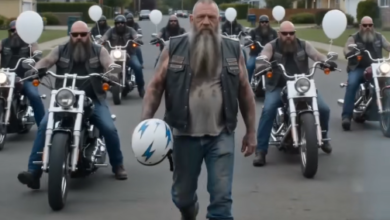
My name is Marcus Bell, although the men in the Iron Harbor Riders call me Bear. I am six-foot-six, weigh just under three hundred pounds, and have enough scars, faded military tattoos, and gray beard to make strangers assume I solve problems with my fists.
That night, glitter covered those fists.
One sparkling wing hung lower than the other. A plastic crown pinched my shaved head, and the silver skirt had been stitched from clearance fabric by three bikers who knew more about welding than sewing.
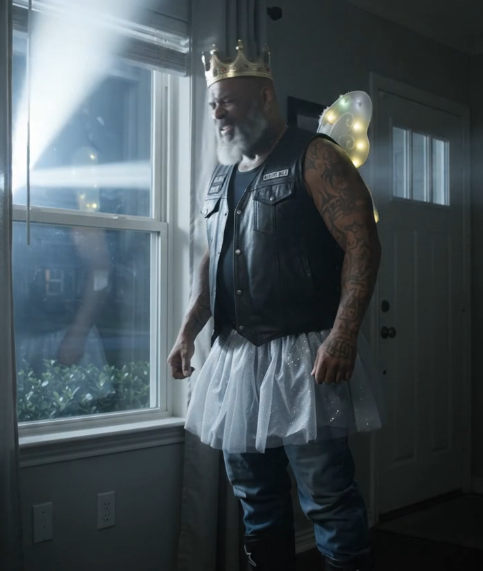
I looked ridiculous.
That was the point.
My seven-year-old daughter, Nia, had lost her first tooth at school two days earlier. She came home carrying it inside a small plastic bag as carefully as if it were the last diamond on earth.
She had one question.
“Dad, is the Tooth Fairy real?”
I told her people believed different things.
Wrong answer.
Nia folded her arms and asked whether I had ever seen the Tooth Fairy. I admitted I had not. Then she announced she intended to remain awake all night, catch the fairy, and settle the matter herself.
For most children, that would have been ordinary curiosity.
Nia was not an ordinary child.
She had spent the first five years of her life learning that adults disappeared. Her biological mother, my younger sister Denise, loved her but had been losing a war with addiction for years. Fathers had passed through. Promises had not survived weekends. Before the court placed Nia with me, she kept her belongings inside a backpack because unpacking made leaving hurt more.
I eventually adopted her.
The paperwork made me her father.
Trust took longer.
Nia questioned birthday candles, lucky pennies, stars people wished upon, and any story requiring her to believe something good might arrive while she was asleep. Yet for reasons I could not understand, she wanted the Tooth Fairy to be real.
Not just money beneath a pillow.
She wanted proof.
So I asked the Iron Harbor Riders for help.
The club had carried flood supplies, escorted funeral processions, and repaired homes for injured veterans. None of that prepared thirty-two tattooed men to manufacture functional fairy wings strong enough for my shoulders.
The first pair snapped.
The second trapped me in the clubhouse bathroom.
The third was built from welding wire, pale fabric, and tiny battery-powered lights. Tiny Walsh made a wand from an old screwdriver. Doc Jiménez found the skirt. Bear-sized tights did not exist, which was a mercy to everyone.
The plan was simple. I would let Nia catch one glimpse of the Tooth Fairy, leave a silver dollar, and disappear before she recognized me.
Nothing about the plan remained simple.
She tied bells to the bedroom door. She scattered building blocks across the carpet. She dusted the hallway with flour to capture footprints. She even placed her stuffed rabbit facing the window as a lookout.
I waited until her breathing slowed.
Then I pulled the costume over my jeans, fastened the wings, and moved down the hallway with a small velvet pouch clenched in one hand.
My boot found the first block.
I swallowed the noise.
The skirt caught on the banister. One wing struck a framed family photograph. When I reached Nia’s door, the bells began trembling.
Outside, our elderly neighbor saw a huge winged figure moving through the house and called the police.
That explained the flashlights.
What I could not explain was the sound behind the bedroom door.
Nia was awake.
The handle began turning.
I had three seconds to decide whether to run, hide, or let a frightened little girl discover that the magic she had waited for wore a biker’s boots.
The door opened.
Nia stared up at me.
Then she noticed the tattoo on the hand holding the wand—the same tattoo she touched every night when she asked me to stay until she fell asleep.
Her expression changed.
And what she whispered made me realize she had not set those traps to catch a fairy.
She had set them to test whether I would come.
Part 2 — The Child Who Never Unpacked
Nia arrived at my house carrying a purple backpack and one grocery bag.
The social worker brought her on a Tuesday afternoon in October. She was five years old, thin, observant, and dressed in a red coat too warm for the Texas weather. The grocery bag contained two shirts, mismatched socks, a toothbrush without a cap, and a stuffed rabbit whose left ear had been repaired with electrical tape.
The backpack remained zipped.
I knew almost nothing about raising a child. At fifty-two, I had spent more nights sleeping beside highways than beside a crib. I owned two frying pans, one towel that could reasonably be called clean, and a refrigerator holding mustard, bottled water, and three varieties of hot sauce.
My home outside San Antonio had one spare room.
It did not look like a child’s room.
I bought a bed that morning, choosing the strongest wooden frame because strength was the only quality I understood how to measure. I added blue sheets, a lamp shaped like a motorcycle, and a shelf filled with books recommended by a clerk who correctly recognized that I was panicking.
Nia stood in the doorway.
“Is this mine?” she asked.
“For as long as you want it.”
That was another wrong answer.
She heard uncertainty where I intended freedom.
“What if I want it too long?”
“Then I buy more sheets.”
She did not smile.
That first night, Nia slept wearing her coat. She placed the backpack beside her feet and the grocery bag beneath the bed. When I checked on her at midnight, her eyes were open.
“You leaving?” she asked.
“No.”
“People say that.”
I sat on the floor rather than approaching the bed.
“Then watch what I do.”
I stayed until morning.
Denise had been fourteen when I enlisted in the Army. After our mother died, I should have become the reliable older brother. Instead, I sent money, made calls from overseas, and assumed distance excused absence. By the time I returned home for good, Denise was moving between unstable relationships and periods of sobriety that never lasted.
I tried to rescue her with cash.
Cash disappeared.
I tried anger.
Anger gave her another reason to hide.
When Nia was born, I became the relative who arrived after emergencies. I fixed broken doors, bought groceries, and told myself temporary help was enough. It was not.
The final call came from a hospital. Denise had overdosed in the bathroom of a motel while Nia sat outside watching cartoons. She survived, but child protective services removed Nia.
The court asked whether I could provide kinship care.
“Yes,” I answered.
The judge looked at my age, criminal record from a fight in my twenties, motorcycle club membership, and the prison number tattooed beneath my right sleeve.
The answer did not become official for four months.
During that time, social workers inspected my house, interviewed club members, tested my sobriety, and explained rules that made me feel as though every foolish choice I had ever made had returned to sit beside me.
The brothers were offended on my behalf.
I was not.
Nia deserved questions.
She had already lived with too many adults nobody questioned soon enough.
Our first year together was built from routines. Breakfast at seven. School at eight. Homework before television. The same bedtime story twice if she requested it. When I rode with the club, Rosa from next door stayed with her, and I returned at the hour I promised.
If traffic delayed me, I called.
If plans changed, I explained why.
If I said Saturday, I meant Saturday.
Slowly, the backpack moved from the bed to the closet. Then one afternoon, I discovered it empty. Nia’s clothes hung in drawers. Her rabbit sat on the pillow.
I closed the closet without mentioning it.
The adoption took place eighteen months later. Thirty Iron Harbor Riders waited outside the courthouse because the courtroom could not hold them. When Nia and I walked down the steps, the engines started one by one.
She covered her ears.
Then she laughed.
That night, she asked whether adoption meant she could never be sent away.
I told her nobody could promise that life would never change, but I could promise I would not choose to leave.
“Even if I’m bad?”
“Especially then.”
“What if I break your motorcycle?”
“We discuss prison.”
She stared at me.
“Joke,” I said.
My jokes required work.
By seven, Nia was sleeping through most nights. She had friends at school and a permanent collection of shoes scattered across my hallway. She called me Dad when she was tired, Bear when she wanted to annoy me, and Marcus when she thought I had made an unreasonable decision.
Still, pieces of the frightened five-year-old remained.
She needed doors partly open. She counted the adults attending school events. She asked where I was going even when I walked to the mailbox.
Then her first tooth became loose.
Nia checked it every morning. She read books about the Tooth Fairy and interrogated classmates about what they had received. One child claimed the fairy left twenty dollars. I considered that child’s parents economic terrorists.
When the tooth finally came out, Nia did not ask what it was worth.
She asked whether the fairy always came.
“Usually,” I said.
“What if the kid moves?”
“I imagine fairies update their records.”
“What if there’s no real family?”
“You’ve got a real family.”
She looked at me.
I understood the question beneath the question.
Does magic know where children like me live?
I decided it would.
Part 3 — Thirty-Two Bikers Build a Pair of Wings
The first club member I told was Miguel Ortega.
Migs had raised two daughters and possessed the dangerous confidence of a man whose children had survived childhood. We were closing the repair shop when I explained that Nia wanted to catch the Tooth Fairy.
“Leave money,” he said.
“She wants proof.”
“Glitter.”
“Proof with a face.”
Migs looked at me for several seconds.
Then he smiled.
“No.”
“That smile says yes.”
“That smile says I want to witness what happens next.”
We brought the problem to the Thursday club meeting. Thirty-two riders sat around folding tables beneath a ceiling fan that had clicked since 1998. The room smelled of coffee, leather, chain lubricant, and the chili Tiny had heated too long.
I described Nia’s request.
Nobody volunteered.
These men had rebuilt houses after hurricanes. They had searched flooded roads in darkness and stood between grieving families and protesters at military funerals. Yet the possibility of sewing fairy wings for a child turned them into boys studying their boots.
Rourke spoke first.
“Hire a woman.”
“She wants to catch the fairy in her room.”
“Hire a small woman.”
“She knows everybody we know.”
“Then buy a doll.”
“She asked for real.”
Rourke leaned back. “Brother, you’re six-six.”
“I’ve been informed.”
“And two-ninety.”
“Before dinner.”
“You’re not a fairy.”
That sentence decided it.
“Meeting adjourned,” I said. “We build wings Saturday.”
The first design came from Doc. He bent coat hangers into two oval frames and stretched white pillowcases across them. They looked less like fairy wings than medical equipment damaged during shipping.
Tiny proposed steel.
“Too heavy,” Migs said.
“Aluminum.”
“Too sharp.”
“Fiberglass.”
“She needs him tonight.”
Tiny appeared personally insulted by the time limit.
We settled on thick welding wire reinforced with plastic tubing. Migs’ wife donated pale organza. Battery-operated holiday lights ran around the edges. The harness came from an old backpack altered to fit beneath my arms.
The first fitting trapped me halfway through.
My shoulders entered. The wings did not.
Four men pulled. Two pushed. One laughed until he had to sit down.
The harness tore across the center.
The second version fit but extended too widely. When I turned, I knocked three coffee cups from a table and sent a framed club photograph to the floor.
“Need folding wings,” Tiny said.
“Need a smaller fairy,” Rourke muttered.
I handed him a needle.
The skirt became another argument. Doc’s sister found silver tulle at a fabric store, but nobody knew how much material was required to cover a man built like a refrigerator.
She bought the entire roll.
Rourke refused to sew until Tiny reminded him who had posted a photograph of another brother learning hair braids the previous year. Shame proved useful. Within an hour, seven bikers sat around a table pushing needles through elastic while pretending the work had no emotional importance.
I tried on the skirt over my jeans.
The room became silent.
Migs took one photograph.
I chased him around the clubhouse until one wing caught in the doorway and spun me backward.
After that, the photograph existed everywhere.
The crown came from a children’s party store. It sat too high on my shaved head, so Rosa attached it to one of my black bandanas. The wand began as a long screwdriver because Tiny trusted steel more than plastic. We covered the handle with ribbon and placed a glittering star over the tip.
By nine that evening, I stood before the clubhouse mirror.
The man looking back wore boots, jeans, a leather cut, a silver skirt, illuminated wings, and enough facial hair to house a small bird.
“Terrifying,” Doc said.
“Convincing?” I asked.
“No.”
“That’s not helpful.”
“You asked.”
The plan required more than clothing. Nia intended to remain awake. She had constructed traps after studying online videos made by children far more strategic than I expected. A string of craft bells hung from her doorknob. Flour covered a strip of hallway carpet. Building blocks lay beneath the window.
She placed her tooth under the pillow inside an envelope.
I was instructed not to look at the envelope before the exchange. Apparently, fairy mail was private.
At bedtime, Nia examined my clothes.
“You’re wearing jeans.”
“Common event.”
“You usually wear sweatpants at night.”
“I may go to the garage.”
Her eyes narrowed. “Why?”
“Motorcycle.”
“What’s wrong with it?”
I had raised an investigator.
“Electrical.”
That part became true when Tiny arrived to repair a loose wire on the wings.
Nia went to bed at eight-thirty. At nine, she called for water. At nine-thirty, she needed the bathroom. At ten, she announced she could still hear me breathing from the living room.
At eleven-fifteen, the house became quiet.
I changed in the garage.
Migs and Tiny waited beside the workbench in case the costume failed. They had promised not to laugh.
Their promise lasted four seconds.
“Keep your voices down,” I warned.
“Your skirt’s crooked,” Migs whispered.
“Leave.”
At twelve-thirty, I entered the house through the kitchen. The wings brushed both sides of the doorway. Every movement produced a faint crinkle of fabric.
I removed my boots to protect the flour trap.
Then I remembered the tattoos on my feet.
Nia knew them.
The boots went back on.
I stepped around the flour, navigated the blocks, and reached her bedroom. The bells hung inches from my hand.
The door was open exactly four inches.
I had to widen it without moving the knob.
I pressed one wing against the wall, turned sideways, and began squeezing through.
That was when the frame snapped.
The right wing folded forward and struck the bells.
They rang once.
Then again.
Inside the bedroom, the mattress creaked.
I froze.
Outside the house, police lights turned silently onto our street.
Part 4 — The Night She Caught the Fairy
Our neighbor Rosa had seen the lights moving through the front window.
She knew I was planning something for Nia’s tooth, but I had not described the costume. From her kitchen, she saw what appeared to be a massive stranger wearing glowing wings inside my dark house.
She called me.
My phone was in the garage.
Then she called the police.
While two patrol cars stopped outside, I remained wedged in Nia’s doorway with one damaged wing and a velvet pouch hanging from my wrist.
The bells became still.
Nia whispered, “Hello?”
I could have retreated. I might have shut the door and hidden in the bathroom until she returned to sleep.
But the entire reason for the costume was to be seen.
I pushed the door wider.
Moonlight from the window cut across the floor. The battery lights on my wings glowed faintly. Nia sat beneath her blanket, eyes wide, one hand gripping the stuffed rabbit.
I lifted the wand.
The star fell off.
It struck the floor.
Neither of us moved.
“Are you the Tooth Fairy?” she asked.
I had prepared a voice. In the garage, it had sounded airy and mysterious. In the bedroom, it sounded like a truck driver inhaling helium.
“I am.”
Nia stared at the beard.
“You’re huge.”
“Union regulations.”
“What?”
“Fairy business.”
Her gaze traveled from the crown to the wings, down the skirt, and finally to my motorcycle boots.
My right hand held the velvet pouch.
Across the knuckles, the tattooed letters were unmistakable.
Nia had traced those letters with her finger hundreds of times while falling asleep. She knew every dark line.
Her eyes settled there.
I felt the entire plan collapse.
Then came pounding at the front door.
“Police!”
Nia flinched.
I lowered the wand. “Stay here.”
“You sound like Dad.”
“Common fairy voice.”
“Dad?”
The officers struck the door again.
I removed the crown.
Nia watched my face emerge from beneath the bandana.
For several seconds, neither of us spoke.
I expected disappointment. Children forgive many things, but perhaps not discovering that the miracle they wanted was a tired man wearing wire wings.
Instead, Nia climbed from bed.
“You came,” she said.
“Course I came.”
“You dressed like this?”
“Against professional advice.”
“For my tooth?”
“Yeah.”
She touched the bent wing.
“It’s broken.”
“Occupational hazard.”
Another knock shook the house. I opened the front door wearing the full costume.
Two officers stood on the porch. One kept his hand near his holster until he recognized me from a veterans’ fundraiser. The other looked from my beard to the skirt and then deliberately focused on my face.
“Mr. Bell?”
“Evening.”
“We received a report of an intruder.”
“Understandable.”
Rosa appeared behind them wearing slippers and holding a baseball bat. When she saw me, she lowered it.
“Oh,” she said.
Nia leaned around my hip.
“He’s the Tooth Fairy.”
The younger officer bit the inside of his cheek.
I pointed one glitter-covered finger at him. “Don’t.”
He looked toward the street.
“Wouldn’t dream of it, sir.”
After they left, Nia returned to bed. I repaired the wing with tape, reattached the star, and approached her pillow with the velvet pouch.
The envelope holding her tooth was missing.
“Where is it?” I asked.
“You have to find it.”
“Nia.”
“Fairies know everything.”
I searched beneath the pillow, inside the stuffed rabbit’s damaged ear, and under the bed. Finally, I found the envelope tucked inside her slipper.
Her name was written across the front.
Inside rested the tiny tooth and a folded note.
I remembered her instruction not to read fairy mail, but I was presently the authorized recipient.
The note contained no request for money or toys.
Dear Tooth Fairy,
Please don’t take me somewhere else because I lost part of me. Dad says this is my forever house, but people said forever before. If you have magic, make forever stay.
Nia
I sat on the floor.
The wings pressed against the bedframe. The skirt spread around my knees. The note shook between hands that had remained steady beneath gunfire.
Nia watched me.
“Did the fairy read it?” she asked.
“Yes.”
“What does she say?”
I looked at the child who had tested the door, the floor, the window, and finally me.
“She says losing one piece doesn’t mean you lose your place.”
Nia considered that.
“Is that a fairy rule?”
“It is now.”
I placed the silver dollar beneath her pillow.
Then she lifted the blanket.
“Fairies stay until kids sleep.”
I sat beside her.
The costume lights slowly faded. My wing remained broken. Glitter transferred onto every surface I touched.
Nia closed her eyes with one hand around my tattooed fingers.
She had recognized me.
She believed anyway.
Part 5 — The Wishes Beneath the Pillow
The next morning, Nia announced that she had seen the Tooth Fairy.
She described the fairy as unusually tall, somewhat clumsy, and possibly overdue for a shave. She told Rosa the wings were damaged during an “official landing.” She showed everyone the silver dollar but kept the note private.
I did the same.
The costume went into a plastic storage bin marked HOLIDAY EQUIPMENT. I assumed it had served its purpose.
Three months later, another tooth became loose.
Nia began testing it during breakfast.
“You think the fairy remembers our address?” she asked.
“Probably has records.”
“Do fairies wear the same outfit every time?”
“Uniforms are expensive.”
She smiled into her cereal.
That was how I understood the costume had become a contract.
The second appearance went more smoothly. Tiny repaired the folding mechanism. Doc replaced the screwdriver wand with something lighter. Rosa took responsibility for preventing unnecessary police involvement.
Nia still built traps.
They became elaborate, though I suspected she designed them to be defeated. She left open spaces between the blocks. The bells hung too high to touch the knob. A paper sign pointed toward the safe side of the flour.
I pretended not to notice.
Each lost tooth came with a note.
The second asked the fairy to help Denise get better.
The third asked for a classmate’s sick dog to recover.
The fourth requested courage for a spelling test and included a warning that money would not improve spelling.
I kept every note.
Denise remained part of our lives in small, difficult ways. She entered treatment, left, returned, and eventually completed nine months. Nia met her under supervision. Those visits stirred questions no winged costume could answer.
One evening after a visit, Nia asked why loving someone did not make them stay well.
I told her love could open doors but could not make another person walk through.
“Magic can’t?”
“I don’t think so.”
“Then magic isn’t strong.”
“Maybe it does smaller jobs.”
“Like teeth?”
“Exactly.”
She accepted that for the night.
At the clubhouse, my brothers developed responsibilities around each tooth. Tiny checked the wing harness. Migs supplied silver dollars. Rourke repaired the skirt after it tore against a bedroom drawer.
Nobody mocked the ritual anymore.
Rourke’s estranged daughter had begun speaking with him. Their first conversations were short. She did not forgive decades because he learned to sew tulle. He kept calling anyway, without demanding that she reward the effort.
One night, he held the skirt while I repaired a seam.
“Kids know, brother,” he said.
“Know what?”
“That adults make the magic.”
I tied off the thread. “Nia knows it’s me.”
“Probably.”
“Then why keep doing it?”
Rourke shrugged. “Maybe knowing who makes it is better.”
That answer stayed with me.
The club photograph eventually escaped our private group. It showed me standing beside my Harley wearing illuminated wings and the silver skirt. Someone posted it publicly without the explanation, and the image traveled around San Antonio.
Strangers laughed.
A radio host called me the Heavyweight Fairy. A motorcycle forum debated whether wearing a skirt violated club dignity. One man wrote that fathers were becoming weak.
Bear had spent enough years confusing hardness with worth.
I ignored him.
Nia’s school discovered the photograph. I expected embarrassment, but she carried a printed copy to show-and-tell.
“That’s my dad,” she said. “He does night shifts.”
Children began writing letters to the Tooth Fairy and sending them home with her. Most requested money. Some asked for pets, game systems, or the removal of younger siblings.
A few were different.
One child wanted his father to come home from deployment. Another wanted her parents to stop fighting. A boy in foster care asked whether the Tooth Fairy could find him if he changed houses before morning.
Nia brought that letter to me.
“We need to answer.”
“We don’t know his address.”
“He’s in my class.”
“We can’t enter people’s homes.”
She considered the problem.
“Could the fairy come to school?”
That request became the first Fairy Run.
The Iron Harbor Riders partnered with the school counselor and a local dental clinic. We collected toothbrushes, toothpaste, books, and small silver-colored tokens. Nobody entered bedrooms. Nobody identified children in foster care publicly. We delivered sealed packages to the counselor, who distributed them privately.
I wore the costume.
Thirty-one bikers rode behind me.
We parked far enough from the school to avoid shaking classroom windows, then walked the final block carrying boxes. Leather creaked beneath the cold morning sun. My wings flashed against black vests and tattooed arms.
Children pressed against classroom windows.
Adults took photographs.
The same image people had mocked now raised enough donations to supply six schools.
I did not become a symbol.
I remained a father fulfilling a contract.
Every time Nia lost a tooth, the wings came out.
Every time, I arrived.
Part 6 — The Last Baby Tooth
Nia lost her final baby tooth at eleven.
By then she was too old to admit belief in front of friends. She understood dental anatomy, compound interest, and the economic impossibility of one fairy serving millions of children in a single night.
She placed the tooth beneath her pillow anyway.
The costume no longer fit.
The skirt’s elastic cut into my waist, and my shoulders had widened the harness until the fabric split near one wing. The battery lights flickered. Glitter had permanently embedded itself in my leather vest.
Tiny offered to build new wings.
“No,” I said. “Last run uses the originals.”
He reinforced the wire with tape.
That evening, Nia acted casual. She left no flour, bells, or blocks. Her bedroom door stood open. The stuffed rabbit still occupied the pillow, although its taped ear had been replaced with careful stitching.
I waited until midnight.
Then I dressed in the garage.
Migs and Rourke were there. Neither man joked. Rourke adjusted the crown. Migs handed me the velvet pouch containing the same silver dollar from Nia’s first tooth.
“She kept it?” he asked.
“Every time.”
The coin had become part of the ritual. I removed it in the morning, then returned it with the next tooth. Nia never spent it.
I entered the house.
At the bedroom door, I found Nia awake.
She sat against the headboard with her arms folded.
“You’re early,” she said.
“Fairy scheduling.”
“You’re Dad.”
“Unproven.”
“You forgot the voice.”
I cleared my throat and attempted the high, breathless tone.
She winced. “Please don’t.”
I sat on the edge of the bed. The frame complained beneath my weight.
Nia held out the envelope.
“No hiding it?”
“Not this time.”
I accepted it.
The final tooth lay inside beside a folded piece of paper.
Dear Dad,
I knew after the first night. Your hand had the same tattoo, your boots smelled like the garage, and no real fairy would say “union regulations.”
But I wasn’t pretending because I felt sorry for you.
I kept doing it because when you wore the wings, you laughed. You didn’t laugh much when I first came here. I thought maybe I was helping.
You always came when I lost something.
That’s what made this home forever.
Nia
I read the letter twice.
The first time, I understood the words.
The second time, they entered.
For years, I had believed I was protecting her belief in magic. I thought the costume proved that someone would cross darkness to leave something good beneath her pillow.
Nia had been protecting something too.
She remembered the man who had sat on the floor beside her bed during those first months—the man who barely slept, blamed himself for Denise, and treated fatherhood like an exam he expected to fail.
The costume made me foolish.
Foolishness made room for joy.
A child who feared being abandoned had noticed that her father was also afraid. She kept setting traps because she wanted me to keep finding my way through them.
“Say something,” she whispered.
My voice refused.
I removed the crown and placed it on her head. It sank over one ear.
“You made me wear this seven times,” I finally said.
“Eight.”
“The school visit doesn’t count.”
“You wore the skirt.”
“Fair.”
She moved closer and leaned against me. One wing bent beneath the wall.
“Do I still get money?” she asked.
“You’re manipulating a magical institution.”
“So yes?”
I placed the silver dollar in her palm.
Nia closed her fingers around it.
We sat there until the wing lights went dark.
Part 7 — Where the Wings Hang Now
The Tooth Fairy costume hangs inside the Iron Harbor clubhouse.
Tiny built a wooden case for it using walnut salvaged from an old bar. The bent wings rest behind glass. The crown sits above the wand, and the silver skirt has been cleaned as well as possible, though glitter remains trapped in the seams.
Nia’s final letter stays with me.
I keep it inside my vest, folded behind the old prison-number patch. I do not show it at fundraisers or hand it to reporters who occasionally ask about the Fairy Run.
That letter belongs to a father and daughter.
The Fairy Run continues every winter. We now supply dental-care packages to shelters, foster programs, and rural schools across three counties. Different riders wear the costume because my knees have started objecting to climbing school steps.
Nobody volunteers twice.
The wings are heavy.
Denise has been sober for four years. She and Nia have built a relationship made from supervised visits, careful boundaries, and promises measured in weeks rather than forever. I am proud of both of them.
Nia is sixteen now.
She no longer needs me sitting beside her bed, although she still asks where I am going when I reach for my motorcycle keys. I still answer every time.
Last December, she volunteered at the Fairy Run. A first-grade boy approached her holding a tiny plastic bag with a tooth inside. His foster family had moved him the previous week, and he wanted to know whether the Tooth Fairy had the new address.
Nia knelt so they were eye level.
“Fairies update their records,” she said.
I recognized the answer.
That evening, after the packages had been distributed, I found Nia standing before the costume case. She opened it and touched the damaged right wing.
“You think it still fits?” she asked.
“Not me.”
She lifted the crown.
“I wasn’t asking about you.”
Ten minutes later, my daughter walked out of the clubhouse wearing the original wings over her winter coat. The silver skirt stopped above her knees. The crown leaned sideways, exactly as it had on my shaved head years earlier.
Thirty bikers watched in silence.
Then Nia picked up the old screwdriver wand.
“Anybody need a fairy?” she asked.
Outside, the Harleys started one by one. Their engines rolled across the parking lot while she climbed behind me, wings folded carefully between us.
I checked the mirror.
The crown was still crooked.
That seemed right.
Follow our page for more unforgettable biker stories about intimidating riders who carry homemade wings, quiet promises, and a little magic beneath their leather vests.