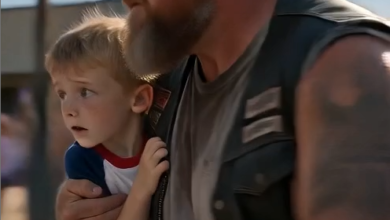
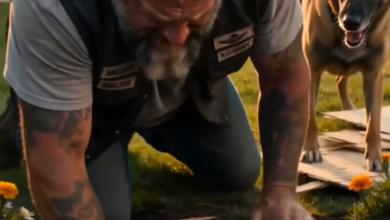
A 6’6″ Biker Wore a Fresh Flower Crown to Walk His Frightened Daughter Into Chemotherapy Every Day—Until a Nurse Discovered Who the Flowers Were Really Keeping Brave
The first time I saw the six-foot-six biker enter pediatric oncology wearing a crown of pink daisies, three parents stared, one child laughed, and his eight-year-old daughter tightened her grip on his tattooed hand as if the flowers were the only reason either of them could keep walking.
I was the charge nurse at St. Catherine Children’s Hospital in Columbus, Ohio, and I had learned not to judge families by what they wore into chemotherapy. Fear dressed people in strange ways. Some fathers arrived in office suits and spent three hours staring at the floor. Some mothers wore pajama pants because they had not slept in four days. Children came dressed as astronauts, princesses, firefighters, and once, memorably, a green dinosaur with an IV line threaded through its tail.
But I had never seen anyone like Mason Rourke.
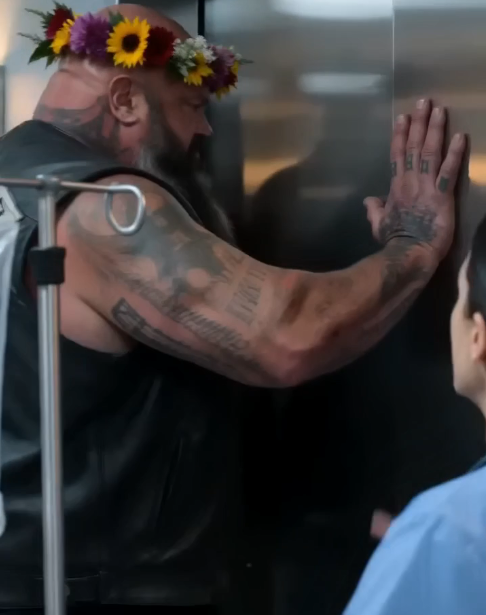
He was forty-three, nearly three hundred pounds, with a shaved head, a thick black-and-gray beard, scarred knuckles, and tattoo sleeves disappearing beneath a plain black leather vest. Heavy motorcycle boots struck the polished floor with a slow thud. A wallet chain clicked against his jeans. Rainwater still glistened on his shoulders from the ride across town.
On his head sat a crooked crown of fresh flowers.
Not silk flowers. Not plastic ones from a costume shop. Real daisies, carnations, lavender, and one yellow rose, all woven around a green florist’s wire that was too small for him. It perched above his ears like something borrowed from a child’s fairy party.
The little girl beside him wore a sunflower dress beneath an oversized gray cardigan. Her name was Lily. She had acute lymphoblastic leukemia, a fading bruise beneath her left eye, and a red backpack that looked too heavy for her narrow shoulders. Wisps of brown hair escaped from under a knitted cap.
She stopped when she saw the infusion-room doors.
Mason stopped with her.
“You said the flowers would work,” he murmured.
Lily looked up at the crown, inspected it seriously, and adjusted one crushed daisy over his eyebrow.
“They’re working a little.”
“How much is a little?”
“Enough to get to the blue chair.”
He lowered himself until one knee touched the floor. Leather creaked. His beard nearly brushed her shoulder as he offered his hand again.
“Then the blue chair is as far as we go.”
They took eight steps.
I counted because Lily counted under her breath. At the eighth, the automatic doors opened. She saw the IV poles, smelled the disinfectant, and heard the soft electronic beeping from the treatment bays.
Her hand began to shake.
Mason’s did too.
Most people noticed only hers.
Lily reached up, pulled a white carnation from his crown, and tucked it through the buttonhole of her cardigan. Then she pressed her palm against the word ROSE tattooed across the inside of his wrist.
“For both of us,” she whispered.
His jaw tightened.
“For both of us,” he answered.
That became their ritual. Every morning Lily had treatment, Mason arrived wearing a new crown. One day it was baby’s breath and purple asters. The next, marigolds. When fresh flowers were unavailable, he wore rosemary sprigs, clover, and three stubborn dandelions collected beside the employee parking lot.
People laughed at first.
Mason never looked at them.
“If flowers make my girl brave,” he told me, “I’ll wear the whole damn garden. I’d rather look ridiculous than watch her be afraid.”
What none of us understood was why his hand trembled whenever Lily touched the name on his wrist, why he refused to enter Treatment Room Four, or why the toughest-looking man in our hospital always stopped beneath the same faded photograph in the hallway.
Then, on Lily’s seventeenth morning of chemotherapy, her chair was empty, Mason’s flower crown lay crushed on the floor, and a nurse who had worked at St. Catherine thirty years whispered a name no one had called him since he was fourteen.
The flowers had never been only for Lily.
Part 2, Eight Steps to the Blue Chair
By the second week, the entire pediatric floor knew the sound of Mason arriving. First came the low V-twin rumble in the parking structure, muffled by concrete but still deep enough to vibrate through the windows. Then the engine stopped. A few minutes later came the measured impact of his boots, the faint rattle of his chain wallet, and Lily’s smaller sneakers squeaking beside him.
I began meeting them near the elevator.
Mason never carried Lily unless she asked. He carried her backpack, her water bottle, the blanket covered in cartoon foxes, and a canvas bag filled with enough crackers to survive a winter. But if she wanted to walk, he let her walk, even when it took fifteen minutes to cross a hallway most adults covered in one.
He did not tell her to be strong.
I noticed that immediately.
Adults say that to sick children because we do not know what else to say. We ask them to be strong while holding them down for needles. We call them brave when they have no choice. Mason never used either word unless Lily used it first.
He offered smaller promises.
“We get through the elevator.”
“We make it to Mara’s desk.”
“We sit in the blue chair.”
“After that, we decide again.”
Mason ran a motorcycle repair shop called Rourke & Sons, although there was no son and never had been. The name belonged to his father, who opened the place in 1978 and left it to Mason along with unpaid taxes, three broken lifts, and the belief that apologies weakened a man.
The shop stood near West Broad Street between a tire warehouse and a boarded-up diner. Six members of Mason’s riding club worked there on and off. They called themselves the Iron Lanterns, though their leather cuts carried only a simple lantern patch and the city name. They rode Harleys, raised money for funeral costs, and argued about everything from oil brands to coffee.
Mason had not always been the man Lily knew.
At twenty-two, he drank too much and fought anyone who looked at him long enough. At twenty-six, after a bar fight fractured another man’s jaw, he spent eleven months in county jail. At thirty, he entered recovery after waking beneath his motorcycle in a drainage ditch with no memory of how he got there.
He had been sober thirteen years.
He spoke about that history without decoration. “I wasted time,” was all he once told me. “Then she showed up, so I quit wasting it.”
“She” meant Lily.
Her mother, Emily, had left when Lily was three. Not dramatically. No screaming scene. No slammed door. She packed two suitcases, kissed her sleeping daughter, and left a note saying she was not built for motherhood. She sent birthday cards for two years, then even those stopped.
Mason kept every card in a steel toolbox at home.
He never insulted Emily in front of Lily. When Lily asked why her mother did not visit, he said, “Some people love you and still don’t know how to stay.” Then he made pancakes shaped like motorcycles, none of which looked remotely like motorcycles.
The flower crown began on the night before Lily’s first treatment.
She had hidden beneath her bed after overhearing two adults discussing side effects. Mason found her clutching a library book about wildflowers, open to a photograph of a mountain meadow.
“Do flowers get scared?” she asked him.
“Probably.”
“They don’t run away.”
“They’ve got roots. Makes running difficult.”
She almost smiled. Then she pointed at the illustrated crown worn by a girl in the book.
“Flowers make people brave.”
“Okay.”
“You should wear some tomorrow.”
Mason expected her to laugh. She didn’t.
“You mean you wear them?”
“No. You.”
He looked down at his tattooed hands. “That so?”
“People will look at you instead of me.”
That was the whole bargain.
At six the next morning, Mason stood outside a twenty-four-hour grocery store trying to weave carnations around a piece of electrical wire. His first crown collapsed. His second cut his forehead. The third survived the ride to St. Catherine beneath an overturned plastic mixing bowl strapped to the luggage rack of his Harley.
By the time he reached the hospital, half the petals were gone.
Lily called it perfect.
After that, the nurses helped. Mara Patel, one of our senior nurses, learned to weave the stems tightly enough to survive the motorcycle ride. The reception staff stored wire and floral tape beneath the desk. Parents brought leftover bouquets. Children donated paper flowers when their immune restrictions prevented fresh ones.
Soon Mason had rules. Nothing with thorns. Nothing heavily scented near nauseated patients. No glitter because it got everywhere. Lily chose the colors each evening, and someone left the finished crown in a cardboard bakery box at the hospital entrance before dawn.
The Iron Lanterns teased Mason exactly once.
A younger member named Cody saw a photograph of him in lavender and laughed in the shop. Mason placed a wrench on the workbench and looked at him.
“My kid asked.”
Cody lowered his eyes. “Then purple suits you, brother.”
The next morning, six flower bundles appeared outside Mason’s garage.
But there was trouble at the shop. Mason missed morning shifts, then full days. Medical bills gathered unopened on his kitchen table. One commercial customer took its delivery vans elsewhere. The club’s treasurer warned that Rourke & Sons might not survive the winter.
Mason listened, rubbed the name on his wrist, and returned to the hospital.
He had already lost one child to that building.
None of us knew it yet.
Part 3, The Empty Blue Chair
The seventeenth treatment morning began wrong.
No engine sounded beneath the windows.
At 7:40, Lily’s appointment time, the elevator opened without them. At 7:46, I called Mason. The phone rang until voicemail. At 7:51, I called again.
Mara was carrying a crown made of white chrysanthemums and small blue asters. She set it beside the computer and watched the elevator doors as if staring could summon them.
At 8:03, Mason appeared.
He was not wearing his leather vest. He wore a gray sweatshirt stained dark across the chest and carried Lily against him. Her red backpack hung from one hand. Her face was flushed, her knitted cap missing, her cheek pressed against his neck.
“She’s hot,” he said.
That was all.
We moved.
Temperature: 103.1.
Blood pressure low.
Heart rate too fast.
Mason stood against the wall as four of us worked around Lily. His hands opened and closed. He answered every question precisely—when she had last eaten, when the fever began, how much water she had consumed, which medication she had vomited.
Then Lily started shaking.
Mason stepped forward.
A resident blocked him gently. “We need room.”
“She needs me.”
“We’re helping her.”
“She needs me.”
His voice stayed low, but the room changed around it. The resident glanced toward security. People saw Mason’s size, his scarred hands, and the tattoos climbing his neck. They did not see his knees beginning to buckle.
I took his forearm.
“Mason. Look at me.”
He didn’t.
“Mason.”
His eyes finally found mine.
“We suspect an infection. We’re starting antibiotics. She needs us to work, and she needs to hear you. Stand by her head.”
He moved there immediately.
Lily’s eyes opened halfway. “Crown?”
Mason reached toward his bare head and froze.
He had forgotten it.
For seventeen mornings, the crown had been their bridge between the elevator and the blue chair. In his panic, he had left home without it.
“I’m sorry, Bug.”
Her lips trembled. “No flowers.”
Mara ran to the reception desk, grabbed the crown she had prepared, and brought it into the room. One side had already loosened. Mason bent, but before Mara could place it on him, Lily’s shaking worsened and the physician called for another line.
The crown slipped from Mara’s fingers.
It hit the floor beneath Mason’s boot.
White petals scattered across the linoleum.
That was when Mason stopped hearing us.
His shoulders pressed against the wall. His eyes fixed on the crushed chrysanthemums. The color drained from his face, and for a second, the man looked not forty-three but fourteen.
“Not again,” he whispered.
Mara heard him.
She had been a pediatric nurse at St. Catherine for thirty-one years. She watched Mason rub the tattoo inside his wrist, looked at the white flowers beneath his boot, and went still.
“Jamie?” she said.
Mason’s head snapped toward her.
Nobody called him Jamie. His legal name was James Mason Rourke, but he had used Mason since his teens. Even his club brothers knew him only by his middle name.
Mara stepped closer. “Jamie Rourke?”
“Don’t.”
Her hand rose toward her mouth.
“You were the boy under the chair.”
He turned away.
Lily moaned. The monitor alarm sharpened. Mason gripped the bedrail so hard that the old scars across his knuckles turned white.
Mara looked at the word tattooed on his wrist.
ROSE.
Not a flower.
A name.
The child Mason had lost in that hospital was not his daughter. She had been his little sister, Rosemary Rourke, whom everyone called Rosie. She was nine years old when leukemia brought her to Treatment Room Four. Mason was fourteen.
Their father rarely visited because he could not bear hospitals. Their mother worked two jobs and slept in a vinyl chair whenever her body finally quit. Most afternoons, Rosie had only her angry teenage brother beside her.
Mason had hated the smells. He hated the fluorescent lights. He hated the rubber gloves, the rolling carts, and the gentle voices adults used when they were hiding something.
So he hid under Rosie’s treatment chair.
Mara had found him there during Rosie’s first spinal procedure, his hands pressed over his ears. Instead of ordering him out, she crawled halfway under the chair and gave him a paper daisy from the nurses’ station.
“Your sister needs to see your face,” she told him.
“I can’t.”
“You don’t need to stop being afraid. Just don’t make her carry it alone.”
For eleven months, Mason walked Rosie into that room.
On her last morning, Rosie wore a crown of white chrysanthemums made by their mother. She removed it, placed it on Mason’s head, and laughed because it looked too small.
Rosie died before sunset.
Mason had not entered St. Catherine again for twenty-nine years.
Until Lily.
Now the same flowers lay crushed beneath his boot, his daughter’s fever was climbing, and the room he had avoided since childhood waited across the hall.
Treatment Room Four was the only negative-pressure room available.
When the physician told us Lily needed to be moved there, Mason released the bedrail.
“No.”
“Mason—”
“Any room but that one.”
“We don’t have another safe option.”
He looked toward the door. His chest rose once, then seemed to stop.
Lily opened her eyes.
“Daddy?”
He leaned over her immediately.
“Right here.”
“Are flowers working?”
Mason stared at the broken crown. Mara knelt, gathered the bent wire and surviving blossoms, and held them out. Half the flowers were missing. One white chrysanthemum remained intact.
Mason placed the ruined crown on his head.
“Like a charm,” he said.
Then he pushed Lily’s bed toward Room Four.
Part 4, What Lily Had Been Protecting
Lily’s infection came from a common bacterium that most healthy bodies would barely notice. Chemotherapy had stripped away her defenses, turning an ordinary threat into an emergency.
The antibiotics began quickly. Then we waited.
Hospital waiting is its own kind of labor. Nothing looks like it is happening, yet every minute pulls something from you. Mason sat beside Lily’s bed in Treatment Room Four with the broken crown still on his head. He did not drink the coffee we brought. He did not check his phone.
He watched her breathe.
Near midnight, three Iron Lanterns arrived. Cody carried Mason’s leather vest. Reuben, the club president, brought a thermos and an envelope. An older rider named Walt stood at the doorway holding a fresh bundle of chrysanthemums but did not enter until Mason nodded.
The room suddenly felt smaller.
Reuben put the envelope on the windowsill. “Shop payroll.”
Mason did not look at it. “Can’t cover it.”
“Covered.”
“By who?”
“Us.”
Mason lifted his head.
For two weeks, the club had been opening Rourke & Sons before sunrise. Cody handled intake. Walt negotiated with suppliers. Reuben’s wife managed invoices. Riders who had never changed more than their own oil cleaned parts, answered phones, and delivered repaired motorcycles after their day jobs.
They had also quietly bought back the commercial account Mason lost by offering free emergency maintenance for the company’s entire fleet.
“You’re going to bankrupt yourselves,” Mason said.
Reuben shrugged. “Then we’ll be bankrupt together.”
“I didn’t ask.”
“That’s why we did it.”
Mason’s face tightened, but he only nodded once. In their language, that was enough.
At 2:17 a.m., Lily’s fever began to fall.
By sunrise, it was below 101. The immediate danger had not passed, but the pressure in the room eased. Mason finally removed the crown. He set it on the tray table and touched the single surviving chrysanthemum with one finger.
Mara stood beside him.
“I’m sorry,” she said.
“For what?”
“For not recognizing you sooner.”
“I made sure nobody would.”
Mara looked at the chair beneath the window. It was not the same chair from twenty-nine years ago, but Mason had been avoiding that corner all night.
“Rosie talked about you after you left the room,” she said.
He gave her a warning glance. “Don’t turn her into a lesson.”
“I wouldn’t.”
“People did that after she died. Called her an angel. Said she was sent to teach us something. She was nine. She liked bad jokes and stole quarters from my dresser.”
Mara nodded. “She also cheated at Go Fish.”
The edge of Mason’s mouth moved.
“She did.”
Mara told him something he had never known. On Rosie’s last afternoon, while Mason was downstairs arguing with a vending machine, Rosie asked Mara to keep the paper daisy she had once given him.
“She said you would come back for it.”
“I didn’t.”
“No. But she believed you would.”
Mara opened a small archival box kept in a locked cabinet where the hospital stored old patient-donated objects. Inside lay a flattened paper flower, yellowed at the edges, with JAMIE—DON’T HIDE written in purple crayon.
Mason stared at it.
“That’s not her writing.”
“It is.”
“She wrote crooked.”
“She was lying down.”
He did not touch the flower. For several seconds, he could not.
Then Lily spoke from the bed.
“I knew.”
Mason turned. “Knew what?”
“That hospitals scare you.”
His eyes narrowed, not angry, only confused. “Who told you?”
“Nobody.”
Lily’s voice was weak. She pointed toward his hands. “You shake before I do.”
The room went quiet.
Mason had believed the crowns were his gift to her. The foolish-looking flowers drew strangers’ eyes away from her thinning hair. The ritual gave her eight manageable steps. It turned a frightening doorway into a promise they could repeat.
But Lily had asked him to wear the first crown because she had seen what no adult noticed.
Her father was terrified.
She had watched him sit in the car outside St. Catherine on the day of her diagnosis, gripping the steering wheel long after they were expected upstairs. She noticed he never used the fourth elevator. She saw him avoid the old photograph in the hallway and rub the name on his wrist whenever a treatment alarm sounded.
“Flowers make me brave,” she said. “But they make you come inside.”
Mason looked toward Mara. Then at the paper daisy in the box. Then back at his daughter.
“You’ve been taking care of me?”
“A little.”
“That’s not your job, Bug.”
“I know.”
“Then quit.”
“I can’t. You’re trouble.”
Cody turned toward the window. Reuben coughed into his fist. Walt suddenly became fascinated by the thermostat.
Mason lowered the rail and sat carefully on the edge of Lily’s bed. His size made her look impossibly small. He leaned his forehead against hers.
“I’m the dad.”
“You can still be scared.”
“Who taught you that?”
“You did.”
That was the twist none of us expected. The towering biker had not been wearing flowers solely to lend his daughter courage. His eight-year-old child had found a way to lead her father past a door he had been unable to cross for almost three decades.
One crown.
Eight steps.
Both of them moving.
Part 5, The Garden Behind the Garage
Lily spent four days in Room Four. Her blood counts recovered slowly, and her treatment schedule had to be adjusted, but the antibiotics worked. On the fifth morning, she woke hungry and demanded pancakes shaped like motorcycles.
Mason called the diner across the street.
The cook said motorcycle-shaped pancakes were impossible.
Mason said, “Make crooked ones. That’s what mine look like.”
The cook sent twelve.
When Lily was discharged, the Iron Lanterns waited outside the hospital. They did not rev their engines or crowd the entrance. Hospital administrators had warned them that some children were sensitive to loud sounds, so twenty-three riders stood silently beside their parked motorcycles holding flowers.
None wore a crown.
Reuben handed Mason a cardboard box.
Inside were twenty-three of them.
They had been woven badly. One was made mostly from clover. Another included a sprig of parsley because Cody could not tell herbs from greenery. Walt’s crown was held together with safety wire from the shop and looked strong enough to survive a tornado.
Mason stared at his brothers.
Reuben lifted his crown. “We figured the big man shouldn’t look stupid alone.”
They all put them on.
Lily laughed so hard she had to hold her stomach.
It was the first full laugh we had heard from her in weeks.
The riders escorted Mason’s truck home while his Harley remained at the hospital garage. They traveled slowly through Columbus, flower crowns visible beneath or above their half helmets, stopping at every yellow light. Drivers took photographs. A few people waved. One man shouted something rude from a pickup.
Mason did not even turn his head.
Back at the shop, he discovered the second secret the club had kept.
The vacant strip of ground behind Rourke & Sons had always been a graveyard of rusted exhaust pipes, broken pallets, and oil-stained gravel. During Lily’s hospital stay, the club cleared it. They removed three truckloads of scrap, built raised beds from untreated lumber, and hauled in soil.
A handwritten sign leaned against the fence:
LILY’S BRAVERY GARDEN.
Mason read it, then flipped the sign facedown.
“No signs,” he said.
Cody looked hurt. “Why?”
“Because this isn’t only hers.”
The next day, Mason returned to the hospital carrying a legal pad. He went from room to room asking children one question: “What flower would you grow if nobody could tell you no?”
A boy awaiting a bone marrow transplant wanted black roses. Mason explained that truly black roses were difficult, so they agreed on deep burgundy. A six-year-old girl chose sunflowers because she wanted something taller than her IV pole. One teenager requested mint, pointing out that nobody had said the answer must be a flower.
Mason wrote down every choice.
The garden became a club project. Bikers who could rebuild a transmission with their eyes half closed learned about soil acidity, irrigation, and shade. They argued over mulch. Cody accidentally planted thirty zucchini seedlings and spent August leaving vegetables on porches across the city.
Mara brought the first white chrysanthemums.
Mason stood over them for a long time.
“You don’t have to plant those,” she said.
“Yeah. I do.”
He placed them in the bed nearest the garage wall. Beneath the roots, sealed inside a weatherproof metal box, he buried a copy of Rosie’s paper daisy. The original remained protected at the hospital, but Mara had made a precise scan.
He did not mark the place.
Lily knew.
Her chemotherapy continued for months. Some mornings she walked all eight steps. Other mornings Mason pushed her in a wheelchair while she complained that he drove worse indoors than on a motorcycle. Her hair fell out completely. His flower crowns grew larger.
The nurses took turns making them, but eventually Mason learned.
His first attempts were clumsy. He pulled stems too hard, used too much wire, and crushed delicate petals in his calloused fingers. Mara showed him how to support each bloom at the base.
“Don’t force it,” she said. “Make room for it.”
He practiced at the workbench after closing time. Carburetors sat beside carnations. Wrenches shared space with floral tape. The garage smelled of gasoline, cut stems, black coffee, and damp soil.
Customers began leaving bouquets instead of tips.
One afternoon, Emily appeared.
Lily’s mother had seen a photograph online of Mason wearing a sunflower crown. She stood outside the shop in a beige coat, looking toward the garden where Lily rested beneath an umbrella.
Mason’s shoulders hardened.
Emily said she wanted to see her daughter.
He could have sent her away. Part of him wanted to. He had carried the fevers, the bills, the midnight terror, and every unanswered question Emily’s absence left behind.
Instead, he walked to Lily.
“Your mother’s here,” he said.
Lily looked toward the gate. “Do I have to forgive her?”
“No.”
“Do I have to be mad?”
“No.”
“What do I have to do?”
“Nothing. You decide what you can carry.”
Lily asked Emily to sit in the garden for ten minutes.
The first visit lasted eight.
The second lasted twenty.
There was no sudden reunion. Emily did not move home, and Mason did not pretend the missing years had disappeared. She began attending counseling. She came to one treatment, then another. Lily allowed her to hold the water bottle but not the red backpack.
Trust returned by inches.
Mason understood inches.
He had built an entire life from eight steps.
Part 6, The Day the Crown Changed Hands
Eleven months after Lily’s first chemotherapy session, the hospital scheduled her final intensive treatment. Maintenance medication would continue, and no one used the word cured. Cancer teaches families to distrust celebrations that arrive too early.
Still, the nurses prepared.
Mara made Mason’s largest crown yet. Sunflowers formed the back. Daisies and asters circled the sides. A single white chrysanthemum rested above his left temple.
The crown weighed almost three pounds.
Mason arrived on his Harley with it protected beneath the same battered mixing bowl he had used on the first morning. He had repainted the bowl purple, but one strip of electrical tape still crossed the bottom.
Lily waited at the entrance wearing her gray cardigan, though the sleeves now ended above her wrists. Her hair had begun growing back in soft brown curls.
“You look ridiculous,” she told him.
“Good.”
“More ridiculous than usual.”
“That took planning.”
They reached the elevator. Mason pressed the button.
When the doors opened, he stopped.
The fourth elevator stood before them.
For months, he had avoided it. Lily noticed but said nothing. Mason looked at the illuminated number, then at the paper daisy Mara had pinned inside his vest.
He stepped in.
No shaking.
On the oncology floor, children and nurses lined the hallway wearing flower crowns. So did the receptionist, two physicians, a janitor, three security guards, the diner cook, and every Iron Lantern who could leave the shop.
Nobody cheered. Lily disliked loud surprises.
They simply stood there.
Mason’s boots slowed. He looked at Reuben, who was wearing an uneven crown of basil and roses.
“You all look stupid,” Mason said.
Reuben nodded. “Leadership starts at the top.”
Lily walked to the blue chair. Eight steps were no longer enough to measure the distance she had traveled, but she counted them anyway.
After treatment, Mara brought the paper daisy in its protective case. She offered it to Mason.
“It belongs with you.”
Mason shook his head.
He carried it to the faded hallway photograph he had avoided for nearly a year. The picture showed the original St. Catherine pediatric wing. A group of children stood beside the nurses’ station in the spring of 1997.
Rosie was in the back row.
Mason had refused to look closely enough to notice.
He opened the frame, placed the paper daisy behind the glass beneath his sister’s image, and closed it again.
Then he removed his huge flower crown.
Everyone expected him to place it on Lily.
He gave it to a seven-year-old boy beginning his first chemotherapy session that afternoon. The boy had been crying beside the elevators, refusing to enter.
Mason knelt.
“These things look dumb,” he said. “But they work.”
The boy studied the tattoos across Mason’s fingers. “Do they make you brave?”
“No.”
The boy frowned.
Mason adjusted the crown on the child’s head.
“They help you walk while you’re scared.”
The boy took his mother’s hand.
Together, they moved toward the blue chairs.
Part 7, Enough Flowers for Tomorrow
Lily’s scans improved. Her blood counts stabilized. Months later, she entered maintenance treatment and returned to school three mornings a week.
Mason never announced remission online. He had learned that good news could feel fragile when spoken too loudly. He marked the day by closing Rourke & Sons early and planting another row of sunflowers.
The bravery garden outgrew the lot behind the garage. Raised beds appeared outside the hospital, then beside a family housing center where parents stayed during long treatments. The Iron Lanterns delivered flowers every Monday, their saddlebags carrying stems instead of tools.
Mason continued wearing crowns.
Not every day. Only when a child asked.
Sometimes the request came from Lily. Sometimes Mara called because a frightened new patient had seen his photograph. Mason would shut down his workbench, wash the grease from his hands, select a crown, and ride to St. Catherine with the old purple mixing bowl strapped behind him.
He never gave speeches.
He entered the lobby, found the child, and offered his hand.
One October morning, I watched him walk beside a little girl who had refused to leave her father’s truck. Mason wore marigolds and rosemary. The girl wore one yellow daisy tucked above her ear.
At the oncology doors, she stopped.
Mason stopped too.
“Does being brave make the scary part go away?” she asked.
“Nope.”
“Then what does it do?”
He considered the question.
“Gets your boots moving.”
The girl looked down at his enormous motorcycle boots, then at her light-up sneakers.
She took one step.
Mason matched it.
Behind them, Lily waited beside the elevator. She was nine now, her hair brushing her shoulders. In her hands was a fresh crown made from flowers she had grown herself—daisies for the frightened child, chrysanthemums for Rosie, and one yellow rose for her father.
When Mason returned, Lily raised the crown toward him.
“Tomorrow?” he asked.
“Someone might need it.”
He bent so she could place it on his head.
Outside, his Harley cooled beneath the hospital windows, its engine ticking softly in the morning air. Mason took Lily’s hand, and together they walked toward the light beyond the glass doors.
There were enough flowers for tomorrow.
Follow our page for more unforgettable biker stories about intimidating men, quiet courage, and the families who reveal what is hidden beneath the leather.