Part 2: A 45-Year-Old Biker Stopped for a Freezing Old Woman on the Road — Four Years Later, He Stood Beside Her Coffin Like Family
He drove like a man carrying glass.
That was the first thing that broke the original picture.
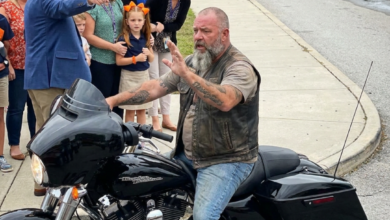
Most bikers people fear are imagined at speed—loud, reckless, aggressive, swallowing roads for the thrill of it. This man did the opposite. The old Harley moved at the pace of a funeral line, low and steady, tires whispering over winter asphalt while the woman sat wrapped in his coat, both gloved hands folded tight in her lap as if still not fully convinced she had done the right thing.
I followed them farther than I meant to.
Not because I distrusted him by then. Not exactly. Mostly because I had seen enough of the setup to know there was a story under it, and I could feel it opening one small careful mile at a time.
The biker never looked back much. Once at a red light. Once turning onto a county road lined with bare trees and limestone walls. Once more when the woman in the sidecar shifted and touched the edge of the coat around her shoulders, almost absently, as if the warmth surprised her every time she noticed it.
That tiny movement told me more than anything else.
She was not relaxed.
But she was staying.
He took her not toward town but away from it, down a narrow road past a shuttered feed store, a church with a cracked bell tower, and finally toward a small cemetery on a rise above frozen fields. That was when I understood it had never been a random walk. The old woman hadn’t lost her way.
She had a destination.
The biker parked by the iron gate, killed the engine, and sat still for one full beat before dismounting, as if he wanted to make sure the sudden quiet didn’t scare her. Then he stepped around, opened the sidecar door, and offered his hand.
She did not take it right away.
Instead she looked at the graves beyond the gate, then at him, then down at his coat still wrapped around her tiny shoulders. When she finally spoke, I could not hear the words, but I saw his face change in that way attentive people do when the truth rearranges the room inside them.
He nodded once.
Then he walked with her through the gate.
I stayed by my car because by then it had become clear I was inside something private, but the cemetery was small enough to read gestures from a distance. They stopped at a headstone near a cedar tree. The stone was older but clean. Somebody had been caring for it. The woman bent slowly to brush snow from the name. The biker stepped back at once, hat in hand, body turned not toward her but toward the horizon like a man giving strangers the dignity of their dead.
She sat on the low folding stool she had somehow managed to carry in a cloth bag.
That detail hit me harder than it should have.
She had planned for the visit.
Even on foot.
Even in that cold.
Fifteen minutes passed.
The biker waited the entire time without smoking, pacing, or checking his phone. He just stood there with the winter wind biting through his thermal and his coat around her shoulders at another man’s grave. That patience began to undo the whole first impression. Predators are rarely patient in useless weather. Show-offs even less so.
When she finally rose, he stepped closer again, and I heard enough this time as the wind dropped.
“Every day?” he asked.
She nodded.
“My husband,” she said, touching the stone. “Five years.”
That explained the walk.
But not yet the rest.
He looked toward the road they’d come from, then at her house shoes. “Your car broke?”
Another nod.
“No neighbor?”
She gave the smallest shrug, the kind old people give when the true answer is lonelier than the polite one. “Not one I’d ask.”
He absorbed that quietly.
Then, instead of launching into sympathy or concern, he did something much stranger and more specific. He crouched to fold the stool himself, shook the snow from it, tucked it carefully back into her bag, and said, “Tomorrow same time?”
She blinked.
Maybe because she thought she had misheard him.
Maybe because old people know better than most that kindness usually comes once and leaves quickly.
He repeated it.
“Tomorrow. I’ll get you here.”
She stared at him for a long second. Then she laughed once, not because it was funny, but because the offer was too large to step into cleanly. “Young man, you don’t even know my name.”
That made him smile for the first time.
It changed his entire face.
Not softer exactly. But younger. Less armored.
“Well,” he said, “that seems fixable.”
Her name was Eleanor Price.
He learned that on the walk back to the bike.
He also learned she was ninety, widowed, living alone three miles outside town in the house she and her husband bought in 1959. Her car had died two days earlier. The garage wouldn’t get to it until the next week. She had no sons nearby, one daughter in Harrisburg with grandchildren and a life too busy to carry daily grief trips, and she had been walking to the cemetery every afternoon anyway because “he shouldn’t have to spend a day alone just because my battery gave out.”
That line should have sounded sentimental.
On her, it sounded factual.
He introduced himself as Cal Bishop, age forty-five, owner of a bike and welding shop outside Lebanon, sober eight years, former Army motor pool, former worse things not volunteered. He did not offer all that at once, but she pulled the details from him in patient threads on the way home the way some old women do—without fuss, without making confession out of conversation.
At her house, a faded white ranch with a crooked mailbox and a dead hydrangea bush, she stood in the driveway still wearing his coat and looked at him like she did not know how to finish the day.
Then she said the line that told me everything about both of them.
“I don’t take rides from strangers.”
He reached for the coat gently. “Good.”
That should have ended it.
A biker stops for a freezing widow, gets her safely to a grave, brings her home, and disappears back into the road where stories like that usually go when they’re done being useful.
Instead, the next day at 1:30, the Harley came back.
And the next day after that.
And the next.
Three weeks became a ritual before either of them called it one.
Every afternoon, at the same hour, Cal’s black Harley rolled up Eleanor’s driveway with the same low V-twin sound, and every afternoon she came out already dressed for the ride: better shoes, proper coat, gloves this time, handbag crossbody, stool folded under one arm. She still moved slowly. He still never rushed her.
That mattered.
A lot of people know how to do kindness once.
Fewer know how to do it on schedule.
The neighbors noticed by day four, of course. Small-town roads notice everything. A tattooed biker arriving daily at a widow’s house in winter was enough to keep porches busy and curtains flexing. By day six, two versions of the story had already begun growing.
One was romantic.
Wrong.
The other was suspicious.
Wronger.
I know because I heard both at the gas station on Route 72.
“That old Mrs. Price has herself a boyfriend now?”
“Or a scam artist.”
“Men like that don’t do things for free.”
People always want to balance kindness like a ledger. If the man is tattooed and rides a Harley, they especially need the math to come out ugly so their fear feels justified.
Cal knew they were talking.
He ignored it.
That was part of his redemption too—not saintliness, just discipline. There had been a time, I learned later, when a sideways comment would have earned a bloody mouth and a courtroom. He had been that man once. Too many fights. Too much whiskey. Too much anger looking for legal excuses. Sobriety didn’t turn him soft. It turned him measured.
He kept his promise all three weeks until Eleanor’s Buick was repaired. He sat at the cemetery gate while she took her fifteen minutes beside her husband, Harold Price, a Korean War mechanic with a square jaw in the old photograph tucked into Eleanor’s wallet. Sometimes she talked at the grave. Sometimes she only sat. Sometimes she cried. Mostly she just breathed beside the stone and let the day recognize what it had taken.
Cal never intruded.
He waited with his hands wrapped around a paper coffee, sometimes talking to the cemetery groundskeeper, sometimes saying nothing at all. He fixed the loose latch on the gate one Wednesday without being asked. Straightened the bent memorial vase on a nearby plot another day. Not performative kindness. Small maintenance. The kind men like him understand better than speeches.
The first real crack in his armor came at the end of week two.
Eleanor had stayed longer than usual. Twenty minutes. Then thirty. The sky had gone the dull purple that comes before bad weather, and I remember this because I had driven up there again to bring flowers to my own mother’s grave and found him leaning against the sidecar smoking nothing, just rolling an unlit cigarette between his fingers.
When Eleanor finally came back down the path, her face was wet and folded in on itself in a way I had not seen before.
He stepped forward.
“Bad day?”
She shook her head once, then nodded, which is how old grief often answers.
“He would’ve been ninety-six today.”
Cal’s whole body went still.
That specific kind of grief—birthdays, not death days—does something different to people. It reminds them the dead would still have been moving through ordinary time if time had let them.
He looked at the headstone, then back at her. “Then we should’ve brought cake.”
It was such an awkward line that she laughed through tears.
He smiled too, embarrassed by his own clumsiness, then opened the sidecar for her like always. The next day he came back with a slice of yellow cake from a bakery box balanced absurdly in the sidecar storage compartment.
They ate it by the graveside on paper plates.
That was when the real bond began.
Not because of grand declarations.
Because grief trusts repetition and ridiculous details more than big speeches.
When her Buick was finally fixed at the end of three weeks, I happened to see the moment in her driveway. The mechanic had just left. Eleanor stood by the running car with the keys in one hand and Cal’s gloved hand in both of hers.
She looked shocked by her own feelings.
Like she had walked into gratitude too deep to handle politely.
Then she hugged him.
He froze for half a beat, then folded those big scarred arms around her with extraordinary care. Not fragile care. Respectful care. The kind you use with old wood and grieving people.
“You’re the best grandson I never had,” she said.
He laughed into her coat collar once, low and pained. “That line’s a little generous.”
“No,” she said. “It’s late, that’s all.”
Late.
That word stayed with him. I know it did because he repeated it two weeks later when somebody at the shop asked why he still disappeared every Sunday afternoon now that the car was fixed.
“She’s late getting a grandson,” he said. “I’m late becoming useful.”
That line explained him better than a résumé ever could.
Because the truth under all of this was harder and uglier than simple kindness. Cal had lost his own grandmother at sixteen while he was locked in juvenile detention after a theft and assault charge that should have scared him straighter than it did. She wrote him weekly. He never wrote back because he was angry at everything and too proud to be reached. She died before he got out. He didn’t make the funeral. Didn’t visit the grave for nine years because shame turns roads longer than geography does.
Helping Eleanor started as rescue. Then routine. Then penance. Then love.
For four years, he kept showing up.
Every Sunday after the car was fixed, he rode her to Harold’s grave. In spring, he brought daffodils from the market. In summer, cold bottles of water in the sidecar cooler. In fall, an old blanket because the cemetery bench stayed cold under the trees. In winter, he warmed the sidecar seat with a heating pad rigged through the bike battery because he was a mechanic and that is how mechanics say, I thought ahead about your pain.
He also fixed things around her house without asking too loudly for permission. Tightened the porch rail. Replaced a loose kitchen faucet washer. Cleaned the gutters. Never enough to make her feel pitied. Just enough to make solitude less punishing.
Her daughter, Marianne, knew some of it.
Not all.
That was another twist. Eleanor talked about Cal constantly, apparently, but in pieces. “My biker boy brought me roses from the gas station because all the flower shops were closed.” “My biker boy says the carburetor sounds dishonest.” “My biker boy doesn’t talk much, which means he’s usually telling the truth.”
Marianne heard the stories but lived forty miles away with teenagers, soccer schedules, and a husband recovering from back surgery. She loved her mother. She was also tired in the ordinary middle-aged way that makes distant miracles sound like exaggerations.
Until the funeral.
But before that came the hardest winter.
Four years in, Eleanor took ill in late December. Pneumonia. Then weakness. Then the kind of steady dimming families pretend is temporary until a hospice nurse says the word gently enough to break them without angering them.
Cal kept coming anyway.
Not with the Harley once the cold got too bad. In his truck. Sundays. Wednesdays. Sometimes Tuesdays too. He still asked if she wanted to go to the cemetery. Once she was too weak to make the trip, he went alone and stood by Harold’s stone with his hat in his hands long enough for the groundskeeper to say later, “I thought the dead man was your father.”
Cal answered, “Something like that.”
When Eleanor died, he showed up to the funeral in a black button-down under his leather cut, beard trimmed, boots polished once for the first time I’d ever seen. He stood beside the coffin not at the back with old friends, not outside with smokers, but where family waits when receiving the line.
That was where Marianne found him.
Funerals strip people down fast.
Not morally. Socially.
Nobody at that funeral cared much what Cal looked like once they saw where he stood and how he stood there—one hand lightly resting on the polished edge of the casket, shoulders squared not in ownership but in witness, as if he had volunteered to hold one corner of the room up while blood family wept.
Eleanor’s daughter approached him near the end of the visitation.
Marianne was in her late fifties, white, beautifully dressed in black wool and pearls that looked inherited rather than purchased, eyes swollen from the kind of crying you do privately before facing a public room. She had her mother’s jaw. Her mother’s directness too.
“Are you Cal?” she asked.
He nodded.
She studied him for a second, taking in the leather cut, the weathered face, the hands that looked made for engines instead of sympathy cards. Then she smiled through tears in a way that made her suddenly look much younger.
“My mother talked about you all the time.”
He looked startled by that.
Not doubtful.
Startled.
As if he had not realized he existed inside her stories the way she had existed inside his Sundays.
Marianne reached for his hand. “Thank you for loving her when it got quiet.”
That nearly undid him.
You could see it.
Not sobbing. Never that. But the mouth tightening, the throat working once, the gaze dropping because men like him survive by controlling what the face gives away and sometimes gratitude hits harder than grief.
He answered with the simplest sentence possible.
“I just stopped once.”
She laughed softly at that, then cried harder.
“No,” she said. “You didn’t.”
And that was the truth of it. The story did not begin with devotion. It began with a man pulling over for a freezing old woman on a winter road because he could not bear the sight of somebody walking alone toward grief in house shoes. Everything after that was built out of the second decision, then the third, then the fourth—the ones that cost time instead of impulse.
He stayed in touch after the funeral the way decent men stay in touch when the dead have connected them. He helped Marianne clean out the garage because Harold’s tools still hung on pegboard hooks exactly as he’d left them and no one else in the family could bear to decide their next life. He rebuilt the old porch swing Eleanor liked in summer. He drove Marianne to the cemetery one Sunday in March because she admitted she had never once managed to go without her mother and didn’t want the first time alone.
They sat there fifteen minutes.
Same as Eleanor always had.
He waited.
Same as always.
When Marianne rose, she wiped her eyes and said, half laughing at herself, “She was right. You really do just wait.”
Cal put his gloves on slowly. “Most people need more of that than they know.”
No sermon.
No explanation.
Just that.
Years later, people in Lebanon still tell the story wrong when they tell it fast. They say a biker rescued a widow on the road. That part is true enough, but too small. Rescue sounds like one day, one action, one visible good deed with a clean ending.
That isn’t what happened.
What happened was a man everyone had reason to mistrust at first chose to become reliable in a world where reliability had become rare. A ninety-year-old woman climbed into a stranger’s sidecar because winter was winning. Then, by the ordinary violence of days, the stranger became the grandson she had gone without too long.
I think about the sidecar most.
Not because it’s cinematic, though it is. An old woman wrapped in a biker’s coat, rolling slow through Pennsylvania winter toward a grave she loved too faithfully to miss. No, I think about it because sidecars are strange things. An added seat. A place made for carrying what the original machine was not built to hold alone.
That feels right for him somehow.
For four years, he carried something grief-heavy and fragile beside him without pretending it belonged anywhere else.
At the funeral, after most people had gone, I watched him stand by Eleanor’s casket one last time. He didn’t touch it this time. He only looked down and said something too low for anyone else to hear. Then he stepped back, squared his cut, and walked out into the cold toward the black Harley waiting by the curb.
The sidecar was empty.
Of course it was.
But there was a folded blanket still sitting in it, tucked neatly at one corner like she might yet complain about the wind and need it again.
He left it there all winter.
Maybe longer.
Some acts of love don’t arrive loud enough to be recognized when they begin. Sometimes they look like persistence. Sometimes like weather. Sometimes like a biker pulling over on a freezing road because a ninety-year-old woman is too stubborn to let the dead spend a day alone.
And sometimes they last four years after a stranger says yes.
Follow the page for more emotional, cinematic stories about misjudged people, quiet devotion, and the kinds of love that arrive wearing the wrong face.