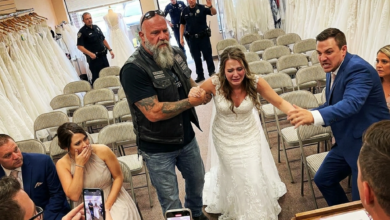
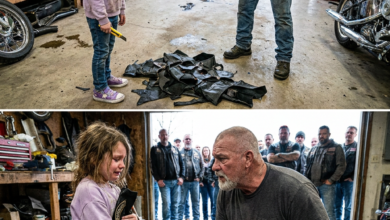
Part 2: A 290-Pound Biker Kept a Running Tab at the Five-Star Restaurant His Daughter Ran From Her Bedroom—Then Thirty-Two Riders Arrived to Settle His 400-Button Debt
Part 2 — The Customer Who Never Complained
Wade Callahan had not always been called Ox.
His mother named him Wade because she wanted something simple, but at seventeen he helped lift the front end of a wrecked pickup off a trapped farmhand near Circleville. A mechanic watching from the shoulder said Wade was built like an ox, and the name followed him into every garage, construction crew, recovery meeting, and motorcycle club he entered afterward.
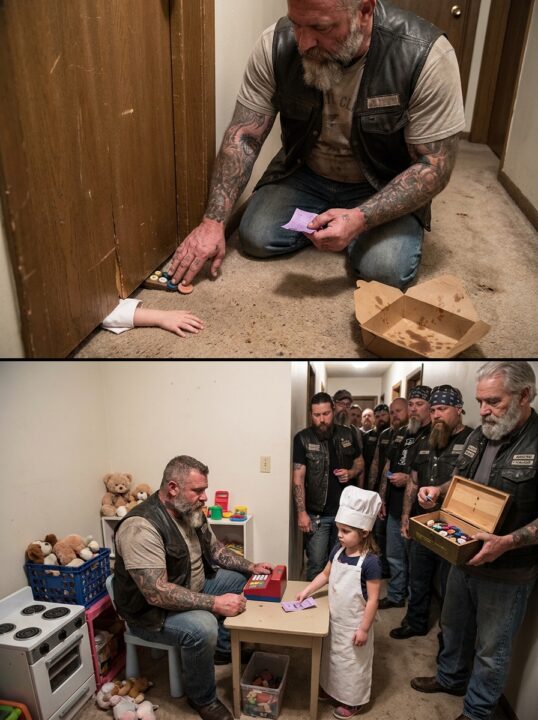
By forty-six, only Rosie and the county clerk still called him Wade.
I learned his history in pieces because Ox did not tell stories about himself. Deacon filled in what he could, Rosie corrected what adults remembered badly, and the receipts inside Ox’s vest explained the rest.
He had grown up south of Chillicothe in a trailer that shook whenever trucks passed on Route 23. His father disappeared before Wade entered high school. His mother cleaned motel rooms and taught him to sew buttons because she was tired of repairing the work shirts he tore.
“Needle doesn’t care how big your hand is,” she told him.
Wade became a diesel mechanic, married a hospital cafeteria cook named Maggie Doyle, and bought an aging Harley Road King from a sheriff’s auction. Maggie disliked the exhaust smell but loved how gently he handled the machine, wiping the tank with one of her good kitchen towels until she caught him.
Rosie was born seven years later.
For a while, the Callahans were ordinary in the best ways. Wade worked ten-hour shifts, Maggie returned home smelling of onions and industrial dish soap, and Rosie constructed businesses from cardboard boxes. She operated a veterinary clinic for stuffed bears, a bank that issued leaves instead of money, and a post office that delivered letters exclusively beneath bedroom doors.
The restaurant came later.
Wade’s complicated years began after a truck transmission slipped from a jack stand and crushed two bones in his right foot. The injury required surgery, and the pain pills made sleeping easy. When the prescription ended, sleep did not return with it.
He bought pills from a coworker.
Then he bought more.
Maggie found him passed out in the garage while four-year-old Rosie sat beside him, covering his boots with stickers. She packed a bag that night. Wade entered treatment the next morning, left after six days, relapsed, and finally returned after Maggie told him she would not teach their daughter to confuse love with waiting beside an unconscious man.
He remained sober for nine years.
The prison sentence came from a night he rarely discussed. During his second month of recovery, before sobriety had settled into habit, Wade broke into the fenced yard of his former employer looking for tools he could sell. A security guard confronted him. Wade shoved the man and fled, then turned himself in before sunrise.
He served eleven months for burglary and assault.
He never asked anyone to erase that fact. He paid restitution, apologized to the guard without requesting forgiveness, and rebuilt his mechanic’s license after release.
Deacon met him at a recovery meeting held in the basement of a Methodist church. The Iron Lantern president was a Vietnam-era Marine’s son with thirty-one years sober and little patience for dramatic promises.
“You got a motorcycle?” Deacon asked.
“Pieces of one.”
“You got tools?”
“Some.”
“You planning to steal mine?”
“No.”
“Good. Club meets Saturday.”
That was how Ox became an Iron Lantern.
The club was not clean in the polished public-relations sense. Its members argued, drank too much coffee, carried old convictions, and occasionally settled disagreements by shouting beside idling motorcycles. Yet Deacon enforced three rules: no drugs at club events, no rider abandoned on the road, and no child used as scenery for a man pretending to be decent.
Ox lived by all three.
Maggie allowed him back slowly. First came supervised afternoons with Rosie, then weekends, then the right to keep a toothbrush in the bathroom he once shared with his wife. Trust returned in teaspoons.
Years later, Maggie developed an aneurysm while working a morning cafeteria shift. She died before Wade reached the hospital.
Rosie was eight.
The little girl who had once operated six imaginary businesses stopped leaving her bedroom except for school. Then she stopped attending school too. She spoke to her father through the closed door, slid drawings into the hallway, and ate only when he left a tray outside.
Ox could rebuild a diesel engine blindfolded.
He could not repair that door.
For forty-three days, he slept on the hallway floor. He attended recovery meetings by speakerphone, showered only when Rosie’s aunt sat outside the room, and declined every club ride. Deacon brought groceries. Other riders repaired Maggie’s car, cut the grass, and sat on the porch without asking Ox to talk.
The blue button appeared on the forty-fourth night.
It slid beneath Rosie’s door attached to a purple crayon bill.
One bowl of tomato-star soup: 1 button.
Table fee: 1 button.
Listening to the chef: free.
At the bottom, Rosie had written: MOONLIGHT FIVE-STAR RESTAURANT. OPEN WHEN THE CUSTOMER KNOCKS.
Ox searched every drawer in the house. He found one loose blue button in Maggie’s sewing tin and pushed it beneath the door.
The second button came from his work shirt.
The door opened six inches.
Rosie wore Maggie’s old cafeteria apron folded twice around her waist. Behind her, a milk crate served as the stove, stuffed animals occupied a row of mismatched chairs, and an upside-down laundry basket held a paper plate containing three cotton balls.
“Mashed-potato clouds,” she whispered.
Ox sat on the floor.
“Smells expensive.”
“You only paid two buttons.”
“Put the rest on my tab.”
Rosie considered this with the severe expression of a restaurant owner assessing a risky customer.
“Tips are separate.”
He removed another button from his cuff.
That was the first dinner.
It was also the first time Rosie ate in forty-three days without the bedroom door between them.
The Moonlight Five-Star Restaurant opened every evening after that. Some nights Rosie spoke. Some nights she only pointed to the menu. Ox ordered every special, praised every invisible sauce, and paid whatever she charged.
If he lacked buttons, Rosie extended credit.
The tab grew.
Ox preserved every receipt because the handwriting changed. Letters steadied. Prices became more elaborate. The chef began adding notes about school, nightmares, Maggie, and which days she needed her father to remain outside the door instead of entering.
Those purple bills were the closest thing Rosie had to a voice.
Ox treated them accordingly.
Part 3 — The Four-Hundredth Night
I became involved because of a missing button jar.
The Lantern Diner kept it beneath the register beside spare pens, burned-out birthday candles, and keys nobody had claimed since the Clinton administration. Most buttons had fallen from waitress uniforms or winter coats forgotten in booths.
One Monday, the jar disappeared.
My cook accused a new dishwasher. The dishwasher blamed the weekend cleaning crew. I reviewed the diner’s old security recording and saw Ox standing behind the counter at 5:12 a.m., holding the jar.
He had entered with a key.
That key belonged to my night manager, Bobby Crane, an Iron Lantern prospect.
I called the police before I called Bobby.
Officer Leah Mercer found Ox at his repair shop. He did not run, argue, or pretend the jar was his. He placed it on the workbench and admitted taking it.
“I was bringing it back Friday.”
“That is not how borrowing works,” I told him.
“No, ma’am.”
“Why didn’t you ask?”
“Needed the red one.”
“There were two hundred buttons in that jar.”
“Didn’t know which red one she meant.”
The answer made me angrier. It sounded ridiculous, and ridiculous excuses often hide ordinary dishonesty.
Bobby arrived on his motorcycle and tried to accept responsibility. He had given Ox the key because the Moonlight Restaurant was approaching its four-hundredth dinner, and Rosie had announced that her customer’s tab would be audited. She wanted a specific red button like the one from Maggie’s cafeteria sweater.
“Ox was supposed to sign it out,” Bobby said.
“From my diner?”
“I left a note.”
He had.
The note had fallen behind the register.
I still pressed charges.
Not because I believed Ox planned to keep the jar, but because a former burglar with a borrowed key should have understood exactly what entering a closed business would look like. He did understand. That was why he accepted the handcuffs without complaint.
The Iron Lantern Riders did not.
Half the club wanted to pressure me into withdrawing the complaint. Deacon refused. He told them brotherhood did not mean converting a brother’s reason into an excuse.
“You can stand beside him,” he said. “You don’t get to erase what he did.”
Ox spent one night in county lockup while Officer Mercer reviewed the recording, found Bobby’s message, and confirmed that none of the money beside the button jar had been touched. I withdrew the complaint the next morning.
Ox returned the jar.
One button was missing.
The red one.
“I’ll pay for it,” he said.
“It is a button.”
“It was yours.”
I wrote a receipt for one cent.
Ox paid with a dollar and refused the change.
Then he did something that bothered me more than the theft. He removed the red button from his pocket and set it on the counter.
“Can’t use it now.”
“Why?”
“Cost somebody trust.”
He left it there.
That evening, I drove to his house with the button in my coat pocket. My intention was to hand it to Rosie, explain that her father had done something foolish for her, and make sure she understood the difference between devotion and permission.
Instead, I found Ox sitting alone outside the bedroom.
The restaurant was closed.
A new purple bill lay on the floor.
Penalty for stealing: 100 buttons.
Penalty for making Miss Clara mad: 50 buttons.
Dinner not served.
Ox had not hidden the arrest from Rosie. He had explained it before I arrived and accepted the exact punishment she chose.
“Your owner has strict policies,” I said.
“Five-star place.”
“You could have asked me.”
“Yes, ma’am.”
“Why didn’t you?”
He rubbed his thumb across the empty buttonhole on his work shirt. “Four hundred nights sneaks up.”
I sat beside him.
The hallway smelled of motor oil, grilled cheese, and the strawberry shampoo Rosie used. From behind the door came the quiet scrape of a crayon.
“What happens at four hundred?”
“Health inspection.”
“By whom?”
“Mr. Pickles.”
“The rabbit?”
“Senior inspector.”
I almost smiled. Ox did not.
The four-hundredth dinner mattered because it fell on the first anniversary of Maggie’s death. Rosie planned to reopen the restaurant to outside customers that day. For the first time, she had invited the Iron Lantern Riders upstairs.
There was one problem.
The club’s annual memorial ride for Manuel “Manny” Alvarez had been scheduled for the same morning.
Manny was the Iron Lantern’s former road captain and Ox’s recovery sponsor after Deacon. He had suffered a fatal heart attack three months earlier while repairing a church van. The memorial ride would carry his ashes from Chillicothe to a hill near Hocking Hills where he had proposed to his wife.
Ox was expected to lead it.
He had promised Rosie first.
At the next club meeting, Deacon placed both obligations in front of him. Forty riders and Manny’s widow would be waiting. The route required a road captain familiar with every fuel stop and dangerous curve. Moving the ride would affect families coming from four states.
Rosie’s restaurant opened at eleven.
The convoy departed at ten.
“Bring her,” one member suggested.
“She’s not ready,” Ox said.
“Then she’ll understand.”
“She’s nine.”
“Manny was your sponsor.”
“My daughter is my daughter.”
The room went still except for rain ticking against the clubhouse roof and the metal rattle of somebody setting down a coffee cup.
Deacon asked Ox to decide.
He removed his road-captain patch.
Leather creaked as he pulled his cut from his shoulders. He placed both on the table.
“Find another captain.”
A younger member named Crow stood abruptly. “You’re quitting on Manny for a pretend lunch?”
Ox crossed the room before anyone could move.
He did not strike Crow.
He stopped close enough that the smaller man had to tilt his head back.
“A child knows when you pretend,” Ox said. “Mine knows when I stay.”
Then he walked out without his patch.
The V-twin of his Road King struck the wet air. A second later it faded toward Paint Creek, leaving thirty-nine riders to decide whether brotherhood meant honoring a dead man’s route or understanding why one living father had stepped away from it.
The vote lasted seven minutes.
It nearly split the club.
Part 4 — The Restaurant Behind the Door
On the morning of the four-hundredth dinner, Ox arrived at my diner before sunrise.
He wore a white shirt without a single button missing, black jeans, clean boots, and no leather cut. Without the vest, he looked less dangerous and more exposed.
He ordered forty grilled-cheese sandwiches.
“For the riders?” I asked.
“For whoever comes.”
“You think they will?”
“No.”
I looked toward the white shirt. “Then why forty?”
“Restaurant policy. Never run out.”
We packed the sandwiches into catering trays. Ox paid in ordinary dollars, then placed a purple receipt beside my register.
Moonlight Five-Star Restaurant catering partnership: approved.
I understood the invitation.
By ten o’clock, I was setting paper cups on Maggie’s old kitchen table while Ox vacuumed the hallway for the third time. Rosie remained inside her bedroom, arranging the restaurant.
At ten fifteen, no motorcycles had arrived.
At ten thirty, Ox checked the street but pretended he was checking the weather.
At ten forty-five, he carried the serving tray upstairs.
A single blue button sat in its center.
It was the first payment he had ever made at the restaurant—the button from Maggie’s sewing tin. Rosie had returned it six months earlier as change, and Ox had sewn it inside his leather cut over his heart.
Now the cut was gone.
So was the button.
“Thought that one mattered,” I said.
“It does.”
“Then don’t spend it.”
Ox looked toward the bedroom. “Money’s supposed to move.”
At ten fifty-five, he removed his boots and sat outside Rosie’s door. I waited on the stairs. The house seemed to shrink around the silence.
At eleven, Ox knocked.
“Moonlight customer.”
No response came.
He knocked again.
“Reservation for one.”
A purple envelope appeared beneath the door.
Ox opened it.
The note inside did not contain a menu.
Restaurant closed. Customer has paid enough.
Below that, Rosie had written in smaller letters:
Mom made me promise to keep you eating.
I watched Ox read the line twice.
The hallway changed.
The restaurant had not begun as Rosie’s attempt to make herself eat after Maggie died, although it had helped her do that. It began with a promise Maggie made her daughter give in the hospital during the final hours before the aneurysm took her.
Maggie knew Wade’s history. She knew grief had once led him toward pills, locked doors, and disappearing acts. She also knew their daughter had seen more of those years than Wade wanted to admit.
While Ox sat in another room completing medical forms, Maggie asked Rosie to keep an eye on him.
“If Dad forgets dinner,” she whispered, “open one of your restaurants. He never turns down your cooking.”
A dying mother had meant it as comfort, perhaps even a small joke.
Rosie had treated it as an assignment.
On the forty-fourth night, she heard Ox speaking to her aunt in the kitchen. He said Rosie might be safer living elsewhere because he was failing her. A suitcase stood beside the back door.
Rosie opened the Moonlight Five-Star Restaurant before he could leave.
Each button purchased one meal and one more evening at home. Every charge forced him to knock the next night. Every receipt gave Rosie a reason to answer.
The running tab had never measured food.
It measured nights.
Four hundred dinners meant Ox had remained sober, present, and within reach of his daughter for four hundred consecutive evenings after Maggie died.
The bills also recorded Rosie’s return. On receipt nineteen, she had asked for the hallway light to remain on. On receipt seventy-two, she let Ox sit inside the doorway. On receipt one hundred forty-six, she told him about a nightmare. On receipt two hundred eleven, she attended school for two hours.
By receipt three hundred eighteen, she had invited me to become the restaurant’s catering partner.
At four hundred, she had decided her father no longer needed the tab.
Ox held the blue button between two fingers.
“What if I do?” he asked the closed door.
Rosie answered softly. “You know where the restaurant is.”
“I owe four hundred.”
“No. You paid every night.”
His thick hand closed around the button.
That should have been the end. A father had kept his promise, a daughter had begun opening her door, and a pretend restaurant had served its purpose.
Then motorcycles came.
Not one.
Thirty-two.
The first engine rolled down Paint Street with the uneven thunder of a Harley V-twin. Another followed, then another, until windows trembled and neighbors stepped onto porches. The riders turned into the block two abreast, black leather darkened by rain.
At the front rode Deacon.
Behind him sat Elena Alvarez, Manny’s widow, holding her husband’s urn against her chest.
The convoy stopped outside the house.
Every engine died.
Deacon removed his boots on the porch. The rest followed, leaving a crooked line of motorcycle boots from the front steps to the curb.
He climbed the stairs carrying a locked wooden ammunition box. Crow walked behind him, wearing a clean dress shirt held closed with safety pins.
“Lost your buttons?” I asked.
“Paid a debt.”
Deacon placed the box outside Rosie’s bedroom and opened it.
Buttons filled the inside—white, black, brass, pearl, wooden, red, blue, pink, and green. Hundreds of them. Some came from work shirts. Some came from motorcycle jackets. One still held a piece of denim because its owner had cut too close.
On top lay a sealed letter written by Manny before he died.
Deacon handed it to Ox.
Brother, if Rosie’s place ever opens to the public, you feed that girl’s customers. Roads will wait. Children should not have to.
Manny had known about the restaurant. During Ox’s worst weeks, he had sat outside the bedroom door pretending to be a health inspector. Rosie charged him twelve buttons and failed him for wearing muddy boots.
Before his heart attack, he had begun collecting buttons for Ox’s tab.
The club vote had not canceled his memorial ride.
It had changed the first stop.
They would eat at Moonlight, pay the debt Manny started collecting, then carry his ashes to Hocking Hills. Deacon had removed Ox as road captain only because the route now began at his own front door.
Brotherhood had not chosen between Manny and Rosie.
Manny had already chosen both.
.
Manny had already chosen—
Part 5 — Thirty-Three Customers
Rosie did not open the bedroom door immediately.
Thirty-two bikers, a diner owner, a police officer, and one widow waited in a narrow hallway for a nine-year-old restaurant owner to decide whether they met the dress code.
Officer Mercer had arrived because of the neighbors’ call. She remained because Deacon handed her a brass button and said every customer had to pay.
“Is this legal tender?” she asked.
“At this establishment,” Ox said.
A bell rang behind the door.
Mr. Pickles appeared first.
The stuffed rabbit came through the opening tied to a toy wagon. A paper badge on his chest identified him as the senior inspector, although the writing faced inward and could not be read from the hallway.
Next came a menu.
Cloud pancakes: 2 buttons.
Dragon steak: 4 buttons.
Invisible soup: 1 button.
Macaroni emergency: market price.
No refunds for food eaten by stuffed animals.
Deacon ordered everything.
The door opened.
Rosie stood inside wearing Maggie’s cafeteria apron and a paper chef’s hat decorated with five uneven stars. She was small for nine, with brown hair cut to her shoulders and a serious expression that looked startlingly like her father her’s.
Her eyes moved across the leather cuts and tattooed arms crowding the stairs.
“You can’t all fit.”
Deacon nodded. “We’ll rotate tables.”
“No boots.”
“They’re outside.”
“No loud voices.”
The riders looked at Crow.
He lowered his head. “Yes, ma’am.”
Rosie inspected the ammunition box. “That’s too much money.”
“Tip,” Deacon said.
“For what?”
“Good service.”
She considered him, then pointed to a folding chair intended for a child. Deacon weighed at least 240 pounds.
“Table one.”
The club president sat.
The chair groaned.
Nobody laughed until Rosie did.
For the next two hours, the Iron Lantern Riders entered the bedroom in groups of four. Large tattooed men folded themselves onto the floor, placed napkins across their knees, and ordered food from a menu written in purple crayon.
Rosie served cotton-ball potatoes, plastic vegetables, empty teacups, and wooden blocks she called meatloaf. No one broke character.
Crow complained once that his soup was cold.
Ox reached for the back of his safety-pinned shirt.
Crow corrected himself. “Perfect temperature.”
Each rider paid at the toy register. Some left one-button tips. Others left twenty. Deacon placed Manny’s brass vest button beside Mr. Pickles and told Rosie it belonged to a customer who had reserved a table but could not attend.
Rosie did not ask where he was.
She set an empty chair beside Ox.
Manny’s widow sat across from it. Elena wore her husband’s red bandanna around one wrist, and when Rosie served the empty chair a plate, Elena pressed her lips together until the trembling stopped.
Ox never gave speeches about grief. He placed one enormous hand over Elena’s and left it there until Rosie announced dessert.
The blue button remained in his palm.
Rosie noticed.
“Customer hasn’t paid.”
Ox set it beside the toy register.
“Closing the tab.”
Rosie pushed it back.
“Restaurant said you paid enough.”
“Customer disagrees.”
“Owner makes the rules.”
“Customer can tip.”
Rosie folded her arms.
For several seconds they stared at one another—two stubborn Callahans negotiating across a plastic cash register.
“What do you want for it?” she asked.
“Lifetime reservation.”
“You have to call if you’re late.”
“Deal.”
“You can’t steal buttons.”
“Yes, ma’am.”
“You can’t leave when the restaurant is closed.”
Ox’s fingers stopped against the table.
The room became quiet.
Rosie’s voice was smaller when she repeated it.
“You can’t leave.”
Ox looked toward the faded waitress apron that had belonged to Maggie, then at the receipts stacked beside Rosie’s toy register.
“No,” he said. “I can’t.”
Rosie accepted the blue button.
She placed it inside the register’s smallest compartment and closed the drawer.
The four-hundred-button debt was settled.
But the restaurant did not close.
After lunch, the riders carried Manny’s urn outside. Ox put on his leather cut again. Deacon had resewn the road-captain patch while waiting downstairs, using dark thread and stitches so crooked that Maggie would have removed them immediately.
Ox ran one scarred thumb over the patch.
“You sew this?”
“Club voted.”
“That wasn’t my question.”
Deacon pointed toward the motorcycles. “Lead the ride.”
Before Ox mounted his Road King, Rosie came onto the porch. It was the first time she had stepped outside during a club gathering since her mother died.
Thirty-two riders waited without starting their engines.
Ox crouched so they were nearly eye level.
“Restaurant closed?” he asked.
“Dinner at six.”
“Hocking Hills is two hours.”
“Then don’t be late.”
“What’s the penalty?”
Rosie considered.
“Fifty buttons.”
“That’s robbery.”
“Owner makes the rules.”
Ox smiled beneath his beard.
It changed his entire face.
He fastened Rosie’s helmet, lifted her onto the passenger seat, and looked at me. “She rides to the end of the street. Clara brings her back.”
Rosie objected.
The owner lost that negotiation.
Ox started the Road King. The V-twin’s deep pulse moved through the porch boards, but he kept the throttle low. One by one, the other engines joined.
At the end of Paint Street, I waited with my car.
Rosie climbed down, removed the helmet, and touched the blue button visible through the toy register drawer she carried beneath one arm.
Ox raised two fingers.
Then he led Manny’s final ride toward Route 35.
Elena carried the urn. Deacon followed beside her. Crow rode last in a shirt still held together with safety pins.
The sound faded through the bare Ohio trees.
Rosie listened until she could no longer hear her father’s motorcycle.
“He’ll be back,” she said.
It was not a question.
Part 6 — Open Fridays
The Moonlight Five-Star Restaurant remained inside Rosie’s bedroom for three more months.
Then it moved.
Not far—only downstairs to Maggie’s old kitchen—but the relocation required a grand-opening inspection, revised menus, and a health certificate signed with Mr. Pickles’s paw.
Every Friday at 6:00 p.m., Ox became the first customer.
He arrived even when he had worked twelve hours, even when rain soaked his jeans, and even when a repair job left grease beneath his nails. He removed his boots, washed his hands, straightened his leather cut, and waited to be seated.
The tab never disappeared.
Rosie reduced the prices because her father complained about inflation. She charged one button for soup, two for an entrée, and one extra if Ox used his phone at the table.
He paid that penalty often.
The Iron Lantern Riders established a button fund at the clubhouse. New members were required to contribute one button, although Deacon refused to explain the tradition until they attended dinner.
Bobby returned my diner key and earned his full patch eight months later. At the ceremony, Ox gave him the original red button from my jar.
“Trust costs more,” Ox told him.
Bobby sewed it inside his cut.
Rosie returned to school full-time. She still had difficult mornings, and the anniversary of Maggie’s death remained a day of closed curtains and short answers, but she no longer needed a bedroom door to speak for her.
She joined the school cooking club.
Her first real dish was tomato soup decorated with small stars cut from toasted bread. Ox ate three bowls and claimed each deserved a five-button tip.
On the second anniversary of Maggie’s death, the Iron Lantern Riders arrived without being invited. They brought no cameras, fundraiser banners, or club announcements. They left their boots outside and filled the kitchen chairs.
Manny’s empty seat remained beside Ox.
Rosie served real grilled-cheese sandwiches that evening.
Elena ate half of hers and wrapped the rest in a napkin. Deacon complained that the soup needed salt. Rosie fined him ten buttons for insulting the chef.
Ox left fifty.
Before closing, Rosie counted the register. The blue button remained in the smallest compartment, separated from all the others.
“Still taking reservations?” Ox asked.
Rosie looked at him.
“Always.”
Part 7 — The Last Bill
Three years after the four-hundredth dinner, Rosie stood behind the counter of my diner wearing a Lantern apron that reached almost to her ankles.
She was twelve and helping on Saturday mornings. Child-labor laws limited what I allowed her to do, but she could greet customers, fold napkins, and lecture Bobby whenever he placed dirty coffee cups in the wrong tub.
Ox occupied his usual booth.
Age had added more gray to his beard and stiffness to the foot crushed years earlier, but he still filled the seat like a man designed for larger furniture. His leather cut hung beside him. The faded blue button remained sewn inside it over his heart.
Rosie approached carrying an order pad.
“Coffee?”
“Black.”
“Special?”
“What is it?”
“Grilled cheese and tomato-star soup.”
“Price?”
“Real money.”
Ox looked offended. “Place has changed.”
“Management grew up.”
She placed the meal before him, then slipped a purple paper beneath the plate.
Ox unfolded it.
Moonlight Five-Star Restaurant—Lifetime Account.
Balance due: 0 buttons.
Reservation status: permanent.
At the bottom, Rosie had drawn five stars and written one additional line.
Customer stayed.
Ox read it without moving.
The diner continued around him. Plates struck the service window, the coffee machine hissed, and a truck changed gears on Route 23. Nobody interrupted.
Finally, Ox removed one small black button from his shirt cuff and placed it on the bill.
“Tip,” he said.
Rosie pushed it back.
“Too much.”
“Service was good.”
“You haven’t tasted the soup.”
“Owner’s got a reputation.”
She sat across from him.
For several minutes, they shared the grilled cheese without talking. Ox dipped each corner into the soup exactly as Maggie once had. Rosie stole the crispest half from his plate.
Outside, the first Iron Lantern motorcycles entered the parking lot. Their V-twins rolled against the diner windows, then fell silent one by one.
Deacon entered carrying an old wooden ammunition box. It was nearly empty now, except for Manny’s brass button and a handful of bright plastic ones saved for emergencies.
“Restaurant open?” he asked.
Rosie looked at Ox.
Her father placed the purple lifetime bill inside his vest.
“Always,” she said.
The riders removed their boots at the door.
Follow our page for more biker stories about intimidating riders, devoted fathers, tested brotherhood, and the quiet promises hidden beneath worn leather cuts.