A 285-Pound Biker Ripped the Microphone from a Little Girl Mid-Song as the Crowd Booed — Eleven Seconds Later, the Stage Above Her Came Down
Part 2 — The Biker Who Kept Looking Up
I had first seen Ray at 5:08 that morning, nearly fifteen hours before the truss fell.
The fairgrounds were almost empty. Dew covered the folding chairs, vendors were raising canvas awnings, and the temporary stage crew was still hanging lights from a box truss suspended above the platform. I had arrived early because temporary electrical systems misbehave most often before breakfast.
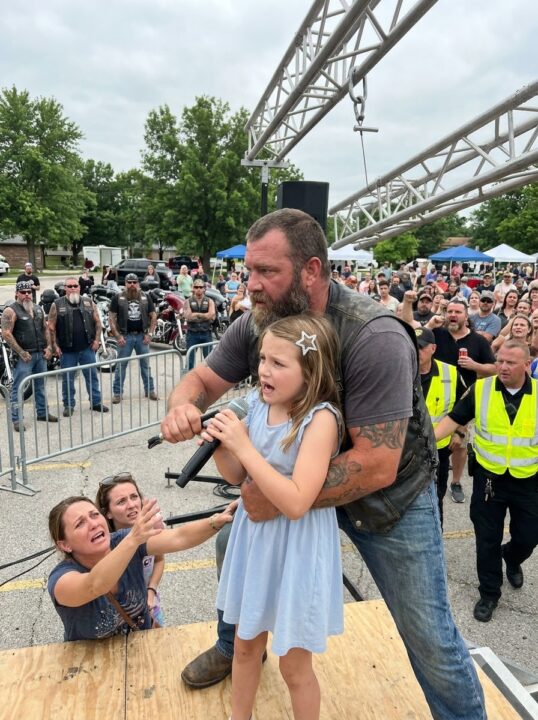
Ray arrived because he did not trust temporary steel.
His Harley came through the service gate at walking speed, the V-twin rumble bouncing between livestock barns before dying beside the stage. He removed his gloves, stood beneath the lighting grid, and watched a rigger tighten the final connection.
“Who signed the overhead?” he asked.
The crew chief, Brett Sloan, looked down from his ladder. “Festival staff only beyond this line.”
Ray repeated the question.
Brett pointed toward the gate.
Ray did not leave until a woman named Denise Halpern, the festival director, came from the production trailer. She was forty-eight, efficient, tense, and already carrying three radios. She recognized him immediately.
“Not today, Hammer.”
“You changed the load.”
Denise glanced at the truss. Four extra moving lights had been installed overnight after the main sponsor complained that the stage looked cheap in promotional videos.
“The engineer approved the system.”
“Before the added heads?”
Denise’s silence answered him.
Ray walked to the stage-left tower, pressed his palm against the aluminum support, and looked upward. The wind was mild, but the suspended lights were moving more than the flags above the food tents.
He took out his phone.
Brett descended the ladder and blocked his camera. “You don’t work here.”
“Neither does gravity.”
That was the longest sentence I heard Ray speak all morning.
Denise ordered security to escort him out. Ray handed me a folded sheet as he passed the audio table.
“If that corner starts singing, kill the bass.”
I unfolded it after he left.
The paper showed a hand-drawn stage tower with three circles around the upper shackle. Measurements ran down the margin. A note beside the drawing read: ADDED LOAD + SIDE MOTION = WALKING PIN.
I carried it to Brett.
He glanced once, crumpled it, and dropped it into a trash barrel.
“Old biker likes pretending he’s still a rigger.”
Still a rigger.
That phrase stayed with me.
At lunch, I searched Ray Dawson’s name. Most of what I found involved motorcycles, an aggravated-assault conviction, and a twenty-three-year-old newspaper photograph of him being led from the Springfield Civic Arena in handcuffs.
The headline said he had attacked a concert promoter after a fatal rigging accident.
One man had died.
A nine-year-old girl had been injured.
Ray served eighteen months.
That was enough information to make me distrust him when he climbed the barricade that evening. It was not enough to understand him.
Hawk later filled in the missing years.
After prison, Ray stopped working large concert venues. No company would insure him, and few union halls wanted his name on a call sheet. He repaired farm equipment, welded motorcycle frames, and eventually joined the Iron Lanterns.
The club did not save him in some grand, sentimental way.
They gave him tasks.
Change this tire. Weld this bracket. Ride behind the new prospect. Bring coffee to the brother whose wife was in surgery. Sit outside a hospital room without asking questions.
Ray understood tasks better than forgiveness.
Over time, the club learned his rules. He never rode beneath a temporary festival arch without looking at its anchors. He never sat under hanging speakers. He checked ceiling exits before ordering food at old theaters.
Most important, he never ignored unfamiliar metal sounds.
Hawk told me Ray could hear a loose washer in a running engine and a damaged shackle above a cheering crowd. He did not call it talent.
He called it punishment.
Three weeks before the Hope Festival, Lucy’s mother, Elise Bennett, visited the Iron Lanterns’ garage. Her husband, Mark, had been a firefighter and a weekend rider who occasionally joined the club’s charity escorts.
Mark never wore their patch.
He had earned their respect anyway.
After Mark died in the warehouse collapse, Lucy stopped singing in public. She wrote songs privately, usually at the kitchen table, but refused to perform them. The Hope Festival offered a scholarship bearing her father’s name, and Lucy finally agreed to sing during the ceremony.
Elise wanted the Iron Lanterns present.
“Mark said engines sounded less lonely when there were enough of them,” she told Hawk.
The club planned a quiet escort from Lucy’s house to the fairgrounds. Ray initially refused to participate.
Then Elise showed him Lucy’s song title.
“Keep the Light On.”
Ray stared at those four words for a long time.
He asked who had built the stage.
When Elise told him Sloan Event Systems, his face closed.
Brett Sloan’s father had owned the production company involved in the Civic Arena collapse twenty-three years earlier.
The son was not responsible for his father’s choices.
Ray knew that.
He also knew companies inherited more than trucks and equipment. They inherited shortcuts, paperwork, and the habit of calling a warning an inconvenience.
He attended the festival for Lucy.
He inspected the stage for everyone else.
That morning, after security removed him, Ray called the city fire marshal. The marshal was handling a chemical spill east of town and sent a junior inspector. The inspector checked the stage tower at 9:20, but Brett had lowered the music volume and removed two of the added lights before he arrived.
After the inspection, the lights went back up.
No new paperwork was filed.
Ray photographed it.
He sent the pictures to Denise, Brett, the festival board, and the police non-emergency number. Denise received them at 5:19. She replied with four words:
PLEASE STOP DISRUPTING THIS EVENT.
Ray returned to the Iron Lanterns.
Hawk suggested contacting Lucy’s mother and asking her to withdraw. Ray refused.
“You know something’s wrong,” Hawk said.
“I know it needs another inspection.”
“That girl goes under it either way.”
Ray looked toward his Harley.
“Not either way.”
The brotherhood voted on whether to enter the grounds after being told to stay away. Fifteen wanted to escort Lucy and leave. Nine wanted to shut the stage down by parking motorcycles across the entrance. Three wanted no involvement.
Ray rejected the blockade.
“No fists. No threats. No engines near kids.”
“What’s left?” a younger biker asked.
Ray pulled his gloves tight.
“Watch.”
So twenty-eight bikers stood behind the barricade that evening, listening to Lucy sing while Ray watched a locking pin move one fraction of an inch at a time.
Part 3 — The Eleven Seconds That Divided the Crowd
After the truss struck the stage, everything became noise again.
A severed power cable snapped across the floor. Smoke rose from a shattered light. Parents called children’s names while security volunteers shouted conflicting instructions through radios.
The truss had fallen diagonally, its stage-left corner punching through the plywood while the opposite end remained suspended by two safety cables. It looked stable.
It was not.
Ray knew the remaining cables had never been designed to hold the entire load at that angle. He pushed Lucy toward me and ordered everyone away from the deck.
She refused to release his vest.
“My mom.”
“Coming.”
“My mom is there!”
Elise had fallen beside the front barricade as the crowd surged. Hawk and another biker lifted the rail off her leg, then carried her through the escape corridor.
Lucy ran to her.
That was the first moment Ray could have stepped away.
Instead, he climbed back onto the damaged stage.
“Ray!” Hawk shouted.
“Six kids backstage.”
The children waiting for the finale had entered a canvas changing tent connected to the rear platform. The fallen truss blocked the main exit, and the tent’s second opening faced a locked service fence.
Ray disappeared behind a hanging curtain.
Police officer Travis Cole followed him. Cole was the officer who had tried to handcuff Ray minutes earlier. He had a flashlight in one hand and a bleeding scrape along his cheek.
Three Iron Lanterns moved after them.
Hawk stopped the rest.
“Too much weight.”
That decision mattered. The deck supports beneath stage left had cracked. Another five men could have collapsed the floor.
Ray reached the changing tent and found four children. The fifth had crawled beneath a costume table. The sixth, a seven-year-old boy named Nolan, was missing.
Officer Cole cut through the rear tent wall with a pocketknife. The bikers passed children through the opening, one at a time, into the arms of firefighters outside the fence.
Ray remained inside.
The suspended truss shifted.
One cable broke.
The sound resembled a rifle shot.
The crowd ducked. Ray did not. He listened, calculated the new angle, and crawled beneath the fallen curtain toward the drum riser.
Nolan was there, curled beside a road case with both hands over his ears. The child’s father had taught him to hide beside heavy furniture during storms.
This was not a storm.
Ray flattened himself and reached through the gap. “Give me your hand.”
Nolan shook his head.
Another light crashed three feet away.
Ray removed the silver skull ring from his right hand and rolled it across the floor. It stopped beside Nolan’s shoe.
“Dragon tooth,” he said. “Bring it back.”
The boy stared at the ring.
Ray held out his hand.
Nolan crawled toward him.
Officer Cole returned through the torn tent wall and helped drag them from beneath the riser. They reached the grass seconds before the second safety cable tore free.
The remaining truss slammed down.
This time, the entire stage roof tilted.
Rain began falling through the open sides.
It came hard, sudden, and cold.
People cheered when Ray emerged with Nolan against his chest. Phones rose again. The same crowd that had booed him now called his name.
Ray ignored them.
He gave Nolan to a firefighter and searched for Lucy.
She stood beside her mother under the medical tent. Blood marked one knee where she had fallen after Ray carried her from the stage, but she was otherwise unhurt.
Ray walked toward her.
Police stopped him.
Denise Halpern had told officers that Ray interfered with the performance, entered a restricted area, and may have destabilized the rig while touching the tower that morning. Brett supported her statement.
The accusation spread before the rain reached the parking lot.
Ray had saved Lucy.
Now people wondered whether he had caused the danger.
Officer Cole looked at the handcuffs on his belt.
“You’re asking me to arrest the man who just brought out a kid.”
Denise pointed toward the collapsed stage. “He climbed the tower before sunrise. We have witnesses.”
“I touched the leg,” Ray said.
Brett stepped forward. “You hit the support.”
Ray stared at him.
Hawk moved between them.
The Iron Lanterns formed a half-circle behind their road captain. Police shifted closer. Parents pulled children away again, uncertain which version of Ray they were supposed to believe.
The brotherhood had reached its test.
One punch would destroy everything.
Ray’s old conviction hung over the field. He had once attacked a man after a rigging death. Everyone who had searched his name knew it.
Brett knew it too.
“Go ahead,” he said quietly. “Show them.”
Ray’s scarred hands closed.
Hawk did not grab him. He spoke from two feet away.
“Task, brother.”
Ray kept looking at Brett.
“Give me a task,” Hawk repeated.
Rain ran down Ray’s beard. The muscles in his jaw shifted.
Finally, he opened his fists.
“Save the hardware.”
The bikers turned toward the wreckage.
Under Officer Cole’s supervision, they began marking every fallen pin, shackle, bolt, clip, and length of cable without moving anything unnecessarily. Several Iron Lanterns had worked as mechanics, welders, crane operators, or heavy-equipment technicians. They photographed positions, placed buckets over loose components to protect them from rain, and kept festival workers from clearing the scene.
Denise objected.
Ray looked at Officer Cole. “She wants it gone before the inspector arrives.”
Cole heard the meaning.
He closed the stage perimeter.
Brett attempted to leave through the service gate. Two bikers stepped into his path, then remembered Ray’s order and moved aside.
They did not touch him.
Police did.
Inside Brett’s work van, investigators found spare hardware, inspection stickers, load sheets, and a cardboard box containing the pins used on the stage.
One label claimed the pins were certified alloy steel.
A magnet told another story.
The fallen pin had been machined from cheaper mild steel. Its retaining groove was too shallow, allowing vibration to walk the clip loose during amplified music.
That explained the failure.
It did not explain the warning.
Denise insisted she had trusted Brett’s certification. Brett claimed the added lights remained within the original load rating. Both avoided the question of why Ray’s photographs had not been forwarded to an inspector.
Lucy sat on an ambulance step while adults argued around her.
She still held the brass tag taken from Ray’s vest.
Elise saw it.
Her face changed.
“Where did you find that?”
“Inside his jacket.”
Elise took the tag with both hands.
PAUL MORENO.
“My father,” she whispered.
Ray stood twenty feet away.
Elise crossed the wet grass toward him.
“You knew him?”
Ray looked at the wrecked stage.
“Yeah.”
“My mother said he died in an arena accident.”
“Yeah.”
“She said another man started a fight afterward and went to prison.”
Ray said nothing.
Elise looked from the old brass tag to his scarred knuckles.
“You were that man.”
“Yeah.”
Lucy moved beside her mother.
“Did Grandpa give you this?”
Ray’s answer came slowly.
“No.”
He looked at the brass tag as if it weighed more than the fallen steel behind him.
“I took it from his body.”
Part 4 — The Brass Tag Beneath the Leather
The first stories told after a disaster are usually the cleanest.
They are also the least true.
The newspaper account from twenty-three years earlier said a rigging worker named Paul Moreno died when part of a concert lighting system failed during rehearsal at the Springfield Civic Arena. A nine-year-old girl suffered a broken arm and head injuries. Ray Dawson assaulted promoter Curtis Sloan in the loading dock and was arrested.
Every sentence was accurate.
Together, they hid almost everything.
Ray had been the arena’s senior climbing rigger. Paul was his closest friend and the only man on the crew who could tell him he was wrong without beginning a fight.
Ray’s daughter, Emma, spent school holidays in the arena because her mother worked double shifts at a nursing home. Emma colored beside the loading dock, learned the names of cables, and could identify her father by the sound of his boots on steel stairs.
During the rehearsal, Emma wandered to the edge of the empty arena floor to watch a singer.
Ray was forty feet above her.
He heard a coupler grind.
The sound was small.
Familiar.
Wrong.
He shouted for power to be cut and ordered the floor cleared. Curtis Sloan, the promoter, refused to stop rehearsal because a record-company representative had arrived late and wanted to see the lighting sequence.
Paul climbed.
Ray began descending from the opposite side.
The coupler slipped before either man reached it.
Paul was closer to Emma.
He disconnected his safety line, swung from a lower beam, and shoved the child beneath the steel frame of the drum platform. The falling lighting bar struck Paul instead.
Emma lived.
Paul did not.
Ray found his daughter unconscious beneath the platform with Paul’s blood on her yellow jacket. Paul’s brass identification tag lay beside her hand, torn from his harness.
Ray placed it in his pocket.
Then he found Curtis Sloan.
Witnesses said Ray hit him fourteen times. Three venue workers were needed to pull him away.
At sentencing, Ray refused to explain what Sloan had ignored because lawyers told him it would sound like an excuse for violence. The rigging company settled privately. Documents were sealed. Sloan rebuilt his business under his son Brett’s name.
Ray went to prison.
Emma recovered physically, but she feared her father afterward. She had watched him leave the hospital in handcuffs and heard adults describe what he had done.
Ray’s wife moved with her to Oklahoma.
For eighteen months, Ray wrote letters from prison. Most returned unopened. After his release, he sent birthday cards, money orders, and one apology every year.
Emma answered only once.
DON’T SAVE ME BY BECOMING SOMEONE I’M AFRAID OF.
Ray folded the sentence and carried it behind Paul’s brass tag inside his vest.
That was why he did not strike Brett.
Hawk’s word—task—had pulled Emma’s sentence between Ray’s fist and another man’s face.
The deeper surprise came from Elise.
Paul Moreno had a wife and a nineteen-year-old daughter when he died. That daughter was Elise. She grew up believing her father’s death was an unavoidable equipment failure and that Ray Dawson had disgraced his memory by turning the loading dock into a crime scene.
She never knew Paul had saved Emma.
Her mother had known.
Ray had asked her to keep Emma’s name away from reporters because the child was already waking from nightmares. Paul’s widow agreed, then buried the rest of the story because speaking about it felt impossible.
When Mark Bennett began riding charity events with the Iron Lanterns years later, he did not know Ray had carried his father-in-law’s tag.
Ray knew who Mark was.
He never told him.
“Why?” Elise asked beneath the medical tent.
Ray rubbed rain from the brass tag.
“Paul didn’t do it for credit.”
“He was my father.”
“Yeah.”
“You let me think he died because somebody made a mistake.”
“He died because somebody ignored one.”
Lucy stood between them, following only part of the history.
“Did Grandpa save your little girl?”
Ray nodded.
“Is she alive?”
Another pause.
“Yeah.”
“Where is she?”
Ray looked beyond the tent at the line of parked motorcycles.
“Not with me.”
Lucy understood that answer more clearly than the adults expected.
Her own father was dead. She knew absence had different causes and did not become smaller because someone was still breathing.
She returned the brass tag.
Ray closed his fist around it.
Then Lucy asked the question that changed the direction of the investigation.
“If you heard the bad metal today, did you hear it back then too?”
Ray looked at her.
“I heard it.”
“Did anyone believe you?”
“Paul did.”
Lucy glanced toward the covered wreckage.
“And today?”
Ray’s eyes moved to Denise.
The festival director was sitting in the police command trailer, giving a recorded statement. She had denied receiving a formal warning.
But Ray’s photographs had been sent through a group message.
Other recipients still had copies.
At 5:27 that morning, the board treasurer had replied: SHOULD WE DELAY?
At 5:29, Denise answered: BRETT SAYS IT IS COSMETIC. DO NOT ALARM PERFORMERS.
The warning had not vanished.
It had been overruled.
Officer Cole showed the message to Elise. Lucy read her mother’s face and realized someone had knowingly allowed her to stand beneath the lights.
Ray saw the realization too.
He stepped between Lucy and the command trailer.
“Not hers to carry.”
Elise looked ready to confront Denise.
Ray shook his head.
“Stay with your kid.”
It was the advice he wished someone had forced upon him twenty-three years earlier.
Police took Denise and Brett for further questioning. Neither was handcuffed in front of the crowd, but the stage records and work van were seized.
By midnight, state inspectors had identified counterfeit load labels on twelve components. The stage had been overloaded, improperly secured, and altered after its morning inspection.
Ray’s warning saved the investigation from being called an unforeseeable accident.
His action saved Lucy.
The Iron Lanterns’ restraint saved Ray.
But Paul Moreno’s brass tag had not finished returning what had been buried.
At 1:16 in the morning, a gray sedan entered the empty fairground.
A forty-one-year-old woman stepped out.
She had Ray’s eyes.
Emma Dawson had watched the collapse online.
For the first time in seventeen years, she had come to see her father.
Part 5 — The Daughter Who Heard Him Choose Differently
Ray recognized Emma before she closed the car door.
He did not walk toward her.
The fairgrounds had emptied except for investigators, cleanup workers, six bikers, Lucy’s family, and me. Rainwater reflected the emergency lights. The ruined stage sat beneath white evidence tarps.
Emma crossed the grass alone.
She was tall, with dark hair pulled behind her neck and a faint scar beside her left temple. Ray’s hands remained at his sides as she approached.
“You heard it again,” she said.
“Yeah.”
“And this time you got the child out.”
“Yeah.”
Emma looked toward Lucy, who had fallen asleep against her mother inside the medical tent.
“Then they blamed you.”
Ray did not answer.
“I watched the video,” she continued. “I saw that man trying to make you hit him.”
Hawk stood near the motorcycles, deliberately looking elsewhere. The other bikers understood that some reunions needed witnesses who pretended not to witness.
Emma removed a folded sheet from her coat pocket.
It was one of Ray’s prison letters.
The paper had softened along the creases. He recognized it immediately.
“You kept one.”
“I kept all of them.”
Ray lowered his head.
“Why didn’t you answer?”
“I was nine when Grandpa told me you nearly killed a man. Mom said you loved me, but love wasn’t supposed to make the house feel dangerous.”
Ray accepted every word without defending himself.
Emma looked at his closed fist. “Is that Paul’s tag?”
He opened his hand.
She touched the brass with one finger.
“I remembered him as a shadow falling over me,” she said. “For years, I thought he was part of the thing that hurt me.”
“He put you under the drum frame.”
“I know now.”
Ray’s face shifted.
“Who told you?”
“His daughter.”
Elise had sent Emma a message after finding her name in an old article. They had spoken for twenty minutes while Emma drove toward Springfield.
Two daughters had finally exchanged the truth their parents had tried to bury for protection.
Emma looked at the motorcycles. “You joined a club.”
“They gave me work.”
“You still fight?”
“No.”
Hawk coughed from across the lot.
Ray glanced at him. “Less.”
Emma almost smiled.
Then she asked to see the place where Lucy had been standing.
Investigators allowed them to approach the perimeter. Ray pointed to the microphone buried beneath bent steel and shattered lights. The silver star Lucy had worn in her hair lay on the plywood nearby.
Emma stopped.
At the Civic Arena, she had worn a red plastic barrette. Ray found it beneath Paul’s body and kept it for years, but never returned it because he feared the object would drag her back into the accident.
Now another child’s hair clip rested beneath another fallen rig.
The two scenes overlapped.
Ray turned away.
Emma caught his wrist.
It was the first time she had touched him since childhood.
“You stopped the song,” she said.
“Had to.”
“You let them hate you.”
“Didn’t have time to explain.”
“You didn’t hit him.”
Ray looked at his daughter’s hand around his wrist.
“Hawk gave me a task.”
“No. You chose one.”
That sentence reached him where applause had not.
Ray sat on the wet edge of a concrete barrier. Emma sat beside him, leaving several inches between their shoulders.
It was not forgiveness.
Not yet.
It was space with two people inside it.
Lucy woke near dawn and noticed Emma. Elise explained who she was, then asked whether her daughter wanted to go home.
Lucy shook her head.
“My song isn’t finished.”
The stage was destroyed. The sound system had been shut down as evidence. Rain had soaked the chairs, and only a few dozen people remained.
Lucy walked to the middle of the empty field.
She held no microphone.
Her voice barely carried beyond the first row.
Ray stood near his Harley with Emma beside him. The Iron Lanterns formed a quiet line. Firefighters, police officers, stagehands, and cleanup workers stopped what they were doing.
Lucy began the final chorus again.
Her song was not about heroes.
It was about leaving a porch light burning for someone who had not found the road home.
When her voice trembled, Elise joined her. Then I did. Hawk’s rough baritone entered a line late. One biker hummed because he did not know the words.
Ray remained silent.
Emma slipped her hand into his.
He looked down at their fingers.
The last line belonged to Lucy alone.
This time, nobody stopped her.
When she finished, Ray removed Paul’s brass tag from his vest and carried it to Elise.
“Should’ve been yours.”
Elise closed his hand around it.
“He gave it to you when he chose your daughter.”
“I took it.”
“Then carry it until you stop calling survival theft.”
Ray stared at her.
Elise turned back toward Lucy.
Paul’s tag stayed inside Ray’s palm.
The second item inside his vest—the letter from Emma—did not.
Emma unfolded it, tore away the sentence she had written as a child, and placed the strip in Ray’s hand beside the tag.
DON’T SAVE ME BY BECOMING SOMEONE I’M AFRAID OF.
“You listened,” she said. “It took you twenty-three years, but you listened.”
Ray folded the words again.
Then he placed them back over his heart.
Part 6 — Every Stage Had to Sing First
The Springfield Children’s Hope Festival returned the following year.
It did not use Sloan Event Systems.
Denise Halpern resigned from the board after investigators found she had deliberately minimized Ray’s warning to avoid refunding tickets and sponsor payments. She pleaded guilty to a misdemeanor safety violation. Brett lost his rigging certification and faced fraud charges related to counterfeit hardware.
Ray attended no hearing unless subpoenaed.
He did not want revenge packaged as closure.
Instead, he helped create the Paul Moreno Stage Safety Fund, which paid for independent inspections at small charity events that could not afford certified riggers. Elise insisted Paul’s name be used. Ray insisted the fund employ professionals rather than motorcycle-club volunteers.
The Iron Lanterns raised the first year’s money through repair work, not speeches. They fixed fences, welded farm gates, restored an old fire engine, and donated every payment.
Hawk kept a dented microphone bucket beside the garage door.
People dropped cash inside.
The club called it Lucy’s Mic.
Ray returned to limited rigging work under a certified inspector named Angela Brooks. He refused arena concerts but inspected school stages, church halls, county fairs, and community theaters.
His method never changed.
First, he checked the drawings.
Then the steel.
Then he turned on the loudest music the system could safely produce and stood beneath the empty rig, listening for movement.
“Every stage has to sing first,” he told me.
At the next Hope Festival, Lucy performed on a low platform beneath a professionally certified ground-supported lighting system. No fixtures hung directly above the children.
Ray checked the bolts three times.
Angela checked Ray’s work four.
Emma attended with her twelve-year-old son, Caleb. Ray met his grandson beside the motorcycle line. Neither knew whether to shake hands or hug.
Caleb solved it by asking about the Harley.
Ray knelt beside the engine and spent twenty minutes explaining why the pipes were hot. Emma watched from a few feet away, arms folded, cautious but present.
When Lucy stepped onto the stage, the audience applauded before she sang.
She looked toward Ray.
He stood beside the same barricade he had climbed the year before.
“Are you going to steal my microphone again?” she asked.
A nervous laugh moved through the crowd.
Ray looked up at the lights.
“Not today.”
Lucy began “Keep the Light On.”
Halfway through the song, a paper cup struck Ray’s back.
He turned.
The man who had thrown lemonade at him during the collapse stood behind him holding two cups. He offered the second one.
Ray accepted it.
Neither apologized.
They watched Lucy finish.
Afterward, she gave Ray the microphone. He tried to hand it back.
“Say something,” she told him.
Ray faced the crowd that had once called him a monster.
He cleared his throat.
“Look up.”
That was all.
Then he returned the microphone and walked back to his brothers.
Part 7 — The Song Beneath Safe Lights
Three years after the collapse, Lucy was fourteen and nearly as tall as her mother. Her voice had grown lower, steadier, and strong enough to fill the fairground without anyone holding their breath for her.
Ray was fifty-nine.
His beard had turned mostly gray. His left shoulder hurt in wet weather, and he had finally replaced the silver skull ring he gave Nolan beneath the fallen stage. The boy had refused to return it.
“Dragon teeth belong to kids who beat dragons,” Nolan said.
Ray accepted that ruling.
Emma and Caleb attended every Hope Festival now. Emma still lived in Oklahoma, but she called her father on Sunday evenings. Some calls lasted five minutes. Others lasted an hour.
They did not recover twenty-three missing years.
They began with the next week.
Before Lucy’s anniversary performance, Ray inspected every stage connection with Angela. He marked each completed point using a strip of pale blue tape.
At the final shackle, he heard a faint ticking.
Everyone froze.
Angela climbed the tower and discovered no structural failure—only a loose metal badge tapping against a technician’s tool bag.
The crew laughed when she brought it down.
Ray did not.
Lucy found him behind the stage, staring at Paul’s brass tag.
“Bad sound?” she asked.
“Wrong sound.”
“But safe?”
“Safe.”
She held out her hand.
Ray gave her the tag.
Lucy carried it onstage and placed it beside the microphone stand. The audience did not know what it was. They saw only a small piece of worn brass beneath ordinary white lights.
Elise knew.
Emma knew.
Ray knew.
Lucy began her song.
At the line where Ray had taken the microphone years earlier, she stopped.
The crowd waited.
She looked toward him.
Ray looked up automatically, checking every light, cable, shackle, and tower. Then he nodded.
Lucy continued.
No steel moved.
No pin fell.
No one ran.
When the final note faded, twenty-eight Harley engines started beyond the field. Their low rumble entered beneath the applause, not loud enough to bury it, only strong enough to carry it toward the highway.
Lucy returned Paul’s tag.
Ray slipped it into his vest beside Emma’s letter.
Hawk handed him his helmet.
“Road’s clear.”
Ray looked back once. Emma stood beside Lucy beneath the safe lights, and Caleb was trying to copy Hawk’s folded-arm stance.
Ray climbed onto his Harley.
The Iron Lanterns left the fairground two abreast, their taillights disappearing beyond the livestock barns. From the stage, Lucy raised the microphone toward the retreating engines.
This time, Ray let her keep it.
Follow the page and leave HAMMER below for more full stories about bikers whose quiet choices changed the people around them.