A 12-Year-Old Girl Pulled The Wedding Ring Off Her Sleeping Mother’s Finger And Threw It Into The River — A Biker Who Saw It All Stopped And Asked Her Why
Part 2
I sat on the curb of that bridge for an hour.
Cars went by. Slow. People stared. A big old biker sitting on the curb next to a barefoot woman in hospital scrubs and a crying girl. One man in a pickup slowed down and rolled down his window and asked if everything was okay.
“Yes, sir,” I said. “We’re just talking.”
He looked at me a long time. Then he drove on.
The girl’s name was Callie Tolbert. Twelve. Seventh grade at Butterfield Trail Middle School in Van Buren.
Her mother’s name was Leah. Thirty-eight. A nursing aide. Night shifts at a nursing home in Fort Smith. She’d just come off one. She’d pulled into that gravel pull-off on the bridge because she was too tired to drive the rest of the way to the pawn shop, and the pawn shop didn’t open until ten anyway. She’d closed her eyes for ten minutes.
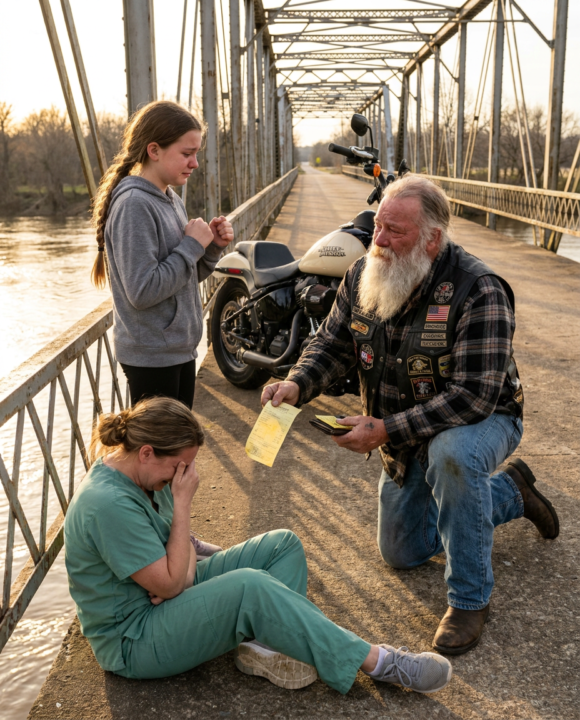
That’s when Callie took the ring.
At first, Leah didn’t want to tell me anything. Why would she? A stranger. A big biker on a bridge.
But Callie sat down on the curb next to me. Right next to me. Close enough that her shoulder touched my arm.
And she started talking.
“My daddy’s name was Ryan,” she said. “He made things. Out of wood. Tables and chairs and cabinets. He made my bed.”
She wiped her nose on her hoodie sleeve.
“He got sick. The kind where your muscles stop working. A-L-something.”
“ALS,” Leah said quietly. From the walkway, where she still sat. “Lou Gehrig’s disease.”
Callie nodded.
“First his hands stopped working. Then he couldn’t walk. Then he couldn’t talk. He used a computer that talked for him with his eyes.”
She was quiet for a second.
“He died two years ago. In September. I was ten.”
Leah came over then. She sat down on the curb on Callie’s other side. The three of us in a row. Facing the traffic.
She told me the rest.
Ryan was diagnosed in the spring of 2022. Thirty-five years old. The doctors in Little Rock said three to five years, maybe less.
There was a clinical trial in Houston. An experimental treatment. It might slow it down. Might give him more time with Callie.
Insurance wouldn’t pay for travel. Wouldn’t pay for the hotel. Wouldn’t pay for the wheelchair van they’d need when he couldn’t walk anymore.
They didn’t have savings. Ryan’s woodshop barely broke even. Leah worked nights.
So Ryan went to a man named Gerald Voss.
Gerald Voss runs a storefront on Midland Boulevard in Fort Smith. RIVERSIDE QUICK CASH. Neon sign. Bars on the windows. He doesn’t call himself a loan shark. He calls himself a private lender.
He loaned Ryan twelve thousand dollars.
Ryan signed papers. A lot of papers. He was sick and scared and his hands were already starting to shake. He didn’t read them closely.
He used the money for Houston. Three trips. A van with a wheelchair lift. A hospital bed for the living room.
The trial didn’t work.
He died two years later. In the bed in the living room. Holding Callie’s hand.
Three months after the funeral, Gerald Voss came to the house.
He was very polite. He offered his condolences. Then he slid a piece of paper across Leah’s kitchen table.
Ryan’s debt. Now hers. With interest.
Leah told me the number on that bridge, and her voice went flat.
“Thirty thousand dollars.”
Part 3
Thirty thousand.
On a twelve-thousand-dollar loan.
I sat there on that curb and did the math in my head and didn’t like any of the answers I got.
Leah said Voss had been coming around every month since. Calling her at work. Calling the house. Once, showing up at Callie’s school pickup line. Sitting in his black Escalade across the street, watching.
He told her if she didn’t pay, he’d take her to court. Take her car. Take the house. Garnish her paycheck. Tell her nursing home employer she was a deadbeat.
She’d been paying him what she could. A hundred here. Two hundred there.
It never went down.
It went up.
Last week, Voss called and gave her a deadline. Friday. Five thousand dollars toward the balance. Or he’d file.
“I don’t have five thousand dollars,” Leah said. “I don’t have five hundred.”
She looked down at her left hand. Where the ring had been.
“I had the ring.”
It was Ryan’s grandmother’s ring. Ryan’s grandfather bought it in 1951 for a girl he met at a dance in Fayetteville. A small round diamond in an old-fashioned gold setting. Ryan’s grandmother gave it to Ryan before she died, for whoever he married.
He gave it to Leah in 2011, under the pecan tree in her parents’ backyard.
She’d never taken it off. Not once. Not even when he died.
On Thursday, she took it to a jeweler in Fort Smith to see what it was worth.
Eight thousand dollars, he told her. Maybe a little more, to the right buyer.
The pawn shop on Towson Avenue offered her six.
That night, Callie heard her mother on the phone in the kitchen. Telling Voss she’d bring him five thousand on Friday. Telling him she was selling the ring tomorrow.
Callie lay awake all night.
In the morning, Leah came home from her shift and said they were going into Fort Smith to run errands. Callie knew what the errand was.
When her mother fell asleep in the car on the bridge, Callie looked at the ring on her mother’s hand.
Then she looked at the river.
“Why?” I asked her. On that curb. I asked it gently. “Why throw it? Why not just hide it?”
Callie thought about it very seriously.
“If I hid it, Mama would find it,” she said. “Or she’d make me give it back. And then she’d sell it anyway.”
She looked out at the brown water.
“If you sell something, it’s gone. Somebody else has it. It’s theirs now. You can’t ever get it back.”
She looked up at me.
“But if it’s in the river, nobody has it. Nobody can buy it. It’s still Mama’s. It’s just in the river.”
I didn’t say anything for a long time.
I took out my wallet.
I took out that soft, folded slip of paper. Fourteen years in my back pocket.
I unfolded it and showed it to her.
UNIVERSITY PAWN & LOAN. Little Rock, AR. April 14, 2011. Item: Ladies’ gold wedding band, 14k. Amount loaned: $900. Redeem by: July 14, 2011.
Callie read it. She didn’t understand at first.
“That was my wife’s,” I said. “Marlene. I sold it to pay her hospital bills. I meant to go back and get it.”
I folded it up again.
“I didn’t make it in time. Somebody else bought it. I never found out who.”
Callie looked at me for a long time.
“So you understand,” she said.
“Yeah, sweetheart,” I said. “I understand.”
That should have been it. A kid did something brave and heartbreaking. An old man who’d lost the same thing sat with her. A sad story with no answer.
Because the ring was gone, and the debt was still thirty thousand dollars, and even if the ring had been sold for eight, it wouldn’t have been enough.
Leah’s phone buzzed in the pocket of her scrubs.
She looked at the screen.
RIVERSIDE QUICK CASH.
She let it ring.
It stopped. Then it started again.
She answered it with shaking hands and put it on speaker by accident.
A man’s voice. Smooth. Cold.
“Mrs. Tolbert. Just confirming you’ll be by this afternoon with the payment. Your husband made a commitment. I’d hate to have to involve your daughter’s school.”
Leah hung up.
She sat there on that bridge and shook.
And I stood up.
“Ma’am,” I said. “Do you still have the papers your husband signed?”
Part 4
She had them. In a folder in the glove compartment. She’d been carrying them around for two years. Every notice Voss ever sent. Every receipt for every payment. Ryan’s original contract, signed with a shaking hand in 2022.
I asked if I could take pictures of them with my phone.
She said yes.
I sent them to one man.
Dale Hensley is sixty-six. He rides a red Road King with the River Valley Riders. We call him Counselor. For thirty-four years, he was a lawyer in Fort Smith. Consumer protection. He spent most of his career suing people like Gerald Voss.
He retired the same year I did. Mostly he rides and fishes and complains about his knees.
He called me back in eleven minutes.
“Royce,” he said. “Where are you?”
“On the bridge.”
“Is she with you?”
“Yeah.”
“Put me on speaker.”
Dale had read every page.
“Mrs. Tolbert,” he said. “I’m going to ask you a few questions. Take your time.”
He asked her how much Ryan originally borrowed. Twelve thousand.
How much they’d paid. She’d added it up once. Around three thousand, before Ryan got too sick to work. Then a few hundred dollars here and there since.
What the contract said the interest rate was.
Leah didn’t know. She’d never been able to understand the paper.
“I know,” Dale said. “That’s the point. They write it so you can’t.”
Then he told us what he’d found.
The interest wasn’t written as a yearly rate. It was written as a “monthly service fee.” Ten percent of the balance every month.
Compounded.
That’s a hundred and twenty percent a year. Before compounding.
After compounding, it’s closer to two hundred and fourteen percent.
“In the State of Arkansas,” Dale said, “there is a cap on consumer interest. It’s in our state constitution. Seventeen percent a year. Not two hundred and fourteen.”
He let that sit.
“Anything over seventeen percent is usurious. And in Arkansas, a usurious contract is void as to the interest. All of it. Not just the extra. All of the interest.”
Leah stared at the phone.
“What does that mean?” she whispered.
“It means you never owed thirty thousand dollars,” Dale said. “Ryan borrowed twelve. You’ve paid back three. The most you could ever legally owe that man is the nine thousand dollars of principal that’s left.”
He paused.
“The other twenty-one thousand was never real. He made it up. And he’s been threatening a widow and a twelve-year-old over money that the law says he can’t collect.”
Leah put her hand over her mouth.
Callie looked at me. “Does that mean we don’t have to pay?”
“It means you only have to pay what’s fair,” I said. “Nine thousand. Not thirty.”
“But we don’t have nine thousand either,” Callie said.
Leah started crying again.
Callie looked down at the river.
“And I threw away the ring,” she said very quietly. “And it was worth eight.”
Her face crumpled.
“I made it worse.”
I knelt down on that bridge. My knees aren’t what they were. I did it anyway.
“Callie,” I said. “Look at me.”
She looked.
“You didn’t make anything worse,” I said. “If your mama had sold that ring today, she’d have given six thousand dollars to a man who was stealing from her. And he’d still say she owed him twenty-four.”
I tapped the folder in Leah’s hands.
“That ring would be gone. And the debt would still be a lie.”
I looked at her.
“You saved it. You just don’t know it yet.”
Part 5
That night, I called a meeting.
The River Valley Riders meet at a VFW post on Wheeler Avenue in Fort Smith. Twenty-two members. Mostly gray. Mostly retired. A couple of younger guys who joined for the rides and stayed for the coffee.
I stood up and told them everything. The bridge. The ring. The girl. Voss.
When I got to the part about Callie saying it’s still Mama’s, it’s just in the river, a man named Hobart, who did two tours in Vietnam and doesn’t cry at anything, had to get up and go outside.
Dale filed suit on Monday in Sebastian County Circuit Court.
Leah Tolbert v. Gerald Voss, d/b/a Riverside Quick Cash. Usury. Unfair collection practices. Harassment.
He did it for free. He said it was the most fun he’d had in three years.
On Tuesday night, Gerald Voss showed up at Leah’s house in Van Buren.
His black Escalade pulled into the driveway at 8:15. He got out. Expensive jacket. Expensive shoes.
He walked up to the front porch.
And stopped.
Eighteen members of the River Valley Riders were sitting on that porch. On the steps. On the railing. In lawn chairs. Drinking coffee out of thermoses.
Nobody stood up. Nobody said a word. Nobody touched him.
We just looked at him.
He stood at the bottom of the steps for a long time.
Then Hobart said, very politely, “Evening.”
Voss got back in his Escalade and left.
He never came back to that house.
The hearing was in January.
Dale brought the contract. The payment records. The voicemails Voss left on Leah’s phone. The text where he mentioned Callie’s school.
And he brought something else.
After the story got around Fort Smith, other people started calling Dale. Widows. Retirees. A man with cancer. A woman whose husband had a stroke. Thirty-one families, all of them with loans from Riverside Quick Cash. All of them signed during a medical crisis. All of them with the same ten-percent monthly “service fee.”
Gerald Voss had been doing this for nine years.
Preying on people who were dying.
The judge didn’t take long.
The interest on Ryan Tolbert’s loan was declared usurious. Void. Every cent of it.
Leah owed nine thousand dollars of principal. Not one dollar more.
The judge referred Gerald Voss to the Arkansas Attorney General’s office. By spring, they’d shut down Riverside Quick Cash. Thirty-one families had their debts recalculated. Eleven of them got refunds.
The River Valley Riders paid the nine thousand.
We passed a hat at the VFW. Two charity rides. A pancake breakfast. Hobart sold his old Shovelhead.
We wrote one check. Dale delivered it to Voss’s lawyer himself.
Leah wouldn’t accept it as a gift. She’s stubborn. She insisted on paying the club back.
So Dale’s son-in-law, who runs a trucking dispatch company in Fort Smith, offered her a job. Day shift. Dispatcher. Better pay than the nursing home. Health insurance. She doesn’t have to work nights anymore. She’s home when Callie gets off the bus.
She pays the club a hundred dollars a month.
We put every dollar of it in a fund. For the next family.
Part 6
But there was still the ring.
I’d been thinking about it since the bridge.
Thirty-one years on that river. I know her bottom better than I know my own kitchen floor. And I know that old Highway 64 bridge.
Under the middle span, right over the channel, the current runs hard against the pier footings. The river’s been dropping junk there for a hundred years. Logs. Shopping carts. Old fishing gear. It all gets caught against the base of those concrete piers and stays.
A ring thrown from the middle of that bridge would go straight down, maybe drift a little with the current, and land somewhere near Pier 3.
Maybe.
I called a man named Bud Langley. Commercial salvage diver out of Tulsa. Sixty years old. I’d worked with him for twenty years on dam inspections. He’s been in that river more times than any catfish.
I told him what I wanted.
He laughed for a full minute.
“A ring. In the Arkansas. In October. Royce, you know what the visibility is down there? Zero. You can’t see your own glove.”
“I know.”
“It’s like looking for a needle in a haystack. In the dark. With the haystack moving.”
“I know.”
He was quiet.
“How much are you paying?”
“Whatever the club can raise.”
“What’s the ring worth?”
I told him about Callie.
He was quiet again.
“I’ll be there Monday,” he said.
He dove for six days.
Every morning, the River Valley Riders sat on that bridge with thermoses of coffee and watched. Leah came on her lunch breaks. Callie came after school, still in her backpack, and stood at the railing at the exact spot where she threw it.
Bud worked by feel. Down there in the black water with the current pushing him sideways, he crawled along the riverbed around the base of Pier 3 with his hands. Sweeping. Sifting mud through his fingers. Every fifteen minutes, he’d come up, shake his head, and go back down.
Day one. Nothing.
Day two. A fishing reel. A license plate from 1974.
Day three. A woman’s watch. Somebody’s car keys. A wrench.
Day four. The river rose six inches from rain upstream. Bud couldn’t dive.
Day five. Nothing.
By then, even I was starting to give up. I didn’t say it. I didn’t need to. Everybody on that bridge felt it.
Day six. Saturday. Late afternoon. Bud’s last dive. He had to be back in Tulsa on Monday.
He’d been down twenty minutes. Longer than usual.
Callie was at the railing. She hadn’t moved in an hour.
Then the water broke beside Pier 3.
Bud came up holding something above his head.
Not a ring.
A wire fish basket. An old one. The kind trotline fishermen used to sink along the river bottom to keep their catch alive. Rusted almost black. Square. Caved in on one side. Wrapped in fishing line and river weeds. It must have been lying against that pier footing for thirty years.
He swam to the riverbank under the bridge. We all ran down the embankment. Leah. Callie. Me. Half the club.
Bud set the basket on the rocks and pulled off his mask.
“Got caught on it,” he said. “Felt something hard in the mesh. Thought it was a bolt.”
He pointed.
Wedged in the rusted wire of that old fish basket, in a little pocket where the mesh had bent, caked in brown river mud, something caught the late-afternoon sun.
Gold.
Part 7
Leah didn’t take it right away.
She just stood there on the rocks under the bridge, staring at it.
Callie knelt down. She reached into that rusted basket with her small fingers, very carefully, and worked it free.
She held it up.
A small round diamond in an old-fashioned gold setting. Muddy. Scratched. A little bent on one side from the wire.
Ryan’s grandmother’s ring.
Callie didn’t give it to her mother.
She closed her hand around it.
“Not yet,” she said.
Here’s what she did instead.
Ryan Tolbert’s woodshop was still in the garage behind their house in Van Buren. Leah hadn’t been able to go in it since he died. His tools were still on the bench. His apron still on the hook.
Callie went in.
For three weeks, every day after school, she went into that garage. Leah heard the sound of a saw. Sanding. A chisel.
She didn’t let anybody in.
On a Sunday morning in November, Callie asked us all to meet her on the bridge.
The River Valley Riders rode out. Twenty-two bikes parked along the shoulder of the old Highway 64 bridge. Bud drove over from Tulsa. Dale came. Hobart.
Leah stood at the railing in the middle of the bridge. The exact spot.
Callie walked up to her holding something in both hands.
A small wooden box. Cedar. You could smell it in the cold air. The corners were a little crooked. The lid didn’t fit perfectly.
On the lid, carved by hand with her father’s chisel, in careful twelve-year-old letters, one word.
RYAN.
Leah opened it.
Inside, on a bed of soft red felt, the ring. Cleaned. The bent side straightened by a jeweler in Fort Smith who heard the story and wouldn’t take a dime.
Leah couldn’t speak.
Callie looked up at her mother.
“I told you,” she said. “It was still yours. It was just in the river.”
Leah put the ring back on her finger.
Then she knelt down on that bridge, on the same concrete where she’d collapsed six weeks before, and held her daughter for a long time.
The whole club stood along the railing and looked at the river so nobody would have to look at anybody else.
I walked a little way down the bridge by myself.
I took out my wallet.
I took out that slip of paper. Fourteen years. Soft as cloth.
UNIVERSITY PAWN & LOAN. April 14, 2011.
I looked at it for a long time.
Then I held it out over the railing, over the brown water of the river I spent thirty-one years on.
And I let it go.
It fluttered. Turned over. Floated down.
The current took it toward Pier 3.
Callie had come up beside me. She watched it go.
“Now it’s in the river too,” she said.
I nodded.
“Still mine,” I said.
👉 If this story stayed with you, follow our page for more stories from the road — and from the ones who know what’s worth keeping. 🏍️