Part 2: A Tattooed Biker Snatched a Teenager’s Phone After They Dumped Paint on His Harley — Then Everyone Learned Why That Bike Was Never Really His to Begin With
PART 2 — MISUNDERSTANDING GETS WORSE
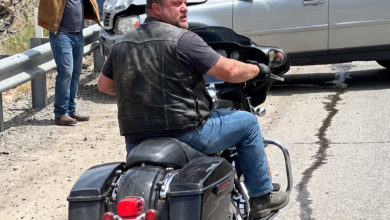
By the time the first police cruiser pulled into the lot outside Miller’s Market, nearly twenty people had their phones pointed at Marcus Hale.
That was the part nobody would remember correctly later. They would say the crowd had gathered because a group of teenagers vandalized a motorcycle, but the truth was messier and more human than that. Most of them had not seen the paint hit the Harley. Most had only turned around when the teenage girl screamed, when the biker grabbed her phone, when the younger boy stumbled backward and Marcus caught the strap of his backpack before he could run into the lane where cars were still pulling through the lot.
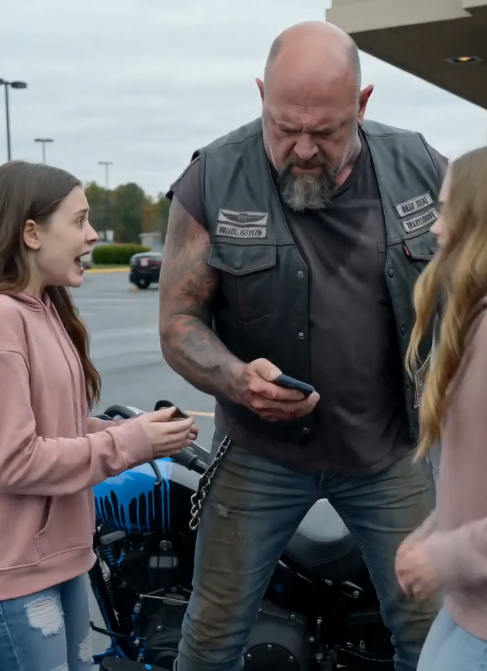
From a distance, it looked ugly.
It looked like a grown man threatening kids over a motorcycle.
The girl, a seventeen-year-old white American named Addison Pike, stood near the curb with mascara running down her cheeks, hugging herself with both arms like she was the injured party. Her phone was now in Marcus’s left hand, held loosely, not hidden, not shoved into his pocket, but the image was enough to convict him in the eyes of half the parking lot. She kept saying, “He took it. He took my phone. I was just filming. He attacked Jace.”
Jace was the boy pressed near the pickup. He was sixteen, Black, skinny in a way that spoke of skipped breakfasts and nervous sleep, wearing a thrift-store hoodie two sizes too large and shoes with peeling soles. His hands were stained blue, but not evenly. The paint was mostly on his palms and fingertips, not splashed across his sleeves like the others. His eyes darted from Marcus to the red-jacketed teen, then down to the asphalt as if he had learned long ago that looking at the wrong person could make life worse.
The boy in the red letterman jacket was Tyler Pike, Addison’s older cousin, eighteen years old, blond, athletic, and polished in that careless way money sometimes made young people. He had the smile of someone who expected adults to believe him because they always had before. Two other boys lingered behind him, one Latino teenager named Marco with a nervous jaw, and one white boy named Wes who kept wiping blue specks from his jeans while pretending he had nothing to do with the mess.
Marcus noticed all of it.
He noticed Jace’s shaking hands. He noticed the way Tyler stood too close to the empty paint can but had almost none on his fingers. He noticed Addison’s phone screen still glowing with a video upload draft, the caption already typed: “Biker freakout after prank gone wrong.” He noticed the little blue-and-silver ribbon keychain near the Harley’s front wheel, the one the paint had nearly swallowed. And he noticed something else, something so small that every furious voice in the parking lot would have missed it.
The Harley’s right saddlebag was unlatched.
That was why Marcus had moved so fast.
Not because of the paint. Not only because of the insult. The paint hurt to see, yes. It had poured over the tank in the same color as the police memorial ribbon painted by hand along the edge. It had covered the pinstripe, the chrome, the stitched leather seat, and half of the small white letters on the windshield that read, “Ride for Eli.” But vandalism was not what made his stomach turn cold.
Someone had opened the saddlebag.
Marcus had grabbed Addison’s phone because she was trying to delete the first thirty seconds of the video, the part before the laughing started. He had blocked Jace because the boy had been shoved toward the Harley at the last second, forced into the center of a prank that was already turning into something more serious. Marcus had said “Nobody leaves” because he had seen a hand go into that saddlebag, and whatever had been taken from inside was not something that could be replaced by insurance, apologies, or a fresh coat of paint.
But he did not explain.
That silence made everything worse.
The security guard, a heavyset Black American man in his late fifties named Reggie Barnes, stepped between Marcus and the teenagers with one palm raised. Reggie had worked that strip mall for nine years. He knew trouble when he saw it, but he also knew panic, and there was panic on the biker’s face beneath all that stone.
“Sir,” Reggie said carefully, “hand me the phone.”
Marcus gave it to him at once.
That surprised people.
He did not fight. He did not curse. He did not even glare at Addison when she lunged for it and demanded it back. He only looked at Reggie and said, “Don’t let her touch the gallery. Don’t let them delete anything.”
Tyler laughed again, but this time it sounded forced.
“Man, he’s crazy,” Tyler said loudly. “It’s paint. We were messing around. He grabbed my cousin’s phone and went after Jace like some psycho.”
Jace flinched when Tyler said his name.
Marcus saw that too.
A police officer stepped out of the cruiser a moment later. She was a Black American woman in her early forties with a calm face and tired eyes, her hair pulled tight under her cap, her nameplate reading MORRIS. She took in the scene the way good officers do, not from the loudest mouth first, but from the angles: the paint, the crowd, the phone in Reggie’s hand, the biker’s open palms, the teenagers standing too far apart from each other, the boy whose hoodie strap was twisted where someone had yanked it.
“Who owns the motorcycle?” Officer Dana Morris asked.
Marcus did not answer immediately.
He looked at the Harley, and something about his expression made the officer’s voice soften before he spoke.
“I’m responsible for it,” he said.
“That’s not what I asked.”
Marcus swallowed. His beard moved with it. Up close, he did not look angry now. He looked like a man trying to keep a door closed inside his chest.
“No one owns that bike anymore,” he said. “Not in the way you mean.”
The crowd murmured. Addison rolled her eyes through her tears. Tyler gave an exaggerated sigh, as if the biker were preparing some dramatic excuse.
But Officer Morris looked past Marcus at the windshield.
She saw the words.
Ride for Eli.
Then she saw the brass keychain under the blue paint.
Her expression changed just a little.
“Reggie,” she said, “pull the parking lot footage.”
Tyler’s smile faded.
PART 3 — FIRST HIDDEN CLUE
The first hidden clue did not come from Marcus.
It came from an old woman carrying a bag of oranges.
Her name was Mrs. Helen Barlow, seventy-four years old, white American, widowed, with soft silver hair tucked beneath a knitted green hat even though the afternoon was warm. She had been walking out of Miller’s Market when the first splash hit the Harley. Her hands trembled from arthritis, and one of the oranges had rolled beneath a cart when the shouting began. Nobody paid attention to her because crowds usually look over small old women when bigger things are happening.
But Mrs. Barlow had seen enough.
She edged toward Officer Morris and said, “Ma’am, the skinny boy didn’t pour it first.”
Tyler snapped his head toward her.
Addison stopped crying for half a second.
Officer Morris turned. “What did you see?”
Mrs. Barlow pressed her lips together, gathering courage. She glanced at Marcus, then at Jace, who was staring at the ground as though the asphalt might open and save him from everyone. “The tall one in the red jacket was laughing before the can opened. The girl was filming. The little one there, Jace, I think they called him, he kept saying no. I couldn’t hear all of it, but I heard that.”
Tyler scoffed. “She’s confused.”
“I’m old,” Mrs. Barlow said, suddenly sharper than anyone expected, “not blind.”
A few people in the crowd shifted uncomfortably.
That was the first crack in the story they thought they were watching.
Reggie returned from the security office with a tablet in his hand. His face looked different now too. Not shocked exactly. Troubled. He gave the tablet to Officer Morris and lowered his voice, but the lot had gone quiet enough that several people heard him anyway.
“The main camera missed part of it because a delivery truck blocked the angle,” he said. “But the pharmacy camera caught the side view. Not perfect, but enough.”
Tyler took a step back.
Marcus noticed.
Officer Morris watched the footage without speaking. The reflection of the parking lot moved across her sunglasses as Addison’s voice played faintly from the tablet speaker. The video was grainy, angled from high above, but it showed the Harley parked near the end of the row, alone and polished, with a folded American flag strapped carefully beneath a clear cover on the rear rack. It showed Tyler carrying the paint can from behind the recycling bins. It showed Addison lifting her phone before anything happened. It showed Jace standing several feet away, both hands up, shaking his head.
Then came the moment that changed the air.
Tyler grabbed Jace by the sleeve and pulled him toward the Harley.
The crowd murmured again, lower this time.
On the screen, Jace stumbled. Marco looked away. Wes laughed but not comfortably. Addison moved closer with her phone, framing the shot. Tyler shoved the can toward Jace’s chest. Jace did not take it. The can slipped, hit the ground, and burst open across the front tire. Some of the paint splashed up onto Jace’s hands when he tried to catch it.
Then Tyler bent toward the saddlebag.
That was when Marcus appeared at the edge of the frame.
He had come from the diner next door, carrying two paper cups of coffee. He dropped both cups the instant he saw the saddlebag open. He did not run at the teenagers with his fists raised. He ran toward the bike like a man trying to stop a fire from reaching a bedroom door.
Officer Morris paused the video.
“What was in the bag?” she asked.
Marcus looked at the Harley again.
His silence stretched long enough for someone in the crowd to cough.
“It’s missing,” he said.
“What is missing?”
He looked at Jace, not Tyler. That mattered. His voice changed when he spoke to the boy.
“Did you see where he put the envelope?”
Jace’s face went pale.
Tyler snapped, “Don’t answer him.”
Officer Morris turned toward Tyler. “You don’t talk for him.”
Jace’s throat worked. His eyes filled, but he still did not look up. “I didn’t take it,” he whispered.
“I know,” Marcus said.
That stunned the boy more than an accusation would have.
“You know?” Jace asked.
Marcus nodded once. “You reached for the keychain. Not the bag.”
Jace’s eyes finally lifted.
The crowd did not understand yet, but Jace did. He looked at the half-buried brass keychain near the front wheel, then at Marcus. The old biker’s face held no softness that strangers would recognize, but there was something steady there, something protective.
Jace whispered, “It fell.”
“What fell?” Officer Morris asked.
“The little badge thing,” Jace said. “Tyler kicked it when the paint spilled. I tried to pick it up before it got covered.”
Tyler cursed under his breath.
Addison said, “He’s lying.”
But her voice had lost its confidence.
Officer Morris looked at Marcus. “What’s the keychain?”
Marcus crouched slowly, ignoring the blue paint soaking into the knee of his jeans. With two fingers, he lifted the brass keychain from the wet asphalt. It was shaped like a small police badge, scratched, old, and attached to a narrow strip of blue leather. On the back, beneath a smear of paint, were four engraved letters.
E.R. Jr.
Marcus wiped them gently with his thumb.
For the first time since the shouting began, his hand shook.
“This was Eli’s,” he said.
No one asked who Eli was.
Not yet.
But everyone felt the name land.
PART 4 — TRUTH BEGINS TO TURN
Officer Morris asked everyone to step back from the Harley, and this time most people listened.
The ones who had been loudest grew quieter first. That was how shame often entered a crowd, not all at once, but like cold air under a door. The woman who had pulled her children away from Marcus lowered her phone. The man in the gray work uniform stopped recording. Mrs. Barlow stood beside Jace now, not touching him, just close enough that he no longer looked entirely alone.
Marcus remained near the bike, his broad shoulders bent in a way that made him seem older than he had ten minutes before. He used a clean towel from his saddle roll to wipe paint away from the engraved badge keychain, but he did not touch the gas tank yet. The blue paint continued to slide down the black metal in slow, ugly lines, covering the hand-painted memorial stripe, dripping across the chrome engine, and pooling near the kickstand like something alive.
Officer Morris watched more footage on the tablet.
The pharmacy camera showed Tyler reaching into the saddlebag. It did not show clearly what he took, but it caught the movement, the quick glance over his shoulder, the hand disappearing under his letterman jacket. It also showed Marcus grabbing Addison’s phone only after Addison tapped the screen repeatedly, trying to exit the camera app. The video showed him taking the phone with one hand and raising the other as if to say stop. It showed him catching Jace by the backpack strap after Tyler shoved the boy backward toward a moving SUV.
The crowd saw it too when Officer Morris turned the tablet toward Reggie.
Nobody cheered.
Real reversals do not feel like the movies. There was no instant applause, no heroic swell of music, no satisfying collapse of the guilty. There was only the uncomfortable sight of people realizing they had mistaken control for violence, silence for guilt, and grief for rage.
Addison looked smaller now. She wiped her face with the sleeve of her pink hoodie and refused to meet anyone’s eyes. Tyler kept insisting the footage did not prove anything. Marco stared at the ground. Wes stood with his mouth slightly open, like the story had moved too quickly for him to keep playing the role he had chosen.
Jace began to cry without making a sound.
Marcus noticed before anyone else did.
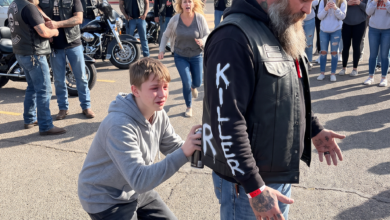
He rose slowly and stepped away from the boy, giving him space. “I didn’t mean to scare you,” he said.
Jace shook his head, but not in denial. More like he did not know what to do with an apology from the person everyone had told him to fear.
“You grabbed me,” Jace whispered.
“I did,” Marcus said. “You were going backward into traffic. But that doesn’t mean it didn’t scare you.”
That answer settled differently than any defense would have.
Officer Morris looked at Jace. “Did he hurt you?”
Jace hesitated, then shook his head. “No. He just stopped me.”
“And Tyler?”
Jace did not answer.
Tyler laughed bitterly. “This is insane. He’s making it sound like some murder case. It’s a motorcycle. A stupid old motorcycle.”
The words hit the parking lot harder than the paint had.
Marcus closed his eyes.
Officer Morris turned toward Tyler. “Where is the envelope?”
“What envelope?”
“The one you took from the saddlebag.”
“I didn’t take anything.”
Reggie cleared his throat. “There’s another camera.”
Tyler looked at him.
Reggie pointed across the lot toward a small independent auto parts store with faded red letters over the door. “My nephew runs that place. He installed a camera last month because people were stealing catalytic converters. It catches the whole row from the other side.”
For the first time, Tyler looked afraid.
Marcus did not look satisfied. That was the strangest part. He did not smile when the truth started moving in his direction. He did not point at anyone or say he had told them so. He just looked tired, as if every new piece of evidence was not a victory but another bruise placed on something already tender.
Officer Morris asked Reggie to get the other footage. Then she asked Marcus again, quieter this time, “What was in the envelope?”
Marcus took a breath through his nose. It was the breath of a man deciding whether to open a room he had kept locked for years.
“Photographs,” he said. “A letter. A scholarship check. And one patch from a police uniform.”
Officer Morris stiffened.
“What officer?”
Marcus looked at the words on the windshield.
Ride for Eli.
“Thomas Rourke,” he said.
A murmur moved through the crowd. In that town, the name still carried weight. Officer Thomas Rourke had been killed six years earlier while helping a stranded family on the shoulder of Route 19 during a freezing rainstorm. Most people remembered the news photo of him in uniform, smiling beside his patrol car. Fewer remembered that he had left behind a wife and a son.
Marcus remembered both.
“The bike belonged to his son,” Marcus said. “Or it was supposed to.”
Nobody interrupted him now.
“Eli Rourke built it with me,” Marcus continued. “He was nineteen. His father died before he ever got to ride with him. That Harley was going to be the one thing they still shared.”
Jace looked at the bike as if it had changed shape in front of him.
Addison put a hand over her mouth.
Tyler whispered, “No.”
But it did not sound like denial anymore.
It sounded like a boy realizing the thing he had damaged was not an object.
It was someone’s last place to put love.
PART 5 — BIKER’S PAST / DEEPER TWIST
Marcus Hale had not always looked like the kind of man people crossed the street to avoid.
At twenty-three, he had been a clean-shaven Army medic with gentle hands and a bad habit of giving away his last cigarette to men who claimed they were quitting. At thirty-one, he was a volunteer EMT in a county where ambulances sometimes took too long because the roads were narrow, the nights were icy, and bad luck never checked a map. By forty, he had buried enough people to stop believing that time was fair, but not enough to stop showing up when someone called.
That was how he met Officer Thomas Rourke.
Tom was a white American police officer in his late thirties then, tall and square-jawed, with the patient voice of a man who had learned how to calm frightened people without making them feel foolish. He and Marcus crossed paths at wrecks, house fires, domestic calls, storm rescues, and one terrible Christmas Eve when a family minivan slid into a ditch and both men worked side by side in freezing rain until their hands went numb.
They were not best friends at first. They were the kind of men who nodded across emergency lights and trusted each other before they knew each other’s middle names. Later, when Marcus’s wife died from a sudden aneurysm and Marcus stopped answering calls, stopped eating properly, stopped caring whether his old Harley ever ran again, Tom was the one who knocked on his garage door every Thursday evening and refused to leave.
He never gave speeches.
He brought coffee. He sorted bolts. He sat on an overturned bucket and talked about ordinary things until grief became less like a locked room and more like weather Marcus could survive.
Tom had a son named Eli.
Eli Rourke was twelve when Marcus first met him, a skinny white kid with sandy hair, serious eyes, and a habit of asking how engines worked with the intensity of someone asking how the universe held itself together. After Tom died on Route 19, Eli changed. He got quiet in a way that scared his mother. He stopped playing baseball. He kept his father’s uniform patch in a shoebox under his bed and refused to let anyone touch it. By sixteen, he was skipping school and wandering toward the kind of boys who liked broken windows, cheap dares, and the feeling of power that came from hurting things before they could hurt you.
Marcus recognized that look because he had seen it in a mirror.
So he did what Tom had once done for him.
He showed up.
Every Wednesday after school, Marcus opened his garage and let Eli work on the Harley. Not ride it. Not yet. Just work. They rebuilt the carburetor, polished the chrome, replaced cracked hoses, rewired the old headlamp, and argued about music while the radio played too softly beneath the clink of tools. Eli wanted the bike painted black with a blue memorial stripe for his father. Marcus pretended to hate the idea just so the boy would defend it.
“That stripe is for Dad,” Eli said one afternoon, his voice fierce.
“Then make it clean,” Marcus replied. “If it’s for him, do it right.”
Eli did.
He hand-painted the thin blue line along the gas tank with a brush so small Marcus joked it belonged in a dentist’s office. He engraved his father’s initials on a brass keychain shaped like a badge. He stitched the words Ride for Eli across the windshield later as a joke, because Marcus had started calling the project “Eli’s ride,” and the name stuck before either of them knew how much it would matter.
Then Eli got sick.
It began with headaches. Then fainting. Then tests. Then a diagnosis so rare and cruel that Marcus still could not say the medical name without tasting metal in his mouth. Eli spent most of his last year between hospitals and home, losing weight, losing hair, losing the easy sarcasm he had just begun to grow into. But he never lost interest in the Harley.
On good days, Marcus rolled the bike into the driveway so Eli could sit beside it in the sun. On bad days, Marcus brought small parts to Eli’s room and let him hold them, clean them, approve them with a weak nod. Two weeks before Eli died, he made Marcus promise something.
Not to keep the bike.
Not to sell it.
Not to park it in a garage and let grief turn it into dust.
“Ride it for Dad,” Eli whispered. “And for kids who don’t get their people back.”
That was how the scholarship began.
Every summer, Marcus rode the Harley at the front of a charity event for children of fallen first responders and emergency workers. The envelope in the saddlebag contained the first scholarship check of that year, a handwritten letter from Eli’s mother, and Tom Rourke’s original shoulder patch, which would be presented at the evening ceremony to a seventeen-year-old girl whose firefighter father had died the winter before. Marcus had been trusted with it because Eli’s mother could no longer stand in crowds without shaking, and because Marcus had never broken a promise to the Rourke family.
Until blue paint ran down the gas tank in Miller’s Market parking lot.
That was why Marcus had reacted before he thought.
Because the moment he saw Tyler’s hand in the saddlebag, he was not seeing a teenager pulling a prank. He was seeing a promise being stolen. He was seeing a grieving mother waiting at the veterans hall for her son’s bike to arrive clean and shining. He was seeing a uniform patch that had survived rain, blood, hospital rooms, and funerals disappear beneath an eighteen-year-old’s jacket for a video that would be forgotten by dinner.
But there was another twist Marcus had not told anyone yet.
He knew Tyler Pike.
Not well. Not enough for Tyler to recognize him. But Marcus remembered the Pike name from a roadside call three years earlier, when Tyler’s older brother had crashed a stolen truck after a night of drinking. Officer Dana Morris had been there too. So had Marcus, working then as a roadside recovery driver after his EMT days became too heavy. Tyler’s brother survived, barely. Another young man in the passenger seat did not.
The case tore the town apart for months.
Tyler’s family blamed the police, the courts, the tow company, the weather, everyone except the boy behind the wheel. Tyler had been fifteen then, standing behind the yellow tape with fury burning in his eyes, watching Marcus load the ruined truck onto a flatbed.
Marcus had seen that kind of fury before.
In Eli.
In himself.
That was why, when Tyler looked at the memorial Harley and called it a stupid old motorcycle, Marcus did not only hear cruelty. He heard a kid drowning in anger and trying to make the world pay for something he had never learned how to grieve.
That did not excuse what Tyler had done.
But it explained why Marcus did not want revenge.
He wanted the envelope back.
He wanted the truth clear.
And whether Tyler deserved it or not, Marcus wanted the boy stopped before he became the kind of man who could not find his way back.
PART 6 — PUBLIC REVERSAL / EVIDENCE
The second video left no room for pretending.
Reggie’s nephew, a twenty-six-year-old Asian American mechanic named Kevin Tran, came jogging from the auto parts store with grease on his hands and worry on his face. He carried his laptop under one arm, already open, the security footage paused on the parking row from a lower, cleaner angle. Kevin had installed the camera after three thefts behind his shop, and he apologized twice for the angle as if the entire town were not suddenly grateful for it.
Officer Morris set the laptop on the hood of her cruiser.
The crowd gathered, but farther back now, quieter and less eager.
The footage showed the prank from the beginning. It showed Tyler, Addison, Marco, Wes, and Jace near the recycling bins. It showed Tyler holding the paint can while Addison filmed him saying something the camera could not record. It showed Jace backing away. It showed Tyler pushing the can into Jace’s chest, then dropping it deliberately when Jace refused to grip it. It showed the paint bursting across the asphalt.
Then it showed Tyler bend beside the Harley.
His hand opened the saddlebag.
He pulled out a large cream-colored envelope and laughed.
Addison zoomed in with her phone.
Even without sound, the body language was clear. Tyler held the envelope up like a trophy. Marco reached for his arm, maybe to stop him. Wes looked toward the diner. Jace stepped forward, then froze when Tyler turned on him. A moment later, Tyler shoved the envelope under the back of his jacket and kicked the brass keychain, sending it skidding toward the front tire.
That was when Jace lunged toward the keychain.
That was when Marcus came running.
That was when the crowd’s partial video began.
Officer Morris paused the footage after Marcus grabbed Addison’s phone. On the laptop screen, his posture was not that of a man attacking teenagers. It was that of a man trying to freeze a chaotic scene before evidence disappeared. One hand held the phone away from Addison. The other caught Jace’s backpack as the boy stumbled backward into the lane where a silver SUV braked hard enough for its front end to dip.
Nobody spoke.
Then Mrs. Barlow, still holding her oranges, whispered, “Oh, that poor boy.”
She meant Jace.
Maybe she meant Marcus too.
Officer Morris turned toward Tyler. “Envelope. Now.”
Tyler’s jaw worked. “I don’t have it.”
Marcus looked at him, and the parking lot seemed to hold its breath.
“Son,” Marcus said, and the word was rough but not cruel, “don’t make this the worst day of your life just because you don’t know how to back up.”
Tyler’s face flushed red. For a second, anger rose in him like a reflex. He looked ready to throw another insult, maybe at Marcus, maybe at the police, maybe at everybody watching him become smaller than the image he had built of himself. But then Jace spoke.
“He put it in the trash can by the vending machine.”
Tyler turned on him. “Shut up.”
Jace stepped behind Mrs. Barlow, but this time he did not lower his eyes. “You said nobody would care because it was just some biker thing.”
The sentence cut deeper than Jace knew.
Officer Morris sent Reggie to the trash can. He came back with the cream-colored envelope, bent at one corner but dry, protected inside a plastic sleeve. Marcus did not reach for it. He waited until Officer Morris opened it and checked the contents.
Inside was the scholarship check.
Inside was the handwritten letter from Diane Rourke, Eli’s mother.
Inside was Officer Thomas Rourke’s uniform patch.
And inside, tucked behind the letter, was a small photograph that had not been listed on Marcus’s inventory because he did not know Diane had placed it there. It showed a younger Marcus in his garage, one arm around a thin teenage boy with sandy hair, both of them standing beside the unfinished Harley. Eli wore a knit cap and a grin too big for his tired face. His hand rested on the gas tank, exactly where the blue paint now ran.
Marcus saw the photograph and turned away.
That was the moment the story became impossible to treat as a prank.
Officer Morris closed the envelope carefully. “Tyler Pike, you’re going to sit in my cruiser while I call your parents and figure out charges. Addison, I need your phone for evidence. Marco, Wes, you’re staying too.”
Addison began crying again, but this time her tears sounded different. Less like fear of Marcus. More like fear of consequence.
Tyler did not fight when Officer Morris guided him toward the cruiser. He looked once at the Harley, then at Marcus, then at the blue paint staining his own shoes. The performance was gone from his face. What remained was a young man who had expected to damage a symbol and instead discovered he had stepped into someone else’s grave.
Meanwhile, the first wrong video had already spread online.
That was the cruelest part.
Someone in the crowd had posted the clip of Marcus grabbing Addison’s phone with the caption: “Biker attacks kids over prank.” In less than thirty minutes, strangers who had never seen Miller’s Market, never met Eli Rourke, never smelled the paint or heard Jace whisper that he didn’t take it, had already decided what kind of man Marcus was.
Officer Morris understood that damage too.
She asked Reggie and Kevin for copies of both security videos. She recorded a short official statement in the parking lot, not dramatic, not defensive, just clear. She stated that officers were investigating vandalism and possible theft, that the initial viral clip did not show the full incident, and that the adult male seen taking a phone had immediately turned it over to security and police. She did not call Marcus a hero. She did not have to.
The full video did that on its own.
By evening, the same people who had shared the first clip began sharing the second. Some apologized sincerely. Some deleted without apology. Some pretended they had “known there was more to the story” all along. That was the internet’s way of protecting itself from shame.
Marcus did not watch any of it.
He was in Kevin Tran’s auto bay, helping remove blue paint from the Harley one careful inch at a time.
Jace was there too.
Not because anyone forced him.
Because after Officer Morris called his foster guardian and explained that he was a witness, not the main offender, Jace asked if he could stay until the bike was clean enough for the ceremony. At first, Marcus said no. The boy had been through enough. But Jace looked at the blue-stained keychain on the workbench and said, “I want to fix the part I touched.”
Marcus stared at him for a long moment.
Then he handed the boy a soft cloth.
“Gentle,” Marcus said. “This tank remembers hands.”
Jace nodded like he understood.
And somehow, maybe he did.
PART 7 — EMOTIONAL PAYOFF / FINAL TWIST
The charity ceremony started forty-seven minutes late.
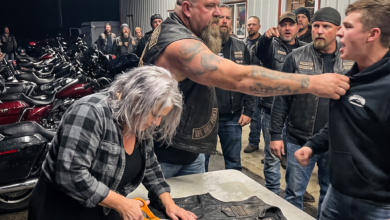
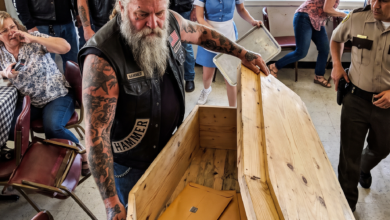
By then the sky had turned the bruised purple color that comes after a humid summer day in the Midwest, and the parking lot outside the veterans hall glowed under strings of warm bulbs. Families filled folding chairs. Firefighters stood in navy dress uniforms near the back wall. Police officers lined one side of the room, not stiffly, but with the tired tenderness of people who had attended too many ceremonies for names that should still belong to living voices.
At the front of the hall, a framed photo of Officer Thomas Rourke stood beside a smaller photo of Eli.
In the first photo, Thomas Rourke wore his police uniform and smiled with one hand resting on the shoulder of his twelve-year-old son. In the second, Eli sat on the unfinished Harley in Marcus’s garage, too thin from treatment, wearing a knit cap and giving the camera a thumbs-up as if daring the world to pity him.
Diane Rourke sat in the front row.
She was a white American woman in her early fifties with brown hair cut at her chin and grief carved softly into her face. She wore a navy dress, low black shoes, and a small silver necklace with Eli’s initials. She had not wanted to attend at first. Crowds made her nervous. Speeches exhausted her. But every year she came because Marcus brought the Harley, and when the engine rumbled into the lot, she could close her eyes and almost imagine her husband and son arriving together.
This year, the sound came late.
People turned when they heard it.
The Harley rolled slowly into the veterans hall parking area, its engine low and uneven, as if the bike itself had endured a hard day and was still choosing to arrive. Marcus rode in front, his leather vest cleaned as best as possible but still faintly marked with blue on one sleeve. Behind him, in Kevin Tran’s pickup, came Reggie, Mrs. Barlow, Officer Morris, and Jace.
The bike was not perfect.
That was the first thing Diane saw.
Most of the paint had been removed, but a faint blue shadow remained along the right side of the tank, just below Eli’s hand-painted memorial stripe. The chrome shone again. The windshield had been cleaned. The brass badge keychain hung from the handlebar, scratched but visible. The folded flag on the rear rack had been spared. The saddlebag was latched.
Marcus parked and killed the engine.
For a moment, no one moved.
Then Diane stood.
Marcus took off his helmet but did not walk toward her right away. He looked like a man prepared to be struck. Maybe not physically. Something worse. Disappointment. Blame. The knowledge that he had failed to protect the one thing he had promised to carry safely.
Diane approached the bike with both hands clasped in front of her.
She touched the faint blue stain beneath the stripe.
Marcus’s voice broke before he finished the sentence. “I’m sorry.”
Diane kept her fingers on the tank. “Did the letter make it?”
“Yes.”
“The patch?”
“Yes.”
“The keychain?”
Marcus lifted it gently from the handlebar and placed it in her palm.
Diane closed her fingers around it.
Then she looked at the stain again.
People expected her to cry. She did, but not the way they expected. A few tears slipped down her face silently, and she gave a small, aching laugh that made Marcus look up.
“Eli would have hated this,” she said.
Marcus swallowed. “Yes, ma’am.”
“He would have said you parked too close to trouble.”
A faint ripple of laughter passed through the people close enough to hear. Marcus almost smiled, but guilt held him still.
Then Diane said, “And then he would have asked if the boy who tried to pick up his keychain was okay.”
Jace, standing near the pickup, froze.
Diane turned toward him. “Are you Jace?”
The boy nodded once.
He had cleaned his hands, but blue paint remained under his nails. He looked painfully young beneath the parking lot lights, his oversized hoodie hanging from narrow shoulders, his face tight with the expectation that adults were safest when they were far away.
Diane walked to him.
Marcus took one step forward, maybe to protect the boy from a grief he had not earned, but Diane raised a hand gently without looking back.
She stood before Jace and said, “Thank you for reaching for Eli’s badge.”
Jace blinked fast.
“I didn’t save it,” he whispered. “Mr. Hale did.”
“You reached first,” Diane said. “That matters.”
The boy covered his face with one hand, and Mrs. Barlow put an arm around his shoulders as if she had known him all his life. Jace did not pull away.
That should have been the ending.
A damaged Harley. A recovered envelope. A public apology. A frightened boy thanked by a grieving mother. It would have been enough for most stories.
But Eli had left one more thing behind.
The final twist came when Diane opened the cream-colored envelope onstage.
She had written a speech, but after the day’s events, she could not read it as planned. Instead, she unfolded the letter and looked at Marcus.
“I put something extra in here this morning,” she said. “I didn’t tell you because I knew you’d argue.”
Marcus frowned.
Diane pulled out the small photograph of Marcus and Eli beside the unfinished Harley. Then she reached deeper into the envelope and removed another paper, older, folded many times, softened at the creases.
Marcus went still.
He knew that paper.
Diane looked at the room. “My son wrote this two weeks before he died. He asked me not to show Marcus until the bike helped someone who reminded Marcus of him.”
Marcus shook his head slowly, not understanding.
Diane’s voice trembled as she read.
“Marcus says broken boys don’t need speeches. They need a garage, a job, and one adult who doesn’t leave when they act ugly. If I’m gone, don’t let him turn my bike into a museum. Make him use it to find another kid who thinks nobody is coming.”
The hall went quiet in a way Marcus had never heard before.
Diane lowered the letter.
Then she looked at Jace.
The boy stared at the floor, crying openly now.
Marcus turned away, but there was nowhere to hide in a room full of people finally seeing him clearly. Not as the monster from the parking lot video. Not as the frightening man with the leather vest and scarred knuckles. Not even as the hero strangers online would try to make him by morning.
Just as a tired man who had kept one promise so long he had forgotten it was allowed to grow.
Officer Morris stepped forward and addressed the room briefly. She explained what had happened, not to humiliate the teenagers, but to correct the lie that had spread. She said charges and restitution would be handled properly. She said the Pike family had been contacted. She said Jace was not the person who planned the vandalism or stole the envelope. And then, with a glance at Marcus, she added that sometimes the first video is not the truth, only the first wound.
The room absorbed that.
Later, Tyler Pike arrived with his parents.
He did not come inside at first. He stood near the door, pale and stiff, no red jacket now, only a plain white T-shirt and the frightened posture of a boy whose armor had been taken away. His father looked angry, his mother looked ashamed, and Tyler looked like he had not decided whether remorse would destroy him or save him.
Marcus saw him before Diane did.
For a moment, everyone wondered what the biker would do.
He walked to the door.
Tyler’s father stepped in front of his son, but Marcus stopped several feet away and kept his hands visible. He did not threaten. He did not raise his voice. He looked Tyler in the eye and said, “You damaged something that belonged to the dead and to the living. You’ll answer for that.”
Tyler nodded once, barely.
“But if you’re willing,” Marcus continued, “you can help repair what you damaged. Not for a camera. Not for forgiveness. For the work.”
Tyler’s face crumpled in a way that made him look younger than eighteen.
“I didn’t know,” he whispered.
Marcus’s eyes hardened for the first time that evening. “You didn’t care enough to know.”
That was worse than shouting.
Tyler lowered his head.
Then Jace did something nobody expected. He stepped beside Marcus, still trembling, still blue under the nails, and said, “He knew it mattered to somebody. That’s why he picked it.”
Tyler looked at him.
Jace did not back down.
That moment did not fix anything. It did not turn Tyler into a good kid or erase what had happened. But it placed the truth in the room where everyone could see it. Harm is not always born from ignorance. Sometimes it is born from knowing just enough to aim at the softest place.
Marcus nodded slightly at Jace, as if the boy had just done a difficult repair correctly.
The ceremony went on.
The scholarship was awarded to a seventeen-year-old Latina girl named Sofia Ramirez, whose father, a firefighter, had died during a warehouse rescue the previous winter. She accepted the check with shaking hands. Diane handed her Thomas Rourke’s uniform patch, not as a replacement for her father’s, but as a reminder that families of service sometimes carry one another when the world gets too heavy.
Afterward, people approached Marcus in awkward little waves.
Some apologized for recording him.
Some apologized for assuming the worst.
Some tried to call him a hero.
He refused that word every time.
“I kept a promise,” he said. “That’s all.”
Near the end of the night, when the crowd had thinned and the folding chairs were being stacked, Jace stood beside the Harley with a soft cloth in his hand, staring at the faint blue stain still visible beneath Eli’s memorial stripe.
“Will it come off?” he asked.
Kevin Tran, who had stayed late with a cleaner and a work light, started to answer, but Marcus spoke first.
“Maybe,” he said. “Maybe not.”
Jace looked worried.
Marcus touched the tank lightly, just below the stripe. “Some marks stay. Doesn’t mean the ride is over.”
The boy absorbed that sentence like water into dry ground.
Diane heard it from a few feet away. She walked over and placed Eli’s brass badge keychain in Marcus’s hand, then closed his fingers around it.
“Keep riding it,” she said.
Marcus shook his head. “After today, I don’t know if I deserve—”
“You brought it here,” Diane said. “Late, bruised, and still running. That sounds exactly like us.”
Marcus could not answer.
So Diane turned to Jace.
“Do you know anything about engines?”
Jace wiped his face with his sleeve. “No, ma’am.”
Marcus looked at her.
Diane smiled through tired eyes. “Then maybe Wednesday afternoons are a good place to start.”
The old biker stared at the boy for a long moment. In Jace’s face he saw fear, shame, anger, hunger, and something else beneath all of it. Not innocence. Not exactly. Possibility.
Eli had known.
Broken boys did not need speeches.
They needed a garage.
A job.
One adult who did not leave.
The next Wednesday, Jace arrived at Marcus Hale’s garage fifteen minutes early, wearing the same oversized hoodie and carrying a paper bag from Miller’s Market. Inside were two oranges from Mrs. Barlow and a note written in careful handwriting.
For when the work gets hard.
Marcus read the note, then looked at the Harley parked beneath the open garage door. The blue stain was still there beneath the memorial stripe, faint but visible in the morning light. He had decided not to remove all of it. Not yet.
Because sometimes a scar did not ruin a thing.
Sometimes it became proof that the thing had survived being hurt.
Jace stood beside him, nervous and silent.
Marcus handed him a wrench.
“First rule,” he said. “Tools go back where they belong.”
Jace nodded.
“Second rule. We don’t hide damage. We fix what we can, and we tell the truth about what we can’t.”
The boy looked at the Harley, then at Marcus.
“What’s the third rule?”
Marcus glanced at the brass badge keychain hanging from the handlebar, catching the sun just enough to shine.
“Third rule,” he said, “no one rides alone.”
And for the first time all week, Jace smiled.
Follow this page for more unforgettable biker stories about misunderstood heroes, quiet kindness, and the rough-looking people who notice what everyone else misses.