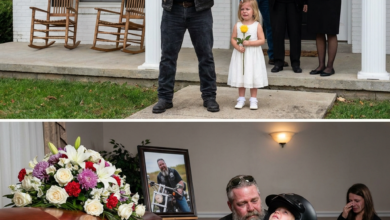
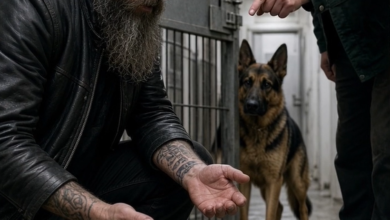
A Biker Dumped My Prescriptions Across My Son’s Pharmacy Floor—Then Pulled Out Something That Made the Pharmacist Stop Saying His Daughter’s Death Was Nobody’s Fault
Daniel reached over the counter.
Not toward Eli.
Toward the blue tin beneath his arm.
My son had looked at the scattered medicine bags as though they were somebody else’s problem. But that dented biscuit tin made him forget the counter between them.
“Where did you get that?”
“Our kitchen,” Eli said.
Our kitchen. Nine months after Nora’s funeral, he still spoke of their apartment as if she might be upstairs changing out of her school clothes.
I stood beside my overturned shopping basket with my cane planted between two sealed bags. Nothing had broken. Nothing had opened. Still, my face burned. A stranger was filming, and my grandson-in-law had just made me look like an old man who couldn’t protect his own prescriptions.
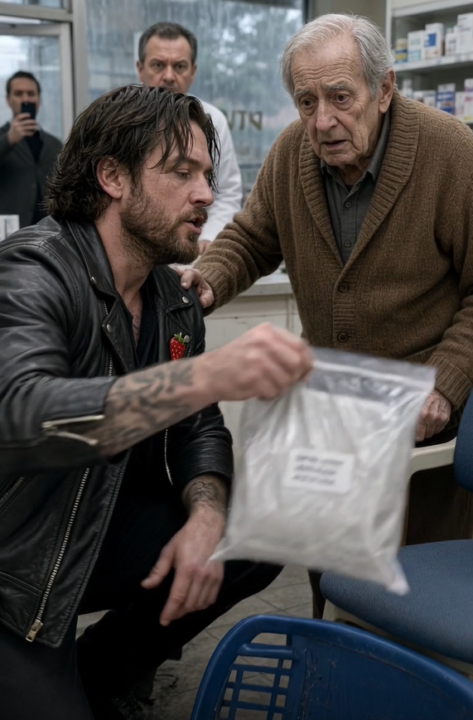
“Pick them up,” I told him.
Eli crouched immediately. His leather vest creaked. He lifted the bags by their handles and placed them on an empty chair, away from people’s shoes.
“I’m sorry, Arthur.”
“You ought to be.”
He nodded.
Daniel’s cashier, June, locked the public entrance after the last waiting customer stepped outside. Nobody was prevented from leaving. My son asked her to call the police about the disturbance, and Eli said he wanted them called too.
That frightened me more than shouting would have.
Daniel came around the counter, white coat open over the same blue shirt he’d worn to Sunday dinner. He touched my shoulder and asked whether I had taken anything from that pickup yet.
“No.”
He exhaled.
It was such an ordinary, fatherly sound that I nearly dismissed Eli’s accusation altogether. My son had filled my prescriptions for sixteen years. He remembered which caps I could open and wrote larger labels when my eyesight worsened.
Men who do that don’t knowingly hurt people.
I wanted the sentence to be true simply because I needed it.
Eli placed a laboratory report on the chair beside the sealed bags. He didn’t call it proof of everything. He said one retained package from Nora’s home contained tablets that did not match what the package claimed.
He had also reported it to the appropriate investigators.
Daniel skimmed the first page.
“This doesn’t establish where they came from.”
“Her receipt is underneath.”
“You handled deliveries for us.”
The words landed between them.
For six months before Nora died, Eli had occasionally delivered sealed pharmacy orders after his repair shop closed. Daniel had offered him the work when winter slowed the motorcycle business.
I remembered being grateful.
Now I looked at the man’s tattooed wrists and wondered what I actually knew about those evenings.
The police arrived. Eli stepped back, kept his hands visible, and described exactly what he’d done to my basket. I described it too, including the part where I hadn’t given permission.
The officer asked whether anybody was injured. Nobody was. He asked whether Eli had threatened me. He hadn’t. Then he asked why I was shaking. I could have blamed my age. Instead, I said I no longer knew which person in the room I ought to trust.
An officer photographed the bags and asked us not to rearrange anything else.
Daniel looked toward the blue tin again.
“Nora threw that medication away,” he said.
Eli’s expression changed.
“Then why did she keep it with the receipt?”
And why did my son know there had been medicine in her biscuit tin?
The last happy Sunday I can remember began with Nora burning toast.
She opened every window in the apartment while Eli fanned the smoke detector with a motorcycle magazine. Daniel laughed so hard he had to sit down. My older son, Paul, arrived carrying strawberries and complaining about the parking.
Nora used the blue tin for things she intended to return: a broken clasp, an incorrect school order, a packet from the pharmacy she’d put aside.
“My complaint department,” she called it.
Paul lifted the tin, heard something rattle, and tapped the lid twice with his wedding ring before setting it on the highest shelf.
“Keep the complaints out of breakfast.”
Later, he gave Nora a little metal strawberry charm for her key ring. She fastened it to Eli’s vest instead, tucked beneath the lapel where only family would notice.
“So he remembers fruit exists,” she said.
We ate the toast anyway.
At the pharmacy, Eli’s vest shifted when the officer asked him to sit. The strawberry caught the fluorescent light.
I remembered Nora attaching it.
I remembered Paul holding the tin.
Memory wasn’t evidence. But it made the room feel less simple than Daniel wanted it to be.
An officer took our statements separately. He explained that he could document the incident and contact the people equipped to investigate the medication, but he couldn’t authenticate tablets by looking at them.
Eli agreed.
He didn’t ask anyone to swallow one, smell one, or compare them against a photograph online. He wanted the sealed pickup preserved and examined properly.
Daniel arranged for another pharmacist to help review my immediate medication needs using a separate, verified source. I left with written instructions specific to my prescriptions and a number to call with questions.
No one told me to stop every medicine in my house.
The practical care my son showed me made his distress look honest.
Perhaps it was.
Before we left, he asked Eli why he had waited nine months to raise this.
Eli stared at the floor.
“I didn’t know.”
“You were her husband.”
“I know.”
I wanted Daniel to stop.
Instead, he asked about the package’s history. Who had stored it? Who had access? Had Nora ever moved pills between containers?
Those were questions somebody would have to answer.
They also sounded like a father looking for a way to make his daughter responsible.
Outside, rain dotted the seat of Eli’s Harley. He wiped it with a shop rag, though he didn’t seem ready to ride.
“The tin was behind her teaching books,” he told me. “I couldn’t sort that room until last month.”
He had found the retained packet, its pharmacy receipt, and a note in Nora’s handwriting about asking her father to check it.
He had called Daniel first.
That mattered later. Eli hadn’t gone looking for a crowd before giving my son a chance to answer. There was a call in his phone history, followed by another the next morning. He showed me both without handing over the rest of the messages he still kept from his wife.
Daniel said he couldn’t remember the conversation she meant.
Then Eli had sought professional help to have the retained product examined. The report had arrived the previous afternoon.
He pointed through the window toward my sealed pickup.
“Same printed batch information.”
That resemblance was a reason to investigate, not a verdict.
But if it meant nothing, why had Daniel tried to replace my bag before anyone photographed it?
For three days, my son looked like a man betrayed by his supplier.
He suspended dispensing from the stock under question, contacted patients through the channels the investigating professionals advised, and provided purchase records. I watched him make calls until his voice went hoarse.
He slept at the pharmacy office one night.
June brought him a blanket.
Then the first records came back.
The suspect products had not entered through the pharmacy’s usual wholesaler. A purchasing file listed an alternate supplier and an account Daniel said he had never personally opened.
The contact name was Eli Mercer.
I read it twice.
Eli’s former delivery work appeared beside the account. Copies of his identification and business details were attached. His repair shop address sat beneath an email address that looked almost like the one on his invoices.
Almost.
Daniel handed the folder to the investigator and sat down hard.
“I let him into my business,” he said.
I looked across the room at Eli.
For a second, his size seemed threatening again. His boots left wet marks on the floor. The little strawberry charm looked absurd against the black leather.
“Tell me that isn’t yours,” I said.
“It isn’t.”
“Then explain it.”
He couldn’t.
Not yet.
That was the awful part. A truthful man can stand in front of a convincing document and have nothing ready except the truth.
Eli authorized his attorney to provide records showing the delivery work he actually performed. He handed over the schedules he had kept for taxes and payment disputes.
Then Paul arrived.
My older son managed the pharmacy’s business accounts. Daniel handled the prescriptions; Paul handled leases, payroll, and purchasing arrangements that were supposed to be checked through the pharmacy’s procedures.
He had spent years being the person nobody noticed until something needed paying.
Now he seemed indispensable.
“Let’s not convict anybody in the stockroom,” he said.
He brought coffee for everyone.
Paul knew how each of us took it. Mine with milk, Daniel’s black, Eli’s with the lid loosened because he always spilled it otherwise. I watched him distribute those cups and felt the terrible comfort of being known by somebody whose explanation I had not yet learned to question.
Even Eli.
I nearly loved him for it.
Paul explained that a delivery contractor might appear on a vendor form for ordinary administrative reasons. He offered to assemble the original correspondence so investigators could follow the transactions.
He spoke calmly enough that Daniel stopped trembling.
For the first time since the basket hit the floor, I thought we might still be a family after the investigation.
Then June asked where the original correspondence was kept.
Paul said the old purchasing computer had failed.
She frowned.
“I used it Tuesday.”
He corrected himself.
The drive hadn’t failed. It was being replaced.
At home that evening, I found an envelope Eli had left for me containing copies of his delivery slips. His actual email address appeared at the top.
One letter differed from the supplier account.
I called June.
She didn’t discuss patient information. She only confirmed something about office work she had witnessed: Paul had prepared the paperwork when Eli first started delivering.
Copies of his identification.
His business details.
Everything now making him look guilty.
If my older son had collected those documents, why had he let me believe the investigator was the first person who could explain them?
The trail did not emerge from one miraculous file.
It arrived in pieces, separated by requests, interviews, and days when nobody would tell me anything new.
My own pickup remained preserved. Other stock was collected through the investigation. More testing followed, and the pharmacy’s familiar labels stopped being reassuring.
The products examined included medicine that did not contain what its packaging claimed. Purchase records tied the affected stock to the alternate supplier.
It had come through our pharmacy.
That fact no longer depended on Eli’s retained packet.
I sat at my kitchen table while an investigator explained what they could share with me as an affected customer. I asked whether that meant the tablets had killed Nora.
He did not give me the answer I wanted.
Her treatment history and the medical circumstances required a separate review. A counterfeit packet in her home was serious evidence. It wasn’t permission to invent the rest.
I hated his caution.
Later, I became grateful for it.
The money moved more quickly than the medical conclusions.
Investigators obtained records connecting payments from the alternate purchasing arrangement to a company Paul controlled. The supposed savings weren’t simply helping the pharmacy survive.
Some of the money came back to him.
The company receiving it had an address I recognized. Paul had once asked me to collect a parcel there while he was away. I had carried it into his house and accepted a sandwich for the trouble. Remembering that small errand made the financial records feel suddenly, horribly physical.
Eli learned through his attorney that the supplier email account had not been established by him. The information used to build it matched the documents Paul had collected when arranging his delivery work.
My older son had taken a real job and built a false story around it.
When I confronted Paul, he didn’t deny knowing the supplier.
He denied knowing the medicine was false.
“I bought what they represented as legitimate stock.”
“Then why put Eli’s name on it?”
He looked toward the window.
“You don’t understand how these accounts work.”
I had spent forty-one years keeping maintenance accounts for a school district. I understood when someone answered a different question.
Paul said his marriage was under strain. He said the pharmacy was carrying debt. He said Daniel had always been generous with everybody’s money except his own.
Then he asked me to remember who had helped when my wife needed long-term care.
He had.
That was true.
He had sat with her so I could sleep. He had argued with insurance representatives. He had brought the only soup she would eat near the end.
I discovered that loving someone doesn’t stop when you find something terrible.
It becomes another terrible thing to carry.
Eli came that night with a casserole from one of his riding friends. He set it in the oven and checked the kitchen window because the frame rattled in the wind.
He didn’t ask whether I believed him now.
I told him anyway.
He braced both hands against the counter.
For a moment, I thought he might cry.
Instead, he asked where I kept a screwdriver.
While he tightened the latch, my phone lit up with a message from Paul.
Ask Daniel what Nora told him before she died.
What warning had my younger son kept out of his account?
Before Daniel answered me, the photographs began circulating.
Eli tipping the basket.
Me leaning on my cane.
The sealed bags suspended in the air between us.
Someone had removed the sound and added a description accusing him of terrorizing an elderly customer. People shared it without mentioning the testing or the purchasing investigation.
My name made it believable.
My silence helped.
I had been waiting until I understood every part before speaking. Meanwhile, the incomplete picture was becoming the only one people saw. June called to ask whether I was all right. She sounded frightened of saying anything about her employer, even after everything she had already helped preserve.
At the repair shop, a customer demanded his motorcycle back unfinished. Another said he didn’t want a man who handled stolen medicine touching his brakes.
Eli returned the first man’s keys and refunded work he hadn’t completed.
His mechanic, Leon, watched from the service bay.
When the customer left, Leon asked whether he should look for another job.
Eli stood still a long time.
“Give me until Friday.”
He told me this later. At the time, he only said business was slow.
Then a letter arrived threatening action over statements allegedly damaging Paul’s reputation. Eli’s attorney handled it. The warning did not vanish simply because investigators were asking serious questions.
It cost money to answer.
Everything cost money.
His riding friends offered to gather outside the pharmacy. Eli asked them to help Leon finish scheduled repairs instead.
Three men spent Saturday sorting parts and calling customers about collection times. Their motorcycles stayed behind the shop, under a leaking awning.
That was the help he could use.
I recorded a statement of my own at my kitchen table. No dramatic music. No accusation I couldn’t support.
I said Eli had acted without my permission. I said he had apologized. I also said the investigation had confirmed counterfeit products in the pharmacy’s stock and that I did not believe he had created the supplier account bearing his name.
Some people thanked me.
Some said I was confused.
One woman asked whether my family was trying to ruin a respected pharmacist to collect insurance money.
I turned the phone facedown.
That afternoon, Daniel finally came over.
He brought a folder and the sweater I had left in his car at Christmas. He set the sweater down first, as if ordinary objects might make the rest easier.
“Nora called about a packet,” he said.
“When?”
He gave me a date three weeks before she died.
She had questioned something about the packaging and asked him to verify what she had received. Daniel said he checked the purchasing record, saw a familiar entry, and reassured her.
“Did you examine what she kept?”
“No.”
“Did you report her concern?”
He looked down.
The folder contained his note of the call. He had supplied it to investigators that morning after first saying he couldn’t remember it.
I thought about the blue tin.
My granddaughter had built a complaint department because the real one had failed her.
Daniel pressed both palms against his eyes.
“There’s something else.”
And what could be worse than a father remembering the warning only after his daughter was gone?
Daniel had been warned about the supplier before Nora called.
Not that its products had been proven counterfeit. Not that anyone knew what later testing would show.
A relief pharmacist had questioned gaps in the purchasing documentation and asked him to stop using that source until they were resolved.
Daniel had signed the follow-up sheet.
Then he let Paul handle it.
“He said it was paperwork,” my son told me.
“And you believed him?”
“I wanted to.”
The admission came out so quietly I nearly missed it.
The pharmacy had been losing money. Paul had threatened to stop covering certain obligations. Daniel feared losing the business, the staff, the place people had associated with our name since before Nora was born.
He had accepted reassurance instead of requiring answers.
He also admitted letting Paul describe Eli as unreliable whenever deliveries ran late. Once, Eli had stopped to help a customer who had fallen outside her apartment. Daniel recorded only the late arrival. The detail seemed small beside everything else, but Eli remembered it. So did the customer.
When Nora called, he did it again.
I sat across from him with my hands around a cold cup of coffee. I had been preparing myself to comfort a father who was also a victim.
Now I had to listen to the pharmacist who had made choices.
“Did you know what was in those tablets?”
“No.”
“Did you know enough to stop and check?”
He began crying then.
“Yes.”
I didn’t move my chair closer.
That was all the kindness I could manage: staying in the room.
Daniel’s attorney had already advised him to preserve and disclose the records. His professional conduct would be examined separately from Paul’s purchasing scheme.
He could lose the work he had used to explain every delay.
He knew it.
But there was another reason he had initially distrusted Eli’s retained package.
Paul had told him Nora’s questioned stock was collected and replaced after her call. Daniel believed the blue tin couldn’t contain the original product.
“Paul went to her apartment?” I asked.
“He said he did.”
I remembered strawberries.
The wedding ring tapping twice.
Paul moving the tin onto the highest shelf.
I called Eli while Daniel sat across from me.
He listened without interruption. Then he described what Nora had written beside the receipt: she wanted her father to examine the retained packet before returning it.
She hadn’t surrendered it.
She had put it aside.
Whatever Paul collected, it wasn’t everything she kept.
Eli came over, but he didn’t sit beside Daniel. He remained near the kitchen doorway, his helmet hanging from two fingers.
Daniel tried to apologize.
Eli raised one hand.
“Tell them. All of it.”
“I have.”
“Keep doing it.”
Weeks later, their attorneys told us enough for another difficult distinction: testing had established the retained product was counterfeit, and medical reviewers were examining its contribution to the failure of Nora’s treatment.
Her death could not be reduced to a package held up in a store.
But it could no longer be dismissed as unrelated without examination either.
Paul still denied ever seeing inside the blue tin.
Then his attorney announced he would challenge the history of Eli’s retained evidence at the public hearing.
What would he say about a container I had watched him lift with his own hands?
The hearing room smelled of damp coats and overheated wiring.
It was part of the proceedings concerning the pharmacy’s license, not a criminal trial. The purchasing investigation continued separately. The people at the long table asked narrow questions, and witnesses answered under oath.
I sat behind Eli.
Leon sat beside him in a shirt that still showed a pale grease stain at the cuff.
Nobody had come wearing a costume for respectability. Eli’s vest was folded on his lap, the strawberry charm hidden beneath the leather.
Daniel testified first.
He described the warning he had failed to resolve. He acknowledged reassuring Nora without examining the packet. When asked why he initially said he couldn’t remember her call, he swallowed twice.
“Because remembering meant admitting what I’d failed to do.”
I looked at the empty chair beside me.
My granddaughter should have been there complaining that the room was cold.
Paul’s explanation was smoother.
He described an outside supplier that deceived him. He said Eli’s details appeared in administrative documents because deliveries had once been routed through him.
He denied constructing the false account.
He denied receiving improper payments.
Questions about those payments were limited when his attorney intervened. The hearing officer made clear which issues belonged before her and which would be addressed elsewhere.
It wasn’t the sweeping confrontation people wanted.
It was slower.
During a break, I found Eli beside a vending machine holding money he hadn’t put in. He said Nora used to buy the same stale crackers on hospital afternoons. I offered to get him something else. He shook his head and returned the coins to his pocket.
Worse, sometimes.
Then came the blue tin.
An evidence photograph showed it on Nora’s shelf. Other photographs documented what Eli said he found and what was submitted for examination.
Paul’s attorney suggested the contents could have changed before submission.
That possibility had to be considered. Eli answered the questions about storage and access, including what he couldn’t independently prove.
Then Paul was asked about his claim that Nora’s questioned medication had been collected.
“She gave me everything,” he said.
“From where?”
“Her kitchen.”
“Did you open this container?”
“No.”
The attorney conducting the examination let the photograph remain on the screen.
Paul leaned toward his microphone.
“And that photograph isn’t how she kept it. The receipt was folded underneath the packet, not laid across the top.”
Eli stopped moving.
The hearing officer looked up.
“Mr. Bennett, how do you know where the receipt was?”
Paul blinked.
“She showed me.”
“Inside the container?”
His attorney touched his sleeve.
Too late.
The earlier denial was read back. Then a message Paul had sent Daniel was introduced through the records already provided: he had said he had never seen whatever Eli claimed was in the tin.
I was called to describe the breakfast visit.
The strawberries. The shelf. The ring striking the lid twice.
That memory did not prove the whole scheme. The transaction records and communications had to do their own work.
But it destroyed one small, important shelter Paul had built for himself.
He knew the tin.
He knew the receipt.
He had been close enough to the warning to describe how it was folded.
If he had collected everything as he claimed, why had he told Daniel there was nothing left for anyone to test?
The public hearing ended with more questions and a date for further proceedings.
Nobody applauded.
Outside, Eli stood beside his motorcycle without putting on his helmet. Daniel approached him and stopped several feet away.
“I should have checked,” he said.
Eli looked at the helmet in his hands.
“I know.”
That was all.
Daniel didn’t ask for forgiveness in the parking lot. For once, he let somebody else decide when a conversation was finished.
The months afterward were harder to explain than the day in the pharmacy. There were additional examinations of records, statements to correct, and appointments where I sat with a different pharmacist while we reviewed what I actually had at home.
The counterfeit products were traced through the affected purchasing records. People were contacted. Some needed clinical follow-up. Some needed reassurance backed by something more substantial than our family name.
The pharmacy’s operation did not continue as before. Daniel faced professional sanctions, and the business was eventually sold under arrangements that kept him from returning to the role he had failed to carry responsibly.
Paul’s case moved separately. The financial records and communications supported charges concerning the scheme, and he ultimately entered a guilty plea.
I attended the hearing.
Afterward, people asked whether the family would receive money. Some claims were still being resolved. Some costs had already been paid by people who couldn’t comfortably afford them. Eli kept his receipts in a kitchen drawer, but he stopped checking the mailbox every evening as though it might deliver an ending.
Paul looked older.
He was still my son.
Neither fact changed what he had done.
The medical review of Nora’s case concluded that the ineffective counterfeit medicine had contributed to the failure of her treatment. Hearing that did not give Eli the clean relief I had imagined.
It gave his grief an additional weight.
There was something that should have worked.
There were questions that should have been answered.
Now we had an answer, and she was still gone.
When the retained objects could be returned, Eli asked me to come over. Her teaching books were still in the spare room, but the door stood open.
On the kitchen table sat the blue tin.
Empty.
He had washed it and dried it carefully. A little rust remained near the hinge.
“I don’t want to put anything bad in it again,” he said.
I asked what he wanted instead.
He shook his head.
We drank coffee. Outside, Leon’s pickup rattled over a pothole on the way to the shop. The ordinary sound made the apartment feel inhabited.
Then Eli reached beneath his vest lapel and removed the strawberry charm.
He set it inside the tin.
The small metal click was almost too much.
The following Sunday, Daniel came by invitation. He brought no medical folder and no explanation. He stood at the door until Eli stepped aside.
We made breakfast.
Daniel burned the toast.
For a moment, none of us moved.
Then Eli opened the window, and I took three plates from the cabinet.
The tin sat on the table between us, its lid open around one ridiculous strawberry.
Daniel reached toward it, then stopped and looked at Eli.
“May I?”
Eli nodded.
My son picked up the charm as carefully as if it could bruise.
After a while, he set it down and pulled out a chair.
Eli looked at the open tin, then at us.
“What good thing should we put in next?”