She Was Abandoned by an Uber Driver After Midnight — Then a Biker’s Engine Stopped Behind Her
The Uber door slammed, the car sped off, and the woman realized the quiet street was no longer empty — because fear had arrived first.
It was past midnight, the kind of hour where even cities seem to hold their breath.
Streetlights hummed overhead, casting thin pools of yellow light that didn’t quite touch each other, leaving long stretches of darkness between them. The neighborhood looked safe during the day. At night, it felt unfinished — sidewalks cracked, storefronts dark, windows closed like eyes refusing to watch.
She stood there for a second, frozen.
Phone in her hand.
Ride marked “Completed.”
Heart beating too fast for no clear reason.
“Wait—” she said, turning toward the car.
But the Uber was already gone.
Tires screeched lightly as it took the corner, red taillights shrinking into nothing. No apology. No explanation. Just absence.
She checked the address again.
Wrong drop-off point.
Industrial strip. Closed warehouse. A bus stop with no bench and no schedule posted.
Her chest tightened.
She tried calling the driver. Straight to voicemail.
Tried support. Automated messages. Estimated wait time: unknown.
The silence grew heavier by the second.
A couple passed on the opposite side of the street without looking at her. A car slowed, then kept going. Somewhere far away, a siren wailed — not close enough to help, not far enough to ignore.
She wrapped her jacket tighter around herself and started walking.
Fast at first. Then slower, as her heels clicked too loudly against the pavement. Every sound felt amplified. Every shadow felt intentional.
That’s when she heard it.
An engine.
Low. Deep. Unmistakable.
Not a car.
A motorcycle.
The sound came from behind her — steady, deliberate — and then slowed.
The engine idled.
Right behind her.
She stopped walking.
Her breath caught.
And she didn’t turn around.
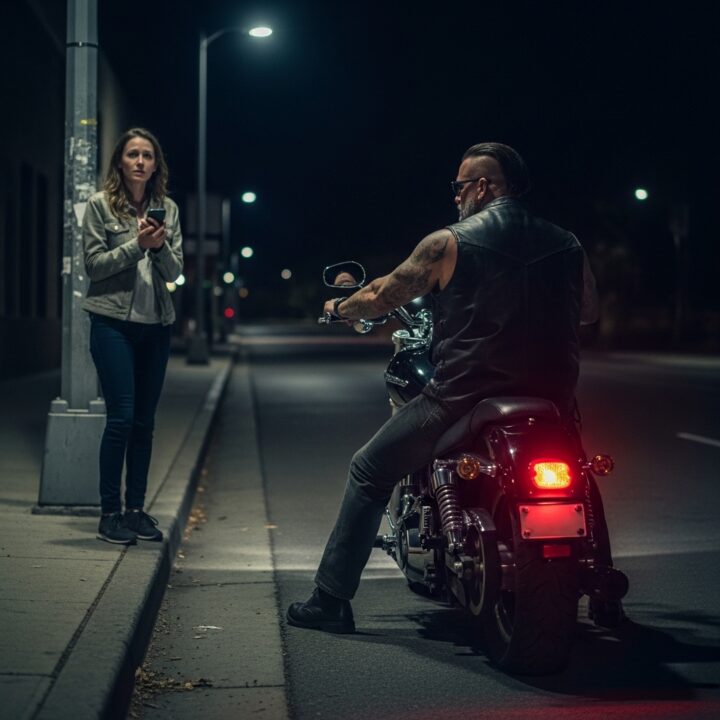
The motorcycle stayed where it was.
Not revving.
Not passing.
Just… there.
She could feel it — the weight of being watched, even before she confirmed it.
Her fingers tightened around her phone.
She turned slowly.
The biker sat astride a large black motorcycle, parked half a lane behind her. Headlight on. Helmet off. Sunglasses still on, even at night. Tattoos ran down his forearms beneath a short-sleeve shirt. A leather vest rested heavy on his shoulders.
He didn’t smile.
Didn’t wave.
Didn’t speak.
And that silence was worse than words.
She took a step back.
He didn’t move.
Another step.
Still nothing.
Her mind filled the gaps faster than logic ever could.
Why here?
Why now?
Why not just pass?
She glanced around for help.
Empty street. Closed buildings. One flickering streetlight.
She raised her phone, pretending to text, really opening the camera. Her thumb hovered over the emergency call button.
“Please don’t,” she said suddenly, hating how small her voice sounded. “I don’t have anything.”
The biker tilted his head slightly — as if he hadn’t expected her to speak.
“I’m not asking for anything,” he said.
His voice was low. Calm. Too controlled to be comforting.
That made her angrier than afraid.
“Then why are you following me?” she snapped. “My driver just left me here. I don’t need this.”
The biker looked past her, down the street she’d been walking toward.
“That way’s not safe,” he said.
There it was.
The sentence that flipped something inside her.
Not safe — according to who?
“You don’t get to tell me where to go,” she shot back. “Stay away from me.”
A car approached from the opposite direction, slowed when it saw them, then sped up.
She noticed.
So did he.
The biker lifted one hand slowly, palm open, showing he wasn’t holding anything.
“I’m just making sure you’re okay,” he said.
She laughed — sharp, bitter.
“That’s what everyone says right before they’re not.”
She stepped into the street, putting distance between them.
The biker sighed quietly.
He reached into his vest.
Her heart slammed.
She took another step back and shouted, “Don’t!”
Windows down the block flickered with movement. A porch light clicked on somewhere. A man across the street paused, watching.
The biker stopped.
He pulled out his phone.
Held it up.
“I’m calling someone,” he said. “You can hear it ring.”
He dialed.
Put it on speaker.
The call connected.
But she didn’t relax.
Because now she wasn’t just afraid.
She was angry.
And fear mixed with anger never stays quiet for long.
The voice on the other end answered.
Calm. Familiar.
The biker spoke briefly. Gave a location. Nothing else.
He ended the call.
She stared at him, heart still racing.
“You think that proves something?” she demanded. “Because it doesn’t.”
He nodded once. “Fair.”
That word — fair — disarmed her more than any threat could have.
A second motorcycle engine echoed in the distance.
Then another.
She heard them before she saw them — low, measured, controlled, like they weren’t in a hurry but knew exactly where they were going.
Her stomach dropped.
She backed away instinctively, hand shaking as she raised her phone higher.
“You called them,” she said. “You actually called them.”
Headlights appeared at the far end of the street.
Two bikes. Maybe three.
She turned, looking for somewhere to run — but the sidewalk ended in a chain-link fence. The bus stop offered no cover. No help.
A neighbor shouted from a porch, “Everything okay over there?”
“Call the police!” she yelled back. “Please!”
The biker looked at her then — really looked at her.
Not predatory.
Not angry.
Just focused.
“Stay where you are,” he said. “No one’s going to touch you.”
She didn’t believe him.
The motorcycles rolled closer and stopped — not surrounding her, but parking in a straight line behind the first bike.
Engines idled.
No one got off.
No one approached.
The street felt suddenly smaller.
Charged.
She stood there, shaking, phone recording now, convinced she was about to become a headline.
And in the middle of it all — with neighbors watching, police possibly on the way, and her fear spiraling out of control — the biker did the strangest thing.
He stepped off his bike.
Removed his vest.
And placed it on the ground between them.
Then he took three steps back.
Hands visible.
Waiting.
The sound reached her before the sight.
Not loud.
Not aggressive.
Just present.
Engines idling — steady, disciplined — the kind of sound that didn’t rush or chase. It claimed space without demanding it.
Three motorcycles now. Then a fourth.
They stopped in a clean line along the curb, headlights angled down, not blinding her. No one revved. No one dismounted at first.
The woman’s breathing came fast, uneven. Her phone shook in her hand.
Neighbors gathered at a distance. Porch lights flicked on. A couple of doors opened. Someone was already on the phone — probably the police.
The biker who had stopped first didn’t move closer.
He stood back, hands loose at his sides, shoulders squared, posture too controlled to be threatening.
Then another biker stepped off his bike.
Mid-50s. White. Gray beard. No vest — just a plain jacket, zipped halfway. He looked at the woman first. Really looked.
“You alright, ma’am?” he asked.
Not loud.
Not rushed.
Just enough.
She swallowed. “I… I was left here. My ride just— he drove off.”
The older biker nodded once. Like that explained everything it needed to.
He turned to the first biker. “This the spot?”
“Yes,” the man replied.
No more words.
A police cruiser pulled up at the end of the block, lights washing the street in red and blue. Another followed.
Officers stepped out cautiously, hands near their belts, eyes scanning the group of bikers.
The woman felt it again — that shift — where people decide who they think is dangerous before anyone speaks.
The officer nearest her looked at the bikes, then at the leather vest on the ground.
“What’s going on here?” he asked.
Before she could answer, the older biker spoke.
“She was abandoned by her driver,” he said calmly. “We stopped so she wouldn’t be alone.”
The officer raised an eyebrow. “You follow her?”
“No,” the biker answered. “We stayed behind her.”
Silence stretched.
The officer looked down at the vest. Then at the first biker — still standing back, still silent.
“You mind explaining why your jacket’s on the street?” the officer asked.
The biker finally spoke again.
“So she wouldn’t think I was hiding anything.”
That landed.
Not with force.
With weight.
The officers exchanged glances.
One of them asked the woman gently, “Did anyone touch you?”
She shook her head.
“Threaten you?”
Another shake.
“Try to stop you from leaving?”
She hesitated.
Then said quietly, “No.”
The street seemed to exhale.
An ambulance arrived.
Not because of the bikers — but because someone had insisted she get home safely.
The paramedic wrapped a blanket around her shoulders even though she wasn’t injured. Asked if she had someone to call.
She did.
The older biker spoke briefly with the police, showing identification. Nothing flashy. Nothing performative. Just facts.
The officers’ posture changed.
Not suddenly.
Gradually.
The tension drained out of their shoulders. Their voices softened.
One of them walked back to the first biker.
“You can pick up your vest,” he said.
The biker did — brushing off the dust quietly.
The woman watched him now with different eyes.
Not fear.
Something closer to embarrassment.
“I’m sorry,” she said suddenly. “I thought…”
He shook his head once.
“You had reason to,” he said. “Night does that.”
That was all.
Her ride arrived shortly after — not an app this time, but a friend who hugged her tight under the streetlight.
As she got into the car, she looked back.
The bikers were already mounting their bikes. No smiles. No nods toward the crowd.
Just engines starting.
Low.
Controlled.
Gone.
By morning, no one would remember the exact words spoken.
But the image would stay.
A woman standing alone on a dark street.
A biker stopping behind her — and choosing not to move closer.
A leather vest placed on the ground like a boundary.
Hands kept visible.
Distance respected.
And a moment where fear was allowed to breathe…
until it passed.
No hero speeches.
No credit taken.
Just someone staying when leaving would’ve been easier.