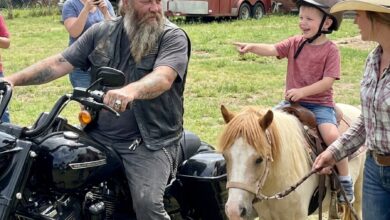
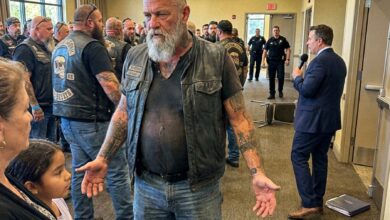
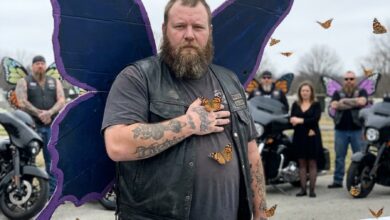
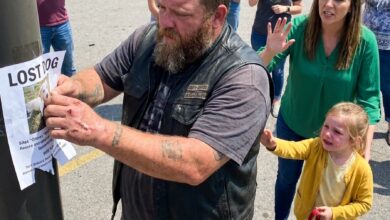
A 290-Pound Biker Wore a Homemade Unicorn Horn on His Helmet for 365 Days — Then His Club Learned Why His Daughter Needed Him to Become Brave First
Part 2 — The First Monster
My name is Mason Mercer, though almost nobody outside courtrooms and hospitals calls me that. On the road, I am Ox. Lily calls me Dad when she is frightened, Mason when she is testing my patience, and Sir Hornsalot when she wants something from the vending machine.
Before leukemia entered our lives, I owned Mercer Recovery, a towing yard wedged between an auto-glass shop and a dry wash on Tucson’s south side. I worked six days a week, slept badly, and raised Lily alone in a two-bedroom stucco house where the air conditioner sounded like loose bolts inside a coffee can.
Her mother, Rachel, had died when Lily was four.
A delivery truck crossed the center line on State Route 86 during a dust storm. Rachel died before the helicopter arrived. Lily survived because her car seat was on the passenger side.
I reached the crash scene in my tow truck before anyone told dispatch who was inside the wreck.
For years afterward, I could not approach a crushed silver car without tasting dirt in the back of my throat.
I had been sober for fourteen months when Rachel died. By the funeral, every man in the Iron Vultures expected me to drink. Diesel removed the whiskey bottles from the clubhouse without mentioning my name. Mercy Bell, our treasurer, slept on my porch for four nights. Cruz Navarro changed the locks at my towing yard because I kept going there at two in the morning and starting equipment I was too exhausted to operate safely.
Nobody gave speeches.
They stayed.
That was how our brotherhood worked when it worked well. When it failed, we mistook silence for loyalty and anger for strength.
Lily grew up among chain wallets, work gloves, coffee cans full of bolts, and men whose faces frightened substitute teachers. She knew which riders carried peppermints, who snored during movies, and whose beard she could braid without asking.
Diesel was her favorite.
He taught her to use a tire-pressure gauge. Every birthday, he gave her a new socket from an old American-made set, promising she would own the entire collection by eighteen. He never attended her school performances, but he waited outside afterward with hot chocolate.
Then Lily became tired.
At first, I blamed summer. Tucson in June can drain the argument from a child. She stopped riding her bicycle after dinner, began falling asleep on the couch, and complained that her legs hurt.
The bruises came next.
One appeared behind her knee, another along her ribs, and three small purple marks gathered near her elbow. When I asked where they came from, she said perhaps she had been wrestling invisible bears.
The clinic drew blood at 4:40 on a Thursday afternoon.
By seven, a pediatrician was speaking carefully while I stared at the unopened juice box in Lily’s hand. Her white blood cell count was wrong. Her platelets were dangerously low. We needed to go to the hospital immediately.
“Can we go home first?” Lily asked.
“No,” the doctor said.
“Can Dad bring my unicorn book?”
I said yes before remembering Rachel had bought that book.
It still contained her handwriting.
At the hospital, specialists repeated tests. Nurses brought warm blankets. A social worker asked whether we had family nearby, and I named a motorcycle club because it was the only answer I had.
The oncologist entered just after midnight.
Dr. Priya Shah was forty-two, small enough that I could have lifted her with one arm, and completely unimpressed by my size. She sat instead of standing over us. Then she said leukemia.
My daughter looked at me.
I looked at the floor.
The room filled with words—bone marrow, chemotherapy, central line, infection, survival rates—but all I heard was the sound of glass breaking somewhere far away. Rachel’s car returned in pieces. Dust filled my mouth. My hands began shaking.
I walked out.
That is the part people usually soften when they tell stories about devoted fathers. They say I stepped into the hallway to collect myself. They say I needed air.
I ran.
I passed the nurses’ station, the elevators, and the security doors. I reached a vending alcove before my legs stopped working. Then I leaned both hands against a soda machine and tried not to be the man who had once solved pain with whiskey.
The floor squeaked behind me.
Lily stood there dragging her IV pole, yellow hospital socks slipping beneath her heels.
“Dad?”
I wiped my face with both hands.
“You’re supposed to be in bed.”
“You’re supposed to be with me.”
That landed cleanly.
She asked whether I was scared. I said no, and she called me a liar. Then she reached into the cloth bag the child-life volunteer had given her and removed a sheet of unicorn stickers.
“Mom said unicorns are brave,” she told me.
I remembered Rachel reading that book at bedtime. I remembered correcting her once, saying unicorns were not real.
Rachel had looked over Lily’s head and said, “Neither is half the courage people need. They make it anyway.”
Lily selected a purple sticker and pressed it against my scarred knuckle.
“If unicorns fight monsters,” she said, “we need one.”
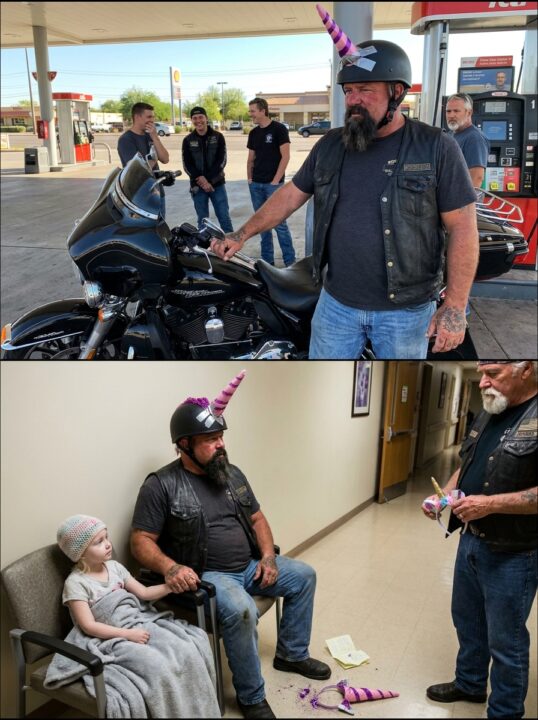
That morning, she began building the horn.
A cereal box supplied the cardboard. Pink foam came from the activity room. The twisted clear plastic tube inside had once covered a sterile medical dressing. Lily insisted on purple glitter because gold looked too royal and silver looked like plumbing tape.
She made me promise to wear it for every treatment.
I promised too quickly.
Neither of us knew treatment would last years.
The first time I fastened it to my helmet, she smiled. Not broadly. Chemotherapy had already made her nauseated, and smiling pulled at a sore inside her mouth.
But she smiled.
I started the Road King beneath her hospital window. The V-twin shook the glitter loose, scattering purple flecks across my shoulders.
Lily placed one palm against the glass.
I touched two fingers to the horn.
That became our signal.
Her first monster had a medical name.
Mine was the door I had abandoned.
Part 3 — The Patch and the Horn
The Iron Vultures first saw the horn at our Friday safety meeting. I parked beside the open garage, shut down the engine, and entered carrying my helmet.
Cruz laughed until he saw my expression.
Mercy asked whether Lily had made it. When I nodded, he touched the glitter with one grease-darkened finger and said, “Looks fast.”
Diesel said nothing.
He studied the horn, then walked into the back room. At the time, I thought he disliked seeing our road captain turned into a joke. I did not know a glittered unicorn had followed him from another hospital eleven years earlier.
The club accepted the horn in the way men like us accept most uncomfortable things: badly, then completely.
Cruz added a cup holder to my handlebars for Lily’s milkshakes. Mercy began carrying disinfecting wipes because her immune system was weak. Our youngest prospect, Tyler, learned which parking garage entrance had the least vibration because rough pavement hurt after spinal procedures.
Nobody called her fragile.
That mattered to Lily.
They called her Short Stack because she could eat three pancakes after steroids and none on ordinary days. They argued about baseball with her. They let her inspect their motorcycles without touching dirty surfaces. When she visited the clubhouse, every beer disappeared before she entered, though she already knew what beer looked like.
The horn traveled everywhere.
I wore it while recovering a burned-out sedan near Marana. I wore it during a veterans’ food drive and while escorting an elderly rider’s ashes along Catalina Highway. I wore it in August heat that softened the adhesive and during a monsoon storm that stripped half the ribbon away.
Every repair came from Lily.
She numbered them beneath the base with a black marker: 17, 41, 88, 103.
The number did not mark repairs.
It marked brave days.
A brave day could mean completing chemotherapy. It could also mean swallowing medicine without arguing, admitting she hurt, or telling me she wanted the lights off. Lily did not confuse courage with smiling. That was one lesson she learned before I did.
Strangers created their own explanations.
Some believed the horn honored a daughter who had died. Others thought it advertised a toy store. A local motorcycle page posted my photograph with the caption “What happened to biker culture?” and collected almost twelve thousand comments.
The towing yard phone started ringing.
A man asked whether my trucks came with fairy wings. Another caller requested a unicorn rescue for his broken-down pickup, then laughed with friends in the background. One woman said she would never trust a company run by someone desperate for attention.
I did not answer them.
Lily found the photograph online.
“Are they laughing at you?”
“Some.”
“Does it hurt?”
“Less than stepping on a socket.”
She knew that was not an answer.
That evening, she sat at the kitchen table with the horn between us. Her hair had begun coming out in thin strands. One clung to the silver ribbon.
“You can stop,” she said.
“Did the doctors tell you to stop?”
“No.”
“Then I don’t either.”
I expected relief. Instead, she looked worried.
The next morning, I found a folded strip of paper near my boots. It read, in her uneven handwriting: Brave doesn’t mean you like it.
I tucked it into the hollow center of the horn.
After that, small papers began appearing.
Sometimes Lily handed them to me. Sometimes I found them inside the helmet after leaving her room. Each held a name or sentence.
Mia was brave during her scan.
Noah let them change his bandage.
Dad came back into the room.
I never removed those papers. I pushed them deeper into the cardboard tube, believing she wanted the unicorn to carry evidence.
By day 126, the horn rattled when I lifted the helmet.
By day 173, the Iron Vultures faced their first serious argument over it.
We had agreed to escort the widow of Sergeant Daniel Rusk, a Marine veteran and longtime mechanic who had died from lung disease. His family requested a quiet procession from the funeral home to Arizona Veterans’ Memorial Cemetery.
A television station planned to film the departure.
Diesel told me to remove the horn.
“Rusk’s ride isn’t about you,” he said.
“It isn’t about my helmet either.”
“Then don’t give the cameras something else to point at.”
His argument was reasonable. That made it harder.
I called Rusk’s widow, Joanne, and explained. She asked why I wore it. I told her only that my daughter was sick and had asked me to.
“Daniel hated people pretending to be tougher than they were,” Joanne said. “Wear the horn.”
So I did.
At the funeral home, a man from another club looked at it and shook his head. Before I could answer, Joanne walked over, placed both hands around the glittered cardboard, and kissed its crooked tip.
“My husband would’ve understood,” she said.
The cameras caught that.
The online laughter changed for a few days. People called me a devoted father. Morning programs requested interviews. A helmet company offered to manufacture a polished metal version.
Lily rejected every offer.
“It has to look homemade,” she said.
“Why?”
“So people know brave can look messy.”
I thought that was the whole reason.
The first false victory came on day 201. Dr. Shah told us Lily’s marrow results showed no detectable disease. She used the word remission but warned that treatment would continue and the coming months still mattered.
Lily rang the hospital bell.
Nurses clapped. I stood behind her with the unicorn helmet against my chest, unable to speak. Diesel waited near the elevators but left before she saw him.
At the towing yard, the club surprised us with purple streamers and a cake shaped like a motorcycle. Lily ate two bites before nausea stopped her. Then she asked everyone to sign a square of pink foam for a replacement horn.
Diesel refused.
The room changed.
“She’s asking for your name,” I said.
“I heard her.”
“Then sign it.”
“No.”
Lily lowered the marker.
Diesel walked out.
Cruz called him a heartless old bastard. Tyler wanted to chase him. Mercy stopped both men and told me there were some wounds nobody should open in front of a child.
I was too angry to ask what he meant.
That night, Lily developed a fever.
By midnight, it had reached 103.4.
At 1:17 a.m., the hospital told us to come immediately.
Part 4 — The Night the Unicorn Cracked
A fever during chemotherapy is not an ordinary fever.
Dr. Shah had explained that repeatedly. Lily’s immune system could not be trusted to fight an infection, so we carried an emergency card and a hospital bag. If her temperature crossed the number printed in red, we were not to wait, debate, or search online.
I lifted her from bed.
She felt too light.
Her skin burned against my arms, yet she shivered hard enough that her teeth clicked. I wrapped her in Rachel’s old gray blanket, carried her to the truck, and left the unicorn helmet on the kitchen table.
Halfway to the hospital, Lily noticed.
“You forgot it.”
“We’re not on the bike.”
“You still forgot.”
I turned around.
Those six minutes haunted me for months, although doctors later said they did not change the outcome. I drove home, ran inside, grabbed the helmet, and returned to the truck.
Lily placed two fingers against the horn.
“Okay,” she whispered.
At the emergency entrance, nurses moved faster than fear. Blood cultures. Antibiotics. Fluids. Monitors. Questions I answered twice because my mind kept dropping them.
Her blood pressure fell.
A doctor said the word sepsis.
Everything accelerated.
I stood against the wall while a team surrounded the bed. My hands opened and closed. The room smelled of sanitizer, warm plastic, and the motor oil still ground into the seams of my fingers.
Then someone asked me to step outside.
I did.
That was different from running, but it felt the same.
The door closed. Through its narrow window, I saw Lily’s purple cap, an oxygen mask, and gloved hands moving around her. I pressed my forehead against the wall.
The unicorn horn struck the doorframe.
It cracked near the base.
A shower of purple glitter and folded paper strips spilled across the hospital floor.
I dropped to my knees.
There were dozens.
Some contained names I recognized from oncology. Others held small truths Lily had never told me.
I cried before the needle but held still.
Dad slept in the chair even when his back hurt.
Mia threw up and said thank you to the nurse.
Noah is scared of the dark now.
Dad lies when he is scared.
Then I opened one that stopped my breathing.
I asked Dad to wear the horn because he ran away when the doctor said cancer. If he has to be a unicorn, maybe he will always come back.
I read it twice.
The hallway tilted.
For seven months, I had believed the horn existed to give my daughter courage. I had endured laughter, heat, online ridicule, and arguments with my club because she needed proof that she was strong.
But that first morning, Lily had watched me leave.
The unicorn was her leash around my fear.
She had made it bright enough that I could never pretend to lose it.
I gathered the papers with hands too large and clumsy for their folds. One slipped beneath a row of chairs. Another stuck to my boot. The hospital doors opened, and Diesel stepped into the hallway carrying my leather vest.
I had not called him.
Mercy had.
Diesel saw me on the floor, the broken horn, and the scattered notes. His face emptied.
“What happened?”
I handed him Lily’s confession.
He read it. His jaw shifted once.
Then he sat beside me.
For several minutes, neither of us spoke. Behind the isolation door, machines continued beeping. Nurses crossed the hallway without looking directly at us.
Finally, Diesel said, “My daughter liked unicorns too.”
I looked at him.
He removed a key from beneath his shirt. It opened a wooden case he had carried from his truck. Inside lay a child’s drawing, a faded hospital bracelet, and a small white headband with a yellow felt horn.
The drawing showed a huge man riding a purple motorcycle through clouds. A tiny girl sat behind him, wearing wings.
Her name was Emily.
She had died eleven years earlier from a brain tumor. She was seven.
Diesel had never told the club that detail. We knew he had a daughter and that she was gone. We knew not to ask. In our world, respecting grief often meant building walls around it and pretending the walls were a home.
Emily had worn the unicorn headband during radiation.
On her last good afternoon, she asked Diesel to wear it for a photograph. He refused because three other fathers were nearby and he did not want to look foolish.
“She didn’t ask again,” he said.
The photograph in the wooden case showed Emily wearing the horn alone.
That was why he could not sign Lily’s replacement. It was not disgust. It was shame with eleven years of rust around it.
“I kept thinking you were turning her thing into a show,” he said.
“I thought you cared about the club image.”
“I did. Easier to be angry about that.”
The isolation-room door opened.
Dr. Shah told us Lily had stabilized enough to move to intensive care. Her blood pressure was responding, but the infection was serious. The next several hours would matter.
I tried to stand.
My knees failed.
Diesel caught me beneath one arm.
At 3:42 a.m., twenty-one Iron Vultures arrived in ordinary trucks and cars. Mercy had ordered them not to bring motorcycles beneath the patient windows. They filled the waiting area without patches, beer, or noise.
Cruz carried a roll of silver tape.
Tyler brought pink foam from a twenty-four-hour craft aisle. An elderly cashier had asked why he needed it at three in the morning. When he explained, she refused his money and added purple glitter.
We repaired the horn on a hospital cafeteria table.
Nobody laughed.
Diesel pushed the folded notes back inside one by one. Before sealing the base, he added a new strip.
He did not show me what he wrote.
At dawn, Lily remained in intensive care. She was sedated, pale, and surrounded by lines. I sat beside her wearing the repaired helmet because she had once said a unicorn needed its horn even indoors.
A nurse almost asked me to remove it.
Dr. Shah shook her head.
For eighteen hours, I stayed.
When Lily finally opened her eyes, she looked first at the helmet and then at me.
“You came back,” she whispered.
“I’m here.”
“Did it break?”
“A little.”
She raised two weak fingers.
I touched them with mine.
“Messy brave,” she said.
Then she slept.
We believed surviving that night was the climax.
It was not.
The real test began after the hospital photographs escaped onto the internet—and the Iron Vultures were offered enough money to change what the horn meant.
Part 5 — What Brotherhood Cost
A visitor took the photograph through the waiting-room doorway.
It showed me asleep beside Lily’s bed, still wearing my black leather vest and the crooked unicorn helmet. My head had fallen against the wall. One scarred hand rested near her blanket without touching the medical lines.
By morning, the image was everywhere.
The visitor did not know our names. Someone else identified my towing company. A local station found the old motorcycle meme, connected it to Lily’s illness, and produced a three-minute segment called “The Unicorn Biker of Tucson.”
Donations arrived before we asked for any.
That was the problem.
People sent money to the towing yard, the hospital, and accounts that did not belong to us. A man in Nevada sold shirts using my photograph. A helmet-accessory company offered the Iron Vultures fifty thousand dollars to turn the horn into a nationwide campaign.
Their prototype was perfect.
It used flexible rubber, reflective material, reinforced mounts, and a polished spiral that glowed under headlights. The company promised a percentage of sales to pediatric cancer charities.
Half the club wanted to accept.
The towing yard was struggling because I had missed weeks of work. Cruz’s wife needed dental surgery. Our clubhouse roof leaked. A legitimate charity could help families whose hospital bills made ours look small.
The offer was not evil.
It was simply too clean.
Lily examined the prototype from her hospital bed. She turned it over, pressed the rubber point, and handed it back.
“Where are the mistakes?”
The company representative smiled. “We improved it.”
“Then it isn’t mine.”
He explained safety testing, manufacturing standards, and fundraising potential. Lily listened politely. Steroids had swollen her face, and the infection had left her weak, but her voice remained steady.
“Can kids put papers inside?”
“No. It’s solid.”
“Then what does it carry?”
The representative looked at me.
I looked at Diesel.
That was the heart of it. The horn had never been decoration. It carried names, fears, brave days, and one confession written by a child who needed her father to stop disappearing.
The company wanted the shape without the weight.
I declined.
Cruz slammed his chair backward.
“You’re throwing away money that could help kids.”
“It can help without owning her horn.”
“That’s not the deal.”
“Then it’s a bad deal.”
He accused me of protecting my pride. Another rider said the attention had already changed me. Tyler argued that refusing money because a sick child disliked perfect rubber was irresponsible.
Diesel surprised everyone.
“The kid said no.”
Cruz turned on him. “You wouldn’t even sign the foam.”
“I was wrong then.”
“And Ox is wrong now.”
The room divided.
This time, brotherhood could not hide inside silence. Every member had to choose whether Lily’s symbol belonged to the child who created it or to the largest cause it might serve.
Mercy requested a formal vote.
Before voting, Diesel placed Emily’s wooden case on the clubhouse table. Most members had never seen it. He removed the faded headband and told them about the photograph he had refused eleven years earlier.
Nobody interrupted.
Then he unfolded the note he had placed inside Lily’s horn.
Emily asked once. Lily gave us another chance.
Diesel said the campaign could still happen, but children should make the horns. Crooked. Fragile. Hollow. Each one should carry whatever its child needed it to carry. No company logo. No photograph used without permission. No club member paid.
The room stayed quiet.
Cruz looked at me.
“You’re willing to lose fifty grand?”
“Yes.”
“For cardboard?”
“For who owns the story.”
The vote passed by one.
The member who changed his decision was Tyler.
He had initially supported the company. Before the vote, he called his eleven-year-old son and asked what he thought. The boy said, “If you fix all the crooked parts, how will people know a kid made it?”
That ended it.
The manufacturer withdrew. Online comments accused us of wasting a charitable opportunity. A radio host claimed I cared more about controlling my image than helping children.
We answered with folding tables.
Every second Saturday, the Iron Vultures opened the clubhouse garage and invited pediatric patients, siblings, parents, nurses, and ordinary families to build helmet horns. The hospital helped establish hygiene rules and ensured no sick children entered unsafe areas. Those unable to attend received clean kits through the child-life department.
Nothing was sold.
People could donate directly to the hospital foundation, but the club did not handle the money.
The first workshop produced fourteen horns.
Some leaned forward. Some bent backward. One looked like a pink carrot. Noah, a six-year-old boy from Lily’s oncology floor, covered his horn in green dinosaurs because he did not like glitter.
Diesel wore Emily’s headband through the entire workshop.
It barely circled his massive helmet, so Mercy attached it with zip ties. When Diesel walked outside, forty people lifted their phones.
He did not turn away.
Lily watched through a live video call. Her laugh came thin but clear from the tablet.
“Mr. Diesel looks worse than Dad.”
“Everybody looks worse than your dad,” I told her.
She rolled her eyes.
The workshops spread. A firehouse in Phoenix copied them. A riding club in Albuquerque built thirty-two horns. Nurses in Denver requested kits. Parents sent photographs, but we never reposted a child’s face without explicit permission.
Every horn carried a paper.
Some contained names. Others carried dates, fears, jokes, or words children did not want to say aloud. One teenage girl wrote nothing and folded the blank paper eight times.
“Still counts,” Lily said.
The Iron Vultures adopted that rule.
Blank courage counted too.
On day 301, Lily returned to school part-time. I rode her there on the Road King with the unicorn horn secured above my helmet. She wore a smaller matching horn on her purple cap.
Students gathered near the gate.
One boy laughed.
Lily looked at him and said, “You can borrow one when you need it.”
He stopped.
That afternoon, I learned the boy’s mother had recently entered hospice care. At the next workshop, he arrived alone with his aunt and built a dark blue horn without glitter.
He placed one paper inside.
Nobody asked what it said.
The club’s vote had not protected a piece of cardboard. It protected the right of frightened people to decide what their courage looked like.
Then, twelve days before the anniversary of Lily’s diagnosis, Dr. Shah called us back to the hospital.
A routine test had found something she wanted to investigate.
Lily heard the caution in her voice.
So did I.
On the drive there, the horn rattled above me. Three hundred days of folded truths moved inside its cracked center.
At a red light, I nearly turned away from the hospital.
Then Lily’s arms tightened around my waist.
“Straight ahead, Unicorn,” she said.
I went straight.
Part 6 — The 365th Day
Additional tests took four days.
Four days is short until your child may have cancer again.
Dr. Shah would not speculate. She ordered repeat blood work and a marrow examination, then told us to wait for complete results. I slept in a chair beside Lily even after she was allowed home.
The horn remained on the kitchen table.
At night, I could hear the papers moving whenever the air conditioner shook the room.
Lily did not ask whether she was relapsing. She asked what we would do on day 365. We had planned a short ride from the hospital to Gates Pass, followed by pancakes at a diner where she once ate five after steroids.
“We wait for the doctor,” I said.
“That isn’t a plan.”
“We make plans after facts.”
“That’s what scared people say.”
She sounded like Rachel.
On the morning of day 365, Dr. Shah called. The suspicious result came from recovering marrow and a laboratory irregularity, not detectable leukemia.
Lily remained in remission.
I sat on the floor.
Not dramatically. My legs simply stopped holding me.
Lily lowered herself beside me, placed the helmet in my lap, and asked why I was not smiling. I told her sometimes relief entered the body too fast to look happy.
She understood.
The Iron Vultures gathered outside Banner’s pediatric center at noon. There were twenty-three club motorcycles and fifty-eight guest riders from Arizona and New Mexico. Every helmet carried a homemade horn.
None matched.
Diesel wore Emily’s yellow felt horn. Mercy’s was built from purple poster board. Cruz had attached a tiny socket to the tip of his. Tyler’s son made one shaped like a lightning bolt because, in his words, unicorn rules should remain flexible.
Hospital staff brought several children to the windows. Those well enough to stand outside waited beneath the shade with their families.
I expected a celebration.
Lily had planned something else.
She carried a clear plastic box filled with folded paper. Over the year, families from twelve states had mailed brave notes to the club. She asked every rider to take one without opening it and carry it for the entire route.
“You don’t need to know someone’s monster to carry part of it,” she said.
Diesel turned his face away.
Before mounting the bike, I asked Lily whether the original horn could survive one more ride. Silver tape covered its fractures. Half the glitter was gone. The pink foam had faded almost white on the side burned by Arizona sunlight.
She shook it.
The papers rattled.
“It’s ugly enough,” she said.
We rode west beneath a hard blue sky. V-twins rolled through Tucson in a low, uneven thunder. Drivers stopped filming once they saw the hospital families waving from the sidewalk.
At Gates Pass, the formation pulled into an overlook above the Sonoran Desert. Engines shut down one by one until only cooling metal and wind remained.
Lily climbed from the passenger seat.
I removed the helmet.
She asked everyone to open their papers.
Mine held seven words:
Brave is coming back after you run.
I recognized the handwriting.
Lily had written it.
Diesel opened his note but did not show anyone. He walked to the edge of the overlook and held it beside Emily’s headband. Cruz received a blank paper. He nodded as though it contained a full page.
Then Lily asked me to open the horn.
For one year, I had treated the folded notes as private. She told me they belonged to both of us now.
We sat on a low stone wall while riders formed a loose circle. I removed the tape from the base and shook the papers into my helmet.
There were 117.
We read the first notes silently. Lily’s early messages were short and frightened. As treatment continued, they changed.
I hate the medicine, but I took it.
Dad burned dinner and we ate it anyway.
I heard him crying in the garage. I did not tell him.
Mr. Diesel looks angry when he is hurting.
I miss Mom, but sometimes I don’t remember her voice, and that scares me more.
I stopped.
Lily took the paper from my hand.
“You remember enough for both of us,” she said.
Then we reached the last note. It had been folded around a small photograph.
The photograph showed Rachel sitting on my Road King when Lily was three. She wore my helmet and held a paper unicorn horn against the crown while our daughter laughed from the fuel tank.
I had forgotten the picture existed.
On the back, Rachel had written:
If she ever gets scared, be willing to look foolish first.
Lily found the photograph inside her mother’s unicorn book shortly before her diagnosis.
That was why she chose the horn.
Not because unicorns were simply the bravest creatures. Not because a volunteer suggested them. She remembered her mother’s handwriting and gave me the instruction Rachel had left before either of us knew we would need it.
I looked at my daughter.
“You knew?”
“Not all of it. I found the picture.”
“Why didn’t you show me?”
“Because you might wear it once for Mom.”
She touched the cracked pink foam.
“I needed you to wear it for us.”
There it was.
The deepest twist was not hidden in medicine, money, or the club vote. It lived in a dead woman’s sentence and a child’s careful decision.
Lily had not recreated her mother’s idea to make herself brave.
She had used it to bring her father back.
Diesel lowered himself beside us. From his pocket, he removed the note he had carried during the ride.
It read:
You can still wear it now.
Emily’s handwriting.
He had found it folded behind her drawing after opening the case at the hospital. For eleven years, he believed his daughter’s last request had expired with her.
Lily took the yellow headband from his helmet and straightened its bent horn.
“She didn’t write ‘then,’” Lily said.
Diesel closed his eyes.
When he opened them, he placed the headband back on.
The wind lifted the loose felt.
Nobody laughed.
Part 7 — What We Carried Home
The anniversary ride did not end the horn.
I had promised one year, but on day 366, I fastened it to my helmet again. Lily stood in the driveway wearing her school backpack and asked whether I had forgotten how numbers worked.
“I’m extending the contract,” I said.
“You need a better horn.”
“No.”
“It’s falling apart.”
“So am I.”
“That isn’t funny.”
“It’s a little funny.”
She repaired the base with fresh tape.
Treatment continued. Remission did not mean life immediately returned to what it had been. There were more medications, blood draws, missed school days, anxious phone calls, and temperatures checked twice because neither of us trusted the first number.
But ordinary problems returned too.
Lily argued about homework. She left wet towels on the floor. She became furious when I refused to let her ride alone with a friend’s older brother. Her hair grew back darker and slightly curled.
The first time she complained about a bad haircut, I sat in the truck afterward and smiled until my face hurt.
Diesel began visiting pediatric wards through an approved family-support program. He never offered advice about grief. He brought horn kits, sat in folding chairs, and let children decide whether he spoke.
At every visit, he wore Emily’s headband.
Cruz organized towing assistance for families whose vehicles failed during long hospital stays. Mercy managed the calls. Tyler created simple consent forms because he had learned that good intentions still needed boundaries.
The Iron Vultures did not become saints.
They argued. They swore. Two members left after the company deal failed. Another accused me of allowing a child to control club decisions.
Maybe she had.
She was the clearest thinker in the room.
A year after the first workshop, we held another ride. This time, nobody contacted the media. We did not announce a route or publish children’s photographs.
At the overlook, riders opened the notes they had carried.
Mine was blank.
I turned it over, expecting hidden writing. Nothing.
Lily watched me.
“What does this one mean?”
“Whatever you don’t know how to say yet.”
I folded it again and placed it inside the horn.
The original cardboard finally collapsed that winter. Too much heat, rain, tape, and road vibration had softened its center. Lily refused to let me discard it. We mounted it inside a plain shadow box above my workbench, along with Rachel’s photograph.
She built another horn.
This one was blue, crooked, and far too large. A small door at the base allowed notes to be added without breaking the tape.
“An engineering improvement,” she explained.
I wore it to the grocery store.
A little boy near the carts stared at me. His mother pulled him closer, perhaps because I was six-foot-five, tattooed, dressed in black leather, and walking toward them with a silver skull ring on one hand.
The boy pointed upward.
“Are you a unicorn?”
I looked at Lily.
She nodded.
“Sometimes,” I said.
“Are unicorns brave?”
“No.”
His mother looked surprised.
I crouched until the boy and I were nearly eye level.
“They get scared,” I said. “Then they come back.”
Outside, I started the Harley. The blue horn trembled above the helmet, and Lily climbed onto the passenger seat.
We passed the oncology center before turning west. Several children stood behind the glass. I raised two fingers to the horn.
Two fingers rose in answer.
The V-twin carried us toward the desert.
And this time, I never left her behind.
Follow our page for more biker stories about rough-looking riders whose quiet courage is understood only after the road reveals what they carry.