A NEIGHBORHOOD CHAIR DRAGGED A BARRICADE IN FRONT OF A BIKER—THEN A LITTLE GIRL UNFOLDED A PAPER STAR AND ASKED, “IS THAT ONE MINE?”
SHE DRAGGED A BARRICADE IN FRONT OF THE LEAD BIKER, THEN AN EIGHT-YEAR-OLD GIRL UNFOLDED A PAPER STAR UNDER THE STREETLIGHT.
At two minutes to midnight on a Friday in September, Mia Ellis brought her daughter out onto their front sidewalk in Chillicothe, Ohio. Nora wore her yellow raincoat even though the pavement was dry. She’d put something in its pocket and spent the walk down the porch steps checking that it was still there. Across the street, forty motorcycles waited along the curb. From where Mia stood, all she could see of most of them was chrome.
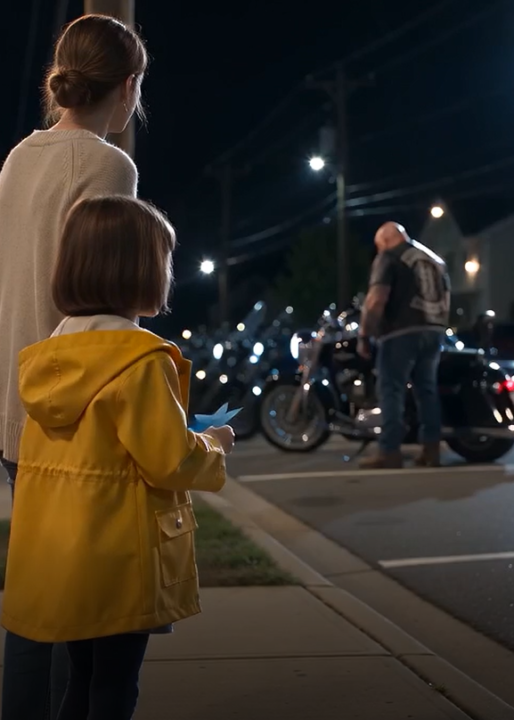
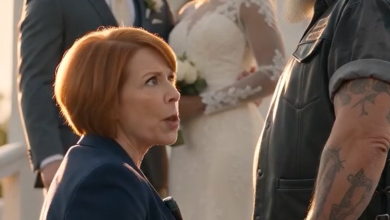
Carol Whitaker, the neighborhood association chair, pulled a folding barricade out of the empty volunteer bay and dragged it across the mouth of the staging lane. Its metal feet scraped the pavement. Hank “Latch” Cole, the lead rider, had just parked his black cruiser.
“Take your midnight show somewhere else,” Carol said. “People actually live here.”
A neighbor in slippers called, “Thank you,” from his porch. Another lifted his phone. Mia watched Nora take a small step toward their own front walk, as though she’d heard somebody say they’d both come outside at the wrong time.
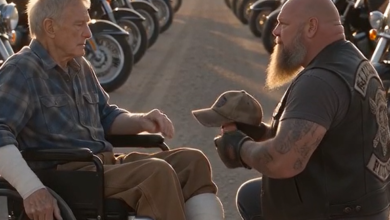
Hank turned the key and the V-twin went quiet. He was six foot four, close to 285 pounds, with a shaved head, a long gray beard, and ink over both forearms and across his knuckles. A wordless bridge patch covered the back of his short-sleeved black leather jacket. He set both boots on the ground and waited for Carol to finish.
“I’ve got a whole block expecting to sleep,” Carol told the neighbors. “He rolls up with forty bikes and expects me to let them through.”
Mia had spent enough nights listening to cars turn around under Nora’s window to understand why the neighbors were watching. Forty motorcycles sounded like a lot when somebody said it twice. For a second, Mia wondered whether she should take Nora back inside and ask Hank what he’d brought them here to see.
Instead, she watched him work off his right glove, easing each finger loose before laying it on the seat. He opened a saddlebag and took out a flat black pouch. There was a cable clipped to the frame below the gas tank. He reached past it and pressed a switch.
A blue star came on against the side of the parked bike. One of its points bent sharply inward. The man in slippers came down a porch step. Carol stopped with one hand on the barricade. A rider behind Hank had been pulling on his gloves. He quit halfway through the second one.
Hank had spent a few evenings at the hardware store helping Nora build a float small enough to fit in a shoebox. Mia had recognized his bike the instant it arrived. What she couldn’t work out was how something Nora had made at a workbench had ended up across the street on the side of that cruiser.
Nora took a creased paper star out of her coat pocket. She opened it carefully, pressing the center flat with both thumbs. One point still folded under. She held the paper in front of her, looked past it at the blue light and called across the street.
“Is that one mine?”
Part 2
Hank looked down at the blue light, then back at Nora.
“Had to bend the wire twice to get that corner right.”
Nora lowered the paper just enough for Mia to see her mouth open. She’d made a habit of holding things in front of her face when somebody across a room wanted an answer. Tonight there wasn’t anything big enough in her pocket to hide behind.
“You saw the broken one?” she asked.
“Figured you’d know that one anywhere.”
Carol looked between them. “You two know each other?”
“He keeps the little screwdriver under the counter for me,” Nora said.
That was as good an introduction as any. Hank repaired small engines in the back of Bell’s Hardware after the front doors closed. Mia worked the register two evenings a week. On nights when her sister couldn’t sit with Nora, Nora came in through the back after dark and did homework at a bench where the vise had a blue rag stuffed between its jaws. Hank had once let her take apart a broken pencil sharpener. She put it back together with the blade in backward, and he paid her a quarter because he said she’d found out why it didn’t work.
When Mia first mentioned the shop to Carol, Carol had asked whether she trusted a mechanic to watch a child. Mia told her Hank could recognize Nora’s footsteps on the ramp and had once stopped a drill in the middle of a job because they sounded wrong. Nora’s shoelace had caught under one shoe. Hank had sat on the floor and waited while she untied the knot herself.
Now he was waiting again. His glove lay on the seat and the blue light picked out the little cracks across its knuckles.
“Can we go over there?” Nora asked.
“Let’s stay here for a minute.”
Mia said it more sharply than she meant to. She could see the front tire of the lead bike, the barricade, the people stepping down from their porches. She’d spent years getting good at noticing where a person might step next. She wanted to know where everybody was supposed to be before she let go of her daughter’s hand.
A woman in a reflective volunteer vest came up from the corner with a clipboard. Mia recognized her as Denise Harper from the town events desk. Denise had called earlier to give her the time and ask whether they preferred the front sidewalk or the driveway. Mia had said the sidewalk. Nora liked the spot where one paving square tilted toward the road. She called it her hill.
“Carol,” Denise said, “that barricade goes at the far end.”
“It’s keeping them from pulling out.”
“We’re holding the street for one pass. I sent you the closure map.”
“You sent me a draft.”
Denise tucked her radio into her vest so she could turn a page. “You replied to the final one.”
Carol took her hand off the barricade. “I said I could help close the corner. I never agreed to a parade.”
Nora leaned against Mia’s arm. “Did she say parade?”
Mia looked at Hank. At the hardware store, he’d told her he was bringing friends to test a few lights. Denise had confirmed there would be one slow pass, with a volunteer at either end. Neither of them had used that word with Nora.
Now her daughter was holding a paper star she’d made for a shoebox float. Mia began to understand why Hank had been so careful about what he called the thing he was bringing.
Then Denise turned the clipboard so Carol could see the last page.
“Whose idea was it to move it back to sunrise?”
Part 3
Carol looked at the page without taking it.
“I suggested six in the morning,” she said. “Most people can handle something at six.”
Nora’s fingers tightened around the paper.
Mia had told Carol in August why an early start wouldn’t work. Carol had been handing out flyers for the neighborhood summer parade. Nora had asked whether it would go past their house this year, and Carol said it would go two streets over. Mia waited until Nora had gone inside before asking if the association ever did anything after dark.
“How late are we talking?” Carol asked.
“After sundown. We plan around the light.”
“She can wear a hat, can’t she?”
Mia had heard that question from people who meant well and from people who wanted the answer to end the conversation. She’d told Carol the same thing she told the school secretary. Nora had a rare skin condition. A few minutes in direct sunlight could hurt her badly. Her care team had given the family a plan, and for playing outside or going to see something on the street, their window was after dark.
“So she’s never been to one?” Carol asked.
“Never seen a parade in person.”
Carol looked down at the flyers. “That’s a shame.”
Mia had thought they understood each other. Now she wondered what Carol remembered from that exchange. She hoped the part she remembered was something more than a neighbor asking for a favor.
Denise tapped the page. “I sent you Mia’s answer about six.”
“I thought it might still be dark.”
“You got the answer.”
The man in slippers came down another step. He was Bill Howard, the neighbor who’d thanked Carol. Mia knew he got up at four on weekdays to open a bakery. On Fridays he went to bed early out of habit. He held his house keys in one hand, though Mia couldn’t see where he intended to go in slippers.
“I heard it was going to be an hour,” he said.
“About ten minutes with the street held,” Denise told him. “The ride past the houses takes less than that.”
“Forty bikes?”
“Forty bikes.”
Bill looked across at Nora. “You really never saw one?”
She shook her head. “I saw the end of one.”
Mia knew which end she meant. Last June, after dark, they’d walked to the route. There were crushed paper cups in the grass and a red strip of ribbon caught around a drain cover. Nora picked it up and asked where a person was supposed to stand when the floats went by. Mia had shown her the curb. Nora stood there a long time, looking both ways down a street full of parked cars.
“Was there music?” Bill asked her.
“Mom said there was.”
There was a pause. Mia could hear a television through the window behind him. It sounded as if somebody on the show was opening a door.
At the curb, Hank reached inside his jacket and brought out a second paper star. It was yellow and had an uneven pencil line around the edge. Nora’s eyes went straight to it.
“I put that in the trash,” she said.
“I know.”
“Why’d you take it out?”
Hank held it against his knee. “Because you told me what the yellow one was for.”
Mia looked down at her daughter. Nora usually told her about every part of anything she made. She hadn’t told her about the yellow star.
“Who was that one for, honey?”
Nora looked over Hank’s shoulder at all the dark motorcycles.
“I thought maybe there was another kid.”
Part 4
Mia bent to Nora’s height. “Another kid where?”
“On the street. Somebody who couldn’t see it.”
Hank held the yellow star by two points to keep it from folding. “Tell her where you put it on the float.”
Nora pointed above her own head. “Way up. So they could see it from their bedroom.”
Mia had seen the shoebox sitting on the hardware store workbench. She’d assumed the paper figures inside were people riding on a float. Nora explained now that they were people watching it. One had been taped to the side because there wasn’t enough room in the box to make a house. There was a boy on the front who wore pajamas. Mia remembered thinking Nora had forgotten to draw his pants.
“Why’d you throw the yellow one away?” Mia asked.
“It fell off two times. I didn’t want it to fall on the people.”
Hank slid the star into the top of the pouch. “That one took me a while to figure out.”
Behind him, a woman named Jo came forward from the second motorcycle. Mia recognized her from the hardware store. She’d bought so many packages of black cable clips that Mia asked whether she was organizing a garage. Jo had said she was getting there.
“We kept making them too big,” Jo said. “Your drawing had them down here.”
She gestured at the side of her saddlebag, below the seat. Her motorcycle was dark. In the spill from a porch light, Mia could see thin shapes fastened to its side. One looked like a crescent. Another looked like it had been cut by somebody who’d measured it with a cereal bowl.
“You have one, too?” Nora asked.
“Got a moon. I could use your opinion once it’s on.”
Jo walked back toward the curb. Mia expected her to touch a switch and show Nora the moon. Instead, she checked the gap between her motorcycle and the one behind it, then raised two fingers to the rider at the corner. That rider walked down to speak to Denise.
Hank had asked Mia earlier whether a small decorative light could be tested in the setting they’d agreed on. She’d checked the plan with Nora’s care team and discussed the setup with Denise. The display lights would stay low and steady, aimed away from the sidewalk. Nobody would use a flash on Nora. Mia had been grateful that Hank asked. It had never occurred to her how many people he’d have to tell, or how many times he’d have to say it to get forty people to do the same thing.
“Did you tell everybody about her?” she asked him quietly.
“Told them where the lights go and where the cameras don’t.”
That was when Mia looked over at the neighbor who’d been filming. The phone was pointed down now, but there were still two screens visible across the street. She hadn’t said yes to anybody recording Nora. She didn’t want her daughter to have to keep stepping back from things she wanted to do because a stranger had decided to film her doing them.
Denise’s radio buzzed. She listened a moment, then walked over to Hank. From where Mia stood, the street suddenly seemed very quiet.
“Somebody called dispatch,” Denise said. “They said the riders were circling the block with their engines running.”
Mia looked at the rows of parked motorcycles. Several riders had their helmets off. One had taken a book out of his saddlebag.
Hank nodded toward the corner.
“Ask the man with the camera what he sent.”
Part 5
The man with the phone was Danny Price, who lived on the corner and took his dog out late enough that Mia saw him most weeks. He looked up when Denise called to him. Then he looked past her at Carol.
“She asked me to film them coming in,” he said. “So we’d know how many there were.”
“I asked you to send me what you had,” Carol said.
“I did. I sent the whole thing.”
Denise asked him to show her. Danny came down to the sidewalk, keeping his screen tilted toward himself until he was next to her. Mia could see enough to recognize the front of her own house. In the video, the motorcycles rolled into the staging lane from the corner a few at a time. The riders parked and shut down. As soon as the last set was in place, Danny had panned back toward the empty corner. No bikes came around again.
“Who called dispatch?” Bill asked.
Carol folded her arms. “I did. I heard engines at both ends.”
“You called after you watched the video?” Denise asked.
“I watched the first bit.”
Danny slipped his phone into his pocket. “First bit was four bikes.”
Mia thought Carol might say something about being frightened. She’d have understood that better than any of the other things Carol had said. Instead, Carol looked at the porch where Danny had been standing and asked whether he’d already put the video online.
“No,” Danny said. “Do you want me to?”
“No. Please don’t.”
Mia knew she’d think about that exchange later. Carol had been ready to show people a clip of the riders arriving. Now that the whole video could answer the question, she wanted it put away.
Denise stepped aside to call in the correction. Nobody had circled. The lane was staged under the approved plan. They would hold until the officer at the far corner confirmed the crossing was clear. Then she asked Danny to keep his phone on the bikes if he wanted to film the pass. He nodded and took two steps down the sidewalk to find an angle that left Nora out.
Bill walked to the edge of his lawn. “You know, I figured the whole thing was going to be a bunch of guys running their engines for each other.”
Jo heard him from her motorcycle. “Most of us did enough of that getting up the hill by the quarry.”
“How fast are you going?”
“About as fast as you walk your trash can out.”
Bill went inside and came back with a folding chair. He put it on his own lawn, then asked Mia if Nora wanted it on their side. Nora declined. She wanted to see how tall the riders looked when she was standing.
Mia almost asked Hank whether it was worth going on after all this. She’d watched Nora talk herself out of staying at places when she felt like somebody had to make too much room for her. If Nora wanted to go home, Mia was ready to go with her.
“Do you still want to watch?” she asked.
Nora looked at the blue star, then down the block. “Can I stand where the paper people stood?”
“Where’s that?”
“Where they can see me wave.”
Denise heard her. She checked the far end of the street and raised her radio.
“Give me one minute,” she said. “Then I can show you the spot.”
Part 6
The spot was three paces to the right of where Mia had been standing. Denise moved a cone from the edge of the grass to make it easier for the volunteers to see where Nora would be. Nora put one foot on the tilted paving square and left the other on the flat one.
“This is higher,” she told Mia.
Mia tried it. “A little.”
“Enough.”
The corner officer confirmed the route was clear. Denise and another volunteer moved Carol’s barricade to the agreed place beyond the staging lane. Hank waited until Denise gave the signal before he turned his key. His engine came up to a low idle. Farther down, the other riders started theirs in small groups. Mia had braced herself for somebody to rev. She heard one motor catch roughly and settle. That was all.
Nora watched the blue star through the spokes of a mailbox post. Hank pulled forward, straightened the bike and came down the closed block at walking pace. When the cruiser reached their part of the sidewalk, he dipped his chin at her. Both his hands stayed on the bars.
Nora raised one hand shoulder-high.
The second bike had a violet crescent. Jo had mounted it lower than the star, near the outside edge of her saddlebag. Nora waved with both hands that time. The third had little green shapes that looked like leaves. After that Mia lost track of colors. She could have counted the bikes if she’d tried, but Nora was counting aloud, and every time somebody nodded back at her she forgot which number she’d said last.
“Was that nine?” she asked.
“Ten, I think.”
“Start me at ten.”
Mia started her at ten. By fifteen, the man in slippers had got out of his chair and was waving, too. A woman near the corner brought her blanket out onto the porch and tucked it around her knees. There were riders who looked younger than Mia and riders who took their time straightening their backs at the staging line. She had expected forty versions of the same motorcycle. She could see how much trouble they’d taken to make each one a little different.
One rider passed with only a small white circle glowing on the side. Nora waited until he was nearly past before she said, “That one’s a full moon.”
The man glanced over. “You got it.”
Then came a woman on a bike with a yellow star set above two smaller ones. Nora caught Mia’s wrist and squeezed it. The top star was high enough to see over the parked cars from a first-floor window.
“Who’s on that one?” Mia asked.
“Miss Jo said her sister helped,” Nora said. “Maybe that’s her.”
Mia couldn’t tell through the helmet. She waved anyway.
At midnight Nora stood under the moon on the sidewalk outside her house, waving at forty glowing motorcycles. Mia knew how many minutes of daylight they’d had to give up that summer. She’d kept track in appointments, canceled plans and the things she’d promised to find a way to do later. Watching Nora now, Mia stopped keeping track for a while.
When the final rider reached the corner, Nora lowered her arm. She looked across the street toward a house where one upstairs window was still lit.
A little hand waved from behind the glass.
“Mom,” Nora said, “can they see me from there?”
Part 7
Mia stepped back to check the angle. From Nora’s spot the maple tree hid part of the window. From one paving square over, you could see a lamp and a hand moving beside it.
“Try here.”
Nora took a step and waved. The hand behind the glass stopped, then waved again.
“That’s Avery,” Bill called from his chair. “She’s been sick this week. Her dad said she could stay up if she watched from bed.”
Nora kept waving until the last motorcycle turned off the block. Then she held up her paper star so high that Mia could see the sleeve of her coat sliding down her arm. There was no way Avery could make out the bent point from that distance. She must have seen something, though. She held up what looked like a stuffed rabbit by one ear.
Hank came back on foot a few minutes later. The riders had parked at the hardware store lot, where they could leave by the main road without coming through the neighborhood again. He carried the blue star in both hands. In daylight, Mia guessed, it would look like a bent piece of wire laid against a black frame. With the power off, it was light enough for Nora to hold against her chest.
“Why did you make forty?” she asked him.
“I made one. I asked Jo to help me put it on.”
“And then?”
“She asked who else was riding.”
“Who else was riding?”
“Far as I knew, nobody.”
Jo had asked the club if anybody wanted to make one trip past a house at midnight. Hank said he figured they’d get six riders, maybe eight if the weather held. The first ten offered within a day. After that Jo started making a list because she had to know how many bikes the staging lane could hold.
“Did you tell them it was a parade?” Nora asked.
“I told them you’d never seen one.”
“Was tonight one?”
Hank glanced at Mia. She could see that he wanted Nora to answer for herself. It was the same look he gave her when she had the last screw out of something and was deciding whether she wanted him to lift the cover.
Nora looked down the empty street. “I think it was.”
“Okay,” Hank said.
“Next time, could we have music?”
“Ask me before I buy anything.”
Nora laughed. Mia could feel it through the sleeve of her cardigan, where Nora’s shoulder was pressed against her arm.
Carol was walking up from the corner with Denise. She had the folded barricade in one hand and stopped to set it flat on the grass before she came any closer.
“Mia,” she said, “I owe you an apology.”
Mia glanced at Nora. “She was standing here when you said it.”
Carol looked down. She rubbed one thumb against the other. “I know. Nora, I said people actually live here. I said that while I was looking right past you.”
Nora said nothing. Mia was glad Carol waited.
“My brother works nights,” Carol went on. “I’ve been the person asking people to turn things down. I thought if I said what I was worried about, you’d all tell me it was only one night. So I tried to make the riders sound worse than they were.”
“Did you know it was for me?” Nora asked.
Carol looked at Mia and then back at Nora. “Yes.”
Mia thought of the sunrise proposal. She could see Nora working through the same thing, slowly and in her own order.
“Then why’d you pick a time I couldn’t come?”
Part 8
Carol sat on the edge of the low retaining wall. For the first time all night, Mia could look at her without having to look past a clipboard or a barricade.
“Because six worked for me,” Carol said. “When your mom told me it didn’t work for you, I should’ve listened. I’m sorry I made you stand out here wondering if you had to go home.”
Nora turned the blue star around in her hands. “I did almost go home.”
“I saw.”
Mia felt Carol look at her again. She had wanted an apology an hour ago. Now that it was happening, she was glad nobody asked Nora to say it was okay. Nora held on to the star and let Carol sit there until Denise asked where they should put the barricades for pickup.
At the next association meeting, Carol corrected the account she’d given the block and confirmed she’d called in a report based on the first few seconds of a video. The association put Denise and another volunteer in charge of coordinating with the town for the next event. Carol offered to help with notices and cleanup. Mia said she’d read a notice if Carol sent her one before it went out.
The first draft arrived a few weeks later. It had a proposed route, a time after dark and a space to request a viewing spot. At the bottom Carol had written a question about whether kids might want to help pick the shapes. Mia read it to Nora at the kitchen table.
“Can Avery make a rabbit?” Nora asked.
“You’d have to ask Avery.”
“I mean, would it look like a rabbit in the dark?”
“I’m pretty sure Hank would let you try.”
By then Mia had watched the video Danny took from the far end of the block. The camera showed the bikes and the people on their porches. It never swung over to Nora. For a few seconds you could hear her counting anyway. Mia recognized her own voice correcting ten and then getting eleven wrong. She played that part twice.
She’d looked at forty jackets on the curb and briefly pictured forty men who’d all come to make the same kind of noise. She remembered that every time she heard a motorcycle after midnight. She also remembered Hank standing still while Nora figured out whether to open her hand.
The blue star came home with them that first night. Hank clipped its power lead out of the way and set it on their kitchen table. Later, when Nora asked to hang it up, he came over with two hooks. He was still wearing the leather jacket. There was a mark on his sleeve where he’d leaned against something dusty at the shop.
“Here?” he asked, holding the star against the bedroom wall.
Nora studied it from her pillow. “Turn it a little.”
He turned it.
“Other way. I want the crooked bit where I can see it.”
Hank shifted his hand. Mia stayed at the door and watched Nora guide him another inch to the left. Across the street, Avery’s light was still on. Nora’s paper star lay on the windowsill, bent point and all.
If you’d like more stories like Nora and Hank’s, follow this page.
“Right there,” Nora said. “That’s mine.”