A Biker Dragged an Empty Chair Through an Entire Veterans Day Parade—The Crowd Mocked Him Until He Stopped Beneath a Hospital Window
The largest biker in our Veterans Day parade chained an empty folding chair behind his Harley and dragged it down Main Street while strangers laughed, shouted and filmed—but he never once looked back to defend himself.
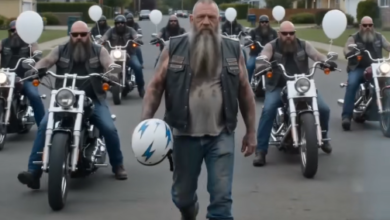
I was riding six feet behind Ray “Hammer” Dawson when the chair struck the first seam in the pavement.
Clang.
The sound cut through the low V-twin rumble of forty-three motorcycles moving at walking speed along Gurley Street in Prescott, Arizona. Children waved paper flags from the curb. Brass instruments echoed between the old brick storefronts. The November air carried exhaust, kettle corn and cold dust from the courthouse square.
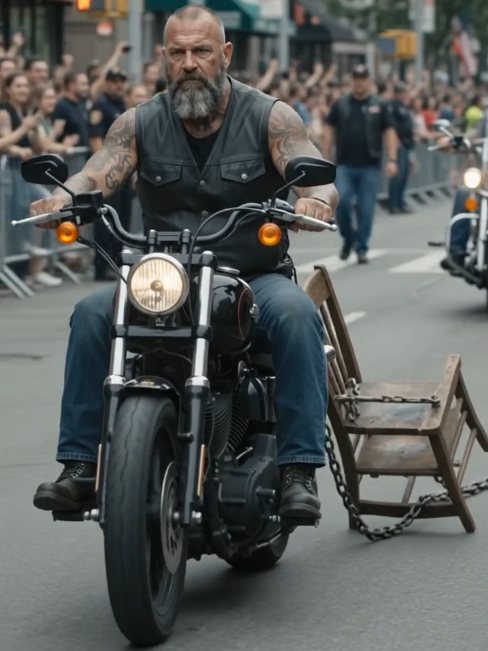
Then came that chair.
Clang. Scrape. Clang.
It was an old steel folding chair, the kind found in church basements and union halls, painted navy blue beneath years of scratches. A heavy chain ran from its rear brace to the crash bar of Hammer’s black Harley Road King. Two small wheels had been bolted beneath the back legs, but the front feet still scraped the pavement and threw tiny sparks whenever the road dipped.
People assumed it was a joke.
Hammer made it easy to assume the worst. He was fifty-six, six-foot-four and close to 285 pounds, with a shaved head, a thick black-and-gray beard and tattooed forearms filling the sleeves of a faded thermal shirt. His scarred knuckles rested on the bars. A plain black leather cut covered his back, and heavy boots hung beneath worn jeans.
Beside him, that empty chair looked like something taken from an interrogation room.
A teenage boy laughed and shouted, “Hey, big man, lose your passenger?”
Several adults raised phones.
One woman pulled her little girl farther from the curb when the chain rattled past. Another man yelled that Hammer was damaging the street. A local livestream host walked backward beside the parade, describing the chair as “some kind of biker stunt” while thousands of strangers posted guesses beneath his video.
Hammer heard them.
He kept riding.
I knew him well enough to notice what the crowd missed. His right hand was steady on the throttle, but his left thumb kept rubbing the smooth edge of a military identification tag tied near the clutch cable. Before we left the staging lot, he had measured the chain three times. He had also wiped the empty seat with the sleeve of his shirt, though nobody was going to sit in it.
At the corner of Montezuma, the parade marshal ordered him to cut the chair loose.
Hammer shook his head.
“You remove it,” the marshal warned, “or your whole club leaves the route.”
Behind us, forty-two Iron Vale Riders reduced their engines to idle. We had promised the city there would be no trouble. We had spent seven years rebuilding a reputation damaged by men who mistook intimidation for brotherhood.
Now our road captain appeared ready to throw all of that away over a battered chair.
“Ray,” I called, using the name almost nobody used anymore. “Tell him why.”
Hammer stared toward the five-story hospital three blocks ahead.
“Not mine to tell.”
The marshal reached for the chain.
Hammer killed his engine.
Every Harley behind him went silent.
The sudden absence of noise made the crowd lean closer. Boots touched pavement. Leather creaked. The chair settled crookedly in the street, its blue seat trembling from the last vibration.
Hammer stepped off his motorcycle and placed himself between the marshal and the chain.
He did not threaten him. He did not raise his voice.
“Nobody unhooks that chair before the fourth-floor window,” he said.
The livestream host moved closer. “What’s at the window?”
Hammer looked up at the hospital, then at the blue handprint painted beneath the chair.
“A man who was supposed to be riding beside me.”
The crowd quieted for perhaps two seconds.
Then someone laughed again.
What none of them knew was that the man above us could no longer move his arms or legs—and Hammer believed the chair, the chain and forty-three idling motorcycles might give him one reason to keep fighting until morning.
Part 2 — The Man Who Refused an Empty Place
My name is Boone Mercer. I was sixty-four that November and had spent nineteen years as president of the Iron Vale Riders before turning the position over to younger men with better knees and fewer grudges.
Hammer had served as our road captain for almost eleven years. He planned fuel stops down to the mile, carried extra insulin for two diabetic Riders and remembered which prospects had children waiting at home. Strangers saw his size first. Most never stayed long enough to see the sewing kit beside the tire gauge in his saddlebag or the reading glasses he wore while checking charity receipts.
The chair belonged to Calvin “Cal” Rourke.
Cal was sixty-one, a retired Army mechanic and the only man I knew who could insult Hammer without making the room tense. He was lean where Hammer was broad, silver-haired where Hammer was bald, and he rode an old burgundy Electra Glide that leaked enough oil to leave directions home.
They had met twenty-eight years earlier beside Interstate 40.
Hammer’s first Harley had thrown a drive belt outside Seligman, and Cal stopped in freezing rain to help a stranger wearing county-jail release boots.
Hammer had been out for nine days.
He had served thirty-two months for aggravated assault after breaking a man’s jaw during a bar fight. He did not hide it or decorate it with excuses. He had been drunk, angry and convinced fear was the same thing as respect.
Cal recognized the boots because he had worn a pair like them fourteen years earlier.
He fixed Hammer’s motorcycle, bought him coffee and never asked what he had done until they reached Flagstaff. Then he listened without interrupting and said, “You’ve already paid the county. Now decide whether everyone else has to keep paying for who you were.”
Hammer hated him immediately.
They became brothers before spring.
Cal found work at a repair shop. Hammer rented the room above it. During those early years, they lived on gas-station coffee, canned chili and whatever jobs other mechanics refused. They pulled abandoned cars from desert washes, rebuilt generators for elderly ranchers and recovered motorcycles after crashes when families could not afford a towing company.
Neither man called it charity.
Cal called it keeping busy.
Hammer called it Tuesday.
The blue folding chair appeared years later at our clubhouse. Cal found it behind a shuttered American Legion hall, carried it home across the back of his motorcycle and painted it with leftover navy enamel.
He sat in it during every meeting despite three couches and a row of padded barstools.
He claimed soft furniture made men confess things they did not mean.
When Hammer’s seventeen-year-old son, Benjamin, died after a pickup crossed the center line near Chino Valley, Cal placed that chair beside Hammer’s garage door and sat there each evening for thirty-one days. He brought no speeches. Most nights, he said nothing at all.
Hammer repaired motorcycles while Cal watched.
Sometimes grief needs a witness more than an answer.
On the eighth night, Hammer threw a wrench through the garage window.
Cal retrieved it from the gravel, set it on the workbench and returned to the chair.
On the seventeenth night, Hammer asked whether Cal believed people could be punished through their children.
Cal said no.
Hammer told him to leave.
Cal stayed.
On the thirty-first evening, Hammer placed a second cup of coffee on the floor beside the chair. Cal drank it without mentioning that it was the first invitation Hammer had given him since the funeral.
The small blue handprint beneath the seat came from Cal’s granddaughter, Avery. She had been four when she dipped her palm into wet paint despite Cal warning her not to touch anything.
He pretended to be angry.
Then he covered the mark with clear varnish after she left.
That handprint was why Hammer refused to repaint the chair before the parade.
Six weeks earlier, Cal had been injured on Route 89A near the switchbacks above Jerome. The first account said a distracted driver crossed the center line and struck his motorcycle. The second claimed Cal had entered the turn too fast.
Neither account was complete.
Cal survived twelve hours of surgery at Yavapai Regional Medical Center. A fractured cervical vertebra damaged his spinal cord. He could breathe without a ventilator for short periods, turn his head a few degrees and move two fingers on his left hand when swelling permitted.
The doctors never used the word hopeless.
They used words that sounded cleaner and hurt worse: incomplete injury, uncertain recovery, respiratory compromise, limited neurological response.
Hammer visited every evening.
Cal refused to see him.
At first, we blamed medication. Then Cal asked nurses to remove Hammer’s name from the visitor list. He accepted me, Mack, two veterans from his old unit and even Dale, a prospect he had called “Dipstick” for three years.
But not Hammer.
Hammer never argued with the nurses. He sat in the waiting area downstairs, drank bad coffee and left shortly before midnight. Sometimes he carried Cal’s old riding gloves. Other nights, he brought a motorcycle part that did not need fixing and polished it until visiting hours ended.
The day before the parade, I found him alone in the clubhouse, kneeling beside Cal’s chair with a drill. Two rubber wheels lay on the floor. A length of chain ran across the concrete, each link wrapped at intervals in black tape to keep it from whipping sideways.
“You planning to steal a dining set?” I asked.
Hammer continued tightening a bolt.
“He can see Gurley from Room 417.”
I knew the hospital faced part of the parade route, but our approved path turned east one block before the building.
“The parade doesn’t pass his window.”
“It will.”
That was when he showed me the revised route request.
The city had denied it twice. The hospital worried that motorcycle noise might disturb patients. Police objected to closing the intersection near the emergency entrance. The parade committee said changing the route for one spectator would create delays.
Hammer had submitted a third request under Cal’s name.
It included forty-seven signatures from hospital patients, a letter from the nurses’ union and a traffic plan drawn by a retired state trooper in our club. The city approved a four-minute detour at 6:12 that morning.
Hammer had told none of us.
“Why the chair?” I asked.
He held up Cal’s identification tag but did not answer.
On its back, beneath the stamped numbers, someone had scratched four words by hand.
DON’T LEAVE MY PLACE EMPTY.
Part 3 — The Block Where the Parade Nearly Ended
The parade marshal’s name was Everett Sloan. He was not a cruel man. He was a forty-eight-year-old city employee trying to move floats, horses, marching bands and thousands of spectators through downtown without sending anyone to the emergency room.
He had approved the hospital detour.
He had not approved the chair.
From his position near the reviewing stand, it looked as though Hammer had chained a piece of furniture directly to a motorcycle. He could not see the hidden wheels, the reinforced braces or the secondary safety cable Hammer had run beneath the frame.
All he saw was steel scraping pavement beside children.
His order was reasonable.
Hammer’s refusal was not.
At least, not from where Everett stood.
The two men faced each other in the street while forty-two motorcycles waited behind them. The high school marching band stopped half a block back. A line of veterans in restored military vehicles idled beyond the band, their engines coughing blue smoke into the cold air.
Spectators began shouting competing advice.
“Cut it loose!”
“Let him ride!”
“What’s wrong with that guy?”
The livestream host moved between Hammer and Everett until Mack guided him aside with one open hand. Nobody struck anyone. Yet phones captured angles that made every movement appear more threatening.
One clip showed Hammer towering over Everett.
Another showed Mack’s tattooed hand near the livestreamer’s chest.
Neither showed Everett trying to examine the safety cable or Mack preventing the man from backing into a moving motorcycle.
The truth had already become less interesting than the appearance of a fight.
Then a woman in a camel-colored coat pushed through the crowd.
She was forty-one, with dark hair tied severely behind her head and a hospital visitor badge still clipped to her collar. Her name was Rebecca Rourke.
Cal’s daughter.
She walked straight to the chair and stared at the blue handprint under the seat. Her expression changed so quickly that I thought she might collapse.
Instead, she turned toward Hammer and slapped him.
The crack carried across the silent motorcycles.
Hammer did not move.
“You don’t get to use him for this,” Rebecca said.
Several spectators gasped. The livestream host lifted his phone higher.
Hammer’s cheek reddened above his beard. “Not using him.”
“You bring his chair out here like he’s dead? You drag it behind your bike while strangers laugh? Is this your idea of honoring him?”
“No.”
“Then what is it?”
Hammer looked toward the hospital.
Rebecca stepped between him and the building. “He doesn’t want to see you.”
“I know.”
“He told the nurses.”
“I know.”
“He wakes up terrified because he can’t feel his hands. He thinks he’ll never hold his granddaughter again, and every time you appear downstairs, his heart rate spikes.”
Hammer absorbed each word without defending himself.
Rebecca grabbed the chain near the chair.
That was when he stopped her.
His scarred hand closed over the link, not her wrist. The chain went taut between them.
“Let go,” she said.
“Can’t.”
“You can. You just never do.”
That sentence struck something the rest of us could not yet see. Hammer released the link immediately and lowered his hand.
Rebecca pulled at the quick-release pin. It would not move because Hammer had secured it with a small brass padlock.
She looked at him in disbelief.
“You locked it?”
“He has the key.”
“My father is four floors up.”
“Yeah.”
The crowd grew louder. Everett told Hammer he had thirty seconds to remove the chair or leave the parade. Police officers approached from the intersection, not aggressively but with purpose.
Behind me, our engines remained silent.
This was the brotherhood test, though it did not look like one. Nobody needed us to fight. We had to decide whether standing with Hammer meant helping him keep a promise or helping him violate Cal’s wishes.
Mack spoke first.
“If Cal said no, we turn around.”
Hammer looked back at him. “He didn’t say no to this.”
“You haven’t talked to him in six weeks.”
“He wrote it.”
“When?”
Hammer touched the identification tag near his handlebar.
Rebecca saw it.
Her anger faltered for the first time. She stepped closer, lifted the tag and read the words scratched into the metal. I watched her thumb move across them.
“That isn’t his handwriting,” she said.
Hammer’s jaw tightened.
“It is.”
“No. Dad prints his E backward when his hands shake. Always has. These letters are straight.”
Several Riders looked at one another.
The promise anchoring Hammer’s entire plan might have been false.
Everett began counting down.
“Twenty seconds.”
Rebecca held out the tag. “Where did you get this?”
“His riding jacket.”
“Who gave it to you?”
Hammer did not answer.
“Ten seconds,” Everett called.
The police reached the chair. Mack dismounted behind me. Then another Rider. Boots touched asphalt in a slow wave extending down the street, but nobody advanced toward the officers.
I climbed off my bike last.
My knees protested when my boots met the pavement. I looked down our line and saw men who had followed Hammer through hailstorms, flash floods and two funeral processions. Every one of them wanted to stand beside him.
None of us knew whether we should.
Hammer looked at the hospital.
Room 417’s window reflected the white morning sky. I saw no face behind it, no curtain moving, no proof that Cal was even watching.
Everett reached one.
Hammer climbed onto his Harley.
For one hopeful second, I thought he would pull out of the parade and end the confrontation.
Instead, he started the engine.
The Road King rolled forward. The chain snapped tight, and the empty chair lurched behind it. One of the small wheels struck a storm-drain grate, twisted sideways and broke from its bracket.
The chair tipped.
Its front leg dug into the pavement. Sparks jumped. The blue seat flipped once and slammed onto its side beneath the staring crowd.
Rebecca screamed.
Hammer stopped so hard the motorcycle leaned beneath him.
The chair lay twisted in the street, the painted handprint facing upward like a child reaching from the ground.
That looked like the end of the promise.
It was only the moment we discovered who had written it.
Part 4 — The Message Cal Could Not Write
Rebecca knelt beside the fallen chair before Hammer could dismount. She ran her fingers over the blue handprint, checked the bent brace and turned the broken wheel in her palm.
“You ruined it,” she said.
Hammer came off the Harley slowly.
“I’ll fix it.”
“You fix everything after you break it.”
He flinched.
Not visibly enough for the cameras.
Enough for me.
A nurse in blue scrubs came running from the hospital entrance. She was a compact Navajo woman named Tessa Begay, one of the respiratory nurses assigned to Cal’s floor.
I recognized her from my visits.
She was also the person who had given Hammer the identification tag.
Tessa reached Rebecca, bent over to catch her breath and said, “Your father is asking why they stopped.”
Rebecca stood. “He’s awake?”
“He’s at the window.”
All of us looked up.
The curtain in Room 417 had been pulled aside. At first, I saw only glare. Then the outline of a hospital bed appeared, angled toward the glass.
A man’s head rested against white pillows, almost too small to identify from the street.
Cal.
Tessa took a tablet from beneath her arm. On the screen was a communication grid containing large letters, common words and colored blocks. Cal used it by fixing his gaze on a square until the camera registered the selection.
“He asked for the chair,” Tessa said.
Rebecca pointed at the tag. “Did you write this?”
“No.”
“Then who did?”
Tessa looked at Hammer.
He removed his riding gloves. The November cold had whitened the scars across his fingers.
“I did.”
The admission traveled through the crowd more effectively than a confession shouted through speakers.
Rebecca’s face hardened. “You forged a message from my father?”
“No.”
“You wrote words on his tag.”
“He chose them.”
“How?”
Hammer glanced at Tessa because the full explanation belonged to her.
Three weeks after the accident, Cal could communicate only through eye movements. One blink meant yes. Two meant no. Looking right meant continue. Looking left meant stop.
Tessa began reading him letters after night rounds because he became agitated whenever staff mentioned the Veterans Day parade.
It took them forty minutes to build the first sentence.
MY CHAIR RIDES.
Tessa assumed he wanted the blue chair brought to his room.
Cal blinked twice.
She tried again.
CLUB PARADE?
One blink.
She called Hammer despite the visitor restriction. Hammer stood outside the ICU while she returned to Cal and worked through the alphabet.
CHAIN IT TO RAY.
Tessa refused. It sounded unsafe and humiliating, and she worried medication had confused him. Cal’s pulse climbed until she promised to ask more questions.
Over two nights, he chose the entire message.
Don’t leave my place empty.
Tessa asked Hammer to scratch the words into the tag because Cal could not hold a pen. Hammer did exactly that. He did not copy Cal’s handwriting or pretend the metal had been marked before the crash.
He simply gave Cal’s chosen words a surface.
Rebecca stared at the tag.
“Why didn’t anyone tell me?”
Tessa lowered her voice. “Your father asked us not to.”
“He can barely communicate.”
“He communicated this.”
Rebecca looked at Hammer. “And you agreed?”
“Yeah.”
“Why?”
“Because he asked.”
That answer made her angrier. “He asked you not to visit, too. You ignored that every night.”
“I stayed downstairs.”
“He knew you were there.”
“Yeah.”
“Then why keep coming?”
Hammer glanced up at the fourth-floor window.
“In case he changed his mind.”
The livestream host had stopped talking. Even Everett appeared uncertain what rule applied to an empty chair requested by a patient who could not come downstairs.
But Rebecca had not finished.
“You’re making him sound brave,” she said. “You don’t know what he says after therapy. You don’t watch him panic when someone turns off the suction machine. You aren’t there when Avery asks whether Grandpa’s hands will work by Christmas.”
“No.”
“You just get to drag his chair through town and call it loyalty.”
Hammer’s voice became rougher. “Never called it anything.”
“Then tell them what happened.”
Silence returned.
I knew there were missing details in the accident report. I did not know Rebecca believed Hammer was responsible.
She pointed toward the motorcycle.
“Tell your brothers why Dad was on Route 89A that night. Tell them whose bike he was chasing.”
Every Rider looked at Hammer.
He did not deny it.
Six weeks earlier, Hammer had ridden away from the clubhouse after an argument with Cal. Our charity fund was missing $18,400. Cal, the club treasurer, had signed the withdrawal slip.
Hammer accused him of taking it.
Cal swore the money had gone where the club authorized, but he refused to identify the recipient. Hammer called him a thief in front of twenty-six brothers and removed his treasurer patch.
Cal left.
Hammer followed.
They rode toward Jerome in freezing rain, taking the narrow mountain curves too fast. A pickup crossed the line near Mile Marker 346. Hammer had space to escape onto the shoulder.
Cal did not.
That was the official story.
It was not the truth.
Cal saw the pickup first. He accelerated beside Hammer and struck Hammer’s saddlebag with his front wheel, forcing the Road King toward the shoulder.
Cal took the impact meant for him.
Hammer walked away.
Cal lost the use of his body.
The chair was not merely an empty place in the parade.
It was being pulled by the man who believed he should have been sitting in it.
Part 5 — What the Missing Money Had Purchased
The broken wheel delayed the parade for eleven minutes.
Those minutes changed everything.
Two Riders carried the chair to the curb. Hammer opened his saddlebag and removed a compact tool roll, a replacement caster and a short steel bracket already drilled to match the frame.
He had expected something to break.
That detail silenced another accusation before anyone voiced it. What looked like recklessness had been planned with the nervous precision of a man who could not afford to fail his friend twice.
Hammer knelt in the street.
His large fingers trembled as he worked the damaged bolt loose. It was the first time I had seen his hands shake since Benjamin’s funeral. He dropped a washer, found it near the gutter and wiped the grit away with his thumb.
Rebecca watched from three feet away.
“You knew he might save you,” she said.
Hammer fitted the new bracket. “No.”
“You rode too fast.”
“Yeah.”
“You chased him.”
“Yeah.”
“You accused him in front of everyone.”
Hammer turned the wrench once more. “Yeah.”
She wanted resistance. Anger can lean against resistance. Hammer gave her none, and for several seconds she seemed to have nowhere to place the weight.
“What happened to the money?” I asked.
Rebecca closed her eyes.
She knew.
Cal had withdrawn $18,400 to purchase a wheelchair-accessible van for Rebecca’s daughter Avery, who had spinal muscular atrophy. Insurance approved a power chair but denied the vehicle conversion that would allow Rebecca to transport it.
Cal did not want the club to know.
Part of the money came from a private emergency fund the Riders had voted to let him administer. The remainder came from selling his late wife’s jewelry and the 1968 Triumph he had restored over sixteen winters.
He listed the full amount on one withdrawal because the dealership required a single cashier’s check. Before he could enter the recipient details in the ledger, Hammer saw the transaction.
Cal refused to name Rebecca because she had spent years distancing herself from the club.
Her mother—Cal’s wife, Linda—had died when Rebecca was twenty. Afterward, Cal lived at the clubhouse more often than at home. He attended charity rides, funerals and roadside rescues while missing Rebecca’s graduation from nursing school and the birth of her daughter.
Rebecca did not want the Riders turning Avery’s medical needs into another public fundraiser.
Cal honored that.
Even while Hammer called him a thief.
I asked Hammer why he had not waited for an explanation.
He held up the bent bracket, studying it as though an answer might be stamped into the steel.
“Because the number matched.”
“Matched what?”
“Ben’s money.”
After Benjamin died, Hammer placed $18,400 from the insurance settlement into the club emergency fund. He told us it was for stranded families, injured Riders and children caught between systems.
He never attached his son’s name because he could not bear to hear it announced at fundraising dinners.
When he saw the exact amount disappear, he believed Cal had stolen the last useful thing Benjamin left behind.
Cal knew that.
He also knew Hammer would demand the money back if he discovered it had gone to Avery. Cal was too proud to accept charity for his granddaughter and too stubborn to let Hammer reverse the purchase.
So he remained silent.
Two grieving men mistook silence for betrayal.
The van had been delivered while Cal lay in intensive care. It was parked in Rebecca’s driveway, the title placed solely in her name.
Inside its glove compartment, she found a note her father had written before the crash.
It contained only seven words.
LET HER GO PLACES WITHOUT ASKING PERMISSION.
Rebecca removed a photograph from her coat pocket and showed it to Hammer. Avery sat inside the van in her power chair, one hand on the lift control, smiling so hard her eyes had nearly closed.
Hammer stared at the picture.
“Money went where it was supposed to,” Cal had told him before riding away.
He had been telling the truth.
The exact amount was not a coincidence, Rebecca explained. Cal had chosen it deliberately. He knew the history of Benjamin’s money and wanted the club’s emergency fund to serve the kind of child Hammer had created it to help.
He had planned to replace every dollar himself after selling the Triumph.
The motorcycle sold for less than expected.
Cal used Linda’s jewelry to cover the difference.
Hammer’s eyes moved from Avery’s photograph to the hospital window. His mouth opened, but nothing came out.
Rebecca softened only slightly.
“He didn’t tell you because he knew what you’d do.”
“What?”
“You’d say it was Ben’s gift. Dad would say it was a loan. You’d fight until one of you broke something.”
Hammer glanced at the chair.
“Guess we got there anyway.”
Tessa’s tablet chimed. She looked at the screen and laughed once through her nose.
“What?” Rebecca asked.
“Your father wants to know why Hammer is still kneeling.”
Tessa entered a reply, then waited while Cal selected another sequence from the fourth-floor room.
The tablet displayed four words.
HE ALWAYS WAS SLOW.
A sound moved through our line of Riders.
Not laughter exactly.
Something more fragile.
Hammer closed his eyes. For the first time since the chair fell, the corner of his mouth lifted beneath his beard.
He replaced the wheel, tested the safety cable and set the chair upright. Rebecca crouched to inspect the repair. Then she pressed her palm over Avery’s painted handprint.
“Will it make it to the window?” she asked.
Hammer nodded. “If he still wants it.”
Tessa checked the tablet.
Cal’s answer appeared.
MAKE HIM PULL HARDER.
The parade restarted.
This time, nobody laughed when the chain tightened.
Part 6 — Four Minutes Beneath Room 417
Everett Sloan walked ahead of Hammer’s Harley as we approached the hospital. He had stopped trying to remove the chair and now cleared the route himself.
The crowd changed before we reached the intersection.
Word traveled faster than our motorcycles.
People lowered their phones. Veterans removed their caps. Parents lifted children onto their shoulders, not to see the strange biker dragging furniture, but to find the fourth-floor window.
Hammer rode at three miles an hour.
Clang.
Scrape.
Clang.
The repaired wheel held. The chain stayed straight. Sunlight caught the worn blue paint and the small handprint sealed beneath the seat.
When the hospital came fully into view, forty-three Harleys spread into two lines facing the building. We stopped beneath Room 417.
Hammer parked in the center.
He killed his engine.
One by one, the rest of us did the same. The final exhaust note rolled between the buildings and faded until I could hear a flag snapping above the courthouse three blocks away.
Tessa opened the hospital window a few inches.
Cold air entered Cal’s room. From the street, we could see him angled toward the glass, Rebecca now beside his bed and Avery positioned in her power chair near the window.
The child raised both arms.
Hammer unhooked the chain from his motorcycle but left the padlock closed. Then he placed the chair directly in front of the Harley, facing the hospital.
He removed Cal’s identification tag from the clutch cable and held it over his heart.
Nobody gave a speech.
That mattered.
Cal had spent most of his adult life avoiding microphones. Turning his pain into a public performance would have betrayed the very thing we came to honor.
Mack began the engines again, but only at idle.
Forty-two V-twins followed.
The sound was low and steady, less like thunder than a pulse traveling through the pavement. Hospital staff appeared behind other windows. Patients lifted hands. A man with an oxygen tube pressed his forehead to the glass.
Hammer watched only Room 417.
Tessa later told us that Cal’s heart rate rose when the engines started, then settled into the most stable rhythm she had seen all morning.
His left index finger moved against the blanket.
Once.
Then again.
Avery noticed first. She leaned toward him, shouting something we could not hear through the glass. Rebecca covered her mouth.
Cal’s finger moved a third time.
It was not recovery. No doctor claimed it was. A finger was still only a finger against a long and uncertain road.
But it was movement he had lost two days earlier.
Hammer saw Rebecca nod from the window.
He put one hand on the empty chair.
Cal fixed his gaze on the tablet. Tessa turned its screen toward the street, though the words were too small for us to read.
Rebecca called Hammer later and told him what Cal had selected.
PLACE HELD. KEEP RIDING.
After four minutes, Everett raised one hand.
The parade had to move.
Hammer chained the chair behind his Harley again. Before starting the engine, he looked toward Cal and touched two fingers to the identification tag.
In the window, Cal turned his head the smallest distance to the right.
Continue.
Hammer rode.
The chair followed.
For the remaining five blocks, the crowd made room for the sound of the chain. Nobody shouted jokes. Nobody accused Hammer of damaging the ceremony.
The livestream host still recorded, but he stopped narrating.
At the final turn, an eight-year-old boy slipped beneath the barricade and held out a small paper flag. His father rushed after him, apologizing.
Hammer stopped.
The boy pointed at the chair.
“Is somebody invisible sitting there?”
Hammer looked toward the hospital behind us.
“No.”
“Then why’s it empty?”
Hammer took the flag and threaded its wooden stick through the chain.
“It ain’t empty.”
He started the Harley again.
The small flag trembled behind him all the way to the end of the route.
Part 7 — The Day Cal Took His Place Back
Cal remained in the hospital for another nine weeks. He transferred to a spinal rehabilitation center in Phoenix, where progress arrived in measurements too small for impatient men: an extra minute breathing without assistance, half an inch of wrist movement, enough strength in one finger to select letters more quickly.
Hammer visited every Thursday.
He waited outside until Cal permitted him to enter.
The first permission came seventeen days after the parade. Hammer rolled the blue chair into the therapy room, placed it beside Cal’s power wheelchair and sat on the floor.
“You stole my seat,” Cal said through a speech device.
Hammer shook his head. “Pulled it.”
“Badly.”
“Wheel broke.”
“I saw.”
That was their apology.
Hammer never asked Cal to forgive him. Cal never said the accident was not his fault. They had known each other too long to hide behind easy words.
Instead, Hammer drove Rebecca and Avery to Phoenix every Sunday. He learned how to secure Avery’s power chair inside the van Cal had purchased. He built portable ramps for Rebecca’s porch and repaired a loose rattle in the lift.
Cal watched him through video calls.
Whenever Hammer completed something, Cal’s speech device said the same sentence.
“Needs more work.”
Hammer always answered, “Yeah.”
By spring, Cal could control his power wheelchair with a small joystick positioned beneath the side of his hand. He still needed help breathing at night and could not open his left fingers fully, but he could move through a doorway without anyone pushing him.
The first doorway he chose belonged to the Iron Vale clubhouse.
We removed the threshold and widened the entrance before he arrived. Hammer wanted to replace every table and lower the bar.
Cal refused.
“Clubhouse,” his device said, “not nursing home.”
We compromised on one table.
The blue folding chair stood at Cal’s old place during his first meeting back. Nobody sat in it. Halfway through the evening, he steered his wheelchair beside it and told Hammer to remove the chair.
Hammer carried it toward the storage room.
Cal stopped him.
“Not hidden.”
Hammer placed it against the wall where everyone could see the blue handprint.
The following Veterans Day, the city placed the hospital block on the official parade route. Nobody requested it. Everett simply included the turn on the map.
Cal attended from street level.
His power wheelchair stood beside the blue folding chair, now mounted securely on a narrow two-wheel platform Hammer had built in his garage. Avery’s handprint remained beneath the seat.
A second handprint had been added beside it—Cal’s left palm, imperfect and blurred because his fingers could not fully open.
Hammer offered him the key to the chain.
Cal could not grip it, so Avery closed his hand around the brass with both of hers. Together, they opened the lock.
The chair did not ride empty that year.
Avery sat in it wearing ear protection and a denim jacket three sizes too large. Cal rolled beside her in his wheelchair while Hammer walked his Harley at their pace, one hand on the handlebar and the other resting near Cal’s shoulder without touching unless asked.
I rode behind them.
At the place where the crowd had once laughed, the livestream host lowered his phone and removed his cap. Rebecca stood beside the curb. Everett directed traffic near the hospital turn.
Hammer never looked toward the cameras.
When the parade ended, Cal used his speech device to call him closer.
“Next year,” the machine said, “you sit in chair.”
Hammer studied the narrow folding seat.
“Won’t hold me.”
Cal’s electronic voice answered after a pause.
“Then lose weight.”
The old chair rocked beneath Avery’s laughter. Cal’s hand rested over the two painted prints while the engines started around him, low and steady in the Arizona cold.
This time, no place was empty.
Follow our page for more unforgettable biker stories about misunderstood Riders, tested brotherhood and the quiet promises carried mile after mile.