A Biker Carried a Wooden Cross Into a Cemetery at Midnight After Twelve Years of Searching — Then Police Learned Who Was Buried Beneath Plot 214
At 12:43 a.m., I watched a tattooed biker carry a six-foot wooden cross between the graves while three police cruisers raced toward our cemetery and half the town decided he had come to disturb the dead.
My name is Thomas Avery. I was sixty-seven then, and I had been the night caretaker at Oak Hollow Cemetery outside Joplin, Missouri, long enough to recognize every ordinary sound after dark—the irrigation pipes knocking beneath the grass, deer brushing cedar branches, loose flag clips tapping against aluminum poles.
That sound was different.
Wood scraped stone.
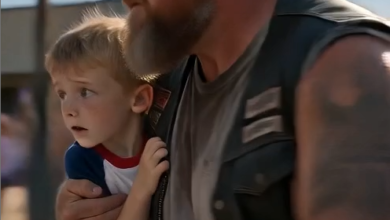
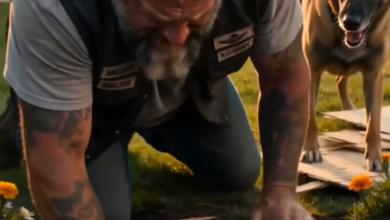
When I stepped from the maintenance shed, I saw a broad shadow moving beyond the veterans’ section. The man was at least six-foot-four, close to 280 pounds, with a shaved head, a gray-streaked beard and tattooed forearms exposed beneath a plain black leather vest. Heavy boots crushed the frost. A silver chain swung from his jeans.
Across his right shoulder rested a rough wooden cross.
Behind the locked gate, five Harley-Davidsons stood along County Road 17, their engines ticking as they cooled. Four other bikers waited beside them, but none crossed the fence. They looked less like accomplices than men who had been ordered to stay behind.
The stranger kept walking alone.
I recognized him. His road name was Graves, which sounded like the sort of name a man invented to frighten people in bars. His real name was Gideon Mercer. He repaired truck transmissions on West Seventh Street and rode a black Harley-Davidson Road King that made the windows in my office tremble whenever he arrived.
For six weeks, Gideon had been asking me about Plot 214.
There was nothing remarkable about it. No headstone. No flowers. No flag. Only a rusted county stake in the oldest section of the cemetery, where indigent people and unidentified bodies had been buried decades earlier.
Our ledger listed the person beneath it as:
UNKNOWN MALE. APPROXIMATELY 60. NO KNOWN FAMILY.
The burial date was October 19, 2001.
Nobody had visited since.
At least, that was what I believed.
That night, Mrs. Halpern saw Gideon climb the side fence with the cross and called the sheriff. By the time I reached him, he had laid the cross beside Plot 214 and driven a shovel into the frozen ground.
“Gideon,” I called. “Step away from that grave.”
He looked over his shoulder.
There was mud on his beard. One knuckle was bleeding. His leather creaked as he straightened, but he kept both hands around the shovel.
“I’m not touching the grave,” he said.
“You’re digging on cemetery property after midnight.”
“Six inches. That’s all I need.”
Red and blue light began flickering through the cedar trees. Gideon’s brothers shouted from the gate, but he never looked toward them. He pushed the shovel down again.
Deputy Lena Brooks arrived first. She was thirty-one, five-foot-five and brave enough not to show what Gideon’s size did to her breathing. She came through the open maintenance entrance with one hand near her holster.
“Drop the shovel.”
Gideon obeyed.
“Back away from the marker.”
He did not.
Deputy Brooks repeated the order. Two officers spread out behind her while Mrs. Halpern and several neighbors filmed from the road. In their phone screens, Gideon looked like exactly what they expected—a huge tattooed man standing over an unmarked grave with a shovel and a cross.
Then he bent down and pulled the rusted county stake from the earth.
Mrs. Halpern screamed.
One deputy seized Gideon’s arm. Another kicked the shovel away. Gideon could have resisted all three men. Instead, he opened his hand and let them force him onto his knees.
“Look under the stake,” he said.
Nobody moved.
“Before you arrest me, turn it over.”
Deputy Brooks picked up the metal marker. Its face displayed the number 214, but something had been scratched into the underside with the point of a nail.
Three letters.
MAC.
Gideon reached inside his vest. Every officer stiffened, but what he removed was only a yellowed photograph folded inside a plastic sandwich bag.
It showed a thinner Gideon at twenty-seven, lying beside a wrecked motorcycle in a drainage ditch. A gray-haired man knelt over him, pressing both hands against his chest.
Around that man’s neck hung a pair of military dog tags.
On his left forearm was the same broken-arrow tattoo described in the coroner’s file for the unknown man buried beneath Plot 214.
Gideon looked at the empty grave, then at the cross he had carried through the dark.
“You buried a soldier here,” he said. “And for twenty-five years, nobody has called him by his name.”
We thought the photograph explained everything.
It did not.
Because the name carved into Gideon’s cross was not in any cemetery ledger, and the words beneath it belonged to a promise made beside a burning motorcycle twelve years before the anonymous burial.
Part 2 — The Man Who Kept Asking About Plot 214
Gideon Mercer first came to Oak Hollow on a hot Tuesday in August. His Road King rolled through the gate at idle, its V-twin pulse moving across the stones like distant thunder, then went silent beside the caretaker’s office.
He removed his gloves before entering. Men who intended trouble rarely did that.
“Plot 214,” he said. “I need everything you have.”
I asked for a family name.
“Don’t have one.”
“Date of death?”
“October 2001. Maybe the eighteenth. Maybe the nineteenth.”
I opened the digital index, found the entry and turned my monitor toward him. Unknown male. County burial. No next of kin. He stared at those words until the leather around his shoulders gave a small creak.
“What was found on him?”
“You’d need the coroner’s records.”
“Already asked.”
“And?”
“They lost the property sheet.”
He thanked me and left.
Gideon returned two days later with a paper bag containing two coffees. He placed one on my desk without asking how I took it. Black, no sugar. Correct.
That time, he wanted the original ledger.
The handwritten burial book was kept in a fireproof cabinet beneath decades of maps. I was not supposed to let visitors handle it, so I placed it on the counter and turned the pages myself.
Beside Plot 214, former caretaker Arthur Bell had written a faint pencil mark.
Possibly “Mac.” Check transit police report.
Someone had later drawn one line through the note.
Gideon leaned over the book. His hands were broad, calloused and scarred, but he did not touch the paper.
“Who crossed it out?”
“I don’t know.”
“Who was Arthur Bell?”
“The caretaker before me. Died nine years ago.”
“Family?”
“A son in Tulsa, I think.”
Gideon nodded and left another coffee the following week.
People in Joplin knew pieces of his story. At twenty-one, he had been convicted of aggravated assault after breaking a man’s jaw during a drunken fight. At twenty-four, he lost his license after a second DUI. At twenty-six, he was thrown out of the Iron Serpents Motorcycle Club for attacking one of his own brothers with a tire iron.
The stories were true.
They were incomplete.
The man who entered Oak Hollow each week had been sober for twenty-three years. He repaired school buses at cost, taught young mechanics recovering from addiction and kept a box of clean socks in his saddlebag for men living beneath the railroad overpass.
He did not discuss any of it.
Gideon also cleaned headstones when he thought I was not watching. He carried a soft brush and a gallon of water, never bleach. The stones he chose belonged to veterans whose flags had fallen or whose names were almost hidden beneath lichen.
He always finished at Plot 214.
There was no name to clean, so he pulled weeds from around the metal stake and sat on the grass. Sometimes he remained for five minutes. Sometimes an hour.
He never left flowers.
He left pennies.
One penny on the first visit. Another on the second. By October, twenty-three coins formed a crooked line beside the marker.
Military visitors traditionally leave a penny to show they came. A nickel means they trained together. A dime means they served together. A quarter means they were present when the service member died.
Gideon left only pennies.
He had never served in uniform.
That detail mattered to him.
One afternoon, a rider named Boone accompanied him. Boone was the president of the Iron Lantern Riders, the club Gideon joined after getting sober. He was smaller than Gideon but carried authority in the quiet way some men carry knives—without needing to display it.
“You found enough,” Boone told him near Plot 214. “Let the county handle the rest.”
“The county handled it once.”
“You don’t know it’s him.”
“I know.”
“That’s not proof.”
Gideon knelt and cleared dead grass from the stake. “Proof’s for people who weren’t there.”
Boone’s jaw tightened. “You planning something stupid?”
“No.”
“That means yes.”
Gideon looked at him. “Don’t bring the club into it.”
“You already did. You’ve had three prospects searching newspaper archives for a month.”
“I asked favors.”
“You used the patch.”
For the first time, Gideon’s voice hardened. “Then take mine.”
Boone stared at him for several seconds. Wind moved through the little flags in the veterans’ section, making the plastic clips knock against their poles.
“No,” Boone said. “But when this goes wrong, you don’t get to say you stood alone.”
That was the first test of the brotherhood. Gideon wanted no witnesses, no club involvement and no men arrested beside him. Boone agreed to keep the riders outside the cemetery when the time came.
He did not agree to let Gideon disappear into the dark.
The reason for the midnight visit arrived three days later, printed on county stationery. A drainage project would begin at dawn on November 2. The oldest indigent section would be graded, its metal stakes removed and replaced with a single memorial plaque.
Plot 214 would not be opened.
But its exact location would vanish.
Gideon filed an emergency request to delay construction. The county denied it because he could not prove a legal relationship to the unidentified man.
That evening, he bought two lengths of oak from a demolished veterans’ shelter and carried them into his garage.
He worked until midnight.
Part 3 — The Veteran Beside the Burning Motorcycle
The photograph Gideon gave Deputy Brooks had been taken on Route 66 outside Galena, Kansas, in April 1989—not beside a wreck, as we first assumed, but moments after Gideon had deliberately pushed his own motorcycle into a ditch.
He told us the truth while sitting handcuffed on the frozen grass.
He had been twenty-seven. Angry. Drunk. Recently released from county jail. His wife, Laura, had taken their four-year-old daughter and moved to Arkansas after he struck a kitchen cabinet hard enough to splinter the door while the child watched.
Gideon insisted he had never hit either of them.
He said that as if terror needed contact to count.
For eight days, he rode between bars and slept wherever the motorcycle stopped. On the ninth, he received divorce papers at a motel. He drank most of a bottle of bourbon, opened the fuel cap on his bike and pushed the machine into a drainage channel.
Then he threw in a match.
He meant to sit beside it until the fuel tank exploded.
An older man appeared from a derelict roadside garage. He wore an Army field jacket despite the heat, work pants and boots held together with silver tape. Gideon remembered the gray beard first, then the scar crossing the man’s right cheek.
The stranger knocked the bourbon from Gideon’s hand.
Gideon swung at him.
The older man ducked, drove one shoulder into Gideon’s chest and forced him into the mud. When Gideon tried to rise, the man sat on his back while flames climbed over the motorcycle.
“Get off me!”
“No.”
“I’ll kill you.”
“Stand in line.”
The fuel ignited.
Heat rolled across the ditch. A passerby stopped and took the photograph after calling the fire department. In the image, the older man appeared to be helping an injured rider. Nobody knew he was pinning Gideon down to stop him from walking into the fire.
His name, he said, was Mac.
Just Mac.
He dragged Gideon toward the abandoned garage and poured rainwater over a burn on his wrist. Inside the building were a camp cot, canned beans, an Army blanket and a coffee tin filled with bolts.
Mac lived there without permission.
When the firefighters arrived, Gideon tried to blame him for the blaze. Mac said nothing. He handed over the matches and allowed a deputy to put him against the wall.
That silence followed Gideon for the rest of his life.
The passerby’s photograph later ran in a small local newspaper beneath a story about a homeless veteran rescuing a motorcyclist from a fire. Mac was released after investigators determined the motorcycle belonged to Gideon. No charges were filed for arson because the bike had been abandoned on private land and nobody else was injured.
Gideon spent the night in a hospital.
Mac sat in the waiting room.
“You should’ve left,” Gideon told him the next morning.
“Probably.”
“I nearly got you arrested.”
“Wasn’t my first time.”
“I don’t owe you.”
Mac drank stale coffee from a paper cup. “Good. Owing me won’t keep you sober.”
Those were almost the only words of advice he gave.
Mac never told Gideon to repair his marriage. He never spoke about God. He did not describe Gideon as broken, wounded or misunderstood. He simply asked whether Gideon wanted to drink before breakfast.
Gideon said yes.
Mac took him to a veterans’ recovery meeting in Baxter Springs. When someone objected that Gideon was not a veteran, Mac replied, “Addiction already checked his papers.”
For the next nine months, Mac met him every morning at 6:30. They drank coffee at a truck stop. Gideon attended meetings, found work in a transmission shop and began sending money to Laura even when she returned the envelopes.
Mac gave him practical rules.
Never carry cash past the liquor store. Eat before sunset. Fix one machine every day. If rage makes your hands shake, put them beneath cold water before touching another human being.
Most importantly, Mac made Gideon rebuild the burned motorcycle.
The frame was warped. The wiring had melted. The seat had collapsed into black foam and wire. Every mechanic Gideon consulted told him the machine was scrap.
Mac disagreed.
“Some things look finished because you’re looking too fast.”
They worked in the abandoned garage through winter. Gideon learned patience by cleaning threads, straightening brackets and waiting for used parts. Mac’s left hand trembled, but his measurements were exact.
He wore military dog tags beneath his shirt. Gideon once asked where he had served.
“Vietnam.”
“What unit?”
Mac returned to the carburetor. “One that lost boys.”
That ended the conversation.
By spring, the motorcycle ran again. Its engine coughed twice, then settled into a rough pulse. Gideon stood beside it with both hands against the bars, unable to speak.
Mac handed him the keys.
“Ride it home.”
“Come with me.”
“No.”
“Why not?”
Mac glanced toward the open garage door. “I don’t ride behind men still learning where they’re going.”
Gideon came back the next morning.
The cot was gone.
So were the blanket, coffee tin and Army jacket. On the workbench lay the newspaper photograph inside a plastic bag. Mac had written one sentence across the back.
WHEN YOU STAY, LEAVE A MARKER FOR THE MEN WHO COULDN’T.
Gideon searched bus stations, shelters, hospitals and VA centers. He found traces but never Mac. A volunteer remembered him repairing a broken furnace. A nurse remembered his dog tags. A diner owner remembered that he paid for coffee with exact change and always left before sunrise.
The trail ended in 1998.
Three years later, an unidentified gray-haired man died on a bench at Joplin’s old bus terminal. He carried no wallet, no coat and no dog tags.
He had a broken-arrow tattoo on his left forearm.
The county buried him beneath Plot 214.
Gideon discovered that connection twenty-five years later, when a retired transit officer answered a newspaper advertisement placed by one of the Iron Lantern prospects.
The officer remembered only one additional detail.
Before the unidentified man died, he kept whispering a name.
“Mercer.”
Part 4 — The Name Missing From Every Record
Deputy Brooks removed Gideon’s handcuffs but did not let him resume digging. She called Sheriff Daniel Harlan, then photographed the cross, the stake and every page Gideon carried inside his vest.
The cross bore the name ELIAS “MAC” REED.
Below it, Gideon had carved:
UNITED STATES ARMY — COMBAT MEDIC
At the bottom were the dates 1946–2001 and Mac’s sentence about leaving a marker.
“Where did you get that name?” Deputy Brooks asked.
“From a dead man.”
“That’s not an answer.”
“It’s the only one I’ve got.”
Gideon handed her a photocopy of an Army reunion newsletter published in 1994. The picture showed fourteen veterans standing outside a VFW hall in Topeka. One man stood at the far end, partly turned away.
Same cheek scar.
Same gray beard.
Same broken-arrow tattoo.
The caption identified him as Specialist Elias Reed, formerly of the 25th Infantry Division. The newsletter said Reed had served as a combat medic and was believed to be living somewhere in southeast Kansas.
The man who supplied the newsletter was Marvin Sloan, one of Mac’s former platoon brothers. Gideon found him in a nursing home near Wichita after twelve years of searching veterans’ registries.
Sloan remembered Mac.
He also remembered why Mac avoided his own name.
During an ambush in 1968, Reed crawled into open fire to reach three wounded soldiers. He saved two. The third died with Reed’s hands pressed against his chest.
The Army recommended Reed for a Bronze Star with Valor. A clerical error recorded his middle initial incorrectly, and by the time the paperwork was corrected, Reed had left the service. He never pursued the medal.
What followed the war was harder to document. A failed marriage. Factory jobs. Arrests for public intoxication. Long stretches in shelters. Years when his daughter had no idea whether he was alive.
Sloan possessed one object Gideon needed: an old platoon photograph showing Mac’s tattoo clearly.
It was strong evidence.
It was not legal identification.
Sheriff Harlan arrived at 1:26 a.m. He had known Gideon for thirty years and arrested him twice in the old days. He examined the papers, then looked at the hole Gideon had started.
“You planned to plant this cross before the graders came.”
“Yes.”
“You knew the court denied your request.”
“Yes.”
“You crossed a locked fence.”
“Yes.”
“You pulled a county marker.”
“Yes.”
The sheriff rubbed both hands over his face. “Give me one reason I shouldn’t take you in.”
Gideon glanced at Plot 214. “Because sunrise takes him twice.”
The sheriff was not moved by poetic answers. He ordered the construction supervisor by phone to delay grading for two hours, then sent a deputy to retrieve the original 2001 property file from county storage.
We waited.
The neighbors remained outside the gate. Their phone screens floated in the darkness. Boone and the other bikers stood beside their Harleys, saying nothing.
At 2:14, Boone finally entered.
“I told you to stay outside,” Gideon said.
“You’re not club president.”
“Neither are you if this gets every patch in trouble.”
Boone stopped beside him. “I called Brooks.”
Gideon stared.
“I knew you’d climb the fence,” Boone continued. “I called before the old woman did.”
That was the second test.
Gideon’s own brother had brought the police.
Boone did not apologize. “If you planted that cross alone, the county would pull it tomorrow and charge you with trespass. We needed witnesses. We needed a report. We needed Harlan standing here before the graders came.”
“You used me.”
“I kept you from becoming another rumor beside an empty hole.”
Gideon’s hands closed. For one second, the man he had been at twenty-seven surfaced in his shoulders. Boone removed his leather cut, folded it and placed it on the grass.
“If you want blood, take the patch first.”
Nobody moved.
Gideon looked at Boone’s bare work shirt, then at the cross. His fists opened.
“Put it back on,” he said.
At 3:02, the deputy returned with a water-damaged cardboard file box. The original property envelope was inside, but the seal had been broken years earlier.
It held a bus ticket, eleven cents, a bent key and a small notebook cover with no pages.
No wallet.
No dog tags.
The coroner’s report mentioned the tattoo but listed no scars because the body had not been examined beyond what was required for an apparent natural death. Fingerprints were taken but never matched in the local database.
Sheriff Harlan shook his head. “This isn’t enough.”
Gideon lowered his eyes.
Then I remembered Arthur Bell’s note.
Check transit police report.
The cemetery file did not contain that report, but Arthur never discarded paper. He kept copies of fuel receipts from 1977 and maps of roads that no longer existed. Before his death, he stored several boxes above the maintenance shed.
I climbed the ladder with Deputy Brooks holding a flashlight.
In the fourth box, beneath invoices for irrigation pipe, we found a brown envelope marked 214—DO NOT THROW AWAY.
Inside was the transit officer’s supplemental report.
A witness had spoken to the unknown man shortly before he died. She heard him give his full name to a bus clerk while asking about a ticket to Wichita.
Elias Reed.
The witness was a nurse named Margaret Harlan.
Sheriff Harlan’s mother.
She had died six years earlier.
The sheriff read her signed statement twice. His breath shook on the second reading. Margaret had tried to help Mac obtain a replacement veterans’ card that night, but he refused an ambulance and left the terminal office. When she returned with coffee twenty minutes later, he was dead.
She placed one item in the transit evidence envelope.
A broken military identification tag found beneath the bench.
That item was not in the county box.
Sheriff Harlan walked to his cruiser and called the retired property officer at home. Forty minutes later, the officer arrived carrying a sealed plastic pouch he had discovered during an evidence-room inventory years ago but never connected to the cemetery file.
Inside was half a corroded dog tag.
Enough of the stamped name remained.
REED, ELIAS.
The cemetery went silent.
No engines. No voices. Only the small metallic tapping of flags in the dark.
Gideon turned away from us. His shoulders rose once, then settled. He did not cry. He placed one calloused hand on the rough oak cross and kept it there.
The man under Plot 214 finally had a name.
But Gideon still had not told us why the cross had to be made from those particular pieces of wood—or why one arm of it was blackened by fire.
Part 5 — The Wood Mac Left Behind
The oak came from Mac’s workbench.
For years after the abandoned garage was condemned, the workbench remained against its back wall beneath a collapsed section of roof. Gideon tried to buy it from the property owner, but the man refused because he intended to demolish everything at once.
In 2010, Gideon received a phone call at 5:11 on a Sunday morning.
The garage was burning.
He reached it before the fire department finished laying hose. Flames had taken the roof, and the warped metal siding glowed orange. Gideon attempted to enter through a rear door, but firefighters pulled him back.
He told them there was nobody inside.
Then he fought them anyway.
Boone was a prospect at the time. He wrapped both arms around Gideon and held him against a pickup while the garage collapsed.
“You can’t save wood,” Boone shouted.
Gideon answered with the same words Mac had once thrown at him.
“Stand in line.”
The fire destroyed almost everything. When the debris cooled, Gideon found two oak beams from the workbench buried beneath sheet metal. One was charred along its edge. The coffee tin of bolts had fused into a black lump.
He carried both pieces home.
For fourteen years, the wood rested above his garage rafters. His club brothers assumed it was scrap. Gideon never corrected them.
The year after the fire, he found Marvin Sloan. The former soldier identified Mac in the Route 66 photograph, but he did not know where Mac had died. Gideon began searching every county burial record between Wichita and Springfield.
Twelve years.
Forty-three cemeteries.
Seven unknown men of approximately Mac’s age.
He paid for fingerprint comparisons twice and was wrong both times. At one cemetery in Oklahoma, he sat beside a grave for an entire afternoon before learning the body belonged to a missing ranch worker.
Each mistake cost him more than money. It forced him to imagine that Mac was still beneath some patch of grass with no name while Gideon kept choosing the wrong dead man.
The Iron Lanterns quietly joined the search. Prospects scanned newspapers. Boone called shelters. A retired medic compared service photographs. Wes Calder, the club’s least patient rider, spent three weekends reading microfilm in a library basement.
Gideon refused to call it club business.
The club ignored him.
The lead finally came from former transit officer Ronald Vance. He remembered the unknown man at Joplin’s bus terminal because of what happened after the coroner removed the body.
A teenage runaway had been sleeping near the ticket machines. Mac gave the boy his field jacket and told him to leave before police arrived. His wallet and complete dog tags were probably inside that coat.
The teenager vanished.
That explained why Mac reached the morgue without identification. His last act had erased his own name from the record.
The metal fragment beneath the bench survived only because one tag had broken from its chain.
Gideon laughed once when he heard that.
“Of course,” he said.
“Of course what?” Vance asked.
“Man spent his whole life giving away the thing he needed.”
Once the county confirmed Mac’s identity, events moved quickly. The drainage project was suspended. The Department of Veterans Affairs began the process for a government headstone. Sheriff Harlan submitted the dog-tag fragment, witness statement, tattoo photograph and military records.
Gideon was cited for trespassing and damaging county ground. He pleaded guilty. The judge ordered him to pay seventy-five dollars and perform twenty hours of community service.
He requested cemetery duty.
For four Saturdays, Gideon repaired leaning stones, replaced loose flag holders and cleared brush from the indigent section. Boone, Wes and sixteen Iron Lanterns appeared each morning, although none had received a court order.
They brought their own shovels.
Gideon did not thank them.
He brought coffee.
The wooden cross remained in his garage until the county approved temporary placement. Before installing it, Gideon sanded everything except the charred edge. He refused to cover that burn.
“That part stays,” he told the cemetery board.
A member objected that it looked unfinished.
Gideon ran his thumb beside the blackened wood. “So did he.”
On November 18, we planted the cross legally above Plot 214. Gideon dug exactly six inches, the same depth he had intended that midnight.
The rusted county marker went into a small display case in my office. We turned it upside down so visitors could see the letters Arthur Bell had scratched beneath the number.
MAC.
Arthur had apparently spoken with Margaret Harlan after the burial. They suspected the unknown man had been a veteran, but without adequate identification, neither could change the official record. Arthur marked the stake so the clue would remain near the body.
Two ordinary county employees had tried to protect a name.
They died before learning they had succeeded.
Gideon stood before the cross after everyone else left. He placed twenty-five pennies in a straight line beneath it—one for each year Mac had lain there unnamed.
Then he removed a quarter from his pocket.
He held it for a long time but did not set it down.
A quarter meant you were present when the soldier died.
Gideon had not been.
Boone stepped beside him. “Close enough.”
Gideon shook his head. “Words mean something.”
He returned the quarter to his pocket and left only the pennies.
Part 6 — Eleven Numbers in a Missing Notebook
Mac received military honors the following spring.
The delay allowed the VA to verify his service and replace the temporary cross with a granite marker. Elias Reed had served two tours in Vietnam as a combat medic. His Bronze Star recommendation was found in an archived personnel file, still bearing the wrong middle initial.
It was approved fifty-six years late.
The cemetery expected perhaps thirty people at the service.
More than two hundred came.
Veterans stood beside mechanics, recovery-group members, county employees and residents who had once watched Gideon through their phone screens. The Iron Lanterns arrived without revving their engines. Twenty-eight Harley-Davidsons rolled through the gate at idle and parked in two silent rows.
Gideon stood at the back.
He wore the same black leather cut, faded jeans and boots, but the chain around his neck held something new—a replica of Mac’s broken dog tag. The original remained with the county until the identification case closed.
A chaplain asked Gideon to speak.
He refused.
Marvin Sloan spoke instead. At eighty-one, he needed a walker and an oxygen tube. He described Mac moving between wounded soldiers while rifle fire cut leaves from the trees above him.
“He was afraid,” Sloan said. “That is important. Courage didn’t make him unafraid. It made him crawl anyway.”
The honor guard folded the flag.
There was no known relative to receive it.
Sheriff Harlan carried it toward Gideon, but Gideon stepped back.
“Not mine.”
“You brought his name home.”
“Still not mine.”
A woman near the front raised her hand.
Her name was Claire Reed Dalton. She was Mac’s daughter.
The VA had located her in Spokane, Washington. She had not seen her father since she was twelve. For most of her life, she believed he had chosen alcohol and the road over her.
That belief was not entirely wrong.
Nor was it complete.
Marvin Sloan possessed nine letters Mac had asked him to mail to Claire. All had been returned unopened because her mother moved without leaving a forwarding address. Mac kept trying until shame convinced him that further contact would cause more damage.
Claire accepted the folded flag.
Then she walked past the officials and stopped before Gideon.
“You knew him at the end?”
“Not the end.”
“What kind of man was he?”
Gideon looked toward the charred wooden cross, now standing temporarily beside the granite marker.
“Hard to keep,” he said. “Harder to lose.”
Claire pressed her lips together. Gideon reached inside his vest and handed her the newspaper photograph. It was the only image she had ever seen of her father after age forty.
She studied Mac kneeling over the young biker beside the burning motorcycle.
“Is this when he saved you?”
“First time.”
“First?”
Gideon nodded toward Plot 214. “Second took longer.”
Before Claire left, she gave Gideon the cover of Mac’s missing notebook. Her father had mailed it to Marvin months before his death, asking him to keep it safe. The pages inside contained eleven cemetery plot numbers spread across Missouri, Kansas and Oklahoma.
Beside each number was a name.
Some included military units. Others had question marks.
Mac had spent his final years searching for veterans buried without proper markers.
Plot 214 was not the end of Gideon’s promise.
It was the first name on Mac’s unfinished list.
Part 7 — The Riders Who Arrive Without Thunder
The Iron Lanterns created no foundation and held no press conference. Gideon distrusted anything that required a banquet before work could begin.
They called the project The Marker Run.
Every winter, club members selected one name from Mac’s notebook. They searched county ledgers, military archives, shelter records and old newspapers. Some investigations ended quickly. Others went nowhere for years.
Three names were confirmed during the first two seasons.
One belonged to a Korean War radio operator buried outside Tulsa. Another was a Marine who died homeless near Springfield after losing contact with his sister. The third turned out not to be a veteran at all, and Gideon insisted that his grave receive a proper civilian nameplate anyway.
“A name doesn’t need a uniform,” he said.
Boone remained club president. Gideon never challenged him, though the two men argued about nearly everything else. Wes became the best archive researcher among them, mostly because he hated leaving blanks unfilled.
Deputy Brooks rode on two Marker Runs in her personal car. Sheriff Harlan donated his mother’s papers to the county historical room. Claire visited Mac’s grave each October and left black coffee in a sealed cup beside the stone.
She also left a quarter.
She had not been present when he died, but she said she had been present for the part of him that never came home.
Nobody corrected her.
I retired from Oak Hollow at seventy. On my final night, Gideon arrived at 12:43—the exact time I had first seen him carrying the cross. He brought two coffees and parked beside the veterans’ section.
We sat near Mac’s marker while his Harley cooled behind us. Metal clicked. Leather shifted. Somewhere beyond the cedar trees, a truck moved along County Road 17.
“You frightened ten years off my life that night,” I told him.
“You were sixty-seven. Didn’t need all of them.”
I laughed. He almost did.
At the foot of Mac’s stone lay twenty-five pennies, Claire’s quarter and a small burned bolt Gideon had recovered from the old workbench. The wooden cross had been moved beside the cemetery office, protected beneath a narrow roof.
Its blackened arm still faced the road.
Before leaving, Gideon placed one hand against the granite. He did not pray where I could hear him. He simply read the name again, as if checking that the county had not allowed it to disappear.
Then he climbed onto the Road King.
The engine caught with one deep concussion and settled into its familiar uneven pulse. At the gate, Boone and eleven Iron Lanterns waited in two quiet rows. Another unknown veteran lay eighty miles west, and sunrise would find the riders searching.
Gideon looked back once.
The headstone reflected his red taillight. For a moment, the carved name glowed beneath the American flag, and the rough shadow of the wooden cross stretched across the grass toward Plot 214.
Then the motorcycles rolled away.
No thunder.
Just names coming home.
Follow our page for more moving biker stories about misunderstood riders, forgotten heroes, hard-earned brotherhood, and the quiet promises carried beneath leather vests.