A Biker Ripped an Oxygen Tank From an Elderly Woman and Threw It Across a Parking Lot—Then Everyone Saw What Had Been Burning Beside Her
The biker tore the oxygen tank from my seventy-nine-year-old mother’s wheelchair and hurled it across the parking lot so violently that, for three unbearable seconds, I believed I was watching a stranger try to kill her.
The metal cylinder struck the asphalt, bounced once, then rolled between two empty parking spaces with its clear tubing whipping behind it. My mother’s nasal cannula tore free. Her shoulders folded forward. One thin hand clawed at her chest while the other reached helplessly toward the tank that had kept her breathing for nearly four years.
“Mom!”
I threw myself between her and the man who had done it.
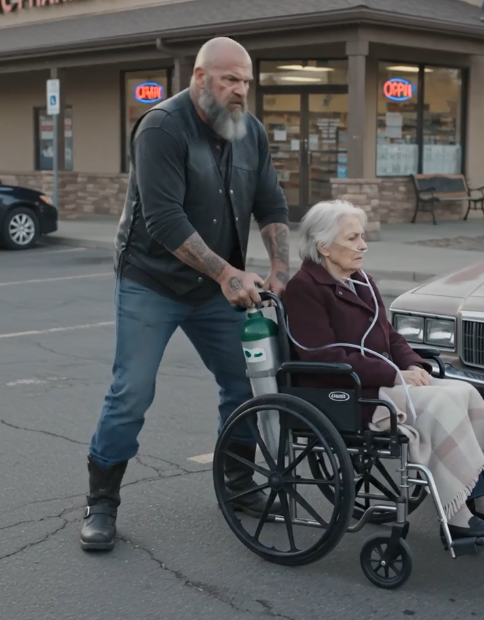
Ray “Hammer” Dawson stood six feet four and weighed close to 285 pounds. His head was shaved, his beard was long and black-gray, and old tattoos covered both forearms beneath a plain leather vest. Heavy boots, faded jeans, scarred knuckles, a chain hanging from his wallet—every part of him looked designed to make ordinary people step aside.
I did not step aside.
I hit him in the chest with both hands.
“What is wrong with you?”
Hammer barely moved. He was staring past me, not at my mother but at the faded Buick parked beside her wheelchair. His jaw was clenched. His nostrils flared as if he were counting something. Behind him, eight other bikers had stopped beside their Harley-Davidsons, their engines rumbling unevenly through the parking lot of Mendez Family Pharmacy on Route 66 in Flagstaff, Arizona.
People began shouting.
A young man near the grocery carts lifted his phone. A woman screamed for someone to call the police. The pharmacy security guard ran toward us with one hand on his radio. My mother’s face was losing color, and the only thing I understood was that a huge tattooed stranger had taken away the air she needed.
I slapped his vest.
“Give it back!”
“No.”
One word.
Cold. Final.
Hammer reached around me and pushed my mother’s wheelchair backward so hard that the front casters jumped over the curb. I grabbed the handles before she tipped. A second biker—Leon Brooks, a broad Black man with a short gray beard and blue bandanna—caught the chair from the other side.
“Easy, ma’am,” Leon said. “We’ve got you.”
“You don’t have anything!” I shouted.
Hammer turned toward the Buick.
That was when I heard it.
A faint ticking came from beneath the hood. Not the metallic sound of a cooling engine. This was sharper, uneven, followed by a soft electrical crackle. A thin ribbon of gray smoke slipped through the gap near the windshield and disappeared into the afternoon wind.
Hammer pointed at the oxygen cylinder rolling away from us.
Its valve was coated with a white crust of frost.
The cylinder hissed.
The crowd did not understand yet. Neither did I. Oxygen has no smell, no color and no flame of its own, but when it escapes near something already burning, it can feed that fire until fabric, plastic and oil ignite with terrifying speed.
Hammer understood.
He seized the handles of my mother’s wheelchair and pulled her farther from the Buick. I tried to stop him again, but Leon caught my shoulders.
“Look at the car,” he said.
A dull orange glow appeared beneath the dashboard.
Then the windshield cracked.
The sound silenced everyone.
Hammer removed his leather vest, wrapped it around his hand and opened the rear passenger door only long enough to pull out my mother’s canvas medical bag. Smoke rolled through the opening. He slammed the door, backed away and shouted for the crowd to clear the lane.
The security guard stopped running toward Hammer.
He began running from the Buick.
Within seconds, an employee wheeled out a small emergency oxygen unit from the pharmacy consultation room. I fitted the cannula beneath my mother’s nose with hands that would not stop shaking. She drew one shallow breath, then another.
Hammer stood ten feet away, bare-armed in the cold, watching the leaking cylinder rather than accepting thanks. The air around it shimmered faintly. He kept everyone back until the fire department arrived.
A police officer separated us and asked what happened. Three witnesses said Hammer had attacked an elderly woman. Two had video. I expected handcuffs.
Instead, the fire captain studied the frosted valve, the scorched Buick and the path the cylinder had taken across the asphalt.
Then he looked at Hammer.
“If that tank had stayed beside the car another thirty seconds,” he said, “we’d be counting bodies.”
My mother raised one trembling hand toward the biker who had frightened us all.
“Come here,” she whispered.
Hammer approached slowly. She touched the inside of his bare wrist, where a faded blue number had been tattooed beneath the darker ink.
His entire expression changed.
My mother looked at him for a long time and asked, “Who taught you to listen for a leaking valve?”
Hammer glanced at the oxygen tubing, then at a small silver charm hanging from my mother’s medical bag.
“My daughter,” he said.
That was the moment I realized the biker had not noticed my mother by accident—and that the girl who taught him about oxygen had once carried the same silver charm.
Want to know why Hammer recognized that quiet hiss and what my mother remembered about his daughter? Drop BREATH in the comments—I’ll share more soon.
Part 2 — The Woman in the Passenger Seat
My name is Clara Whitaker, and before that afternoon, I believed I was good at reading people. I had spent twenty-two years working behind pharmacy counters, watching customers lie about lost prescriptions, frightened husbands pretend not to understand diagnoses, and exhausted parents count coins beneath fluorescent lights.
I thought experience had made me careful.
It had mostly made me confident.
My mother, Eleanor Whitaker, had pulmonary fibrosis. Scar tissue had slowly tightened around her lungs until crossing a room required the same concentration most people used to climb a hill. The oxygen cylinder attached behind her wheelchair was not optional. It was the difference between speaking in full sentences and turning gray around the mouth.
We were at Mendez Family Pharmacy because her portable backup unit had failed that morning. The medical supply company promised a replacement within two days, but she had an infusion appointment in Sedona the following afternoon. We needed extra tubing, fresh cannulas and a regulator gasket.
My Buick had been unreliable for months. The dashboard lights flickered when I turned left. The blower fan sometimes continued running after I removed the key. That afternoon, I smelled something warm when we parked, but I blamed an old heater and rushed inside before the pharmacy closed.
Hammer noticed what I had ignored.
He and the Iron Lanterns were returning from a funeral escort in Williams. Eight motorcycles pulled into the lot for coffee and fuel cards. Their engines settled into that low V-twin rhythm that can feel less like sound than pressure against the ribs.
Hammer parked at the edge of the group.
Leon later told me he had been quiet all morning. That was not unusual, but this silence had weight. The funeral had been for a retired respiratory therapist named Margaret Cole, a woman Hammer had known years earlier through his daughter.
His daughter’s name was Grace.
She had died at seventeen.
I learned these facts in pieces because Hammer did not tell stories about himself. Other people carried his history for him. Leon knew one part. Boone knew another. A respiratory nurse in Flagstaff remembered something else. Hammer spoke only when a missing detail threatened to become a lie.
Grace was born with a rare autoimmune disorder that scarred her lungs. By thirteen, she used supplemental oxygen at night. At fifteen, she needed it most of the day. Hammer learned every sound her equipment could make: the clean click of a working regulator, the soft flow through a cannula, the rattle of a loose humidifier bottle and the sharp hiss of a failing valve.
He labeled backup tanks. He installed brackets in his truck. He could change a regulator in darkness while Grace counted her breaths.
Before all that, Hammer had been a different man.
He served six years as an Army vehicle mechanic, came home angry and slept poorly, then spent several seasons moving between construction crews and county jail. He drank hard. He fought harder. His marriage failed before Grace entered middle school.
The Iron Lanterns did not rescue him from that life. Brotherhood is rarely that clean. They gave him people who noticed when he disappeared, a garage where he could work without being asked why his hands shook, and a reason to return borrowed tools.
Grace did the rest.
When she became sick, Hammer stopped drinking because she hated the smell. He learned to cook food low in sodium because steroids made her retain fluid. He sewed a narrow pouch inside his leather vest for emergency tubing and carried a pulse oximeter beside his tire gauge.
The intimidating biker people avoided in grocery aisles became the father who slept upright beside a teenager’s hospital bed because she was afraid the oxygen alarm would sound after midnight.
The silver charm on my mother’s medical bag had belonged to Grace.
It was shaped like a tiny motorcycle.
My mother had worked nights at Flagstaff Medical Center for thirty-seven years. She was not a respiratory therapist, but she was the nurse who cared for Grace during three long admissions. Hammer remembered her voice before he recognized her face.
“Slow breath,” she used to tell Grace. “In through your nose. Out like you’re cooling soup.”
Grace called her Nurse Ellie.
Eighteen years had changed both of them. My mother’s hair had turned white. Steroids had rounded her cheeks, then illness hollowed them again. Hammer’s beard had grown long, and tattoos covered the bare skin my mother remembered.
Neither recognized the other immediately.
The silver motorcycle charm connected them.
My mother had kept it because Grace pressed it into her palm during her final hospital stay and said, “Give this to somebody who still needs help breathing.”
Mom had attached it to her medical bag years later, when she began carrying oxygen herself.
Hammer saw it after throwing the leaking cylinder.
That was why he looked as if the parking lot had opened beneath his boots.
He had saved the nurse who once helped his daughter breathe.
But by sunset, the video online showed none of that. It showed only a giant biker snatching a tank from a frightened elderly woman and throwing it across a parking lot.
The truth lasted ninety seconds.
The lie lasted twelve seconds.
And twelve seconds were enough.
Part 3 — Twelve Seconds Without Context
The video reached forty thousand views before we left the parking lot.
Its caption said: BIKER ATTACKS SICK GRANDMOTHER IN FLAGSTAFF.
The clip began after Hammer noticed the leaking valve. It did not show the frost. It did not show smoke from my Buick. It showed my mother reaching for her oxygen, Hammer pulling the cylinder away and me striking his chest.
Then it ended.
By six o’clock, strangers had identified Hammer, the Iron Lantern clubhouse and several members’ workplaces. People called the club criminals. Someone posted that the motorcycles had surrounded the pharmacy to prevent witnesses from leaving.
The police had not arrested Hammer, but that detail did not travel as quickly.
Inside the pharmacy consultation room, my mother sat with an emergency oxygen unit beside her chair while paramedics checked her saturation and blood pressure. She was stable, though exhausted. Smoke from the Buick had irritated her lungs, and the shock left her hands cold.
Hammer waited outside.
He refused to enter until Mom asked for him twice.
When he finally stepped through the door, he had put his leather vest back on. One shoulder was smeared with soot. His beard smelled faintly of smoke, and a narrow burn reddened the side of his hand where the vest had shifted while he retrieved my mother’s medical bag.
He kept that hand behind him.
Mom noticed anyway.
“Sit down, Raymond.”
No one called him Raymond. Even the police report listed him as Ray Dawson, commonly known as Hammer.
He obeyed her.
My mother studied his face. “Grace had your eyes.”
Hammer looked toward the floor.
“She had her mother’s.”
“She had your stubbornness.”
“That too.”
The words were plain, but something passed between them that left the room smaller. I realized my mother had known a version of this man before his beard, before the club, perhaps before the scars on his knuckles had turned white.
“I’m sorry I didn’t recognize you,” Mom said.
“You were busy breathing.”
“You always did have terrible manners.”
One corner of Hammer’s mouth moved.
The paramedic finished arranging transport to the hospital for observation. Our Buick could not be driven. The fire department had disconnected the battery after finding scorched wiring behind the dashboard. A short circuit near the blower motor had smoldered beneath the instrument panel, hidden by plastic and insulation.
The leaking oxygen tank had been less than four feet away.
The fire captain explained it carefully. Oxygen had not caused the electrical fault, but the leak could have made any ignition grow with extraordinary speed. Clothes, upholstery and plastic that normally burned slowly could flare intensely in an oxygen-enriched area.
Hammer had seen frost on the damaged valve. He had heard the hiss beneath the motorcycles. He had noticed smoke from the Buick and understood the combination before anyone else did.
“Throwing a pressurized cylinder carries its own risk,” the captain said. “But he moved it toward an empty open section and away from the heat. In that moment, separation mattered.”
Hammer did not defend himself. “I did what I had time for.”
The officer asked whether my mother wanted to file a complaint about the way he moved her wheelchair.
Mom stared at him. “Against the man who kept me from becoming part of a car fire?”
The officer closed his notebook.
Outside, the situation worsened. Two men who had seen the video arrived at the pharmacy and began shouting at the bikers. One kicked the rear tire of Boone’s Harley. Boone stepped forward, fists clenched.
Hammer came through the door.
“Stand down.”
Boone pointed at the man filming them. “They’re calling you a murderer.”
“Let them.”
“They’re giving out our address.”
Hammer’s face hardened. “Then don’t give them the video they came for.”
That order tested the club more than a roadside fight would have. The Iron Lanterns were built around loyalty, and loyalty often demands action. Hammer was asking them to endure humiliation without striking back.
Leon moved first.
He removed his gloves, tucked them into his belt and stood beside Hammer with both hands visible. The others followed. No shouting. No engines. No threats.
The crowd wanted monsters.
The bikers refused to perform.
An ambulance transported my mother to the hospital. I rode with her. As the doors closed, I saw Hammer standing alone near the scorched Buick while police lights reflected from his vest.
Mom reached toward the rear window.
“Don’t leave him there,” she told me.
“I have to go with you.”
“Not you.”
She pointed weakly toward Leon.
Leon understood. He walked over and stood shoulder to shoulder with Hammer as the ambulance pulled away.
That should have been the end of the crisis. Mom was safe. The fire had been contained. Investigators confirmed Hammer’s explanation.
Then the oxygen supplier called.
The damaged cylinder belonged to my mother, and her insurance would not authorize an immediate replacement until the incident report was processed. Her remaining portable unit held less than three hours of oxygen. The hospital could discharge her only if safe equipment was waiting at home.
Processing could take several days.
Her infusion was the next morning.
My car was ruined.
And while strangers argued online about whether Hammer Dawson was a hero or a criminal, my mother quietly asked the nurse whether missing one treatment might kill her.
Part 4 — The Tank in Grace’s Closet
Hammer learned about the insurance delay before I did.
The hospital social worker called Mendez Pharmacy, and the pharmacist mentioned it to Leon, who was still in the parking lot. By eight that evening, the Iron Lantern clubhouse had become an equipment command post.
This did not happen because the club was wealthy. Most members were mechanics, welders, drivers, roofers or retired servicemen. One owned a towing company that survived month to month. Another worked nights stocking supermarket shelves. They understood overdue bills better than charitable foundations.
They also understood Hammer.
He did not ask them for money.
He stood beside the clubhouse workbench, placed his burned hand beneath cold running water and said, “Grace’s backup is still boxed.”
Leon stared at him. “After eighteen years?”
Hammer nodded.
He had kept one oxygen cylinder in the hall closet of his small house outside Flagstaff, sealed behind Grace’s winter coat and a cardboard box of hospital drawings. It had not been used since her death. The cylinder itself was outdated and unsuitable for my mother, but the aluminum carrying frame, padded transport case and secure vehicle bracket could be inspected and adapted.
Boone misunderstood.
“You want to give her Grace’s tank?”
“I want to get her the right tank.”
Hammer opened an old metal cash box. Inside was the money the club had collected to repair the clubhouse roof before winter.
“Use this.”
Boone objected. “Brother, that roof leaks over the electrical panel.”
“Move the panel.”
“You can’t keep paying for every person who reminds you of her.”
The room went silent.
Boone regretted the sentence immediately, but Hammer did not strike him. He did not shout. His jaw tightened, and the scar along his right thumb turned pale as he closed his fist.
“This isn’t about who she reminds me of,” he said. “She needs oxygen.”
Boone looked away.
Leon later told me this was the moment the brotherhood came closest to breaking. Not because Boone lacked compassion, but because he had watched Hammer punish himself for eighteen years. Every hospital fundraiser, every child’s ride, every family needing a medical bill paid—Hammer responded as if helping one more person might alter the last night of Grace’s life.
Leon stepped between them.
“Roof fund stays,” he said. “We call Margaret’s supplier.”
Margaret Cole, the respiratory therapist whose funeral they had attended that morning, had worked for a nonprofit equipment exchange before retirement. Her organization inspected donated oxygen equipment, coordinated with licensed suppliers and provided temporary units during insurance delays.
Hammer had forgotten.
Leon had not.
Calls moved quickly. The nonprofit located a certified portable concentrator and a full backup cylinder appropriate for my mother’s prescribed flow rate. A licensed respiratory technician could deliver and set them up before midnight, but the nonprofit needed payment for the regulator, fresh tubing and emergency service.
Boone removed his wallet.
Then his watch.
“Pawn this if you need to.”
Hammer looked at him.
Boone shrugged. “Roof can wait.”
Within twenty minutes, cash covered the cost. The club’s treasurer documented every dollar. Nothing was improvised medically; the equipment came through professionals, matched my mother’s prescription and would be installed by someone trained to do it.
Hammer contributed one item from Grace’s old equipment.
The padded transport case.
It was navy blue, faded around the handles, with a small stitched pocket on the side. Inside that pocket lay a folded card in my mother’s handwriting.
BREATHE IN SLOWLY. YOU ARE NOT ALONE.
Mom had given it to Grace during her first overnight admission.
Hammer had never found it.
At 11:17 p.m., eleven motorcycles and Leon’s pickup rolled onto our street. They kept the engines low because the neighbor’s baby was sleeping. A medical equipment van followed behind them.
I was still at the hospital when my doorbell camera alerted me. Through the small screen, I watched Hammer stand on my porch holding the empty blue case against his chest. Snow had begun drifting through the streetlight.
The respiratory technician set up the concentrator inside, tested the alarms and secured the backup cylinder. Leon checked the smoke detectors. Boone replaced a scorched extension cord he found near Mom’s recliner, though it had nothing to do with the car fire.
The bikers did not fill the house.
They formed a line outside and passed in what was needed: bottled water, fresh blankets, sealed tubing, groceries and a battery-powered lantern for outages. Each item traveled through tattooed hands and disappeared into the home of a woman most of them had never met.
Hammer placed Grace’s blue case beside my mother’s chair.
He left the card in its pocket.
At the hospital, Mom watched the footage from my phone without speaking. When the line of bikers finished unloading, she touched the silver motorcycle charm on her medical bag.
“Grace used to worry about him,” she said.
“About Hammer?”
“About what would happen after she was gone.”
“What did you tell her?”
Mom looked toward the dark hospital window.
“I told her men like her father survive by finding someone who still needs them.”
The next morning, discharge paperwork took longer than expected. Mom’s infusion clinic was forty-seven miles south, and winter weather had closed one lane of Interstate 17. My rental car reservation was canceled because every available vehicle had been taken.
I called Leon, expecting advice.
He said, “We’re downstairs.”
The entire club had returned.
Not on motorcycles alone. Leon brought his heated pickup. Another member brought a wheelchair-accessible van borrowed from his church. Hammer had installed Grace’s inspected oxygen-case bracket in the van under the technician’s supervision.
They were not offering my mother a dramatic motorcycle ride.
They were offering safe transportation.
Hammer opened the van door and secured the blue case beside her seat. My mother looked at the card in its pocket, then at him.
“You kept this all these years?”
“Didn’t know it was there.”
“Maybe Grace did.”
Hammer shook his head. “She wasn’t magic.”
“No,” Mom said. “She was organized.”
For the first time, Hammer laughed.
It was short, rough and almost rusty.
Then we drove south through the snow.
Part 5 — The Road to Sedona
The convoy moved differently that morning.
No roaring formation. No dramatic lane changes. Leon drove the accessible van at a careful speed, while two motorcycles traveled ahead to report ice and another pair remained behind to make the van visible through blowing snow. Hammer rode beside us only where the highway widened, his headlight steady beyond my mother’s window.
The rest alternated between pickups and motorcycles at designated stops.
Mom’s oxygen saturation remained stable. The portable concentrator hummed beside her. Every few miles, she placed two fingers against the blue carrying case as if checking that the past had not vanished.
At the Oak Creek overlook, traffic stopped behind a jackknifed delivery truck. Snow gathered along the shoulder. The infusion clinic called to warn us that arriving more than thirty minutes late might force a reschedule.
Hammer walked back between the idling vehicles.
He did not pound on windows or demand passage. He found the highway patrol officer managing traffic, explained that a medically fragile patient was inside the van and showed him the appointment documentation the hospital had provided.
The officer arranged a controlled route through the cleared shoulder once emergency crews made it safe.
We arrived with six minutes to spare.
The clinic staff stared when the doors opened and my mother rolled inside followed by bikers carrying nothing more dangerous than coffee and spare blankets. Several people recognized Hammer from the viral video. One woman moved her chair away from him.
Mom noticed.
She stopped her wheelchair beside the reception desk and spoke loudly enough for the waiting room to hear.
“This is the man who took my oxygen.”
The room froze.
Hammer’s eyes narrowed slightly. “Ellie.”
She continued.
“He took it because it was leaking beside a burning car. Then he replaced it before my insurance company finished putting me on hold.”
Nobody moved for a moment.
Then an older man near the window began clapping.
Hammer looked as if he would rather face another fire.
By afternoon, the full pharmacy surveillance footage had been released with the permission of everyone involved. It showed Hammer hearing the leak, noticing smoke, moving the cylinder and pulling my mother away. The fire captain gave a statement explaining the hazard.
The twelve-second lie began losing ground.
Yet Hammer refused interview requests. A national morning show offered to fly him to New York. He deleted the email. A motorcycle company proposed donating equipment if he appeared in an advertisement. He told Leon to send them the nonprofit’s address and leave his name out.
When reporters asked why he recognized the leak, he gave the same answer.
“I’d heard it before.”
Mom understood what he was protecting. The story belonged partly to Grace, and Hammer would not turn his daughter’s illness into a performance.
After the infusion, the weather worsened. The clinic recommended we remain in Sedona overnight, but Mom wanted her own bed. Hammer examined the forecast, spoke with highway patrol and made the decision no one expected.
“We stay.”
Not every act of protection looks dramatic. Sometimes it is refusing the road.
The club rented four cheap motel rooms and rotated chairs in the lobby so my mother would never be alone. Boone found soup. Leon located an outlet on a dedicated circuit for the concentrator. Another biker named Travis sat outside Mom’s room listening for the backup alarm because he had once cared for a wife with emphysema.
Hammer took the midnight shift.
I woke at two and found him seated in the hallway beneath a buzzing light, Grace’s blue case between his boots. He held the silver motorcycle charm my mother had loaned him.
“Do you blame yourself?” I asked.
He knew which death I meant.
“Yes.”
The answer came without hesitation.
“For what?”
“For not fixing it.”
“Grace’s illness?”
He nodded.
“You couldn’t.”
“I know.”
Knowing had not helped.
I sat beside him. For several minutes, the only sounds were the concentrator behind the door and wind moving grit across the motel walkway.
“Mom said Grace worried about you.”
“She worried about everybody.”
“What did she want for you?”
Hammer rubbed his thumb across the little charm. “She wanted me to stop standing in doorways.”
I did not understand.
He explained that during Grace’s hospital stays, he always stood near the door. He told himself he was watching staff, equipment and exits. Grace knew the truth. He remained close enough to help but far enough to flee if the worst happened.
On her final night, she made him sit beside the bed.
“Stay where people can reach you,” she told him.
Hammer had spent eighteen years failing that instruction.
Then my mother recognized him in a pharmacy parking lot.
The next morning, before we left Sedona, Mom asked Hammer to lean closer. She clipped Grace’s silver motorcycle charm inside his vest, behind the leather where no camera could see it.
“She told me to give it to someone who still needed help breathing,” Mom said. “Turns out she meant you too.”
Hammer swallowed once.
“Keep the blue case,” he told her.
“Only if you keep the charm.”
“Deal.”
The convoy returned to Flagstaff beneath a clearing sky. At every stop, Hammer checked the secure equipment bracket, then stepped away before anyone could thank him.
By the end of the week, the club had created a transportation calendar covering all six of my mother’s remaining infusions. Members volunteered pickups, accessible vans and fuel cards. No one transported medical oxygen casually; every vehicle and setup followed the supplier’s safety guidance.
They called the calendar Ellie’s Road.
Mom hated the name.
So naturally, it stayed.
Part 6 — Tuesday Engines
Every second Tuesday, engines arrived outside our house at 6:40 a.m.
Sometimes there were two motorcycles and a van. Sometimes snow or wind kept every rider inside a truck. The vehicle changed, the driver changed, and the coffee changed, but Hammer always arrived first.
He checked the weather.
Leon checked the route.
I checked Mom’s medication and appointment folder.
Mom checked whether the bikers had eaten breakfast.
The arrangement lasted through winter and into spring. Boone became her favorite because he pretended not to like the oatmeal cookies she packed for him, then returned the container clean enough to look polished. Leon brought crossword puzzles. Travis installed a handrail beside our porch after Mom nearly slipped.
Hammer carried the blue oxygen case.
He never allowed it to drag, strike a doorway or rest unsecured. His large scarred hands treated every buckle with the care of someone touching a memory that could still bruise.
The online attention faded. Another video replaced ours. The people who had threatened the club moved on without apologizing. Hammer seemed relieved.
Mom did not need an audience.
She needed a ride.
Halfway through her treatment cycle, she asked the Iron Lanterns to take her to Grace’s grave. Hammer refused at first, saying the cemetery path was uneven and the weather too cold.
Mom stared at him. “Raymond, I spent thirty-seven years telling stubborn men what to do.”
He surrendered.
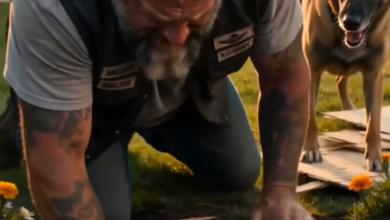
Grace’s headstone stood beneath a juniper tree overlooking the edge of Flagstaff. Hammer parked the wheelchair near it and stepped back. Mom placed one hand on the stone while oxygen flowed quietly through the cannula.
“I kept him busy,” she said.
Hammer looked away.
Mom left no flowers. She placed a fresh card beneath a small stone.
BREATHE IN SLOWLY. YOU ARE NOT ALONE.
On the ride home, Hammer stopped at the pharmacy lot. My burned Buick had been removed months earlier, but a dark stain remained on the asphalt. He stood where he had thrown the cylinder and listened to the ordinary sounds around him: shopping carts, traffic, a loose sign tapping in the wind.
Mom rolled beside him.
“Still hear it?” she asked.
“The leak?”
She nodded.
“Sometimes.”
“So do I.”
They stayed there until the sun lowered behind the stores.
After that, Hammer began volunteering twice a month with Margaret Cole’s equipment exchange. He did not handle prescriptions or regulators. Licensed professionals did that. He repaired transport frames, built storage shelves and secured delivery crates.
Metal work.
Something he could fix.
Each finished bracket received three firm taps from his wrench. The habit became his private ritual. Leon said the sound traveled through the workshop like a small bell.
Three taps.
Then the next one.
Part 7 — A Tank Full of Air
My mother completed her final infusion on a warm April morning.
There was no parade. She forbade one.
The Iron Lanterns waited outside the clinic anyway, lined along the curb with their engines off. Doctors had not promised a cure, but her disease had stabilized enough to reduce her oxygen flow while resting. To Mom, that counted as good news.
Hammer wheeled her toward the van.
She locked both brakes and refused to move.
“I have something for you.”
From beneath her blanket, she produced Grace’s blue oxygen case. The replacement equipment had recently been transferred into a newer protective carrier supplied by the nonprofit. Mom had cleaned the old case and repaired its worn handle.
Hammer did not take it.
“Grace’s,” he said.
“Yes.”
“Keep it.”
“I don’t need two.”
He stared at the faded fabric. “Then donate it.”
“That is what I’m doing.”
Inside the case, Mom had placed envelopes containing fuel cards, contributions from clinic families and enough money to fund emergency transport equipment for three more patients caught in insurance delays. She had also included a new card.
STAY WHERE PEOPLE CAN REACH YOU.
Hammer read it, closed the case and held it against his chest.
Boone started an engine to hide the sound of someone clearing his throat. The others followed until the curb trembled beneath a low wall of V-twin thunder.
Mom pointed at Hammer’s Harley.
“You ever carry passengers?”
“Not difficult ones.”
“Good. I’m too old for it anyway.”
Leon opened the van, and Hammer secured her new oxygen carrier beside the wheelchair. He checked the buckle twice.
The club continued driving her to appointments even after I replaced the Buick. By then, the rides were no longer only about transportation. Tuesday had become the day Mom brought cookies, Leon argued about crossword clues and Hammer allowed someone to reach him.
One evening, months later, we passed Mendez Pharmacy just as the parking-lot lights came on. Hammer’s Harley was parked near the empty space where the fire had started.
He stood beside an elderly man learning how to secure a medical-equipment case inside a pickup. A licensed technician supervised while Hammer tightened the transport bracket.
Three taps from his wrench.
Done.
Mom lowered her window as we passed.
Hammer heard us, raised one scarred hand and smiled through his gray beard. Beneath his vest, Grace’s silver motorcycle charm caught a sliver of light.
Then he turned back to the work.
Follow this page for more unforgettable biker stories about frightening first impressions, quiet courage and the people whose lives change when someone refuses to ride past.