The 82-Year-Old Woman Smashed a Biker’s Harley Headlight With Her Cane—Then She Recognized the Lightning-Shaped Crack Her Dead Son Had Left Twenty Years Earlier
The eighty-two-year-old woman raised her wooden cane and smashed the headlight of my Harley while a Route 66 crowd surrounded her—then she touched the old lightning-shaped crack and whispered the name of a man I had buried twenty years earlier.
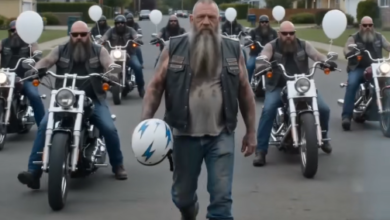
My name is Ray “Hammer” Dawson. I was fifty-six years old, six feet four and nearly 285 pounds when Evelyn Hayes attacked the one motorcycle I had sworn never to restore completely.
It happened outside the Copper Rail Diner in Kingman, Arizona.
The Iron Lanterns had stopped for coffee after escorting a deceased Vietnam veteran’s ashes along Route 66. Twenty-three Harleys filled the curbside parking spaces, their engines ticking as they cooled beneath the October sun.
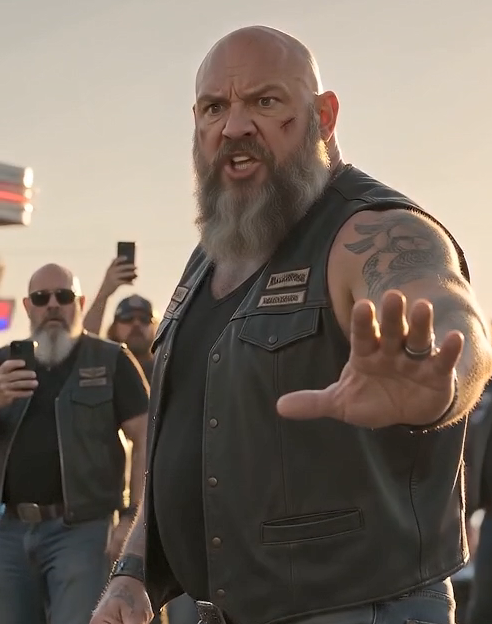
Mine stood apart.
It was a black 1987 Heritage Softail with worn saddlebags, faded pinstriping and a glass headlight lens carrying a three-pronged crack across its lower-left corner. Clear resin and a safety laminate held the old glass together. A modern light sat behind it, but I had refused every offer to replace the original outer lens.
The crack mattered.
Evelyn was crossing the parking lot with a grocery bag hooked over one arm. She was a small white woman with silver hair, a dark blue coat and a wooden cane polished smooth by years of use.
She stopped when she saw the Harley.
Her grocery bag slipped.
Two oranges rolled beneath a parked pickup, but she did not look down. She walked toward my motorcycle, faster than an eighty-two-year-old with an arthritic hip should have been able to move.
I stepped outside as she reached it.
“Ma’am, don’t touch—”
She swung the cane.
The brass tip struck the headlight lens. Glass snapped beneath the clear laminate, and the old crack spread upward.
Every biker on the sidewalk stood.
A tourist lifted his phone. Someone shouted that the woman was destroying private property. One of our prospects moved forward to take away the cane.
I blocked him.
Evelyn struck the headlight again.
This time, the outer lens collapsed inward. She pressed one trembling hand against the broken glass and traced the original three-pronged crack with her fingertip.
Then she looked at me.
“Where did you get Danny’s motorcycle?”
The parking lot went silent.
Daniel “Danny” Hayes had been my closest friend, my Army brother and the first road captain of the Iron Lanterns. Twenty years earlier, before our final convoy in Iraq, he placed his Harley key in my hand and made me promise not to replace the cracked headlight.
He said his mother would recognize it.
I had tried to return the motorcycle after Danny died.
Evelyn refused to see it.
She told the club to remove every engine, helmet and leather vest from her driveway. Then she moved away from Kingman, changed her telephone number and disappeared from the veterans’ community.
For two decades, I kept Danny’s Harley running.
I replaced tires, seals, brake lines and wiring. I rebuilt the engine twice. Yet I preserved the damaged lens beneath clear resin because Danny’s final instruction had been short.
“Leave the crack. Mom knows that one.”
Now she stood before it.
Evelyn hit my chest with her cane.
“You stole it.”
I did not stop her.
She struck my vest, my shoulder and one tattooed forearm while strangers recorded the giant biker allowing an old woman to beat him beside a damaged Harley.
Then I opened the headlight housing.
Behind the broken lens, wrapped inside oilskin, was a military dog tag and a small silver voice recorder that had traveled with the motorcycle for twenty years.
Evelyn recognized the name stamped into the tag.
Her cane fell.
“You had this all along?”
I told her the part she did not yet know.
“Danny said you’d come when you were ready.”
She stared at the recorder.
Then she asked the question I had dreaded since the morning her son did not return from our convoy.
“Did he know I was sorry?”
The final message inside that headlight contained her answer—but before Evelyn could hear it, a county deputy arrived and asked whether she wanted me arrested.
Want to know what Danny recorded before his final convoy and why Hammer carried Evelyn’s unopened letter for twenty years? Drop CRACK in the comments—I’ll share the rest below.
Part 2 — The Boy Who Broke the Glass and Took the Blame
Danny Hayes broke the headlight when he was seventeen.
His mother broke it again at eighty-two.
The first time happened in the narrow driveway behind the Hayes family’s house in Kingman. Danny had bought the old Heritage Softail from a retired railroad mechanic for $2,300 and three months of unpaid labor.
The motorcycle barely ran.
Its starter dragged. The rear cylinder leaked oil. The seat had been patched with black electrical tape, and the headlight shell contained more rust than chrome.
Evelyn hated it immediately.
Her husband, Robert, had died in a highway collision when Danny was nine. A drunk driver crossed the centerline outside Needles and struck Robert’s pickup. From that day forward, Evelyn distrusted speed, engines and every road that led away from home.
Danny loved all three.
He rebuilt the Harley in the family garage. Evelyn complained about the smell of gasoline, yet she left sandwiches beside his tools when he worked after midnight.
The headlight cracked during a neighborhood baseball game.
Danny’s twelve-year-old cousin hit a foul ball through the open garage door. The ball struck the lens and left a three-pronged fracture resembling a bolt of lightning.
The younger boy panicked. His father had warned him to stay away from the motorcycle.
Danny took the blame.
He told Evelyn he dropped a wrench.
She knew he was lying because the baseball remained behind the front tire. Still, she said nothing. She watched Danny seal the crack with clear adhesive and draw a tiny line beside it with a paint marker.
“Why not replace it?” she asked.
“Because now I know which one’s mine.”
“There can’t be many broken black motorcycles in this driveway.”
“Still mine.”
Years later, he told me that story during a sandstorm outside Kandahar.
Danny and I met as Army mechanics. He could listen to an engine for ten seconds and locate a failing bearing. I needed instruments, a flashlight and quiet.
He never needed quiet.
He whistled beneath incoming fire. He sang country songs while changing tires in 115-degree heat. When officers shouted, Danny waited until they left and imitated them accurately enough to make exhausted soldiers laugh.
We became brothers because neither of us knew how to ask for one.
My own family had scattered after my father’s death. Danny invited me to Arizona during leave and introduced me to Evelyn as “the ugly one who keeps me alive.”
Evelyn inspected my tattoos, beard and motorcycle boots.
“You don’t look reliable.”
“I’m not.”
“Good. Liars usually say they are.”
She served me pot roast.
For several years, I spent Christmas in the Hayes house. Danny and I repaired his Harley in the garage while Evelyn complained from the kitchen that motorcycle parts had again appeared in her sink.
She knew every sound the machine made.
The starter’s hesitation.
The uneven idle on cold mornings.
The faint ring from the cracked headlight lens when Danny closed the garage door too hard.
Then Danny reenlisted.
Evelyn considered it a betrayal.
She had survived one man leaving home and dying on a highway. She could not accept her only son volunteering for another deployment after completing his obligation.
Their final argument occurred on her porch.
Danny told her the soldiers in his unit were his responsibility. Evelyn said men often used duty to make abandonment sound honorable.
He left angry.
She did not hug him.
Two weeks later, she mailed a letter to our base. The envelope traveled through three military postal facilities while our unit moved between assignments.
It never reached Danny.
By the time the letter arrived, he was dead.
I received his personal effects in a sealed box because his paperwork listed me as the person responsible for returning the Harley and several private items. Evelyn’s letter sat inside that box, unopened and stamped with red forwarding marks.
I should have delivered it immediately.
I tried.
Three days after Danny’s funeral, I rode his Harley to Evelyn’s house.
She heard the cracked headlight ring against its housing before she opened the door.
When she saw me instead of her son, grief turned the sound into cruelty.
“Take it away.”
“Ma’am, Danny left—”
“I don’t want his things.”
“He asked me to bring the bike.”
“Then he should’ve come himself.”
She closed the door.
I stood on the porch holding the unopened letter.
The Harley idled behind me.
For twenty years, I wondered whether I should have knocked again.
Part 3 — The Convoy That Left Without One Mechanic
Our final convoy began before sunrise on March 18, 2005.
Danny and I had spent the previous night preparing vehicles for a supply movement north of Baghdad. Intelligence warned of roadside explosives and small-arms fire, but warnings had become part of every briefing.
Danny acted normal.
That should have frightened me.
He checked my vehicle twice, replaced a hose clamp that did not need replacing and reorganized tools inside my door pocket. Then he removed the Harley key from the chain around his neck.
“You hold this.”
I tossed it back.
“Bring it yourself.”
He caught it.
For the first time, he did not make a joke.
“If I don’t, the bike goes to you.”
“Your mom gets it.”
“She won’t take it from anybody but me.”
“Then she gets it when you’re home.”
Danny looked toward the dark motor pool.
“Keep the crack.”
I told him to stop talking like a man writing his own memorial.
He placed the key inside my vest pocket anyway.
“Mom could pick that headlight out of a thousand bikes. If she ever asks, she’s ready.”
I asked ready for what.
Danny tapped my pocket.
“To know I made it home somehow.”
The convoy departed at 5:42 a.m.
I drove the fourth vehicle. Danny rode in the sixth, a recovery truck carrying tools, spare parts and lifting equipment.
The explosion struck near a narrow market road.
The first blast disabled the second vehicle. Dust covered the convoy. Civilians ran between buildings while our radios filled with overlapping commands.
I left my truck to help secure the damaged vehicle.
A second explosive detonated near the rear.
Danny’s recovery truck remained upright, but fragments tore through the passenger side. Fuel began leaking near a hot exhaust component.
Danny could have withdrawn.
Instead, he saw two soldiers trapped inside the second vehicle. Fire had reached the rear panel.
He drove the recovery truck forward, positioned its winch and pulled the damaged vehicle away from the burning fuel.
That movement exposed him.
A burst of gunfire struck the cab.
Danny remained conscious long enough to complete the pull. When I reached him, both soldiers were out of the disabled vehicle.
He was breathing.
Barely.
I held pressure against his wound while a medic worked beside me. Danny’s eyes moved toward my vest pocket.
“Key?”
“I’ve got it.”
“Crack?”
“Still there.”
“Mom knows.”
Those were his final clear words.
He died before the evacuation helicopter arrived.
For years, Evelyn believed I had encouraged Danny to reenlist. She believed motorcycles, soldiers and men like me had offered him an identity more important than being her son.
She was not entirely wrong.
Danny loved the Army. He loved the Iron Lanterns before the club had a name. He loved machines that carried broken people home.
He also loved his mother.
Those truths did not cancel one another.
After the funeral, our unit returned Danny’s uniforms, medals and official belongings. Evelyn accepted them because soldiers in clean uniforms delivered the box.
I arrived in leather on her son’s motorcycle.
She rejected everything.
The Iron Lanterns offered to store the Harley temporarily. Temporary became a year.
Evelyn sold the house and moved to Tucson to live near her sister. Letters I sent were returned. Leon Brooks found a new address three years later, but a response came from Evelyn’s sister asking us not to contact her.
I honored the request.
Still, I maintained the Harley.
The original headlight lens became difficult to preserve. Vibrations widened the crack, and moisture entered the housing. A mechanic told me the glass would eventually collapse.
I installed a modern sealed light behind it and stabilized the original lens with transparent resin and safety laminate. The modification kept the motorcycle roadworthy while preserving the visible crack.
Every restoration specialist told me it ruined the front end.
I did not care.
Chrome could be replaced.
Recognition could not.
I rode Danny’s Harley once each year on March 18. I followed Route 66 from Kingman to the desert overlook where he and Evelyn used to watch freight trains.
Sometimes I parked outside the old Hayes house.
Different families lived there.
I never expected Evelyn to see the motorcycle again.
Then, two decades after Danny’s death, Leon scheduled a funeral escort through Kingman. My own Harley developed an electrical problem that morning, so I took Danny’s Heritage Softail.
I told myself it was practical.
Maybe some promises choose their own route.
Part 4 — The Recorder Behind the Broken Lens
Deputy Lena Ortiz arrived while Evelyn stood beside the damaged headlight.
The tourist who called police insisted he had witnessed deliberate vandalism. His video showed Evelyn swinging the cane and me preventing club members from stopping her.
Lena asked whether I wanted to file a complaint.
“No.”
Evelyn answered for me.
“He stole my son’s motorcycle.”
Lena looked at the registration documents Leon retrieved from my saddlebag. The title had legally transferred to me under instructions Danny completed before deployment.
That did not satisfy Evelyn.
“Paper doesn’t make it his.”
“No,” I said. “Danny did.”
Her face tightened.
I removed the damaged outer lens carefully. The cane had broken the safety laminate along one edge, but most fragments remained attached.
Behind it sat the modern sealed lamp.
Beneath the headlight bucket, inside an oilskin pouch, were Danny’s dog tag, Evelyn’s returned letter and a small voice recorder.
Danny purchased the recorder at a military exchange two days before our final convoy. He made three messages.
One for Evelyn.
One for the unit.
One for me.
I had listened only to mine.
His message instructed me to preserve the motorcycle, keep the cracked headlight and return the recorder if Evelyn ever recognized the bike on her own.
That condition had angered me for years.
Danny knew his mother’s grief could make any visit feel forced. He did not want bikers arriving at her house annually, asking her to relive the worst day of her life. He wanted her to control the moment.
So I waited.
Evelyn looked at her unopened letter.
“You had this?”
“It came back with his effects.”
“Did he read it?”
“No.”
The word nearly folded her.
Her cane slipped from her fingers. I caught it before it struck the pavement.
In that letter, Evelyn apologized for their porch argument. She told Danny she remained angry because fear needed somewhere to go. She asked him to telephone when he could and promised the garage light would remain on.
For twenty years, she believed he died thinking the door was closed.
That was why her first question in the parking lot mattered more than ownership of the Harley.
Did he know she was sorry?
I gave her the recorder.
Her hands shook too badly to press the button, so I did it for her.
Danny’s voice emerged through the tiny speaker, distorted by age but recognizable.
“Mom, if Hammer is playing this, you found the crack.”
Evelyn covered her mouth.
Danny laughed softly in the recording.
“Knew you would.”
He explained that he had not read her letter because it had not arrived, but he knew her. He knew the garage light would remain on, even if she wanted to throw a wrench at him when he returned.
Then he spoke about their final argument.
“You didn’t have to apologize. I knew fear was talking. Mine was talking too. I left mad because leaving hurt less that way.”
Evelyn leaned against the Harley.
Danny asked her not to blame Hammer. He said I had tried to talk him out of reenlisting and that the final choice belonged to him.
“He’ll carry anything you hand him,” Danny said. “So don’t hand him this.”
I had carried it anyway.
His message ended with the sound of someone calling him toward the motor pool.
Then Danny added one final sentence.
“Keep an eye out for my headlight, Mom. Broken things still make it home.”
The recording stopped.
No one in the parking lot spoke.
Evelyn touched the spread of cracks across the broken lens. The original lightning shape remained visible beneath the new damage from her cane.
“I broke it worse,” she whispered.
I looked at the glass.
“Runs in the family.”
She laughed once.
The sound became a sob.
Evelyn pressed her forehead against my vest. I held her carefully while the crowd lowered its phones.
Deputy Ortiz closed her notebook.
No complaint.
No arrest.
Only an eighty-two-year-old mother standing beside the motorcycle that had waited twenty years for her to recognize it.
Part 5 — The Garage Light Evelyn Never Turned Off
Evelyn did not take the Harley home that afternoon.
She asked me to bring it to the assisted-living apartment where she had moved six months earlier. The building manager objected until I explained that the motorcycle would remain outside.
Evelyn waited near the entrance.
She had changed clothes. A faded denim jacket covered her blue sweater, and she carried a photograph of Danny at seventeen, sitting on the unfinished Harley with grease across his cheek.
We parked the photograph against the fuel tank.
For nearly an hour, Evelyn told me details I had never known.
Danny saved for the motorcycle by repairing lawn mowers. He once slept on the garage floor because he wanted to hear whether oil continued dripping overnight. He practiced balancing the heavy Harley in the driveway before he possessed a license.
Evelyn had secretly paid the final insurance bill his first year.
“Never told him,” she said.
“He knew.”
“How?”
“Danny knew everything you did when you thought he wasn’t looking.”
She examined twenty years of changes to the bike. The saddlebags had been repaired. The seat was reupholstered around the original leather. The engine cases carried scratches from desert roads.
The odometer showed nearly sixty thousand additional miles.
“You rode it that much?”
“Some.”
“Where?”
I had taken Danny’s Harley to thirty-four military funerals. It carried toys to children’s hospitals, blankets to homeless veterans and donated blood-cooler boxes between rural clinics.
The bike had crossed every state west of the Mississippi.
I kept a paper record of each ride inside the right saddlebag. Evelyn read the entries while I stood near the curb.
March 18, 2008 — Kingman overlook.
December 12, 2011 — Children’s hospital delivery.
May 6, 2015 — Escort for Sergeant Luis Ortega.
March 18, 2020 — Solo ride during shutdown.
Every March 18 entry ended with the same notation:
Garage light checked.
Evelyn stared at the words.
After Danny died, I returned to the old Hayes house each year until she sold it. The detached garage had a small exterior lamp controlled by a switch near the side door.
Evelyn had left it on when she moved.
The new owner thought the light was connected to an old security system and never switched it off. I replaced the bulb twice with permission.
After the house changed owners again, I stopped entering the property. I still rode past each March 18 and recorded whether the light remained visible.
“Why?” Evelyn asked.
“Your letter.”
The one she mailed to Danny said the garage light would remain on.
He never read it.
I decided the motorcycle should.
Evelyn sat on the apartment bench with the ride log across her knees. For twenty years, she had believed the club erased Danny’s ordinary life beneath leather, flags and military ceremony.
Instead, we carried parts of it quietly.
Not perfectly.
I should have tried harder to reach her after the first years. She admitted she should have opened one of the returned letters. Grief had turned both of us into guards posted outside the same locked room.
Neither knew the other was waiting.
The original headlight could not be used again. Its glass had become unstable after the cane strikes. A specialist advised replacing the outer lens before the motorcycle returned to public roads.
Evelyn objected.
“The crack is how I knew.”
I offered a compromise.
We collected every original fragment and reconstructed the lightning shape inside a shallow display frame. The safe replacement lens would carry a fine etched replica of the crack—not enough to weaken the glass, only enough to preserve the pattern.
Evelyn approved the first sketch.
Then she added something.
Near the lower corner, she asked the glass artist to etch a tiny square resembling a garage window with one light glowing inside.
The repaired headlight was not identical.
It carried both returns.
Danny’s crack.
Evelyn’s light.
Part 6 — The Passenger Beside the Old Harley
Evelyn began visiting the Iron Lanterns’ workshop on Thursdays.
At first, she came to supervise the headlight repair. Then she began bringing sandwiches because she disapproved of the food in our vending machine.
The club feared her more than they feared me.
She corrected Boone’s language, made Leon wash his coffee cup and struck the workbench with her cane whenever someone attempted to lift something alone.
The prospect she had nearly hit in the parking lot became her regular driver.
His name was Mateo Ruiz, a twenty-four-year-old Latino Army veteran with a quiet voice and a fear of disappointing elderly women. Evelyn called him “the nervous one.”
She attended Danny’s memorial night and told the club stories no soldier knew. Daniel hated peas. He cheated at cards. At twelve, he attempted to repair a toaster without unplugging it and blacked out the kitchen.
The man beneath the memorial patches became a son again.
We installed the reconstructed original lens in a frame above Danny’s motorcycle space. Beneath it hung his dog tag and a copy of Evelyn’s returned letter.
The recorder remained with her.
She listened only twice more.
Not because Danny’s voice hurt less, but because she no longer needed to test whether it remained real.
The safe headlight lens was installed in December. The etched lightning line caught sunlight like the old crack but did not interfere with the beam.
Evelyn stood in front of the Harley and inspected it.
“Too clean.”
I rubbed road dust across the chrome rim.
“Better?”
“Little more.”
I added another smear.
She nodded.
At the first engine start, the Heritage Softail coughed, turned and settled into the uneven rhythm Evelyn remembered.
Her eyes closed.
For years, she had feared hearing that sound without Danny. Now it carried the places his motorcycle had traveled because he could not.
The club owned a touring sidecar rig used for charity events. After a physician cleared her and we fitted a supportive seat, Evelyn asked to ride beside Danny’s Harley for one mile.
We chose the quiet road leading past the old Hayes house.
Mateo drove the sidecar rig. I rode Danny’s motorcycle beside them.
At the house, the garage light remained on.
Evelyn raised one gloved hand toward it.
The new owner stood in the driveway. I had told him the story, and he agreed to keep the light burning each March 18.
We stopped at the desert overlook.
Freight trains moved below us. Wind pressed against Evelyn’s blue scarf.
She touched the etched crack on the headlight.
“I spent twenty years thinking he never came back.”
I did not offer comfort.
Danny’s recording had already answered.
Broken things still make it home.
Part 7 — The Light at the End of Route 66
On what would have been Danny’s fifty-eighth birthday, the Iron Lanterns organized a short ride through Kingman.
No banners carried his name.
Evelyn did not want a funeral repeated on the calendar. She wanted a ride Danny would have recognized: bad coffee, unnecessary stops and an argument about directions.
Twenty motorcycles left the Copper Rail Diner.
Evelyn traveled in the sidecar beside Mateo. She wore a white helmet and the same denim jacket she had brought to her first visit.
I rode Danny’s Heritage Softail.
The replacement headlight shone beneath the etched lightning crack. A small garage-window symbol rested near its lower edge.
At every stop, Evelyn inspected the motorcycle.
“You checking my work?” I asked.
“Checking his bike.”
“Still mine legally.”
She raised her cane.
I withdrew the argument.
We reached the old overlook near sunset. Leon parked the club in a wide semicircle while a freight train moved west below the ridge.
Evelyn carried the framed fragments of the original lens from the support truck. She placed the display on a stone wall, where sunlight passed through the reconstructed crack.
The broken glass cast three narrow lines across the ground.
She set Danny’s photograph between them.
Then she handed me his Harley key.
“I think you should keep riding it.”
“Was planning to.”
“I’m giving permission.”
“Didn’t ask.”
The cane rose an inch.
I accepted.
Evelyn smiled.
Before leaving, she played Danny’s recording one final time. His voice drifted across the overlook beneath the cooling tick of motorcycle engines.
Keep an eye out for my headlight, Mom.
When the message ended, Evelyn did not cry.
She walked to the Heritage Softail and placed her palm over the etched crack. Then she tapped the headlight gently with the wooden cane that had shattered the original.
“Don’t lose it again,” she told me.
“I won’t.”
“You did once.”
“He went to war.”
“Excuses.”
I started the Harley.
The V-twin settled into Danny’s familiar uneven rhythm. Evelyn returned to the sidecar, and Mateo secured her cane beside the seat.
We rode toward Kingman as dusk lowered across Route 66.
At the old Hayes house, the garage light turned on.
I flashed Danny’s headlight once.
Evelyn raised her hand.
The cracked light answered the one left waiting.
Follow our page for more unforgettable biker stories about hidden promises, long roads home and the rough-looking riders who preserve what grief cannot bear to recognize yet.