The Entire Diner Went Silent When a Biker Knelt Before a Stranger
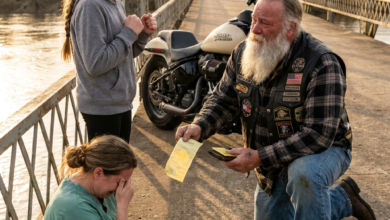
He dropped to one knee without a word.
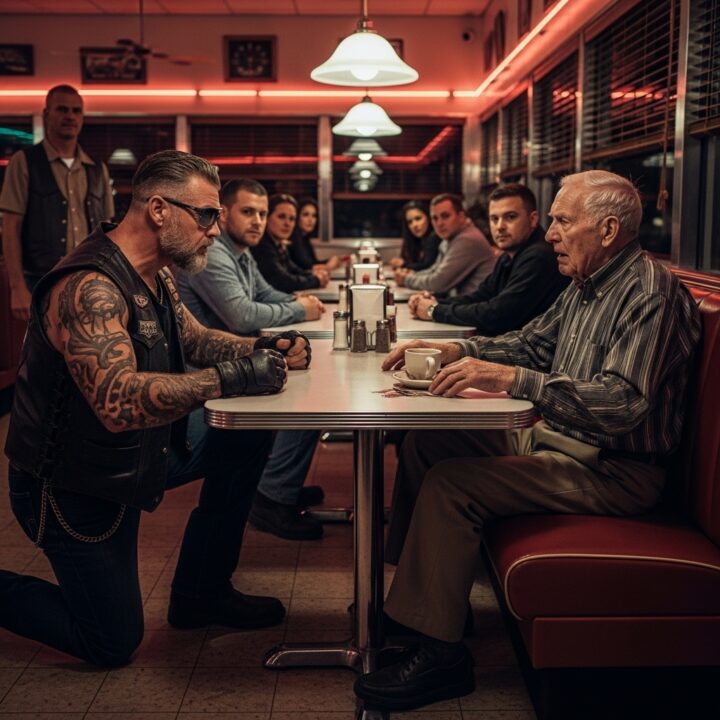
The sound of his leather vest brushing against the tile was loud enough to slice through the diner’s chatter. Forks froze midair. A waitress stopped pouring coffee, the stream trembling before splashing onto the counter. Someone near the window muttered, “What the hell is he doing?”
At first glance, it looked wrong.
Dangerous.
Like the calm before violence.
A biker—big, broad-shouldered, sleeveless leather vest stretched tight across his back, patches stitched with a history no one bothered to read—had just knelt in front of an old man he didn’t seem to know.
For a heartbeat, the entire diner stood still.
The neon sign above the counter buzzed softly. Grease popped on the grill behind the cook, forgotten. The smell of bacon and burnt coffee hung in the air, heavy and uncomfortable. Somewhere, a spoon slipped from a trembling hand and clattered to the floor, far too loud in the silence.
The old man sat alone in a corner booth.
Thin.
Stooped.
A paper napkin folded and refolded between his fingers until it was nothing but wrinkles. His coat—too light for the season—hung loosely on his narrow frame. His hands shook, not dramatically, just enough to notice if you were looking closely.
And now a biker was kneeling in front of him.
People didn’t lean in. They leaned away.
The diner manager, a man who had learned to trust instincts over explanations, took one step forward. His jaw tightened. This was how trouble started. Loud men. Leather. Scenes that ended with broken plates and police reports.
“Sir,” he called out carefully, “you need to stand up.”
The biker didn’t move.
He kept his head bowed. One knee on the floor. Hands resting calmly on his thigh, scarred knuckles relaxed. His face—lined, weathered, gray threaded through his beard—showed no anger. No challenge.
Only something heavier.
The old man stared down at him, eyes wide with confusion and fear. His breath came shallow. His fingers clenched the napkin like it might anchor him to the booth.
“I—I don’t have anything,” the old man whispered, voice cracking. “I didn’t do anything.”
A ripple moved through the room.
Of course.
That made sense.
An old man. Alone. Maybe someone thought he’d skipped out on a bill. Maybe the biker was here to scare him. Collect something. Send a message.
The assumptions landed easily.
The biker finally looked up.
His eyes were pale. Steady. And wet.
“I know,” he said softly. “I’m not here for that.”
The manager hesitated. Rules were rules. Safety mattered. He gestured toward the door, already imagining the call he might have to make.
Before he could speak again, the biker reached out.
Slowly. Deliberately.
He took the old man’s shaking hand in both of his.
The contact was gentle. Almost reverent.
That was the moment the room shifted.
The old man flinched at first, then stilled. His eyes searched the biker’s face, scanning it like a half-remembered photograph. His mouth opened, closed, then opened again.
“No,” he breathed. “That’s not… you can’t be…”
The biker swallowed hard.
“Yes, sir,” he said. “It’s me.”
The silence deepened.
Outside, engines rumbled—not aggressively, not revving. Just present. Through the front windows, a line of motorcycles had pulled into the lot, parked cleanly, evenly spaced. Men dismounted quietly. Older. Younger. Different shapes and scars. They stood by their bikes, hands folded, heads slightly bowed.
No one came inside.
They waited.
The old man’s grip tightened suddenly, strength flaring from somewhere deep and stubborn. Tears welled in his eyes, spilling down grooves carved by time.
“I thought you were gone,” he said. “They told me no one made it out.”
The biker’s shoulders rose and fell once.
“I almost didn’t,” he replied.
The manager lowered his hand.
A waitress wiped her eyes with the edge of her apron, not entirely sure when she’d started crying.
The biker shifted, still kneeling, so they were eye to eye.
“You saved my life,” he said quietly. “Korea. Winter. I was bleeding out and didn’t even know it yet.”
The old man laughed—a thin, broken sound. “I just did my job.”
“You held pressure for twenty minutes,” the biker said. “You talked to me the whole time. Told me about your wife. Your son. Told me I wasn’t allowed to die before dessert.”
A faint smile crossed the old man’s face. “Pie,” he said. “I promised you pie.”
“You did.”
The biker reached into his vest and pulled out something small. Metal. Worn smooth with years of handling.
Dog tags.
He placed them gently on the table between them.
“I kept them,” he said. “Couldn’t give them back. Didn’t know how to find you.”
The old man stared at the tags, then at the biker. His breathing hitched.
“I’ve been eating here every Tuesday for ten years,” he said softly. “Same booth. Same order. Figured if anyone ever came looking…”
The biker nodded. “I ride past every week. Never thought…”
The manager cleared his throat, voice unsteady. “Sir,” he said to the old man, “your meal’s on us today.”
The old man shook his head. “No,” he said firmly. “Not today.”
He looked at the biker. “Sit,” he said. “You still owe me pie.”
The biker rose slowly, unfolding to his full height. For the first time, he looked unsure. Smaller, somehow.
He slid into the booth across from the old man.
Around them, life resumed—but differently. Quieter. More careful.
A young man at the counter leaned over to his companion. “That biker,” he whispered, “he was military.”
An older woman shook her head. “No,” she said. “He was family.”
The bikers outside remained still. No threats. No noise. Just presence.
When the pie arrived—apple, warm, two forks set carefully on the plate—the old man laughed again. Stronger this time.
“Looks like you survived after all,” he said.
“Because you didn’t let me quit,” the biker replied.
They ate in silence for a while.
When the old man’s hands began to tremble again, the biker reached out and steadied them without thinking. When the biker’s jaw tightened, the old man squeezed his fingers back.
Outside, a few people stepped closer, curiosity softened into something else. Respect, maybe. Understanding.
When it was time to leave, the biker stood first. He waited patiently while the old man rose, slow and careful.
They hugged.
Not tight.
Not dramatic.
Just enough.
The biker walked to the door, then turned back.
“I’ll be here next Tuesday,” he said.
The old man smiled. “I’ll save you a seat.”
The diner exhaled as one.
Outside, engines started—low, controlled. The bikers rode off together, not fast, not loud.
Inside, the manager wiped down the counter and shook his head.
“Funny,” he said to no one in particular. “People see leather and think danger.”
The waitress smiled softly. “Sometimes,” she said, “it’s just someone kneeling to say thank you.”