An Elderly Biker Drove His Harley Through a Nursing Home’s Glass Entrance—Everyone Thought He Had Lost Control Until Smoke Filled the Hallway Behind Them
The old biker lowered his head and drove a Harley straight through the nursing home’s glass entrance—but why was smoke crawling along the ceiling, and what did he know about the locked door behind us?
My name is Naomi Brooks. I was forty-three and working as the charge nurse at Maple Ridge Senior Living outside Asheville, North Carolina, on the afternoon Walter “Bear” Lawson turned our lobby into a storm of safety glass, motorcycle exhaust, and screaming families.
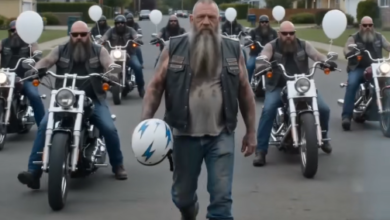
Bear was sixty-nine years old, six-foot-three, and still carried nearly 260 pounds across shoulders that looked built for moving engines. He had a thick silver beard, a scar across his left eyebrow, tattooed forearms, heavy boots, faded jeans, and a black leather vest without any club name large enough to read from a distance.
He visited his wife every Thursday.
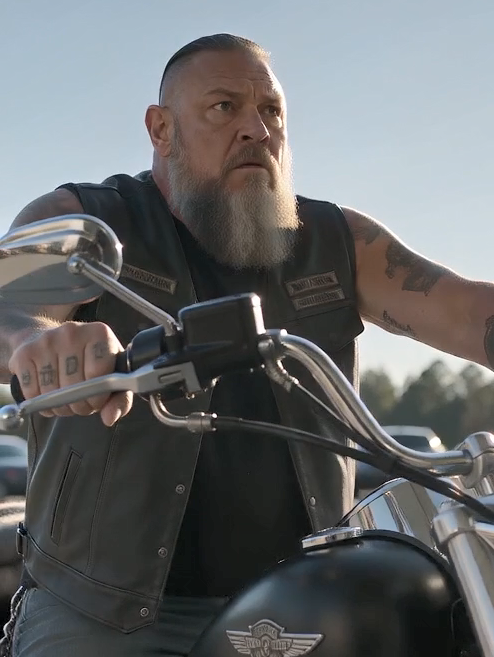
Eleanor Lawson had suffered a major stroke two years earlier. She used a wheelchair, spoke only a few words at a time, and sometimes forgot Bear’s name before remembering the sound of his Harley.
That afternoon, he parked near the front entrance as usual.
He never came inside.
Instead, Bear sat on the motorcycle, staring through the glass.
I stepped into the lobby and waved at him, but he didn’t wave back. He revved the engine once. The deep V-twin pulse shook the front windows and made several residents cover their ears.
Our administrator, Martin Keene, hurried from his office.
“Tell him to shut that thing off.”
I pushed through the automatic doors and approached Bear. His eyes weren’t on me. They were fixed on the eastern hallway behind the reception desk.
“Walter, you can’t idle here.”
“Get them outside.”
“What?”
“Move the wheelchairs.”
I looked back. Nothing seemed wrong. Residents were gathering for afternoon music, and an aide was handing out coffee near the recreation room.
Then I smelled hot plastic.
Bear removed a red recovery strap from his saddlebag.
“What are you doing?” I asked.
“Your alarm’s dead.”
I heard a faint mechanical clicking somewhere beyond the east corridor. No siren. No flashing lights.
Bear pointed through the glass.
A narrow ribbon of gray smoke appeared near the ceiling.
I turned and ran inside.
“Call 911!” I shouted.
The front doors closed behind me.
Then they locked.
Maple Ridge used an electronic security system because several residents had dementia and were at risk of wandering. During an alarm, every controlled door was supposed to release automatically.
They didn’t.
The lobby doors would open from inside, but the side panels restricted the width. Two large wheelchairs could not pass together, and twenty-seven residents were converging on the same entrance while smoke thickened behind them.
Bear saw the crush forming.
He backed the Harley away.
Martin came running toward the glass, waving both arms. “Stop him!”
Bear dropped his helmet visor.
For one heartbeat, I believed the same thing everyone else did.
The old man had panicked.
The Harley surged forward at controlled speed. Its front wheel struck the lower glass panel beside the locked doors. Tempered glass burst into thousands of small pieces, scattering across the lobby floor while families screamed and aides pulled residents backward.
Bear rode through the opening.
He shut the engine off almost immediately, dismounted, and threw heavy blankets over the broken glass so wheelchairs could cross safely.
Martin grabbed his vest.
“You could’ve killed somebody!”
Bear removed the administrator’s hand.
“Door’s wider now.”
That was when black smoke rolled from the eastern hallway.
The lights flickered. Someone shouted that six residents were still inside the dining room. Another aide reported that the rear emergency exit had jammed and would not open.
Bear looked toward Eleanor.
She sat near the corridor in her wheelchair, a blue blanket across her knees. Smoke drifted between them.
He did not run to her.
Instead, he restarted the Harley and rode toward the smoke.
I chased him, shouting that he was going the wrong way. Bear stopped beside the jammed steel exit, looped the red strap through its horizontal bar, and secured the other end low on the Harley’s frame.
The door shuddered but held.
Flames reflected against the corridor wall.
Bear turned toward five other bikers who had just arrived outside the shattered entrance.
“Brothers,” he called. “I need weight.”
They entered without hesitation.
One climbed onto the passenger seat. Two braced the motorcycle. Another wrapped his leather jacket around the hot metal bar. Bear eased the throttle open.
The V-twin roared inside the nursing home.
The strap tightened.
For a second, nothing moved.
Then the steel door bent outward half an inch, releasing a breath of clean winter air.
Nobody knew why Bear had carried that recovery strap on every ride for thirty-one years, why he recognized the failure of our alarm before trained staff did, or why he saved the residents trapped behind the dining room door before going to his own wife.
But when firefighters arrived, they found Walter Lawson still gripping the Harley’s handlebars while the exit door slowly tore free of its warped frame.
And inside his leather vest was a photograph from another nursing home fire—one where the same kind of door had remained closed.
Part 2 — The Man Eleanor Remembered by Sound
Bear did not live at Maple Ridge.
He lived seven miles away in a one-story brick house with a narrow garage and an empty bedroom he had not changed since Eleanor entered long-term care. Every Thursday, unless snow made the mountain roads impassable, he rode his black Harley-Davidson Road King to see her.
He always arrived at 2:10 p.m.
Never 2:09.
Never 2:11.
Eleanor spent most afternoons near the lobby window. Her stroke had damaged the part of her brain responsible for language and recognition. Some days she knew me. Other days she mistook her adult daughter for a childhood neighbor.
But she recognized the Harley.
The first uneven pulses reached us before Bear turned into the driveway. Eleanor’s fingers would begin moving against her blanket as though counting the firing rhythm.
“Bear,” she would say.
One word.
Clear every time.
He never revved near the residents. He rolled into the lot at low speed, parked beside the same maple tree, and removed his gloves before approaching Eleanor. He wanted the first thing she felt to be his bare hand.
Bear spoke little, even with his wife. He would sit beside her and describe ordinary things—the leaking garage faucet, a neighbor’s dog digging beneath the fence, the stubborn carburetor on an old generator he was rebuilding.
Eleanor understood more than she could answer.
Sometimes she rested two fingers against the scar above his eyebrow. Sometimes she touched the memorial pin hidden inside his vest.
The pin carried a name.
THOMAS LAWSON — ENGINE 14.
I asked about it only once.
Bear closed the vest.
“My brother,” he said.
That was all.
The other five riders who came to Maple Ridge during the fire belonged to Bear’s club, the Carolina Ridge Riders. They were not outlaws. Doc Mercer was a retired emergency-room physician. Leon Banks installed commercial electrical systems. Caleb Reed ran a towing company. Isaac Porter taught welding at a community college. The youngest, forty-seven-year-old Daniel Cho, owned a building-inspection business.
They rode together on Sundays and repaired homes for veterans who could not afford contractors. They also visited Maple Ridge, though never as regularly as Bear.
Residents called them the Thunder Men.
Martin Keene called them a liability.
Our administrator believed motorcycles frightened families and lowered the property’s polished appearance. He once asked Bear to park behind the kitchen.
Bear looked at the empty front parking spaces.
“Why?”
“Some visitors find the club image intimidating.”
Bear glanced at his plain vest. “Which image?”
Martin had no answer that didn’t sound like prejudice.
Bear continued parking beneath Eleanor’s window.
Our relationship with him was complicated. He could be blunt, stubborn, and impatient with paperwork. Yet he noticed things the rest of us stopped seeing.
A loose wheelchair bolt.
A frayed oxygen-tank strap.
A rug corner that could catch a walker.
Bear carried a small tool roll in his saddlebag, along with electrical tape, a flashlight, work gloves, a glass breaker, and the red recovery strap. If he repaired something, he left no bill and rarely mentioned it.
Three months before the fire, he examined the rear emergency exit after hearing the latch scrape.
“That door’s dropping,” he told me.
The steel door opened into a service courtyard beside the east dining room. Its lower edge had begun rubbing against the frame, especially after heavy rain caused the older section of the building to settle.
I submitted a maintenance request.
The maintenance supervisor adjusted the closer and lubricated the hinges. For several weeks, the door improved.
Then it began scraping again.
Bear tested it during one of his visits. He placed both hands on the horizontal release bar and pushed.
The door opened only halfway.
“Frame’s twisted,” he said. “Hinge adjustment won’t fix that.”
Martin overheard him.
“We passed inspection.”
“When?”
“Seven months ago.”
Bear pushed the door again. Metal groaned against metal.
“Fire won’t wait for the next one.”
Martin’s expression hardened. “Our licensed contractor says it’s functional.”
Bear looked at me.
“Write it down.”
“I already have.”
“Write it again.”
I did.
So did Daniel Cho. He offered to inspect the door without charging Maple Ridge, but Martin refused because the facility’s management company required approved vendors.
Daniel sent a letter anyway.
No response came.
The red strap in Bear’s saddlebag was rated for far more weight than a motorcycle would normally pull. It was old but carefully maintained, its fabric faded almost pink along one edge. Caleb had offered to replace it.
Bear refused.
“Still holds.”
“What’d you buy it for?” Caleb asked.
Bear folded the strap along lines worn into the fabric.
“Door.”
“What door?”
Bear secured the saddlebag.
“One that didn’t open.”
We assumed he meant a garage, a wrecked truck, or some rescue from his years as a firefighter.
Nobody knew he had spent thirty-one years waiting to meet that door again.
Part 3 — The Hallway That Filled Without an Alarm
The fire began inside a wall behind the commercial laundry room.
Investigators later determined that an overloaded electrical junction overheated near a bundle of old wiring. The fire burned unseen for several minutes, feeding on insulation and wood framing before smoke escaped through a ceiling vent.
The detection system should have responded.
A smoke sensor in the laundry corridor had been placed in test mode that morning while a contractor worked nearby. The panel displayed a fault signal, but the alert was muted because staff had complained about repeated beeping.
Someone intended to restore it.
Nobody did.
Leon smelled the electrical fire from the parking lot before most of us saw smoke. Bear recognized it seconds earlier because he had spent twenty-six years inside burning buildings.
Hot plastic has a particular odor.
Bitter. Chemical. Wrong.
When I ran back into the lobby, I still believed we had time to evacuate through the front doors. We practiced fire drills every quarter. Staff knew which residents required two-person assistance and which oxygen users needed portable tanks.
But drills begin with working alarms.
They assume clear hallways.
They assume doors open.
That day, confusion became our first enemy.
Residents continued moving toward the recreation room because no siren instructed them otherwise. One aide smelled smoke and began evacuating the east wing without notifying the west. Another tried to call Martin, whose phone was locked inside his office.
Then the security system entered an incomplete alarm state.
Some magnetic locks released.
Others remained engaged.
The automatic front doors shifted into manual mode and closed, leaving only a narrow central opening when pushed. Three wheelchairs converged there at once.
Bear saw the bottleneck from outside.
His decision to breach the glass looked reckless because nobody inside understood what he was calculating. The wall beside the automatic doors contained a wide tempered-glass panel. Breaking it would create nearly six feet of additional exit space.
A motorcycle was the heaviest controlled tool available.
Bear backed up no more than twenty yards. He lowered his visor, aimed for the lower corner, and approached at less than fifteen miles per hour. The Harley’s crash bar and front tire absorbed much of the impact.
The panel exploded.
Glass rained across the tile.
People screamed.
Bear rode no farther than the reception mat. He killed the engine, dropped the stand, and pulled thick moving blankets from the motorcycle’s saddlebags. Those blankets were not normally part of his gear.
He had brought them for Eleanor.
Her room heater had failed two nights earlier, and Bear intended to leave the blankets beside her bed.
Instead, he spread them across the broken glass. Staff rolled the first wheelchairs through the new opening thirty seconds later.
By then, smoke had swallowed half the east corridor.
“Laundry fire!” an aide shouted.
“Dining room isn’t clear!”
I counted residents near the entrance.
Twenty-one.
Maple Ridge had thirty-two residents that day. Four were visiting doctors. That meant seven remained inside.
Eleanor was one.
I saw her through the gray haze near the nurses’ station. She had tried to propel her wheelchair with her functioning right arm, but the wheel kept turning her toward the wall.
Bear saw her too.
He started toward her.
Then a young aide named Sophie Greene stumbled from the dining corridor.
“The exit won’t open!” she coughed. “I’ve got six in there.”
Bear stopped.
His wife was less than thirty feet away.
Six other residents were behind a jammed door.
That was the moment I understood what kind of man stood inside the leather vest. He did not choose the person he loved most.
He chose the door trapping the greater number.
“Naomi,” he called. “Get Ellie.”
He used Eleanor’s old nickname. The sound cut through my panic.
I ran toward her.
Bear pushed the Harley deeper into the lobby, walking beside it with the engine off until he reached the junction near the east dining room. Smoke lowered around his shoulders.
Doc and the other riders entered through the broken opening. Each man had removed his vest or jacket and wrapped cloth across his mouth.
Martin tried to block them.
“Fire department is coming!”
Caleb grabbed two wheelchairs and pushed them toward the exit. “Then we’ll give them fewer people to carry.”
Nobody waited for permission again.
Leon moved to the electrical panel, but smoke prevented him from safely reaching the main disconnect. Daniel began checking resident rooms. Isaac and Doc followed Bear toward the dining room.
I found Eleanor coughing near the nurses’ station.
“Bear,” she said.
“He’s here.”
She pointed toward the engine sound.
Bear had restarted the Harley.
The V-twin thundered beneath the low ceiling, louder than the absent alarm. Residents who could not understand shouted instructions understood that sound. Heads turned. Staff followed it toward the exit.
The dining-room door stood open, but the exterior steel exit beyond it remained stuck in the warped frame. Sophie and another aide had pushed until both women’s hands bled along the palms.
Bear shoved the release bar.
Nothing.
Isaac joined him.
The door moved perhaps a quarter inch before springing back.
Smoke poured through the ceiling vent behind them.
“Other route?” Doc asked.
“Too far,” I said. “They’d have to cross the laundry corridor.”
Inside the dining room were six residents. Three used wheelchairs. Two required walkers. The sixth, Mr. Everett, could stand only with a mechanical lift.
The front exit was reachable, but moving them through the smoke-filled corridor one by one could take fifteen minutes.
We did not have fifteen minutes.
Bear opened his saddlebag and removed the red strap.
Daniel stared at it. “You’re pulling the door?”
“Trying.”
“With the bike?”
“Got something bigger?”
The fire department was still four minutes away.
Bear looped the strap through the steel handle assembly and around the door’s reinforced crossbar. Isaac protected the strap from the sharp edge with his folded leather vest.
The motorcycle faced the dining room. To pull the door outward, Bear needed to reposition it through a tight section of hallway slick with sprinkler water.
Caleb and Leon lifted the rear slightly while Bear turned the handlebars.
“Easy,” Caleb warned. “Floor’s wet.”
Bear mounted.
Doc climbed behind him to add traction over the rear tire.
I wanted to tell them the plan was impossible. A Harley was not a tow truck. Its tire could slip. The strap could snap. The door could tear loose violently.
Then the corridor lights went out.
Darkness.
Smoke.
Residents crying.
Bear’s headlight came on.
It cast a white beam straight toward the jammed exit.
“Everyone behind the wall,” he ordered.
The riders moved staff and residents away from the strap’s line. Isaac covered Mrs. Bell’s head with his jacket. Sophie crouched behind a serving counter beside two wheelchair users.
Bear engaged the clutch.
The engine deepened.
The strap lifted from the floor.
Tight.
Tighter.
The rear tire turned, slipped, and caught again.
The door groaned.
For one second, the upper hinge shifted.
Then the strap’s metal hook struck the frame and released with a violent crack.
The Harley lurched forward.
Bear and Doc fell sideways.
The engine guard slammed into the tile, trapping Bear’s left boot beneath nearly eight hundred pounds of motorcycle.
The door remained closed.
Part 4 — The Brother Behind the Steel Door
Bear did not shout when the Harley fell.
He grunted once, released the throttle, and tried to pull his boot free. Doc rolled clear and immediately returned to lift the handlebar.
Caleb and Isaac joined him.
The three men raised the motorcycle just enough for Bear to drag out his leg. His boot was crushed along the ankle, but he stood before anyone could inspect him.
“Strap,” he said.
The metal hook had bent. The webbing remained intact.
Caleb stared at him. “We get one more pull before that anchor tears.”
“Then make it count.”
Smoke rolled lower.
The six residents inside the dining room began coughing harder. Mr. Everett had stopped responding to questions. Doc abandoned the motorcycle to check him.
Bear looked toward the jammed door.
Something inside him shifted.
Not panic.
Recognition.
He removed the memorial photograph from the inner pocket of his vest and handed it to me.
It showed a younger Bear standing beside another firefighter in front of a red engine. The other man had the same broad jaw, the same heavy shoulders, and the same crooked smile Bear sometimes showed Eleanor.
Thomas Lawson.
Behind the photograph, written in faded ink, were four words.
HENDERSON HOME — EAST EXIT.
“What happened there?” I asked.
Bear retied the recovery strap.
“Door stuck.”
The Henderson Care Home fire occurred in 1993 in a small Tennessee town seventy miles west of Asheville. Bear and Thomas both served with a volunteer fire department at the time.
Thomas was thirty-four.
Bear was thirty-eight.
The fire began in a kitchen grease duct and spread into an attic. Staff evacuated most residents, but eight people remained trapped in a rear wing when a steel emergency door twisted inside its frame from heat.
Bear reached the exterior first.
He tried a Halligan tool. Then an axe. Then a chain attached to Engine 14.
The chain broke.
Thomas entered through another corridor to lead the residents toward the jammed exit. Bear heard his brother striking the door from inside.
Three impacts.
Pause.
Three more.
They spoke through the steel.
“Pull it!” Thomas shouted.
“I’m pulling!”
The engine moved forward. The replacement chain tightened. The door bent but did not open.
Fire reached the attic above the east wing.
The roof failed.
Thomas and four residents died inside.
Three others were rescued through windows by another crew.
Bear kept the second recovery strap used that night. The one that did not break. It arrived after the roof collapse, delivered by a neighboring department that responded too late to change the outcome.
He folded it into his motorcycle saddlebag when he retired.
He carried it for thirty-one years.
“Why?” I asked him later.
Bear’s answer was simple.
“Doors remember.”
At Maple Ridge, the east exit carried the same institutional design as the Henderson door—steel frame, horizontal panic bar, outward opening, three heavy hinges.
Bear noticed the resemblance on his first visit.
That was why he tested it.
That was why he filed complaints.
That was why he recognized the danger before any of us.
He had spent three decades rehearsing what he would do differently if another door refused to open.
The first attempt failed because he anchored the strap too high on the Harley and too close to the damaged handle assembly. For the second attempt, Caleb crawled through smoke to reposition the webbing around the lower door brace.
Isaac removed his belt and secured the bent hook closed.
Leon scattered dry absorbent powder from a kitchen container beneath the Harley’s rear tire to improve traction. Daniel and I braced the motorcycle upright.
Bear’s left foot could barely support weight.
“You’re not riding,” Caleb said.
Bear swung onto the seat.
“Then you are.”
Caleb climbed behind the handlebars. Bear sat over the rear portion to add weight and control the strap angle.
“Slow,” Bear instructed. “Don’t jerk it.”
Outside, sirens became audible.
Too far.
The dining-room ceiling vent glowed orange around its edges.
Doc crouched beside Mr. Everett, delivering oxygen from a portable cylinder. Sophie placed wet napkins over the mouths of two residents. Mrs. Bell began reciting a prayer from memory.
Caleb engaged first gear.
The V-twin pulse struck my chest.
The strap rose.
Leon watched the anchor.
“Straight!”
Caleb eased the throttle.
The tire turned slowly. Rubber complained against the powder-covered tile. Bear leaned backward, keeping weight over the wheel while his injured boot dragged beside the floor.
Metal screamed.
The door’s lower edge shifted.
One inch.
Then two.
Cold daylight appeared along the frame.
“Keep it steady!” Bear shouted.
The upper hinge tore loose.
The door tilted outward, but the warped lower corner remained trapped.
Isaac and Daniel pushed from inside while Caleb maintained tension. The Harley crawled forward another foot.
The steel frame cracked.
The door came free.
Winter air rushed into the dining room, lifting napkins, papers, and gray hair. Smoke poured outside in a rolling black cloud.
Nobody celebrated.
Bear shut off the engine and pointed through the opening.
“Move them.”
Firefighters arrived at the front entrance as we began pushing wheelchairs into the courtyard. They saw shattered glass, a motorcycle inside the building, and six leather-clad men moving elderly residents through a broken emergency exit.
For several seconds, nobody understood the scene.
Then the fire captain took command.
Crews entered the east corridor. Another team stretched hose through the front breach Bear had created. Paramedics assessed residents in the courtyard while staff counted names.
Six from the dining room.
Twenty-one from the lobby.
Eleanor.
Everyone.
All residents were outside.
Only after the final count did Bear try to reach his wife.
His injured leg failed beneath him.
He fell beside the Harley.
Eleanor saw him from her wheelchair.
She pushed at one wheel with her functioning hand, turning slowly toward him. A firefighter tried to stop her, but she struck his arm away.
Bear dragged himself across the wet pavement.
They met beside the torn steel door.
Eleanor touched his face.
“Thomas?” she asked.
The name stopped him.
Bear had not heard his brother spoken in her voice since the stroke.
“No, Ellie.”
She looked at the smoke. Then at the strap.
Her fingers moved to the scar above his eyebrow.
“You opened it,” she whispered.
Bear lowered his head against her knees.
This time, the door had opened.
Part 5 — The Man They Tried to Blame
The fire was contained before it reached the west wing.
Damage remained severe. The laundry room and east corridor were destroyed. Smoke affected the dining area, and water damaged several resident rooms.
No one died.
Seven residents were treated for smoke inhalation. Three staff members were hospitalized overnight. Bear had two fractured bones in his left foot, a deep bruise along his hip, and small glass cuts across his forearms.
The Harley suffered a bent crash bar, broken headlight bracket, damaged floorboard, and scratches deep enough to expose bare metal.
Bear asked about the motorcycle only after checking Eleanor’s condition.
She was transferred to another care facility temporarily. Bear refused his own ambulance until he saw her loaded safely into one.
Martin Keene approached while paramedics wrapped Bear’s foot.
“You destroyed the entrance,” he said.
Bear looked at him.
“You brought a running motorcycle into a building full of oxygen equipment.”
“Engine was off near the tanks.”
“You could have ignited the entire lobby.”
“But I didn’t.”
Martin’s hands shook. Fear had become anger now that the emergency was over.
“The fire department should have handled the door.”
“Wasn’t here.”
“They arrived minutes later.”
“Door was open when they arrived.”
Martin turned toward me. “You witnessed him drive through the glass.”
“I did.”
“We’ll need a formal statement.”
“You’ll get one.”
Bear stood with help from Caleb. “Include the door complaints.”
Martin became still.
“What complaints?”
“The ones Naomi filed.”
I had submitted four maintenance reports over three months. Daniel sent two written warnings. Bear spoke directly to Martin at least twice.
The records existed.
So did evidence that the fire alarm fault had been muted.
Within hours, Maple Ridge’s management company began protecting itself. A public-relations representative described Bear’s actions as an “unauthorized civilian intervention” and claimed staff evacuation procedures had already been underway when he entered.
The first news reports focused on the broken entrance.
ELDERLY BIKER CRASHES MOTORCYCLE INTO NURSING HOME DURING FIRE.
Video recorded by a visitor showed the Harley striking the glass. The clip ended before smoke became visible.
Online, people called Bear confused, reckless, intoxicated, and desperate for attention. Commenters asked why a sixty-nine-year-old man still possessed a motorcycle license.
Bear watched none of it.
He spent that night beside Eleanor’s temporary hospital bed with his fractured foot elevated on a chair. His leather vest hung over the backrest, still smelling of smoke.
The red strap lay inside an evidence bag at the fire marshal’s office.
The truth emerged more slowly.
Security-camera footage showed the smoke appearing before Bear struck the glass. Another angle recorded the wheelchair bottleneck at the locked entrance. Body-camera footage from the first firefighters showed residents already exiting through the steel door while crews had only begun deploying hoses.
Then the fire marshal released the preliminary timeline.
Bear created the wider lobby exit one minute and forty-six seconds before the first engine arrived.
He pulled open the jammed rear door three minutes and twelve seconds before firefighters reached the dining room.
Investigators stated that moving six mobility-impaired residents through the smoke-filled interior corridor would likely have delayed their evacuation and increased exposure.
The story changed.
Reporters gathered outside Eleanor’s temporary facility. Bear refused interviews until one journalist asked about Thomas Lawson.
Someone had found the Henderson Home report.
Bear stopped walking.
“Who gave you that name?”
“It’s in the public record.”
“Leave him out.”
“Was that fire why you carried the strap?”
Bear stared directly into the camera.
“My brother isn’t your hook.”
He entered the building.
The clip spread farther than the crash video.
People began leaving flowers, cards, and motorcycle parts outside the Carolina Ridge Riders’ garage. Bear moved everything to Maple Ridge’s temporary-resident fund.
He accepted no money for the Harley.
When the dealership offered him a new motorcycle, he refused that too.
“Mine still runs.”
Caleb repaired the front end. Isaac straightened the crash bar but stopped before repainting the scratches.
“You want these covered?” he asked.
Bear ran his thumb across the exposed metal.
“No.”
The Harley carried the marks thereafter.
Maple Ridge suspended Martin pending investigation. The management company paid a civil penalty for fire-safety violations and agreed to replace the entire alarm and door-control system.
Martin claimed he had never received Daniel’s inspection warnings.
Daniel produced certified-delivery receipts.
The maintenance records revealed something worse: an approved contractor had recommended replacing the warped emergency-door frame six weeks before the fire. The work was postponed until the next budget quarter.
Bear read the report once.
Then he folded it.
“He knew?” I asked.
“Somebody did.”
“You warned them.”
“Door’s open now.”
He would not give me the anger I expected.
For Bear, blame was less useful than repair.
He asked whether Maple Ridge planned to keep residents at the temporary facility for long. He wanted to know whether Eleanor’s new room received afternoon light, whether wheelchair brakes had been inspected, and whether the new building’s emergency exits opened with one hand.
He tested every door himself.
At the final one, a security employee tried to stop him.
Eleanor spoke from behind us.
“Let him.”
The guard moved aside.
Part 6 — Engine Fourteen Rides Again
Maple Ridge reopened eight months later under new management.
The front entrance no longer had a narrow central passage. Two wide automatic doors opened onto a level walkway, and an adjacent manual exit required no electronic release.
The eastern emergency door was replaced with a reinforced frame, new panic hardware, and an external indicator showing whether the door was fully latched.
Every sensor reported independently to the fire department.
No alert could be muted without creating a recorded supervisory warning.
Bear inspected the repairs beside the fire marshal, a building engineer, and Daniel Cho. He pushed each exit bar once.
The new door opened smoothly.
“Again,” he said.
They tested it under simulated power failure.
Then under full pressure from the ventilation system.
Then with the frame heated to mimic fire conditions.
It opened every time.
Only after the final test did Bear nod.
The management company offered to name the east courtyard after him. He refused.
They suggested a plaque.
He refused that too.
Eleanor solved the problem.
During the reopening ceremony, she sat beside the repaired Harley in her wheelchair. The old motorcycle’s scratches remained visible across the crash bar and fuel tank.
A covered object stood near the emergency exit.
When staff removed the cloth, we saw the restored brass number plate from Engine 14—the fire truck Bear and Thomas served on during the Henderson fire.
Beneath it were no names.
Only two words.
DOOR OPEN.
Bear stared at the plate.
Eleanor touched his hand.
“Thomas,” she said.
This time, she knew exactly whom she meant.
The Carolina Ridge Riders began working with the county fire department on a program to inspect emergency exits at small care homes, churches, veterans’ lodges, and nonprofit residences.
They called it Engine Fourteen.
Bear hated the name until Eleanor approved it.
The riders did not replace licensed inspectors. They helped facilities identify damaged hinges, obstructed routes, dead exit lights, and doors difficult for older or disabled people to operate. Official reports went to property managers and local authorities.
Within the first year, the program found fourteen serious exit problems.
One door had been chained to prevent wandering.
Another was blocked by stored oxygen cylinders.
A third opened into a courtyard surrounded by a locked fence.
Bear stood before that gate for a long time.
Then he removed his phone and called the fire marshal.
The chain came off that afternoon.
His red strap was returned after the investigation. It had suffered heat damage and could no longer be trusted for recovery work.
Caleb offered to discard it.
Bear took it home.
He washed the soot away by hand, dried it across his garage workbench, and folded it along the old lines. Then he carried it to Maple Ridge.
The strap was placed behind glass beneath the Engine 14 plate.
Next to it sat the bent hook from the first failed pull.
Bear insisted both pieces remain visible.
“Why show the broken one?” Martin’s replacement asked.
“Because first try didn’t work.”
“And?”
Bear looked toward the open door.
“We tried again.”
Part 7 — The Thursday Ride
Bear returned every Thursday after Maple Ridge reopened.
At 2:10 p.m., the Harley’s scarred engine guard appeared beneath Eleanor’s window. The V-twin settled into its uneven idle, and her fingers began counting against the wheelchair blanket.
“Bear,” she said.
Some weeks, it remained the only word she spoke clearly.
He parked beneath the maple tree, removed his gloves, and entered through the new automatic doors. Staff no longer flinched at his boots or the chain against his jeans.
New residents sometimes did.
Then they watched him kneel to repair a wheelchair footrest, guide a confused man back from the wrong hallway, or sit for an hour while Eleanor slept with her hand resting inside his.
The Harley was never restored to its old appearance.
Bear replaced every damaged mechanical part, but he left the scratches in the paint and the small dent where the crash bar struck the glass frame.
“The bike deserves better,” a visitor once told him.
Bear looked at the scarred tank.
“It did its job.”
Three years after the fire, Eleanor died in her sleep.
Bear rode to Maple Ridge the following Thursday anyway.
He arrived at 2:10.
He parked beneath her window, carried two cups of diner coffee into the east courtyard, and placed one beside her empty wheelchair.
Nobody disturbed him.
Before leaving, he walked to the emergency exit and pushed the bar.
The door opened.
Bear stood in the winter air for several seconds, then closed it gently and tested it once more.
Outside, five Harley engines waited beside his.
Doc.
Leon.
Caleb.
Isaac.
Daniel.
His brothers had known where he would be.
Bear mounted the scarred Road King. His left foot still moved stiffly when he lifted it to the floorboard, but he refused help.
He looked once toward Eleanor’s window.
Then the six motorcycles rolled away from Maple Ridge, their exhaust fading along the Blue Ridge road until only the open courtyard door remained.
Follow our page for more powerful biker stories about misunderstood riders, tested brotherhood, and the quiet courage hidden beneath leather, scars, and engine noise.