An Immigrant Family Lost Nearly Every Dollar to a Fake Transmission Repair—Then a Tattooed Biker Mechanic Asked to Open the Hood
The garage owner said the family needed a $4,800 transmission, but the tattooed biker beside them kept staring at the little boy clutching his schoolbooks—and at one clean bolt beneath a hood covered in dust.
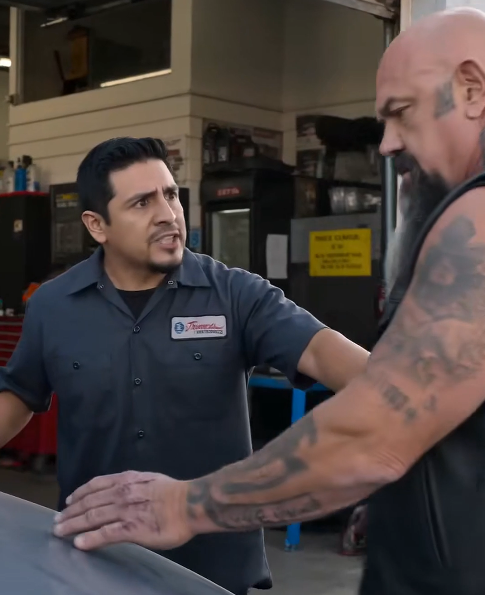
I first saw the Hernández family outside Wilson Auto Care on Central Avenue in Albuquerque, New Mexico, just after seven on a cold Thursday morning. The father stood beside an old blue Honda Odyssey with both hands pressed against the roof, while his wife held a wrinkled invoice and tried to understand words the manager was repeating louder instead of more clearly.
Their son sat on the curb.
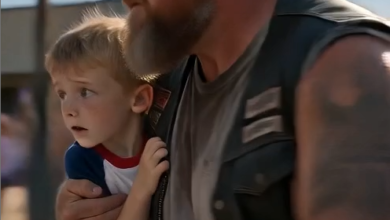
He looked about nine. His name, I would later learn, was Tomás. He wore a red school sweater beneath a jacket too thin for the morning wind, and he held three workbooks against his chest as though someone might take those too.
The garage manager pointed at the invoice.
“Transmission,” he said. “Completely gone. You already approved the work.”
The father, Javier Hernández, shook his head. “No complete. You say check.”
“You signed.”
“Only check car.”
“You signed the authorization.”
Javier looked toward his wife, Lucía. She stared at the paper without moving. Neither of them understood enough written English to know whether the page authorized an inspection or a complete transmission replacement. They understood the number at the bottom.
$4,812.64.
They also understood the handwritten note showing a $3,200 cash deposit.
Nearly everything they had saved since arriving in the United States was already inside the garage’s register.
I had stopped at the neighboring parts store because the throttle cable on my Harley felt rough. My name is Ray Dawson, though most men call me Hammer. I was fifty-six, six feet four, nearly two hundred eighty-five pounds, with a shaved head, a thick gray-black beard, faded tattoos across both arms, and knuckles scarred by thirty years of engines.
People tended to notice the leather cut before they noticed the diagnostic scanner in my saddlebag.
Wilson’s manager noticed both.
“Private conversation,” he said as I approached.
I nodded toward the boy. “Doesn’t look private from the sidewalk.”
“Family’s having trouble understanding their repair.”
“I heard.”
“Then you heard the transmission’s shot.”
I looked at the Honda. Dust covered the hood, roof, and fenders. The vehicle was old but cared for. One rear door wore a strip of silver tape. A child’s paper sun had been taped inside the back window. Beneath the windshield lay a school pickup card and two fast-food uniforms.
“What was it doing?” I asked Javier.
The manager answered for him. “Wouldn’t accelerate. Bucking under load. Transmission failure.”
I kept my eyes on Javier.
He searched for words. “Car shake. Light come. No power. But engine…” He made a stuttering sound with his mouth and moved one hand as if something were choking.
That did not sound like a transmission.
“What codes?” I asked.
The manager folded his arms. “We cleared them during diagnosis.”
“You clear codes before completing a repair?”
“We know what we’re doing.”
“Then opening the hood shouldn’t worry you.”
His face changed.
Only slightly.
But I had spent most of my life watching men lie around broken machinery. A liar usually watches your eyes. A mechanic hiding something watches your hands.
The manager stepped between me and the Honda.
“You need to leave.”
Tomás stood from the curb. “Mister,” he asked me carefully, “you fix motorcycles?”
“Some.”
“Can you fix cars?”
“Sometimes.”
He looked at his workbooks. “If car no work, I cannot school. My mom work night. Bus is far.”
Lucía pulled him close and whispered in Spanish. I did not understand every word, but shame has no language barrier. She was telling him not to bother a stranger.
I crouched far enough away that I would not frighten him.
“You miss school today?”
He nodded.
“What’s in the books?”
“Math. English. Science.”
“Which one you like?”
“Science.”
“Then we ought to find out what’s actually broken.”
The garage manager reached for his phone. “I’m calling the police.”
“Tell them to bring a Spanish interpreter.”
That stopped him for half a second.
I called Luis Ortega instead. Luis belonged to the Iron Lanterns and had worked twelve years as a certified court interpreter before opening his welding shop. He answered on the second ring.
“Need you at Wilson Auto,” I said.
“Fight or paperwork?”
“Paperwork.”
“Worse.”
He said he was ten minutes away.
While we waited, I asked Javier for permission to inspect the Honda. He looked toward the manager, then toward the invoice, uncertain whether the car still belonged to him in any practical sense.
The manager said the vehicle could not leave until the outstanding balance was paid.
“That’s not what I asked,” I said. “I asked the owner.”
Javier placed one trembling hand on the hood.
“Open.”
The manager refused to release the keys.
Tomás reached into his backpack and produced a spare. His father had given it to him months earlier because the boy liked unlocking the van after school. He held it toward me with both hands.
The manager stared at that small key as though it were a weapon.
I unlocked the Honda, released the hood, and raised it.
The engine bay carried twelve years of road dust. Hoses were faded. Aluminum surfaces had oxidized. Nothing looked recently disassembled—except one clean bolt on the air-filter housing and two fresh fingerprints on the intake tube.
I removed a compact scanner from my saddlebag and connected it beneath the dashboard.
The stored codes appeared.
No transmission codes.
Not one.
The computer reported an airflow problem and an engine running too lean. I followed the intake tube with my fingers until I found a split hidden beneath the clamp. When the engine shifted under acceleration, the crack opened, allowing unmetered air inside. The motor bucked. Power dropped. The warning light came on.
A replacement tube cost less than forty dollars.
Then I noticed something worse.
The crack had been turned downward where the family could not see it, and the clamp bore fresh tool marks. Someone had inspected the tube, found the problem, rotated it out of sight, then written an estimate for a rebuilt transmission.
I looked toward the garage manager.
He had gone pale.
Luis’s Harley rumbled into the lot. Two more bikes followed him. The manager backed toward the office, still holding his phone.
I showed Javier the scanner, the split tube, and the untouched transmission casing. Luis translated each sentence into Spanish.
Javier listened without blinking.
Then Lucía opened her handbag and removed a small bank envelope. Inside was the receipt for the cash deposit—and a withdrawal slip showing the money had been saved for something other than a vehicle.
At the top was the name of an immigration attorney.
The $3,200 had been meant to keep their family together.
The manager had known.
And taped beneath the invoice was a second document containing three other names, three other immigrant families, and three nearly identical “transmission failures.”
That was when this stopped being a dishonest repair.
It became evidence.
Part 2 — The Money Inside the Envelope
Luis translated the invoice line by line while we stood beneath the open hood. The morning traffic moved along Central Avenue, tires hissing over pavement still damp from overnight rain, but the Hernández family seemed to be standing somewhere outside that sound.
The first page authorized a diagnostic inspection for $129. The second page approved “necessary repairs up to the estimated amount,” language printed in smaller type beneath a signature box. Javier’s name appeared on the line.
The signature was his.
The meaning had not been.
A handwritten note stated that the manager, Wade Wilson, had explained the repair verbally and received informed authorization. According to Javier, Wilson had pointed at the page and said, “Check car. Sign here.”
Luis asked the family what happened next.
Lucía answered first. Her Spanish came quickly, then slowed as emotion tightened her voice. They had brought the Honda in three days earlier after it began losing power on the highway. Wilson told them the transmission was failing and the vehicle was dangerous to drive.
He said the repair would normally cost nearly six thousand dollars.
But he could help them.
If they paid $3,200 cash immediately, he would order a rebuilt transmission at a special price. They could pay the remaining balance when the work was finished. He drove Javier to their credit union, waited outside while the family withdrew its savings, and returned with them to collect the money.
That detail made Luis stop translating.
“He drove you to the bank?”
Javier nodded.
“Did you ask him to?”
“No. He say car no safe. He help.”
Wilson had sold coercion as kindness.
The $3,200 represented four years of small sacrifices. Javier worked maintenance at an apartment complex during the day and cleaned restaurant kitchens three nights a week. Lucía worked at a commercial laundry from four in the afternoon until midnight. They lived in a two-bedroom duplex with Lucía’s sister and bought nearly everything secondhand.
The savings had a specific purpose.
Javier’s work permit required renewal, and the family had hired an immigration attorney after receiving paperwork they could not understand. The attorney wanted a retainer within two weeks. Losing that money would not automatically remove them from the country, but fear does not wait for legal nuance. To Javier and Lucía, the empty account meant a door closing behind their children.
Tomás understood only part of the situation.
He knew the van carried his mother to work, his younger sister to medical appointments, and him to a magnet school six miles away. The school bus did not serve their address because he had transferred through an academic program. If the van stayed broken, he believed he would lose his place.
That was why he held his workbooks.
They were not homework.
They were proof of the future he feared losing.
I asked Wilson to return the deposit.
He stood inside the garage doorway, arms folded across a clean polo shirt with the business logo embroidered above his heart.
“The transmission was ordered,” he said.
“Show us the order.”
“Supplier’s closed.”
“It’s seven-thirty on a weekday.”
“Different time zone.”
“Show us the invoice.”
“That’s proprietary.”
I pointed at the Honda. “That transmission hasn’t been touched.”
“We haven’t begun removal.”
“Then refund the money.”
“Special-order parts are nonrefundable.”
Luis translated each exchange for Javier and Lucía. Their expressions changed as they understood how many different excuses could be built around one lie.
Wilson told us to leave his property.
I said the family would leave as soon as the Honda was safe and their money returned.
He called the police.
Two Albuquerque officers arrived nine minutes later. By then, four Iron Lanterns stood near the van: Luis, Clay, Noah, and me. We kept our helmets on the motorcycles and our hands visible. Nobody blocked the garage doors.
Wilson met the officers first.
He described an aggressive motorcycle gang interfering with a lawful transaction. He said I had entered a customer’s vehicle without permission and accused him of fraud in front of his employees.
The officers looked toward us.
I understood what they saw: four large men in leather, one open hood, a frightened family, and a business owner claiming intimidation.
So I did not speak first.
Luis did.
He identified himself as an interpreter, explained the family’s limited English, and asked whether the department could provide a qualified Spanish-speaking officer. One of the responding officers, Sergeant Elena Ruiz, spoke Spanish fluently.
She separated everyone.
Ruiz interviewed Wilson inside his office while her partner spoke with me. Then she sat with the Hernández family inside their van and listened for nearly twenty minutes.
When she returned, she examined the paperwork.
“This appears to be a civil dispute,” she said.
Wilson smiled.
“But,” Ruiz continued, “the allegation of deceptive authorization and the circumstances of the cash payment can be documented.”
His smile disappeared.
She asked to see proof that the transmission had been ordered.
Wilson refused.
The officer could not force him without a warrant or an active criminal investigation. She explained that the family could file complaints with the New Mexico Attorney General’s Consumer Protection Division and the city office handling business licensing. They could also pursue the money through civil court.
Every option required English, time, transportation, and confidence.
Wilson knew that.
Scams like his do not depend only on deception. They depend on the victim becoming too tired to fight.
The police left after creating an incident report. Wilson interpreted their departure as victory.
“Get the van off my property,” he said. “Storage fees start at noon.”
Javier’s shoulders fell.
That was when I asked whether Wilson objected to us repairing the vehicle on the public curb.
“You touch it, you own the problem.”
“Good.”
With Ruiz still watching from her patrol car, we pushed the Honda beyond the property line. Noah rode to the parts store and returned with a replacement air-intake tube, two clamps, and a fresh filter.
The total came to $38.47.
I laid every item on the hood so Luis could photograph it beside the original estimate. Then I showed Tomás the cracked tube.
“This is what stopped your car.”
“That little thing?”
“That little thing.”
“Not transmission?”
“No.”
He stared back at the garage. “Why the man say big thing?”
Because a frightened customer is easier to charge than an informed one. Because Wilson had seen limited English and mistaken it for limited intelligence. Because people who sell fear know the victim will often pay to make the fear stop.
I could have said all that.
Instead, I told him, “Sometimes people make a problem sound bigger so they can make themselves look necessary.”
Tomás considered the answer.
“Are you necessary?”
“No,” I said. “That’s why I’m showing you how.”
I gave him a flashlight.
For the next twenty minutes, he stood beside me while I removed the damaged tube, installed the new one, checked the connections, and cleared the codes. His hands never touched a hot or moving part. He watched every tool. He asked why the crack changed the engine’s sound and why the computer light had appeared.
When I started the Honda, the idle settled.
No stumble.
No warning light.
I drove it around the block with Javier and Sergeant Ruiz beside me. Acceleration was smooth. The transmission shifted normally through every gear.
We returned to the garage.
Wilson had locked his office door.
On the glass, someone had taped a handwritten sign claiming the business was closed for an inventory emergency.
But through the side window, I could see him feeding documents into a shredder.
And Lucía recognized the name on the top page.
It belonged to a woman from her church.
Part 3 — Twenty Minutes Under an Open Hood
Lucía called the woman immediately.
Her name was Maribel Santos, a hotel housekeeper and single mother of two. Six months earlier, Wilson Auto Care had charged her $2,700 for a rebuilt transmission after her sedan began stalling at traffic lights. The repair took one day. She received no warranty paperwork and no serial number for the replacement unit.
The car began stalling again three weeks later.
Wilson told her the engine now needed work.
Maribel could not afford another repair, so she sold the car for eight hundred dollars to a wholesaler recommended by Wilson himself.
Luis translated the story while I watched movement behind the office blinds.
One victim can be dismissed as a dispute.
Two establish a question.
Three create a pattern.
The second document taped beneath the Hernández invoice listed Maribel’s name, a man named Abdul Rahman, and a woman named Srey Mom Chan. Each entry included a dollar amount and the same abbreviation: RT CASH.
Wilson claimed it meant rebuilt transmission, cash payment.
I had worked in garages for three decades. No standard repair notation used those initials in that way.
To me, it meant returning target or repeat target—customers who could be pressured again.
We could not prove that yet.
Sergeant Ruiz had not left. She saw Wilson shredding paperwork through the window and returned to the office door. Destroying business records was not automatically a crime, but doing so after a documented fraud allegation gave her reason to preserve what she could lawfully observe.
She knocked.
Wilson did not answer.
Ruiz called him through dispatch. We watched him look at his ringing phone and ignore it. Then the shredder stopped.
A younger mechanic stepped out through the rear bay.
He could not have been older than twenty-two. His coveralls bore the name Eli, and anxiety made him move as if he expected someone to grab him.
I kept my distance.
“You work on the Honda?” I asked.
He glanced toward the office. “I’m not talking.”
“Fair enough.”
He walked toward an old pickup in the alley.
Then Tomás held up the cracked intake tube.
“Did you see this?”
Eli stopped.
The boy was not accusing him. He was asking the way he had asked me about airflow and warning lights, with the open curiosity of someone who still believed adults would tell the truth if given a clear question.
Eli looked at the tube.
“I found it Monday,” he said.
Every person in the lot went still.
“What did you tell Wilson?” Ruiz asked.
Eli hesitated. “That it needed an intake boot. Maybe a sensor test after replacement.”
“What did he tell you?”
“To rotate the split downward and park the car outside.”
Wilson opened the rear door.
“You’re fired,” he shouted.
Eli flinched.
Ruiz stepped between them. “Mr. Wilson, go back inside.”
“He’s stealing company information.”
“I’m describing a repair I inspected,” Eli said, his voice shaking. “That isn’t yours.”
Wilson looked at the bikers and accused us of threatening his employee.
Eli shook his head.
“Nobody threatened me.”
That sentence changed the legal shape of the morning.
Ruiz asked Eli whether he would provide a written statement. He agreed. Luis offered to remain as a witness, but Ruiz kept the interview separate to protect its integrity.
While they spoke, I finished documenting the Honda. I photographed the old intake tube, fresh clamp marks, scan results, transmission casing, odometer, and every page of the invoice. I gave the images to Javier and backed them up to a secure drive.
I also wrote a diagnostic report on my garage letterhead.
Customer complaint: hesitation, bucking, reduced power.
Codes retrieved: airflow and lean-condition faults; no current or stored transmission faults.
Inspection: split air-intake tube beneath clamp; recent rotation concealed visible damage.
Repair: replace intake tube and air filter; clear codes; complete road test.
Labor time: twenty minutes.
Total charged: zero.
Javier read the Spanish translation and stared at the last line.
“No money?”
“No money.”
He reached into his pocket anyway. I closed his fingers over the bills.
“Keep it.”
“I pay part.”
“No.”
“Why?”
Before I could answer, Tomás asked the same question.
“Why help strangers?”
The boy stood beside the open hood, his red sweater smudged with dust from leaning over the engine. His workbooks now rested safely on the passenger seat.
I wiped my hands on a rag.
“Because the street is hard enough,” I said. “It doesn’t need more people selling fear to those without a voice.”
Luis translated.
Javier lowered his head. Lucía looked away and pressed one hand over her mouth. Tomás did not smile. He absorbed the sentence with the seriousness children reserve for words they suspect might matter later.
Then he pointed toward my Harley.
“Who fixes that?”
“I do.”
“Who teach you?”
That question carried me back thirty-four years.
I had been twenty-two when I began working at Baker’s Service outside Gallup. The owner, Don Baker, hired men other garages rejected. I had a juvenile record, a temper, and more confidence than skill. Baker taught me to diagnose before replacing parts and to listen to an engine before believing a customer’s description.
He also taught me how a dishonest shop hides theft inside technical language.
Baker overcharged tourists and elderly drivers. He found repairs likely to frighten people—brakes, transmissions, steering—and used those words before completing a diagnosis. He called it “selling the risk.” I watched him convince a widowed Navajo woman that her pickup’s brakes were failing when it needed a twelve-dollar switch.
I knew the truth.
I stayed silent because I needed the job.
She paid with grocery money.
Three weeks later, she returned carrying a bag of canned food she wanted to exchange for part of the bill. Baker laughed after she left.
I quit that afternoon.
But quitting did not return her money. It did not undo my silence. For years, I kept the twelve-dollar brake switch in my toolbox as the cheapest part that ever cost me sleep.
That was why I knew Wilson’s methods. Men like him rarely invented new lies. They inherited them, refined the paperwork, and learned which customers were least likely to challenge the vocabulary.
I did not tell Tomás all of that beside the Honda.
“An honest mechanic taught me some things,” I said. “A dishonest one taught me the rest.”
By noon, Eli had completed his statement. He also provided Ruiz with photographs stored on his phone. For months, he had documented invoices that did not match the repairs he performed. He had not known what to do with them and feared losing his apprenticeship.
Several showed vehicles billed for rebuilt transmissions even though no transmission had been removed.
One image showed Maribel Santos’s sedan on a lift.
The original factory transmission remained in place.
Wilson had taken $2,700, performed no transmission repair, and later arranged to buy the car cheaply when the actual engine problem returned.
The family’s case was no longer a misunderstanding over an estimate.
It was evidence of deliberate, repeated fraud.
Yet Wilson still had their $3,200.
And when officers requested access to the records inside his office, he demanded a warrant, closed the garage doors, and left through a rear exit.
We watched his truck turn onto Central Avenue.
Clay started toward his motorcycle.
I blocked him.
“We could follow.”
“No.”
“He’s leaving with their money.”
“Then we make the law follow the paper.”
Clay hated that answer. So did I.
But the Hernández family did not need bikers chasing a garage owner through Albuquerque. They needed witnesses who would still look credible when the complaint reached a judge.
So we stayed.
We gathered documents.
We called the right people.
And Tomás went to school in a van repaired for $38.47.
He arrived before science class ended.
Part 4 — The Files Nobody Was Expected to Read
The formal complaints began that afternoon.
Luis sat beside Javier and Lucía at our clubhouse, translating every question on the Attorney General’s consumer form. Marisol Vega, an Iron Lantern who worked as a paralegal, organized the photographs, police report, repair estimate, withdrawal receipt, diagnostic results, and Eli’s written statement.
Our clubhouse had never looked so quiet.
Men who usually argued about routes and carburetors sat around folding tables scanning documents. Coffee replaced beer. A printer ran until its paper tray overheated. Leather vests hung over chair backs while bikers sorted evidence into labeled binders.
This was brotherhood without engines.
Marisol warned us not to publish accusations online while the investigation remained active. She also told us not to contact Wilson’s other customers directly in any way that could be interpreted as harassment.
“We document,” she said. “We don’t perform justice ourselves.”
Clay disliked the phrase.
“What if justice takes six months?”
“Then we document for six months.”
It took longer.
The Attorney General’s office acknowledged the complaint within two weeks. Albuquerque’s consumer-affairs unit opened a preliminary investigation. The police referred Eli’s statement to an economic-crimes detective, but proving criminal intent required more than showing that a diagnosis was wrong. Prosecutors needed evidence that Wilson knowingly charged for work he did not perform.
Wilson hired a lawyer.
Through that lawyer, he claimed Eli had sabotaged vehicles after being fired. He accused me of altering the intake tube and intimidating the Hernández family into participating in a dispute. He said the $3,200 had been forwarded to a transmission supplier and could not be refunded until the order was canceled.
No supplier invoice appeared.
Meanwhile, Javier and Lucía still needed the immigration attorney’s retainer.
The club offered to pay it. They refused.
“We work,” Javier said. “We pay.”
Pride was not the obstacle. Dignity was. They had already endured one man treating limited English as helplessness. They would not accept another group making decisions for them, even generously.
So we asked what they needed instead.
Transportation to extra shifts.
Childcare during appointments.
Translation.
Help understanding letters.
Those things they accepted.
Luis drove Lucía to work on nights when Javier used the Honda. Marisol attended legal appointments as an interpreter when permitted. Clay repaired the van’s rear door without charging labor, though Javier insisted on purchasing the parts.
Tomás began visiting my garage on Saturday mornings.
He never arrived without schoolwork. He sat on an overturned bucket near my workbench, completed math problems, then asked to inspect whatever harmless component I had removed that day. I taught him how to identify worn belts, read tire dates, and understand the difference between a symptom and a diagnosis.
“A sound is a clue,” I told him. “Not a verdict.”
That applied beyond engines.
The first break in the case came from Maribel Santos. With Luis translating, she filed her own complaint and supplied the sale documents for her sedan. The wholesaler who purchased it was a shell company registered to Wilson’s brother-in-law.
The car had never left Albuquerque.
It was cleaned, given a minor engine repair, and resold two weeks later for $6,900 with the original factory transmission.
Then Abdul Rahman came forward.
Wilson had charged him $3,400 for a transmission replacement on a delivery van. Abdul’s teenage daughter spoke fluent English and had questioned the lack of warranty paperwork. Wilson told her the supplier had misplaced it.
A dealership later confirmed the transmission serial number matched the original assembly installed at the factory.
Srey Mom Chan brought another invoice.
So did a retired janitor.
Then a single mother.
Then an elderly man who communicated through American Sign Language and believed he had approved brake work totaling six hundred dollars. Wilson charged him $2,900 for a steering repair he never requested.
A pattern emerged.
Wilson targeted customers who faced language, age, disability, or financial barriers. He did not scam every vulnerable person. That would have made the pattern obvious. He selected customers who paid in cash, lacked technical knowledge, or were unlikely to navigate complaint systems.
The documents taped beneath the Hernández invoice were part of a handwritten follow-up list.
“RT CASH” meant return customer—cash preferred.
Eli confirmed it.
He also revealed that Wilson kept two versions of certain work orders: one describing the actual low-cost repair performed by employees, another showing an expensive assembly replacement billed to the customer.
The second version went into the accounting system.
The first stayed inside a locked cabinet.
Detectives obtained a warrant.
When officers searched Wilson Auto Care, the cabinet was empty. The shredder contained fragments too damaged for immediate reconstruction. Wilson’s computer had been wiped the morning of the raid.
It appeared the evidence was gone.
Then Noah noticed something in one photograph Eli had taken.
Mounted above Wilson’s service desk was a security camera. The shop advertised twenty-four-hour surveillance to discourage theft. If recordings were stored off-site, they might show which vehicles actually entered the repair bays, how long they remained on lifts, and whether major components were removed.
Police obtained records from the security provider.
Wilson had canceled the service four days after the Hernández confrontation.
The company still retained thirty days of cloud footage.
That footage showed no transmission deliveries.
No removed units.
No rebuilt assemblies.
For seven separate customers billed for transmission replacement, the vehicles remained inside the bay for less than ninety minutes—far too little time to complete the documented work.
One recording captured Wilson instructing Eli to rotate the Hernández family’s damaged intake tube.
There was no audio.
None was needed.
Eli pointed to the crack. Wilson looked toward the office, rotated the tube downward himself, and closed the hood.
The investigation now had a lie caught in motion.
Wilson was arrested on multiple counts related to fraud, forgery, and deceptive business practices. He posted bond the same evening. His shop remained closed while the licensing review continued.
But the seized accounts contained less than twelve thousand dollars.
Investigators had identified more than twenty possible victims whose combined losses exceeded ninety thousand.
The Hernández family’s savings appeared to be gone.
At the clubhouse, Clay punched a steel locker hard enough to split his knuckle.
“We proved it,” he said. “They still lose.”
Marisol handed him a clean rag.
“Proof and repair are different jobs.”
The sentence stayed with me.
We had fixed the van.
Now we had to help repair what the lie had taken from the family without turning them into a charity project or ourselves into heroes.
The answer arrived from someone none of us expected.
Don Baker—the dishonest garage owner I had worked for thirty-four years earlier—was still alive.
And after seeing a local news report about Wilson, he called my shop.
Part 5 — The Twelve-Dollar Switch
Don Baker was eighty-one and living in an assisted-care apartment outside Gallup. His voice sounded thinner than I remembered, but the old habit of beginning every sentence as though he controlled the room remained intact.
“You told reporters somebody taught you how fear gets sold,” he said.
I had not mentioned his name.
“You recognized yourself?”
“I recognized the brake switch.”
My hand tightened around the phone.
I kept that switch in the top drawer of my toolbox. Yellowed plastic. Two metal contacts. Twelve dollars in 1992.
The Navajo widow’s name had been Alice Begay. Her pickup’s brake lights remained on after she removed her foot from the pedal. Baker told her the hydraulic system was failing and charged for a master cylinder, brake booster, and labor he never performed.
I replaced the switch.
He billed her $614.
She returned later with canned beans, corn, and soup because she lacked enough cash for groceries and hoped Baker might refund part of the charge. He refused.
I watched.
Then I quit.
For three decades, I told myself leaving had separated me from what happened. It had not. Silence completed the transaction.
“What do you want?” I asked.
“To give the money back.”
“Alice died eighteen years ago.”
“I know.”
“How?”
“I looked.”
That answer surprised me.
Baker said he began tracking former customers after his wife died. He found some. Not all. He mailed anonymous checks to several. Others had moved or passed away. He had never found Alice’s surviving family.
“Why call now?”
“Because that boy on television was holding schoolbooks.”
The news report had shown Tomás beside the Honda. Reporters concealed the family’s address but used their names with permission. Baker saw the boy and remembered Alice carrying groceries she could not afford to surrender.
His remorse did not erase the theft.
But remorse that stays private is often only another form of self-protection.
“What are you offering?” I asked.
Baker owned the building that had housed his old service station. He wanted to sell it and use part of the proceeds to reimburse verified victims of dishonest auto repairs, beginning with the Hernández family and Alice Begay’s descendants if they could be found.
I did not trust him.
So I called Marisol.
She arranged a meeting with Baker, his attorney, representatives from a consumer-law nonprofit, and a Navajo legal-aid organization. Every commitment had to be written. Funds would enter an independently administered account. Baker would control neither the recipients nor the publicity.
He agreed.
We found Alice’s granddaughter in Arizona.
Her name was Leah Begay, and she remembered the pickup. She also remembered her grandmother skipping meals during the month after the repair. When Baker’s attorney offered repayment with interest, Leah accepted only after the fund agreed to finance vehicle-safety workshops in rural communities.
“This isn’t forgiveness,” she said during the meeting.
Baker nodded.
“I know.”
“It doesn’t make you good.”
“I know.”
“It means you finally stopped keeping what wasn’t yours.”
He lowered his eyes.
“Yes.”
The Hernández family received $3,200 from the fund before Wilson’s criminal case concluded. Javier insisted on signing a document promising to return any restitution later recovered through court. The fund’s attorney told him the recovered money would instead help the next victim.
Lucía paid the immigration attorney.
Their paperwork was filed on time.
Weeks later, the judge ordered Wilson to provide restitution as part of a plea agreement resolving several charges. He lost his business license, received a suspended prison sentence conditioned on compliance, and was placed under strict probation. Some people believed the punishment was too light. Others argued incarceration would not recover anyone’s savings.
I had opinions.
I kept most of them private.
The court ordered Wilson to attend the first restitution meeting in person. Victims could give statements if they wished. Javier spoke through an interpreter.
He did not describe the van first.
He described Tomás.
“My son thinks when adults use difficult words, it means he must obey,” Javier said. “He saw me sign something I did not understand. He saw you take our money. Now when a teacher gives him paper, he asks whether someone is hiding something.”
Wilson looked down.
“You did not only sell repair,” Javier continued. “You sold fear inside my son.”
Lucía placed the cracked intake tube on the evidence table.
It had become the central object in the case: thirty-eight dollars of rubber beside an estimate for nearly five thousand.
She asked Wilson whether he remembered rotating the crack downward.
He said nothing.
The judge ordered him to answer.
“Yes.”
“Why?”
His lawyer leaned close, but Wilson had already spoken.
Lucía did not shout. She did not call him evil. She asked one final question.
“Did you think we were stupid?”
Wilson swallowed.
“I thought you wouldn’t challenge it.”
Luis translated.
The difference between those sentences was small.
The truth inside them was not.
After the hearing, Wilson approached me in the corridor. A court officer remained nearby. He looked older than he had at the garage.
“You made this bigger than it had to be,” he said.
“No. You picked people you thought couldn’t make it big.”
“You think your club scared me?”
“If we wanted fear, we would’ve brought noise. We brought translators.”
He glanced toward Javier and Lucía, who were speaking with Marisol.
“I lost everything.”
“You lost a business built on money that wasn’t yours.”
He stepped closer. “And Baker gets to buy redemption?”
“No.”
That answer stopped him.
“He gets to pay a debt,” I said. “Redemption isn’t a receipt.”
Outside the courthouse, Tomás waited beside my Harley. He had grown fascinated by the exposed fins, cables, and mechanical connections. I let him hold the old twelve-dollar brake switch from Baker’s garage.
“This did all that?” he asked.
“The lie did. The part just proved it.”
He turned the switch in his hand.
“Why keep it?”
“So I remember what silence costs.”
Tomás gave it back.
Then he removed a folded science worksheet from his backpack. At the top, he had drawn a simple engine with arrows showing air entering through a tube.
His teacher had given him an A.
“I told class about diagnosis,” he said.
“What’d you tell them?”
“A clue is not a verdict.”
I smiled.
The boy had remembered.
Part 6 — Saturday Mornings at the Garage
The Hernández family’s Honda remained on the road for another four years.
Every few months, Javier brought it to my shop before sunrise. He paid for parts, refused discounts he had not requested, and waited while I explained each repair. Lucía kept every estimate inside a blue folder. She asked Luis to translate until her English became strong enough to question us herself.
Tomás came on Saturdays.
At first, he swept floors and organized sockets. Then he learned tire pressure, battery safety, and how to read a repair manual. By twelve, he could identify basic engine sensors. By fourteen, he understood that the best mechanics were not the ones who named the most expensive failure first.
They were the ones willing to say, “I don’t know yet.”
The Iron Lanterns began hosting free vehicle-inspection mornings every three months. We partnered with legal-aid groups, churches, refugee organizations, and a community college. Certified interpreters volunteered in Spanish, Vietnamese, Arabic, Dari, and American Sign Language.
We did not perform every repair for free. That would have been impossible and, sometimes, unsafe. We inspected vehicles, explained estimates, photographed problems, and helped owners compare options.
Most garages were honest.
We said that clearly.
Good mechanics deserved trust, and dishonest ones harmed them too.
Don Baker’s restitution fund paid for printed guides explaining common repair terms in five languages. The covers showed photographs of actual parts beside plain explanations: brake pads, alternators, batteries, sensors, belts, and transmissions.
The transmission page included one sentence in bold:
An expensive diagnosis should come with evidence.
Eli joined my garage after completing a formal apprenticeship. He almost refused the job because he believed staying silent at Wilson’s shop made him unworthy.
I showed him the twelve-dollar switch.
“Shame can warn you,” I said. “Don’t let it become your address.”
He became one of my most careful technicians.
Sergeant Ruiz visited inspection mornings when off duty. She taught families how to document disputes without escalating them: obtain written estimates, photograph the odometer, request returned parts, keep receipts, and never sign blank forms.
Marisol helped establish a nonprofit clinic called Roadside Voice. It provided translation and second-opinion support for low-income drivers. Our club funded the first diagnostic scanner through a charity ride.
The event ended at the old Baker service-station building, now converted into a training center.
Baker attended the opening in a wheelchair.
Leah Begay stood beside him but did not pose for photographs. She had agreed to serve on the fund’s oversight board. Their relationship was not friendship. It was accountability carried in public.
Baker asked to see me privately after the ceremony.
“You still have the switch?”
I showed him.
He touched the plastic but did not ask to hold it.
“I used to think guilt meant I still had a conscience,” he said.
“Maybe.”
“You don’t sound convinced.”
“Conscience is what you do next.”
He nodded.
Three months later, Baker died.
His estate transferred the building permanently to the nonprofit. No plaque bearing his name was installed. Leah requested that the training room be named for Alice Begay instead.
Above its workbench hung an enlarged photograph of the twelve-dollar brake switch.
Beneath it were six words:
SHOW THE PART. EXPLAIN THE TRUTH.
Tomás was sixteen when the Honda finally failed beyond practical repair. The transmission, after more than two hundred thousand miles, genuinely wore out.
Javier called me.
We inspected it together.
This time, the diagnosis was real.
Tomás stood beneath the lift while I showed him the fluid, internal debris, and test results. His face tightened when he heard the word that had frightened his family years earlier.
“Transmission,” he said.
“Yeah.”
“Can fix?”
“Can.”
“Should fix?”
I looked at the rust beneath the van, the aging suspension, and several repairs waiting behind the transmission.
“No.”
He nodded slowly.
An honest mechanic must sometimes tell a family not to pay him.
The club helped them locate a reliable used vehicle. Javier negotiated the price himself in English. Lucía read every page before signing. Tomás inspected the engine and asked for service records.
Before they traded the Honda, he removed the paper sun from the back window.
Then he asked for the cracked intake tube we had saved from that first morning.
He placed it in his school backpack.
Part 7 — The Mechanic Who Asked One More Question
Tomás graduated high school with honors and enrolled in the automotive program at Central New Mexico Community College. He could have studied anything. For years, I worried that becoming a mechanic would tether him to the morning his family was humiliated.
He explained it differently.
“A bad mechanic made my father feel small,” he said. “A good mechanic opened the hood.”
During his second year, Tomás began working part-time at Roadside Voice. He spoke English and Spanish fluently and had learned enough Guatemalan K’iche’ from his grandparents to help older community members understand basic repairs.
He never began with the invoice.
He began with the person.
“What did the car do?”
“When did it start?”
“What did you hear?”
“What are you afraid will happen?”
That last question mattered because fear often arrives before diagnosis. A parent is not only worried about a battery. They are worried about missing work. A student is not only worried about brakes. She is worried about losing school. A newly arrived family may hear “transmission” and imagine every door closing at once.
One Saturday, a Somali father arrived with two children and an estimate for a complete engine replacement. His sedan shook at idle and lost power.
Tomás opened the hood.
Fifteen minutes later, he found a loose ignition-coil connector.
The repair cost twelve dollars.
I watched from across the garage while he explained the problem through an interpreter. He showed the father the damaged connector, the scan result, and the completed repair. Then he placed the expensive estimate beside the tiny part without making a speech.
The man’s daughter asked why he had checked again when another garage had already given them an answer.
Tomás glanced toward me.
For a moment, I saw the nine-year-old boy holding schoolbooks beside a blue Honda, believing a stranger’s technical words might end his education.
He crouched beside the girl.
“Because a clue isn’t a verdict,” he said.
After they left, Tomás opened his toolbox. Inside lay the cracked intake tube from his family’s van and Baker’s old brake switch. I had given him the switch when he earned his first professional certification.
Two cheap parts.
Two expensive lies.
Two reminders that knowledge matters most when it is shared with someone being pressured into silence.
That evening, we closed the garage together. Luis and Clay waited outside beside their Harleys. The V-twins rolled low against the cooling pavement while Tomás locked the bay doors.
He was twenty-one now.
Tall. Quiet. Certain with tools.
Before climbing onto my motorcycle, I asked why he had waived the father’s diagnostic fee.
Tomás smiled.
“Because the street is hard enough.”
He did not need to finish.
We rode east along Central Avenue as the garage lights faded behind us. In Tomás’s toolbox, the small broken parts waited beneath a clean white rag.
Follow our page for more unforgettable biker stories about quiet courage, second chances, and strangers who refuse to let fear have the final word.