Twenty Bikers Led a Youth Soccer Coach Off the Field — What a Father Found Before the Match Stopped
I watched twenty bikers walk onto a children’s soccer field and take the coach by both arms while the game was still moving, and for one terrible minute even I thought we had become the thing the parents feared.
My name is Ray Mercer. I was fifty-four that spring, thick through the shoulders, gray beard down to my chest, and the president of a riding club whose members worked regular jobs in and around Dayton, Ohio. My daughter Lily played defense for the eleven-and-under Tigers. I had spent most Saturdays standing beside a folding chair with a travel mug in my hand, trying to understand why a referee could watch a ball strike a shin and call nothing at all. At that field, I was a father first, and the motorcycles parked beyond the fence were mostly a way of getting there.
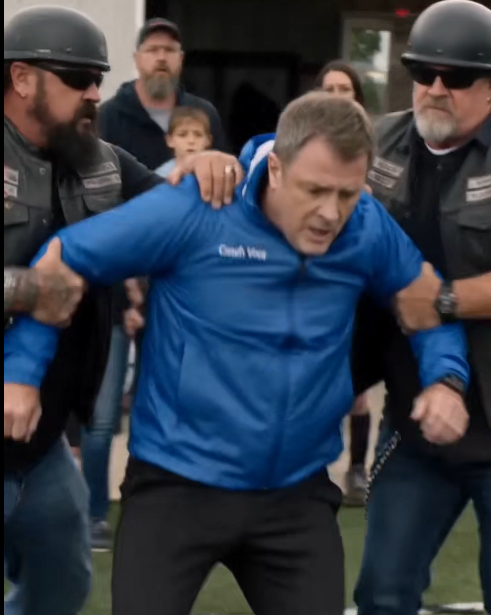
The coach, Martin Voss, wore a blue windbreaker with a whistle around his neck. He was saying something to the children clustered near the sideline when Hank reached him. I saw Hank put one hand lightly around Voss’s upper arm, and Voss twisted as if the field had suddenly tilted. Boone stepped to the other side. Then the other men formed a broad, uneasy line between Voss and the children, leaving an open route to the parking lot. From the bleachers, it looked like an organized abduction. A mother shouted that somebody should call the police. Another parent already had his phone raised.
The whistle bounced against Voss’s chest. He shouted, “You can’t do this.” Behind me Lily stood motionless in her striped socks with one cleat on the chalk line, and I made myself look at her face. She was watching us decide what kind of men we were.
I lifted both hands where the parents could see them. “Kids to the assistant coaches,” I said. “Nobody touches him again.” My voice carried farther than I expected, perhaps because no engine was running and the match had stopped. The assistant coach, a college student named Ana, gathered the children and led them toward the far goal. My wife Carol went with them. Hank and Boone let go immediately, although they stayed nearby. Voss took a step after Ana; I stepped into the space between them and asked him to wait for the officers already on their way.
“You brought twenty men to intimidate me?” he demanded. That was a fair description of how it looked, and looking bad mattered when every child on that field could see it. A little boy started crying because he thought his coach was being arrested. One parent demanded my name. Another demanded that I stop filming, although my phone was in my pocket. There were videos from three directions by then, none beginning early enough to show what had happened beside the equipment shed five minutes before.
I had arrived with one motorcycle, not twenty. The rest of the club had been at a breakfast stop down the road. Hank was the parent who had called them, his words clipped so badly over the phone that Boone thought Lily had been injured. Hank had looked down at something on his screen near the shed, then at Voss, then at the children. His face had changed. I had never seen him look that frightened while standing perfectly still.
He had shown me a photograph. Not a blurry screenshot with a cruel caption, but a face on an official-looking public record that required more checking than the few seconds he had allowed himself. I recognized the cheek scar on Voss’s left side and the unusual spelling of his full name; recognition was not proof. Before calling anyone else, I had asked Hank where he found it, whether the birth date matched, and whether he had already told the league. He said no. He said he had been trying to reach me because the coach had just asked three children to help carry bags into the back equipment room.
I sent Carol to stay with Lily, told Hank to call the league director, and dialed the police dispatch line myself. While we waited, Voss walked toward the equipment room. Hank panicked, and the men coming through the gate followed him. That was the instant the parents would remember; I knew it would be the instant the video remembered. I could not take it back. I could only slow what happened next.
Officer Kim’s patrol car turned onto the gravel lot before anyone had laid hands on Voss a second time. She stepped out, looked across the field at twenty leather vests and a stopped children’s game, and kept one hand on her radio. I felt the weight of every parent’s stare on my back.
Hank held his phone toward her. “Please check this,” he said. “Please check the person, not just the picture.”
Kim read the screen, looked up at Voss, and then asked him for a form of identification. He reached toward his pocket, stopped, and glanced past her at the open door of the equipment room. Why had the man tried to go there when the children had already left?
Part 2
At the first match of the season, I had liked Voss. He knew how to make a child who missed the ball try again, and he remembered that Lily preferred to be called Lily rather than Lillian. It made my stomach turn later to recall those ordinary kindnesses. There is a dangerous habit people develop after a discovery: they go back through every memory and paint a warning sign on it. On that first Saturday, nothing about his conduct had made me think a child was unsafe. I had watched closely because I was a parent; I had noticed nothing that would have justified a public accusation.
Hank was different from me. He kept dates, names, and addresses in neat folders because he had learned that a copied rumor could ruin a person. He ran the bookkeeping at a machine shop and rode an old touring bike that smelled faintly of warm rubber. His son Ben was on Lily’s team. Three weeks before the match, a league parent had forwarded Hank a message saying the volunteer screening portal had sent an incomplete result for one coach. It did not name the coach. Hank had asked the league director, Paula, whether the screening was complete; she said she would check and get back to him.
That morning, while he waited for the game, Hank received an email from Paula acknowledging that a document had been omitted from Voss’s volunteer file. She had attached a case reference and was already calling her board. Hank searched the public court record rather than passing the email around. He found a conviction for sexual abuse of a child, attached to a name, birth date, and photograph matching the man coaching beside the field. He did not know whether the record also carried an active restriction or whether a separate person had been confused with him. He knew enough to ask professionals to check immediately.
He came to me behind the equipment shed because I was easier to find than Paula. I remember the blue light on his screen in the morning glare and his index finger resting away from the picture, as though touching it would make it spread. “We need the kids off this side of the field,” he said. I asked if anybody had reported current harm. He shook his head. “I don’t know,” he answered. That distinction mattered. We were acting to separate an adult from a group of children while officials verified an alarming record. We were not announcing that we knew what had happened to any child that morning.
Boone called the club at the breakfast stop, and his message got there before my correction. Twenty of us ended up at the park. Some had helmets under their arms; some had abandoned half-eaten eggs. I met them at the gate and told them clearly, “Keep a lane open, keep your hands to yourselves, keep the children with their adults.” I should have put that instruction in Hank’s ears as well, but he was already watching Voss move toward the equipment building, where the children stored water bottles and spare jerseys.
When he walked onto the grass, he did not look like a man trying to protect privacy. He looked like a man afraid he would miss the only chance he had to move Voss away. He took an arm. Boone, seeing him, took the other. The rest of us followed before we had settled what “follow” should mean. A group can make a bad decision in one collective step. I shouted for the children to move toward Ana. Then I shouted for the hands to come off Voss. Both things happened within seconds, but those seconds were enough to frighten an entire sideline.
Now Officer Kim stood in front of us, and Paula was running from the far parking area with her keys in her fist. The parents were divided between anger at us and fear that anger was premature. I asked Kim if I could speak privately. She looked at Voss, asked him to remain near her partner, and took me ten yards away. I told her everything I knew, including where we had crossed a line by putting hands on him. She wrote it down. I did not call that confession a noble act. It was the minimum owed to somebody who had walked into a scene we had made harder to manage.
Paula confirmed that the league had suspended Voss from coaching pending review. The board had not yet spoken to him. Kim said an officer would verify the record and any current legal conditions; she would also need a statement about the physical contact on the field. We had made a scene on the basis of a public record, but the next steps belonged to the league, the police, and, if warranted, the courts. Our vests could not do their work for them.
Part 3
Voss said there was a mistake. He gave his date of birth. It matched the record Hank had shown Kim. His explanation shifted to the age of the case and the fact that he had completed his sentence. Parents close enough to hear began talking over one another. One demanded that the boys and girls be checked immediately; another said she wanted the match restarted because his old conviction did not prove anything had happened here. Both fears were real. Neither could be settled by asking children questions in a crowd of adults with phones out.
Carol brought Lily and Ben to the picnic shelter and sat with them while Ana stayed with the rest of the team. She asked the parents to lower their cameras, then handed Lily a bottle of water. I could see my daughter holding it in both hands without drinking. I wanted to leave the adult conversation and sit beside her. I also knew that if I abandoned the scene, the person best placed to describe what the bikers had done would disappear just when accountability mattered. Protection included staying for questions.
Paula called an emergency board member and gave Ana authority to end the game. She asked Voss for the equipment key. He told her it was on the ring in his left jacket pocket and held it out by the metal loop. In the same motion he tried to step toward the equipment room again, saying he needed his bag. Officer Kim’s partner said someone else could retrieve it after the space was checked. He was not accused of concealing evidence there; the officer simply refused to let a dispute unfold behind a closed door while the field was full of children.
One of our youngest riders, Travis, heard Voss say, “This was years ago,” and took a step forward with his jaw set. His own niece played on the next field. I put my palm against his chest and said, “Back by the fence.” He protested that we were letting Voss talk his way out. I said, “We are letting the officer work.” Travis went to the fence, but he did not forgive me for it that morning. Anger is easier to share than restraint. I had to keep asking the men to do the harder thing.
The league records were another complication. Voss had not simply appeared on the field. Someone had accepted his application, checked a box, assigned him a roster, and given him an equipment key. Paula’s hands shook while she searched messages from the screening vendor. She had received a “review required” notice and assumed the board had completed the review because Voss had been scheduled. The board member thought Paula had done it. Neither of them had. No one could blame a database glitch and go home. A warning existed; the handoff had failed.
Officer Kim’s dispatcher confirmed the court case and told her there might be a current condition requiring further review. Kim did not announce an arrest to the bleachers. She asked Voss to step aside and speak with her partner while they checked the specific terms. She also asked which parents had seen him arrive and whether any child had been taken somewhere out of view that day. Paula said the team had remained together for warmups and the match, except for ordinary bathroom trips with their families. Kim wrote it down as a starting fact, not a verdict about the entire season.
At the shelter, Lily asked Carol if she had done something wrong by listening to her coach. Carol said no. Ben asked if his father had helped or made things worse. Hank heard him from behind the bench and sat down carefully, leaving a space between them. “I was scared and I grabbed an adult,” he said. “I should have waited for the officer. I did get you away from him.” Ben stared at the dirt, then asked whether Hank was going to jail. Children ask the question underneath the question. Hank answered that he did not know what the officers would decide about the grabbing, but he would tell them exactly what he had done.
I had planned to make a statement about what other people failed to notice. Instead, I found myself describing the sound of twenty pairs of boots crossing a field. We had known our numbers would scare Voss; we had forgotten they would also scare Lily. Paula sent the children home with their parents and promised a written message about what the league could verify. She would give families contact details for a child advocate rather than asking them to question each child in a group chat. A parent offered to send her the video. Paula thanked him and asked that it not be posted first.
Kim returned as the last cars pulled away. Her face was steady, and she spoke only to Paula and me. “There is more to check,” she said. “The record is real. Do not turn this into a public naming campaign.” I nodded. A confirmation had narrowed one uncertainty and widened others. We still did not know how an adult with that record had been handed a whistle, or what the children had understood about the men who removed it from him.
Part 4
Monday brought letters. The league sent families a plain account: coaching activity suspended; a screening review in progress; officials had received a verified record; families could contact the police or a child advocacy service privately if they had concerns. It did not attach Voss’s photograph or name the children. Somebody posted my thirty-second field video anyway. In it, Hank and Boone had their hands on a man’s arms, and twenty bikers blocked the camera’s view of the far goal. The clip ended before Officer Kim’s car arrived. Comments accused us of staging a kidnapping for attention. Others congratulated us for beating a man, which we had not done. Both versions made the children into props.
I wanted to write an answer beneath every comment. Carol stopped me with a question: “Will Lily want her name in this tomorrow?” The answer settled it. I gave Kim the full video from a parent who had recorded the call to disperse and our cooperation afterward; I did not post it as a public defense. Boone wanted to release a club statement. I said we could state only what the league and police had cleared, and we had to leave room for the investigation to remain theirs. We told members not to identify Voss online or contact him. A few people called that weak. I had no interest in being strong at a child’s expense.
The police later told the league that the court record belonged to the coach who had been on the field. There was an active condition they needed to evaluate, and officers dealt with him through their own process after obtaining the necessary information. The league removed him from its volunteer roster and began reviewing every adult screening and access key. The details of his original case were not our story to embellish; the facts already established why a youth organization should have paused his application. An old conviction did not give us a license to punish him on the grass, but it did give the league an urgent reason to keep him away while officials checked the rules.
Kim asked me in for an interview about the contact. Hank and Boone gave their own accounts. I did not sit beside them to rehearse lines. We said where each man stood, who touched Voss, who told them to release him, and which direction the children moved. Kim treated our report of concern and our physical conduct as separate matters. That was exactly right. When she asked whether I would make the same call again, I said I would call her sooner, stop the match, bring the children to their parents, and keep my men at the fence. “You could have done that on Saturday,” she said. I told her she was right.
Hank paid to replace a broken equipment-room latch. It had been knocked loose in the confusion, and although we could not say which shoulder struck it, our movement had caused the damage. Paula tried to refuse the money. Hank asked her to use it on a door that closed properly and a sign-in system that recorded who held the key. We had entered that day thinking there was a single dangerous adult to remove. The quieter failure was a chain of adults assuming someone else had read the warning. The answer needed a better chain.
Our club held a meeting without cameras. Travis wanted the rules written in large letters on the wall: if a child might be at risk, call police, move the children, identify one spokesperson, document what you know, do not confront a suspect with a crowd. Boone added “Do not forward names.” I added “Follow up with the children you frightened.” That line hurt more than the others. Lily had started walking the long way around the clubhouse because she did not want twenty men asking if she was all right. She was all right enough to say she wanted the men to leave her alone. We listened.
Paula held a parent meeting the next Thursday. I stayed at the back with Carol. Nobody gave me a hero’s welcome, and I was relieved. Parents asked about screening, training, access to storage rooms, how concerns could be reported without confronting a child, and why the assistant coach had not known which adult had final responsibility. Paula did not hide behind the vendor. She laid out the missed review and the corrective steps, including an independent audit. When one father demanded guarantees that no adult would ever fail them again, she said she could promise procedures, checks, and honest notification, not omniscience. It was an answer worth keeping.
Afterward a mother approached me holding the hand of a little girl who had been on the field. “She thought you were taking everybody’s coach,” the mother said. I crouched so the girl could see my face without looking up my chest. “I scared you,” I told her. “I’m sorry.” She asked whether I would come back with twenty motorcycles. “Not to your game,” I said. “I only need one seat in the stands.” She studied my beard and said I should sit farther from the orange slices because my hands were big. I promised to do that. It was the first useful agreement I had made all week.
Part 5
The independent review found that the league’s screening system had not failed silently. A flag had been visible. There had been no designated person to close a flagged application before a volunteer was placed on a roster, and the storage keys were handed out from a hook without a log. That account did not make Voss’s past less serious. It showed why a parent had been able to discover something after a child had already spent weeks practicing under him. When Paula sent the summary to families, she included the dates of corrective work, not a promise that new software alone would save them.
The police did not give our club every investigative detail, nor should they have. They confirmed to the league that the man was the person in the record and that officers had handled the current legal questions. No accusation of new abuse from that particular game was announced. Parents were given a private route to report concerns if their children described something. I repeat that distinction because rumors did not respect it. One post claimed a child had been pulled from a locked shed. Another claimed we had found a camera. Both were false. A rumor can injure the same children people say they are protecting.
For Hank, the hardest part was Ben. He had imagined that once the record was verified, his son would understand the grab. Ben understood why his father had been frightened but could not shake the memory of the coach stumbling and twenty grown men moving together. Hank let him say both things. He did not ask Ben to pick one version because doing so would have made the boy responsible for his father’s comfort. On a Sunday at our garage, Hank spread a cardboard soccer field on the bench and asked Ben where the children had stood. Ben moved a washer to the far goal, away from the storage building. “That part was good,” he said. Then he moved another washer for the bikers. “You could have stayed here.” Hank said, “Yes. I could have.”
I recognized a little of my own father in Hank’s first impulse to explain. My father had thought a child needed to hear reasons before apologies. When I was small, his best intentions came with a raised voice and a doorway filled by his shoulders. I remember agreeing with him because it was quicker than waiting for the room to become safe. That memory did not make our field confrontation a replay of my childhood; it simply gave me a way to understand why Lily kept looking past my face at the men behind me. Size changes the sound of every word.
I visited Officer Kim at a community safety meeting she was already scheduled to lead. She and a child advocate explained how parents could listen without rehearsing a story for a child, how to document a specific concern, and when to call immediately. I did not stand beside them as a featured guest. Carol came too, and we sat in the third row. Kim was not there to reward our good intentions. She showed everyone the phone number for reporting concerns and the steps for moving a group of children away from an adult until help arrived. It was practical and a little boring. Practical and boring was exactly what Saturday had needed.
The league installed a second check for volunteer approvals and changed the way keys were issued. Ana remained involved, but only with the training and support she requested; she was a student volunteer, not the person who had designed the faulty system. A new coach took over, and the children learned his name slowly. He let them help choose whether practice would begin with passing drills or a silly warmup, and he never treated their caution as an insult. Lily kept playing defense. Ben began scoring again after two matches in which he would only kick the ball to someone else.
Travis apologized to Kim for stepping toward Voss. She told him that stopping when Ray directed him back had helped. He asked what he should do if something like it happened to his niece. She said to make space, call, and be a good witness. He repeated it aloud, as though memorizing the torque on a difficult bolt. We were men who knew how to move heavy things together. Learning when to stand still took longer.
By the end of the season the clip of us on the field had traveled farther than the league’s correction. Some strangers still thought we had abducted an innocent coach, while others imagined we had carried out a rescue with punches and police sirens. The truth had fewer clean angles. We had moved a man away from children after a parent found a real and deeply troubling record; we had done it with unnecessary hands and numbers; and the people with authority had taken over. Lily asked me once whether I would tell the story differently if nobody had filmed it. I looked at the cleats beside our back door and said I hoped not. Then I asked her what I had missed. She said, “I needed you to look at me sooner.” I have tried to remember that sentence.
Part 6
The following spring, the club was invited to help set up field tents. We carried poles and water jugs before the first game and left our motorcycles across the road where they wouldn’t block the sidewalk. Paula had asked for six volunteers. Six came. Hank was one of them. Nobody wore a vest onto the field, not because a vest was shameful, but because the field belonged to the kids and our clothing had become part of its bad memory.
Ben and Lily were on different teams now. They shouted for one another from opposite sidelines with the generosity children can manage better than adults. When a younger player tripped near the goal, Travis took one involuntary step forward, then waited as the girl’s coach and mother reached her. She got up annoyed, brushing grass off her knees. Travis sat back down. He had brought orange slices, and the little girl who had once inspected my beard decided his were acceptable.
Paula showed me a binder with the revised volunteer checklist. She did not offer it as a trophy. She wanted another pair of eyes on whether a flag could be left unanswered. We walked through what would happen if a screening came back incomplete, who would remove a name from the schedule, and who would tell an assistant coach. I asked what happened if the responsible person was sick. Paula pointed to the second name printed beside the first. A backup was a more useful promise than confidence.
Hank still carried guilt about the grip on Voss’s arm. He had not been charged after he cooperated with the investigation and gave his statement, but the absence of a charge did not settle the matter for him. One afternoon he watched Ben line up for a throw-in and said, “I thought if I moved fast enough, he would never see anything frightening.” Ben heard him and shrugged. “I saw it,” he said. “But I saw you say sorry too.” He ran back onto the grass before Hank could turn that sentence into a speech.
I never used our club’s encounter as a story about how leather vests had saved the day. The warning came from a parent and a league document. The safe distance came from moving children with Ana. The official decision came from trained people with authority to make it. Our part was real, and so were our mistakes. At a club meeting, I said only what I could stand behind: “We won’t leave a child near someone we have good reason to question. We also won’t teach that child a mob is the same thing as safety.” Travis wrote that down on the workshop board, then erased it a week later when somebody needed room for parts numbers. The habit stayed.
Part 7
On the last Saturday of the second season, the Tigers played under a pale sky that promised rain. Lily’s team lost by one goal. She came off the field breathing hard and smiling because she had stopped two good shots. I held out her water bottle and waited while she finished telling Carol about the second one. She wanted me to hear the play, not give her an account of what had once happened on that patch of grass.
As families folded chairs, Officer Kim walked past the gate in plain clothes with a little boy holding her hand. Her nephew, she told me, had just joined a younger team. We spoke about the weather and the traffic. She did not mention the investigation. I did not ask. Beside the equipment building, Ana checked the key back in against a paper log and tucked it into the league box. The movement took perhaps five seconds. I noticed it because once you have learned what a forgotten check can cost, a checked box is no longer boring.
Hank packed Ben’s muddy shoes into a grocery bag and looked up when our club’s rides passed on the road beyond the park. Twenty bikes would have sounded like a declaration. Today there were only two, heading toward the diner. They slowed for the school crossing, rolled on, and vanished behind the trees. Nobody on the field stopped playing to watch them. That was fine by me.
I thought about the sentence I had said to Kim that first day: we would not leave a man with that history beside our children while authorities checked what needed checking. I still meant it. I meant the quieter sentence I learned afterward as well: move the children, tell the truth, accept your part, then let them return to the game. Lily tugged my sleeve and asked if I could practice corner kicks with her at home. “After lunch,” I said. She made me look at my phone before she accepted that promise.
We went home with a ball rolling against my boots in the truck bed and the game still hers.
Follow our page for more biker stories about the choices made under pressure, and the small acts that let children feel safe again.