Thirty Bikers Stopped an Ambulance Outside a Clinic — The Woman Inside Kept Tapping on the Window
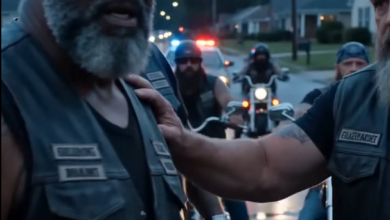
Thirty motorcycles closed around an ambulance at the edge of a clinic parking lot** while a woman inside** beat her palm against the side window, and the crowd assumed we had decided an old woman’s life could wait.
I was the man who asked the riders to form that line. My name is Daniel Price, and I had spent twenty-three years repairing municipal vehicles before retiring to a smaller garage outside Asheville, North Carolina. I rode with the Blue Ridge Lanterns because they would answer a call at two in the morning and show up the next day to paint a porch. That afternoon we had been taking donated blankets to a warming center. Thirty bikes on a gravel lot were a coincidence I wished I had not needed.
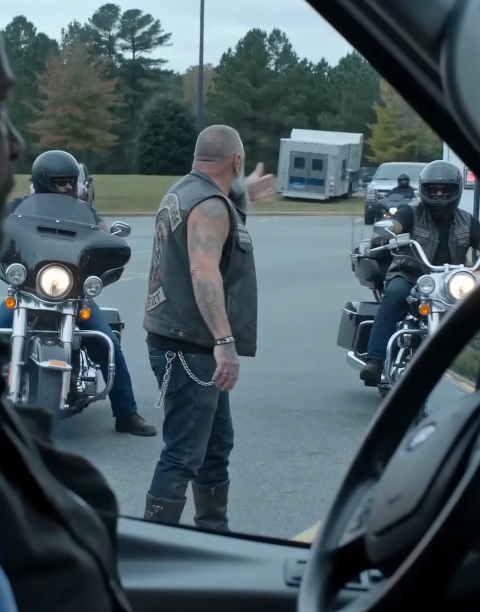
The vehicle wore the colors of a private medical transport company. Its roof lights were off. Its engine was running. People waiting at the clinic saw leather vests and motorcycles blocking its path; they did not see what I had seen when it passed me near the side entrance. A white-haired woman sat upright on the bench inside. She was not lying on a stretcher, and her palm stayed flat against the glass a second too long. A man in a dark jacket sat opposite her, close enough that she could not reach the door without asking him to move.
I had met her once. Her name was Evelyn Hart, and she had a way of speaking to mechanics as if their answers mattered. That summer she had paid for a broken lift at a volunteer garage, then insisted we send her the invoice so she could know what her money repaired. She lived alone by choice, with a gardener and a niece who called every Wednesday. She was eighty-one, comfortably wealthy, and very clear when somebody treated those facts as a reason to speak over her. When I glimpsed her through the window, she did not look confused. She looked trapped in an argument she had already lost once.
I pulled my bike across the entrance lane and called to Boone, who was behind me. “Park. Leave the clinic drive open.” He did. The riders behind us made a loose half circle around the exit, their engines going quiet one by one. Two parents waiting with a child yelled that we were stopping an emergency vehicle. I raised my hand to ask for room and dialed the clinic desk. The young receptionist said no transport for Evelyn was scheduled through their office. She did not know if another department had arranged one. That was a warning, not an answer.
The driver leaned out of his window. “Move your bikes. Medical pickup.” His tone was practiced. I asked for the dispatch company name. He gave a name matching the paint on his door, but the round emblem beneath it was strange: an old crest printed with the wrong shape around the edge. I knew the local fleet because I had helped replace cracked mirror housings on their vans. I could have misremembered a branding change. A wrong logo alone was not proof of a crime.
Then I looked at the rear plate. A bolt covered part of the final character, and the number did not match the trip information the clinic had on file when its supervisor called me back. Again, there could be innocent reasons. A replacement vehicle. A clerical error. Our line of bikes had already created another problem: if an actual patient in that vehicle needed emergency care, our suspicion could hurt her. I told Boone to leave an unobstructed lane toward the clinic entrance and kept my voice low enough that the people filming could not hear every word.
Evelyn struck the window again. Not frantically; three measured taps, a pause, and three more. She had done the same thing with her knuckles when a mechanic had tried to explain an estimate over her head. She wanted a person to look at her, not at the uniform. I walked closer without touching the vehicle.
“Mrs. Hart, are you all right?”
The man inside shifted across the window. For an instant I could see only his shoulder and Evelyn’s hand. The driver said, “She has paperwork. Let us go.” I told him police and clinic staff were on their way to verify the pickup. He killed the engine, then started it again. Several parents shouted at us to move. A teenager held his phone high enough that I could see my beard and leather vest mirrored on the black screen.
Boone, who was built like a refrigerator, kept his hands on his handlebars. The riders did the same. They were a visible barrier, nothing more. We had no right to become a second emergency by rushing a door we did not understand. The clinic supervisor came running with a nurse, and I could hear a patrol siren approaching from the highway.
The driver reached under his seat. Evelyn raised her palm again, pressed it flat to the glass, and mouthed a word I could not hear. I could not tell whether she had asked us to wait or warned us about the man beside her.
Part 2
That morning I had stopped at the garage to collect a box of winter coats. Boone and twenty-eight other members were meeting me before we rode to the warming center. There was no plan to visit the clinic and certainly no plan to surround a vehicle. I mention that because a photograph later made our arrival look rehearsed: thirty motorcycles, riders in vests, an ambulance between us and the exit. The first truthful fact was less impressive. We happened to be in the right place and then had to decide whether our suspicion justified interfering with someone else’s route.
I had learned to trust details without worshiping them. Years spent fixing fleet vehicles had taught me that a logo can change overnight and a plate can be transferred while a shop waits for paperwork. It had also taught me that a driver on a legitimate call should be able to name the dispatcher or ask the clinic to confirm a pickup without turning a stranger’s question into a contest of authority. The man at the wheel responded to my first question by repeating “medical pickup” louder. I felt my old mechanic’s irritation rise; irritation is poor evidence. I called the clinic instead of arguing with him.
Evelyn had been due at that clinic for a routine follow-up. I knew that only because she had mentioned it the previous week when she came by the volunteer garage. She wanted us to arrange a delivery of lumber to a neighbor, not to escort her to appointments. She had said her niece, Mara, would pick her up afterward if the weather turned bad. It had turned bad. Rain swept across the valley, leaving black leaves stuck to the pavement. When the vehicle passed the side entrance, I was idling at a stop sign with the coat van behind me. I recognized Evelyn’s bright blue scarf through the glass.
The scarf mattered more than the gold lettering on the door. Evelyn always tied it loosely because she disliked anything tight at her throat. In the ambulance she had it bunched in her fist. She was looking toward the clinic, not toward the road ahead. I had watched enough people being taken for appointments to know passengers can be worried even during perfectly ordinary trips. Yet her expression and the quick repeated taps made me take the lane toward the exit.
I phoned the nonemergency police line while Boone spoke to the clinic desk. We gave our names, the parking-lot location, the visible plate, and the reason we were asking for verification. I said plainly that the vehicle was stationary and we would keep access open for other traffic. Dispatch asked us not to approach the doors. That instruction was easy to give and hard to obey when I could see Evelyn’s hand inches beyond the glass. It kept us from making her situation worse.
A woman near the entrance asked whether we were affiliated with a protest. Her husband had a medical appointment and wanted to know if his car could get through. Boone moved two motorcycles farther back and showed him the lane. A delivery van used it minutes later. Thirty machines make a wall in a photograph, but in life we had left more room than the photograph suggested. The driver of the ambulance could still have turned toward the clinic entrance. He kept trying to leave by the outer exit.
Mara called my phone because the receptionist had given her my number after receiving my name. She sounded out of breath. “I haven’t arrived yet,” she said. “A car broke down ahead of me. Aunt Evie texted that she was waiting by the lobby.” The message had come twelve minutes before I saw her inside the vehicle. Mara had not authorized a transport. Evelyn had not mentioned one. The clinic supervisor said her chart showed no medical transfer order. That did not settle whether Evelyn had independently called a private ride, but it narrowed the innocent explanations.
I asked Mara one question I wish I had asked earlier: “Would she get into a vehicle with someone she didn’t know?” Mara paused. “She might if they knew my name,” she said. Evelyn had been receiving calls about an old insurance claim and had complained that strangers knew too much about her schedule. Mara and I did not turn that into a theory about a kidnapping. We passed it to dispatch as a reason to check who arranged the ride. The siren grew louder. The driver turned his head to look at the highway, and the man seated beside Evelyn dropped his hand out of sight.
Part 3
Officer Alvarez arrived first and parked a little way off, leaving the clinic lane clear. He did not charge through our motorcycles. He asked me for my name, listened to my short account, and told Boone to make sure no rider blocked the rear of the vehicle. Then he approached the driver from a safe distance while a second unit came in behind him. The clinic supervisor stood with a nurse near the side doors. The whole parking lot seemed to hold its breath, although a lawn crew across the road kept working under the rain.
Alvarez asked the driver for the transport company and trip details. The man repeated the company name I had heard. When Alvarez asked whether the clinic had ordered the pickup, the driver said a family member had. Mara, still on the phone with me, heard that sentence. “I did not,” she said. I passed it to the officer without dramatizing it. The driver looked from my phone to the vehicles lining the exit and accused us of harassing a patient. A plausible sentence can still be false.
The nurse asked to speak with Evelyn directly. That changed the shape of the scene. It was Evelyn’s ride and Evelyn’s body, and all our suspicions should have made room for her answer. The man inside said she was too tired. The nurse said she only needed to hear Evelyn herself. Through the side window we saw Evelyn lean forward, and the man’s arm move across her again. Alvarez asked him to keep his hands visible. I stepped backward as the officer spoke. No biker needed to be at the center now.
Travis, our youngest member, had a temper sharpened by worry. He whispered that he could open the rear door before the man understood what was happening. I looked at the strap of his helmet twisted around his fingers. “If you touch that handle, he reaches her first,” I told him. “Stay.” He stayed, though his feet shifted in the gravel. Later he told me he had never felt so useless. Standing still is work when someone else is in danger.
The driver gave Alvarez a dispatch number. The clinic supervisor dialed the publicly listed office for the legitimate company, not the number written on the vehicle. Their dispatcher could not match the visible plate or the claimed pickup to any current assignment. The company did operate in the region; its name had been borrowed. The emblem on the door was an old version with elements in the wrong positions. Together with Mara’s denial, the clinic’s scheduling information, and Evelyn’s inability to answer freely, those details had become much more than a mechanic’s visual hunch.
The driver said perhaps another branch had taken the call. Alvarez asked both men to step out so he and the nurse could speak with Evelyn. For several seconds neither moved. Evelyn looked at the nurse through the glass and shook her head once. I could not tell whether she meant no to the men, no to another move, or no to the questions adults kept putting in her mouth. The second officer was now near the rear quarter of the vehicle. The driver finally opened his door. The man inside followed a moment later, leaving his jacket on the bench.
The nurse climbed in only after Alvarez said it was safe. Evelyn spoke too quietly for me to hear. A minute later she came out under her own power, accepting the nurse’s offered elbow while keeping her other hand on her scarf. She pointed at Mara’s name on my phone and said, “That’s my niece. Please call her.” I held out the phone. She told Mara that she was at the clinic and wanted to stay there. That was the first clear instruction she had been able to give us.
An officer guided the two men away for questioning. Nobody announced charges in the parking lot. Alvarez asked us to remain for statements. The parents who had yelled at us were now silent. One man apologized for calling us reckless. I told him he had seen thirty motorcycles around what appeared to be an ambulance, and it was reasonable to be concerned. Had we trapped a real emergency patient, he would have been right to challenge us. That answer disappointed a bystander waiting for a dramatic reversal. It was still true.
Inside the clinic, Evelyn wanted a chair and a cup of tea. The nurse took her blood pressure and asked if she was hurt. She said she was not injured and did not want anyone touching her without asking again. We all heard the emphasis. I wondered how many times she had said that already that day. When Mara arrived, wet hair stuck to her cheeks, Evelyn did not collapse into a hug. She pointed to the other chair and said, “Sit down. Then I’ll explain.” Rescue had returned her the floor.
Part 4
Evelyn’s account began in the lobby. A man wearing medical transport clothing had approached her after her appointment and said Mara had arranged a ride because her car had broken down. That fact was true, which was why Evelyn had listened. He also knew the neighborhood where she lived and the name of the doctor she had just seen. She asked to call Mara, but he said the phone would be easier to use once they were seated. She had walked out with him, believing she could verify the arrangement at the vehicle. Inside, she asked for the phone again. The man beside her took it, saying he needed to confirm insurance information. She refused to leave. The driver started the engine.
It was a short, chilling explanation, and it did not require a cinematic chase. An ordinary detail had been used as a key. Mara’s delay, the doctor’s name, a vehicle resembling one the clinic sometimes used: each small true thing made the next false thing easier to accept. Evelyn had not been naïve. She had demanded confirmation twice and tried to get back out. The door had not opened for her from the seat where she was placed. Police would determine exactly what happened next and how the men knew her schedule. Evelyn needed people to stop debating whether a smart woman could be deceived and start listening to what she described.
The officers checked the vehicle and interviewed clinic staff. Later, after evidence was reviewed, authorities described it as an attempted abduction; the van was not a registered vehicle of the company it imitated. The rear plate was inconsistent with the fleet information, and the emblem had been copied badly. Investigators also looked into how the men knew Evelyn’s appointment and Mara’s name. I did not receive every finding. I was a witness, not the lead investigator or a relative. The boundaries of what I knew did not make the threat less real.
The first online clip labeled our club “bikers block ambulance with grandma inside.” Someone reposted it with an arrow pointing at my face. A second clip showed Evelyn walking back into the clinic under her own power; people began calling her a rich woman who had hired a stunt to test public sympathy. Both claims traveled farther than the cautious statement the police issued later. Mara called me furious. I told her she could decide whether to speak publicly, and she said her aunt would decide for herself. I was glad she did not ask us to issue a dramatic statement on Evelyn’s behalf.
At a later press conference, Evelyn appeared beside Mara. She gave no exact address, no wealth estimate, and no detailed itinerary. She said, “I told them I wanted to call my niece. When I saw people stopping the vehicle, I knew I might get another chance to say it.” She thanked the clinic nurse by name, thanked the officers, and mentioned the riders as a group. Then she asked reporters not to show the inside of her home or the names of her caregivers. The request was so practical that several cameras lowered. She had survived an attempt to make choices for her. She intended to keep choosing.
Somebody asked me how I had spotted the fake ambulance. I said I had noticed details that bothered me and then checked them with the clinic and the people responsible for transportation. A wrong-looking logo by itself would not have justified surrounding a car. Evelyn’s hand at the window mattered. The absence of an order mattered. Mara’s denial mattered. The officer’s checks mattered most. I hoped anyone watching would learn to verify a troubling scene quickly and leave space for real emergency access, not imitate a line of motorcycles whenever a decal looked unfamiliar.
Boone was still troubled by the optics of what we had done. He asked whether I would park thirty bikes the same way again. “Only if we kept that lane open,” I said. “And I’d get a clinic supervisor outside sooner.” We drew the lot on a piece of cardboard at the garage, marking where other patients had been able to move. Then we looked for the places our tires had come too close to the clinic exit. Memory is an unreliable traffic diagram when adrenaline has drawn it. The clinic’s camera footage helped us tell the truth. We had left a lane, but two late-arriving riders had narrowed it before Boone moved them. We apologized to the supervisor and revised how we responded to a sudden call.
Part 5
Evelyn came to the garage on a Wednesday with Mara and a paper bag of cinnamon rolls. She had declined every suggestion that someone drive her by a special route or keep reporters from seeing her. She wanted the ordinary entrance and a place where she could sit without cameras. I pulled out a chair. She put the rolls down and asked to see the coat donations we had failed to deliver that afternoon. We laughed, not because what happened was funny, but because the unfinished errand was still there, asking for attention.
She asked whether the youngest rider had wanted to open the door. Travis admitted it. “I’m glad you didn’t,” she told him. “I could see that you wanted to. I was already having trouble persuading one man to listen to me.” Travis flushed and said he had thought doing nothing would make him a coward. Evelyn cut a roll in half and handed him the larger piece. “You waited for the nurse,” she said. “I saw her arrive because you didn’t crowd the window.” That was more generous than he had expected and more precise than praise for bravery. He later asked if he could volunteer to deliver the coats by van. She said yes, provided he checked whether the warming center wanted them first.
Mara and the clinic organized a review of visitor and patient pickup procedures. It was not a plan invented by bikers. Staff looked at how an outside driver might learn an appointment time, how a patient could verify a proposed ride without leaving the lobby, and how to report a vehicle whose credentials did not match a scheduled trip. Evelyn attended because she understood the embarrassment of being an older adult talked around rather than consulted. She asked staff to make the questions simple and direct: “Did you arrange this ride? Who did you speak with? Would you like us to call that person from here?” The patient should be asked before a vehicle becomes her answer.
An investigator later told us the two men had obtained personal details through a fraud scheme and were being prosecuted. That was enough information for our statements. It did not give us a license to publish a map of their methods or speculate about ransom. Evelyn had money, but describing her only as wealthy erased the eighty-one years of her life that were hers before we met her. She had helped fund the garage lift because she remembered her father repairing tractors in a shed with an unsafe jack. She had left an office career she loved at fifty-eight and learned to restore native plants on a hillside. She kept a drawer of birthday cards from her nieces and nephews because their handwriting changed as they grew. Those were the facts that made her Evelyn.
The boys at our garage wanted a story about the clever biker who recognized a decal. Evelyn gave them a better one. She described the moment the nurse asked her what she wanted and then waited long enough to hear the answer. She said it had taken only a few words: “I’d like to get out now.” No voice cracked. No heroic music played. The officer helped the men step away, and the nurse made room. That was the moment the situation turned for her. I was glad she told it that way, even though it moved me from the center of the picture.
One Saturday she joined our delivery run to the warming center, riding in the coat van with Mara. The thirty motorcycles followed at a distance because the road was slick and the van needed room. At the center Evelyn insisted on carrying one light bag herself. I offered to take it, then caught myself. She raised an eyebrow. “You can carry the heavy one,” she said. I picked up the heavy bag and followed her through the door. Help works better when it has been invited.
The public interest faded, as it usually does. There were depositions, court dates we did not all attend, and ordinary Tuesdays when Evelyn preferred to spend her time pruning roses rather than remembering the van. The clinic changed its pickup workflow. The riding club kept a small note in our meeting room: call dispatch, keep access open, defer to responders, protect the person at risk. It was not a plaque in my honor. Boone wrote it on the back of the same cardboard where we had sketched the parking lot, and when it grew stained with oil, he copied it onto clean paper. The lesson survived the photograph.
Part 6
Several months later, Evelyn asked me to visit the repaired lift. She had heard it was making a clicking sound and wanted to know if that meant her donation had been wasted. I ran it empty, checked the part that caught, and showed her a loose cover plate. We fixed it in ten minutes. She held the work light while I tightened the screws. I told her she could set it on a stand. “I know,” she said, angling the beam back toward my hands. She liked being useful even when nobody had assigned her a job.
Mara had gone back to Wednesday calls, now sometimes complaining about the weather before asking if her aunt needed groceries. Evelyn had refused an around-the-clock watcher, though she welcomed a neighbor at dinner on rainy days. She and the clinic had agreed on a simple way to confirm future rides. None of that erased the fear she had felt in the vehicle. Once, while we walked past a van idling outside a hardware store, she went quiet and gripped her scarf. I stopped with her. She chose when to keep walking. There was no tidy sentence that made that moment disappear.
Travis took over the coat pickup schedule. He was better at it than I had been: he checked sizes with the center before loading the van, and he learned the names of the volunteers at the receiving door. When he got impatient with one man’s directions, he caught himself and stepped back. I watched him learn to be attentive without waiting for a dramatic emergency to prove it mattered. No one filmed those deliveries.
The company whose name had been copied visited the clinic to help staff distinguish their current paperwork and confirm appointments directly. Its driver spoke with Evelyn afterward. He apologized that people had used a lookalike vehicle to borrow the trust his coworkers had earned. Evelyn told him the legitimate company was not to blame. Then she asked him how long he had driven and whether he ever got a lunch break. He laughed because it was such an Evelyn question. She was still capable of making a stranger feel seen, and she had become more careful about when a stranger’s answer should be believed.
At the end of that winter, the clinic hung a small card by its lobby desk telling patients they could ask staff to verify a ride before leaving. Evelyn helped choose the wording. It did not mention bikers, wealth, or a crime. It began with a simple question: “Want us to confirm your pickup?” A good safeguard could fit beside a bowl of pens. I visited the clinic once for my own appointment and saw a man use the card to check a delayed ride for his mother. Nobody made a scene. The correct driver arrived, and they left.
Part 7
The next spring, Mara gave me a photograph. Evelyn stood by the garage lift holding the same work light she had refused to put down. She was wearing her bright blue scarf, tied loose as ever. I put the picture on the shelf above my workbench, where it was less likely to collect grease than the cardboard parking-lot map. Looking at it, I could remember the woman who held the light, not only the woman who tapped a window.
I still ride past the clinic when the club brings coats to town. Most days the lot looks ordinary: cars arriving, patients finding their appointments, drivers waiting where staff can see them. On that afternoon the scene had looked simple from a distance, too. Thirty bikers around an ambulance. People who challenged us had seen a danger, and their challenge forced me to leave a route open and account for our choices. We were right to suspect the vehicle. They were right to demand that someone explain why it had stopped. Both concerns helped keep the scene answerable.
Evelyn called me last month about a garden gate that would not close. I told her I would come by on Thursday, and she asked if I had checked with Mara, as if a mechanic needed a chaperone. She was teasing. I said I would bring a hinge and let her decide whether the gate needed one. She said, “That’s better.” When I arrived, she had already taken the old screws out and laid them in a dish. I put the new hinge on while she held the post steady. Her hands were smaller than mine and firmer than anyone expected.
We tested the gate three times. She wanted it to swing freely but catch when the wind pushed it. When it did, she stepped through first and looked back to make sure I followed. I could hear one of my club’s motorcycles somewhere on the road beyond her hill, going about its ordinary business. The gate was hers to open.
Follow our page for more biker stories about strangers who look twice, listen carefully, and make room for the people they hope to protect.